Northrop Grumman to Produce First Hypersonic Glide Phase Interceptor
Northrop Grumman will produce the Glide Phase Interceptor (GPI) program, the first-of-its-kind defensive countermeasure against hypersonic missile threats. (Northrop Grumman)
Program is first-of-its-kind countermeasure against hypersonic threats
From Northrop Grumman, Sept. 25, 2024
CHANDLER, Ariz. – Sept. 25, 2024 – The U.S. Missile Defense Agency (MDA) will proceed with Northrop Grumman Corporation (NYSE: NOC) for the Glide Phase Interceptor (GPI) program, the first-of-its-kind defensive countermeasure against hypersonic missile threats. Working in close partnership with MDA, the three-year developmental effort produced a purpose-built, innovative design capable of defeating existing and emerging hypersonic threats.
During this next phase of development, Northrop Grumman will:
Continue to refine the preliminary design of the GPI, which will fire from the U.S. Navy’s Aegis Ballistic Missile Defense destroyers and Aegis Ashore using the standard Vertical Launch System
Demonstrate system performance in hypersonic environments prior to conducting its Preliminary Design Review
Complete flight experiments ahead of schedule leveraging the company’s own flight-proven systems
Use digital engineering practices to connect the entire GPI program to accelerate design processes and develop interceptor capabilities faster and more efficiently
Expert:
Wendy Williams, vice president and general manager, launch and missile defense systems, Northrop Grumman: “GPI adds mission critical standoff to warfighters in scenarios where distance creates an advantage. Tailorable to a multitude of mission requirements, Northrop Grumman’s revolutionary solution is designed to perform in the evolving threat landscape.”
Details:
Northrop Grumman’s design includes advanced technologies, such as a seeker for threat tracking and hit-to-kill accuracy, a re-ignitable upper stage engine used for threat containment and a dual engagement mode to engage threats across a wide range of altitudes.
Northrop Grumman will work closely with the United States in support of its role under the GPI Cooperative Development program with the Japan Ministry of Defense to deliver interceptors to the MDA.
Sept 24 U.S. Central Command Update
From U.S. Central Command, Sep. 24, 2024
TAMPA, Fla. – In the past 24 hours, U.S. Central Command (USCENTCOM) forces successfully destroyed one Iranian-backed Houthi uncrewed aerial vehicle over the Red Sea.
It was determined this system presented an imminent threat to U.S. and coalition forces, and merchant vessels in the region. This action was taken to protect freedom of navigation and make international waters safer and more secure for U.S., coalition, and merchant vessels.
U.S. Navy selects BAE Systems to provide advanced digital interrogator target data processor solution
Identification Friend or Foe tech refresh design implements new capabilities into one system
From BAE Systems
GREENLAWN, N.Y. — September 24, 2024 – BAE Systems has received a $19 million contract from the U.S. Navy to design and implement UPX-24 target data processor capabilities into a single digital interrogator Identification Friend or Foe (IFF) solution. The upgraded IFF digital interrogator (DI) will optimize data collection and processing to provide time-critical insights and enhance decision making for the maritime fleet.
“This is a collaborative effort with our customer to bring the Navy’s UPX-24 target data processor functions into our digital interrogator systems,” said Donna Linke-Klein, director of Tactical Systems at BAE Systems. “Going from two separate hardware sets on a shipboard platform to a single consolidated solution allows for reduced obsolescence and the ability to rapidly integrate new technology. The latest design will optimize performance while providing the situational awareness our warfighters need in a variety of threat environments.”
BAE Systems’ digital interrogator systems enable operators to identify friendly forces and make informed decisions that reduce friendly fire incidents and support mission success. The DI collects the data by emitting an “interrogating” radio signal at one frequency, prompting an IFF transponder to emit a reply signal at a different frequency, indicating that an approaching platform is “friendly.” The U.S. Navy’s UPX-24 system provides target data to the ship’s command, control, communications, computer and intelligence system, and processes all the inputs to decide how to respond.
By combining these capabilities into one multifunction solution, this advanced DI will support size, weight, power, and cost objectives and accommodate future upgrades.
With more than 80 years of IFF experience, BAE Systems has delivered over 16,000 transponders, 1,500 interrogators, and 6,000 combined interrogator transponder systems for use on new and existing platforms, including unmanned aerial vehicles, ships, and rotary- and fixed-wing aircraft.
Work on the advanced IFF digital interrogator target data processor solution will be performed at BAE Systems’ state-of-the-art facility in Greenlawn, New York.
USS Leyte Gulf Decommissioned
From USS Leyte Gulf Public Affairs, Sept. 24, 2024
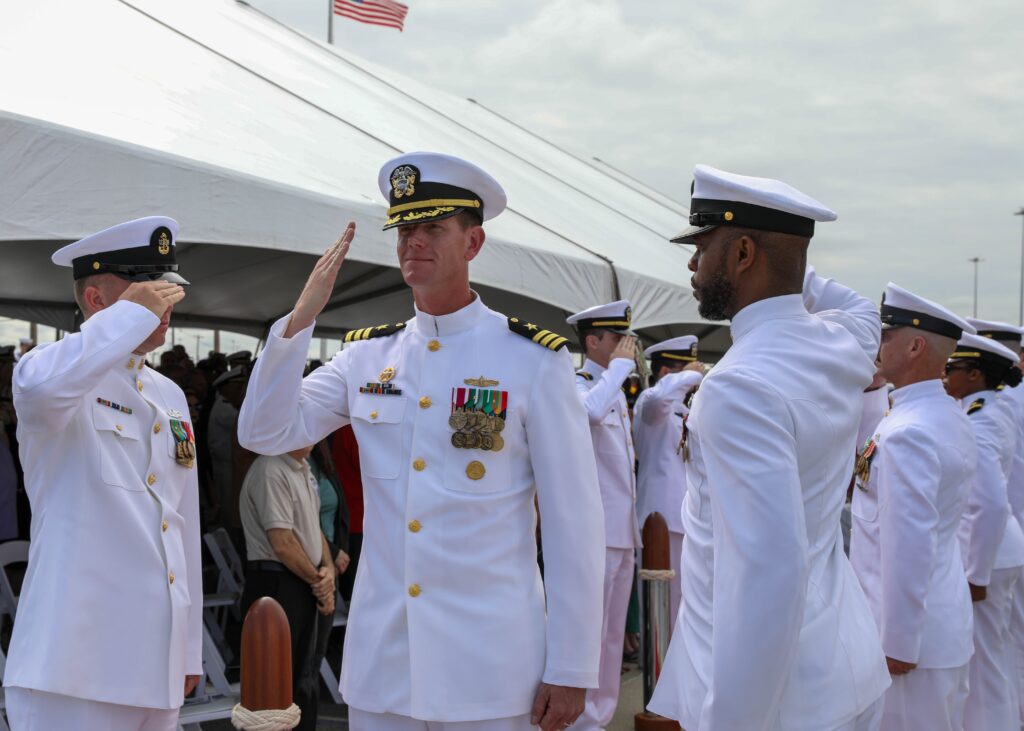
NORFOLK, Va. – The crew of the Ticonderoga-class guided-missile cruiser USS Leyte Gulf (CG 55) held a decommissioning ceremony onboard Naval Station Norfolk on September 20th.
Over 500 attendees including plankowners and former crew members joined together to celebrate the ship’s distinguished 37 years of naval service. Vice Adm. Eugene Black III, Leyte Gulf’s 14th commanding officer, served as the ceremony’s keynote speaker, wishing the current crew fair winds and following seas as they bade their ship farewell.
“What a great opportunity to celebrate the Sailors who brought this ship to life, kept her operating at the highest level and ready for a fight throughout her long and illustrious career of service to our nation,” he said.
Cmdr. Brian M. Harrington, who served as the 23rd and final commanding officer of Leyte Gulf, led the ship’s final crew through the decommissioning process, assuming command following Leyte Gulf’s deployment to the Caribbean Sea and South Atlantic earlier this year.
“It’s been an honor to lead America’s Battle Cruiser and her crew through the final chapter in her storied career. This crew accomplished the final mission with professionalism and dedication that honors all Leyte Gulf Sailors past and present.”
The ceremony atmosphere was one of fond but somber remembrance as Black and Harrington shared a few memories created over Leyte Gulf’s 37 years of service, inviting shared laughter from crewmembers past and present.
Leyte Gulf was built at Ingalls Shipbuilding Corporation in Pascagoula, Mississippi, and commissioned in Port Everglades, Florida, on September 26, 1987. Leyte Gulf’s namesake commemorates the largest naval battle in history, fought from October 23-26, 1944 during World War II.
Since her maiden deployment in 1988, the warship has been vital to America’s national defense strategy, leading the way in air defense throughout 17 deployments around the world. After decommissioning, the ship will be towed on October 16th to the Navy’s Inactive Ship’s facility in Philadelphia, Pa., where it will be in a Logistical Support Asset status.
Navy Partners With Private Industry to Grow Submarine Industrial Base Capacity
By Naval Sea Systems Command Office of Corporate Communication
Sept. 20, 2024
WASHINGTON – The Navy is proud to announce a groundbreaking co-investment collaboration to bolster U.S. maritime dominance and national security.
In order to meet submarine production requirements, and in support of Navy Secretary Carlos Del Toro’s Maritime Statecraft initiative, the Navy and its submarine industrial base partners are committed to rebuilding a manufacturing base that has shrunk to just one-third of its capacity from 30 years ago. As part of this challenge, submarine production must nearly double, requiring an additional 3.5 to 4.5 million submarine module production and outfitting hours annually. This partnership will play a key role in ensuring submarine shipbuilders can meet the Navy’s required sustained submarine construction cadence for the Columbia Class and Virginia Class submarine programs.
A key element of this initiative is to incentivize private investment in the expansion of domestic shipyard capacity for submarine module manufacturing, including through an investment by Austal USA, LLC (Austal USA) in the qualified opportunity fund acquiring and developing Alabama Shipyard in Mobile, Alabama. This Gulf Coast site, with its deep-water port, advanced facilities, and proximity to significant infrastructure and a skilled workforce, is ideally suited for expanding industrial base capacity. Positioned next to Austal USA, an existing U.S. Navy shipbuilding contractor, the Alabama Shipyard will support the production of Columbia Class and Virginia Class submarine modules, as well as additive manufacturing and training.
“Today’s announcement underscores our commitment to finding innovative and creative solutions to accelerate submarine production and is emblematic of my Maritime Statecraft initiative that seeks to incentivize expansion of our national shipbuilding capacity by engaging new, forward-leaning stakeholders and leveraging the power of public and private investment,” said Secretary of the Navy Carlos Del Toro. “This announcement answers my call for investment into small-to-medium size shipyards, both active and dormant, that were previously the backbone of our Nation’s maritime power, and I look forward to continuing to work with industry on future initiatives to strengthen our maritime industrial base.”
To finance this ambitious development, the United Submarine Alliance (USA), Qualified Opportunity Fund LP (the USA Fund) has acquired the assets of the 355-acre Alabama Shipyard, where it will prioritize U.S. Navy maritime infrastructure investments and sustainment activities with the goal of developing an additional 75% of the site to support submarine production, workforce training, and industrial capacity, including facilities aimed at serving unemployed and underserved communities. These efforts will significantly boost the capacity of the submarine industrial base while enhancing workforce training, recruitment, and retention across the entire Gulf Coast.
The agreement includes contractual mechanisms that support Navy oversight and authorities to safeguard Navy and national security interests. The project is expected to create approximately 3,000 new, sustainable jobs while preserving all current employment at the shipyard.
By revitalizing infrastructure supporting the maritime industrial base to enable increased production capacity, the Alabama Shipyard investment supports the U.S. Navy’s continued maritime dominance, enhances strategic deterrence, and protects the nation’s interests well into the future.
USS Omaha Participates in Oceania Maritime Security Initiative
PACIFIC OCEAN – Sailors from USS Omaha (LCS 12), along with five U.S. Coast Guard law enforcement members, transit in a rigid-hull inflatable boat to a foreign flagged fishing vessel in support of the Oceania Maritime Security Initiative (OMSI) in the Pacific Ocean, Sept. 12. Omaha, assigned to U.S. 3rd Fleet, is operating in support of OMSI in the Indo-Pacific region. A U.S. Coast Guard law enforcement detachment from the Pacific Tactical Law Enforcement Team embarked aboard Omaha is supporting maritime fishery law enforcement operations for U.S. and Pacific Island nations in Oceania. OMSI is a Secretary of Defense program that leverages Department of Defense assets to increase U.S. Coast Guard maritime security and maritime domain awareness support in Oceania through operations in remote U.S. Exclusive Economic Zones and bilateral maritime law enforcement agreements with Pacific Island nations. (U.S. Navy photo by Hospital Corpsman First Class Weiju Lai)
By Commander, Littoral Combat Ship Squadron 1, Sept. 20, 2024
PACIFIC OCEAN – The Independence-variant littoral combat ship USS Omaha (LCS 12), with an embarked detachment from Helicopter Maritime Strike Squadron (HSM) 35 and a law enforcement detachment from U.S. Coast Guard Tactical Law Enforcement Team Pacific, began operations in support of Oceania Maritime Security Initiative (OMSI) Sept. 8.
A Secretary of Defense program, OMSI is aimed at diminishing transnational illegal activity on the high seas in the Pacific Island nations of Oceania’s Exclusive Economic Zones (EEZ), as well as increasing interoperability with partner nations.
Omaha’s range and capabilities allow the embarked U.S. Coast Guard law enforcement detachment the ability to access the remote U.S. and Pacific Island nations’ EEZs.
“We embrace the opportunity to work closely with the U.S. Coast Guard as we help enforce economic policies among some of our closest partners in the Western and Central Pacific,” said U.S. Navy Cmdr. Kevin Smith, commanding officer of Omaha. “It is rewarding to work with these island nations to patrol their waters, maintaining a free and open region.”
The objective of OMSI is to reduce and eliminate illegal, unregulated and unreported fishing, combat transnational crimes in EEZs of the Western and Central Pacific region and enhance regional security.
“The partnership between the U.S. Navy and U.S. Coast Guard plays an integral role in the OMSI mission,” said Coast Guard Chief Maritime Enforcement Specialist Kyle Smouse. “Deploying U.S. Coast Guard law enforcement detachments aboard U.S. Navy vessels allows the Coast Guard to have a greater presence and impact in enforcing Western and Central Pacific Fisheries Commission (WCPFC) regulations. These areas of operation would be difficult to reach without the support of the U.S. Navy.”
The WCPFC international fisheries agreement focuses on the long-term conservation and sustainable use of fish stocks in the Western and Central Pacific Ocean. The WCPFC seeks to address problems in the management of the high seas fisheries in the Western and Central Pacific Ocean, where there is unregulated fishing and vessel re-flagging to evade controls.
Omaha, homeported in San Diego and assigned to U.S. 3rd Fleet, is on a scheduled deployment in the Pacific Ocean. Littoral combat ships are fast, optimally manned, mission-tailored surface combatants that operate in near-shore and open-ocean environments, winning against 21st-century coastal threats.
Harry S. Truman Carrier Strike Group Deploys
NORFOLK, Va. (Sept. 23, 2024) Sailors assigned to engineering and aviation intermediate maintenance department muster on the flight deck of the Nimitz-class aircraft carrier USS Harry S. Truman (CVN 75), Sept. 23. (U.S. Navy photo by MCSN Michael Gomez)
NORFOLK, Va. (Sept. 23, 2024) Sailors assigned to engineering and aviation intermediate maintenance department muster on the flight deck of the Nimitz-class aircraft carrier USS Harry S. Truman (CVN 75), Sept. 23. (U.S. Navy photo by MCSN Michael Gomez)
NORFOLK, Va. – The Nimitz-class aircraft carrier USS Harry S. Truman (CVN 75) departed Naval Station Norfolk for a regularly scheduled deployment, Sept. 23.
The Arleigh Burke-class guided-missile destroyers USS Jason Dunham (DDG 109) and USS Stout (DDG 55) will join the Harry S. Truman and guided-missile cruiser USS Gettysburg (CG 64), to conduct a regularly scheduled deployment to the U.S. Naval Forces Europe-Africa/U.S. Sixth Fleet area of operations, demonstrating the commitment and power projection capability of the Navy’s globally deployed force.
“This deployment comes on the heels of the Dwight D. Eisenhower Carrier Strike Group’s nine-month mission that highlighted the need for continuity in our sustained presence amid escalating international tensions,” said Adm. Daryl Caudle, commander, U.S. Fleet Forces Command. “The Truman Carrier Strike Group will contribute to the ongoing training and combat readiness of our naval forces. The operational experience gained through these deployments is invaluable for maintaining a deep bench of skilled warfighters with trust and confidence in their system’s reliability, adaptability, and lethality in a rapidly changing security environment.”
The Italian Navy Carlo Bergamini-class frigate ITS Carabiniere (F 593) is expected to join the strike group and support operations and exercises during portions of the deployment. HSTCSG practiced interchangeability and transfer of authority with Carabiniere during the Composite Training Unit Exercise (COMPTUEX) in August.
“Over 6,500 Sailors of the Harry S Truman Carrier Strike Group have put in a tremendous effort to train and prepare to demonstrate the combat power and flexibility of our U.S. Naval forces and the warfighting advantage they bring anywhere in the world,” said Rear Adm. Sean Bailey, commander HSTCSG. “We are looking forward to operations in the SIXTH Fleet area of operations and to working with our Allies and partners to continue building interoperability and deter potential adversaries and threats.”
The deployment follows months of intense training and preparation, including the Board of Inspection and Survey (INSURV) and various underway training exercises such as Group Sail and COMPTUEX.
“At the heart of the Carrier Strike Group is the aircraft carrier, and this impressive warship remains the cornerstone of the Navy’s forward presence through sea control and power projection capabilities,” said Capt. Dave Snowden, commanding officer of Harry S. Truman.
“I’m incredibly proud of our Team Truman and Tarbox Sailors and their warfighting spirit and professionalism that brings our ship and flight deck to life.”
Throughout its 26 years of service, Harry S. Truman has deployed nine times to support critical missions and numerous operations and played a pivotal role in the United States’ commitment to ensuring a free and open international order that promotes security and prosperity.
The squadrons of Carrier Air Wing (CVW) 1 embarked aboard Harry S. Truman include:
– The “Red Rippers” of Strike Fighter Squadron (VFA) 11
– The “Pukin’ Dogs” of Strike Fighter Squadron (VFA) 143
– The “Sunliners” of Strike Fighter Squadron (VFA) 81
– The “Knighthawks” of Strike Fighter Squadron (VFA) 136
– The “Main Battery” of Electronic Attack Squadron (VAQ) 144
– The “Seahawks” of Control Squadron (VAW) 126
– The “Proud Warriors” of Helicopter Maritime Strike Squadron (HSM) 72
– The “Dragonslayers” of Helicopter Sea Combat Squadron (HSC) 11
– A detachment from the “Rawhides” of Fleet Logistics Squadron (VRC) 4
Ships of DESRON 28 include the Arleigh Burke-class guided-missile destroyers USS Stout and USS Jason Dunham.
To learn more about the Harry S. Truman Carrier Strike group, please visit its website, Facebook, or DVIDS page. For more information about the flagship, please visit its website, Facebook, or Instagram.
SECNAV Del Toro Names Future Nuclear-Powered Attack Submarine USS Baltimore
Deputy Defense Secretary Kathleen Hicks accepts a proclamation naming her the sponsor of the future submarine USS Baltimore from Navy Secretary Carlos Del Toro after the naming ceremony for the USS Baltimore in Baltimore, Sept. 20, 2024. (E.J. Herson, Department of Defense)
From SECNAV Public Affairs, 20 September 2024
BALTIMORE (Sept 20, 2024) – Secretary of the Navy Carlos Del Toro announced that the future Virginia-class nuclear-powered attack submarine SSN 812 will be named USS Baltimore. Del Toro made the announcement during a ship naming ceremony held in Baltimore aboard the historic USS Constellation, Sept. 20.
The future USS Baltimore honors the city of Baltimore, the crews of one Continental Navy ship, and the five previous Navy vessels named Baltimore.
The naming selection of the future USS Baltimore (SSN 812) continues the recent trend of naming Virginia-class submarines after cities. Del Toro previously named USS Long Island (SSN 809), USS San Francisco (SSN 810), and USS Miami (SSN 811).
“The city of Baltimore maintains a strong connection with our maritime services and is a critical enabler of our National Maritime Statecraft,” said Del Toro. “It is my honor and privilege to announce the name of the next Virginia-class nuclear-powered submarine, SSN-812, USS Baltimore.”
Maryland Sen. Ben Cardin joined Del Toro for the ceremony honoring Baltimore.
“Maryland is proud of our connection to the Navy and our strong history as a coastal state,” said Cardin. “I am excited that the next USS Baltimore will be sailing the seas again as the Navy’s newest submarine. Our Navy maintains and protects free and open international waters. From defending our young nation from pirates in the late 1700s to ensuring freedom of navigation today in the Red Sea and Taiwan Strait, our Navy is always on watch.”
Baltimore Mayor Brandon Scott also served as a guest in the official party and spoke about the honor and meaning behind the naming of the Navy’s newest submarine.
“We are honored that Baltimore is being represented across the globe once again with the naming of this future ship,” said Scott. “As a city with such a rich naval and maritime history, the naming of the USS Baltimore ensures that legacy will continue to live on for decades to come. I want to extend my deepest thanks and gratitude to the U.S. Navy for this honor and for continuing to uplift our city, including all Baltimoreans who choose to serve.”
Along with the ship’s name, Del Toro also announced Deputy Secretary of Defense Kathleen Hicks will serve as the ship’s sponsor. In her role as sponsor, she will represent a lifelong relationship with the ship and crew.
“When Baltimore joins the fleet, with a world-class crew, it will be among the most agile, lethal, resilient, and capable conventional nuclear-powered submarines we’ve ever made,” said Hicks. “Make no mistake about Baltimore’s purpose, like all of our submarines, conventional and otherwise, we build them not to provoke war, but rather to prevent wars, through deterrence.”
The city of Baltimore has significant ties to American and Naval history. The Port of Baltimore was established in 1706 and the Town of Baltimore in 1729. One of the Navy’s six founding frigates, USS Constellation, was built in Baltimore, and the city’s skilled ship workers later would construct the famous Baltimore clipper ships. In 1814, the Battle of Baltimore inspired the American national anthem.
The first Baltimore served in the Quasi-War against France, while the second Baltimore served during the Civil War. The third Baltimore fought in the Battle of Manila Bay during the Spanish-American War and later conducted mine-laying operations in World War I. The fourth Baltimore earned nine battle stars during World War II, fighting in campaigns for the Caroline Islands, Gilbert and Marshall Islands, and Okinawa. The fifth Baltimore participated in undersea operations against the Soviet Union, completing a variety of intelligence, surveillance, and reconnaissance missions. The Navy simultaneously decommissioned and struck the most recent vessel from the list on 10 July 1998.
After the collapse of the Francis Scott Key Bridge in March 2024, the Navy provided equities to the established “Key Bridge Response Unified Command.” NAVSEA’s Navy Supervisor of Salvage and Diving (SUPSALV) led critical efforts to support the clearance of the Port of Baltimore’s Fort McHenry Federal Channel, responsible for managing all on-scene assets tasked with debris removal and channel clearing. Del Toro personally assessed the site and met with Navy personnel on April 19, 2024.
Attack submarines are designed to seek and destroy enemy submarines and surface ships; project power ashore with Tomahawk cruise missiles and Special Operation Forces (SOF); carry out Intelligence, Surveillance and Reconnaissance (ISR) missions; support battle group operations; and engage in mine warfare.
USNS Lucy Stone Christened as MSC’s Newest Fleet Replenishment Oiler
SAN DIEGO-Fleet replenishment oiler USNS Lucy Stone (T-AO 209), the Military Sealift Command’s newest ship, was christened during a ceremony at the General Dynamics NASSCO shipyard in San Diego, Calif., today.
The event was attended by Secretary of the Navy, Carlos Del Toro; Meredith Berger, Assistant Secretary of the Navy for Energy, Installations and Environment; Vice Adm. John F. G. Wade, commander, U.S. THIRD Fleet; Vice Adm. Jeffrey Jablon, Deputy Chief of Naval Operations for Installations and Logistics; Rear Adm. Thomas J. Anderson, Program Executive Officer, Ships; Capt. Micah Murphy, commander, Military Sealift Command Pacific; U.S. Merchant Marine Capt. Lee Apsley, Stone’s civil service master; as well as executives and employees of NASSCO San Diego.
The ship honors American suffragist Lucy Stone, who joined other notable advocates such as Elizabeth Cady Stanton, Susan B. Anthony, Ernestine Rose, and Antoinette Brown Blackwell to petition for suffrage and abolition in the 19th century. Her efforts as a founder of the Women’s National Loyal League were essential to the passage of the Thirteenth Amendment abolishing slavery.
“In choosing to name this ship after Lucy Stone, Secretary Mabus and Secretary Berger knew the legacy of this remarkable woman, who dedicated her life to freedom and to equality for all, “said Deborah Donnley Simmons, Stone co-sponsor. “Her legacy will continue to be told, as this ship sails throughout the world.”
The official christening moment happened when the ship’s co-sponsors, Alicia Aadnesen Deborah Donley Simmons broke a bottle of champagne over the ship’s bow with the words, “For the United States of America, I christen you the USNS Lucy Stone. May God bless this ship and all who sail on her.” Following the christening moment, the ship blew her horns and slid down the rails, amid a fanfare of music from the Navy Band Southwest and red, white and blue streamers.
“The enduring legacy of Lucy Stone as a trailblazer in the women’s rights movement remains an indelible source of inspiration today,” said Del Torro. “How extraordinary that all of these years later, today, our United States Navy is headed-up by the Chief of Naval Operations, a female by the name of Adm. Lisa Franchetti. It would not have been possible if it had not been for the efforts of Lucy Stone.”
The 746-foot Stone is the fifth ship in the new John Lewis-class previously known as the TAO(X). This class of oilers has the ability to carry 162,000 barrels of diesel ship fuel, aviation fuel and dry stores cargo. The upgraded oiler is built with double hulls to protect against oil spills and strengthened cargo and ballast tanks and will be equipped with a basic self-defense capability. The Lewis-class of oilers will replace the current Kaiser Class fleet replenishment oilers as they age out of the MSC fleet. The ship will be manned by a crew of about 100 civilian Merchant Mariners, sailing under the operational control of MSC.
“In order to maintain sustained operations at sea, our Navy warships rely on Military Sealift Command’s Combat Logistics Fleet,” said Del Toro. “Despite the challenges posed by shortfalls in numbers, MSC continues to play a vital roll in supporting our nation’s logistics readiness. I thank all of our Merchant Mariners for answering our national call to maritime service, and for their ongoing efforts to recruit and maintain our critical capabilities!”
Harry S. Truman Carrier Strike Group Deploys Sept. 23-15
From U.S. Fleet Forces Public Affairs
NORFOLK, Va. — More than 6,500 Sailors assigned to the Harry S. Truman Carrier Strike Group (HSTCSG) will leave Norfolk for a regularly scheduled deployment, Sep. 23-25.
The carrier strike group consists of the flagship USS Harry S. Truman (CVN 75); Carrier Air Wing (CVW) 1 with nine embarked aviation squadrons; staffs from Carrier Strike Group (CSG) 8, CVW-1, and Destroyer Squadron (DESRON) 28; the Ticonderoga-class guided-missile cruiser USS Gettysburg (CG 64); and two Arleigh Burke-class guided-missile destroyers, USS Stout (DDG 55) and USS Jason Dunham (DDG 109).
The squadrons of Carrier Air Wing (CVW) 1 embarked aboard Harry S. Truman include:
-The “Red Rippers” of Strike Fighter Squadron (VFA) 11
-The “Pukin’ Dogs” of Strike Fighter Squadron (VFA) 143
-The “Sunliners” of Strike Fighter Squadron (VFA) 81
-The “Knighthawks” of Strike Fighter Squadron (VFA) 136
-The “Main Battery” of Electronic Attack Squadron (VAQ) 144
-The “Seahawks” of Control Squadron (VAW) 126
-The “Proud Warriors” of Helicopter Maritime Strike Squadron (HSM) 72
-The “Dragonslayers” of Helicopter Sea Combat Squadron (HSC) 11
-A detachment from the “Rawhides” of Fleet Logistics Squadron (VRC) 40