Senior Navy Leader Visits Indo-Pacific for AUKUS, Strengthens Interoperability from Under Secretary of the Navy Public Affairs 

PERTH, Australia (Sept. 2, 2024) – USS Emory S. Land (AS 39) Sailors brief the Acting Under Secretary of the Navy Tom Mancinelli (front right) aboard the ship about their job, Sept. 2, during the Submarine Tendered Maintenance Period (STMP) in Perth, Australia. Mancinelli traveled to Australia to observe the AUKUS STMP and affirm and advance the strong alliance between Australia and the U.S. for an enduring resilient, free and open Indo-Pacific. (U.S. Navy photo by Capt. Courtney Hillson)

From SECNAV Public Affairs, Sept. 4, 2024 

PERTH, Australia – Acting Under Secretary of the Navy Tom Mancinelli traveled to Perth, Australia, Sept. 1-3, to meet with partner navies, government officials, and military leaders to discuss their shared commitment to maintaining a free and open Indo-Pacific. 

Mancinelli observed the Submarine Tendered Maintenance Period (STMP) and engaged with Royal Australian and U.S. Navy Sailors supporting this Australia, United Kingdom, United States (AUKUS) milestone. 

“AUKUS is a partnership to defend a free and open Indo-Pacific and defend our shared interests,” the acting Under Secretary said.  “The United States is committed to its success as we take on the challenges of the 21st century together.” 

Throughout the trip, he discussed the trilateral AUKUS partnership and held several engagements to communicate the Department of the Navy’s commitment to advancing interoperability, innovation, and maritime security. 

The acting Under Secretary of the Navy met with senior defense leaders, Royal Australian Navy (RAN) leaders, and government leaders during his travel to Western Australia, to include Australian Prime Minister Anthony Albanese, Deputy Prime Minister and the Minister of Defence Richard Marles, Minister for Defence Industry and Capability Development Pat Conroy, Premier of Western Australia Roger Cook, Western Australia Minister for Defence Paul Papalia, Minister for Resources and Northern Australia Madeleine King, British High Commissioner Vicki Treadell, RAN Chief of Navy Vice Adm. Mark Hammond, and Director General Australian Submarine Agency Vice Adm. Jonathan Mead. 

Leaders exchanged views on the importance of maritime security and spoke about AUKUS Optimal Pathway accomplishments, the significance of maintaining strong navies, as well as their shared commitment to ensure a stable, peaceful, and prosperous Indo-Pacific region, complementing the existing regional security architecture. 

“There is no substitute for presence.  We are supporting this generational opportunity that will increase our maritime capabilities and interoperability, while also helping Australia develop and operate its own sovereign, conventionally armed, nuclear-powered submarines,” Mancinelli emphasized. 

“The Submarine Tendered Maintenance Period, a hallmark of AUKUS Pillar I for 2024, is a proud step forward in our shared journey,” said Mancinelli.  “It represents one of the tangible ways in which our navies are sharing our talents and resources.” 

At HMAS Stirling, the future home to Submarine Rotational Force – West, which is helping to shape Australia’s future fleet of conventionally armed, nuclear-powered submarines, he visited commands and thanked personnel. 

The acting Under Secretary toured the USS Hawaii (SSN 776) alongside Albanese and Marles. On board he spoke with Australian and U.S. Navy Sailors working together and conducting maintenance on the submarine. 

Separately, Mancinelli met with Fleet Support Unit Sailors and visited the submarine tender ship USS Emory S. Land (AS 39) to talk with Sailors and meet defense and RAN leaders.  

USS Emory S. Land Sailors are supporting maintenance activities aboard the Hawaii.  This is the first time Australians have participated in a U.S. submarine maintenance period in Australia. Additionally, more than 30 Australian personnel who participated in a knowledge exchange period that began in January 2024 aboard Emory S. Land are executing the majority of planned maintenance work with U.S. support and oversight. 

“I am excited to see progress firsthand, and I look forward to seeing an even closer partnership with the Australian Navy and British Navy in the future as we work together to preserve a free and open Indo-Pacific.” 

Mancinelli then toured the Henderson Shipyard and Hoffman Engineering, an Australian firm that supplies parts for Australia’s Collins class submarines. 

 “We’re making historic investments in our own defense industrial base capabilities and standing shoulder to shoulder with two countries that share our values and our commitment to peace and security,” he noted.  

Lastly, he visited a Perth-based think tank and engaged in dialogue with defense and national security experts about AUKUS.  He also discussed the strategic importance of the enduring Alliance between Australia and the U.S. and the ways in which our navies are working together to uphold the rules-based order.  

The U.S. and Australian navies share a mutual interest in maintaining freedom of navigation and open sea lanes for trade and commerce. They conduct frequent cooperative deployments, and regularly operate together during flagship theater exercises such as Pacific Partnership, Rim of the Pacific (RIMPAC), and the Australian-led Kakadu. 

This trip marked Mancinelli’s first international trip as the acting Under Secretary of the Navy and his first visit to Perth, Australia. 


Austal USA Starts Construction of Coast Guard Offshore Patrol Cutter

Representatives of Austal USA and U.S. Coast Guard gathered to celebrate the start of construction on the future USCGC Pickering. (Photo from Austal USA) 

From Austal USA, Aug. 29, 2024 

MOBILE, Ala. – Austal USA celebrated the start of construction on the first U.S. Coast Guard Heritage-class Offshore Patrol Cutter (OPC) to be built at the company’s Mobile, Ala. ship manufacturing facility today.  Pickering (WSMM 919) is the first OPC being built under a contract that includes up to 11 cutters and has a potential value of $3.3 billion. 

Austal USA was honored to have Coast Guard Rear Admiral Michael Campbell as a key speaker at today’s event.  The OPC program will recapitalize the Coast Guard’s aging medium endurance cutters and provide a capability bridge between the service’s national security cutters, which operate in the open ocean, and the fast response cutters which operate closer to shore.  

“Austal USA is excited to begin construction on the first of these high priority cutters for the U.S. Coast Guard,” commented Dave Growden, vice president of new construction programs. “This contract exemplifies the flexibility of our workforce and importance of our steel panel line to Austal USA’s future success. Our multi-talented shipbuilders are well prepared to demonstrate their capability to produce the same high-quality steel ship as they have been producing for our aluminum programs.” 

The 360-foot OPC will support the national security strategy for maintaining the nation’s economic, social, environmental and military security mission areas. The OPC will typically conduct its primary missions beyond 12 nautical miles from shore and will be employed anywhere the national interests require the Coast Guard’s unique blend of authorities and capabilities. 

OPCs meet the service’s long-term need for cutters capable of deploying independently or as part of task groups to conduct law enforcement, search and rescue, homeland security and defense missions. 

OPC will provide the majority of the Coast Guard’s offshore presence conducting a variety of missions including law enforcement, drug and migrant interdiction, and search and rescue.  With a range of 10,200 nautical miles at 14 knots and a 60-day endurance period, each OPC will be capable of deploying independently or as part of task groups, serving as a mobile command and control platform for surge operations such as hurricane response, mass migration incidents and other events. The cutters will also support Arctic objectives by helping regulate and protect emerging commerce and energy exploration in Alaska. 

Through continual capital investments, over $500 million to date, Austal USA has expanded its capability and capacity to enable concurrent production of aluminum and steel ships. The company recently broke ground on a new assembly building which will provide 192,000 square feet of new covered manufacturing space.  The building will consist of three bays, two of which will be sized specifically to erect the OPC. 


USS Laboon Returns Home from Combat Deployment 

Photo By Chief Petty Officer Matthew Jackson | 240901-N-MJ491-1023 NORFOLK, Va. (September 1, 2024) Arleigh Burke-class guided missile destroyer USS Laboon (DDG 58), is guided by a tugboat during it’s return to homeport. Laboon, assigned to Dwight D. Eisenhower Carrier Strike Group (IKE CSG), returned to its homeport on Naval Station Norfolk on September 1 following a deployment to the U.S. 5th and 6th Fleet areas of operations. (U.S. Navy photo by Chief Mass Communication Specialist Matthew N. Jackson) 

From U.S. Fleet Forces Command, Sept. 1, 2024 

NORFOLK, Virginia – The Arleigh Burke-class guided-missile destroyer USS Laboon (DDG 58) returned to Naval Station Norfolk, Virginia, from an independent deployment to the U.S. 2nd, 5th, and 6th fleet areas of operation, Sept. 1. 
 
Laboon deployed for 279 days to the Arabian Gulf, Red Sea, Gulf of Oman, Gulf of Aden, Arabian Sea and the Mediterranean Sea providing deterrence and defense to U.S. partners. 
 
Rear Adm. Kavon Hakimzadeh, commander, Carrier Strike Group (CSG) 2, was on the pier to welcome home the crew of Laboon. 
 

“We are honored to welcome back the men and women of USS Laboon who have proven their proficiency and resolve throughout a demanding deployment,” said Hakimzadeh. “From safeguarding critical maritime routes to deterring threats in volatile regions, Laboon’s crew has exemplified the very best of our Navy’s tradition of excellence. We are deeply proud of what they have accomplished, and we thank each Sailor and their families for their unwavering dedication to our nation’s security.” 
 
While independently deployed, Laboon participated in the multi-national Operation Prosperity Guardian to protect international shipping lanes in the Red Sea, the Bab al-Mandeb, and Gulf of Aden. In support of freedom of navigation, Laboon and her crew countered multiple attacks carried out by Iranian-backed Houthi terrorists in the Red Sea. 
 
“It has been a challenging nine month deployment to hostile waters, but this team demonstrated time and again just how capable our warships are and that we have the best trained most professional warfighters in the world ready to bring the fight to any enemy,” said Cmdr. Eric Blomberg, Laboon’s commanding officer. 
 
Chief Petty Officer Rickey Gisclair attributes Laboon’s success to training and teamwork. 
 
“This deployment really embodied why we train so hard and every Sailor stepping up to fulfill their role in a challenging environment,” said Gisclair.

While on deployment, a refrain heard frequently onboard was: “If we have to fight; we fight and we win!” Laboon is named for Pittsburgh, Pa. native John Francis Laboon who left to serve his country as a U.S. Naval officer. After attending Carnegie Technical Institute (now Carnegie Mellon University), he was commissioned at the Naval Academy and served as the communications officer, gunnery and torpedo officer and executive officer on USS Peto (SS 265), a Gato-class submarine in World War II. During a Western Pacific patrol, while under intense enemy fire, he rescued a downed pilot from heavily-mined waters and was awarded the Silver Star. Shortly after the war, he left the Navy only to be called back to duty as a Chaplain to become Father John Francis Laboon or “Father Jake.” 
 
During their 5th Fleet operations, Laboon upheld the tradition of Father Jake, rescuing three mariners in distress in the Gulf of Aden who had been stranded adrift at sea for ten days. 
 
U.S. 5th Fleet area of operations encompasses about 2.5 million square miles of water area and includes the Arabian Gulf, Gulf of Oman, Red Sea and parts of the Indian Ocean. The expanse comprises of 20 countries and includes three critical choke points at the Strait of Hormuz, the Suez Canal and the Bab al-Mandeb. 
 

NAVEUR-NAVAF, headquartered in Naples, Italy, operates U.S. naval forces in the U.S. European Command (USEUCOM) and U.S. Africa Command (USAFRICOM) areas of responsibility. U.S. Sixth Fleet is permanently assigned to NAVEUR-NAVAF, and employs maritime forces through the full spectrum of joint and naval operations. 
 
U.S. 2nd Fleet, reestablished in 2018 in response to the changing global security environment, develops and employs maritime forces ready to fight across multiple domains in the Atlantic and Arctic to ensure access, deter aggression, and defend U.S., allied, and partner interests. 
 
U.S. Fleet Forces Command (USFFC) is responsible for manning, training, equipping and employing more than 125 ships, 1,000 aircraft, and 103,000 active duty service members and government employees, and providing combat-ready forces forward to numbered fleets and combatant commanders around the globe in support of U.S. national interests. USFFC also serves as the Navy’s Service Component Commander to both U.S. Northern Command and U.S. Strategic Command, and providing naval forces in support of joint missions as Commander, Naval Forces Northern Command (NAVNORTH) and Commander, Naval Forces Strategic Command (NAVSTRAT). USFFC is the Strategic Command Joint Force Maritime Component Commander (JFMCC STRAT), and executes Task Force Atlantic in coordination with U.S. Naval Forces Europe. 
 
For any inquiries, contact [email protected]. For more news from USFFC, visit www.usff.navy.mil and for more information visit www.facebook.com/usfleetforces or www.twitter.com/usfleetforces


Hughes and Boost Mobile Demonstrate Automated, Multi-Transport Network Management for Resiliency at the Tactical Edge 

From Hughes Network Systems, Aug. 27, 2024 

Standalone 5G Network with enterprise management and control ensure Primary Alternate Contingency Emergency (PACE) planning for warfighter communications 

GERMANTOWN, Md., Aug, 27, 2024 —Hughes Network Systems and Boost Mobile, EchoStar (Nasdaq: SATS) companies, successfully demonstrated optimized, multi-transport network management for the U.S. Navy. The demonstration, which took place earlier this year, tested remote network orchestration, wide area network (WAN) resiliency, and secure Radio Access Network (RAN) sharing between standalone Private 5G networks operating at the U.S. Navy Air Station, Whidbey Island, Washington, and a base in Hawaii. 

Hughes collaborated with Boost Mobile, both of which are part of the EchoStar family of companies. Boost Mobile’s innovative Open-RAN-based 5G networking technologies for US-wide public network deployment experience provided a rich heritage for the standalone, secure 5G networks on each base. In addition, Hughes implemented its intelligent network orchestration capabilities, Smart Network Edge (SNE) mission-planning technology, and Network Management System (NMS). Together, these technologies maintained communications in contested and congested environments. 

“The combined team successfully demonstrated a flexible and resilient mission network that dynamically switched communications paths to ensure uninterrupted situational awareness,” said Dr. Rajeev Gopal, vice president of Advanced Programs for the Defense Division at Hughes. “We are ready to implement smart network orchestration and secure Private 5G networks, for the U.S. Department of Defense to ensure that users have critical command and control information when they need it most, even in disrupted, occasionally disconnected, and low-bandwidth conditions.” 

The network supported Automated PACE planning, leveraging the powerful Hughes NMS and SNE technologies that dynamically utilize multiple transport paths to deliver situational awareness. These advanced automation techniques optimize capacity, QoS, and various time/space-based resource commitments to speed up changes and access to SATCOM resources. With command-in-the-loop, the Hughes technology can process new service requests in less than 5 seconds to accommodate new threats in the theatre and automatically distribute information across paths orchestrated by Hughes SNE. The NMS and SNE are critical enablers for state-of-the-art resilient communications utilizing multiple diverse transports, including GEO, MEO, LEO, and 5G systems. 

The demonstration confirmed that the EchoStar Private 5G ORAN network can maintain secure connectivity for devices and applications when users travel outside the naval base. This capability supports a concept of operations where a device running on the Whidbey Island NAS 5G network can travel to another location and still securely access applications that reside at Whidbey Island. The Navy can use this secure internet access for missions requiring a user to relocate from one base to another. 


Coast Guard Cutter Escanaba Completes 46-day Counter-Drug Patrol in Eastern Pacific Ocean

The crew of Coast Guard Cutter Escanaba poses for a group photo on the cutter’s flight deck during a contraband offload, Aug. 23, 2024, alongside select personnel from Coast Guard Cutters Spencer (WMEC 905), Legare (WMEC 912), Coast Guard Helicopter Interdiction Tactical Squadron, Pacific Area Tactical Law Enforcement Team, and Coast Guard Atlantic Area Command while moored to the pier in Fort Lauderdale, Florida. Escanaba conducted a 46-day counter-drug patrol in the Eastern Pacific Ocean. (U.S. Coast Guard photo by Petty Officer 2nd Class Brandon Hillard)

From U.S. Coast Guard Atlantic Area, Aug. 29, 2024 

PORTSMOUTH, Va. — The crew of the Coast Guard Cutter Escanaba (WMEC 907) returned home to Portsmouth, Wednesday, following a 46-day counter-drug patrol in the Eastern Pacific Ocean.   

While deployed, crew members supported the Coast Guard Eleventh District, headquartered in Alameda, California, and Joint Interagency Task Force – South, headquartered in Key West, Florida.   

During the patrol, Escanaba’s crew disrupted illegal narcotics smuggling, interdicting 3,408 pounds of cocaine and 4,418 pounds of marijuana valued at nearly $50 million during two separate interdictions. The drugs were offloaded in Port Everglades, Florida on Aug. 23. Additional information about Escanaba’s drug offload, including photos and video, can be found here.   

Escanaba’s drug seizures contributed directly to furthering Coast Guard objectives to combat transnational criminal organizations and enhance regional stability and security.  

While at sea, Escanaba’s crew was assisted by members of Helicopter Interdiction Tactical Squadron (HITRON), based in Jacksonville, Florida and members of Tactical Law Enforcement Team (TACLET) Pacific – Law Enforcement Detachment (LEDET) 107, based in San Diego, California.   

HITRON crew members delivered air support for the use of force and enhanced long-range detection capabilities while deployed aboard Escanaba. The TACLET Pacific LEDET supplied skilled boarding personnel critical for mission execution and served as a force multiplier for other law enforcement activities.  

“The crew of Escanaba and our shipmates from HITRON and TACLET are to be commended for executing a demanding mission with professionalism and precision,” said Cmdr. Jared Silverman, commanding officer of Escanaba. “In concert with the Coast Guard’s partner agencies and with support from Joint Interagency Task Force – South, the accomplishments of Escanaba serve as a reminder of how vital this mission is.”   

Escanaba is a 270-foot, Famous-class medium-endurance cutter homeported in Portsmouth, Virginia. The cutter’s primary duties are counter-narcotics operations, migrant interdiction, living marine resources protection, and search and rescue in support of U.S. Coast Guard operations throughout the Western Hemisphere.  

For information on how to join the U.S. Coast Guard, visit GoCoastGuard.com to learn about active duty, reserve, officer, and enlisted opportunities. Information on how to apply to the U.S. Coast Guard Academy can be found here.   


Aug.30-Sept. 2 U.S. Central Command Update

From U.S. Central Command 

Sept. 2, 2024 

Houthis attack two crude oil tankers 

TAMPA, Fla. – On the morning of Sep. 2, the Iranian-backed Houthis attacked two crude oil tankers, the Panama flagged/owned, Greek operated MV BLUE LAGOON I and the Saudi flagged, owned, and operated MV AMJAD, with two ballistic missiles and a one-way attack uncrewed aerial system, hitting both vessels.  Both vessels are laden with crude oil. The MV AMJAD is carrying approximately two million barrels of oil, almost twice the amount onboard the Greek-owned MV DELTA SOUNION, which the Houthis attacked on Aug. 21. Currently, salvage efforts are underway in the Southern Red Sea for the disabled MV DELTA SOUNION, which is still on fire and threatens the possibility of a major environmental disaster. 

These reckless acts of terrorism by the Houthis continue to destabilize regional and global commerce, as well as put the lives of civilian mariners and maritime ecosystems at risk. 

U.S. Central Command will continue to work with international partners and allies to protect commerce and mitigate potential impacts to the environment despite the irresponsible and careless actions of the Iranian-backed Houthis.  

Sept. 2, 2024 
 

TAMPA, Fla. – In the past 24 hours, U.S. Central Command (USCENTCOM) forces successfully destroyed two missile systems in a Houthi-controlled area of Yemen. 

It was determined these systems presented an imminent threat to U.S. and coalition forces, and merchant vessels in the region. These actions were taken to protect freedom of navigation and make international waters safer and more secure for U.S., coalition, and merchant vessels. 

Aug. 31, 2024 
 

TAMPA, Fla. – In the past 24 hours, U.S. Central Command (USCENTCOM) forces successfully destroyed one Iranian-backed Houthi uncrewed aerial vehicle (UAV) and one uncrewed surface vessel (USV) in Houthi-controlled areas of Yemen. 

It was determined these systems presented a clear and imminent threat to U.S. and coalition forces, and merchant vessels in the region. This action was taken to protect freedom of navigation and make international waters safer and more secure for U.S., coalition, and merchant vessels. 

Aug. 30, 2024 
 

TAMPA, Fla. – In the past 24 hours, U.S. Central Command (USCENTCOM) forces successfully destroyed two Iranian-backed Houthi uncrewed aerial vehicles in a Houthi-controlled area of Yemen. 

It was determined these UAVs presented a clear and imminent threat to U.S. and coalition forces, and merchant vessels in the region. These actions were taken to protect freedom of navigation and make international waters safer and more secure. 


Acting Sec. Su, Navy Sec. Del Toro Highlight Workforce Development, National Security at Newport News’ Apprentice School

Toured site of PCU John F. Kennedy’s construction, world’s most capable, adaptable carrier 

From the U.S. Department of Labor, Aug. 29, 2025 

WASHINGTON – Acting Secretary of Labor Julie Su and Secretary of the Navy Carlos Del Toro visited Virginia today to see how the Apprentice School in Newport News – one of the nation’s critical apprenticeship programs – is making construction of one of the world’s most capable and adaptable aircraft carriers, the PCU John F. Kennedy, possible. 

During their visit, Secretaries Su and Del Toro highlighted their shared commitment to strengthening the Department of Defense’s organic and industrial base workforce.  

“Our partnership with the U.S. Navy will enhance the quality of jobs for workers who play an essential role in protecting our nation,” said Acting Secretary of Labor Julie Su. “The Department of Labor is committed to making sure our Navy has the strongest, most diverse and skilled workforce needed to ensure military readiness and modernization.”   

The U.S. Navy and the Department of Labor have partnered to help advance Secretary Del Toro’s Maritime Statecraft Initiative and to create high-quality, good-paying jobs critical to national security, using practices included in the departments of Labor and Commerce’s Good Jobs Principles to fill the estimated 10,000 jobs needed per year over the next 10 years in the growing maritime industry.  

“The U.S. Navy’s investments in the highest possible job quality for its workforce will help to reinvigorate America’s comprehensive maritime power,” said Secretary of the Navy Carlos Del Toro. “With skilled workers who represent the best of America, the defense industrial base and maritime ecosystem will continue to thrive with an ingenuity and dedication recognized around the world.”   

Good Jobs Principles seek to create broad, equitable access to good jobs and attract the most diverse pool of talent possible, by reaching into traditionally underserved populations and communities. By doing so, the departments of Labor and Defense intend to build the skilled, diverse and ready workforce needed to strengthen the U.S. Navy in an era of intense strategic competition. 

As part of his Maritime Statecraft strategy, Secretary Del Toro is rallying organized labor as an essential stakeholder in ensuring America’s maritime power. Currently, the Navy is piloting a program to train experienced union welders to join a rotational expeditionary workforce that deploys to shipyards nationwide to support naval objectives. In October, the first class of 169 union welders will begin work on PCU John F. Kennedy at Newport News.  

In this joint effort, the departments will pursue the following key outcomes:  

  • Expanded equitable workforce development pathways to good jobs through pre-apprenticeship and Registered Apprenticeship programs.   

  • Broader active partnership with the Department of Labor’s Job Corps program.  

  • Developed and expanded partnerships with agencies, including the department’s Employment and Training Administration, Veterans Employment and Training Service, and Women’s Bureau to advance to advance workforce development initiatives aligned with the Good Jobs Principles.  

Founded in 1919, the Apprentice School at Newport News Shipbuilding offers eight advanced programs of study and apprenticeships in 19 shipbuilding disciplines for terms from four to eight years. Offering apprentices the opportunity to earn college credit, receive competitive pay and benefits and learn a trade, the institution is accredited by the Commission of the Council on Occupational Education and registered with the Virginia Apprenticeship Council. The Apprentice School is a Department of Labor Apprenticeship Ambassador.  


68th Annual Tailhook Symposium Concludes 

Rear Adm. Doug Verissimo, commander, Naval Air Force Atlantic, speaks during the 2024 Tailhook Symposium in Reno, Nevada. The symposium brought together Navy and Marine Corps aviators and industry partners to discuss significant issues impacting the Naval Aviation Enterprise. (U.S. Navy photo by Mass Communication Specialist 1st Class Ryan J. Batchelder)

By Petty Officer 1st Class Aron Montan, Commander, Naval Air Forces   

RENO, Nev. – U.S. Navy and Marine Corps aviators, veterans, industry partners and supporters attended the 2024 Tailhook Association symposium, Aug. 22-24, at the Grand Sierra Resort in Reno, Nevada. The symposium consisted of various speaking panels, junior officer engagements, an awards luncheon, winging ceremony and a banquet. 
 
Guest speakers included Adm. Sam Paparo, commander U.S. Indo-Pacific Command; Adm. Daryl Caudle, commander, U.S. Fleet Forces Command; Vice Adm. Dan Cheever, commander Naval Air Forces; Rear Adm. Michael Donnelly, director, Air Warfare Division; Rear Adm. Daniel P. Martin, commander, Naval Safety Command; and Rear Adm. Marc Miguez, commander, Carrier Strike Group Two. 
 
The 68th Tailhook Symposium focused on today’s warfighters and topics relevant to the modern landscape of the Naval Aviation Enterprise (NAE). This year’s theme of “Be Ready” emphasized the importance of alignment and teamwork between warfighters and industry partners to ensure mission readiness. 
 
“Naval aviation is essential to our maritime nation,” said Cheever. “Sea control requires air superiority, and air superiority is what naval aviation provides. The U.S. Navy’s indispensable aircraft carriers, carrier air wings and the Tailhookers who operate on them are key to our ability to win.” 
 
The three-day event kicked off with an integrated air dominance panel and NAE update to industry partners, emphasizing their contributions to naval aviation. On the second day of the event, Cheever moderated a flag officer panel facilitated discussion between flag officers and Navy and Marine Corps attendees. 
 
“The Navy, enabled by naval aviation, provides credible capability for deterrence, sea control, preservation of peace, response in crisis and power projection to win decisively in combat,” said Cheever. “When coupled with our expeditionary forces, USMC, joint forces, allies and partners and industry partners, we are a formidable and key part of distributed maritime operations.” 
 
Additionally, a panel of junior officers from Carrier Air Wing Three, embarked on the USS Dwight D. Eisenhower (CVN 69), shared their experiences of operating in a combat zone, emphasizing the intense coordination required during missions and the personal growth they gained facing unprecedented challenges. They highlighted the camaraderie among the crew and the critical role their training played in ensuring successful operations under high-pressure conditions. 
 
Tailhook 2024 concluded with a winging ceremony where student naval aviators received their “Wings of Gold,” marking their transition to fully qualified naval aviators. 
 
The Tailhook Association is an independent, nonprofit organization supporting aircraft carrier and other sea-based aviation. 
 
The NAE benefits national security by improving the operational readiness of Naval Aviation. The NAE provides a collaborative forum for leaders to deliberate and resolve interdependent issues affecting multiple stakeholders across the whole of naval aviation. 
 
As the type commander for naval aviation, Commander, Naval Air Forces’ mission is to “man, train and equip deployable, combat-ready Naval Aviation forces that win in combat.” 


Coast Guard Cutter Campbell Returns Home Following 73-day Patrol in Windward Passage 

Coast Guard Cutter Campbell is moored to the pier, June 26, 2024, during a port-of-call in Miami, Florida. (U.S. Coast Guard photo by Cmdr. Jonathan R. Harris) 

From U.S. Coast Guard Atlantic Area, Aug. 29, 2024 

NEWPORT, R.I. — The crew of the Coast Guard Cutter Campbell (WMEC 909) returned to their home port in Newport, Wednesday, following a 73-day migrant interdiction patrol in the Windward Passage. 

Campbell deployed in support of Homeland Security Task Force – Southeast (HSTF-SE) and Operation Vigilant Sentry (OVS) while underway in the Seventh Coast Guard District’s area of responsibility. During patrol, Campbell’s crew conducted maritime safety and security missions while working to detect, deter and intercept unsafe and illegal maritime migration ventures bound for the United States. 

While deployed, Campbell served in the lead role as commander, task unit for multiple assets operating in the Windward Passage and coordinated the employment of Coast Guard Cutters Venturous (WMEC 625), Isaac Mayo (WPC 1112), Joseph Napier (WPC 1115) and Robert Yered (WPC 1104). 

During the patrol, Campbell’s crew cared for and repatriated 11 Haitian migrants. In addition, the combined presence of U.S. Coast Guard assets in the Windward Passage supported the interdiction and deterrence of 643 migrants throughout Campbell’s deployment. 

“I am continuously impressed by the professionalism and work ethic demonstrated by the many other U.S. Coast Guard crews on cutters and aircraft that are constantly operating in the Windward Passage,” said Cmdr. Jonathan Harris, commanding officer of Campbell. “Teamwork is one of our greatest strengths on Campbell, and that was a key factor in preventing unsafe migrant ventures on board overcrowded vessels in these waters.” 

To ensure operational readiness for this mission, the crew of Campbell trained extensively while underway with Coast Guard Air Station Clearwater and Coast Guard Air Station Cape Cod. Campbell conducted bow hoisting, flight deck hoisting, helicopter launches and landings. These exercises were aimed at preparing for medical emergencies and improving response times when working with aviation assets. 

HSTF-SE serves as the Department of Homeland Security lead for operational and tactical planning, command and control, and acts as a standing organization to interdict unlawful maritime migration attempts with federal, state and local partners. HSTF-SE continues to enhance enforcement efforts in support of OVS, which is the 2004 DHS plan to respond to mass maritime migration in the Caribbean Sea and the Florida Straits. 

Campbell is a 270-foot, Famous-class medium endurance cutter. The cutter’s primary missions are counter-narcotics operations, migrant interdiction, living marine resources protection, and search and rescue in support of U.S. Coast Guard operations throughout the Western Hemisphere. 

For more information on how to join the U.S. Coast Guard, visit GoCoastGuard.com to learn about active duty, reserve, officer, and enlisted opportunities. Information on how to apply to the U.S. Coast Guard Academy can be found here

For more, follow us on Facebook, Instagram and X.  


Coast Guard Heavy Icebreaker Returns to Seattle Following Antarctic Deployment 

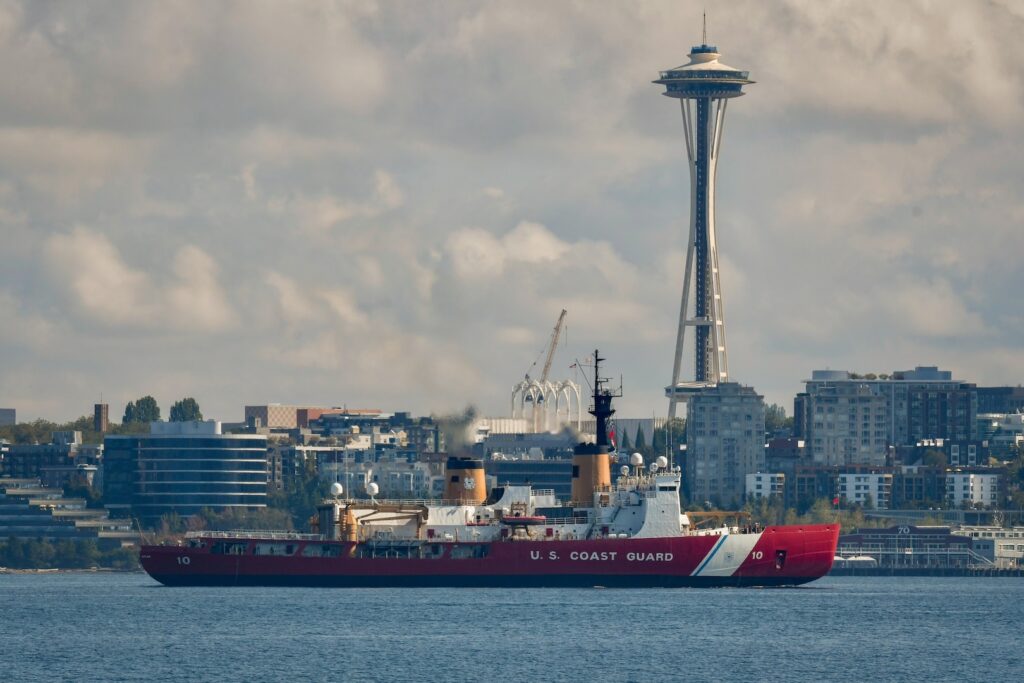
U.S. Coast Guard Cutter Polar Star (WAGB 10) transits Elliott Bay near the Seattle waterfront as the cutter approaches its homeport of Coast Guard Base Seattle, Aug. 25, 2024. At a length of 399-feet, the Polar Star is one of the largest cutters in the Coast Guard’s fleet. (U.S. Coast Guard photo by Capt. Holly Harrison) 

From U.S. Coast Guard Pacific Area, Aug. 28, 2024 

SEATTLE — The U.S. Coast Guard Cutter Polar Star (WAGB 10) and crew returned to Seattle, Sunday, after 285 days away from the cutter’s home port. 
 
Following a 138-day deployment to Antarctica supporting Operation Deep Freeze 2024, the Polar Star reported directly to Mare Island Dry Dock (MIDD) LLC. in Vallejo, California, to commence the fourth phase of a five-year Service Life Extension Project (SLEP). 
 
The work completed at MIDD is part of the in-service vessel sustainment program with the goal of recapitalizing targeted systems, including propulsion, communication, and machinery control systems, as well as effecting significant maintenance to extend the cutter’s service life. 
 
Polar Star’s SLEP work is completed in phases to coordinate operational commitments such as the cutter’s annual Antarctic deployment. Phase four began on April 1, 2024, targeting three systems: 

Boiler support systems were recapitalized, including the electrical control station that operates them. 

The heating, ventilation and air conditioning (HVAC) system was refurbished through the overhaul of ventilation trunks, fans and heaters that supply the cutter’s berthing areas. 

The flooding alarm system was redesigned, providing the ability to monitor machinery spaces for flooding from bow to stern. 

Additional work not typically completed every dry dock included removing and installing the starboard propulsion shaft, servicing and inspecting both anchor windlasses, inspecting and repairing anchor chains and ground tackle, cleaning and inspecting all main propulsion motors and generators, installation of an isolation valve to prevent seawater intrusion into the sanitary system, and overhauling the fuel oil purifier. 
 
Phase four of Polar Star’s SLEP took place over approximately 140 days and represented a total investment of $16.8 million. By replacing outdated and maintenance-intensive equipment, the Coast Guard will mitigate lost mission days caused by system failures and unplanned repairs. The contracted SLEP work items and recurring maintenance is taking place within a five-year, annually phased production schedule running from 2021 through 2025. 
 
The Coast Guard is investing in a new fleet of polar security cutters (PSC) that will sustain the service’s capabilities to meet mission needs in both the Arctic and Antarctic regions. The SLEP allows Polar Star to continue providing access to the Polar regions until the PSCs are operational and assume the high latitude missions. Polar security cutters will enable the U.S. to maintain defense readiness in the Polar regions; enforce treaties and other laws needed to safeguard both industry and the environment; provide ports, waterways and coastal security; and provide logistical support – including vessel escort – to facilitate the movement of goods and personnel necessary to support scientific research, commerce, national security activities and maritime safety. 
 
“Completing a dry dock availability is a positive milestone, and despite challenges due to being away from home port, our crew’s energy and resilience inspires me every day,” said Capt. Jeff Rasnake, Polar Star’s commanding officer. “The amount of time and effort put into Polar Star and its mission is truly remarkable. The dedication and teamwork displayed across all stakeholders exemplifies the Coast Guard’s flexibility and commitment to ensuring the continued success of Operation Deep Freeze as well as strengthened partnerships among nations invested in the Antarctic latitudes. I look forward to observing how this crew will continue to grow as a team and to discovering what we can accomplish together.” 
 
Along with the rigorous maintenance schedule, Polar Star held a change of command ceremony on July 8, 2024, in Vallejo, where Rasnake relieved Capt. Keith Ropella as the cutter’s commanding officer. Rasnake served as the deputy director for financial management procurement services modernization and previously served as Polar Star’s executive officer. Ropella transferred to the office of cutter forces where he will oversee the management of the operational requirements for the cutter fleet and develop solutions for emerging challenges facing the afloat community. 
 
Polar Star is the Coast Guard’s only active heavy polar icebreaker and is the United States’ only asset capable of providing year-round access to both polar regions. 
 
Commissioned in 1976, the cutter is 399 feet, weighing 13,500 tons with a 34-foot draft. Despite reaching nearly 50 years of age, Polar Star remains the world’s most powerful non-nuclear icebreaker with the ability to produce up to 75,000 horsepower. Polar Star’s SLEP is important to the survival of the Antarctic mission and crucial to the well-being and success of Polar Star and crew during these long missions.