General Dynamics Mission Systems Awarded Modification to Deliver Hammerhead Encapsulated Effectors to U.S. Navy
From General Dynamics Mission Systems, August 20, 2024
TAUNTON, Mass. – General Dynamics Mission Systems announced today that it was awarded a cost-plus-fixed-fee modification to a previously awarded contract by the U.S. Navy worth $20.7 million to exercise an option for Hammerhead Encapsulated Effector systems. Hammerhead is a moored anti-submarine mine which delivers new capabilities and effects to the U.S. Navy.
Work will be performed in Taunton, Mass., and is expected to be completed by June 2026.
“General Dynamics Mission Systems has more than 60 years of experience designing, testing, integrating and delivering advanced maritime technologies. Our expertise in integrating undersea payloads and sensors is being applied to this critical maritime mine capability. The Hammerhead program will ensure that threats to the fleet will be neutralized safely and effectively. We look forward to delivering these additional Hammerhead systems to the U.S. Navy,” said Paul Dalton, vice president of Undersea Systems at General Dynamics Mission Systems.
BAE Systems to Upgrade Flight Control Computers for FA-18E/F and F-15EX Fighters
Technology refresh increases processing power to enhance aircraft performance, capabilities, and readiness
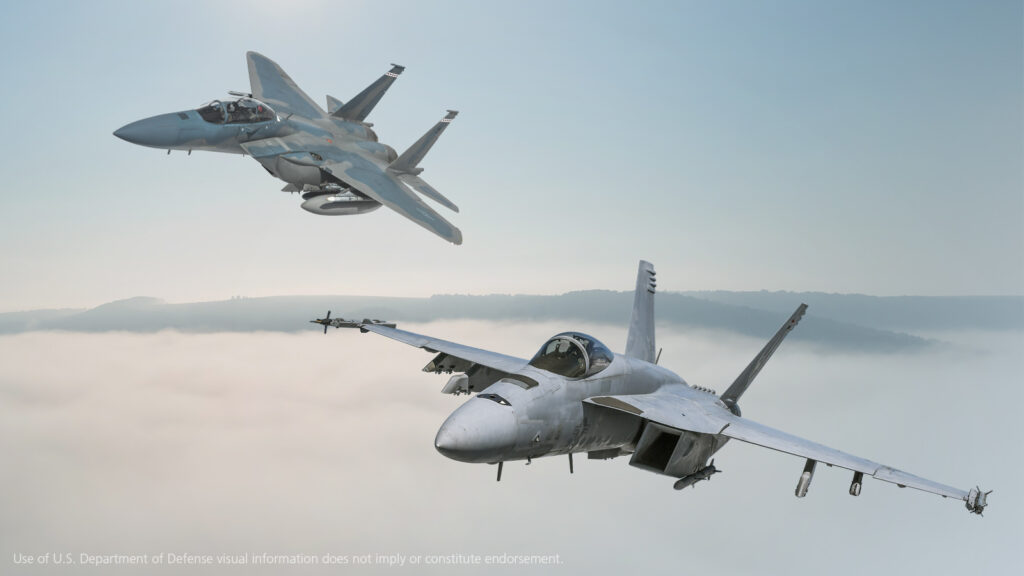
ENDICOTT, N.Y. — August 20, 2024 — BAE Systems has been selected by Boeing to upgrade the fly-by-wire (FBW) flight control computers (FCC) for the F-15EX Eagle II and F/A-18E/F Super Hornet fighter aircraft. The FCCs feature common core electronics that support the quad-redundant FBW flight control systems (FCS), providing the safety, reliability, robustness, and performance needed for the missions of these advanced platforms.
As the original manufacturer of the FCCs for both aircraft, BAE Systems will modernize the FCC electronics hardware and software to increase processing power, enhance cyber and product security, address obsolescence issues, and support sustainment well into the future. The upgraded FCC will leverage the company’s high-integrity flight control product roadmap, built upon technology investments, and used across multiple recent military airborne platform flight control upgrades. The F/A-18E/F FCC will also receive an additional processor to enable future capabilities for the fleet.
“BAE Systems is a leader in high-integrity controls and this upgrade reflects our commitment to providing our customers with next-generation solutions,” said Corin Beck, senior director of Military Aircraft Systems for Controls and Avionics Solutions at BAE Systems. “Our advanced flight-critical solution ensures that these platforms will maintain fleet readiness now, and in the future, as well as provisions the aircraft to support the integration of new functions.”
These computers efficiently manage aircraft flight by processing pilot inputs, monitoring real-time aircraft movement conditions via on-board sensors, and transmitting commands to actuators that move the control surfaces. The redundant FCS, along with the flight control laws, enables the pilot to maintain controlled operation across the demanding flight regime and multiple loadout configurations. Additionally, the FCS can reconfigure how it controls the aircraft in case of a failure or battle damage by mixing the remaining control surfaces differently. The advanced FBW FCS allows the pilot to focus more on the mission and less on flying the aircraft.
BAE Systems has more than 40 years of experience developing and integrating flight control technology for military and commercial platforms. This flight control upgrade will be conducted at the company’s state-of-the-art engineering and manufacturing facility in Endicott, New York.
Saildrone Completes Autonomous Survey of Gulf of Maine to Identify Potential Deep-sea Coral Habitat
Saildrone has surveyed 1,500 sq. nm in the Jordan and Georges Basins that had never before been mapped in high resolution.
From Saildrone, August 20, 2024
PORTLAND, Maine — Saildrone has mapped 1,500 square nautical miles in the north-central Gulf of Maine in support of the National Oceanic and Atmospheric Administration (NOAA)’s efforts to survey deep-sea coral habitat. The Gulf of Maine is a productive and dynamic marine environment, with a diverse array of marine life, productive fisheries, unique underwater habitats, and a complex topography of deep basins, shallow banks, and steep slopes. However, there is extremely limited mapping data available, especially in deeper waters.
Two Saildrone Voyager uncrewed surface vehicles (USVs) gathered data at depths up to 300 meters around the Jordan and Georges Basins. The data has revealed a complex and varied underwater landscape, reflecting its glacial history and dynamic oceanographic processes.
“The Saildrone Voyagers are filling in a substantial gap in seafloor data in the Gulf of Maine. NOAA and partners are very interested in better understanding habitats in the region that may support fish production. These high-resolution seafloor maps will inform future surveying and modeling efforts, as well as aid in the New England Fishery Management Council’s fishery management decisions,” said Heather Coleman, a researcher with the NOAA Fisheries Office of Habitat Conservation’s Deep Sea Coral Research and Technology Program.
These high-resolution maps will guide visual surveys of coral and sponge habitats using remotely operated vehicles for multiple NOAA cruises in 2024 and 2025. The data will also inform new species distribution models in the Gulf of Maine, which until now was not possible because of the lack of high-resolution seafloor information.
“This is the first successful demonstration of Saildrone Voyager mapping capabilities, pushing the envelope of what is possible using autonomous systems for shallow to mid-depth EEZ mapping. Its state-of-the-art Norbit multibeam echo sounder combined with near-silent operations and classification from the American Bureau of Shipping, make Saildrone’s Voyager the USV of choice for near-shore mapping. These capabilities can be applied for any number of missions, from habitat exploration to safety of navigation to site characterization for offshore wind,” said Brian Connon, Saildrone’s VP of Ocean Mapping.
Saildrone has been operating autonomous data collection missions for ocean research, seafloor mapping, and maritime security since 2015. To date, Saildrone has built more than 140 USVs across the three Explorer, Voyager, and Surveyor classes. The Saildrone fleet has already spent more than 42,000 days at sea and sailed more than 1,300,000 nautical miles from the High North to the Southern Ocean.
Secretary of the Navy Advances Maritime Statecraft in Copenhagen
From SECNAV Public Affairs, 19 August 2024
Secretary of the Navy Carlos Del Toro visited A.P. Moller-Maersk during a trip to the Kingdom of Denmark last week. During the visit, he met with A.P. Moller-Maersk CEO Vincent Clerc, and stated that the U.S. Navy would continue to protect commercial ships and mariners against unprovoked Houthi attacks on civilian shipping in the Red Sea.
During the visit, he met with A.P. Moller-Maersk CEO Vincent Clerc, and stated that the U.S. Navy would continue to protect commercial ships and mariners against unprovoked Houthi attacks on civilian shipping in the Red Sea. As during each of his previous Maritime Statecraft engagements with global maritime industry leaders, Secretary Del Toro encouraged investment in American shipbuilding. Discussions were productive and centered on attracting demand and investment in constructing commercial sealift vessels in the United States.
The visit reflects ongoing efforts to renew the foundations of American seapower, since Secretary Del Toro announced his new maritime statecraft initiative at the Harvard Kennedy School on Sept. 26, 2023.
“With some of the world’s most technologically advanced shipbuilders already heeding our call to invest in integrated commercial and naval shipbuilding facilities in the United States, the next step in our maritime statecraft strategy is to attract the world’s foremost commercial shipping firms to signal their demand for new ships built in American shipyards,” Secretary Del Toro said.
In a more recent speech to the Naval War College on Aug. 8, Secretary Del Toro explained that “long-term solutions to many of the Navy’s challenges require we renew the health of our nation’s broader seapower ecosystem.” He added “Making naval shipbuilding more cost effective requires we restore the competitiveness of U.S. commercial shipping and shipbuilding.”
Secretary Del Toro’s visit follows months of collaboration with interagency partners – such as the U.S. Department of Energy and U.S. Department of Transportation Maritime Administration – and Congress to find innovative ways to leverage existing authorities and craft new incentives to build and flag commercial ships in the United States. For example, the Department of Energy’s Title 17 Clean Energy Financing program now permits the U.S. Government to offer low-interest loans for U.S.-built dual-fuel commercial ships. “Our calculus is that bringing a larger portion of the newbuild orderbooks of the world’s biggest shipping firms to American shores in the coming years will offer significant returns to Navy shipbuilding and sealift.”
Managed by the U.S. Maritime Administration, the Maritime Security Program (MSP) maintains a fleet of commercially viable, militarily useful U.S.-flagged merchant ships in international trade to support military sealift requirements during times of conflict or in other national emergencies.
Secretary Del Toro said he and his team were looking forward to continuing discussions with the leadership of A.P. Moller-Maersk on their next visit to the United States in the coming weeks.
U.S. Coast Guard Completes Operation Island Chief in Pacific Region
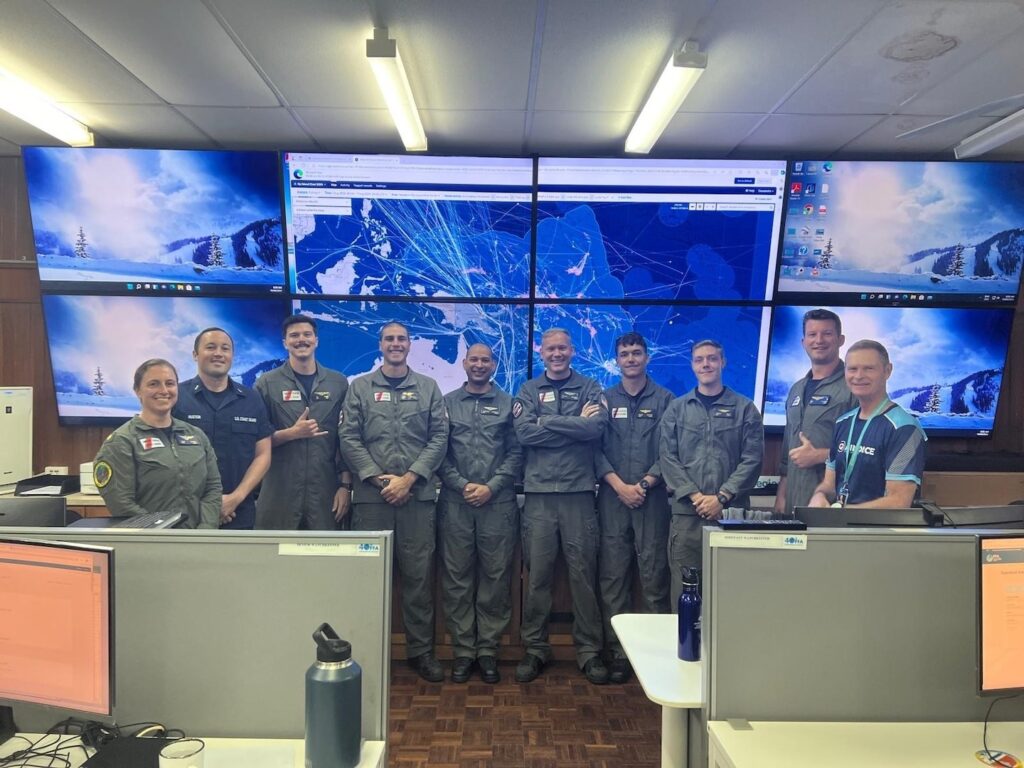
U.S. Coast Guard personnel from District Fourteen and Air Station Barbers Point pose for a photo with a member of the Royal New Zealand Air Force and Forum Fisheries Agency at the Regional Fisheries Surveillance Centre (RFSC) in Honiara, Solomon Islands, Aug. 13, 2024. (U.S. Coast Guard courtesy photo)
From U.S. Coast Guard District 14 External Affairs, Aug. 19, 2024
HONOLULU – The U.S. Coast Guard completed Island Chief, a 13-day operation to safeguard the invaluable marine resources of Pacific Island nations and the Western Central Pacific Ocean.
From Aug. 5-16, an HC-130 Hercules airplane crew from Coast Guard Air Station Barbers Point patrolled the South Pacific High Seas in and around the exclusive economic zones of Fiji, Federated States of Micronesia, Kiribati, Palau, Papua New Guinea, Nauru, Republic of Marshall Islands, Solomon Islands, Tuvalu and Vanuatu to detect, investigate and report any illegal, unreported and unregulated (IUU) fishing activity.
The Hercules crew worked with the Regional Fisheries Surveillance Centre, a part of the Forum Fisheries Agency (FFA) in Honiara, Solomon Islands, to reinforce the conservation work of the Western and Central Pacific Fisheries Commission.
Coast Guard participation in Operation Island Chief is part of Operation Blue Pacific, an overarching multi-mission Coast Guard endeavor promoting security, safety, sovereignty and economic prosperity in the Pacific while strengthening relationships between partner nations.
The Coast Guard conducted Operation Island Chief alongside the Pacific Quadrilateral Defense Coordinating Group (Pacific QUAD), in support of the Pacific Islands FFA and its members.
FFA Director General Dr. Manu Tupou-Roosen highlighted the significance of the FFA-led Operation Island Chief 2024, coordinating surveillance efforts for participating Members.
“Operation Island Chief reinforces FFA’s commitment to sustainable fisheries management and maritime security in the Pacific,” said Dr. Tupou-Roosen. “This operation exemplifies the spirit of regional collaboration and determination among Pacific Island nations. The compliance checks of vessels and operators through a robust regional surveillance operation ensures effective management regime and preserving our marine resources, as well as securing the livelihoods and food security of our people.”
“Given the vastness of the Pacific region, close collaboration between U.S. Coast Guard personnel, patrol assets and regional partners is integral to sustained success in combatting IUU fishing across the region,” said Marc Stegman, IUU fishing strategic advisor, Coast Guard District Fourteen.
Joint efforts for Operation Nasse covered over 7 million square miles, with the Coast Guard contributing:
Over 37 hours of flight time
Over 10,500 miles flown
Over 232,100 square miles searched
Three missions flown from Vanuatu and four missions flown from Solomon Islands
70 vessels sighted and analyzed
Located in Honolulu, U.S. Coast Guard District Fourteen covers more than 14 million square miles of land and sea, conducting operations over the Hawaiian Islands, American Samoa, Saipan, Guam, Singapore and Japan.
U.S. Navy Awards SAIC Three Contracts for Engineering Services
PHILIPPINE SEA (Jan. 29, 2024) An EA-18G Growler, assigned to the “Gauntlets” of Electronic Attack Squadron (VAQ) 136, taxis on the flight deck of Nimitz-class aircraft carrier USS Carl Vinson (CVN 70). (U.S. Navy photo by MC2 Isaiah B. Goessl)
From SAIC, August 15, 2024
Contracts to support work at Naval Air Warfare Center Weapons Division, Point Mugu, California
RESTON, Va.–(BUSINESS WIRE)–Aug. 15, 2024– Science Applications International Corp. (NASDAQ: SAIC) has been awarded three contracts worth $58.2M to support the Airborne Electronic Attack (AEA) Integrated Product Team (IPT) Jammer Technique Optimization (JATO) Program, the International Program, and the AEA IPT EA-18G Program.
“These three contracts are a testament to SAIC’s reputation of delivering mission-critical solutions and dedicated support to the Naval Air Warfare Center Weapons Division, Point Mugu,” said Barbara Supplee, executive vice president, Navy Business Group at SAIC. “This work goes beyond technical services. We are contributing to the sustainment of engineering services as well as airborne jammer optimization and effectiveness data collection and reporting for the Navy.”
Under the JATO contract, SAIC will deliver a wide range of technical services including jammer technique development, test and evaluation engineering, interoperability testing and analysis, threat analysis, tactics development, mission data development and production and Fleet liaison activities. This work will play a crucial role in optimizing jamming techniques, enhancing the effectiveness of Electronic Warfare (EW) platforms and systems and ensuring the readiness of the EA-18G aircraft and other EW assets.
Under the AEA IPT International contract, SAIC will continue to provide support to the international service project by performing maintenance of existing AEA simulations and development of tools and new simulations. SAIC will also perform the engineering, technical and policy support services for the international program teams, supporting Foreign Military Sales (FMS), Cooperative Development and other relationship programs for the Electronic Attack (EA) and Electronic Warfare products.
Additional support to AEA IPT includes engineering services for the development and sustainment efforts of both the United States Navy (USN) and Foreign Military Sales (FMS) configurations of the EA-18G. Engineering services will include cooperative and collaborative engineering support to other laboratories and will include general management, engineering support, product support and systems engineering, integration, and test for the EA-18G team.
Final VH-92A Presidential Helicopter Delivered
From U.S. Naval Air Systems Command, August 19, 2024
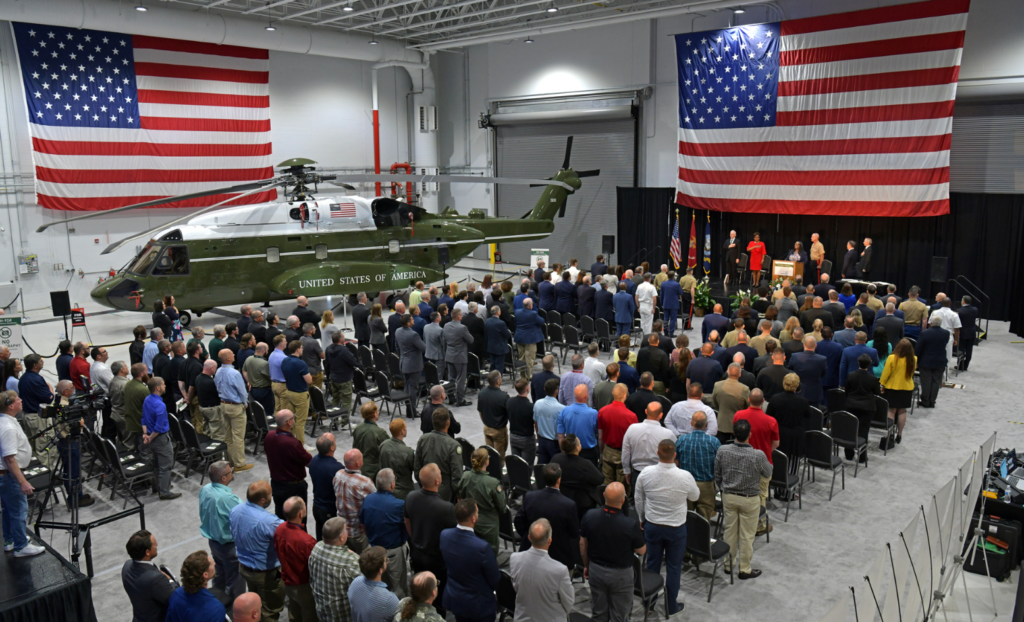
NAVAL AIR SYSTEMS COMMAND, Patuxent River, Md. — Presidential Helicopters Program Office (PMA-274) and the Marine Corps accepted delivery of the final VH-92A helicopter, built by Sikorsky, a Lockheed Martin Company, in August. The achievement signifies the completion of the program of record to deliver 23 new presidential helicopters in support of the executive lift mission.
The total inventory of 23 VH-92A aircraft will consist of 21 operational and two test aircraft. This quantity allows for aircraft to be ready to support the executive lift mission, undergo various levels of maintenance, lifecycle upgrades, and provide assets for pilot/aircrew training.
“This exceptional team has successfully completed the program of record for the VH-92A within budget and schedule,” said Brigadier General David Walsh, program executive officer for air anti-submarine warfare, assault, and special mission programs. “This helicopter not only embodies the hard work and dedication of those responsible for building and delivering the aircraft, but it will remain a recognizable patriotic asset known around the globe for safety, security, and reliability.”
In May 2014, PMA-274, with approval from the Navy, awarded Sikorsky a contract to build the next presidential helicopter, the VH-92A, a derivative of the commercial S-92.
The new presidential helicopter was built to increase performance and payload over the VH-3D and VH-60N. It will provide enhanced crew coordination systems and communications capabilities in addition to improving availability and maintainability.
The Marine Corps works with the White House Military Office, PMA-274, and HMX-1 to ensure the conditions are set for a successful transition from the current in-service VH-3D and VH-60N aircraft to the VH-92A. Currently there are ten VH-3Ds, six VH-60Ns, and nine VH-92As that support various missions assigned to HMX-1.
“Between the program staff and artisans within Sikorsky and PMA-274, we have the best and brightest. These great Americans are experts at their craft and put their all into this platform,” said Colonel Alex Ramthun, PMA-274 program manager. “Not only have we delivered increased performance and reduced maintenance costs and time over the current fleet of presidential helicopters, but we have also delivered the next phase of Marine One helicopters. Knowing those who step aboard any of the 21 VH-92As will have absolute top-notch execution, maintenance, and service for the life of the aircraft makes me proud to be part of this amazing team.”
The VH-92A Patriot is in the midst of a phased plan to ensure a smooth, safe, and timely transition from the legacy VH-3D and VH-60N aircraft.
PMA-274 expeditiously provides safe, ready, high-performing, and affordable aircraft, capabilities, and support to HMX-1.
U.S. Navy Investigating Incident Involving Two MH-60S Seahawks at Naval Air Station Fallon
PHILIPPINE SEA (June 10, 2024) Sailors stand by to assist as an MH-60S Sea Hawk, attached to the Golden Falcons of Helicopter Sea Combat Squadron (HSC) 12, lands on the flight deck of the U.S. Navy’s only forward-deployed aircraft carrier, USS Ronald Reagan (CVN 76), during flight operations in support of Valiant Shield 2024 in the Philippine Sea, June 10. (U.S. Navy photo by MC3 Kazia Ream)
From Commander, Naval Air Force, U.S. Pacific Fleet, 16 August 2024
FALLON, Nev. – The U.S. Navy is investigating the cause of an incident involving two MH-60S Seahawk helicopters assigned to Helicopter Sea Combat Squadron (HSC) 12 on the training ranges of Naval Air Station (NAS) Fallon, Nevada, at approximately 7:25 p.m. (PDT) on Aug. 15.
The two helicopters, each with a crew of five personnel, were conducting routine training at the time of the incident. All ten crew members were transported to a nearby hospital for medical treatment and have been released from the hospital following medical treatment for non-life threatening injuries.
The cause of the mishap remains under investigation. Security personnel from NAS Fallon have secured the mishap site, which is on the Fallon Range Training Complex in a remote location.
Assigned to Carrier Air Wing (CVW) 5, HSC-12 is currently at NAS Fallon for comprehensive, integrated training in both real and simulated environments. CVW-5 is the ready, reliable and proven Forward-Deployed Naval Forces-Japan (FDNF-J) carrier air wing. CVW-5 will remain the FDNF-J air wing following the planned hull swap with Nimitz-class aircraft carrier USS George Washington (CVN 73).
USS Halsey Returns Home from Westpac Deployment
The Arleigh Burke-class guided-missile destroyer USS Halsey (DDG 97) returns from a seven-month deployment to its homeport at Naval Base San Diego, Aug. 16, 2024. (U.S. Navy photo by MC2 Maria G. Llanos)
By Mass Communication Specialist 2nd Class Maria Llanos, Aug. 16, 2024
NAVAL BASE SAN DIEGO, Calif. – The Arleigh Burke-class guided-missile destroyer USS Halsey (DDG 97) returned to Naval Base San Diego Aug. 16, following a seven-month deployment to U.S. 7th Fleet.
Halsey departed San Diego on Jan. 10 as part of the Theodore Roosevelt Carrier Strike Group and served as a carrier escort before detaching to conduct independent operations in the Indo-Pacific region.
“I am tremendously proud of my Sailors’ sense of ownership and dedication to each other and the mission,” said Cmdr. Sara Lynch, Halsey’s commanding officer. “We operated successfully across a wide spectrum of operations with allies and partners from around the world and displayed the immense capability of Halsey Sailors and the U.S. Navy.”
While deployed to U.S.7th Fleet, Halsey conducted operations across multiple warfare areas, providing regional stability and supporting a free and open Indo-Pacific. Halsey participated in various multi-nation exercises such as Noble Dingo, Milan, Tiger Triumph, Tenacious Trident, and Valiant Shield, which reinforced America’s commitment to allies and partners throughout the Indo-Pacific region and increased force interoperability.
Across U.S. 7th Fleet, Halsey contributed to enduring partnerships critical to maintaining an international rules-based order, including key tri-lateral operations with the Japan Maritime Self-Defense Force and Republic of Korea Navy during Freedom Edge. Halsey participated in several operations with the Royal Australian Navy, including flight operations, tactical maneuvering and a personnel exchange before participating in Exercise Milan 2024, a multinational exercise in India with maritime events from anti-submarine warfare to live fire engagements of an unmanned aerial vehicle.
“I am incredibly proud of this crew for always rising to the occasion,” said Lynch. “I am also extremely grateful to the families and friends back home who supported our Sailors during these last seven months.”
An integral part of U.S. Pacific Fleet, U.S. 3rd Fleet leads naval forces in the Indo-Pacific and provides the realistic, relevant training necessary to flawlessly execute our Navy’s role across the full spectrum of military operations—from combat operations to humanitarian assistance and disaster relief. U.S. 3rd Fleet works together with our allies and partners to advance freedom of navigation, the rule of law, and other principles that underpin security for the Indo-Pacific region.
Aug 16-18 U.S. Central Command Update
From U.S. Central Command
August 18, 2024
TAMPA, Fla. – In the past 24 hours, U.S. Central Command forces successfully destroyed one Iranian-backed Houthi uncrewed aerial vehicle (UAV) in a Houthi-controlled area of Yemen.
It was determined the UAV presented an imminent threat to U.S. and coalition forces, and merchant vessels in the region. These actions were taken to protect freedom of navigation and make international waters safer and more secure.
Aug. 16, 2024
TAMPA, Fla. – In the past 24 hours, U.S. Central Command (USCENTCOM) forces successfully destroyed one Iranian-backed Houthi Unmanned Surface Vessel (USV) in the Red Sea.
It was determined this USV presented a clear and imminent threat to U.S. and coalition forces, and merchant vessels in the region. This action was taken to protect freedom of navigation and make international waters safer and more secure for U.S., coalition, and merchant vessels.