NOAA, Defense POW/MIA Accounting Agency Agree to Share Ocean Exploration Data
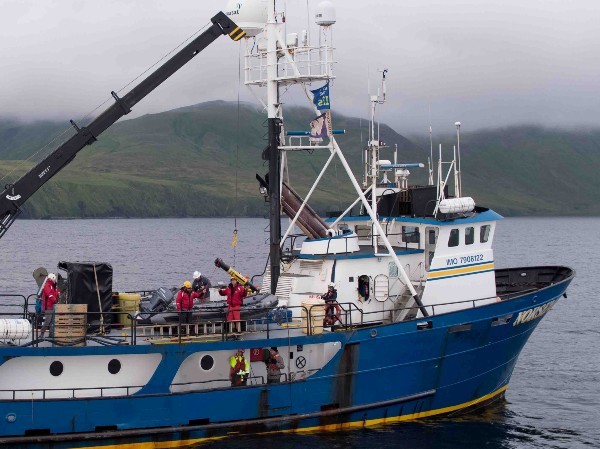
In 2018, a multidisciplinary team traveled to Kiska, Alaska, to survey historic battlefields from World War II and document and honor the final resting place of U.S. and Japanese service members who lost their lives in the waters surrounding Kiska Island. The expedition, which was funded by NOAA and coordinated with the Defense POW/MIA Accounting Agency, resulted in the discovery of the missing section of the USS Abner Read, a 376-foot Fletcher-class U.S. Navy destroyer that struck a Japanese mine on August 18, 1943, resulting in the loss of 71 U.S. Navy sailors. In this image, the expedition team deploys one of the autonomous underwater vehicles used to survey Kiska Harbor off the side of Research Vessel Norseman II. (Kiska: Alaska’s Underwater Battlefield expedition) 

Two-pronged partnership will honor U.S. military lost at sea and advance scientific ocean discovery 

July 25, 2024 

NOAA and the Defense POW/MIA Accounting Agency (DPAA) have signed a formal memorandum of understanding (MOU) to share data and scientific information and collaborate on ocean exploration work that contributes to the missions of both federal agencies. 

“NOAA is excited to strengthen our collaboration with the agency responsible for locating, recovering and identifying the remains of unaccounted-for U.S. soldiers, sailors and other personnel from past maritime conflicts,” said Steven Thur, Ph.D., NOAA assistant administrator for Oceanic and Atmospheric Research. “Sharing ocean data and collaborating on projects will help our agencies honor courageous military personnel lost at sea defending our nation and at the same time, enable scientists to better understand our ocean.” 

The five-year MOU outlines areas of collaboration between NOAA and DPAA, to:  

  • Undertake joint expeditions, personnel exchanges and engagements between personnel to share methods of operation related to missions. 

  • Share data and scientific information resulting from research cruises, expeditions and campaigns.  

  • Share relevant updates and meet at least annually to share objectives, plans and needs for both the current year and the following five-year period.  

  • Provide DPAA with access to subject matter experts, vessels and other equipment, mission results and technology expeditions, as well as shoreside facilities and programs throughout NOAA’s ocean, weather, climate and coastal science mission. 

  • Provide NOAA and its sponsored scientists with access to vessels, technology and other equipment for participation in expeditions. 

  • Advance the public understanding of both agency’s missions as well as the new partnership when undertaking joint projects and other opportunities as practicable. Engage in cross promotion of activities where practicable and across various media platforms. 

“NOAA’s expertise is world renowned, and we are excited about this partnership and our collective commitment to keep our nation’s promise to provide the fullest possible accounting for those still missing from past conflicts,” said Fern Sumpter Winbush, DPAA’s Principal Deputy Director. “Our agencies will learn from one another as we stretch the limits of technology to search for those still missing since World War II, and as we provide answers to their families.”  

This MOU builds on an existing partnership between NOAA and DPAA. The two federal agencies have collaborated on past expeditions, including the recent 2023 search for a B-25 bomber during the Seascape Alaska expedition. 

Please go online to read the MOU. 

The Defense POW/MIA Accounting Agency is the U.S. government agency responsible for locating, recovering and identifying the remains of the more than 81,000 unaccounted-for U.S. Department of Defense personnel from designated past conflicts. DPAA’s mission involves historical research, archeology, forensic anthropology, laboratory analyses and other related activities. 


George Washington, Ronald Reagan Conduct Hull Swap

From U.S. Navy Office of Information, 25 July 2024 

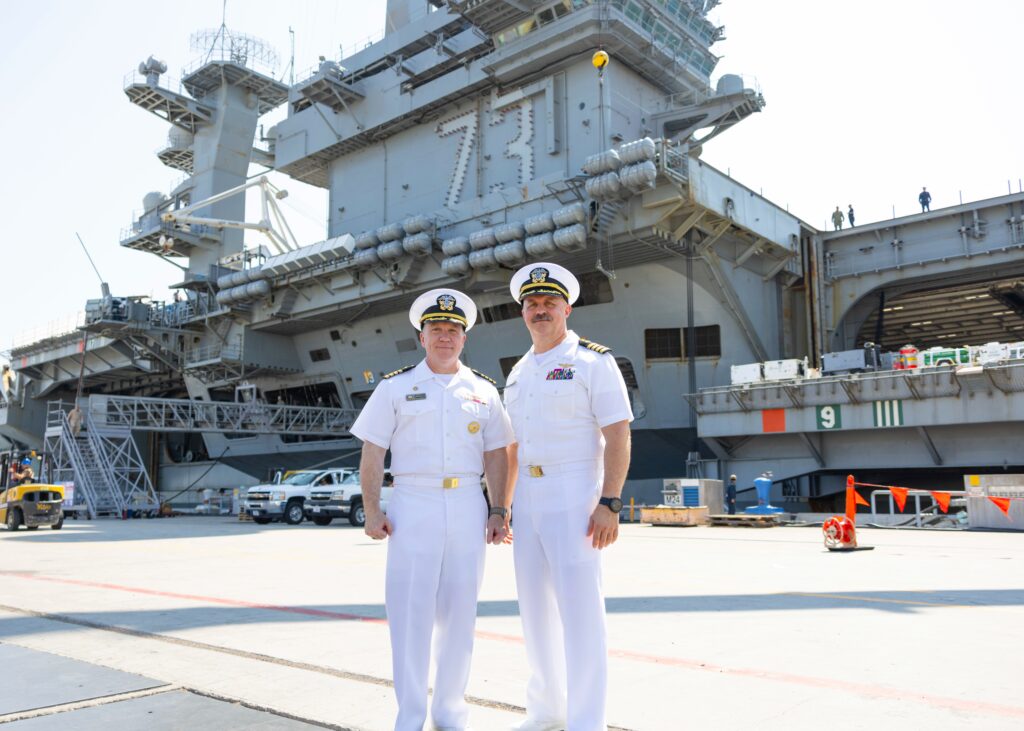
SAN DIEGO – Nimitz-class aircraft carriers USS George Washington (CVN 73) and USS Ronald Reagan (CVN 76) conduct a hull swap on Naval Air Station North Island that sends Ronald Reagan to Bremerton, Washington, and returns George Washington to Yokosuka, Japan, as the Navy’s only Forward-Deployed Naval Forces-Japan (FDNF-J) aircraft carrier effective Aug. 1. 

The hull swap between Ronald Reagan and George Washington was planned in coordination with the government of Japan, and as a part of the 50-year lifespan of the U.S. Navy’s Nimitz-class aircraft carriers. 
 
“USS Ronald Reagan has served exceptionally as America’s forward deployed aircraft carrier for nearly a decade, projecting credible combat power while sailing and flying where international law allows and doing so with allies and partners throughout the Indo-Pacific,” said Rear Adm. Greg Newkirk, commander of Task Force 70 and Carrier Strike Group 5. “Reagan’s crew and those who have served aboard over the past several years should be tremendously proud of what they accomplished.” 
 
George Washington relieving Ronald Reagan marks the second time the ship will serve as the FDNF-J aircraft carrier. In 2008, George Washington became the first nuclear powered aircraft carrier to serve as FDNF-J and was relieved by Ronald Reagan seven years later after a historic tri-carrier hull swap. 
 
“For the last nine years, Ronald Reagan Sailors upheld the international rule of law and maintained a free and open Indo-Pacific alongside our allies and partners through their diligence and dedication towards our common goals,” said Capt. Daryle Cardone, Ronald Reagan’s commanding officer. “Their commitment has left a mark on the 7th Fleet area of responsibility and the impact we made will be continued as George Washington makes their way to Yokosuka, Japan. I know 7th Fleet is in good hands and as Ronald Reagan left behind a legacy of ‘peace through strength,’ George Washington will embody the ‘spirit of freedom’ in the Indo-Pacific once again.” 
 
George Washington’s return to Japan continues the long-standing alliances and partnerships, and consistent U.S. presence in the Indo-Pacific region. 
 
“Now is also an exciting time for the men and women of the USS George Washington, who are building on that ship’s history as Reagan’s predecessor in Yokosuka and re-establishing ‘GW’ as America’s forward-deployed aircraft carrier – a tangible and enduring sign of our nation’s commitment to peace, stability and freedom in the region,” said Newkirk. “Over its previous years as our forward-deployed carrier, George Washington built a reputation for professionalism, confidence and true excellence in Japan across the Indo-Pacific. I know today’s GW Sailors are trained and ready to retake the mantle, make their own mark in this consequential theater.” 
 
Prior to arriving in San Diego, the George Washington Carrier Task Group completed Southern Seas 2024, circumnavigating South America, and the Ronald Reagan Carrier Strike Group completed its final patrol as the FDNF-J aircraft carrier in the U.S. 7th Fleet area of responsibility. 
 
“Having the George Washington back in Yokosuka is a new and exciting adventure for the crew, but it more importantly ensures the United States remains best positioned to meet common goals in the region,” said Capt. Tim Waits, George Washington’s commanding officer. “This nuclear aircraft carrier was a huge part of the foundation of trust between the U.S. and Japan, and that trust is the cornerstone of peace and stability in the Indo-Pacific.” 
 
George Washington and crew are in the process of completing the hull swap, replacing USS Ronald Reagan (CVN 76) as the forward-deployed U.S. Naval Forces Japan aircraft carrier at Fleet Activities Yokosuka, Japan. As part of the transition, the embarked Air Wing and Staffs, which include Carrier Air Wing 5 (CVW 5) and Destroyer Squadron 15 (DESRON 15) will all cross deck to USS George Washington (CVN 73) bringing with them their vast operations experience operation on one of the most advanced and capable warships in the world. About 350 Sailors, 13 percent of the USS Ronald Reagan (CVN 76) crew, will swap with USS George Washington (CVN 73) Sailors. With them, these Sailors will bring their Indo-Pacific and forward deployed experience to George Washington. 


Coast Guard Cutter Stone Returns Home After 63-Day Patrol in the Atlantic Ocean and Caribbean Sea

Coast Guard Cutter Stone (WMSL 758) makes way, June 29, 2024, in the Atlantic Ocean. (U.S. Coast Guard photo by Petty Officer 2nd Class Thomas Settle)

From U.S. Coast Guard Atlantic Area, July 24, 2024 

NORTH CHARLESTON, S.C. — The crew of Coast Guard Cutter Stone (WMSL 758) returned to their home port in North Charleston, Wednesday, following a 63-day patrol in the Atlantic Ocean and Caribbean Sea in support of homeland defense and counterdrug operations. 

Supporting the Tri-Party partnership, Stone served as on-scene commander, leading U.S. Navy and Royal Canadian navy assets in a dynamic mission to preserve the sovereignty of U.S. waters and counter the actions of foreign actors and transnational criminal organizations.  

The Tri-Party partnership, comprised of U.S. Coast Guard Atlantic Area, U.S. Second Fleet and Canadian Joint Task Force-Atlantic maritime forces, was established in 2015 and continues to be an effective partnership aimed at preserving mutual interests and upholding the rules-based international order in support of good maritime governance. 

“This deployment offered a unique opportunity to demonstrate the diverse capabilities of the national security cutter, and how seamlessly and rapidly the Coast Guard can integrate with joint and allied forces to counter maritime threats,” said Capt. Jonathan Carter, commanding officer of Stone. “The Stone’s crew performed admirably throughout the demanding mission.”  

Stone is a 418-foot, Legend-class national security cutter. The cutter’s primary missions are counterdrug operations and defense readiness. Stone falls under the command of the Coast Guard Atlantic Area in Portsmouth, Virginia. Atlantic Area oversees all Coast Guard operations east of the Rocky Mountains to the Arabian Gulf. In addition to surge operations, Atlantic Area also allocates ships to deploy to the Caribbean Sea, Eastern Pacific Ocean, and South Atlantic Ocean to combat transnational organized crime and illicit maritime activity. 


Navy Demonstrates ‘Game-Changing’ System to Rearm Warships at Sea

Sailors from the Navy Expeditionary Logistics Support Group and USS Chosin (CG 65) carefully guide a missile canister using the U.S. Navy’s Transferrable Rearming Mechanism as they demonstrate the ability to reload a Vertical Launching System cell on July 10 at Naval Surface Warfare Center, Port Hueneme Division’s Underway Replenishment Test Facility. (U.S. Navy photo by Dana Rene White)

From Naval Surface Warfare Center, Port Hueneme Division (NSWC PHD) 

Naval Surface Warfare Center, Port Hueneme Division (NSWC PHD) successfully conducted the first land-based demonstration of the Transferrable Rearming Mechanism (TRAM), which will enable U.S. Navy surface combatants to reload missile canisters into their MK 41 Vertical Launching Systems (VLS) at sea. 

Secretary of the Navy Carlos Del Toro has made TRAM one of his top priorities.  In a speech at Columbia University in New York City in December 2022, the secretary set out the goal that, “during my tenure, we will set the Navy on track to deliver the game-changing capability to rearm our warships at sea. Being able to quickly rearm our warships’ vertical launch tubes at sea will significantly increase forward, persistent combat power with the current force.  No longer will our combatants need to withdraw from combat for extended periods to return for vulnerable in-port reloading of weapon systems…. My intention is to perfect this capability and field it for sustained, persistent forward-strike capacity during wartime.” 

The Naval Sea Systems Command (NAVSEA) and NSWC PHD team delivered on the secretary’s call for speed at the Sea-Air-Space Exposition in National Harbor, Maryland, in April, where Del Toro said, “The at-sea demonstration will take place later this year — an unheard-of pace for a capability with such revolutionary strategic potential. If we had waited to Program Objective Memorandum, or POM, for it, we wouldn’t see it demonstrated for at least another two or three years. Instead, we’re on track to begin fielding it in two or three years.”   

The test’s execution underscored the versatility and rapid adaptability of the Navy’s sailors and engineers. Tim Barnard, director of the NAVSEA Technology Office (05T), praised the speed at which the sailors of the Navy Expeditionary Logistics Support Group and USS Chosin (CG 65) became acquainted with TRAM in order to execute the demonstration.  

“This team has been remarkable,” Barnard said. “Without previous familiarity with TRAM, the sailors got spun up for this week’s shore demonstration with just a week of training. They understand TRAM is a game-changer that will allow our ships to reload missiles just like they refuel — using connected underway replenishment, steaming at speed and in open ocean.”  

This week’s land-based test incorporated, for the first time, real-time analytics and direct monitoring through instrumentation, which facilitated real-time assessment and modifications that would otherwise take weeks or months. This unique approach will inform the upcoming at-sea demonstration and follow-on engineering updates.  

Ryan Hayleck, technical director for NAVSEA 05T and technical lead for the demonstration, emphasized during the test that “as we introduce new improvements based on the sailors’ inputs this week and in the upcoming at-sea test, TRAM will only get better and faster from here. I am very excited to take TRAM to sea.” 

NSWC PHD Commanding Officer Capt. Tony Holmes stressed the importance of the Navy’s support behind the test. 

“NSWC PHD appreciates this opportunity to further such a critical and essential capability for the warfighter and the U.S. Navy, thanks to the efforts and focused interest of the secretary of the Navy,” Holmes said. “We look forward to continuing to work on the next steps.” 

Technical Director Jeff Koe added that the resourceful spirit of NSWC PHD’s Underway Replenishment Team has demonstrated that innovation is alive and well in the Navy.  

“Our enterprising teammates years ago saw the need to rearm surface ships at sea and took the initiative to design a way to materialize that vision,” Koe said. “Now, our Navy will benefit from that ingenuity as NSWC PHD and its partners bring TRAM to fruition.”   

Rich Hadley, director of NSWC PHD’s underway replenishment division which designed TRAM, explained that “by solving key relative motion challenges, TRAM is a capability enabling reloading operations while underway in significant sea states. TRAM will greatly expand the fleet’s logistical flexibility, resilience, as well as volume and tempo of long-range fires.” 

Thanking the NAVSEA-NSWC PHD leadership team and the sailors from the Navy Expeditionary Logistics Support Group and USS Chosin who carried out the demonstration, Steven Brock, senior adviser to the secretary of the Navy, noted the historic import of the occasion.  

“This demonstration that you superbly delivered on the secretary’s aggressive timeline sends a powerful message,” Brock said. “This revolution in surface warfare will make our existing fleet even more formidable, both in sustained forward presence and lethality — and will create a powerful new near-term deterrent that will disrupt the strategic calculus of our adversaries.”   

Hunter Stires, maritime strategist with the Office of the Secretary of the Navy, added, “TRAM will enable us to do the modern-day equivalent of firing two broadsides to the enemy’s one. The U.S. Navy’s very best are making this capability real.” 


NAVCENT Units Awarded Navy Unit Commendation

By U.S. Naval Forces Central Command Public Affairs | July 25, 2024 

MANAMA, Bahrain — The Secretary of the Navy recently awarded the Navy Unit Commendation (NUC) to several units assigned to or operating within U.S. Naval Forces Central Command. 

The award recognized the commands for their outstanding performance during the period from October 19, 2023, to May 30, 2024. 

Commands include: 

Commander, U.S. 5th Fleet (COMFIFTHFLT); Commander, Task Force (CTF) 53; CTF 54 Bahrain Team; CTF 54 Japan Team; CTF 55 / Destroyer Squadron (DESRON) 50; CTF 56, Task Group (TG) 56.1 Explosive Ordnance Disposal (EOD), TG 56.9 Intelligence Exploitation Team (IET), TG 56.3 Expeditionary Reload Team (ERT); CTF 57; Task Force (TF) 3; Commander, Submarine Squadron (CSS) 21; Commander, Submarine Group (COMSUBGRU) 7; COMSUBGRU 7 NCCS; Anti-Submarine Warfare Forces; TF 51 / 5th Marine Expeditionary Brigade; Amphibious Ready Group (COMPHIBRON) 8; 26th Marine Expeditionary Unit (Special Operations Capable); Antiterrorism Security Team Company-Central Command (FASTCENT); 1st Battalion, 6th Marines (BLT 1/6); Marine Medium Tiltrotor Squadron (VMM) 162; Combat Logistics Battalion 22; Tactical Air Control Squadron (TACRON) 21; Fleet Surgical Team (FST) 8; Naval Beach Group (NBG) 2; Beachmaster Unit 2; Assault Craft Unit 2; Assault Craft Unit 4; USS Laboon (DDG 58); USS Mason (DDG 87); USS Florida (SSGN 728) (Blue Crew); USS Thomas Hudner (DDG 116); USS Bataan (LHD 5); USS Carter Hall (LSD 50); USS Lewis B. Puller (ESB-3); USS Stethem (DDG 63); USS McFaul (DDG 74); USS Gravely (DDG 107); USNS Alan Shepard (T-AKE-3); USNS Amelia Earhart (T-AKE-6); USNS Kanawha (T-AO-196); USNS Supply (T-AOE-6); Detachment, Deployable Joint Command and Control (DJC2) Rotation 23.2; DJC2 Rotation 24.1; Fleet Logistics Support Squadron (CRC) 40; Tactical Operations Control Squadron (TOCRON) 10; Patrol Squadron (VP) 5; VP 9; VP 10; VP 40; Fleet Air Reconnaissance Squadron (VQ) 1; Helicopter Sea Combat Squadron (HSC) 26. 

Established by the Secretary of the Navy on Dec. 18, 1944, and awarded by the secretary with the approval of the President, a unit commendation is conferred on any ship, aircraft, detachment or other unit of the U.S. Navy or Marine Corps that distinguished itself for extremely meritorious service in support of military operations, which were outstanding when compared to other units performing similar service. 

The U.S. 5th Fleet area of operations encompasses approximately 2.5 million square miles of water space and includes the Arabian Gulf, Gulf of Oman, Red Sea, parts of the Indian Ocean and three critical choke points at the Strait of Hormuz, Suez Canal and Strait of Bab al-Mandeb. 


July 24 U.S. Central Command Update 

From U.S. Central Command, July 24, 2024

TAMPA, Fla. – In the past 24 hours, U.S. Central Command (USCENTCOM) forces successfully destroyed two Iranian-backed Houthi missiles on launchers in a Houthi-controlled area of Yemen. It was determined these weapons presented an imminent threat to U.S., coalition forces, and merchant vessels in the region. These actions were taken to protect freedom of navigation and make international waters safer and more secure. 


SECDEF Announces Two Flag Nominations for SOUTHCOM, NDU

Secretary of Defense Lloyd J. Austin III announced today that the president has made the following nominations: 

Navy Vice Adm. Alvin Holsey for appointment to the grade of admiral, with assignment as commander, U.S. Southern Command, Doral, Florida. Holsey is currently serving as military deputy commander, U.S. Southern Command, Doral, Florida. 

Navy Rear Adm. Peter A. Garvin for appointment to the grade of vice admiral, with assignment as president, National Defense University, Washington, D.C. Garvin is currently serving as president, Naval War College, Newport, Rhode Island. 


Coast Guard Cutter James Returns Home Following South Atlantic Ocean Deployment to Counter Illegal, Unreported and Unregulated Fishing 

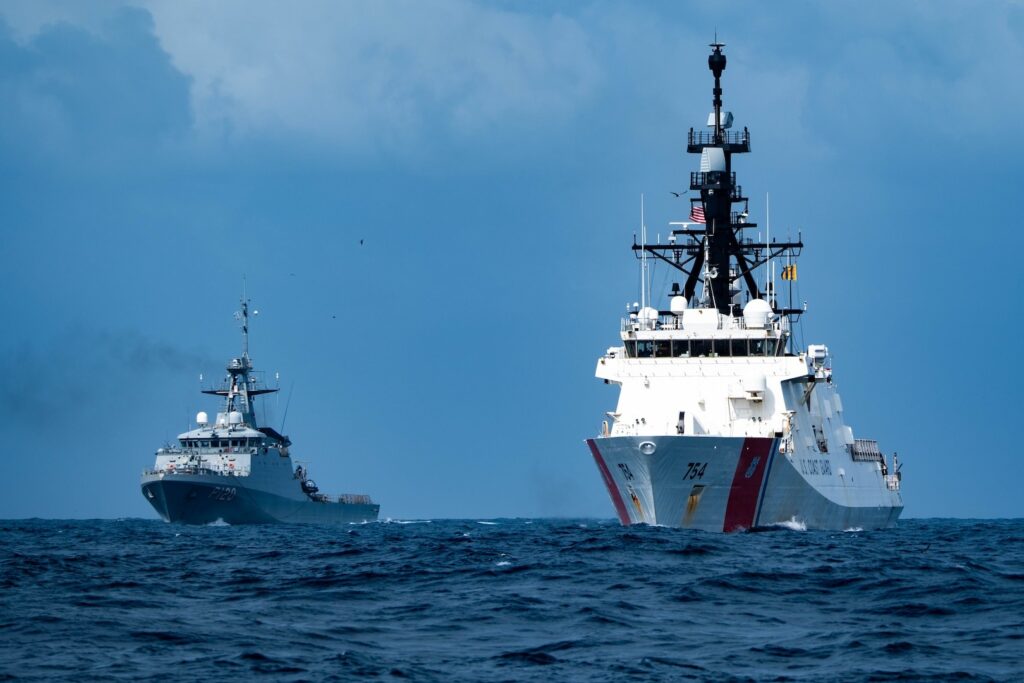
The U.S. Coast Guard Cutter James (WMSL 754) and the Brazilian navy Amazonas (P 120) conduct a passing exercise at sea in the southern Atlantic Ocean, May 25, 2024. (U.S. Coast Guard photo by Petty Officer 3rd Class Logan Kaczmarek)

NORTH CHARLESTON, S.C. — The crew of the Coast Guard Cutter James (WMSL 754) returned to their home port in North Charleston, July 11, after completing a 98-day patrol in the South Atlantic Ocean and the Caribbean Sea. 

James’ crew patrolled in support of Operation Southern Cross, promoting maritime governance with partners in the South Atlantic by working to illuminate and monitor illegal, unreported, and unregulated fishing (IUU-F) activity in the region. 

While on patrol, James interacted with partners in Uruguay, Argentina and Brazil, strengthening relationships by focusing on shared interests in countering illicit maritime activity. Through several subject matter expert (SME) exchanges and joint engagements, James demonstrated counter IUU-F capabilities to promote the rules-based order and advance White House initiatives to further advance Atlantic Cooperation.  

During the patrol, James’ crew conducted port visits to Montevideo, Uruguay; Buenos Aires, Argentina; and Rio de Janeiro and Fortaleza, Brazil. At each city, Coast Guard personnel engaged with their international counterparts to promote partnership. Notably, James’ command cadre met with senior leadership from the Uruguay Navy, the Argentine Prefectura Naval, and the Brazilian Navy, holding roundtable discussions to tackle the global impacts of IUU-F while devising strategies to enhance maritime domain awareness, improve information sharing and combat the threat together. 

Additionally, James’ small unmanned aircraft system (UAS)-contracted team presented their system and capabilities to senior naval leadership, illustrating the sizable benefits of UAS in detecting and monitoring IUU-F activity. The visits included community relations events and tours of the ship, and culminated in diplomatic receptions aboard James, bringing together key civilian and military leaders from each respective country. 

Showcasing law enforcement expertise and dedication to joint efforts against illicit maritime activity, James’ crew organized and hosted in-port SME exchanges and at-sea mock boarding engagements with the Argentine Prefectura Naval and the Brazilian Navy. James crew members conducted a mock counter-IUU-F engagement with the Argentine Prefectura vessel Mantilla (GC-24), demonstrating the procedures of a high seas boarding inspection on a foreign-flagged fishing vessel. James also organized multiple demonstrations of visit, board, search and seizure procedures to exercise interoperability with the Brazilian Navy. 

During the cutter’s visit to Buenos Aires, James’s crew received a presidential welcome from Argentina’s President Javier Milei. Coast Guard Capt. Donald Terkanian welcomed President Milei on board and provided him with a tour of James. This historic event initiated several other key engagements with Argentina’s Vice President Victoria Villarruel, senior military and civilian leaders. 

During the deployment, James’ crew members also had the unique opportunity to join U.S. Navy Carrier Strike Group 10 to execute Operation Southern Seas 2024 with the Brazilian Navy and celebrate the bicentennial of U.S.-Brazilian diplomatic relations. Promoting interoperability with the Brazilian Navy and simultaneously advancing the Tri-Service Maritime Strategy through U.S. sea-service engagement, James completed formation steaming and close quarters maneuvering exercises with Brazilian Navy frigates BNS União (F 45) and BNS Independência (F 44) alongside the USS George Washington (CVN 73) and USS Porter (DDG-78). James conducted a joint live-fire exercise, utilizing its onboard 20mm close-in-weapon system to engage a target flare in tandem with Independência, União and Porter. Finally, James and Independência exchanged crewmembers for five days. 

After departing the Southern Atlantic Ocean, James patrolled the Caribbean Sea to execute Operation Martillo in support of Joint Interagency Task Force-South, collaborating with fellow Coast Guard units as well as the Department of Defense, Department of Homeland Security, and international partners to counter illicit trafficking in the region. 

James is a 418-foot, Legend-class national security cutter. The cutter’s primary missions are counter-drug operations and defense readiness. James falls under the command of the Coast Guard Atlantic Area in Portsmouth, Virginia. Atlantic Area oversees all Coast Guard operations east of the Rocky Mountains to the Arabian Gulf. In addition to surge operations, Atlantic Area also allocates ships to deploy to the Caribbean Sea, Eastern Pacific Ocean, and South Atlantic Ocean to combat transnational organized crime and illicit maritime activity. 


Coast Guard Offloads More Than $96 Million in Illegal Narcotics Interdicted in the Caribbean Sea

Crew members from Coast Guard Cutter Forward offload more than $96 million in illegal narcotics at Port Everglades, Florida, July 22, 2024. (U.S. Coast Guard photo by Petty Officer 3rd Class Nicholas Strasburg) 

From U.S. Coast Guard 7th District, July 23, 2024 

MIAMI – The crew of Coast Guard Cutter Forward offloaded more than 7,302 pounds of cocaine with an assessed street value of approximately $96 million in Port Everglades, Monday.    

Coast Guard crews, working alongside interagency and international partners, interdicted the illegal drugs in the international waters of the Caribbean Sea during three separate cases.  

“This was another vital success of our combined drug interdiction efforts,” said Lt. Cmdr. Juan Ramirez, a Coast Guard District Seven staff attorney. “These drug offloads underscore our continued partnerships with the U.S. Navy and the Royal Netherlands Navy in combating the flow of illicit narcotics across the Caribbean. The success of our joint efforts to save lives by reducing the availability of these harmful drugs is dependent on our cooperation with regional and international partners.”  

The following assets and crews were involved in the interdictions:  

  • Royal Netherlands Navy ship HNLMS Groningen (P 843)  

  • USS St. Louis (LCS 19)  

  • U.S. Coast Guard Tactical Law Enforcement Team Pacific (PAC-TACLET) Law Enforcement Detachments 110 and 105  

  • U.S. Coast Guard Helicopter Interdiction Tactical Squadron (HITRON)  

  • Joint Interagency Task Force South (JIATF-South)  

  • U.S. Customs and Border Protection Air and Marine Operations (CBP-AMO)  

Three suspected smugglers will face prosecution in federal courts by the Department of Justice.  

PAC-TACLET is part of the Coast Guard’s deployable specialized forces program, with advanced training in high-risk interdiction operations in the maritime environment, including non-compliant vessel pursuit missions. Law enforcement detachments from PAC-TACLET and HITRON aircrews deploy aboard Coast Guard, U.S. Navy and foreign allied ships to augment their capabilities and authorities to perform counter drug missions under U.S. law.  

Detecting and interdicting illegal drug traffickers on the high seas involves significant interagency and international coordination. The Joint Interagency Task Force South in Key West, Florida conducts the detection and monitoring of aerial and maritime transit of illegal drugs. Once interdiction becomes imminent, the law enforcement phase of the operation begins, and control of the operation shifts to the U.S. Coast Guard throughout the interdiction and apprehension. Interdictions in the Caribbean Sea are performed by members of the U.S. Coast Guard under the authority and control of the Coast Guard’s Seventh District, headquartered in Miami.    

These interdictions relate to Organized Crime Drug Enforcement Task Forces (OCDETF) designated investigations. OCDETF identifies, disrupts, and dismantles the highest-level criminal organizations that threaten the United States using a prosecutor-led, intelligence-driven, multi-agency approach. Additional information about the OCDETF program can be found at https://www.justice.gov/OCDETF.   

USCGC Forward (WMEC 911) is a 270-foot Famous-class, medium endurance cutter homeported in Portsmouth, Virginia. The cutter’s primary missions are counter drug operations, migrant interdiction operations, enforcement of federal fishery laws, and search and rescue in support of Coast Guard operations throughout the Western Hemisphere.   


July 23 U.S. Central Command Update 

From U.S. Central Command 

July 23, 2024

TAMPA, Fla. –In the past 24 hours, U.S. Central Command (USCENTCOM) forces successfully destroyed three Iranian-backed Houthi missile launchers in a Houthi-controlled area of Yemen. 

It was determined these weapons presented an imminent threat to U.S., coalition forces, and merchant vessels in the region. These actions were taken to protect freedom of navigation and make international waters safer and more secure.