TAMPA, Fla. – In the past 24 hours U.S. Central Command (USCENTCOM) forces successfully destroyed four Iranian-backed Houthi uncrewed surface vessels (USV) in the Red Sea.
It was determined the USVs presented an imminent threat to U.S. and coalition forces, and merchant vessels in the region. These actions were taken to protect freedom of navigation and make international waters safer and more secure.
July 20, 2024
TAMPA, Fla. - In the past 24 hours U.S. Central Command (USCENTCOM) forces successfully destroyed one Iranian-backed Houthi uncrewed aerial vehicle (UAV) over the Red Sea.
It was determined the UAV presented an imminent threat to U.S. and coalition forces, and merchant vessels in the region. These actions were taken to protect freedom of navigation and make international waters safer and more secure.
USCGC Vigilant returns home after 55-day patrol in the Windward Passage
Credit: U.S. Coast Guard
From the U.S. Coast Guard Atlantic Area, 22 July 2024
CAPE CANAVERAL, Fla. — The crew of Coast Guard Cutter Vigilant (WMEC 617) returned home to Cape Canaveral, July 11, following a 55-day maritime safety and security patrol in the Windward Passage. Vigilant deployed in support of Homeland Security Task Force Southeast (HSTF-SE) and Operation Vigilant Sentry (OVS).
During the deployment, Vigilant’s crew operated in the Seventh Coast Guard District area of operations and worked alongside other Coast Guard assets, international partners, the Department of Defense, U.S. Customs and Border Protection, and Puerto Rico Police’s Joint Force of Rapid Action units to conduct counterdrug and migrant interdiction operations.
While on patrol, Vigilant’s crew assisted Coast Guard Sector Key West with the interdiction of 117 Haitian migrants in the Florida Straits from an unlawful voyage bound for the United States. The migrants were endangered by the unsafe conditions aboard their grossly overloaded and unseaworthy vessel before being rescued by the Coast Guard.
Vigilant’s crew also coordinated post-seizure operations after the Royal Netherlands Navy intercepted eight suspected drug smugglers and interdicted 503 pounds of cocaine worth an estimated value of $6.8M. The joint-operations with the Royal Netherlands Navy served to strengthen ties with international partners and promote regional stability and security.
For over a week of patrol, Vigilant served as Cutter Tasking Unit for OVS while operating in the region. Crews executed maritime intelligence, surveillance, and reconnaissance operations while maintaining a continuous surface presence in the waters around Haiti. These operations were essential to deterring illegal migration ventures and illicit drug smuggling, contributing directly to the shared U.S. Coast Guard and U.S. national objective of combatting transnational criminal organizations.
“It was great to have another successful patrol aboard Vigilant, ensuring the safety and protection of mariners and conducting law enforcement operations,” said Cmdr. Jon Potterton, commanding officer of Vigilant. “Our crew did an exceptional job maintaining and operating our vessel as it approaches 60 years of service to our nation. We look forward to returning to our community, family, and friends after we successfully deterred illegal maritime migration, saved lives, and prevented drugs from entering the United States.”
Established in 2003, HSTF-SE is the Department of Homeland Security-led interagency task force charged with directing operational and tactical planning, command and control, and functions as a standing organization to deter, mitigate, and respond to maritime mass migration in the Caribbean Sea and Florida Straits.
OVS is the 2004 DHS plan that provides the structure for deploying joint air and surface assets and personnel to respond to irregular maritime migration in the Caribbean corridor of the United States. Its primary objectives are to protect life at sea while deterring and dissuading mass maritime migration alongside our federal, state, and local partners.
Vigilant is a 210-foot, Reliance-class medium endurance cutter. The cutter’s primary missions are counterdrug operations, migrant interdiction, enforcement of federal fishery laws and search and rescue in support of U.S. Coast Guard operations.
Valiant is a Coat Guard asset assigned to U.S. Coast Guard Atlantic Area, which is based in Portsmouth, Virginia. Atlantic Area oversees all Coast Guard operations east of the Rocky Mountains to the Arabian Gulf. In addition to surge operations, Atlantic Area also allocates ships to deploy to the Caribbean and Eastern Pacific to combat transnational organized crime and illicit maritime activity.
For information on how to join the U.S. Coast Guard, visit GoCoastGuard.com to learn about active duty, reserve, officer and enlisted opportunities. Information on how to apply to the U.S. Coast Guard Academy can be found here.
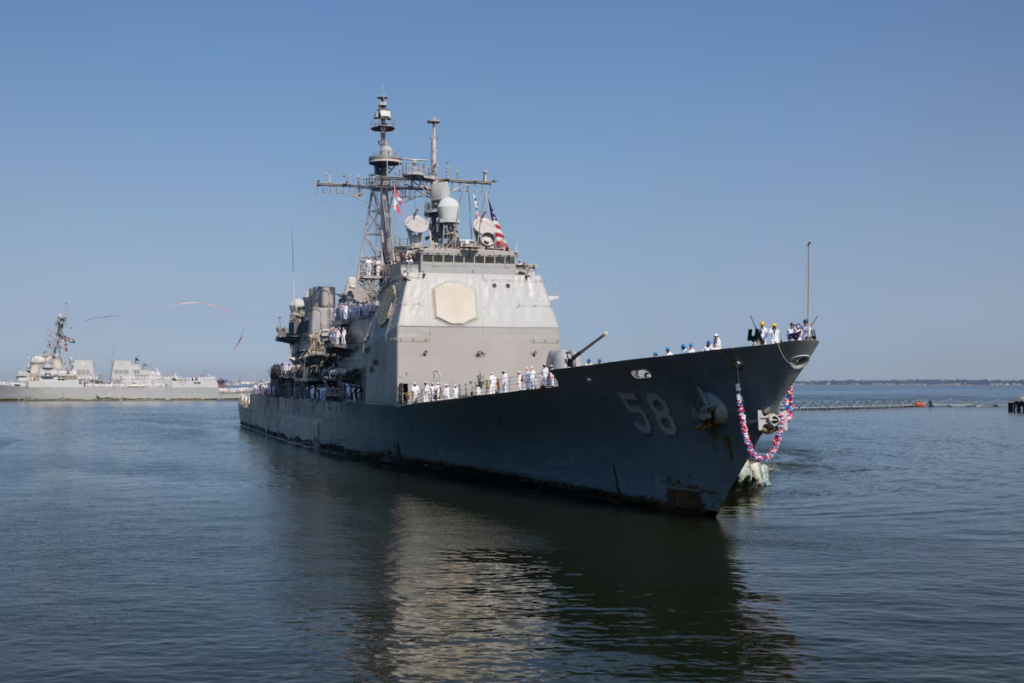
USS Philippine Sea Returns Home from Red Sea Deployment
Caption: NORFOLK, Va. (July 14, 2024) – The Ticonderoga-class guided-missile cruiser USS Philippine Sea (CG 58) returns to Naval Station Norfolk, July 14, 2024, concluding a nine-month deployment to the Atlantic. (U.S. Navy Photo by MC2 Grace V. Lyles)
From Commander, Surface Force Atlantic, 14 July 2024
NORFOLK, Va. (July 14, 2024) – The Ticonderoga-class guided-missile cruiser USS Philippine Sea (CG 58) returns to Naval Station Norfolk, July 14, 2024, concluding a nine-month deployment to the Atlantic. Eisenhower, the flagship of the Ike Carrier Strike Group, departed Norfolk October 14, 2023 to conduct a scheduled deployment to U.S. 5th and 6th Fleet area of operations in support of maritime security operations, theater security cooperation efforts, and enhanced vigilance activities operations with NATO Allies and Partners. (U.S. Navy Photo/Video by Mass Communication Specialist 2nd Class Grace V. Lyles)
The Ticonderoga-class guided-missile cruiser USS Philippine Sea (CG 58) returned to Naval Station Norfolk after a nine-month deployment as part of the Dwight D. Eisenhower Carrier Strike Group (IKECSG), July 14, 2024.
During deployment, Philippine Sea worked with coalition partners to defend merchant shipping and traffic in the U.S. 5th and 6th Fleet areas of operations. Philippine Sea led the strike group’s air defense for IKECSG, assisting in strike missions alongside coalition partners and launching Tomahawk Land Attack Missiles in response to Iranian-backed Houthi aggression threatening innocent merchant shipping.
“When the crew first departed Norfolk they did not expect to be here for this long,” said Capt. Steven Liberty, commanding officer of Philippine Sea. “However, the crew showed great resiliency, adapting and reengaging the challenges we faced this deployment. I could not be more proud of the crew.”
Philippine Sea provided aid to allies, partners and civilian mariners, supporting IKECSG’s successful escort of nearly 30 merchant vessels through the Strait of Hormuz, Gulf of Oman and Aden, Bab al-Mandeb Strait, and the Red Sea. Philippine Sea and embarked Helicopter Maritime Strike Squadron (HSM) 74 aided the M/V Verbena after it was attacked by Iranian-backed Houthis in the Red Sea. HSM-74 evacuated a civilian mariner requiring medical assistance to a partner vessel. Only days later, Philippine Sea demonstrated courage and exceptional seamanship when they rendered aid to the M/V Tutor after another Houthi attack damage and sunk the ship. Philippine Sea rescued yet another civilian mariner from the M/V Tutor, and subsequently transported him to IKE for medical care.
“Before the start of deployment I did not think that we would be able to put our training to the test to this extent.” said Ens. Luke Baca, a first-tour division officer. “Knowing that my division and I performed at the highest levels brings me great joy and pride.”
After 275 days at sea, Philippine Sea returned to homeport, greeted by their friends and families on the pier. USS Philippine Sea departed Norfolk, Virginia for a scheduled deployment on Oct. 14.
The IKECSG is commanded by Carrier Strike Group 2 and comprised of flagship aircraft carrier USS Dwight D. Eisenhower (CVN 69), guided-missile cruiser USS Philippine Sea (CG 58), guided-missile destroyers USS Mason (DDG 87) and USS Gravely (DDG 107) of Destroyer Squadron (DESRON) 22, Carrier Air Wing (CVW) 3, and the Information Warfare Commander.
Squadrons of CVW 3 include the “Gunslingers” of Strike Fighter Squadron (VFA) 105, the “Fighting Swordsmen” of Strike Fighter Squadron (VFA) 32, the “Rampagers” of Strike Fighter Squadron (VFA) 83, the “Wildcats” of Strike Fighter Squadron (VFA) 131, the “Screwtops” of Carrier Airborne Early Warning Squadron (VAW) 123, the “Zappers” of Electronic Attack Squadron (VAQ) 130, the “Dusty Dogs” of Helicopter Sea Combat Squadron (HSC) 7, the “Swamp Foxes” of Helicopter Maritime Strike Squadron (HSM) 74 and the “Rawhides” of Fleet Logistics Support Squadron (VRC) 40.
New Contract Award to Help Train Fleet to Counter Electronic Warfare
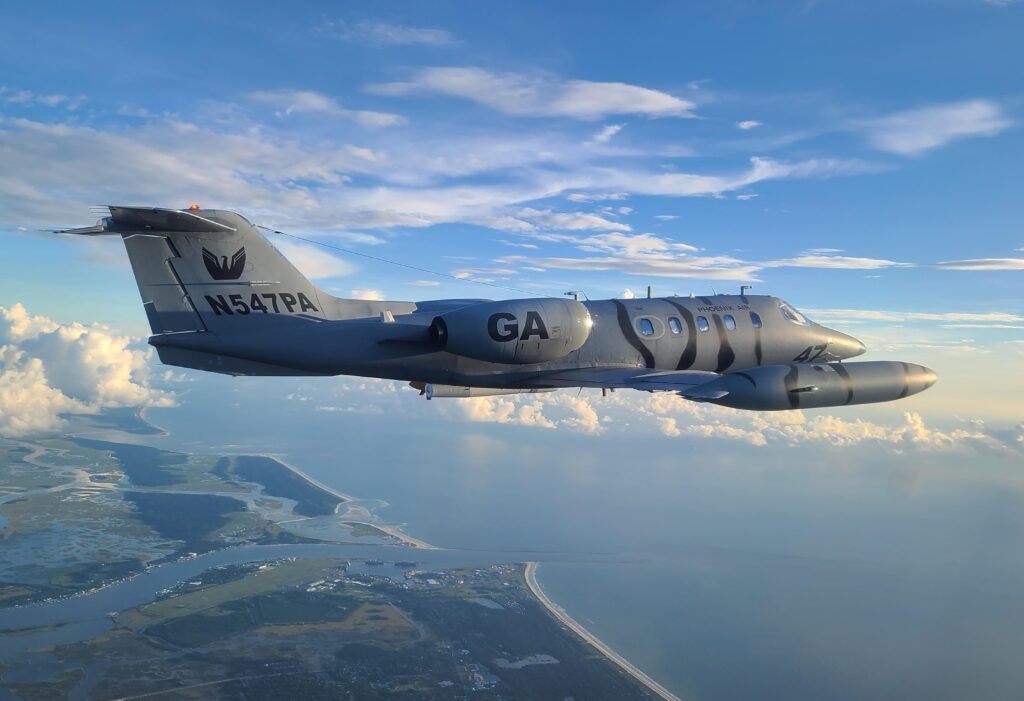
The U.S. Navy awarded the Phoenix Air Group Inc. a contract for Contracted Air Services to simulate airborne electronic warfare threats to help train shipboard personnel and squadrons. The contract includes use of 10 contractor-owned and operated aircraft, such as the Learjet 36 (pictured). (Photo courtesy of Phoenix Air Group Inc.)
Jul 18, 2024
NAVAL AIR SYSTEMS COMMAND, PATUXENT RIVER, Md. — The U.S. Navy awarded the Phoenix Air Group Inc. a $165 million contract June 28 for Contracted Air Services (CAS) flight hours to simulate a variety of airborne electronic warfare (EW) threats to train, test and evaluate shipboard personnel and aircraft squadron weapon systems operators and aircrew.
“Fleet training against airborne electronic attack forces is a priority and a critical path to achieving electromagnetic spectrum superiority,” said Capt. Greg Sutton, Adversary and Specialized Aircraft Program Office (PMA-226) Program Manager. “The CAS EW jet services contract provides an ability to simulate both the threat and overall spectrum density of the current and future high-end fight of which is essential to effective aircrew training.”
The contract includes use of 10 contractor-owned and operated aircraft that can support up to 5,000 flight hours of EW jet capabilities per year for fleet scheduling on the East and West Coasts. They can be used in a variety of venues, from basic “schoolhouse” air intercept control training, large multinational exercises, and small, single unit training exercises, including target/banner tow missions supporting the Navy, Department of Defense (DOD) and non-DOD agencies.
“CAS affordably fills critical and mandatory training requirements, mitigating readiness gaps and capability divestments,” said PMA-226 CAS EW Integrated Product Team Lead Matt Rhodes. “It provides fleet air defense training to include evaluation of evolving threats via uniquely modified aircraft configured as required to simulate Fleet Forces Command identified hostile EW near peer threats for air-to-air and air-to-surface training events.”
The EW jets contract is a firm-fixed-price, indefinite-delivery/indefinite-quantity contract with work scheduled to begin this August and completed in August 2029.
RTX’s Raytheon Demonstrates SM-6 integration with LTAMDS and IBCS
July 18, 2024
Army and Navy programs combine to defeat complex threat
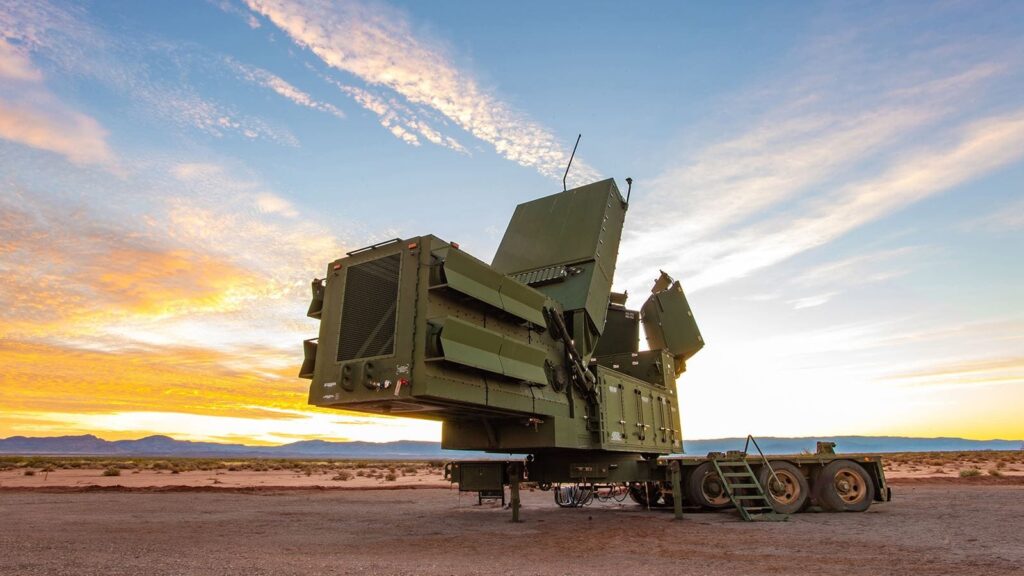
PEARL HARBOR, Hawaii, July 18, 2024 /PRNewswire/ — At Valiant Shield 24, Raytheon, an RTX business, demonstrated a simulated complex missile engagement leveraging the U.S. Army’s Lower Tier Air and Missile Defense Sensor, or LTAMDS, and Integrated Air and Missile Defense Battle Command System, IBCS, launching the U.S. Navy’s premier, long-range effector, Standard Missile-6 (SM-6).
Using track data from Army LTAMDS simulators and operational SM-6 engagement control software interfaced with IBCS, the test demonstrated the successful integration of these existing, respective Army and Navy program capabilities. This proves the feasibility of SM-6 as an additional effector within the Army IAMD architecture including IBCS and LTAMDS. The experiment, which used a combination of physical systems’ hardware and simulation, demonstrated the effective detection and identification of an in-coming threat, target and track data transfer, launch command, and the successful guide to missile intercept.
“The successful test confirms a viable option for INDOPACOM by demonstrating SM-6 integrated with IBCS and LTAMDS,” said Tom Laliberty, president of Land & Air Defense Systems at Raytheon. “LTAMDS matched with SM-6 adds an exceptional capability to defeat increasingly diverse and complex threats with a multi-mission missile that flies as far as the radar can see – providing for long range Army and Joint integrated air and missile defense.”
Valiant Shield is a bi-annual exercise that brings allies and partners together to develop, test and train in a relevant and realistic environment. Government and industry bring technologies, designs and solutions with the common goal to increase the joint-combined force’s ability to plan, communicate and conduct complex, multi-domain operations throughout the Indo-Pacific.
July 18 U.S. Central Command Update
From U.S. Central Command, July 18,2024
TAMPA, Fla. – In the past 24 hours, U.S. Central Command (USCENTCOM) forces successfully destroyed two surface-to-air missiles (SAM) and four uncrewed aerial vehicles (UAV) on the ground in Houthi-controlled areas of Yemen.
It was determined these weapons presented an imminent threat to U.S., coalition forces, and merchant vessels in the region. These actions were taken to protect freedom of navigation and make international waters safer and more secure.
Pearl Harbor Naval Shipyard and Intermediate Maintenance Facility Welcomes ASC Personnel
Twenty-eight ASC [formerly known as the Australian Submarine Corporation] personnel pose for a photo at Pearl Harbor Naval Shipyard and Intermediate Maintenance Facility (PHNSY & IMF), Joint Base Pearl Harbor-Hickam, Hawaii, July 16, 2024. The team is part of the Australia, United Kingdom and United States (AUKUS) enhanced trilateral security partnership. (Photo by Claudia LaMantia)
By PHNSY & IMF and AUKUS I&A Public Affairs, July 19, 2024
PEARL HARBOR, Hawaii – Twenty-eight ASC Pty Ltd [formerly known as the Australian Submarine Corporation] personnel began training at Pearl Harbor Naval Shipyard and Intermediate Maintenance Facility (PHNSY & IMF) in Pearl Harbor, Hawaii, as part of the Australia, United Kingdom and United States (AUKUS) enhanced trilateral security partnership this week.
The ASC employees will be trained and certified on various aspects of submarine maintenance to support the AUKUS Pillar 1 program that is supporting Australia’s acquisition of sovereign conventionally armed, nuclear-powered submarines.
“After months of preparation, we are excited to welcome the Australian maintainers into our shipyard family. The intensive training process they will undergo over the next few years will lay the groundwork for them to ultimately lead and execute their own maintenance operations,” said Capt. Ryan McCrillis, commanding officer of PHNSY & IMF.
In July 2023, PHNSY & IMF was chosen as the Naval Supervising Authority and Lead Maintenance Activity for Submarine Rotational Force – West (SRF-W) at HMAS Stirling in Western Australia. SRF-W will host up to four U.S. Virginia-class submarines and one UK Astute-class submarine, starting as early as 2027. Routine intermediate maintenance work, which does not require dry-docking the submarines and takes weeks – rather than months or years – to complete, will be planned and executed by ASC’s trained workforce and certified by PHNSY & IMF personnel.
“Conducting joint training and working side-by-side with our Australian colleagues is critical to building the essential knowledge needed to fully support SRF-W,” McCrillis added. “This training evolution, which focuses on technical maintenance skills, strengthens our own readiness, ensuring warfighters are equipped to carry out their complex mission.”
The first cohort of ASC personnel will receive a mix of classroom instruction and hands-on experience covering radiological controls, nuclear engineering, non-nuclear engineering and quality assurance. The training durations will vary based on the specific trades and disciplines being taught. Once they complete their training, the ASC personnel will return to Australia appropriately qualified and skilled to conduct Virginia-class maintenance, under U.S. supervision, during routine U.S. submarine port visits to HMAS Stirling. Australia and the United States expect more than 100 ASC personnel to start training at PHNSY & IMF over the next twelve months.
“We are ushering in a new era for our submarine maintenance workforce,” said Rear Adm. Matt Buckley, Head of Nuclear Submarine Capability within the Australian Submarine Agency. “By leveraging the U.S. and UK’s decades-long expertise, we are learning from the best to develop our own world-class sovereign nuclear-powered, conventionally armed submarine force. The 28 ASC personnel, combined with more than thirty Royal Australian Navy personnel who joined the crew of U.S. submarine tender USS Emory S. Land (AS 39) this year, represent the cornerstone of our future submarine force maintenance workforce.”
“The AUKUS partners share a commitment stretching back over a century to preserving democracy and maintaining an international rules-based order,” said Rear Adm. Lincoln Reifsteck, program manager, AUKUS Integration and Acquisition Office. “Thanks to bipartisan Congressional support last year to pass legislation allowing us to train Australian maintenance personnel in our public shipyards, we continue to make progress toward establishing Australia’s sovereign, conventionally-armed, nuclear-powered submarine force in support of our shared vision of a free, open, and stable Indo-Pacific.”
PHNSY & IMF is also hiring additional personnel to support training hundreds of Australian maintainers.
“The shipyard is growing, so we will continue to hire to meet the needs of our fleet while adding additional personnel to support the increased training demand,” said McCrillis. “Our efforts will not only support Australia’s goal to build a sovereign SSN capability, but also provide real benefits to the U.S. Navy mission in the Indo-Pacific.”
PHNSY & IMF is a field activity of NAVSEA and a one-stop regional maintenance center for the Navy’s surface ships and submarines. It is the largest industrial employer in the state of Hawai’i, with a combined civilian and military workforce of approximately 6,400. It is the most comprehensive fleet repair and maintenance facility between the U.S. West Coast and the Far East, strategically located in the heart of the Pacific, being about a week’s steaming time closer to potential regional contingencies in the Indo-Pacific.
The AUKUS Integration and Acquisition Program Office is responsible for executing the trilateral partnership to support Australia’s acquisition of sovereign, conventionally armed, nuclear-powered fast-attack submarines at the earliest possible date while setting the highest nuclear stewardship standards and continuing to maintain the highest nonproliferation standard. The AUKUS partnership is a strategic endeavor that will uplift the industrial bases of the three partners and promote a safe, free and open Indo-Pacific, ensuring an international, rules-based order is upheld in the region.
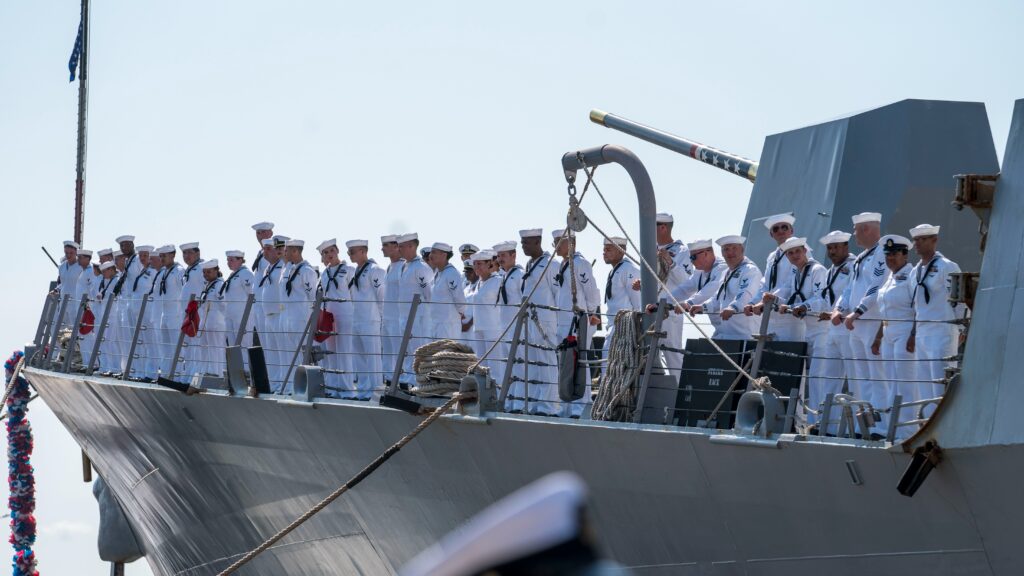
Sailors assigned to the Arleigh Burke-class guided-missile destroyer USS Gravely (DDG 107) man the rails as Gravely returns to Naval Station Norfolk, July 14, 2024, concluding a nine-month deployment to the Atlantic. (U.S. Navy photo by MC2 Anderson W. Branch)
From U.S. Naval Surface Force Atlantic, 14 July 2024
NORFOLK, Va – The Arleigh Burke-class guided-missile destroyer USS Gravely (DDG 107) returned to Naval Station Norfolk, Virginia, July 14, following a nine-month deployment to the U.S. 5th and 6th Fleet areas of operation as part of the Dwight D. Eisenhower Carrier Strike Group (IKECSG).
As a unit attached to IKESCG, Gravely played a pivotal role providing air defense for the strike group, conducting defensive strikes into Houthi-controlled areas of Yemen, and escorting shipping through the Bab al-Mandab Strait. Since December 2023, IKECSG spearheaded Operation Prosperity Guardian, defending against Houthi attacks on shipping in the Red Sea and Gulf of Aden and supporting freedom of navigation and maritime stability in the region.
“Throughout our time in theater, our purpose was to be a ready asset for IKECSG,” said Cmdr. Brian Sánchez, commanding officer of USS Gravely. “The Sailors on Gravely defended mariners, strike group units, and allies and partners in the region, while engaging threats when required. On numerous occasions, our Sailors fulfilled their duty knowing exactly what needed to be done when it mattered the most. They provided support for innocent merchant shipping vessels. I could not be more proud of our Sailors and what they’ve accomplished this deployment.”
Gravely left Norfolk, Virginia on October 13, 2023 for a scheduled deployment. As part of the IKECSG, Gravely was extended twice, to complete the nine-month deployment.
The IKECSG is commanded by Carrier Strike Group 2 and comprised of flagship aircraft carrier USS Dwight D. Eisenhower (CVN 69), guided-missile cruiser USS Philippine Sea (CG 58), guided-missile destroyers USS Mason (DDG 87) and USS Gravely (DDG 107) of Destroyer Squadron (DESRON) 22, Carrier Air Wing (CVW) 3, and the Information Warfare Commander.
Squadrons of CVW 3 include the “Gunslingers” of Strike Fighter Squadron (VFA) 105, the “Fighting Swordsmen” of Strike Fighter Squadron (VFA) 32, the “Rampagers” of Strike Fighter Squadron (VFA) 83, the “Wildcats” of Strike Fighter Squadron (VFA) 131, the “Screwtops” of Carrier Airborne Early Warning Squadron (VAW) 123, the “Zappers” of Electronic Attack Squadron (VAQ) 130, the “Dusty Dogs” of Helicopter Sea Combat Squadron (HSC) 7, the “Swamp Foxes” of Helicopter Maritime Strike Squadron (HSM) 74 and the “Rawhides” of Fleet Logistics Support Squadron (VRC) 40.
Chief of Naval Operations Hosts Futures Game at U.S. Naval War College
From CNO Public Affairs, July 18, 2024
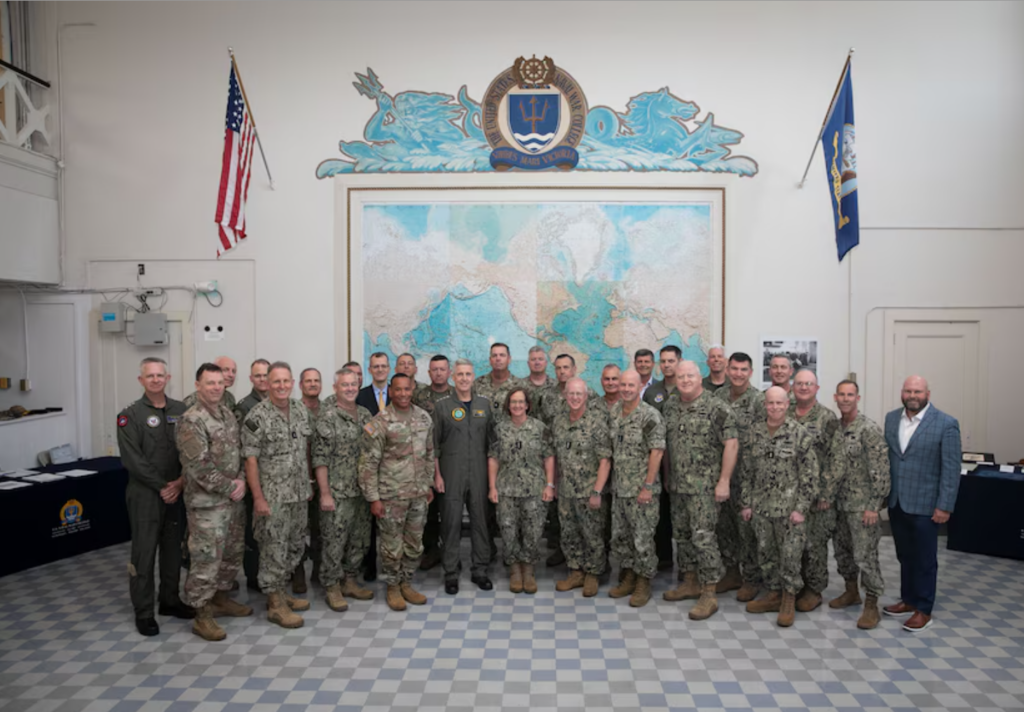
Newport, R.I. — Chief of Naval Operations (CNO) Adm. Lisa Franchetti hosted the CNO Futures Game at the U.S. Naval War College in Newport, Rhode Island, July 16-17.
Franchetti emphasized the need for leaders across the Joint Force to think, act, and operate differently, and seek ways to integrate conventional capability with hybrid, unmanned, and disruptive technologies, because tomorrow’s battlefield will be incredibly challenging and complex.
“It is our duty to plan for the future and ensure our Fleet is always ready to preserve the peace, respond in crisis, and win decisively in war,” said Franchetti. “The Navy is never going to fight alone. We will work hand-in-hand with our Joint teammates and Allies and partners. To that end, I challenge you to have an open mind and think about the capabilities, people, and broader warfighting ecosystem across the Joint Force that we’re going to need to effectively carry out our missions.”
Futures Game is organized by the Deputy Chief of Naval Operations for Warfighting Development Vice Adm. Dan Dwyer.
“The Navy uses events like the CNO Futures Game as part of our ongoing analytic efforts to shape and inform naval strategy, analysis, operational concepts, and warfighting requirements,” said Dwyer. “By examining potential future states, we can characterize the operational problems the Navy will face today and tomorrow as well as what roles the Navy may be asked to perform in support of our national security. Events like the CNO Futures Game support this process and allow us to better characterize future challenges.”
Robust wargaming and analysis underpin Navy efforts by providing analytic rigor and a comprehensive examination of strategic and operational concepts to support CNO decision making on the most consequential issues facing the Navy.
“We know our enduring functions: sea control, power projection, deterrence, maritime security, and sealift, but it is our ability to test alternative concepts, reinvigorate analysis, and explore future force structure options that will enable us to field a force capable of responding to all threats–anywhere and anytime,” said Franchetti.
As a critical component of the Navy’s Analytic Master Plan (AMP), the U.S. Naval War College (NWC) is designated by the CNO as the Navy’s pillar lead for wargaming. NWC spearheads efforts to integrate all research activities within the naval wargaming enterprise and facilitates the promulgation and integration of research findings across the naval analytic community.
Wargaming has been integral to NWC since 1887. While the tools and technology used in simulations have evolved over the past century, the value of wargaming in maritime leadership development remains strong. Today, NWC conducts more than 50 gaming events per year, ranging in variety from complex, multi-sided computer-assisted games to simple, single-sided seminar games. This was Franchetti’s first time hosting the Futures Game as CNO. She hosted the Futures Game in 2023 as Vice Chief of Naval Operations.
SENEDIA and the Undersea Technology Innovation Consortium Forge Partnership with Defense Teaming Centre in Australia
Defense Industry Organizations Sharing Commitment to Building Workforce and Expanding Capabilities Through AUKUS
MIDDLETOWN, R.I. – SENEDIA, the Alliance for Defense Tech, Talent, and Innovation, and the Undersea Technology Innovation Consortium (UTIC) have entered a partnership with the Defence Teaming Centre (DTC) in Adelaide, South Australia. The partnership is the result of a shared, deep commitment to the AUKUS (Australia, United Kingdom, United States) agreement aimed at promoting a free and open Indo-Pacific.
As partners, SENEDIA, UTIC, and DTC will share insights on their respective efforts related to workforce development, small business assistance, supply chain development, and advanced research and commercialization. SENEDIA and UTIC will make some of their networking and education opportunities available to DTC members.
“The historic agreement made through AUKUS lays the foundation for the most significant integration of our undersea and military capabilities ever achieved between the United States, Australia, and the U.K,” said U.S. Senator Jack Reed (RI), Chairman of the Senate Armed Services Committee. “For this partnership to protect global security, improve the capabilities of our allies, and ensure effective collaboration across nations, we need these points of connection at every level of the defense ecosystem, including our industry leaders.”
“This new collaboration will deepen southern New England’s leadership in executing the historic AUKUS security agreement. SENEDIA’s support for job training and supply chain development perfectly fits the urgent requirements for Australia to uplift their submarine industrial base. Programs like eastern Connecticut’s Manufacturing Pipeline Initiative, which SENEDIA helps fund, is a great example of how the US can strengthen Australia’s maritime economy,” said Rep Joe Courtney, Ranking Member of the House Seapower Subcommittee and Co-Chair of the Congressional AUKUS Working Group.
“Individually and together, our organizations are focused on supporting our collective submarine shipbuilding and undersea technology ecosystems, including closing the gaps in human capital, cyber resiliency, and modernization of defense manufacturing capacity,” said Molly Donohue Magee, Chief Executive Officer of SENEDIA and UTIC. “DTC is as trusted a partner and leader in Australia as SENEDIA and UTIC are to our members in the United States, so we look forward to finding ways to work together to build the global industry workforce and expand capabilities across both nations.”
Like SENEDIA and UTIC, the Defence Teaming Centre is an industry association focused on supporting and growing the defense sector. Based in Adelaide, South Australia, Australia’s ‘defense state’, DTC brings together prime contractors, small and medium sized enterprises, academia, and professional service providers to collaborate for defense market opportunities and to meet Australia’s defense needs. Seven of out ten of the world’s leading defense businesses have a presence in Adelaide.
“The Australian defense sector is rapidly evolving to help our nation capitalize on the opportunities presented by AUKUS and to meet our obligations as a strategic partner,” said Libby Day, CEO of the Defence Teaming Centre. “Our alliance with SENEDIA and UTIC will facilitate shared knowledge and innovation and introduce efficiencies that we can leverage to ensure the safety of our nations and the health of our industries.”