HII’s Newport News Shipbuilding Completes Contracted Work at Naval Nuclear Laboratory’s Kenneth A. Kesselring Site
NEWPORT NEWS, Va., July 18, 2024 (GLOBE NEWSWIRE) — HII (NYSE: HII) announced today that its Newport News Shipbuilding (NNS) division has completed contracted work at the Naval Nuclear Laboratory’s Kenneth A. Kesselring Site in West Milton, New York.
Since 2012, NNS provided maintenance services and led the refueling overhaul of a nuclear reactor prototype at the Kesselring site, a research and development facility that supports the U.S. Navy’s Naval Nuclear Propulsion Program.
“With the completion of our work, Kesselring is positioned to continue to train nuclear operators for decades to come,” explained Mary Cullen, NNS vice president of nuclear propulsion. “We are proud of our legacy supporting the Navy’s Naval Nuclear Propulsion Program. I want to thank the thousands of NNS shipbuilders who touched this project over the years. Their dedication and commitment to excellence is unmatched.”
NNS is the nation’s sole designer, builder and refueler of nuclear-powered aircraft carriers and one of only two shipyards capable of designing and building nuclear-powered submarines for the U.S. Navy.
Coast Guard Cutter Valiant returns home after 49-day deployment in the Florida Straits and Windward Passage
(U.S. Coast Guard courtesy photo)
July 17, 2024
NAVAL STATION MAYPORT, Fla. — Coast Guard Cutter Valiant (WMEC 621) and its crew returned to their homeport at Naval Station Mayport, June 28, following a 49-day migrant interdiction operations patrol in the Florida Straits and Windward Passage.
Valiant’s crew deployed in support of Homeland Security Task Force – Southeast (HSTF-SE) and Operation Vigilant Sentry (OVS) while underway in the Seventh Coast Guard District’s area of operations. Throughout the patrol, the crew of Valiant conducted maritime safety and security missions to protect life at sea and enforce U.S. maritime law.
While at sea in the Florida Straits, crew members rescued eight Cuban migrants from a makeshift vessel that was transiting northward toward the Florida Keys, attempting to reach the United States unlawfully by sea.
Valiant’s crew also patrolled off coastal Haiti to deter illegal and dangerous maritime migration from the region. While underway in the Windward Passage, Valiant’s crew interdicted two unsafe migrant vessels north of Haiti. These interdictions resulted in the collective rescue of 197 Haitian migrants who were adrift at sea, including three Haitian migrants who were retrieved from the water by crew members after they had fallen overboard due to their vessel being grossly overloaded.
While on patrol near Dominican Republic waters, Valiant located a 20-foot wooden vessel with no lights or safety equipment and 15 migrants on board. After intercepting the vessel, Valiant’s crew transferred the migrants to a Dominican Republic Navy vessel for repatriation to their country of origin. This action led to the successful rescue of the migrants and reinforced the U.S. Coast Guard’s continued ability to interoperate with our partner nations in the region.
“This patrol was extremely busy, and the crew is proud that we were able to save over 200 people in unseaworthy vessels,” said Ensign John Vaaler, a law enforcement officer aboard Valiant. “The vessels we interdicted were not carrying essential lifesaving equipment adequate for the many people on board. I am very glad we found them when we did, or people may have been lost at sea.”
Later in the patrol, Valiant intercepted a go-fast, drug-smuggling vessel in the Windward Passage. This action disrupted the vessel’s voyage and forced the suspected drug traffickers to jettison their contraband to the sea, preventing harmful narcotics from reaching American shores.
Valiant is a multi-mission 210-foot, Reliance-class medium-endurance cutter. Its primary missions include search and rescue, maritime law enforcement, marine environmental protection, homeland security and national defense operations.
For information on how to join the U.S. Coast Guard, visit www.GoCoastGuard.com to learn more about active duty and reserve, officer and enlisted opportunities. Information on how to apply to the U.S. Coast Guard Academy can be found here.
Navy, DOD Leaders Discuss Space Capabilities During Second Naval Space Summit at NPS
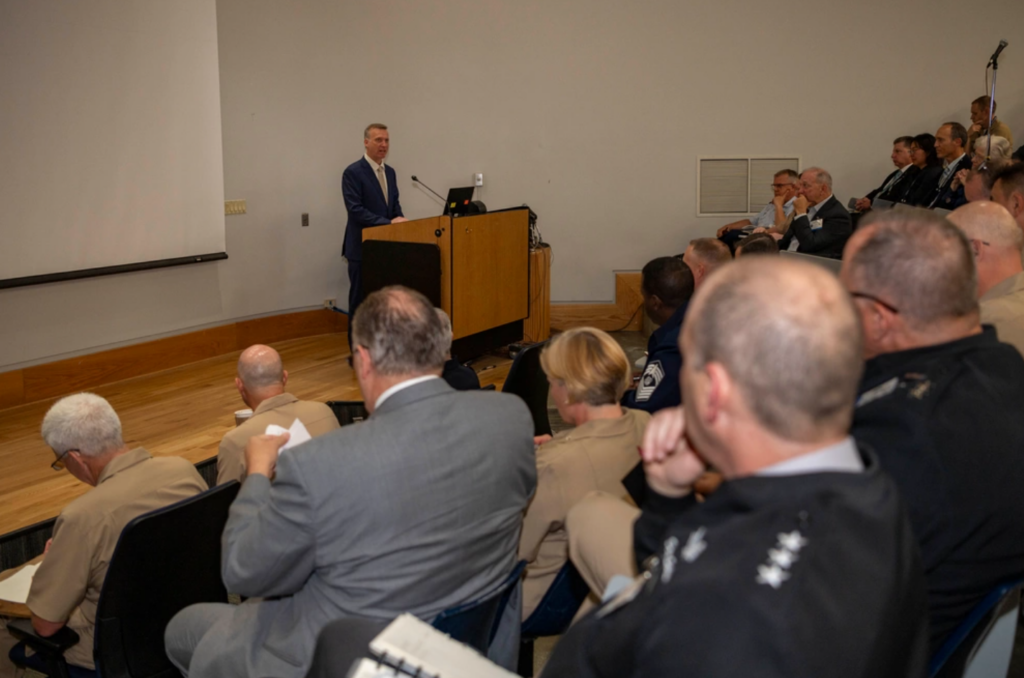
MONTEREY, Calif. (July 10, 2024) Under Secretary of the Navy Erik Raven offers his opening remarks during Day 2 of the second annual Naval Space Summit at the Naval Postgraduate School (NPS). (U.S. Navy photo by MC1 Leonard Weston)
MONTEREY, Calif. — Recognizing the importance of a rapidly evolving space domain to U.S. national defense, key leaders from the U.S. Navy, Marine Corps and Department of Defense gathered at the Naval Postgraduate School (NPS) for the second annual Naval Space Summit, July 9-11.
The summit, sponsored by the Secretary of the Navy and organized by the office of the Deputy Chief of Naval Operations for Information Warfare (N2N6), provides an essential venue for top DOD and Department of the Navy officials to discuss the state of space operations and capabilities within the services, as well as the latest issues and opportunities in the space domain.
Under Secretary of the Navy Erik Raven, who represented Secretary of the Navy Carlos Del Toro at the summit, reminded attendees of the similarities between the maritime domain and the space domain, as well as their importance to our nation’s history.
“The sea has left an indelible mark on history and character of our nation. For nearly 249 years, our nation has relied on the grit, tenacity, and courage of our Sailors and Marines,” said Raven. “Just as the oceans have shaped the last quarter-millennium of our nation, space will shape our future – for centuries to come.”
Vice Chief of Naval Operations Adm. James Kilby, himself an NPS graduate, acknowledged NPS’ crucial, longstanding role in space systems education, operations and engineering through the school’s Space Systems Academic Group (SSAG).
“No other venue brings together the fleet and expertise with our SPACECOM joint partners to address warfighting issues in the space domain at the most senior levels of Department of the Navy and DOD,” said Kilby. “Advancing the state of the art in space-based capability is fundamental to advancing our maritime advantage. This also requires a deep bench of talented naval leaders who understand the technologies and can develop new concepts of operations for how we fight – this is happening at NPS.”
The first Naval Space Summit in 2023 was convened by Del Toro at NPS with the goal of assessing the needs, challenges and opportunities of future maritime operations in the space domain.
For this year’s event, Raven and other senior leaders not only expanded on those themes, but also centered their discussions around strengthening U.S. warfighting capabilities in the space domain. Dialogue focused on the development of space capabilities as force multipliers, as well as the increasing demand for military and commercial space capabilities to support naval operations.
As with the inaugural event, the 2024 Naval Space Summit featured classified briefs and discussions involving DOD’s top space stakeholders, with the intent of giving attendees the opportunity to share information, make connections and continue the dialogue begun the previous year.
“Our goal this year is to build on last year’s discussions (of current military space capabilities and operations and NPS space-based research) and continue on the path to align our efforts on how we plan to fight in this critical domain,” said Vice Adm. Karl Thomas, Deputy Chief of Naval Operations for Information Warfare and Director of Naval Intelligence, during his opening address on July 9.
In addition to Raven, Kilby and Thomas, senior Navy and Marine Corps leaders who came to NPS included Vice Adm. Craig Clapperton, commander of Fleet Cyber Command, Navy Space Command and U.S. Tenth Fleet; Marine Corps Lt. Gen. Brian Cavanaugh, commanding general of Fleet Marine Force, Atlantic and Marine Forces Command; and Vice Adm. Blake Converse, deputy commander of U.S. Pacific Fleet.
Among the senior DOD and U.S. government officials attending were U.S. Space Force Gen. Stephen Whiting, commander of U.S. Space Command (SPACECOM); Space Force Lt. Gen. Douglas Schiess, commander of U.S. Space Forces-Space; U.S. Air Force Maj. Gen. Steve Butow, military deputy and director of the space portfolio at the Defense Innovation Unit (DIU); and Mr. Bale Dalton, NASA Chief of Staff.
Raven, Whiting, Schiess, Butow and Dalton presented keynote addresses during the course of the summit, while Schiess, Cavanaugh and Converse participated in a flag and general officer panel – moderated by Thomas – to discuss dependencies of warfighting on the space domain.
The majority of the other briefs during the Naval Space Summit’s agenda were presented by senior DOD and DON representatives, as well as subject matter experts from other U.S. government agencies.
As the host of the Naval Space Summit, NPS – and in particular SSAG – provided substantial contributions to the summit’s agenda, ranging from student research presentations during the opening session in King Hall Auditorium to student showcase events later in the week.
“Bringing the Naval Space Summit back to NPS reinforces the importance of our institution as a center of space education, research and innovation for the Navy and Marine Corps,” said retired Vice Adm. Ann Rondeau, President of NPS.
Rondeau, NPS Acting Provost Dr. Jim Newman and SSAG Acting Chair Dr. Wenschel Lan all spoke during the opening session, which saw presentations by three NPS students – Marine Corps Maj. Dillon Pierce and Navy Lt. Chuck Bibbs and Lt. Conor Murtha.
“The underlying message of the Naval Space Summit aligns closely with the lessons from NPS’ space policy and space strategy courses,” said Bibbs, who graduated from NPS in December 2023 with dual master’s degrees before returning to support the school’s Space Systems research efforts. “Both emphasize the need for military and commercial partners to develop solutions proactively to address imminent space challenges posed by adversaries.
“NPS serves as the perfect venue for these crucial conversations, offering junior and mid-level officers the opportunity to listen to general and flag officers and familiarize themselves with these challenges early in their careers, and for them to hear our ideas. I was grateful for the opportunity to share my story and research with these senior leaders.”
Among the NPS students attending sessions throughout the week were Navy and Marine Corps officers who had been designated as Maritime Space Officers – individuals with space expertise who will directly support Navy and Marine Corps activities in key space-oriented billets.
Students from SSAG also had the opportunity to provide updates on their own space-based research during a showcase event and poster session, and a separate Emerging Tech Showcase gave summit participants a chance to learn more from industry partners who have signed Cooperative Research and Development Agreements (CRADAs) with NPS to support relevant research efforts.
“Having the Naval Space Summit at NPS was a great opportunity for our students,” Lan said. “Not only were they able to hear from our naval and joint space leaders and engage with them firsthand, the meaningful discussions have already enhanced course lectures and spurred future thesis research ideas.”
The participation of non-Navy agencies in the Naval Space Summit, including NASA and the Space Force, served as a reminder that space operations are truly a joint effort – something which Lan believes is also reflected in NPS and its mission.
“Our student population doesn’t just include naval officers – we have officers from the other armed forces as well as our foreign partner nations, which we recognize as an incredible value as the space domain evolves,” she added. “Through the interdisciplinary nature of the Space Systems curricula at NPS, we strive to educate our students so that they can contribute towards solving real-world operational problems.”
According to Thomas, the Naval Space Summit resulted in greater information sharing and an increase in dialogue between the services – and considerable enthusiasm to continue that dialogue again next year.
“This was a busy three days of open and frank discussions on current and future issues of critical importance to the naval space mission and the future fight,” Thomas said. “Additionally, many new working relationships were established and connections made – these relationships will ensure this important work and focus continues.”
– Learn more about the Space Summit agenda and advanced space education at NPS: https://nps.edu/web/ssag
Parsons Offers Counter-UAS Technology to Protect Marine Corps Installations
ARLINGTON, Va. — The U.S. Marine Corps is seeking counter-unmanned aerial systems technology to protect its installations. One of the companies bidding to be the provider is Parsons, in partnership with Rafael Systems Global Sustainment LLC (RSGS).
Counter-Unmanned Aerial Systems (CUAS) is a sector of defense technology that has been of increasing focus over the last decade and has become even more to with the extensive use of UAS in the Ukraine War, the Israel-Hamas War, and the Houthi drone attacks against naval and commercial shipping in the Red Sea.
The need to provide force protection extends not only to deployed forces but to their installations.
The Marine Corps solicited proposals for “installation counter-small UAS,” said Christopher Hamilton, vice president for innovative technology solutions at Parsons, in an interview with Seapower. “They’re looking to protect Marine Corps facilities and infrastructure around the world from the small UAS threat, primarily Group 1and Group 2 UAS, but some Group 3 potentially as well. That’s the lower half of the UAS spectrum, but those drones, as we’ve seen, can do quite a bit of damage if configured in the right way and with explosives, or just wreak havoc in terms of security responses to drones, as we’ve seen with sporting events over the past year or so.”
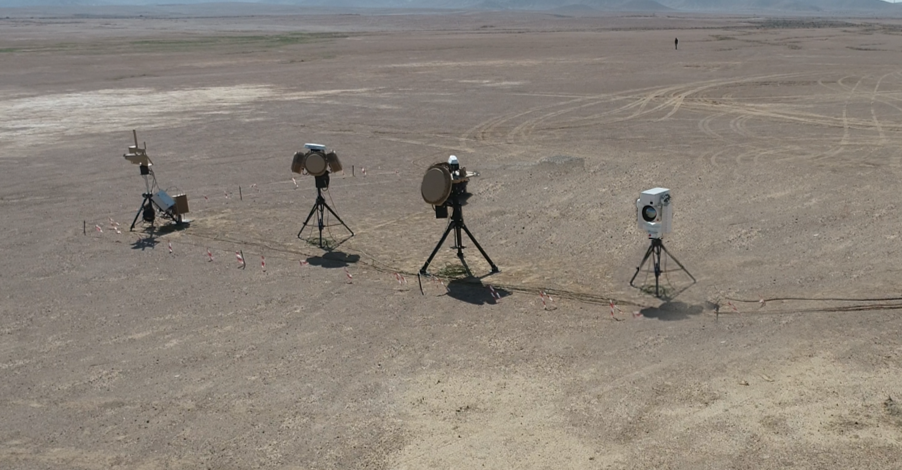
Parsons, in its proposal, is the prime solutions provider, delivering overall program management, sustainment, and systems integration, while RSGS is providing the Rafael Drone Dome System, a Parsons spokesman said.
The Marine Corps requirement is focused on its permanent installations in the United States and overseas, Hamilton said, noting that Parsons has “years and years of experience of developing, integrating, and deploying critical infrastructure protection systems, and over the past few years, CUAS has become really the most critical of those infrastructure protection components.
He said the Marine Corps requirement for infrastructure protection played to the strengths of Parsons, which has been “deploying CUAS systems for other clients around the world to do very similar functions.”
Parsons’ analysis of the Marine Corps requirement came down to providing two capabilities: the most effective system and the most available system — 100% of the time.
The Drone Dome system would be tailored specifically for the Marine Corps. Hamilton said it was the most battle-proven system and has been deployed in several different theaters with great success in defeating threats.
In addition, Hamilton said that Parsons “has the knowledge and experience to manage a global logistics enterprise, where you’re looking to maintain near 100% availability of systems. We do that today.”
The Drone Dome system includes a command-and-control system, RF sensors, radars, and kinetic and non-kinetic effectors that are options. The Marine Corps requires a modular open systems approach to allow the system to adapt to evolving threats. It will make maximum use of artificial intelligence.
“It’s clear that the Marine Corps wants a system that evolves over time,” Hamilton said.
Parsons, based in Chantilly, Virginia, has a center of excellence for CUAS at Summit Point, West Virginia, where it assesses CUAS threats.
Parsons delivered its proposal to the Marine Corps in April. A single contract award in the competition is expected this summer. The program is to have a duration of at least 10 years.
U.S. Navy Embarks Expeditionary Medical Unit Aboard USNS Cody for Test and Evaluation
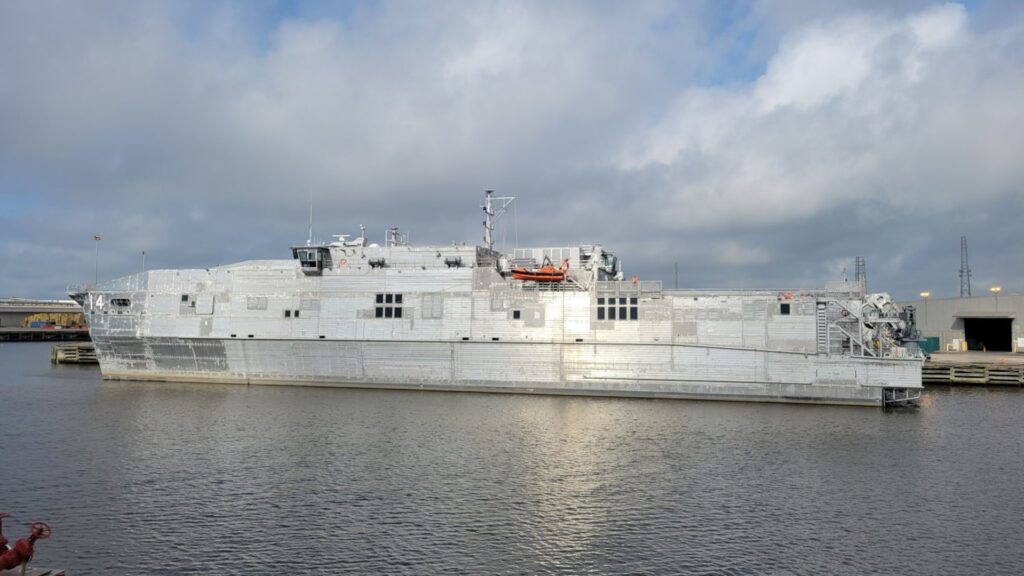
MOBILE, Alabama (May 2, 2024) USNS Cody (T-EPF 14) moored pier side in the harbor at Austal USA’s shipyard in Mobile, Alabama.
By Program Executive Office Unmanned and Small Combatants (PEO USC) Public Affairs, July 16, 2024
WASHINGTON, D.C. – The U.S. Navy is embarking the first Expeditionary Medical Unit (EMU), a cutting-edge medical support system with personnel from EMU-1 designed to provide Role 2 (R2) level healthcare services both afloat and ashore, aboard the expeditionary fast transport USNS Cody (T-EPF 14) at Joint Expeditionary Base Little Creek-Fort Story, July 15-26. EMUs will enhance medical support in various military and humanitarian missions, ensuring comprehensive care from the sea to the shore.
EMUs extend the Navy’s R2 care capabilities currently aboard amphibious assault ships and aircraft carriers to smaller ships and vessels. It offers a broad spectrum of medical and healthcare services such as biomedical repair, command and control, information technology, sterile supply, medical operations, and patient decontamination provided by medical support personnel.
“The mission of the EMU is to deliver R2 healthcare services with versatile surgeries, intensive care unit, acute care ward, radiology, pharmacy, laboratory, dental service, and combat operational stress control,” said Capt. Jonathan Haase, program manager of the Expeditionary Missions program office. “EMUs are strategically equipped to receive patients from afloat platforms, directly from combat areas to provide patient holding, patient movement, and prolonged field care, based on injury severity and EMU’s specific mission for the Navy.”
As an embarked mission, EMUs are designed to be moveable and transportable, allowing for flexibility in deployment across various naval platforms.
“The EMU onboard the USNS Cody is crucial because it provides a mantle for agile and enhanced surgical intervention,” said Mabinty Chapman, deputy assistant program manager of the Expeditionary Missions program office and retired chief medical corpsman. “The union of dexterity and military medicine is embedded in our Navy’s newest vessel, fulfilling the future standard of damage control surgical care in a distributed maritime environment.”
The equipment for EMUs is contained within ten 20-foot equivalent units (TEUs), which facilitates the storage and transport of both the authorized medical allowance list and dental allowance list items. These primarily commercial off-the-shelf items are protected by environmental control systems when at sea, ensuring their readiness and functionally across the spectrum of warfare during naval operations.
“The Navy is dedicated to maintaining peace and security through diverse missions, from combat operations to humanitarian assistance,” concluded Haase. “With the introductions of the EMU, the Navy will continue its commitment to providing exceptional medical care and support to service members and affected communities worldwide.”
PEO USC designs, develops, builds, maintains and modernizes the Navy’s unmanned maritime systems; mine warfare systems; special warfare systems; expeditionary warfare systems; and small surface combatants.
Defeat ISIS Mission in Iraq and Syria for January – June 2024
From U.S. Central Command, July 16,2024
TAMPA, Fla. –From January to June 2024, ISIS has claimed 153 attacks in Iraq and Syria. At this rate, ISIS is on pace to more than double the total number of attacks they claimed in 2023. The increase in attacks indicates ISIS is attempting to reconstitute following several years of decreased capability.
To continue the effort to defeat ISIS and prevent its ability to conduct external attacks, United States Central Command, along with our Defeat ISIS partners, Iraqi Security Forces and the Syrian Democratic Forces, conducted 196 Defeat ISIS Missions resulting in 44 ISIS operatives killed and 166 detained in the first half of 2024. In Iraq, 137 partnered operations resulted in 30 ISIS operatives killed and 74 ISIS operatives detained. In Syria, 59 operations conducted alongside the SDF and other partners resulted in 14 ISIS operatives killed and 92 ISIS operatives detained.
The above operations resulted in eight senior ISIS leaders killed and 32 captured in both Iraq and Syria. These leaders include those responsible for planning of operations outside of Syria and Iraq, recruiting, training, and weapons smuggling. The removal of these individuals from their leadership positions further degrades ISIS capabilities to conduct external operations in the U.S. and allied nations.
The continued pursuit of the approximately 2,500 ISIS fighters at large across Iraq and Syria is a critical component to the enduring defeat of ISIS. Equally important are the ongoing international efforts to repatriate more than 9,000 ISIS detainees in detention facilities in Syria, and the repatriation, rehabilitation, and reintegration of more than 43,000 individuals and families from the Al Hol and Al Roj camps. This is down from the peak of over 70,000 in 2019.
“The global enduring defeat of ISIS relies on combined efforts of the Coalition and partners to remove key leaders from the battlefield and the repatriation, rehabilitation, and reintegration of families from Al Hol and Al Roj,” said Gen. Michael Erik Kurilla, commander of U.S. Central Command. “We continue to focus our efforts on specifically targeting those members of ISIS who are seeking to conduct external operations outside of Iraq and Syria and those ISIS members attempting to break out ISIS members in detention in an attempt to reconstitute their forces.”
AIRBUS U.S. UH-72 Lakota Fleet Surpasses 1.5 Million Flight Hours
From Airbus, 17 Jul 2024
Today, Airbus U.S. Space and Defense announced the UH-72 Lakota fleet surpassed 1.5 million flight hours with U.S. Army, U.S. Army National Guard, and U.S. Navy.
“This milestone is an incredible achievement for the Lakota fleet and reflects its impressive reliability over the past 18 years,” said Robert Geckle, Chairman and CEO of Airbus U.S. Space & Defense. “Having reached the one million flight hour milestone less than three years ago, this number is indicative of Lakota’s value as a staple of the U.S. military that is multi-mission capable, reliable, and affordable.”
With nearly ten different configurations, the Lakota provides unmatched versatility; more than 480 Lakota helicopters have been delivered to date.
Today, Army, Navy, and Army National Guard units use Lakota helicopters to perform essential training and real-world missions year-round across 50 U.S. states and territories.
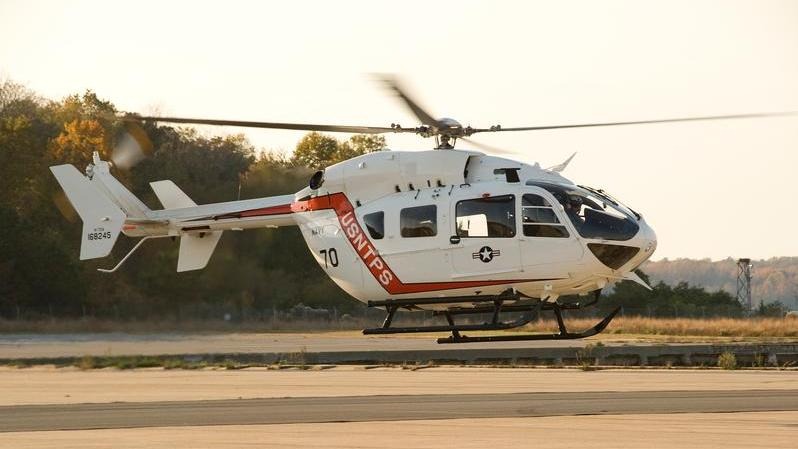
Airbus delivered the first Lakota helicopter to the U.S. Army in 2006, and currently supports a fleet of 223 UH-72As that serve as the primary training helicopters for the service. 212 UH-72A and 18 UH-72B Lakota aircraft support Army National Guard operations including counter drug, search and rescue, and disaster response, among others. The helicopters are used at the U.S. Naval Test Pilot School to teach aviators rotary wing flying characteristics and test procedures.
“Our aircraft has proven its value to the U.S. Army and Navy by performing a range of important and often overlooked missions and will continue to deliver as needed for years to come,” said Didier Cormary, Head of Military Helicopter and Uncrewed Systems for Airbus U.S Space and Defense. “This milestone is a testament to the many U.S. military veterans who built the helicopter and take pride in supporting the aviators who serve our nation at home and abroad.”
Approximately one-third of the workforce in Columbus, Mississippi, who build and deliver the Lakota are veterans.
SECNAV Exonerates 256 Defendants from 1944 Port Chicago General and Summary Courts-Martial
From SECNAV Public Affairs, 17 July 2024
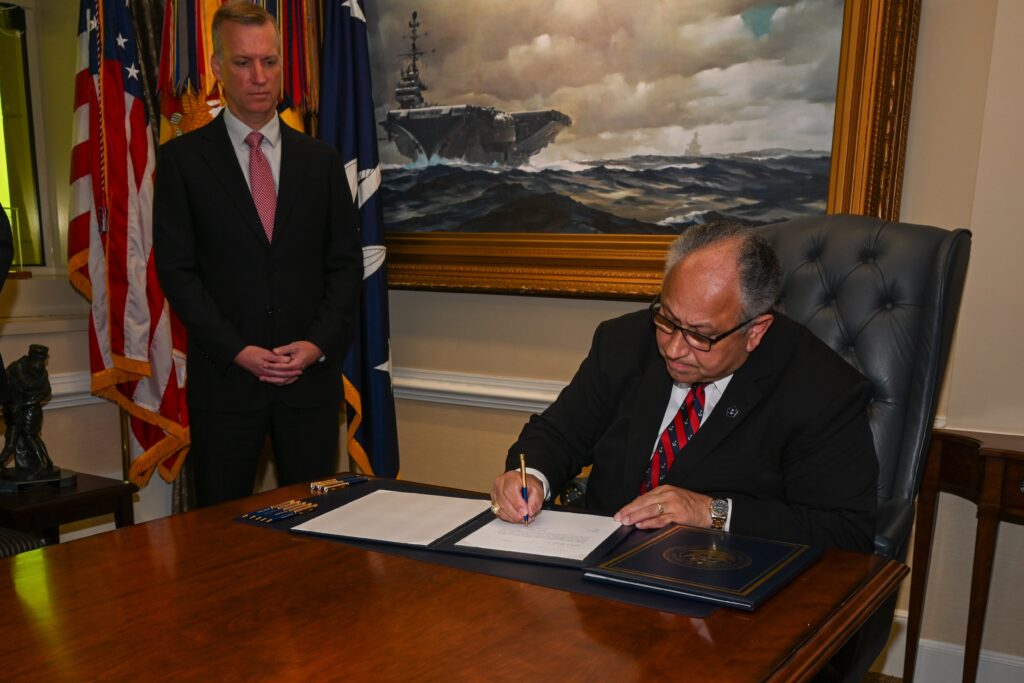
WASHINGTON, DC – The Secretary of the Navy announced on July 17 the full exoneration of the remaining 256 defendants of the 1944 Port Chicago general and summary courts-martial.
The Honorable Carlos Del Toro, Secretary of the Navy, made the announcement on the 80th anniversary of an explosion that occurred at Port Chicago Naval Magazine in California. The explosion killed 320 people, injured 400 others, destroyed two ships and a train, and caused damage to the nearby town of Port Chicago.
Secretary Del Toro expressed his deepest condolences for the Sailors, civilians, Coast Guardsmen, members of the U.S. Maritime Service, and one Marine who lost their lives and for their family members.
Following the 1944 explosion, white supervising officers at Port Chicago were given hardship leave while the surviving African-American Sailors were ordered back to work. The circumstances surrounding the disaster were reflective of the Navy’s personnel policies at the time, which barred African-American Sailors from nearly all seagoing jobs. Most of the Navy ordnance battalions assigned to Port Chicago Naval Magazine and similar facilities were comprised of African-American enlisted personnel and white officers.
In the absence of clarity on the explosions or further safety training, 258 African-American Sailors refused to resume ammunition handling. After threats of disciplinary action, 208 of the Sailors returned to work; however, the Navy still subsequently convicted all 208 Sailors at a summary court-martial for disobeying orders.
The Navy sentenced each of the summary court-martial defendants to a Bad Conduct Discharge and forfeiture of three month’s pay. During subsequent reviews of the summary court-martial, the Bad Conduct Discharges were suspended, the forfeitures reduced, and one conviction was set aside for insufficient evidence.
The remaining 50 Sailors continued to refuse to return to work and were charged with mutiny. The Navy later convicted all 50 Sailors (who came to be called the “Port Chicago 50”) of mutiny at a mass general court-martial. Each of these defendants was sentenced to a Dishonorable Discharge, fifteen years confinement at hard labor, reduction in rate to E-1, and total forfeitures of their pay.
During subsequent reviews of the general court-martial, the Dishonorable Discharges were suspended and the period of confinement was reduced from 15 years to 17-29 months. One conviction was also set aside for mental incompetency. By January 1946, nearly all the Sailors were released and given the opportunity to finish their contracts.
“The Port Chicago 50, and the hundreds who stood with them, may not be with us today, but their story lives on, a testament to the enduring power of courage and the unwavering pursuit of justice,” said Secretary Del Toro. “They stand as a beacon of hope, forever reminding us that even in the face of overwhelming odds, the fight for what’s right can and will prevail.”
After a thorough review of the case and related materials, the General Counsel of the Navy concluded that there were significant legal errors during the courts-martial. The defendants were improperly tried together despite conflicting interests and denied a meaningful right to counsel.
The courts-martial also occurred before the Navy’s Court of Inquiry report on the Port Chicago explosion was finalized, which certainly would have informed their defense and contained nineteen substantive recommendations to improve ammunition loading practices.
Following the Navy’s most recent review, Secretary Del Toro fully exonerated the remaining 256 defendants of the 1944 Port Chicago general and summary courts-martial.
If any family members of the defendants of the 1944 Port Chicago general and summary courts-martial would like to reach out to the Department of the Navy for future notifications on the topic or more information, please reach out to [email protected] or 703-697-5342.
NOAA Orders Second High-Altitude Jet for Hurricane and Climate Research
Artist’s concept of the NOAA Gulfstream G550. (Image credit: Gulfstream Aerospace Corporation)
New aircraft, to join NOAA fleet in 2028
By Jonathan Shannon, July 16, 2024
Today, NOAA announced that it is exercising a $106 million contract option with Georgia-based Gulfstream Aerospace Corporation to purchase a fully modified G550 aircraft that will be specially configured to support hurricane and tropical storm forecasts, atmospheric research and other NOAA missions.
Funded in part by the Inflation Reduction Act, as part of President Biden’s Investing in America agenda, the fully instrumented aircraft is expected to join NOAA’s fleet in 2028. This will be NOAA’s second G550. The first, which NOAA ordered from Gulfstream in 2019, is expected to be delivered in spring 2025 and will replace NOAA’s aging Gulfstream IV-SP, which has been an essential part of the NOAA Hurricane Hunter fleet since 1996.
“These new state-of-the-art aircraft will greatly enhance NOAA’s ability to gather data critical to hurricane research and forecasting, atmospheric river research and forecasting, climate studies and other missions,” said NOAA Administrator Rick Spinrad, Ph.D. “Infrastructure investments like this protect both lives and livelihoods.”
Both twin-engine aircraft will be equipped with a variety of sensors for collecting atmospheric data, including a tail-mounted Doppler radar system. The G550s, which can fly fast, far and high with a range of more than 4,000 nautical miles and a maximum altitude of 51,000 feet, will paint a detailed picture of atmospheric conditions above and around hurricanes and other tropical cyclones — information essential for accurate forecasts.
Data collected by the G550s will supplement the critical low-altitude data collected by NOAA’s pair of four-engine Lockheed WP-3D Orion turboprop aircraft, which fly directly into storms.
When aircraft data are available, hurricane track and intensity forecasts are improved significantly. Longer lead-time for tropical cyclone forecasts are imperative as coastal populations and infrastructure continue to grow, evacuation decision times increase and climate change raises hurricane intensity, rainfall and storm surges.
“The acquisition of these highly capable aircraft is a major step forward in the recapitalization of NOAA’s aircraft fleet, which forecasters, researchers and decision-makers depend on for life-saving information,” said Vice Adm. (select) Nancy Hann, director of the NOAA Commissioned Officer Corps and NOAA Marine and Aviation Operations.
Together, the G550s will help NOAA meet the requirements of the Weather Research and Forecasting Innovation Act of 2017 by creating additional capability for hurricane reconnaissance.
The G550s will be based at the NOAA Aircraft Operations Center in Lakeland, Florida, along with NOAA’s other specialized environmental data-gathering aircraft. The fleet is operated, managed and maintained by a combination of NOAA Corps officers and civilian personnel.
Coast Guard Maritime Safety and Security Team (MSST) Seattle 91101 to Conduct Waterborne Missions in Homer, Alaska
HOMER, Alaska — The Coast Guard is scheduled to conduct waterborne operations in the Homer vicinity over the summer as Sector Western Alaska and U.S. Arctic augments its capabilities with small boat teams from Maritime Safety and Security Team Seattle (MSST) 91101.
MSST 91101, utilizing two 29-foot response boat crews, will patrol harbors, fishing grounds, and trafficked waterways including areas with significant traffic convergence to enforce living marine resources (LMR) regulations on domestic, commercial, recreational, and charter fishing vessels.
“For the next few months, our teams will be conducting operations around Homer in support of various missions, including search and rescue, recreational and commercial vessel safety, and protection of Alaska’s living marine resources,” said Lt. Karl Gunther, Sector Western Alaska and U.S. Arctic enforcement chief. “Teams will maintain a regular presence on the water and conduct routine boardings at sea to inspect a vessel’s catch, gear, and other items to ensure regulatory compliance as well as safety.”
Mariners are advised to research the federally mandated safety and fishery requirements for their vessels prior to conducting operations in Kachemak Bay and to prepare for the highly likely occurrence that a Coast Guard boarding team inspects their vessel for compliance.
Coast Guard boarding teams have the authority to (at any time) go aboard any vessel operating under the jurisdiction of the United States, and address inquiries to those on board, examine the ship’s documents and papers, and examine, inspect, and search the vessel as outlined in 14 USC 522.