NIWC Atlantic Develops 5G Technology for Use Across the Fleet

12 July 2024 

By Jerry Sekerak and Amanda Vallieres 

The U.S. Navy fleet could soon start reaping the benefits of 5G technology. For the past several years, in collaboration with Office of the Under Secretary of Defense, Research and Engineering (OUSD R&E) FutureG office, Naval Information Warfare Center (NIWC) Atlantic has developed and tested 5G capabilities in naval ship environments and is primed and ready to deploy those capabilities on board U.S. Navy ships. This same technology used by just about every civilian with a cell phone is now ready and waiting to start making an impact on improving shipboard quality of life and quality of work, that combined is known as Quality of Service (QoS) for Sailors.   

The U.S. Navy fleet could soon start reaping the benefits of 5G technology. For the past several years, in collaboration with Office of the Under Secretary of Defense, Research and Engineering (OUSD R&E) FutureG office, Naval Information Warfare Center (NIWC) Atlantic has developed and tested 5G capabilities in naval ship environments and is primed and ready to deploy those capabilities on board U.S. Navy ships. This same technology used by just about every civilian with a cell phone is now ready and waiting to start making an impact on improving shipboard quality of life and quality of work, that combined is known as Quality of Service (QoS) for Sailors.   
 
This new shipboard 5G technology got its start about five years ago in NIWC Atlantic’s Assured Real-Time Communications (ARC) Laboratory in Norfolk, which focuses on joint interoperability and cybersecurity. 
 
While Wi-Fi technology has recently been piloted and used in limited but successful capacities in the Navy, such as with “Sailor Edge Afloat and Ashore” on board USS Abraham Lincoln (CVN 72), NIWC Atlantic engineers are working to implement 5G technology both afloat and ashore to make Wi-Fi and other technologies more effective, efficient and secure. Ultimately, NIWC Atlantic’s efforts of 5G implementation will help ensure better overall QoS in part due to its more advanced security and performance.  
 
“What our NIWC Atlantic (5G) engineers did with industry partners has laid a solid engineering foundation for 5G technology to potentially take off across the Navy,” said Peter Reddy, NIWC Atlantic Executive Director. “The use cases we worked on here were shipboard and pier side, and there are a lot of other use cases that 5G will satisfy in the Department of the Navy.” 
 
The work that NIWC Atlantic does with 5G technology relates back to advancing QoS. “We try to use that [QoS] mindset in our development of engineering processes so that we’re looking at solutions that meet [common communication capabilities such as] gaming or FaceTime, where Sailors are able to witness the birth of their children. It also allowed us to address security challenges with command and control-type communications,” said Kevin Thompson, a senior engineer at NIWC Atlantic and test director for the Assured Real-Time Communications (ARC) Laboratory. 
 
In the early stages however, NIWC Atlantic wasn’t able to test this technology in a true shipboard environment without disrupting active Navy operations and activities. Fortunately, in 2021, USS Wisconsin (BB 64), an Iowa-class battleship that is now a functioning museum ship ported in Norfolk, Virginia, reached out to NIWC Atlantic’s Norfolk 5G team asking if they had a replacement part for one of their messaging systems. Over time, the museum ship crew and NIWC Atlantic 5G teams formed a meaningful relationship that continued to develop, and eventually provided the 5G team an opportunity to request, and subsequently start the testing of 5G aboard USS Wisconsin. 
 
Testing on board USS Wisconsin by the NIWC Atlantic Norfolk 5G team has been vital to the success of 5G technology. NIWC Atlantic engineers deployed a private 5G core and tested 5G coverage and performance in the ship’s interior spaces. They ultimately found that 5G propagation within those confined interior spaces proves to be excellent and consistent with results from prior testing. 
 
However, working with 5G data hasn’t always been smooth sailing. Since ships face unique radio frequency (RF) spectrum and security challenges, and because 5G technology is a common technological area used for many different purposes, the 5G team found it difficult to predict whether commercial 5G solutions would work as expected in Navy operational environments. 
 
Also, 5G technology has different levels of maturity. “What that means is when we start looking at how we implement solutions leveraging 5G for quality of work and quality of life, we’re taking two different systems and trying to figure out how we make them agree on a common infrastructure that can support both things,” said Thompson. 
 
Nevertheless, NIWC Atlantic has been hard at work overcoming the various challenges associated with 5G data. According to Thompson, NIWC Atlantic continues to come up with collaborative solutions so 5G successfully works across all devices and systems. Currently, they are trying to improve and maintain the relationships they have with different program offices so NIWC Atlantic can implement 5G technology into their existing systems.   
 
Arnel Castillo, senior engineer working as Program Manager (PM) for NIWC Atlantic’s 5G prototyping efforts, explained that these relationships are vital. “You have to be able to respect the processes that are in place today, that way when you insert this technology, there is some grain of familiarity and some confidence that you’re not totally changing the paradigm,” said Castillo. 
 
Thus far, the NIWC Atlantic 5G team has achieved numerous advancements with 5G technology including developing a reference architecture for ship-wide, littoral, blue-water, pier-side, and ashore operational domains. 
 
The team also designed and implemented the Department of Defense’s (DoD) maritime 5G multi-vendor (shipboard and pier-side networks) testbed, which enables the experimentation of 5G networks and user equipment (UE) in a wide range of 5G frequencies. 
 
Additionally, they implemented the DoD’s first Voice over New Radio (VoNR) and Video over New Radio (ViNR) private 5G network, which is especially favored by Sailors since it provides them with a better QoS. 
 
According to both Castillo and Thompson, 5G technology holds a promising future for all Sailors. Not only will this technology, common to cell phones, soon transform communications and connectivity on all naval ships both afloat and ashore, the Get Real Get Better initiative helps arm leaders and problem-solvers with a near-limitless warfighting advantage. 
 
“The great work this team has done has really positioned the Navy very well to be ready to move out quickly to rapidly expand 5G capabilities across the fleet,” said Reddy. 


July 15 U.S. Central Command Update

From U.S. Central Command, July 15, 2024 

TAMPA, Fla. – In the past 24 hours, U.S. Central Command (CENTCOM) forces successfully destroyed five Iranian-backed Houthi uncrewed aerial vehicles (UAV), three over the Red Sea and two over Houthi-controlled areas of Yemen.  

It was determined these UAVs presented an imminent threat to U.S., coalition forces, and merchant vessels in the region. These actions were taken to protect freedom of navigation and make international waters safer and more secure. 

Additionally, Iranian-backed Houthis launched multiple attacks against MT Bentley I, a Panama-flagged, Israel-owned, Monaco-operated tanker vessel in the Red Sea carrying vegetable oil from Russia to China. Iranian-backed Houthis used three surface vessels in this attack, one uncrewed surface vessel (USV) and two small boats. No damage or injuries have been reported at this time. 

Later, Iranian-backed Houthis launched an anti-ship ballistic missile (ASBM) from a Houthi-controlled area of Yemen, over the Red Sea toward MT Bentley I. No damage or injuries have been reported at this time. 

Separately, Iranian-backed Houthis attacked MT Chios Lion, a Liberian-flagged, Marshall Islands-owned, Greek-operated crude oil tanker with a USV in the Red Sea. The USV caused damage, but MT Chios Lion has not requested assistance. No injuries have been reported at this time. 

This continued reckless behavior by the Iranian-backed Houthis threatens regional stability and endangers the lives of mariners across the Red Sea and Gulf of Aden. The Houthis claim to be acting on behalf of Palestinians in Gaza and yet they are targeting and threatening the lives of third country nationals who have nothing to do with the conflict in Gaza. USCENTCOM will continue to act with partners to hold the Houthis accountable and degrade their military capabilities.  


HII Hosts Congressional and Australian Delegation at Newport News Shipbuilding

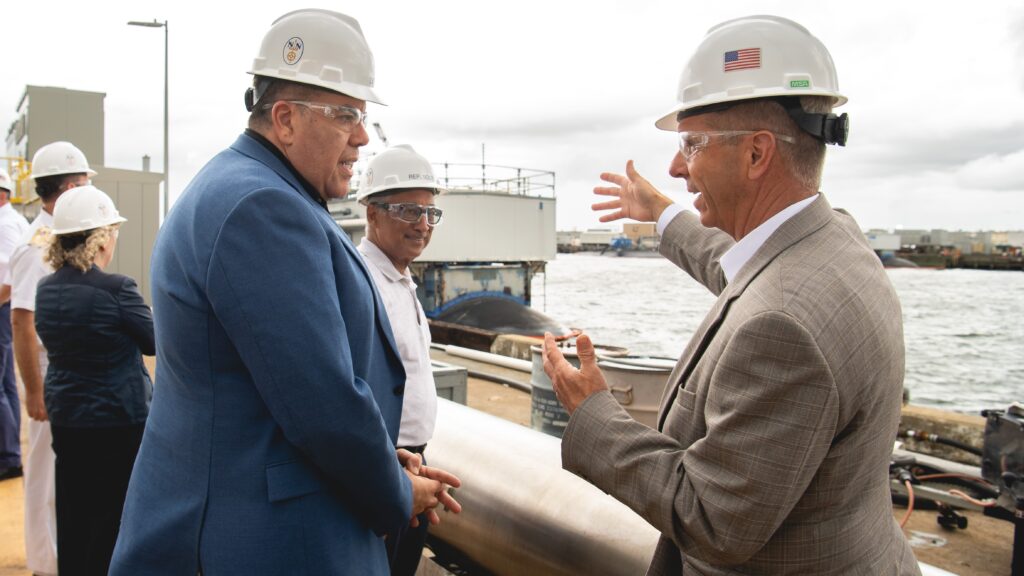
NEWPORT NEWS, Va., July 15, 2024 (GLOBE NEWSWIRE) — Shipbuilder and all-domain technologies provider HII (NYSE: HII) hosted Rep. Robert C. “Bobby” Scott, D-Va.; Rep. Rob Wittman, R-Va.; and a delegation of Australian parliamentarians at its Newport News Shipbuilding division Friday. 

The visit was held in support of the trilateral Australia, United Kingdom and United States (AUKUS) partnership. HII continues to bolster AUKUS, which set in motion tasking across all three countries to determine the optimal pathway to provide Australia with conventionally armed, nuclear-powered submarines. 

The Australian delegation included Milton Dick, speaker of the Australian House of Representatives; Australian House of Representatives members David Littleproud, Sharon Claydon, Joanne Ryan and Bert van Manen; as well as officials from the Parliament of Australia and the Embassy of Australia. 

During the visit, the delegation engaged with senior leadership about the company’s nuclear-powered submarine sustainment expertise, supply chain management experience and longstanding industry-leading workforce development efforts. 

Photos accompanying this release are available at: https://hii.com/news/hii-hosts-congressional-and-australian-delegation-at-newport-news-shipbuilding/

“We are honored the delegation chose to invest time with us during their trip to the United States, and thank Congressmen Scott and Wittman for their continued support,” NNS President Jennifer Boykin said. “We value every opportunity to demonstrate how HII is working in earnest to leverage our experience and stewardship of complex platforms and technologies in support of the critical AUKUS agreement.” 

“I am proud to represent thousands of the nation’s best shipbuilders and welcome the Australian delegation to Hampton Roads where we build nuclear-powered submarines,” Scott said. “We welcome the opportunity to support the AUKUS agreement and strengthen the bonds with our Australian allies.” 

“The AUKUS agreement is integral to deterring China’s growing military aggression in the Indo-Pacific, and Virginia’s robust submarine industrial base plays an outsized role in upholding our nation’s commitment to this trilateral security pact,” Wittman said. “As vice chairman of the House Armed Services Committee, I was proud to bring this delegation of Australian Parliamentarians to Newport News and show them the cutting-edge platforms and technology used to build Virginia-class submarines here in the Commonwealth.” 

“I’m proud to lead a delegation of cross-party representatives from the Australian Parliament to demonstrate enduring bipartisan support for the AUKUS partnership,” Dick said. “It was great to join Congressmen Wittman and Scott for this visit to HII. The tour was an excellent opportunity to deepen our understanding of the work behind nuclear powered submarine construction, workforce and supply chain development as Australia develops our nuclear powered submarine enterprise.” 

NNS is one of only two shipyards capable of designing and building nuclear-powered submarines for the U.S. Navy. HII is the founding member of the AUKUS Workforce Alliance (AWA), a dedicated partnership committed to preparing a skilled workforce in support of all steps of Australia’s optimal pathway to sovereign nuclear-powered submarines. 


Dwight D. Eisenhower Carrier Strike Group Returns from Combat Deployment 

NORFOLK, Va. (July 14, 2024) The Nimitz-class aircraft carrier USS Dwight D. Eisenhower (CVN 69) returns to Naval Station Norfolk, July 14, 2024, concluding a nine-month deployment to the Atlantic. (U.S. Navy Photo by MC2 Hunter Day) 

From Carrier Strike Group Two (CSG-2), 15 July 2024 

NORFOLK, Va. – The Dwight D. Eisenhower (IKE) Carrier Strike Group (CSG) returned to Norfolk, after a historic nine-month combat deployment to U.S. 5th Fleet, July 14, 2024. 

The strike group – comprised of the nine squadrons of Carrier Air Wing (CVW) 3, Ticonderoga-class guided-missile cruiser USS Philippine Sea (CG 58), and Arleigh Burke-class guided-missile destroyers USS Gravely (DDG 107) and USS Mason (DDG 87) of Destroyer Squadron (DESRON) 22 – engaged in combat operations in the Middle East region from Nov. 2023 to June 2024. 
 
“We provide options to our nation’s decision makers. Our job is to preserve the peace, respond in crisis, and if necessary, fight and win decisively, and you delivered on all of those objectives,” said Chief of Naval Operations Adm. Lisa Franchetti. “You had a mission and you did it every day with purpose and perseverance.” 
 
When Houthi capabilities threatened innocent merchant traffic in critical waterways, CVW-3 collaborated with U.S. Air Force assets and coalition partners to launch seven pre-planned, dedicated strikes into Iranian-backed, Houthi-controlled territories in Yemen. The Arleigh Burke-class guided-missile destroyers USS Laboon (DDG 58) and USS Carney (DDG 64) augmented the strike group in the U.S. 5th Fleet operating area, launching Tomahawk Land Attack Missiles (TLAMs) into Yemen from the Red Sea to support the strikes. 
 
“When called upon, the force brought the fight to the Houthis in their front yard, linking airpower and dynamic and self-defense strikes. These acts reduced the risk to shipping and also reinforced our nation’s commitment to maritime security,” said Vice Adm. George Wikoff, commander, U.S. 5th Fleet. “The currency used to fund this important mission was incredible focus, resiliency and professionalism of the sailors of the IKE Carrier Strike Group over eight months…this is the Navy’s finest moments since World War II.” 
 
Beyond self-defensive strikes into Yemen, IKECSG units engaged dozens of one-way attack uncrewed aerial vehicles, uncrewed surface vehicles (USVs), and uncrewed underwater vehicles, earning awards including the Combat Action Ribbon and Navy Unit Commendation award. Several aviators were also awarded personal medals for their exemplary actions against the December 31, January 9, and subsequent Houthi attacks on IKECSG units. At sea, Philippine Sea and Gravely successfully escorted over 28 high-value, vulnerable units conducting innocent passage through the Strait of Hormuz, Gulfs of Oman and Aden, Bab al-Mandeb Strait, and through the Red Sea. 
 
In total, IKECSG warships launched 155 standard missiles, and 135 TLAMs from their vertical launch system across self-defense and pre-planned strikes. IKECSG aircraft expended nearly 60 air-to-air missiles and released 420 air-to-surface weapons. 
 
The Houthi targets in Yemen posed an immediate threat to U.S., coalition, and merchant shipping, and these strikes were designed to degrade Houthi offensive capabilities.across more than 460 pre-planned, dynamic, and self-defense targets. 
 
These threats damaged many civilian vessels, and IKECSG warships answered their distress calls. Laboon rescued stranded civilians in the Red Sea and returned them to the regional coast guard. Philippine Sea and its embarked detachment of MH-60R helicopters from Helicopter Maritime Strike Squadron (HSM) 74 rescued 24 civilian mariners in distress after a USV struck the M/V Tutor in the southern Red Sea. 
 
For nine months, the units within IKECSG sustained operations with minimal port calls thanks to their seamless integration with Military Sealift Command (MSC). The Supply-class fast combat ship USNS Supply (T-AOE 6) deployed as a part of the IKECSG. Also supporting logistics in the Red Sea were the Henry J. Kaiser class USNS Kanawha (T-AO 196), and the Lewis and Clark-class dry cargo ship USNS Alan Shepard (T-AKE 3). Together with the carrier, they enabled all strike group operations, logistics support, command and control structure, and essential medical resources. 
 
The Sailors of IKECSG demonstrated unparalleled resiliency, supported by the embarked Deployment Resiliency Team who worked tirelessly to build connections between Sailors, families, and friends. The team included a Deployed Resiliency Counselor, two psychologists, a Licensed Clinical Social Worker, an Embedded Integrated Prevention Coordinator, seven Chaplains, and a command facility dog named Demo, As IKECSG returns home, Return and Reunion teams are embarked to offer Sailors workshops and one-on-one counseling designed to help them ease back into reuniting with loved ones at home. 
 
“What a wonderful day,” said Rear Adm. Kavon Hakimzadeh, Commander, CSG-2, IKECSG, speaking on the return of IKECSG. “These Sailors are surrounded by their loved ones after a long deployment. Every single one of them demonstrated a level of courage and resiliency that we can all be proud of. I am so proud to be part of this Navy team, and I am grateful to everyone who put in the time and effort to make this a great homecoming!” 
 
The units departed their homeports of Norfolk and Oceana, Virginia, Mayport, Florida, and Whidbey Island, Washington, on Oct. 13 & 14 for the scheduled deployment. Now back home, IKECSG Sailors will get opportunities for downtime to rest and recuperate. 
 
Squadrons of Carrier Air Wing 3 include the “Gunslingers” of Strike Fighter Squadron (VFA) 105, the “Fighting Swordsmen” of Strike Fighter Squadron (VFA) 32, the “Rampagers” of Strike Fighter Squadron (VFA) 83, the “Wildcats” of Strike Fighter Squadron (VFA) 131, the “Screwtops” of Carrier Airborne Early Warning Squadron (VAW) 123, the “Zappers” of Electronic Attack Squadron (VAQ) 130, the “Dusty Dogs” of Helicopter Sea Combat Squadron (HSC) 7, the “Swamp Foxes” of Helicopter Maritime Strike Squadron (HSM) 74 and the “Rawhides” of Fleet Logistics Support Squadron (VRC) 40. 
 
For more information about the Dwight D. Eisenhower Carrier Strike Group, head to Facebook (/CSGTwo & /TheCVN69); Instagram (@CarrierStrikeGroupTwo & @TheCVN69); LinkedIn (Carrier-Strike-Group-TWO). For inquiries, email [email protected]


Fighter Squadron 147, Fleet Logistics Squadron 30 Detachment to Forward Deploy to Japan 

ATLANTIC OCEAN (May 8, 2024) Lt. Cole Drechsler, from Temecula, California, assigned to Strike Fighter Squadron (VFA) 147, takes off from the Nimitz-class aircraft carrier USS George Washington (CVN 73) in an F-35C Lightning II in the Atlantic Ocean, May 8, 2024. (U.S. Navy photo by MC3 August Clawson) 
 

15 July 2024 

From Commander, Naval Forces Japan 

YOKOSUKA, Japan — The U.S. Navy announced today that Strike Fighter Squadron (VFA) 147 and Fleet Logistics Multi-Mission Squadron (VRM) 30, Detachment Forward Deployed Naval Forces (FDNF) will forward deploy to Iwakuni, Japan. 

The squadrons will join the aircraft of Carrier Air Wing (CVW) 5, which is forward-deployed to Marine Corps Air Station Iwakuni. 
 
The F-35C Lightning II aircraft of VFA-147 will replace the F/A-18 Hornets of VFA-115, while the CMV-22B Osprey aircraft of VRM-30, Det FDNF will replace the C-2A Greyhound aircraft of the Fleet Logistics Squadron (VRC) 30 (later assigned to VRC-40 — ed.) detachment previously supporting CVW 5 and Carrier Strike Group (CSG) 5. 
 
The F-35C is the most capable fighter in the U.S. Navy and the backbone of air superiority; it complements the carrier strike group with a dominant, multi-role, 5th generation aircraft that enhances U.S. power projection and deterrence. 
 
The Navy’s V-22 variant includes increased operational range, faster cargo loading/unloading, aerial refueling capability, increased survivability and enhanced beyond-line-of-sight communications when compared to the legacy C-2A. This aircraft brings agility, flexibility and sustainability to effectively operate our naval forces forward in a high-end fight. The CMV-22B represents the next generation of the Carrier Onboard Delivery (COD) mission and is the critical enabler to ensure sustained deployed mobility for the carrier strike group. 
 
CVW 5 is currently embarked aboard the Nimitz-class aircraft carrier USS Ronald Reagan (CVN 76), which is slated to return to the United States for scheduled maintenance this year after nearly nine years forward-deployed to Japan. 
 
Ronald Reagan, which is conducting routine operations in the Pacific Ocean, will be replaced as America’s forward-deployed aircraft carrier in Yokosuka by USS George Washington (CVN 73). CVW 5 will continue to serve as the U.S. forward-deployed carrier air wing and will be embarked aboard George Washington upon its return to Japan later this year. 
 
George Washington previously served as the Navy’s forward-deployed carrier in Yokosuka from 2008-2015. 
 
The forward presence of VFA-147 and VRM-30 supports the United States’ commitment to the defense of Japan and the security and stability of the vital Indo-Pacific region. They will directly support the Defense Strategic Guidance to posture the most capable units forward in the Indo-Pacific region. 
 
The United States values Japan’s contributions to the peace, security and stability of the Indo-Pacific and its long-term commitment and hospitality in hosting U.S. forces forward deployed there. These forces, along with their counterparts in the Japan Self-Defense Forces, make up the core capabilities needed by the alliance to meet our common strategic objectives. 
 
The security environment in the Indo-Pacific requires that the U.S. Navy station the most capable ships and aircraft forward. This posture enables rapid response times for maritime and joint forces, and brings our most capable ships with the greatest amount of striking power and operational capability to bear. 


CNO, MCPON Attend Largest Maritime Exercise in the World, Emphasize Interoperability with Allies and Partners 

PEARL HARBOR, Hawaii – Chief of Naval Operations Adm. Lisa Franchetti and Master Chief Petty Officer of the Navy James Honea tour the Royal New Zealand Navy Ship HMNZS Aotearoa (A-11) during Rim of the Pacific (RIMPAC) 2024, July 11. (U.S. Navy photo by MCC Michael Zingaro/Released) 

HONOLULU — Chief of Naval Operations (CNO) Adm. Lisa Franchetti and Master Chief Petty Officer of the Navy (MCPON) James Honea traveled to Hawaii, July 10-12, 2024, to meet with Sailors and visit Allies and partners participating in Rim of the Pacific (RIMPAC) Exercise 2024. 

Franchetti and Honea visited several U.S. and partner nation ships, where they spoke with Sailors and service members across the Joint Force, observed the ongoing exercise, and emphasized the strategic importance of interoperability with Allies and partners. 

“RIMPAC is the world’s premier joint and combined exercise in the maritime domain. It’s a great opportunity to operate, to train, and to build interoperability with an amazing cross section of Allies and partners, from the Indo-Pacific to the Americas and to Europe,” said Franchetti. “It’s really important that we work together on areas of mutual concern to maintain freedom of the seas and uphold the rules based international order that has supported peace, stability and prosperity for so many years.”  

CNO and MCPON started the visit by holding an all hands call at Joint Base Pearl Harbor-Hickam, with Sailors assigned to USS Shiloh (CG 67), USS Antietam (CG 54), USS Wayne E Meyer (DDG 108), USS Decatur (DDG 73), and USS Hopper (DDG 70) in attendance. CNO and MCPON thanked the Sailors for their service and all that they do to contribute to America’s Warfighting Navy. 

“Thank you. Thank each and every one of you for what you do, for being the warfighters that you are, for building the warfighting teams that you do and all the readiness it takes to do that,” said Honea. “Thank you very, very much for what you’re doing, being on this pointy end, ready to surge at any moment.” 

Following the all hands call, CNO and MCPON visited the crew and shipyard maintenance team of the Virginia-class fast-attack submarine USS Hawaii (SSN 776) and triad of the USS Minnesota (SSN 783) to congratulate them on their successful maintenance periods.  

“Central to my America’s Warfighting Navy is the need to put more players on the field, and that applies to our submarines,” said Franchetti. “I know that we can’t deter and win against our would-be adversaries without getting all our submarines on the field. Whether it’s new construction ships or those in maintenance, we need to get these platforms in and out of the shipyard on time and on cost. And, we have to get all the people – with the right skills, tools and training – to man our submarines. That’s all more players on the field, and you did that. I am so proud of you for all that you accomplished.” 

Franchetti and Honea also visited the Virginia-class fast-attack submarine USS Illinois (SSN 786) to meet with the crew and congratulate them on their success in the maintenance period and with the “Every Sailor a Recruiter” program. Since the CNO’s call to action earlier this year, the crew of Illinois has found, coached, and mentored 11 future Sailors to get contracts and join the Navy, the highest number for any command, with the USS Carl Vinson (CVN 70) in second place with 10. 

“The crew of the USS Illinois is extremely motivated and focused on excellence in all mission areas which also includes investing in their warfighter development with their high completion rate of the Enlisted Leader Development course,” said Honea. “Illinois exemplifies the culture of excellence, and I’m not surprised they fully embraced ‘Every Sailor is a Recruiter’ and excelled at it as well. The crew exudes the ship’s motto ‘None More Brave.’ They know who makes a great teammate and recruits and mentors them to ensure our Navy has the most lethal combat warfighters. I am extremely proud of them and happy that CNO and I were able to present them with a small token of appreciation for their hard work.”  

After visiting the submarines CNO and MCPON visited the K. Mark Takai Pacific Warfighting Center on Ford Island, the command-and-control center for RIMPAC, observing more than 250 watchstanders from the Joint and Combined Forces participating in the exercise. CNO and MCPON also met with senior naval leaders from several Allied and partner nations, to include Australia, Chile, Colombia, Peru, and the Republic of Singapore. 

“The United States is an Indo-Pacific nation. We know that our partnerships in this region make a difference–that friendship is strength. We don’t take that for granted,” said Franchetti. “It’s great to be out here working together with all of you. This is an incredible opportunity to continue to build interoperability across the entire maritime domain from humanitarian assistance, logistics, anti-submarine warfare all the way up to the highest end of combat training.” 

Finally, CNO and MCPON flew out to a number of ships participating in RIMPAC. They visited the Republic of Korea ship ROKS Cheon Ja Bong (LST-687), the Japanese ship JS Kunisaki (LST-4003), and the Royal New Zealand ship HMNZS Aotearoa (A-11), where they thanked service members, met with leadership, and observed the exercise first-hand. 

“It was great to be able visit these ships, see their RIMPAC experiences, talk to them about what they are hoping to get out of the exercise, and thank them for being here and taking on some key leadership roles in the exercise,” said Franchetti. 

In its 29th iteration, dating back to 1971, the biennial event is the world’s largest international joint exercise in the maritime environment, providing a unique training opportunity to foster and sustain cooperative relationships critical to ensuring security on the world’s oceans. Capabilities exercised during RIMPAC range from disaster relief and maritime security operations to sea control and complex warfighting. 

This was Franchetti’s first time attending RIMPAC as CNO. 


RTX’s Pratt & Whitney completes F135 Engine Core Upgrade preliminary design review 

Caption: PACIFIC OCEAN (June 7, 2024) An F-35C Lightning II, assigned to Strike Fighter Squadron (VMFA) 314, launches from the flight deck of the Nimitz-class aircraft carrier USS Abraham Lincoln (CVN 72). (U.S. Navy photo by MCSA Mario Castro Gamez) 

Program remains on track to fully enable the F-35’s future needs  

July 15, 2024 

EAST HARTFORD, Conn., July 15, 2024 /PRNewswire/ — Pratt & Whitney, an RTX (NYSE: RTX) business, completed the F135 Engine Core Upgrade’s (ECU) preliminary design review (PDR), affirming the ECU’s design is on schedule and exceeding expectations. The upgrade will deliver increased engine durability and performance that will fully enable Block 4 and beyond capabilities for all three variants of the F-35 worldwide. 

During the PDR, Pratt & Whitney and the F-35 Joint Program Office evaluated the ECU’s design changes and propulsion technologies, both of which are needed to restore full life to the engine and provide improved performance to enable next generation weapons and sensors. 

“Pratt & Whitney is upgrading the F135 engine with technology from multiple development programs to deliver increased capability and performance for the warfighter,” said Chris Johnson, vice president of Pratt & Whitney’s F135 program. ”Upgrading the F-35’s propulsion system to ECU is a critical step toward ensuring the F-35 remains the world’s premier air dominance fighter.” 

Earlier this year, the U.S. Department of Defense formally selected the F135 ECU as the only modernization solution for the F-35’s propulsion system because it assessed that Pratt & Whitney alone “has the experience, special skills, proprietary technical documentation, software/algorithms, and technical expertise required to furnish the supplies and services.” 

“The PDR was a successful first step toward the capability the ECU will provide in meeting the challenging performance and durability requirements of the F135,” said U.S. Navy Capt. Mitchell Grant, F-35 propulsion program manager. “The ECU will ensure that the U.S. and our international partners remain well positioned to outpace adversary threats.” 

To date, Pratt & Whitney has delivered more than 1,200 F135 production engines, with more than 860,000 engine flight hours recorded. The F135 ECU will be incorporated into F-35s at the point of production or retrofitted at one of the multiple F135 depot sustainment facilities around the world. 


July 12-14 Central Command Update 

From U.S. Central Command 

July 14, 2024 
 

TAMPA, Fla. – In the past 24 hours, U.S. Central Command (USCENTCOM) forces successfully destroyed two Iranian-backed Houthi uncrewed aerial vehicles (UAV) over the Red Sea and one uncrewed surface vessel (USV) in the Red Sea.  

USCENTCOM forces also successfully destroyed one Houthi UAV in a Houthi-controlled area of Yemen.  

It was determined these systems presented an imminent threat to U.S., coalition forces, and merchant vessels in the region. These actions were taken to protect freedom of navigation and make international waters safer and more secure. 

July 12, 2024 
 

TAMPA, Fla. – In the past 24 hours, U.S. Central Command (USCENTCOM) forces successfully destroyed three Iranian-backed Houthi uncrewed aerial vehicles (UAV) in a Houthi-controlled area of Yemen.  

It was determined these UAVs presented an imminent threat to U.S., coalition forces, and merchant vessels in the region. These actions were taken to protect freedom of navigation and make international waters safer and more secure. 


USS San Diego to Forward Deploy to Japan

11 July 2024 

The San Antonio-class amphibious transport dock ship USS San Diego (LPD 22) will move to Sasebo, Japan, to join the Forward Deployed Naval Forces Japan (FDNF-J), the U.S. Navy announced today. This will be executed as a permanent change of station for the crew and family members. 

San Diego will replace USS Green Bay (LPD 20), which has been forward deployed to Sasebo for a decade. Green Bay will return to the United States at its new homeport of San Diego. The forward presence of San Diego supports the United States’ commitment to the defense of Japan, enhances the national security of the United States and improves its ability to protect strategic interests. San Diego will directly support the Defense Strategic Guidance to posture the most capable units forward in the Indo-Pacific Region. 
 
The United States values Japan’s contributions to the peace, security and stability of the Indo-Pacific and its long-term commitment and hospitality in hosting U.S. forces forward deployed there. These forces, along with their counterparts in the Japan Self-Defense Forces, make up the core capabilities needed by the alliance to meet our common strategic objectives. 
 
The security environment in the Indo-Pacific requires that the U.S. Navy station the most capable ships forward. This posture allows the most rapid response times possible for maritime and joint forces and brings our most capable ships with the greatest amount of striking power and operational capability to bear in the timeliest manner. 
 
Maintaining an FDNF capability with the most advanced ships supports the United States’ commitment to the defense of Japan and the security and stability of the vital Indo-Pacific region. 


NAVAIR Selects Near Earth Autonomy for USMC Aerial Logistics Connector Program

Near Earth will use Leonardo’s AW139 helicopter for the Aerial Logistics Connector program.

PITTSBURG, Pa. – [July 12, 2024] – NAVAIR has selected Near Earth Autonomy (Near Earth) to lead one of the teams demonstrating optimized logistics using rotorcraft for the U.S. Marine Corps’ Aerial Logistics Connector (ALC) program through an Other Transaction Agreement (OTA) under the Naval Aviation Systems Consortium (NASC). In collaboration with industry leaders Leonardo and Honeywell, Near Earth will showcase advanced autonomy on the Leonardo AW139 helicopter to provide logistical support during expeditionary operations in contested environments. The AW139, renowned for its versatility in defense, medical rescue, law enforcement, and energy operations worldwide, combined with Near Earth’s logistics mission autonomy system, will be the centerpiece of this program. 

The objective is to field a flexible solution capable of transporting various types of cargo and serving in casualty evacuation roles, operating in both crewed and uncrewed configurations. This dual capability will significantly expand the range of missions USMC rotorcraft will be able to undertake. Specifically, the 20-month initiative will demonstrate the rapid deployment of cargo up to 3,000 lb. over a 200 NM radius. 

For the ALC program, Leonardo will implement a fast loading, securing, and unloading system for Joint Modular Intermodal Containers (JMIC) on the AW139 helicopter. This system will integrate seamlessly with the helicopter, maintaining payload capacity and structural integrity. Honeywell, which already provides the AW139’s autopilot, will augment it to enable autonomous take-off and landing capabilities. As the prime contractor, Near Earth will demonstrate a fully integrated logistics system featuring onboard autonomy that guides the aircraft and modifies the flight trajectory to avoid hazards without requiring a remote operator. Additionally, Near Earth will demonstrate mission autonomy, enabling lightly trained personnel to request, dispatch, monitor, and retask supply deliveries in contested environments. 

The ALC program marks an operational-scenario implementation of Near Earth’s foundational vision — to pioneer autonomous solutions for full-scale helicopter logistics. This initiative underscores Near Earth’s commitment to enhancing efficiency, safety, and reliability in aerial logistics. 

Sanjiv Singh, CEO of Near Earth, stated, “We started the company in 2012 to demonstrate autonomous resupply operations in austere environments at an unprecedented scale. We proved feasibility in 2017 with an autonomous UH-1, and now the Aerial Logistics Connector program allows us to demonstrate a complete system that meets this operational need in the near future. We look forward to working with our partners at Leonardo, Honeywell and NAVAIR to build upon state-of-the-art to advance the efficiency and safety of military logistics. ” 

“Leonardo Helicopters is excited to introduce the USMC to the world-class AW139 helicopter for this next-generation FVL mission,” said Scott Volkert, Dir. of USMC Programs for Leonardo Helicopters. “The combination of Near Earth’s autonomy and AW139 platform will provide the Marines relief on their combat rotorcraft fleet and reduce their workforce requirements.” 

“The future of aviation will include several layers of autonomy, and Honeywell is proud to work with our partners to provide the cutting-edge technologies that enable safe and secure autonomy solutions across a range of vehicles, including the AW139,” said Matt Milas, president, Defense & Space, Honeywell Aerospace Technologies. 

This project builds on Near Earth’s extensive experience with numerous defense logistics products and initiatives. In 2010, the founders demonstrated the first autonomous helicopter flight for the Army Combat Medic program. From 2012 to 2017, Near Earth focused on the USMC Autonomous Aerial Cargo/Utility System (AACUS), to demonstrate an aircraft-agnostic autonomy system suitable for logistics. Currently, Near Earth is actively integrating autonomy into various other aircraft to support USMC logistics needs. Near Earth also leads Project Crimson to enable autonomous delivery of blood and medical supplies for Army Telemedicine and the Army Heavy VTOL UAS program to demonstrate a multipurpose uncrewed aerial system.