TAMPA, Fla. – In the past 24 hours, U.S. Central Command (CENTCOM) forces successfully destroyed one Iranian-backed Houthi uncrewed aerial vehicle (UAV) in a Houthi controlled area of Yemen.
It was determined the UAV presented an imminent threat to U.S., coalition forces, and merchant vessels in the region. This action was taken to protect freedom of navigation and make international waters safer and more secure.
U.S. Navy Funds Mercury to Advance Chip-Scale Technologies
ANDOVER, Mass., July 10, 2024 (GLOBE NEWSWIRE) — Mercury Systems, Inc. (NASDAQ: MRCY, www.mrcy.com), a technology company that delivers mission-critical processing power to the edge, today announced an agreement with the U.S. Navy to advance sensor processing technologies that will allow radar and electronic warfare (EW) capabilities to be designed on much shorter timelines.
For decades, increasing system and software complexity has extended the timelines for developing and fielding military platforms. The Office of Naval Research’s Open Rapid Chipletized Approach (ORCA) program aims to reduce the time needed to design edge processing solutions by increasing the modularity of components at the chip level. Under a $13.2 million contract, Mercury will develop a next-generation RF System-in-Package (SiP) that integrates the latest commercial chips from major semiconductor providers within a smaller and lighter footprint.
This work will build on Mercury’s RFS1140 SiP, which integrates an AMD Versal FPGA, Jariet Electra-MA high-speed data converters, and Micron memory for a truly advanced solution to support sensor processing.
“ORCA represents a significant evolution of the Mercury Processing Platform that will drive down radar and EW system development timelines, allowing next-generation capabilities to be fielded much faster,” said Tony Trinh, Mercury’s Senior Director of Advanced Packaging. “The ORCA approach opens up incredible opportunities to integrate mission-specific pre-processing chiplets to rapidly upgrade systems on a wide variety of existing platforms and stay ahead of evolving threats.”
“Mercury is pioneering the way for on-shore advanced secure microelectronics integration and packaging capability with DMEA-certified full product lifecycle support, including concept, design, assembly, and test, to rapidly deliver application-tailored system solutions to the warfighter,” said Adam Miller, Office of Naval Research Program Officer.
Navy Accepts Delivery of Future USS John Basilone
By Team Ships Strategic Operations, July 8, 2024
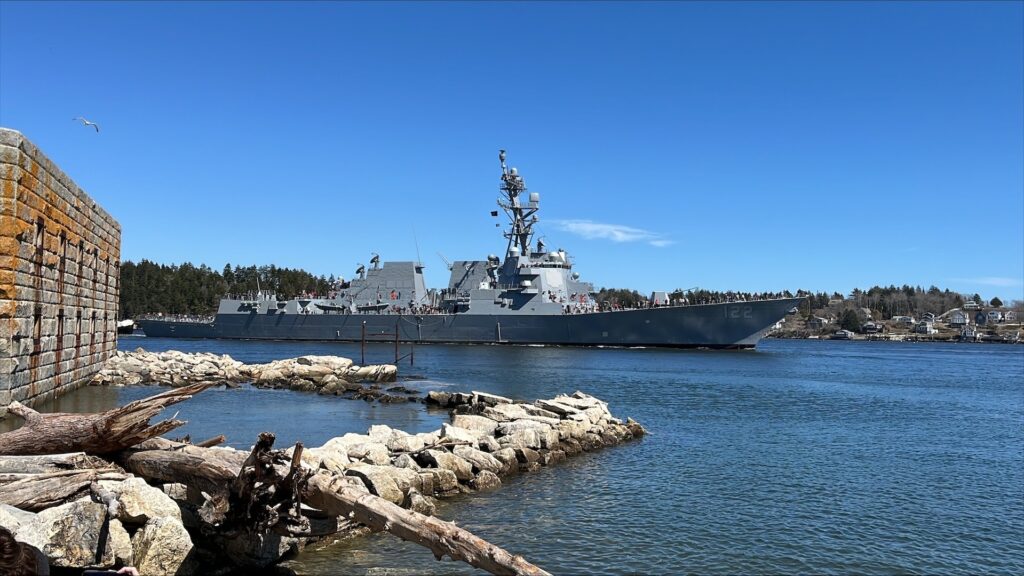
BATH, Maine- The future USS John Basilone (DDG 122) was delivered to the U.S. Navy, July 8.
Delivery represents the official transfer of a ship from the shipbuilder to the Navy. Prior to delivery, the ship conducted a series of at-sea and pier-side trials to demonstrate readiness.
The ship is named after United States Marine Corps Gunnery Sergeant John Basilone, who received the Medal of Honor for his extraordinary heroism during the Battle of Guadalcanal.
“The future USS John Basilone will bring significant capability to the fleet and strengthen our advantage at sea,” said Capt. Seth Miller, DDG 51 Class program manager, Program Executive Office (PEO), Ships. “DDG 122 and all of its Sailors will be a living reminder of the perseverance and sacrifice exhibited by its remarkable namesake.”
As a Flight IIA destroyer, DDG 122 will serve as a multi-mission surface combatant capable of conducting Anti-Air Warfare, Anti-Submarine Warfare and Anti-Surface Warfare.
General Dynamics Bath Iron Works has six additional future Arleigh Burke-class destroyers under construction, Harvey C. Barnum Jr. (DDG 124), Louis H. Wilson Jr. (DDG 126) Patrick Gallagher (DDG 127), William Charette (DDG 130), Quentin Walsh (DDG 132) and John E. Kilmer (DDG 134).
PEO Ships, one of the Department of Defense’s largest acquisition organizations, is responsible for executing the development and procurement of all destroyers, amphibious ships and craft, auxiliary ships, special mission ships, sealift ships and support ships.
Austal USA Breaks Ground in New Final Assembly Facility
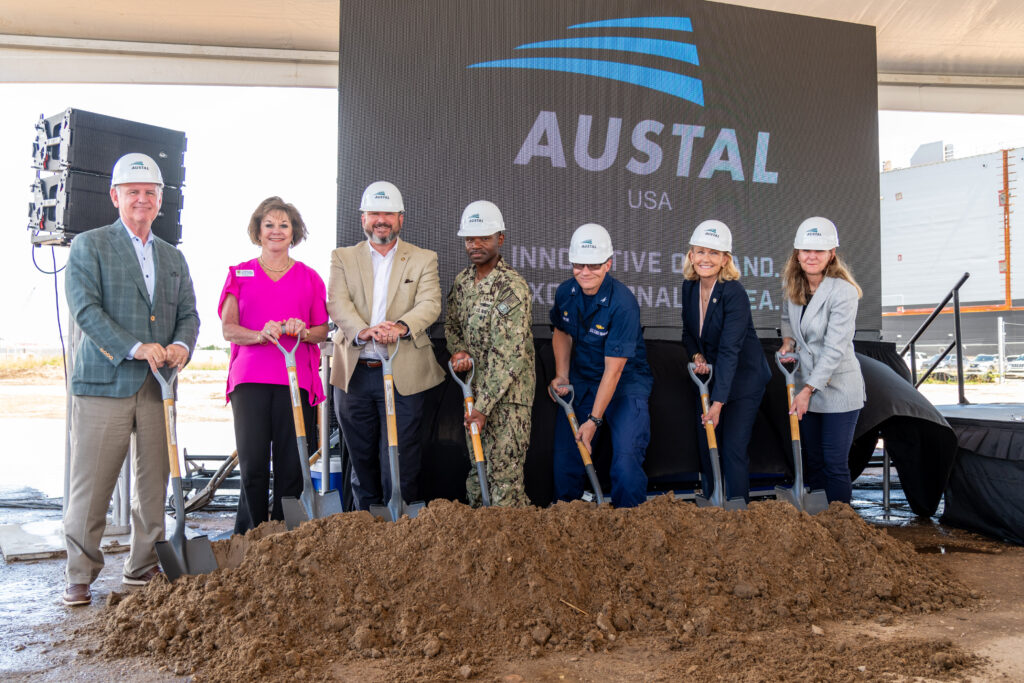
MOBILE, Ala. – Austal USA celebrated the start of construction for the company’s newest final assembly facility with a groundbreaking ceremony today. The infrastructure expansion, which will be to the south of Austal USA’s current waterfront facility, will include a new assembly building, waterfront improvements, and a new shiplift system. The project is scheduled to be complete and fully operational by summer of 2026.
The construction of this new building and waterfront support area continues the expansion Austal USA began in March 2021 with the groundbreaking of the steel panel line. This latest expansion provides a new assembly bay which will enable the erection of large steel modules for Navy and Coast Guard ships, including the Offshore Patrol Cutter (OPC) and TAGOS-25 programs. In addition to the manufacturing capacity of the new buildings, the expansion includes a shiplift that will provide a safe and reliable system to launch ships as they are completed in the assembly buildings. The shiplift will also enable bringing ships back on the land-side facility for repair and maintenance.
Secretary of Commerce Ellen McNair was the principal speaker at today’s ceremony representing Governor Kay Ivey. In her remarks, Secretary McNair highlighted the long-standing partnership of Alabama and Austal USA and the important role that partnership has played in Austal USA’s 25-year history.
“As evidenced by this major expansion, Austal USA continues to be both an economic engine to Alabama and a driving force behind U.S. Naval modernization,” said Governor Kay Ivey. “It is fitting that during its 25th anniversary year in Alabama, Austal breaks ground on its third final assembly facility that will usher in more jobs for Mobile and the Gulf Coast. We are proud to be home to one of our U.S. Navy’s most relied upon shipbuilders.”
“Austal USA is poised for significant growth, and this infrastructure expansion plan reflects that,” commented Austal USA President Michelle Kruger. “Austal USA’s investment in this latest facility expansion project reflects our commitment to supporting the implementation of the National Defense Industrial Strategy and our commitment to investing in the Mobile region.”
The new assembly building will occupy four and a half acres and will be approximately 400 feet long by 480 feet wide providing over 192,000 square feet of new covered manufacturing space. It will consist of three bays enabling erection of the Coast Guard’s Offshore Patrol Cutter and Navy’s TAGOS-25 ocean surveillance steel ships as well as provide flexibility to manufacture modules for submarine and other surface ship programs. Austal USA has partnered with Pearlson & Pearlson Inc., program manager and owner’s representative; Kiewit Infrastructure South Co., lead for design and construction; and, Pearlson Shiplift Corporation, designer and builder of the shiplift system, to execute the project.
The Pearlson-designed shiplift system will feature an articulated lifting platform approximately 450 feet long by 125 feet wide, capable of lifting and launching vessels in excess of 18,000 long tons. This capacity will facilitate the launch and docking of the U.S. Navy Constellation-class Frigates, TAGOS-25 class Ocean Surveillance Ships, Independence-variant Littoral Combat Ships, and the U.S. Coast Guard Heritage-class Offshore Patrol Cutters.
When this expansion is complete, Austal USA’ s Mobile, Ala. facility will include a 117,000 square foot steel panel line, two module manufacturing facilities totaling over one million square feet of covered manufacturing space optimized for serial production, and seven assembly bays providing over 400,000 square feet of indoor erection space. In all, the Mobile facility covers 180 acres and, when this project is complete, over 1.5 million square feet of indoor manufacturing space.
Arlington, Va. — CAES, a leading provider of mission-critical advanced electronics, has received an award of $172.7 million from Raytheon Technologies (RTX) in support of a major international missile program. This award covers the next three lots of follow-on production for the missile data-link assembly.
“CAES is at the forefront of RF electronics and advanced EW capabilities, supplying critical components that our customers rely on,” said CAES President and CEO Mike Kahn. “CAES has been a long-time partner of RTX and we value our continued relationship supporting their mission and advancing capabilities to defend and defeat future threats.”
CAES is a critical subsystem provider to the missiles and munitions market on almost all key platforms covering a broad range of advanced electronic capabilities, including antennas, flight termination receivers, telemetry assemblies, preselectors, RF processors, converters, RF heads, RF front ends, receivers, and data links.
Partnering with customers, CAES designs and manufactures complex microwave and millimeter wave solutions for electronic warfare, radar, and other mission-critical needs. Learn more about CAES’ advanced capabilities here.
Cruiser USS Vicksburg is Decommissioned
3 July 2024
NAVAL STATION NORFOLK – The crew of the guided-missile cruiser USS Vicksburg (CG 69) held a decommissioning ceremony on June 28, 2024.
Hundreds gathered to celebrate the ship’s distinguished history of Naval service. Vicksburg’s former Commanding Officer Capt. Chip Swicker, USN (Ret.), spoke of the powerful bond between Sailors and their ships and the lives shaped aboard. His words resonated with the audience as they bade farewell to the cruiser.
“These Sailors brought Vicksburg to life for 32 years under 17 commanding officers,” said Swicker. “This ship was their schoolhouse, their training field, their home and their powerful weapon as they stood fast between good people and bad things night and day, in good weather and bad, close to home and far over the horizon for more than three decades.”
Swicker added, “A ship is only as strong as her crew and Vicksburg has been an exceptionally lucky ship, the training ground for generations of exceptional Sailors led by commanding officers dedicated to the relentless pursuit of combat readiness.”
Vicksburg’s current Commanding Officer Cmdr. Christopher M. Stolle shared his admiration for the crew, both current and former, for their hard work, dedication and setting the standard over the years.
“To all former shipmates, you have been trailblazers in sensor integration, tactical development, the bolstering of regional partners, and prepping the battlefield to ensure that America’s Navy has a home field advantage anywhere in the world,” said Stolle. “Today we decommission Vicksburg, but the legacy of her crews will live on indefinitely. I am humbled to be a part of the final chapter and to join the prestigious ranks of Vicksburg Alumni.”
The ship was built at Ingalls Shipbuilding in Pascagoula, Miss., and commissioned during a ceremony held there November 14, 1992. The ship was named in commemoration of both the land Battle of Vicksburg fought during the American Civil War and the city of Vicksburg, Miss.
Inactivation is a normal part of a warship’s lifecycle. After decommissioning, the ship is slated to be towed to the Navy’s Inactive Ship’s facility in Philadelphia, Pa., where it will be in a Logistical Support Asset status.
Over its 32 years of service, the cruiser has been an important part of America’s national defense strategy.
Under Secretary of the Navy Raven to Step Down
From SECNAV Public Affairs, July 3, 2024
Under Secretary of the Navy Erik Raven will step down from his position in August.
Below is Secretary of the Navy Carlos Del Toro’s statement on the upcoming departure of Under Secretary of the Navy Erik Raven:
“Erik Raven has been a true leader in executing the Department of the Navy’s top priorities. He has demonstrated unfailing commitment to protecting our Nation, strengthening our Navy and Marine Corps Team, and building enduring warfighting advantages. His expertise ensured our naval forces are equipped with the capabilities to deter and, if necessary, prevail decisively in time of war, while also ensuring the welfare of our service members, civilians, and their families.
For the past two years his steadfast leadership has been a driving force for actions that will have long-lasting, positive impacts, not just for the United States but also for our Allies and partners. His efforts contributed significantly to the AUKUS trilateral security partnership, the largest-ever investment in shipbuilding, improving Guam’s infrastructure to support defense in the INDOPACOM region, as well as improving the Department of Navy’s business operations, optimizing information management and cyber operations while improving efficiency.
We have benefited from Erik’s wise counsel and loyal service to the Department and to our Nation. Our national security, Navy, and Marine Corps are stronger because of his service. We wish him the best in his future endeavors.”
Military Sealift Command Supporting Biennial Rim of the Pacific Exercise
3 July 2024
From Sarah Cannon, Military Sealift Command Pacific
Military Sealift Command will support the biennial Rim of the Pacific (RIMPAC) 2024 maritime exercise though out the month of July in Hawaii.
MSC fleet replenishment oilers USNS Pecos (T-AO 197) and the MSC dry cargo/ammunition ship USNS Washington Chambers (T-AKE 11) will provide logistics services including aviation fuel, diesel ship fuel, dry, fresh and frozen food equipment and supplies to the ships participating in the exercise.
MSC chartered tanker ships MT Overseas Mykonos and MT Allied Pacific will provide fuel to the MSC combat logistics ships during replenishment-at-sea events. With the closing of the Navy’s The Red Hill Bulk Fuel Storage Facility, the tanker replenishment events will allow the CLF ships to receive fuel at sea, enabling them to provide logistic services to exercise participants as needed, without delay.
MSC rescue and salvage ship USNS Grasp (T-ARS 51) will deliver two decommissioned Navy ships to the designated target area in preparation for sinking exercises (SINKEX); amphibious transport dock Ex-Dubuque (LPD 8) and amphibious assault ship Ex-Tarawa (LHA 1).
Five members of Military Sealift Command Pacific’s (MSCPAC) Headquarters Unit are serving as watch standers, providing maritime logistics support to Commander, Task Group 173. These reservists, alongside will providing comprehensive planning and coordination for each replenishment-at-sea conducted during the exercise, including arranging and coordinating rendezvous locations and times for MSCs CLF ships and MSC chartered tankers. In addition, the Reservists will coordinate towing operations Grasp.
At sea, 24 members of MSC Cargo Afloat Rig Team (CART) will support at-sea logistics operations in support of the exercise, training and working hand-in-hand with the civil service mariner crews in order to meet the huge underway replenishment demands of keeping the ships of the 29 participating nations supplied and moving.
“MSC and our crews of highly professional civilian mariners are proud to be a part of RIMPAC 2024,” said Leonard Bell, Deputy to the Commodore, Military Sealift Command Pacific. “This is a great opportunity for us to not only demonstrate our logistics capabilities, but to work and learn from our foreign Navy partners in an at-sea environment. In today’s challenging environments, exercises such as RIMPAC allow us to foster goodwill and relationships with like-minded partners, ensuring safe seas for military and commercial sailing.”
Hosted biennially by Commander, U.S. Pacific Fleet (PACFLT), and executed by Commander, U.S. 3rd Fleet (C3F), RIMPAC is a multinational maritime exercise that takes place in and around the Hawaiian Islands. This year marks the 29th iteration of RIMPAC, a series that began in 1971 and is scheduled to take place from June 26 to August 2. Approximately 29 nations, 40 surface ships, three submarines, 14 national land forces, over 150 aircraft and more than 25,000 personnel are scheduled to participate. This year’s exercise will include units or personnel from Australia, Belgium, Brazil, Brunei, Canada, Chile, Colombia, Denmark, Ecuador, France, Germany, India, Indonesia, Israel, Italy, Japan, Malaysia, Mexico, Netherlands, New Zealand, Peru, the Republic of Korea, the Republic of the Philippines, Singapore, Sri Lanka, Thailand, Tonga, the United Kingdom and the United States. RIMPAC is a unique training opportunity designed to foster and sustain the cooperative relationships that are critical to ensuring the safety of sea lanes and security on the world’s oceans.
U.S. Central Command Update
From U.S. Central Command
July 7, 2024
TAMPA, Fla. - In the past 24 hours, U.S. Central Command (CENTCOM) forces successfully destroyed two Iranian-backed Houthi uncrewed aerial vehicles (UAVs) in Houthi-controlled areas of Yemen.
Additionally, partner forces successfully destroyed two Houthi UAVs over the Gulf of Aden. There were no injuries or damage reported by U.S., coalition, or merchant vessels.
It was determined these systems presented an imminent threat to U.S., coalition forces, and merchant vessels in the region. These actions were taken to protect freedom of navigation and make international waters safer and more secure for U.S., coalition, and merchant vessels.
July 4, 2024
TAMPA, Fla. – In the past 24 hours U.S. Central Command (USCENTCOM) forces successfully destroyed two Iranian-backed Houthi uncrewed surface vessels (USV) in the Red Sea and one Houthi radar site in a Houthi-controlled area of Yemen.
It was determined the USVs and radar site presented an imminent threat to U.S. and coalition forces, and merchant vessels in the region. These actions were taken to protect freedom of navigation and make international waters safer and more secure.
July 3, 2024
TAMPA, Fla. – In the past 24 hours, U.S. Central Command forces successfully destroyed two Iranian-backed Houthi radar sites in Houthi controlled areas of Yemen and two uncrewed surface vessels (USV) in the Red Sea.
It was determined the radar sites and USVs presented imminent threats to U.S., coalition forces, and merchant vessels in the region. This action was taken to protect freedom of navigation and make international waters safer and more secure.
USNS Burlington Departs for Continuing Promise 2024 Deployment
NAVAL STATION MAYPORT, Fla. (July 3, 2024) The USNS Burlington (T-EPF 10) departs Naval Station Mayport for Continuing Promise 2024 on July 3, 2024. Continuing Promise 2024 marks the 14th mission to the region since 2007 and the second aboard USNS Burlington. The mission will foster goodwill, strengthen existing partnerships with partner nations, and encourage the establishment of new partnerships among countries, non-government organizations, and international organizations. (U.S. Navy photo by Mass Communication Specialist 2nd Class Alexa Trafton)
MAYPORT, Fla. – The U.S. Navy Spearhead-class fast transport ship, USNS Burlington (T-EPF 10), departed from Naval Station Mayport for Latin America and the Caribbean in support of Continuing Promise 2024.
During this iteration of U.S. Naval Forces Southern Command/U.S. 4th Fleet’s Continuing Promise mission, the 14th since 2007, Burlington will stop in Jamaica, Costa Rica, Honduras, Colombia, and Panama to share knowledge and provide side-by-side professional expertise with international partners.
“One of the major benefits of being aboard the USNS Burlington for Continuing Promise 2024 is that this ship is incredibly versatile and has the ability to conduct a variety of mission types,” said Lt. Cmdr. Zachary Smith, mission commander for Continuing Promise 2024.
Christened in 2018, the USNS Burlington is the tenth Spearhead-class ship. It is also the first ship in service named to honor Burlington, Vermont, the state’s largest city. The ship has an off-load ramp for vehicles to move on and off the ship and a flight deck rated to be capable of receiving U.S. Navy helicopters. Operated by a crew of 22, it is capable of transporting over 300 personnel. Of the U.S. Navy personnel onboard, there are 18 unique enlisted job specialties and 10 unique officer specialties to support eight different mission areas.
“The better we can learn to work together during missions such as Continuing Promise the better we can work together as we respond to the real-world challenges that will inevitably come,” said Smith.
The first mission stop for Burlington will be Kingston, Jamaica. While there, embarked medical personnel will work with local medical practitioners to provide enhanced direct patient care, share knowledge and expertise, and strengthen partnership between the U.S. military and Jamaican civilian and military officials.
“It’s important to contribute to other countries… and help out any way we can,” said Hospital Corpsman 2nd Class Ricardo Maldonado, a dental technician from Navy Medical Readiness Training Command Portsmouth. While providing assistance to the dental officer onboard, he expects to put smiles on people’s faces by providing them with the medical attention they need.
Pharmacists, optometrists, nurses, biomedical technicians, optometrists, dentists, and general practitioners will be among the 30 U.S. Navy medical professionals sharing their expertise and working with local patients.
Just as in past iterations of Continuing Promise, an integral part of the mission is the United Nations’ (UN) Women, Peace, and Security (WPS) initiative. WPS is derived from a UN resolution signed in 2000 that recognizes women are disproportionally affected by crisis and conflict and aims to provide better support and protection to provide a safer environment in their communities.
“Continuing Promise 2024 will feature at least two multi-day seminars in each location discussing the prevention of gender-based violence, in addition to discussions with the military forces of each partner nation regarding women in the military as it relates to the initiative,” said Smith. “WPS is a cornerstone of the USSOUTHCOM and U.S. 4th Fleet mission because they believe that societies are more peaceful and prosperous when women and men have equal rights, liberties, dignities, and access to resources.”
These seminars are an important way to share knowledge on and provide tools to prevent gender-based violence and improve cooperation on stopping gender inequality.