USS Constitution to go Underway in Honor of Independence Day
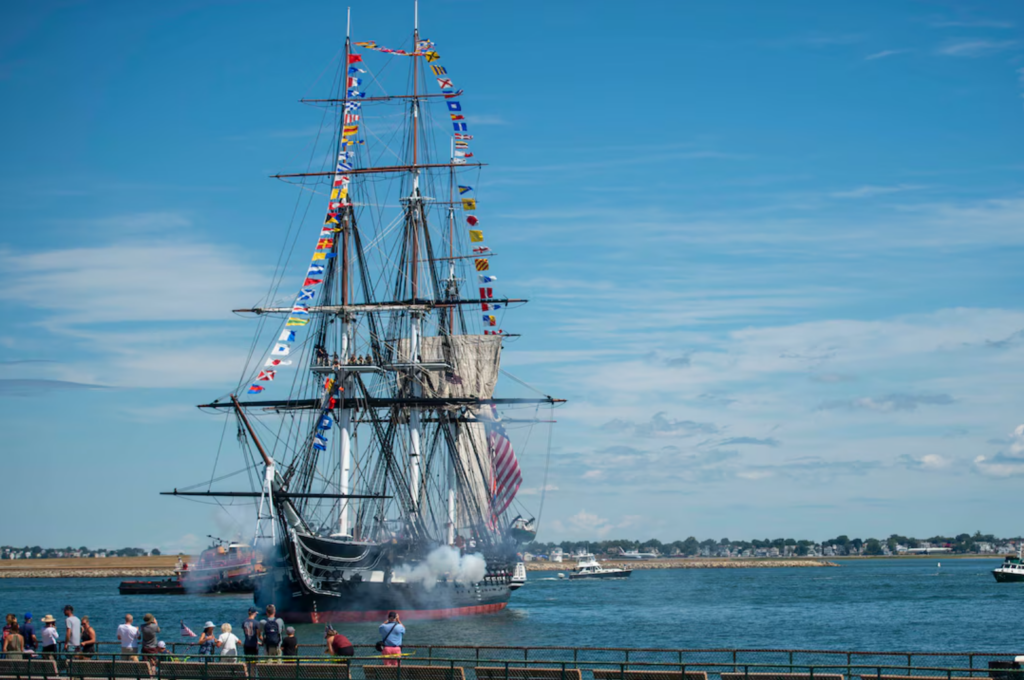
BOSTON (August 12, 2022) USS Constitution fires a 21-gun salute from its saluting batteries off the coast of Castle Island, Mass. (U.S. Navy photo by Airman Austin Jean)
From the Department of the Navy, 28 June 2024
BOSTON – USS Constitution is scheduled to go underway from Charlestown Navy Yard, Massachusetts, on Thursday, July 4, at 10 a.m.
USS Constitution will be closed in the morning and reopen to the public for tours following the underway from 3 p.m. to 6 p.m.
The underway will celebrate the United States’ 248th birthday and will include a 21-gun salute viewable from Fort Independence on Castle Island at approximately 11:30 a.m.
USS Constitution will fire an additional 17-gun salute as she passes the U.S. Coast Guard Sector Boston, the former site of Edmund Hartt’s Shipyard, where USS Constitution was built and launched on Oct. 21, 1797.
USS Constitution’s cruise will be viewable from the Boston Harborwalk, Castle Island, and Charlestown Navy Yard.
USS Constitution is open Tuesday to Sunday from 10 a.m. to 6 p.m. for public visitation.
USS Constitution is the world’s oldest commissioned warship afloat and America’s Ship of State.
She played a crucial role in the Barbary Wars and the War of 1812, actively defending sea lanes from 1797 to 1855.
The active-duty Sailors stationed aboard USS Constitution provide free tours and offer public visitation as they support the ship’s mission of promoting the Navy’s history and maritime heritage and raising awareness of the importance of a sustained naval presence.
USS Constitution was undefeated in 33 at sea engagements with opponents. The ship earned the nickname of Old Ironsides during the War of 1812 when British cannonballs were seen bouncing off the ship’s wooden hull.
June 30 U.S. Central Command Update
From U.S. Central Command
June 30, 2024
TAMPA, Fla. – In the past 24 hours, U.S. Central Command (USCENTCOM) forces conducted a self-defense engagement, destroying three Iranian-backed Houthi uncrewed surface vessels (USVs) in the Red Sea.
It was determined the USVs presented an imminent threat to U.S. and coalition forces, and merchant vessels in the region. These actions were taken to protect freedom of navigation and make international waters safer and more secure.
This continued malign and reckless behavior by the Iranian-backed Houthis threatens regional stability and endangers the lives of mariners across the Red Sea and Gulf of Aden.
Expeditionary Fast Transport to Support SOUTHCOM’s Continuing Promise Goodwill Deployment
SANTA MARTA, Colombia (Aug. 20, 2023) Expeditionary fast transport ship USNS Burlington (T-EFP 10) arrives in Santa Marta, Colombia, Aug. 20, 2023. Continuing Promise 2023 marks the 13th mission to the region since 2007 and the first involving USNS Burlington. The mission will also foster goodwill, strengthen existing partnerships with partner nations, and encourage the establishment of new partnerships among countries, non-government organizations, and international organizations. (U.S. Navy photo by Lt. j.g. Nicko West)
By Richard R. Burgess, Senior Editor
ARLINGTON, Va. — A Spearhead-class expeditionary fast transport, USNS Burlington (T-EPF 10), is scheduled to deploy next week on a voyage to five countries in the Caribbean and Central and South America to provide humanitarian and civic assistance to the population and to promote regional good will under the U.S. Southern Command’s annual Continuing Promise mission.
Making its second such deployment, the Burlington will deploy with more than 100 Sailors, Soldiers, State Department personnel, and crew members to provide medical, veterinary, and construction services, subject-matter exchanges, and cultural exchanges. The ship is crewed by 26 Civil Mariners of the U.S. Military Sealift Command.
The Burlington, making the 14th annual deployment of Continuing Promise since 2007, will visit Jamaica, Costa Rica, Honduras, Columbia, and Panama during the two-month deployment. The countries visited differ from year to year.
“We really try to spread the opportunity around the Caribbean and even — based on resources — to some of the other countries in South America,” said Rear Admiral Jim Aiken, commander, U.S. 4th Fleet and commander, Naval Forces, U.S. Southern Command, speaking to reporters during a June 28 phone conference. “We have a spreadsheet and spend a significant amount of time evaluating [and] assessing where we should go. So, we’re going to a lot of different countries than we did previously. The only one is actually a repeat country from last year is Panama.
“So, going forward, we’ll keep looking for different opportunities and different engagements,” Aiken said. “This is based on a couple of things. First of all, there has to be a working relationship where there’s a need and a desire. The second thing is that we look at it and we really want to try to be strategic where there’s ‘no kidding’ need.
Aiken listed the mission sets of the deployment as medical and veterinary assistance; humanitarian and disaster relief discussions; civil construction, bio-medical assistance, and the State Department’s Women, Peace, and Security Program discussions.
He said the USNS Comfort is available for the Continuing Promise deployment “every two or three years,” with the ship planned for next year.
While the Burlington, smaller than the Comfort, brings the assistance teams to port, the teams actually conduct their medical assistance in hospitals ashore side-by-side with local teams.
Aiken mentioned that the “Navy staff has decided to convert a number of EPFs into hospital-like assets that actually could support surgeries and care actually on board.”
“Both numerically and qualitatively, Continuing Promise has been one of the most impactful humanitarian missions in the U.S. Navy’s history,” said Lieutenant Commander. Cmdr. Zachary Smith, the mission commander the operation. “The mission is a symbol of our long-standing commitment to the nations and people of Latin America and the Caribbean.
“We’ve delivered on our promises,” Smith said. “Working hand-in-hand with our partners we delivered over the course of the history of the mission more than 600,000 medical treatments, over 7,000 surgeries, and countless constructions projects, … and community relations events. Previous iterations of the mission have been extremely successful, and we anticipate making just as much of an impact this year.”
According to a Navy release, ”30 U.S. Navy medical professionals, including general practitioners, nurses, pharmacists, radiologists, dentists, optometrists, and biomedical technicians from Navy Medicine Readiness and Training Command (NMRTC Portsmouth, NMRTC Jacksonville, NMRTC Great Lakes, NMRTC Pensacola, NMRTC Camp Lejeune) and Naval Medicine Readiness and Logistics Command bring their expertise to this year’s iteration of Continuing Promise.
“The Continuing Promise team includes a U.S. Army veterinary team from the 248th Medical Detachment (Veterinary Service Support), which will collaborate with host nation colleagues to provide direct public health education and animal care at local veterinary organizations in-country,” the release said. “U.S. Navy Seabees from Navy Mobile Construction Battalion 1 will assist in host nation led community engineering projects. U.S. Navy experts will host seminars and training exercises with host nation civilian officials and military professionals covering disaster preparedness and response. These exchanges aim to support host nation facilities, improve readiness, and empower local and national officials with the knowledge and experience to act with confidence during emergencies.”
“This is a very special mission for me because I’ve seen it many times firsthand in my nearly three years in this assignment, Aiken said. “This is our shared neighborhood. We have friends and we have partners, and we enjoy the side-by-side that we have with each and every one of them. We learn from them, and they learn from us.”
The admiral recalled a previous Continuing Promise deployment to Columbia and being approached by a citizen who had been assisted during a Continuing Promise four years prior by the medical team on board the hospital ship USNS Comfort. The person was given surgery on his palate. He approached, saying that the surgery “changed my life so much, and instead of me being ridiculed by my schoolmates I am now able to live a normal life. … I just wanted to come back and say, Thank you.’”
“That’s the reason why I still get excited about this and every time we do this,” Aiken said.
Coast Guard Commissions First Pacific Northwest-Based Fast Response Cutter
Coast Guard Cutter David Duren (WPC 1156) transits near the Cape Disappointment Lighthouse as it enters the Columbia River near Astoria, Ore., for the first time on May 20, 2024. (U.S. Coast Guard photo by Petty Officer 2nd Class Steven Strohmaier)
From U.S. Coast Guard 13th District, June 28, 2024
ASTORIA, Ore. — The Coast Guard commissioned its 56th Fast Response Cutter and first one to be stationed in the Pacific Northwest during a ceremony held in Astoria, Ore., Thursday.
Coast Guard Cutter David Duren (WPC-1156) is the first of three planned Fast Response Cutter’s (FRC) to be homeported in Astoria.
The ceremony was presided by Vice Adm. Andrew Tiongson, Pacific Area Commander. Members from the Duren family were also on hand, including the cutter’s sponsor, Dawn Duren.
The namesake for the cutter, Master Chief Petty Officer David Duren, enlisted in the Coast Guard in 1965 and retired in 1993. During his career, Duren became a heavy weather coxswain and graduated from the Coast Guard’s National Motor Lifeboat School in 1969, qualifying as Coast Guard surfman No. 100.
During his tenure, Duren received two Coast Guard Medals for exceptional heroism and the Douglas Munro Inspirational Leadership Award. He deployed on search and rescue cases more than any other officer-in-charge at the time and during one year, he participated in 250 cases. Personnel under his command received a total of 24 medals and awards.
The crew of the David Duren will primarily serve in the Pacific Ocean, Puget Sound, Strait of Juan de Fuca, and the Columbia River. The Sentinel-class FRC is designed for multiple missions, including search and rescue; fishery patrols; ports, waterways, and coastal security; drug and migrant interdiction; and national defense.
The Coast Guard has ordered a total of 65 FRCs to replace the 1980s-era Island-class 110-foot patrol boats. The FRCs feature advanced command, control, communications, computers, intelligence, surveillance and reconnaissance equipment; over-the-horizon cutter boat deployment to reach vessels of interest; and improved habitability and seakeeping.
The commissioning ceremony is one of the most important traditional milestones in the life of a cutter, as it represents the readiness of the cutter to conduct Coast Guard operations and marks her entry into active service.
June 27 U.S. Central Command Update
From U.S. Central Command
June 27, 2024
TAMPA, Fla. – In the past 24 hours, U.S. Central Command (CENTCOM) forces successfully destroyed one uncrewed aerial system (UAS) launched by Iranian-backed Houthis into the Red Sea. It was determined this UAS presented an imminent threat to U.S., coalition forces, and merchant vessels in the region.
This action was taken to protect freedom of navigation and make international waters safer and more secure.
This continued malign and reckless behavior by the Iranian-backed Houthis threatens regional stability and endangers the lives of mariners across the Red Sea and Gulf of Aden.
BlueHalo Selected for U.S. Army Next Generation C-UAS Missile
From BlueHalo, June 27, 2024
The U.S. Army Combat Capabilities Development Command Aviation & Missile Center (CCDC AvMC) Aviation & Missile Technology Consortium® (AMTC) has down-selected BlueHalo as one of two vendors to move forward for the development of the Next-Generation Counter-Uncrewed Aerial System (C-UAS) Missile (NGCM). BlueHalo is leveraging a long corporate heritage in proven C-UAS technologies to expand its layered defense solutions with a long-range missile–entering the kinetic interceptor market space and providing an agile and alternate prime within the industrial base to counter the rapidly evolving threats.
“As we’ve seen in Ukraine, Jordan, Israel, and the Red Sea, drone attacks are increasing in number, sophistication, speed, and size–representing the fastest evolving threat vector of the modern era,” said Jonathan Moneymaker, BlueHalo Chief Executive Officer. “Adding the increased range, reduced time-to-target, and rapid launch capabilities of our technically superior NGCM to BlueHalo’s operational, industry-defining RF and directed energy C-UAS solutions gives unmatched, layered protection to our warfighters, allies, and assets. We are honored to work alongside AMTC to expand our nation’s kinetic C-UAS capabilities and continue BlueHalo’s legacy of delivering next-generation defense technology into the hands of the warfighter.”
Last fall, BlueHalo revealed its NGCM in response to the U.S. Government request for a more advanced C-UAS missile technology to meet the pacing threat. NGCM goes beyond current capabilities to increase lethality and range against Group 3 UAS and other larger air threats while –enabling a rapid delivery timeline to get the technology to the frontlines quicker and more cost-effectively than alternatives.
“BlueHalo’s NGCM provides an agile, disruptive, technically superior interceptor to the munition industrial base, delivering unmatched protection to our warfighters and transforming our nation’s air defense systems at mission speed,” said Jimmy Jenkins, General Manager, Defense Sector, and a former air defender in the US Army.
BlueHalo is the leading provider of innovative, effective C-UAS solutions for national defense customers providing critical products to essential Programs of Record with the Department of Defense. The company’s SkyView system offers autonomous radio-frequency (RF) detection and precision tracking of small UAS. Titan, another RF-based C-UAS solution from BlueHalo, can detect, track, and force drones to safely land without disrupting nearby communications or electronics. BlueHalo’s LOCUST Directed Energy Laser Weapon System combines precision optical and laser hardware with advanced software, artificial intelligence, and processing. It has been successfully delivered and operationally deployed to identify, track, and engage a wide variety of targets with its hard-kill High Energy Laser. NGCM expands BlueHalo’s portfolio of layered C-UAS air defense technologies to deliver best-in-class solutions to warfighters.
Kratos’ Erinyes Hypersonic Test Bed Makes First Flight
From Kratos Defense & Security Solutions, June 27, 2024
SAN DIEGO, June 27, 2024 (GLOBE NEWSWIRE) – Kratos Defense & Security Solutions, Inc. (Nasdaq: KTOS), a technology company in the defense, national security and global markets, announced today that its Space & Missile Defense Systems Business Unit, a part of Kratos’ Defense & Rocket Support Systems (DRSS) Division, supported the Missile Defense Agency (MDA) and the Naval Surface Warfare Center (NSWC), in the successful launch and flight of the Kratos Erinyes™ Hypersonic Test Bed, on June 12, 2024, from the NASA Wallops Flight Facility (WFF) in Virginia. This successful first flight of the Erinyes vehicle demonstrates a new and novel platform capability for rapid hypersonic experimentation for the U.S. Department of Defense.
The exercise, designated Hypersonic Test Bed-1 (HTB-1), demonstrated hypersonic flight that enabled the collection of data for multiple experiments to be provided to test teams for design validation and evaluation of new technologies.
“Hypersonic experimenters now have a robust and affordable path across the TRL [Technology Readiness Level]. The ability to demonstrate experimental technologies on a real hypersonic flight testbed, without adding risk to programs of record, is game-changing,” stated Dave Carter, president of Kratos’ DRSS Division. “Following this success, we will turn to preparing for our next test, incorporating a new set of experiments. I couldn’t be prouder of our team.”
Eric DeMarco, president and CEO of Kratos, said, “The 100% successful flight of the Kratos Erinyes hypersonic vehicle with our MDA and Navy partners is representative of the power of Kratos’ approach to be first to market with leading technology systems and products, which accelerates development and delivery schedules, while significantly reducing cost. Kratos’ Rocket and Hypersonic systems development programs are positioned to disrupt the market with affordable, relevant systems, and we expect Kratos’ hypersonic franchise, including Erinyes, Zeus, Oriole and other systems to be a key contributor to our expected future organic growth trajectory. Kratos is laser focused on expanding the U.S. National Security Industrial Base, increasing competition, reducing cost and delivering significant value to all Kratos stakeholders, including the MDA, U.S. Navy and other Government customers. Kratos has served the U.S. hypersonic community for decades through novel system and vehicle flight testing.”
Strategic Systems Programs Promotes Workforce Modernization At Nuclear Triad Symposium
By Shelby Thompson, 26 June 2024
SHREVEPORT, La. – SHREVEPORT, La. – Strategic Systems Programs (SSP) represented the Navy’s leg of the nuclear triad during the 25th Annual Nuclear Triad Symposium held on the Louisiana State University (LSU) Shreveport campus June 20th.
Representatives from across the nuclear triad, including Air Force Global Strike Command (AFGSC) and industry partners, advocated for increased focus on workforce needs, small business collaboration, and mentorship programs throughout the nuclear enterprise.
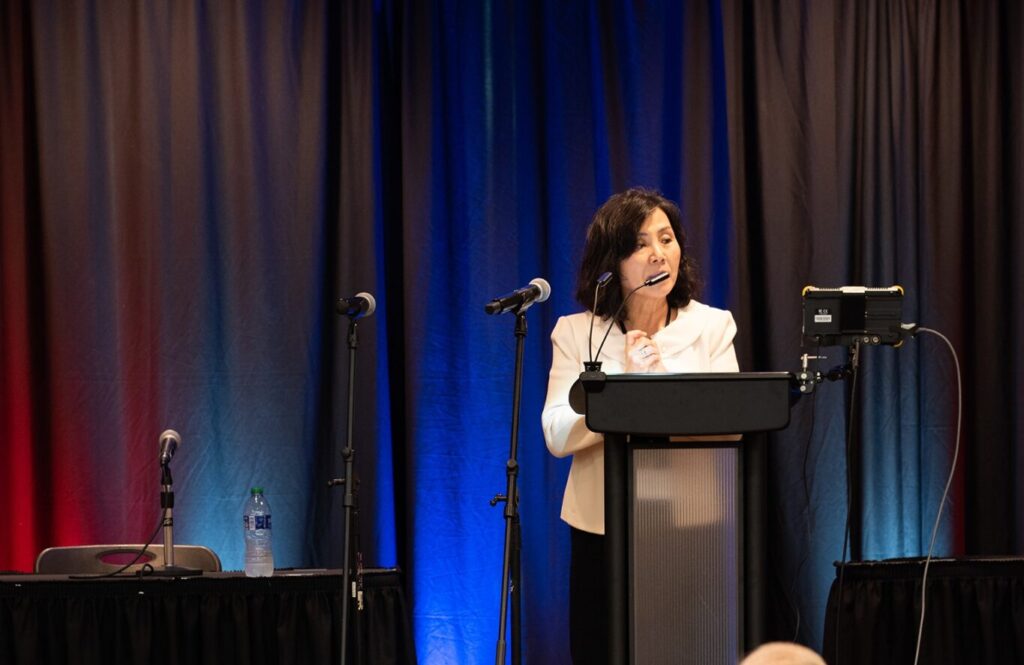
SSP’s Director of Plans and Programs Kelly Lee—also a member of the Senior Executive Service—addressed areas SSP is modernizing in order to maintain the reliability, accuracy, and safety of the current sea-based strategic weapon system – known as Trident II D5 Life Extension (D5LE), while concurrently developing the future strategic weapon system.
“In order to achieve Sea-Based Strategic Deterrence 2084, SSP has developed a strategic plan that outlines our program priorities and the key enablers to support the modernization of the strategic weapons system to counter emerging and future threats,” said Ms. Lee, who oversees the development and execution of the program plans and budget for the strategic weapons system.
Modernization touches every inch of the nuclear enterprise; however, Ms. Lee narrowed that scope into three discreet themes: modernizing SSP’s workforce, modernizing industry and infrastructure, and modernizing the nuclear triad through collaboration across the services.
Aligning with the 2022 Nuclear Posture Review’s call to action to develop a “capable, motivate [nuclear enterprise] workforce,” Ms. Lee zeroed in on people as the real strategic assets for both the Navy and Air Force.
“We need a good talent pipeline to support sustainment and modernization,” she said.
“Without people, there are no weapons systems.”
“We are at an inflection point for industry and government as we modernize,” added Jeffrey Duncan, Vice President of Systems Engineering at JRC Integrated Systems, Inc., advocating for industry to invest in bringing in employees new to the nuclear enterprise.
“We need to introduce new people into the ecosystem.”
LSU Shreveport’s selection for these annual gatherings is not a coincidence. Barksdale Air Force Base, home of AFGSC, is located right next door and maintains close ties with the Shreveport-Bossier City community. This close proximity is a daily reminder that strategic deterrence is a local, as well as a national, endeavor.
Shreveport Mayor Tom Arceneaux, kicked off the symposium by reminding attendees how important the nuclear triad is to the nation and the close-knit local community.
“You are here to make sure we keep peace in the world,” he said.
AFGSC’s responsibility for two of the three legs of the nuclear triad – the strategic bomber force and Intercontinental Ballistic Missiles - makes it a crucial pillar of the nation’s national security strategy. SSP, the Navy command that provides cradle-to-grave lifecycle support for the sea-based leg of the nation’s nuclear triad, collaborates closely with the Air Force to manage the increased demands of modernization and development that both services face.
“Strategic deterrence is a team sport, and all three legs are needed to win,” said Ms. Lee.
“The entire team must work together to leverage each other’s strengths and apply lessons learns.”
Hosted by LSU’s Strategy Alternatives Consortium (SAC), the Nuclear Triad Symposium’s mission is “to advance national policies, plans, strategies, resources, and professionals” in the realm of strategic deterrence, specifically through exploring the role of the U.S. Air Forces’ strategic deterrent history and present-day mission.
A credible, effective nuclear deterrent is essential to our national security and the security of U.S. allies. Deterrence remains a cornerstone of national security policy in the 21st century.
SLBMs are one leg of the nation’s strategic nuclear deterrent Triad that also includes the U.S. Air Force’s intercontinental ballistic missiles (ICBM) and nuclear-capable bombers. Each part of the Triad provides unique capabilities and advantages.
SLBMs make up the majority – approximately 70 percent – of the U.S.’s deployed strategic nuclear deterrent Triad. The SLBM is the most survivable, provides persistent presence, and allows flexible concept of operations.
Boeing Completes F/A-18 Super Hornet Upgrade Ahead of Schedule
– Boeing delivers first two Service Life Modification (SLM) Block III fighters from two locations – St. Louis and San Antonio
– Public-Private Partnership agreement with Navy opens third Block III SLM production line
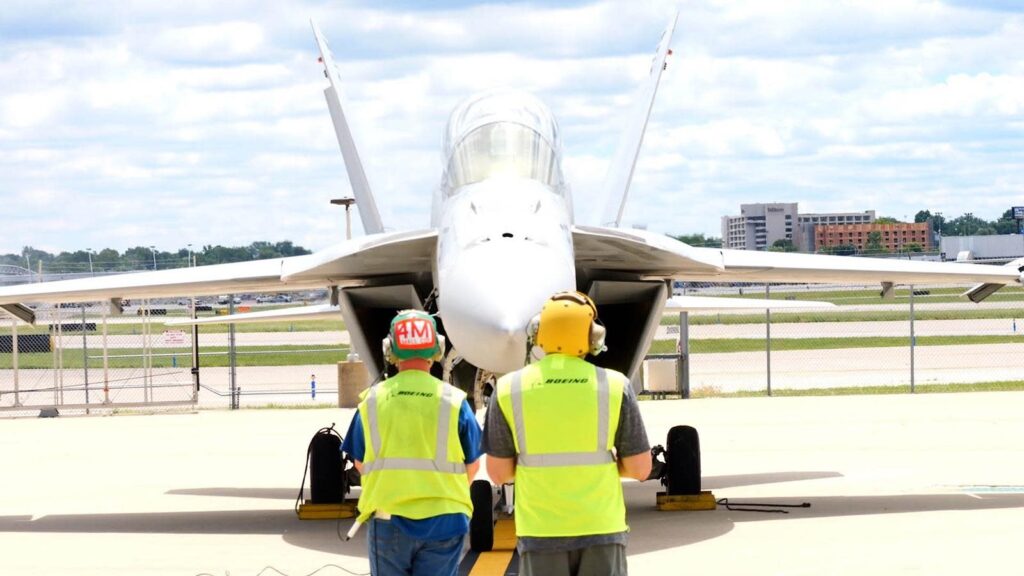
ST. LOUIS, June 27, 2024 — Boeing [NYSE: BA] has completed the upgrade and life extension of the first two service life modification (SLM) F/A-18 Block III Super Hornets, delivering them to the U.S. Navy one month ahead of schedule from St. Louis and two months ahead of schedule from San Antonio. The upgraded jets have the same capabilities as Super Hornets being delivered from Boeing’s new-build production line.
“Our success in meeting the accelerated timeline is proof our service life modification game plan is working,” said Faye Dixon, Boeing SLM director. “Thanks to our years of learning on the program and our partnership with the Navy, the F/A-18 Super Hornet remains at the forefront of defense technology with renewed years of service to support the fleet.”
In partnership with the Navy, Boeing has improved productivity and is completing Block III upgrades ahead of the 15-month contract requirement. This was made possible by:
Establishing a baseline for the condition of Block II F/A-18s received at Boeing, and the Navy’s work to prepare the jets in advance.
Sharing information and best practices across multiple SLM sites to improve efficiency, manage workload distribution and optimize resource allocations.
“Great measures were taken by the Boeing and Navy teams to ensure these are the safest and most capable Block III F/A-18s we can give our warfighters,” said Mark Sears, Boeing Fighters vice president. “These are just the first of many deliveries, with around 15 years of SLM deliveries to go. Our warfighters are counting on us to get this right every time.”
Block III upgrades include a large area display and more powerful computing through Tactical Targeting Network Technology and a Distributed Targeting Processor-Networked open mission systems processor. The work is being done at Boeing sites in St. Louis and San Antonio, and at the Navy’s Fleet Readiness Center Southwest in San Diego.
Boeing and the Fleet Readiness Center Southwest signed a Public-Private Partnership agreement in March to expand the work scope at the command, paving the way for the readiness center to now perform the same Block III SLM work done in St. Louis and San Antonio.
“These first deliveries of Block III SLM jets are a major milestone in our continued efforts to ensure capability, reliability, availability and maintainability of the Super Hornet aircraft,” said Capt. Michael Burks, program manager for the F/A-18 and EA-18G Program Office. “We look forward to our continued partnership with Boeing to deliver this critical warfighting capability to the fleet.”
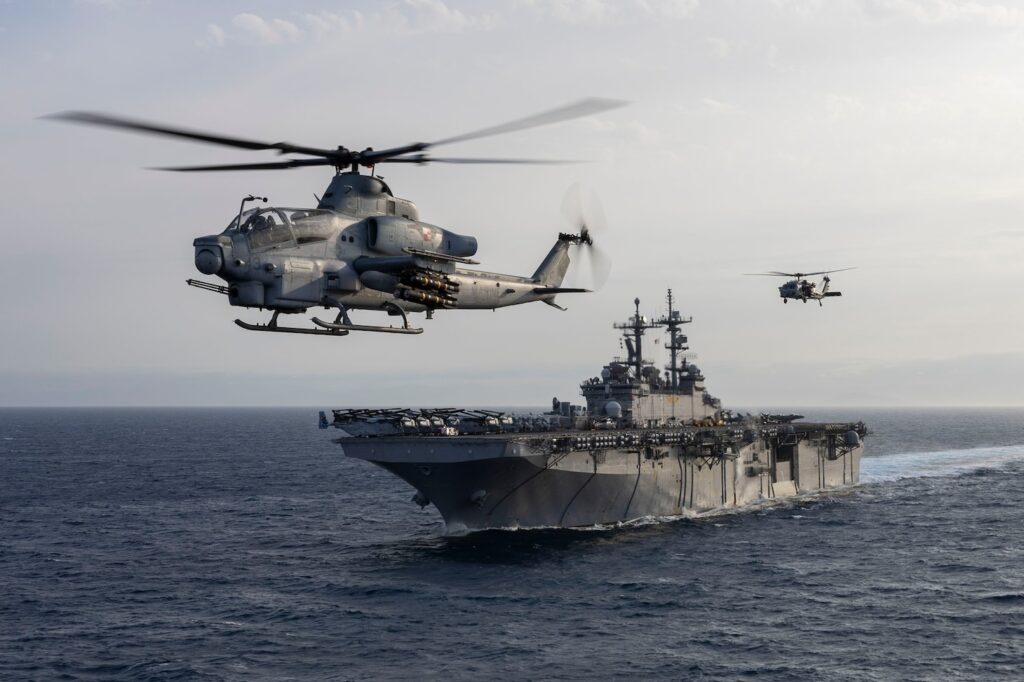
USS Wasp Transits Through the Strait of Gibraltar
STRAIT OF GIBRALTAR (June, 26, 2024) An AH-1Z Viper, left, assigned to the “Blue Knights” of Marine Medium Tiltrotor Squadron (VMM) 365 (Reinforced), and an MH-60S Sea Hawk, assigned to the “Dragon Whales” of Helicopter Sea Combat Squadron (HSC) 28, flies patrol as the amphibious assault ship USS Wasp (LHD 1) transits the Strait of Gibraltar, June 26, 2024. (U.S. Navy photo by MC2 Sydney Milligan)
By Lt. Mckensey Cobb, June 27, 2024
STRAIT OF GIBRALTAR – The amphibious assault ship USS Wasp (LHD 1), flagship of the Wasp Amphibious Ready Group (WSP ARG) and embarked 24th Marine Expeditionary Unit (MEU) Special Operations Capable (SOC) transited the Strait of Gibraltar and entered the Mediterranean Sea, June 26.
Upon arrival in the Mediterranean Sea, Wasp will reunite with the Harpers Ferry-class amphibious landing dock ship USS Oak Hill (LSD 51), one of two other ships in the WSP ARG. Oak Hill conducted a Strait of Gibraltar transit, June 18, after participating in D-Day 80 commemoration celebrations in Cherbourg, France.
“There is an inherent flexibility to the type of missions an ARG-MEU can support,” said Capt. Nakia Cooper, commodore of Amphibious Squadron 4, embarked aboard Wasp. “Our ability to operate effectively as distributed force gives the ARG-MEU that flexibility. Each of our ships is capable of conducting amphibious operations, crisis response, and limited contingency operations on their own, but there is no substitute for the type of combat power we bring to the fight when we constitute as an Amphibious Ready Group.”
While in the NAVEUR-NAVAF area of operations, Wasp will work alongside allied and partner maritime forces, focusing on theater security cooperation efforts to further regional stability and demonstrate the strong maritime partnership between the U.S. and allies and partners.
This marks the first time that Wasp has operated in the Mediterranean region since its homeport shift from Sasebo, Japan to Norfolk, Virginia in 2019, after which the crew completed an extensive maintenance availability followed by a robust pre-deployment training program culminating in Composite Training Unit Exercise, which certified the ship, and all embarked commands, to deploy.
“Wasp is truly the number one ship in the fleet,” said Capt. Chris “Chewie” Purcell, Wasp’s commanding officer. “We’ve all worked tirelessly to reach this point. I am grateful for the energy our Sailors and Marines bring to the fight each day and confident they will meet every challenge head on over the coming months.”
Wasp has been underway conducting operations in the Atlantic Ocean since early April and recently departed the Baltic Sea after participating in Baltic Operations 2024 (BALTOPS 24).
The Wasp Amphibious Readiness Group consists of the amphibious assault ship USS Wasp (LHD 1), San Antonio-class amphibious transport dock ship USS New York (LPD 21), Harpers Ferry class dock landing ship USS Oak Hill (LSD 51), and embarked 24th Marine Expeditionary Unit (MEU).
The 24th MEU (SOC) is a Marine Air-Ground Task Force (MAGTF) providing strategic speed and agility, ensuring our Marines are prepared to respond and protect U.S. national security interests around the globe. The MEU can respond rapidly from longer ranges with greater capabilities across the spectrum of military conflict.
You can follow USS Wasp’s adventures on Facebook and Instagram (@usswasp_lhd1).
To learn more about WSP ARG and 24th MEU (SOC) “Team of Teams,” visit their DVIDS feature page at https://www.dvidshub.net/feature/wasparg24thmeu.