Amphibious Combat Vehicles Conduct Egress Training, Mark First Time Ashore Overseas in Okinawa

From the 15th Marine Expeditionary Unit 

OKINAWA, Japan (June 24, 2024) – The 15th Marine Expeditionary Unit conducted the first overseas ship-to-shore operations with Amphibious Combat Vehicles June 24, 2024, at White Beach Naval Facility, Okinawa, Japan.  

Elements of the 15th MEU, embarked aboard the amphibious dock landing ship USS Harpers Ferry (LSD 49), arrived at White Beach June 18 for a port visit and to conduct sustainment training.  

During the training June 24, the Marines and Sailors of Alpha Company, Battalion Landing Team 1/5, 15th MEU, embarked the ACVs as they splashed from the well deck of Harpers Ferry. Safety boats assigned to 3rd Expeditionary Operations Training Group then pulled alongside the ACVs to transfer personnel to their boats and back to the pier, simulating a situation that required personnel to execute safety egress procedures.  

Following the transfer of all embarked personnel, the ACV Platoon then transited through the nearby boat basin to come ashore at the White Beach area to conduct maintenance.  

“This was fairly standard training for us, but I’m proud it also represented the first overseas ship-to-shore employment of ACVs,” said U.S. Marine Corps Lt. Col. Nick Freeman, commanding officer of BLT 1/5, 15th MEU. “We’ll continue to train at other locations in the months ahead, using a deliberate approach, capturing useful data and lessons learned, and ultimately sharpening our understanding of how to best employ the ACV in its intended environment — embarked with our forward-deployed ARG/MEUs.”  

In the days prior to the ACV amphibious operations, commanders from III Marine Expeditionary Force, 3rd Marine Division, 3rd Marine Expeditionary Brigade, Task Force 76, and Amphibious Rapid Deployment Brigade of the Japanese Self Defense Force and other commands visited 15th MEU aboard Harpers Ferry on June 20. This visit included a tour of the amphibious combat vehicles staged aboard Harpers Ferry, the ship’s well deck, the ACV simulator, and a demonstration of an unmanned hydrographic sensor. See imagery of this visit on DVIDS here. Some of the VIPs also returned to observe the ACV egress training.  

Marines and Sailors of Alpha Company, BLT 1/5, are scheduled to host Marines of Battalion Landing Team 1/4, their counterpart unit assigned to the 31st MEU, at White Beach for a subject matter expert exchange about expeditionary ACV operations. The hands-on exchange will include topics such as well deck operations, vehicle handling, maintenance, embarked troops and amphibious operations.  

The 15th MEU’s Reconnaissance Company is also scheduled to pair with other U.S. military units in the area in the coming days to conduct integrated maritime interdiction operations. The teams will plan, rehearse and execute a simulated visit, board, search and seizure mission using small boats to climb aboard Harpers Ferry and clear key objective areas together to improve their ability to conduct these types of specialized missions.  

“Although this was a routinely-scheduled port visit, both Harpers Ferry and the 15th MEU took advantage of the time to conduct sustainment training to enhance their readiness and cross-train with other Navy and Marine Corps units to strengthen our force,” said U.S. Navy Rear Adm. Chris Stone, commander, Task Force 76 and Expeditionary Strike Group 7. “It was incredible to see the ACVs in operation, as they truly are a force multiplier in this area of operations.”  

The 15th MEU is under the command and control of Commander, Task Force 76, which the U.S. 7th Fleet employs to cooperate with allies and partners to preserve a free and open Indo-Pacific.  

As the U.S. 7th Fleet’s primary Navy advisor on amphibious matters in the 7th Fleet area of operations, CTF 76 is responsible for conducting expeditionary warfare operations to support a full range of theater contingencies, ranging from humanitarian assistance and disaster relief operations to full combat operations.  


Keel Authenticated for Future USNS Sojourner Truth 

By Team Ships Strategic Operations, June 21, 2024 

SAN DIEGO – The keel for the future USNS Sojourner Truth (T-AO 210), a John Lewis-class fleet replenishment oiler, was authenticated at General Dynamics (GD) NASSCO, June 21. 

The ship is named for human rights pioneer Sojourner Truth, an abolitionist and women’s rights activist. 

A keel laying ceremony represents the joining together of the ship’s modular components at the land level. During the ceremony, the keel is authenticated when a welder etches the initials of the ship sponsor into the ceremonial keel plate, which will sail with the ship throughout its service life. The ship sponsor is Marian Wright Edelman, civil rights trailblazer and Founder and President Emerita of the Children’s Defense Fund.  

“The future USNS Sojourner Truth will aid in expanding refueling capability at sea,” said John Lighthammer, program manager, Auxiliary and Special Mission Ships, Program Executive Office (PEO) Ships. “This ship honors the legacy of a woman of great character and determination and the ship will bring the critical capacity needed to the fleet in often rapidly changing environments.” 

The John Lewis-class of ships is operated by the Military Sealift Command and the oilers feature substantial volume for oil, a significant dry cargo capacity and aviation capability. T-AOs provide additional capacity to the Navy’s Combat Logistical Force and become the cornerstone of the fuel delivery system. 

PEO Ships, one of the Department of Defense’s largest acquisition organization, is responsible for executing the development and procurement of all destroyers, amphibious ships and craft, auxiliary ships, special mission ships, sealift ships and support ships. 


Eisenhower Carrier Strike Group Departing the CENTCOM Area of Responsibility 

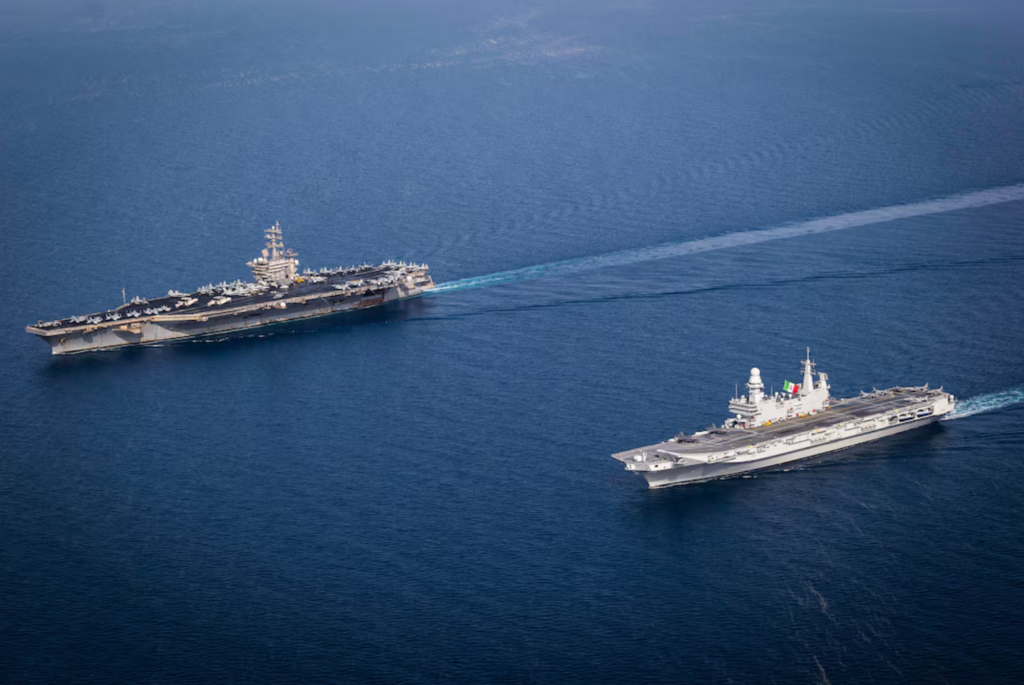
RED SEA (June 7, 2024) The Nimitz-class aircraft carrier USS Dwight D. Eisenhower (CVN 69) and the Italian aircraft carrier ITS Cavour (CVH 550) steam in formation in the Red Sea, June 7, 2024. (U.S. Navy photo courtesy of the Italian navy) 

From the U.S. Department of Defense, June 22, 2024 

ARLINGTON, Va.–Pentagon Press Secretary Maj. Gen. Pat Ryder provided the following statement:  

The Dwight D. Eisenhower Carrier Strike Group (IKE CSG) departed the U.S. Central Command area of responsibility today and will remain briefly in the U.S. European Command area of responsibility before returning home after more than seven months deployed in support of U.S. regional deterrence and force protection efforts. Following completion of a scheduled exercise in the Indo-Pacific, the USS Theodore Roosevelt Carrier Strike Group (TR CSG) will arrive in the U.S. Central Command’s area of responsibility to continue promoting regional stability, deter aggression, and protect the free flow of commerce in the region.  

During its deployment, the IKE CSG protected ships transiting the Red Sea, Bab-el-Mandeb and the Gulf Aden, rescued innocent mariners against the unlawful attacks from the Iranian-backed Houthis, and helped to deter further aggression. 

Next week, the TR CSG will depart the Indo-Pacific for the U.S. Central Command area of responsibility. The United States will continue to maintain a robust presence in the Indo-Pacific region to strengthen peace, stability, and deterrence alongside allies and partners. 


Iron Mountain Anticipates Increase in Work for the Navy Under GPO Contract 

ARLINGTON, Va. — An information technology company expects its business with the U.S Department of the Navy to increase as task orders come under a government contract from the U.S. Government Printing Office (GPO) for document scanning and conversion services. 

In late April, the GPO awarded Iron Mountain a contract “to provide off-site document conversion and scanning services for the Defense Logistics Agency (DLA)” the GPO announcement said. “The contract covers a range of services including document preparation, scanning, optical character recognition (OCR), indexing, and output to various media. The estimated value of the contract is not specified, but it indicates 15-25 orders per year, with 5-10 being multi-year efforts, and scanning requirements ranging from 1,000 to 9,000,000 images per order. The contract term is from April 26, 2024, through February 28, 2025, with up to four 12-month option periods.” 

“Currently, with the Navy, we are kind of in our infancy in joining and partnering with them,” said Melissa Carson, general manager of Iron Mountain’s Government Solutions Group. “The thing we have with them is the traditional Iron Mountain business, records information management. We have a BPA [blanket purchase agreement] with them, a master agreement with them [the Navy’s records office], to help them with all their record storage needs across the whole naval installation. 

Iron Mountain provides records management and storage services to federal, state, and local governments as well as public education institutions. The company, with corporate headquarters in Nashua, New Hampshire, maintains 1,400 sites across the world in 110 countries. The company’s Government Solutions Group is based in Herndon, Virginia. 

Carson said the company also has partnered with some of the system integrators and has acquired some other companies. 

“We actually have made a couple of acquisitions here in the last couple of years and really have a robust solution that takes all this e-waste within that ecosystem and not only just takes it off their hands securely,” she said. “We’ve got proprietary software that does the data erasure that meets DoD standards off of hard drives, but also with the recent acquisition of Regency, we actually now have a goal of recycling components. We take it down to bare metals and are able to actually only put 8% in the landfill.” 

Iron Mountain digitized all of the Veterans Administration’s personnel files, part of which involved digitization of a million boxes of records. 

Iron Mountain expects task orders from the Navy similar to its work for the Veterans Administration. 

“Iron Mountain can do intelligent document processing with Insight AI [artificial intelligence], with one touch, create the image, classify it for records storage and retention, along with the metadata off of it,” Carson said, noting that her company can pass the data and images back to the agency—the usual scenario–or provide off-site storage. 

“We now with this Insight tool, have used the power of AI and machine learning models with natural language models behind it,” she said. “We’re now able to do millions of documents a month with 30% less labor, equipment, and facilities. We’ve been able to absolutely increase that capability and throughput so that one is lower priced — because it was also [prohibitively] expensive for many of these agencies to even start with that — so it’s not only saved that but it’s also eight times faster. So that’s why we’re able to digitize millions [of records] in a month.” 

Carson pointed to one example: “For a large financial agency in the government we were able to do a billion images in less than a year at 96% accuracy of pulling data off of these records. The old-fashioned way would have taken 30 years by 800 people. 

“Many agencies are finally getting policy changes so that once it is digitized, they do not have to hold on to that paper record,” she said. “Iron Mountain is full-life cycle: “We take it and shred it and we put all of that paper back into the paper industry. We are one of their biggest suppliers to be able to trade with recycled paper.” 
 

The tedious task of scanning documents has led to improvements in scanning technology. 

“We’ve been very influential with the scanning equipment suppliers,” Carson said. “We’ve forced them to innovate, too, so there is a particular machine that we’re actually using for the IRS [Internal Revenue Service]. We are actually taking their paper tax returns — so about nine million people still file with paper — and they come in crumpled, with coffee stains and all that. With this new scanning technology, we don’t need to do all of that repair anymore. Literally, it is sensitive enough that you scan it through even with a tear, even with coffee stains, even rumpled, and it looks like a perfectly good piece of paper.”  

Iron Mountain even has infrared scanners for fragile old onion-skin paper that never touches the paper.  

The company is working to make data storage technology more robust, and “future-proof,” to avoid obsolescence overtaking the technology and ensuring that digital records are accessible and readable. The company also maintains an inventory of obsolete technology in order to read older analog and digital records. 


SECNAV Names Future Guided Missile Frigate USS Galvez (FFG 67) 

From SECNAV Public Affairs, 21 June 2024 

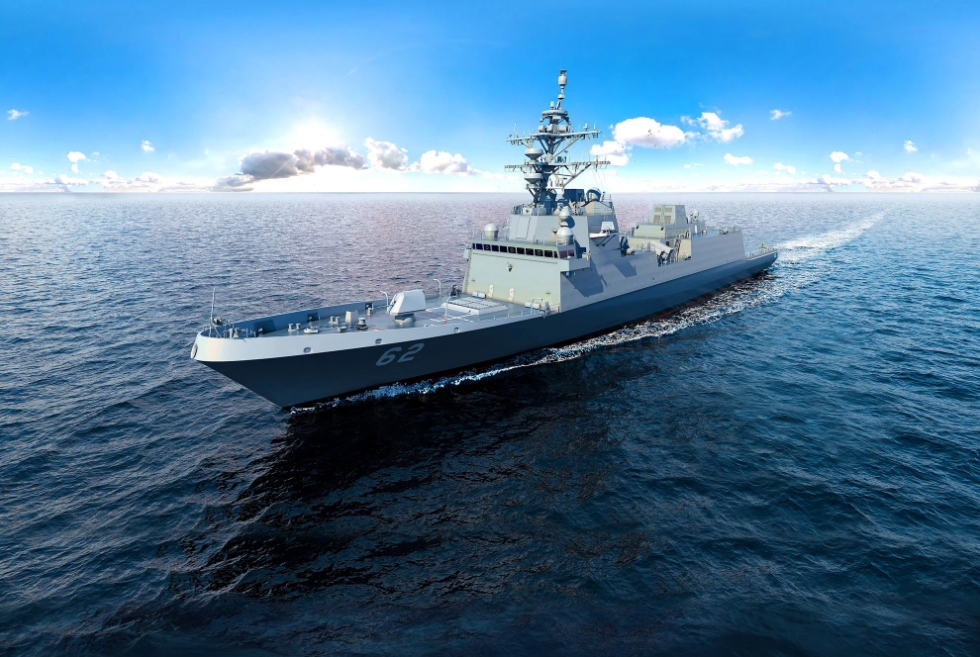
MADRID – Secretary of the Navy Carlos Del Toro announced that a future Constellation-class Guided Missile Frigate, FFG 67, will be named USS Galvez, June 21. 

Secretary Del Toro made the announcement while joining U.S. Ambassador to Spain Julissa Reynoso Pantaleón and Chief of Staff of the Spanish Navy, Admiral Antonio Pineiro, in Madrid, Spain, for the U.S. Embassy’s Fourth of July Celebration. 

The future USS Galvez honors Conde Bernardo de Gálvez y Madrid and his service during the American Revolutionary War.  This will be the first U.S. Navy vessel named for Gálvez. 

“Gálvez wasn’t just a supporter from afar—his actions directly influenced the course of the war and helped secure American Independence,” said Secretary Del Toro. “That is why, in his homeland, I am incredibly pleased to announce that our next Constellation-class frigate, FFG 67, will be named the USS Gálvez.” 

During the American Revolution, Gálvez provided supplies, intelligence, and military support to the American colonists and led military victories for Spain against Great Britain.  As governor of Spain’s territory in Louisiana, he covertly worked with American agent Oliver Pollock in 1777 to transfer money, gunpowder, and vital supplies to colonial forces.  

In his direct service to Spain, Gálvez recruited an army of 7,500 men made up of Spanish, French, African American, Mexican, Cuban, and Anglo-American forces.  In 1779–1780, his forces defeated the British at Battles in Baton Rouge, Louisiana; Natchez, Mississippi; and Mobile, Alabama.  In 1781, he successfully seized Pensacola, Florida, and was wounded during the fighting.  His contributions were recognized by George Washington as a decisive factor in the outcome of the Revolutionary War.  

After the Revolutionary War, Gálvez led an effort to chart the Gulf of Mexico, including Galveston Bay, and served as the viceroy of New Spain.  In 2014, the United States Congress passed Public Law No. 113-229, granting him honorary citizenship of the United States—making him one of only eight honorary citizens in U.S. history. 

The future USS Galvez, the sixth of the new Constellation-class frigates, was appropriated in 2024. The other ships in the class are USS Constellation (FFG 62), USS Congress (FFG 63), USS Chesapeake (FFG 64), USS Lafayette (FFG 65), and USS Hamilton (FFG 66). Secretary Del Toro named the future USS Lafayette (FFG 65) in 2023 and the future USS Hamilton (FFG 66) in May 2024. 

Along with the ship’s name, Secretary Del Toro announced the sponsors for the USS Galvez will be Ambassador Reynoso Pantaleón and Spanish Ambassador to the U.S. Ángeles Moreno Bau. They, in their role as sponsors, will represent a lifelong relationship with the ship and crew. 

“Honoring Bernardo de Gálvez in this way at our Independence celebration marks not only the close, enduring, and historic partnership between the United States and Spain, it also recognizes his and Spain’s critical role in the war for America’s Independence almost 250 years ago,” said Ambassador Reynoso. 

The Constellation-class guided-missile frigate represents the Navy’s next generation small surface combatant. This ship class will be an agile, multi-mission warship, capable of operations in both blue-water and littoral environments, providing increased combat-credible forward presence that provides a military advantage at sea. 

The Constellation-class will have multi-mission capability to conduct air warfare, anti-submarine warfare, surface warfare, electronic warfare, and information operations. 


June 22/23 U.S. Central Command Update 

From U.S. Central Command 

June 23, 2024 
 

TAMPA, Fla. – Iranian-backed Houthis struck the M/V TRANS WORLD NAVIGATOR, a Liberian-flagged, Greek-owned, and operated bulk cargo carrier in a suspected uncrewed aerial system (UAS) attack. Today, at 4:00 a.m. (Sanaa time), the crew reported minor injuries and moderate damage to the ship, but the vessel has continued underway. M/V TRANSWORLD NAVIGATOR most recently docked in Malaysia and was en route to Egypt. This marks the fourth attack by Iranian-backed Houthis on the M/V TRANSWORLD NAVIGATOR. There were no injuries on U.S. or coalition vessels. 

This continued malign and reckless behavior by the Iranian-backed Houthis threatens regional stability and endangers the lives of mariners across the Red Sea and Gulf of Aden. CENTCOM will continue to act with partners to hold the Houthis accountable and degrade their military capabilities. 

June 22, 2024 
 

TAMPA, Fla. – In the past 24 hours, U.S. Central Command (USCENTCOM) forces successfully destroyed three Iranian-backed Houthi uncrewed surface vessels (USV) in the Red Sea. 

It was determined these systems presented an imminent threat to U.S., coalition forces, and merchant vessels in the region. This action was taken to protect freedom of navigation and make international waters safer and more secure for U.S., coalition, and merchant vessels. 

Separately, Iranian-backed Houthis launched three anti-ship ballistic missiles (ASBM) from a Houthi controlled area of Yemen into the Gulf of Aden. There were no injuries or significant damage reported by U.S., coalition, or merchant vessels. 

Recent claims about a successful attack by Houthi forces on the aircraft carrier USS Dwight D. Eisenhower (CVN-69) are categorically false. 

This continued malign and reckless behavior by the Iranian-backed Houthis threatens regional stability and endangers the lives of mariners across the Red Sea and Gulf of Aden. The Houthis claim to be acting on behalf of Palestinians in Gaza, and yet they threaten and have taken the lives of innocent civilians who have nothing to do with the conflict in Gaza. CENTCOM will continue to act with partners to hold the Houthis accountable and degrade their military capabilities. 


USCGC Cutter Alert transfers from Astoria, Oregon, arrives at new home port in Cape Canaveral, Florida 

Caption: The crew of Coast Guard Cutter Alert departs Astoria, Oregon, on the Columbia River May 10, 2024. Alert is a 210-foot Medium Endurance Cutter. (U.S. Coast Guard photo by Petty Officer 1st Class Travis Magee) 

U.S. Coast Guard Atlantic Area, June 24, 2024 

CAPE CANAVERAL, Fla. — U.S. Coast Guard Cutter Alert (WMEC 630) and its crew arrived at their new home port of Cape Canaveral, June 10, 2024. Alert began the eastward journey in May after concluding 30 years of service while homeported in Astoria, Oregon, along the Pacific Northwest’s Columbia River. 

Over the course of the 30-day, 6,000 nautical mile transit, Alert crossed the equator, transited the Panama Canal, and responded to search and rescue cases. Marking a new era, Alert rendered honors to the U.S. Coast Guard Cutter David Duren (FRC 1156), a fast response cutter transiting northbound to Astoria in order to relieve Alert’s watch in the Pacific Northwest. 

Alert is now assigned to U.S. Coast Guard Atlantic Area, headquartered in Portsmouth, Virginia, and is taking the place of U.S. Coast Guard Cutter Confidence (WMEC 619) in Cape Canaveral after the Confidence was placed in commission, special status in early May. Confidence’s former crew will now crew Alert. 

The replacement of Confidence and re-homeporting of Alert represent the Coast Guard’s continued efforts to adapt to growing service demands and workforce shortages, helping ensure the Coast Guard’s ability to prioritize lifesaving missions, national security, and protection of the Maritime Transportation System with no degradation to these critical services. 

“This is not the first time Alert has shifted home port, said Cmdr. Lee Crusius, commanding officer of Alert. “Prior to her time in Astoria, Alert was homeported on the East Coast in Cape May, New Jersey. In many senses, Alert is returning to her home where she will continue to perform the vital missions demanded of the Coast Guard cutter fleet by our partner nations and the American people.” 

Alert, commissioned in 1969, was the final 210-foot, Reliance-class medium endurance cutter built. Alert performs a variety of missions including search and rescue, law enforcement, maritime defense, and protection of the marine environment. 

More information about the U.S. Coast Guard’s AY24 Force Alignment Initiative can be found here.  


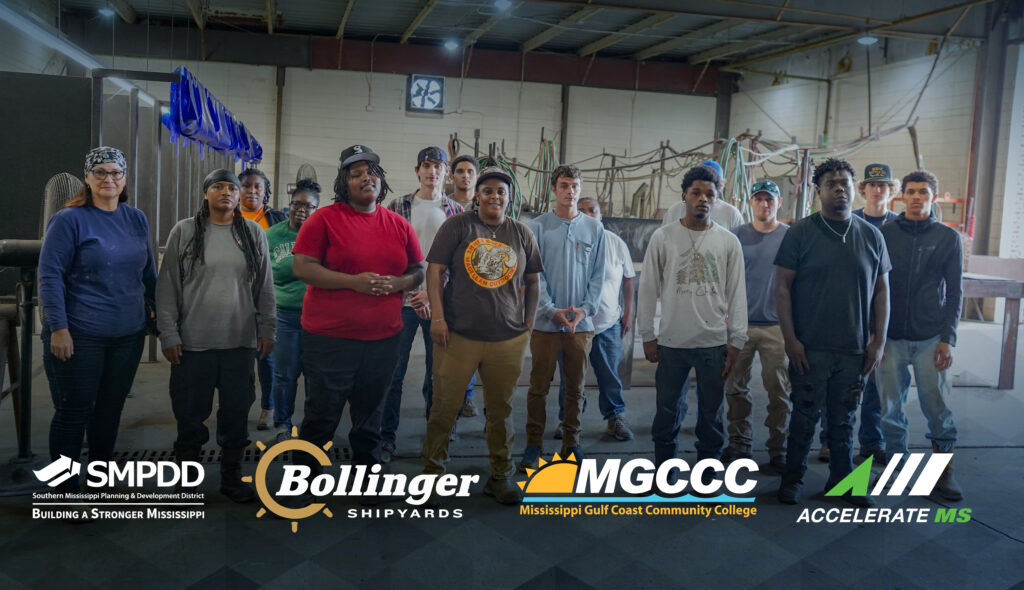
Bollinger Shipyards Launches Inaugural Shipfitter Boot Camp

Partnership with Mississippi Gulf Coast Community College, South Mississippi Planning & Development District and AccelerateMS will hire and train the next generation of Gulf Coast shipbuilders 

PASCAGOULA, MS. – (June 20, 2024) This week, Bollinger Shipyards (“Bollinger”) kicked off the inaugural Shipfitter Bootcamp, an innovative workforce development initiative alongside Mississippi Gulf Coast Community College (MGCCC), the South Mississippi Planning & Development District and AccelerateMS that will recruit, hire, and train the next generation of skilled shipbuilders, ensuring Bollinger’s workforce in Mississippi remains second to none in the shipbuilding industry. The Shipfitter Bootcamp is a critical step to establishing Bollinger Shipyards as a Center of Excellence in the design and construction of heavy polar icebreakers. 

The Shipfitter Bootcamp is a comprehensive workforce development program designed to equip current and future Bollinger employees with the essential skills and knowledge required to take their careers to the next level. Through a blend of classroom instruction and hands-on experience, students will learn the essential functions that are required to become a Shipfitter in a 14-week program.  The first 12 weeks will be taught at MGCCC and the final 2 weeks will be taught on-site at Bollinger Mississippi Shipbuilding located in Pascagoula, Mississippi.  Upon successful completion of the program each Shipfitter Trainee will be evaluated and their compensation will increase according to their skill level. 

“We are thrilled to launch this exciting new program that will ensure Bollinger and the Mississippi Gulf Coast remain synonymous with best-in-class defense shipbuilding,” said Ben Bordelon, CEO of Bollinger Shipyards. “Our industry relies on the expertise and dedication of skilled shipfitters, and this bootcamp will provide invaluable training and opportunities for individuals looking to start or advance their careers at Bollinger. When we invest in our Mississippi workforce, we’re investing in and ensuring the future success of our industry.” 

Participants in Bollinger’s Shipfitter Bootcamp will benefit from state-of-the-art facilities and resources at MGCCC, as well as becoming a Bollinger employee and earning an income while they learn.  This opportunity not only provides an income for themselves and their families, but it also offers full benefits, paid holidays and vacation.  The bootcamp is open to anyone who is interested in learning the skills necessary to become a Shipfitter. 

“For over seven decades, Bollinger has exhibited excellence and innovation in the shipbuilding industry,” said Jonathan Woodward, Ph.D., Vice President for Teaching & Learning and Community Campus at Mississippi Gulf Coast Community College. “Bollinger Mississippi has consistently delivered the highest quality ships by accentuating efficiency and effectiveness – rising above external challenges. The paramount challenge in all sectors of the current economy is human capital. The Shipfitter Bootcamp illustrates a novel, practical, and attractive approach to meet this challenge head on.” 

“Shipbuilding is a critical defense industry and a major contributor to the economic growth of the Mississippi Gulf Coast,” said Dr. Courtney Taylor, Executive Director of AccelerateMS. “These students have the opportunity to achieve success through training programs that few other fields can offer. We’re proud to support initiatives like these, which equip a new generation of workers to drive the industry’s evolution in our state.”


Austal USA Starts Construction on T-ATS 13

MOBILE, Ala. – Austal USA has started construction on the future USNS James D. Fairbanks (T-ATS 13), the third of five steel U.S. Navy Navajo Class Towing, Salvage, and Rescue Ships Austal USA has under contract with the Navy. Construction is well underway on both the future USNS Billy Frank Jr. (T-ATS 11) and USNS Solomon Atkinson (T-ATS 12).   

“It’s exciting to see another ship begin traveling down the steel production line which has been busy since we opened it just a little over two years ago,” Austal USA Vice President of New Construction Dave Growden said. “I’m proud of how well our workforce is handling the diversity of work we have taken on since the steel line became active.” 

The ship’s namesake, James D. Fairbanks, was a Camp Pendleton Marine who also served in the Navy, where he became a prominent figure in the Seabees. Fairbanks grew up on the White Earth Indian Reservation in northern Minnesota and went on to compile an impressive service record. He first served with Second Battalion Eleventh Marines (2/11) at Camp Pendleton and then did two tours in the Navy. The first included service during Operation Iraqi Freedom, where he was awarded the Bronze Star. Fairbanks also was hailed for his service in the Seabees, the Navy’s storied construction battalion. 

T-ATS will provide ocean-going tug, salvage, and rescue capabilities to support U.S. Navy fleet operations and will be a multi mission common hull platform capable of towing heavy ships. These ships will also support several missions, including oil spill response, humanitarian assistance, and wide area search and surveillance.  


Platform Aerospace’s Vanilla UAS – Communications Relay at Valiant Shield 2024  

HOLLYWOOD, Md., June 20, 2024 (Newswire.com) Platform Aerospace’s Ultra-Long Endurance Group 3 Unmanned Aircraft System (UAS), Vanilla, completed mission requirements during a 27-hour flight at the Valiant Shield 2024 (VS24) exercise in Guam. 

From June 7th to June 18th, Platform Aerospace participated in VS24, a training exercise built on the collaborative efforts of the United States Navy, Marine Corps, Army, Air Force, Coast Guard, Space Force, and partner nations. 

Upon take-off from Andersen Air Force Base (AAFB) in Guam, Vanilla completed mission requirements by demonstrating communications relay functionality through Link 16 (BATS-D) and Silvus radio connections to other participating assets, including High Altitude Balloons (HABS) and manned and unmanned air and surface vessels. In the early hours of June 13th, Vanilla flew through substantial precipitation, including multiple events of 1,000 ft/min climbs and descents due to airmass motion, in the mission airspace. Due to ongoing extreme weather, Platform Aerospace operators returned to base early rather than risk damage to the aircraft. 

On June 14, Vanilla returned to AAFB and executed a normal landing on runway 24R. Landing occurred at 11:21 local, concluding a 1-day, 3-hour, 2-minute flight with the Link 16 relay active for the entire duration. Whereas this is a relatively short flight for Vanilla, which has demonstrated >8-days of unrefueled endurance in a desert environment, this flight demonstrates advanced technology readiness for any military operational environment. 

Vanilla can be configured for Intelligence, Surveillance, and Reconnaissance (ISR), Communications Relay, Decoy, Air Launched Effects (ALE), Signals Intelligence (SIGINT), Electronic Warfare (EW), or any combination of those mission requirements. 

Vanilla is a Rapid Defense Experimentation Reserve (RDER) Program; VS24 was Vanilla’s graduation event and formal Technology Readiness Level (TRL) 8 assessment. Platform Aerospace participated in VS24 in partnership with OUSD(R&E) and the 3rd MDTF.