24th MEU (SOC) Deploys Aviation Detachment to Sweden for BALTOPS 24
By 24th MEU (SOC) Public Affairs Office, June 10, 2024
KALLINGE – The 24th Marine Expeditionary Unit (MEU) Special Operations Capable (SOC) deployed a detachment of U.S. Marine Corps AV-8B Harrier jets, MV-22B Osprey tiltrotor aircraft, and personnel to Ronneby Airport in Kallinge, Sweden to conduct expeditionary advanced base flight operations in support of exercise Baltic Operations (BALTOPS) 24, June 9, 2024.
The aircraft are assigned to Marine Medium Tiltrotor Squadron (VMM) 365 (Reinforced), 24th MEU (SOC), which is currently deployed with the U.S. Navy Wasp Amphibious Ready Group (ARG). While based at Ronneby Airport, the detachment is capable of self-sustaining and self-deploying in support of various events with NATO Allies during BALTOPS 24.
“Our self-deploying and self-sustaining detachment demonstrates the ARG-MEU’s ability to project force more than 900 nautical miles and establish a forward operating base in the Baltic region,” said Lt. Col. Cory Jobst, commanding officer, VMM-365 (REIN). “This expeditionary advanced base is a historic first with our longstanding partner, and newest NATO Ally, Sweden.”
The USS Wasp (LHD 1) and USS New York (LPD 21), with the Wasp ARG and embarked 24th MEU (SOC), are participating in BALTOPS 24. The Wasp ARG-24th MEU (SOC) is deployed to the U.S. Naval Forces Europe area of operations to support high-end warfighting exercises while demonstrating speed and agility in a dynamic security environment.
BALTOPS 24 is the premier maritime focused military exercise in the Baltic Region. The exercise, led by U.S. Naval Forces Europe-Africa, and executed by Naval Striking and Support Forces NATO, provides a unique training opportunity to strengthen combined response capabilities critical to preserving freedom of navigation and security in the Baltic Sea.
BALTOPS 24 is also part of the U.S. Department of Defense exercise series, Large Scale Global Exercise (LSGE). LSGE is an umbrella term that incorporates several exercises and military activities, which enable the U.S. Joint Force to train with Allies and partners and improve shared understanding, trust and interoperability on security challenges across the globe.
While the exercise is led by U.S. Naval Forces Europe-Africa/U.S. Sixth Fleet, it will be command-and-controlled by Naval Striking and Support Forces NATO, headquartered in Oeiras, Portugal.
U.S. Coast Guard Completes Operation Tui Moana in Pacific Region
U.S. Coast Guard 14th District, June 12, 2024
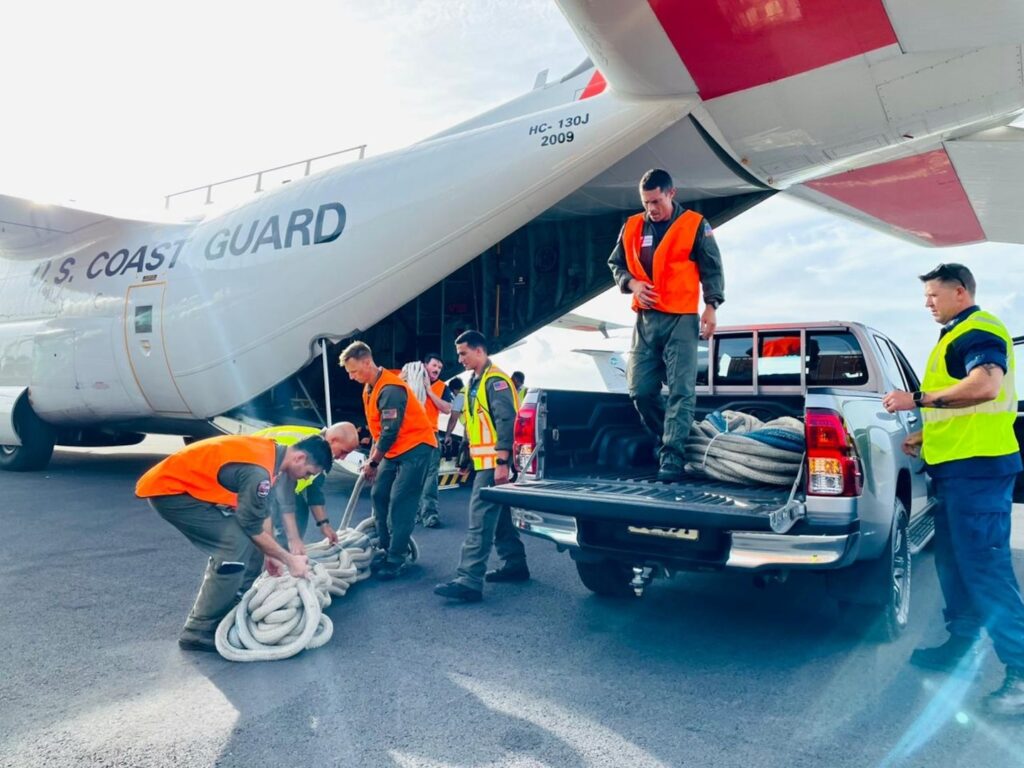
HONOLULU – The U.S. Coast Guard has completed Tui Moana, a two-week operation to safeguard the invaluable marine resources of Pacific Island nations and the Western Central Pacific Ocean, Jun. 12, 2024. –
Operation Tui Moana is part of Operation Blue Pacific, an overarching multi-mission Coast Guard endeavor promoting security, safety, sovereignty, and economic prosperity in the Pacific while strengthening relationships between partner nations.
The wide-ranging operation was conducted alongside the Pacific Quadrilateral Defense Coordinating Group (Pacific QUAD), in support of the Pacific Islands Forum Fisheries Agency (FFA) and its members.
The FFA coordinated Tui Moana to detect and deter illegal fishing activities and tackle non-compliance with international fisheries across the nine participating Pacific Island countries. The operation reinforces the conservation work of the Western and Central Pacific Fisheries Commission (WCPFC).
“The Coast Guard put into action the recent maritime law enforcement bilateral agreement with Samoa,.” said U.S. Chargé d’Affaires at U.S. Embassy Apia, Samoa, Noriko Horiuchi. “Conducting air surveillance of their exclusive economic zone from May 20-24, with two riders from Samoa ’s Ministry of Agriculture and Fisheries and Police Maritime Division onboard the aircraft.”
The joint efforts for Operation Tui Moana covered over 2.45 million square miles, with the U.S. Coast Guard contributing:
• 306, 960 nautical miles flown
• 968 total minutes on multiple scenes
• 23 vessels surveyed
• 335,760 nautical miles total searchable area
While engaged in the region, the Coast Guard conducted aerial flights to capture imagery of fishing vessels potentially operating illegally within the Samoan and Tongan exclusive economic zones, and in the high seas pocket nearby.
“Operation Tui Moana reflects the Foreign Fishery Agency’s mission to prevent overfishing in the Pacific Ocean and help our neighbors protect their natural resources,” added Horiuchi.
Located in Honolulu, U.S. Coast Guard District Fourteen covers more than 14 million square miles of land and sea, conducting operations over the Hawaiian Islands, American Samoa, Saipan, Guam, Singapore and Japan.
U.S. Navy Efforts Aid in Baltimore Channel Reopening
BALTIMORE (May 1, 2024) Salvage efforts for the Francis Scott Key Bridge and the M/V Dali cargo vessel. (U.S. Navy by Petty Officer 2nd Class Christine Montgomery)
By Naval Sea Systems Command Office of Corporate Communications
June 12, 2024
BALTIMORE — The U.S. Navy’s Supervisor of Salvage and Diving (SUPSALV) led critical efforts in support of the Unified Command in clearing the Port of Baltimore’s Fort McHenry Federal Channel, following the M/V Dali’s allision into the Francis Scott Key Bridge.
“In the aftermath of the tragic accident and profound sadness experienced by the City of Baltimore and indeed the nation, I am proud of the extraordinary work and professionalism displayed by our Sailors and civilians, under the supervision of Capt. Sal Suarez, in support of the Key Bridge Response Unified Command,” said Secretary of the Navy Carlos Del Toro. “Our Navy and Marine Corps Team remains critical to defending our economic security, including the crucial efforts of our Navy’s diving and salvage experts to keep our waterways open.”
SUPSALV arrived within hours after tasking by the U.S, Army Corps of Engineers to support the Unified Command by leading the clearing of the Baltimore Harbor waterway. The team, along with several private maritime salvage companies, mobilized resources to the site and worked to remove debris, support truss cuts, rigging and bridge sections. Their efforts also included controlled explosions that allowed the Dali to be refloated and moved back to port.
“SUPSALV expertise is recognized throughout the U.S. Navy, Department of Defense and other federal agencies,” said Capt. Sal Suarez, commander, Supervisor of Salvage and Diving. SUPSALV provides technical, operational, and emergency support in marine salvage, towing, pollution control and abatement, diving and diving system safety and certification, diving and salvage equipment procurement, and underwater ship husbandry. Its expertise in marine salvage has been leveraged globally removing a sunken dredge barge in Alexandroupoli, Greece, in 2019, and recently clearing Louisiana waterways impacted by Hurricane Ida in 2021.
“SUPSALV supports other federal agencies and the country with its national response capability, including active duty and contractor salvage experts,” said Paul Hankins, director, Salvage Operations at SUPSALV. “We have resources and support agreements in place so we can immediately respond with our expertise and resources when called upon.”
Throughout the entirety of the process SUPSALV was responsible for managing all on-scene assets tasked with debris removal and channel clearing effort. Each day began at 06:30 a.m. to coordinate assets, align on objectives and finished daily at 5:30 p.m. to share what was accomplished that day and what they plan to accomplish next.
SUPSALV provides technical, operational, and emergency support in marine salvage, towing, pollution control and abatement, diving and diving system safety and certification, diving and salvage equipment procurement, and underwater ship husbandry.
U.S. Coast Guard Cutters Return Home After Successful Central American Deployment
U.S. Coast Guard 11 District, June 10, 2024
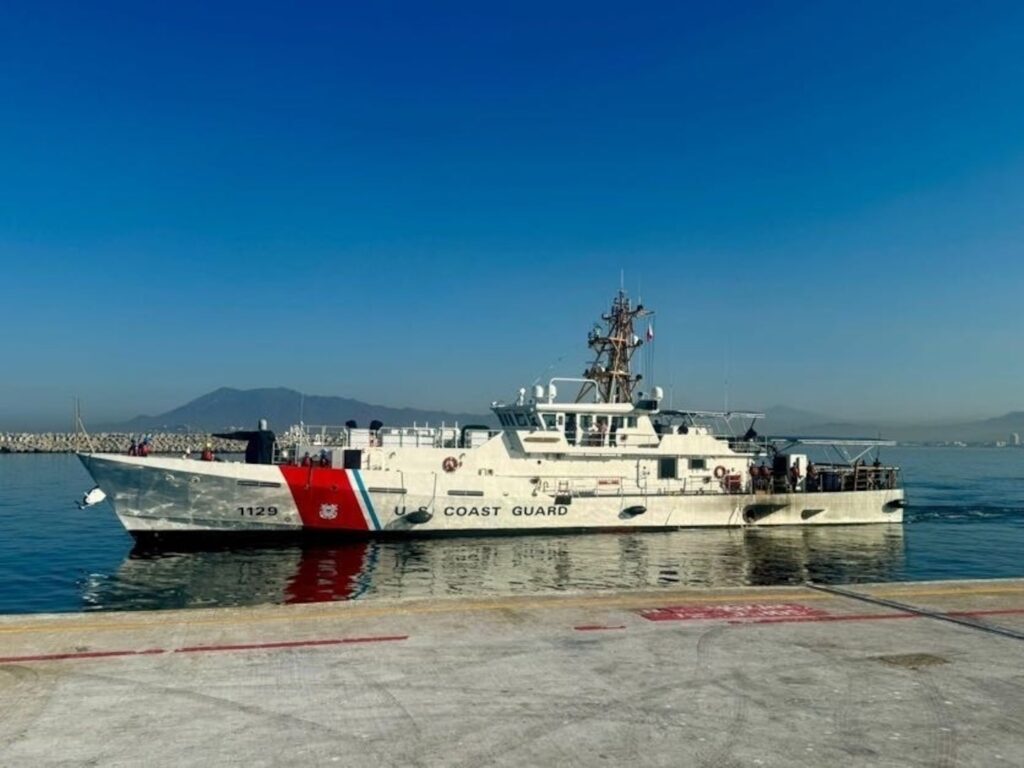
SAN PEDRO, Calif. — U.S. Coast Guard cutters Forrest Rednour and Blackfin have returned to their homeports after a 49-day deployment in Central America, where they played a crucial role in multiple operations.
During this period, both cutters demonstrated outstanding readiness and operational capability, significantly contributing to international cooperation, search and rescue missions, and efforts to combat criminal activities. This deployment was part of a broader strategy to enhance regional security and strengthen partnerships. Throughout the mission, Forrest Rednour covered over 8,200 miles and logged 800 operational hours, while Blackfin covered over 8,300 miles and also logged 800 operational hours.
“The amount of effort and commitment from both crews during this 49-day deployment was remarkable,” said Rear Adm. Andrew Sugimoto, commander, Coast Guard District 11. “Their readiness and professional exchanges provided an invaluable experience to our partner nations and crews. The enthusiasm to lead multiple engagements with several international maritime organizations helped strengthen ties and fortify continued collaboration between all.”
Key Achievements:
Search and Rescue Exercises (SAREX):
Manzanillo, Mexico: Blackfin led a successful SAR operation, including helicopter rescue exercises with the Mexican Navy.
Puerto Quetzal, Guatemala: Hosted tours and conducted SAR exercises with the Guatemalan Navy, building stronger maritime partnerships.
La Union, El Salvador: Rednour led a SAR exercise and joint operations with the Salvadoran Navy, marking the first U.S. vessel visit to this port in two years.
Partnership and Training:
Amapala, Honduras: Engaged in discussions and training on maritime law enforcement and security with the Honduran Navy and Merchant Marine.
Golfito, Costa Rica: Shared knowledge on maritime governance with the Costa Rican Coast Guard, enhancing mutual understanding.
Rodman, Panama: Provided damage control and medical evacuation training to Panamanian forces, marking the first U.S.-Panama Coast Guard engagement in over two years.
PASSEX with ARM PALENQUE: Forrest Rednour and Blackfin conducted a passage exercise (PASSEX) with the Mexican Navy’s ARM PALENQUE. This included formation steaming, code exercises, and a crew exchange to enhance mutual operational understanding and cooperation.
“This patrol was truly an amazing experience and a testament to the incredible devotion to duty that the crews of the Forrest Rednour and Blackfin have,” said Lt. Kevin Ng, commanding officer of Coast Guard Cutter Forrest Rednour. “Both crews adapted and overcame several challenges leading up to and during the patrol, but never took their eyes off the main objective. As a result, the Coast Guard was able to strengthen the valuable relationships that the United States has with our international partners throughout Central America and unify our efforts to address critical maritime security initiatives in the Eastern Pacific. Thank you to crews on a job well done, District 11 and Sector Los Angeles/Long Beach for the coordination, and the families and friends of the crew for all of the support; the success of this historic patrol could not have been accomplished without them all.”
“I could not be prouder of both crews for the incredible amount of hard work they have dedicated to making this historic patrol possible. The success of this Surface Action Group is a testament to the Coast Guard’s ability to overcome dynamic challenges in the completion of unprecedented mission sets. It also signifies the Coast Guard’s steadfast commitment to advancing our vital maritime partnerships in the Eastern Pacific. The international relationships formed and strengthened during this deployment have set the groundwork for future engagements which I look forward to watching,” said Lt. j.g. James Morrison, commanding officer of Coast Guard Cutter Blackfin.
Commissioned in 2000, the USCGC Blackfin is one of the Coast Guard’s Marine Protector-class patrol boats homeported in Santa Barbara, California. Marine Protector-class patrol boats are 87 feet long and 19.5 feet wide and have a 100 long-ton displacement. They have a top speed of 25 knots and a range of 900 nautical miles. They can hold a crew of up to 10. The Blackfin is equipped with advanced electronics and navigation systems for multi-mission operations, including search and rescue, law enforcement, and homeland security. The Blackfin shares the name of the USS Blackfin (SS-322), a submarine that participated in World War II and the Korean War.
U.S. 4th Fleet Announces Continuing Promise 2024 Deployment
SANTA MARTA, Colombia (Aug. 20, 2023) Expeditionary fast transport ship USNS Burlington (T-EFP 10) arrives in Santa Marta, Colombia, Aug. 20, 2023. Continuing Promise 2023 marks the 13th mission to the region since 2007 and the first involving USNS Burlington. The mission will also foster goodwill, strengthen existing partnerships with partner nations, and encourage the establishment of new partnerships among countries, non-government organizations, and international organizations. (U.S. Navy photo by Lt. j.g. Nicko West)
By USNAVSOUTH/4TH FLEET PUBLIC AFFAIRS, June 11, 2024
MAYPORT, Fla. – MAYPORT, Fla. – (June 10, 2024) — The U.S. Navy expeditionary fast transport USNS Burlington (T-EPF 10) will deploy this July and August to the U.S. Southern Command area of operations as part of U.S. Naval Forces Southern Command/U.S. 4th Fleet’s Continuing Promise 2024 mission. After several months of detailed planning, USNS Burlington is scheduled to visit Jamaica, Costa Rica, Honduras, Colombia, and Panama during the nearly two month-long mission.
Continuing Promise 2024 marks the 14th mission to the region since 2007 and the second aboard USNS Burlington. The mission will foster goodwill, strengthen existing partnerships with partner nations, and encourage the establishment of new partnerships among countries, non-government organizations, and international organizations.
The focus during each mission stop will be working alongside partner nation medical personnel to provide direct patient care and technical expertise in community clinics to improve medical readiness, strengthen partnerships, and enhance the combined capabilities of the U.S. Navy and partner nations to respond to public health disasters and humanitarian crises. 30 U.S. Navy medical professionals, including general practitioners, nurses, pharmacists, radiologists, dentists, optometrists, and biomedical technicians from Navy Medicine Readiness and Training Command (NMRTC Portsmouth, NMRTC Jacksonville, NMRTC Great Lakes, NMRTC Pensacola, NMRTC Camp Lejeune) and Naval Medicine Readiness and Logistics Command bring their expertise to this year’s iteration of Continuing Promise.
“During Continuing Promise 2024, we’re working side-by-side and step-by-step with our partners,” said Rear Adm. Jim Aiken, U.S. Naval Forces Southern Command/U.S. 4th Fleet Commander. “Our investment into the region is our enduring relationships, and we are committed to ensuring improved interoperability and collaborative regional security together. We gain so much by this opportunity to serve alongside true professionals.”
The Continuing Promise team includes a U.S. Army veterinary team from the 248th Medical Detachment (Veterinary Service Support), which will collaborate with host nation colleagues to provide direct public health education and animal care at local veterinary organizations in-country. U.S. Navy Seabees from Navy Mobile Construction Battalion 1 will assist in host nation led community engineering projects. U.S. Navy experts will host seminars and training exercises with host nation civilian officials and military professionals covering disaster preparedness and response. These exchanges aim to support host nation facilities, improve readiness, and empower local and national officials with the knowledge and experience to act with confidence during emergencies.
“Actions certainly speak louder than words and Continuing Promise 2024 will certainly demonstrate that,” said U.S. Navy Capt. Scott Maloney, Continuing Promise 2024 mission commander. “It is a way for us to collaborate and work alongside our partners in the Caribbean, Central and South America and make a positive impact in local communities at each stop.”
Continuing Promise will also continue its popular series of seminars on the prevention of gender-based violence in support of the mission’s Women, Peace, and Security (WPS) initiative.
WPS is a United Nations (UN) initiative that started with UNSCR 1325 signed in 2000. The UN resolution is a public acknowledgement that women are more adversely impacted by conflict and crisis, and including women in security planning will lead to a more peaceful world.
Continuing Promise will feature the U.S. Fleet Forces Band, “Uncharted Waters”. The band will embark on USNS Burlington to conduct classes at community schools, collaborate with military and civilian musical organizations in partner nations, and entertain local communities with concerts at each mission stop. This cultural exchange aims to strengthen community ties and foster goodwill.
USNS Burlington is an expeditionary fast transport (EPF) operated by Military Sealift Command and crewed by 26 Civil Service Mariners led by Ship Master, Capt. Tyler Driscoll. The crew composition follows a commercial model of bridge and engineering watches. The ship is a shallow draft, all aluminum, commercial-based catamaran capable of regional transport of personnel and cargo lift, providing combatant commanders high-speed sealift mobility with inherent cargo handling capability and agility to achieve positional advantage over operational distances. Burlington will bring the personnel, equipment and supplies necessary to conduct the Continuing Promise mission, as well as act as the mission’s logistics and command hub.
USNAVSOUTH/FOURTHFLT is the trusted maritime partner for Caribbean, Central and South America maritime forces leading to improved unity, security and stability. Learn more about USNAVSOUTH/4th Fleet at https://www.fourthfleet.navy.mil, https://www.facebook.com/NAVSOUS4THFLT and @NAVSOUS4THFLT.
Senators Blast Coast Guard Chief for Sexual Assault Response
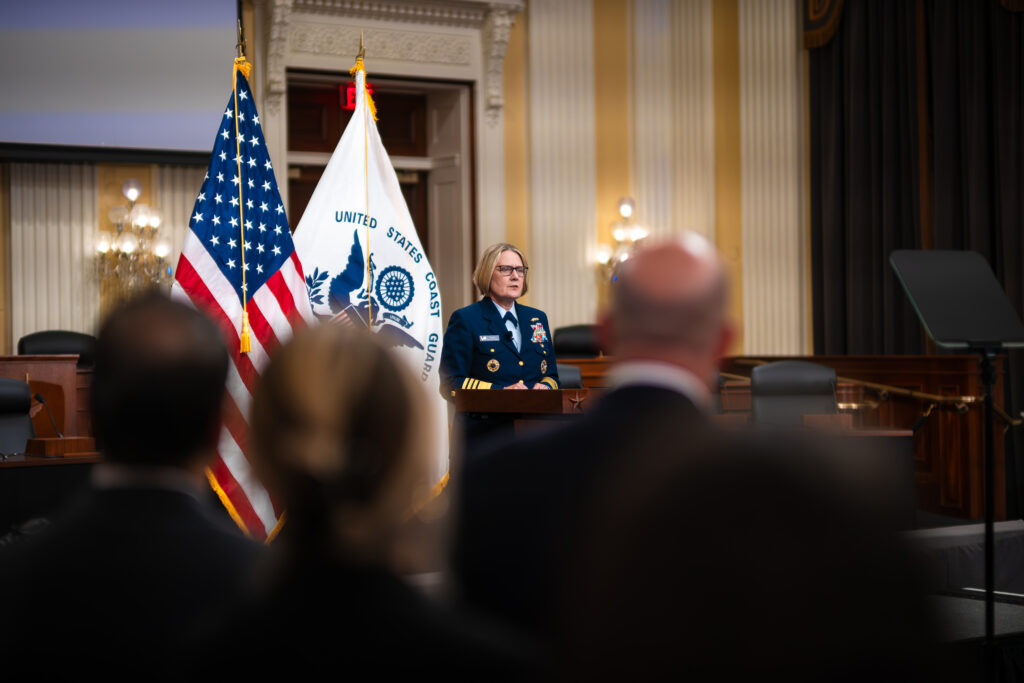
Adm. Linda L. Fagan, commandant of the Coast Guard, speaks to guests during the 2024 State of the Coast Guard Address in Washington, D.C., March 20. U.S. Coast Guard | Petty Officer 1st Class Brandon Giles
Coast Guard Commandant Admiral Linda L. Fagan endured withering criticism of the service’s treatment of sexual harassment issues at the Coast Guard Academy on June 11, as Senators from both sides of the aisle said the Coast Guard has not been forthcoming with its investigations or in helping the Senate panel conduct its own.
The Homeland Security & Government Affairs Committee’s Permanent Subcommittee on Investigations looked into the Coast Guard’s Operation Fouled Anchor investigation into sexual assault at the Coast Guard Academy. During a hearing, members said the Coast Guard buried its own critical report, retaliated against whistleblowers and has been dragging its feet in providing information about the report to the committee.
Sen. Richard Blumenthal (D-Connecticut), the panel’s chair, said Operation Fouled Anchor “was hidden from the public as well as Congress” and decried what he called “a culture of coverup continuance.”
Blumenthal said the Coast Guard attempted to say much of the assault and harassment had occurred in the past, but more than 40 whistleblowers told the committee it is ongoing.
“The question is, what will the Coast Guard do about it now, in the present?” Blumenthal asked. “We are now expecting action.” He also said, “our investigation has shown a deep moral rot inside the Coast Guard.”
Fagan appeared at the hearing as the primary witness, along with Master Chief Heath Jones, the highest-ranking enlisted officer in the Coast Guard
Fagan said the Coast Guard is trying to provide all relevant documents to the committee, is cooperating with an Inspector General review of the Fouled Anchor effort, and is about to contract with an outside, independent investigator with $1.5 million provided by Congress.
The Inspector General (IG) is “looking into Operationa Fouled Anchor, the totality of it, including action or inaction of senior leadership,” Fagan said.
“Sexual assault is “unacceptable. Not in my Coast Guard,” said Fagan, the service’s first female commandant. “It is not who we are.”
She said she has met with victims of assault, and “to the victims, the survivors, I am truly sorry for what you have had to go through.”
She said the failure to provide the Fouled Anchor report to Congress was a mistake that eroded trust but said now the service is being fully responsive to the subcommittee.
“I cannot change the past. But as the commandant today, I reaffirm to our workforce, past and present, that I remain steadfast to making lasting cultural change,” Fagan said.
Sen. Ron Johnson (R-Wisconsin), the ranking member of the panel, complained that the Coast Guard had issued a “data dump” of 1,000 pages of heavily redacted material on Operation Fouled Anchor, which he said was purposefully confusing and hard to follow.
Operation Fouled Anchor
The issue of Operation Fouled Anchor, first uncovered by CNN, burst into the news just days before the hearing, when Shannon Norenberg, the sexual assault response coordinator at the Coast Guard Academy, resigned and post an open letter on Maritime Legal Aid.com in which she wrote, “The Coast Guard lied to me. Worse than that, they used me to lie to victims, used me to silence victims, and used me in a coordinated effort to discourage victims of sexual assault at the Academy from speaking to Congress about their assaults and about the Coast Guard’s investigation of their cases.”
Fagan said Norenberg, who was in the room, “has been an incredible employee for us” and “the allegations she has made will be part of the IG investigation.” She said she had not read Norenberg’s posted statement but would do so.
Norenberg had started working with Operation Fouled Anchor in 2018, her letter says, but it had been ongoing for four years before that and had investigated dozens of sexual assaults reported at the academy.
Part of her work with the operation was to call victims and offer what she called “official expressions of regret,” along with in-person meetings in 2019 with 25 to 30 victims. Norenberg discovered she would not be offering CG-6095s to victims, which is proof offered to the Department of Veterans Affairs that the victim reported an assault while in the military, making it easier for them to obtain VA services to deal with their trauma.
Blumenthal said he was especially outraged by this, calling it “one of the most damning parts of her letter.” He asked Fagan what she would do to provide access to VA services for sexual assault victims.
Fagan replied “I am committed to working with the IG,” and later said, “my priority is supporting victims … I don’t want any victim to not get the support they are entitled to.”
Blumenthal said “the IG report cannot be used as a shield for inaction” or as a reason for not disclosing documents, drawing a small smattering of applause.
Fagan said she did not become aware of the full extent of potential victims uncovered by Operation Fouled Anchor “until we had some of the FOIA requests from CNN.”
She said her predecessor, Admiral Karl Schultz, was commandant of the Coast Guard at the time the decision was made to not reveal the findings of Operation Fouled Anchor but said she did not know if he was involved.
Blumenthal said maybe she didn’t want to know, but Fagan replied, “I am committed to full transparency with regard to the allegations.” She said the service will continue to cooperate with the IG and the third-party investigator “so we can understand what was known, when, and bring clarity to the allegations.”
RIMPAC to begin June 27
Commander, U.S. 3rd Fleet (C3F) Vice Adm. John Wade participates in briefings about Exercise Rim of the Pacific (RIMPAC) 2024 at C3F headquarters, June 11, 2024. (U.S. Navy photo by Mass Communication Specialist 2nd Sarah C. Eaton)
From Commander, U.S. 3rd Fleet Public Affairs, 12 June 2024
SAN DIEGO- Planning and preparations are being finalized for the 29th biennial Exercise Rim of the Pacific (RIMPAC), a multinational exercise involving 29 nations and more than 25,000 personnel, set to run June 27 to Aug. 1, in and around the Hawaiian Islands.
Hosted by Commander, U.S. Pacific Fleet, RIMPAC 2024 will be led by Commander, U.S. 3rd Fleet, who will serve as the Combined Task Force commander. Vice Adm. John Wade, who recently took command of U.S. 3rd Fleet, received overview briefs, June 10-11, from staff members on the full range of exercise elements.
“The subject matter expertise and wide-ranging insights that our partner nations, non-military organizations, sister services, and 3rd Fleet staff bring to planning is the reason RIMPAC is the premier joint and combined maritime exercise in the world,” said Wade. “I’m looking forward to returning to Hawaii to exercise and rehearse as a combined multinational operational force.”
Prior to the exercise several surface groups sailing from their respective home ports will meet at designated points and conduct multinational group sails to Hawaii to build upon the established interoperability. The 29 nations are sending 40 surface ships, three submarines, 14 national land forces, and over 150 aircraft. Aircraft including the F-35 Lightning II, P-8 Poseidon, and V-22 Osprey will be operating out of Joint Base Pearl Harbor-Hickam and Marine Corps Base Hawaii at Kaneohe Bay.
The exercise will include multi-domain warfare in a range of scenarios from anti-submarine warfare, multi-ship surface warfare, multinational amphibious landings, and multi-axis defense of the carrier strike group against live forces.
“RIMPAC offers a uniquely complex and challenging multinational environment for forces to train in areas where common national objectives overlap,” said RIMPAC coordinator Royal Australian Navy Lt. Cmdr. Timothy Gill. “Throughout the planning process we’ve built true partnerships based on mutual understanding and respect and expect that to continue during execution.”
RIMPAC 2024 amphibious and land forces will be made up of nine partner nations and 13 ships, with a unique and highly capable mixture of aircraft, ground assault vehicles and ship-to-shore connectors. During execution of RIMPAC, this group of Sailors, Soldiers, and Marines will apply knowledge from their respective nations and skillsets to build a better joint, combined force that can respond to challenges, ranging from high-end conflict to humanitarian aid and disaster relief.
This year’s RIMPAC will host its largest humanitarian aid and disaster relief exercise with eight countries, five ships, five landing craft, five aircraft, multiple land forces, and over 2,500 total participants including the statewide Hawaii Healthcare Emergency Management exercise. The exercise control and scenario development are supported by subject matter experts from the Center for Excellence in Disaster Management, Pacific Disaster Center, USAID’s Bureau for Humanitarian Assistance, and Singapore’s Changi Regional Humanitarian Assistance and Disaster Relief Coordination Centre.
“Environmental stewardship is a top priority during RIMPAC, and all participants will observe protective measures for cultural and natural resources throughout the exercise,” said Wade. “We have the immensely valuable opportunity to train in the Hawaiian Islands and surrounding ranges – nowhere else in the world provides a more realistic and relevant training opportunity!”
RIMPAC is designed to foster and sustain the cooperative relationships that are critical to ensuring the safety of sea lanes and security on the world’s oceans. RIMPAC trains and enhances preparedness at all levels, including individual proficiency, and sharpens command and control skills while challenging participants to integrate across changing conditions as part of a joint or combined force.
US Coast Guard Cutter Resolute Returns Home From Caribbean Patrol; Interdicts Four Suspected Smugglers, 3,736 Pounds Of Illicit Drugs
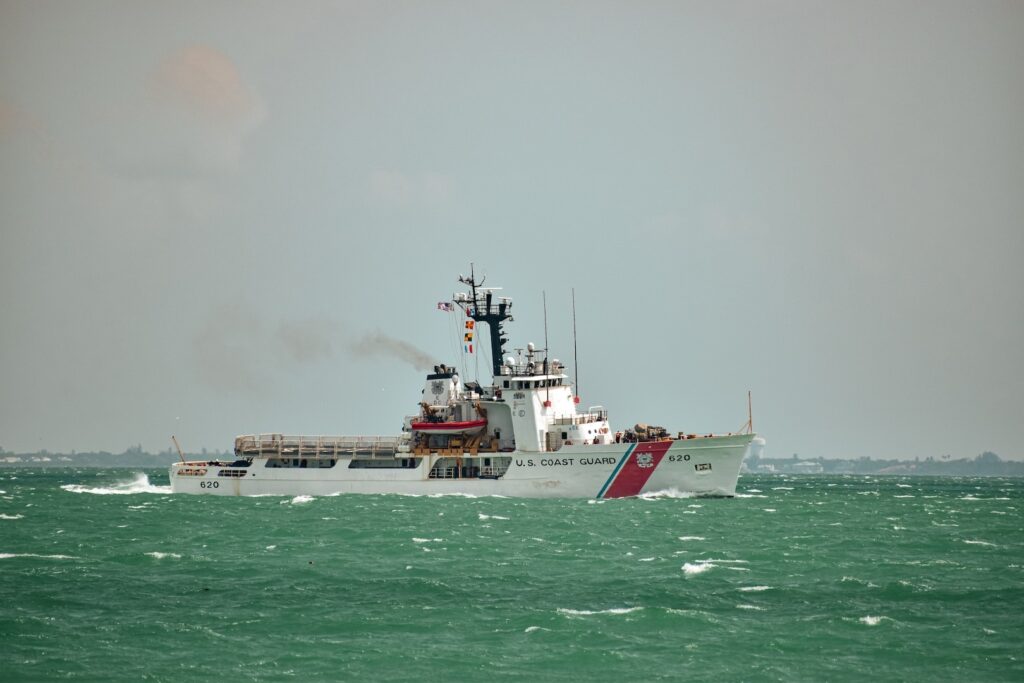
U.S. Coast Guard Cutter Resolute (WMEC 620) transits outbound for sea from homeport, St. Petersburg, Florida, ahead of a migrant interdiction and maritime safety and security patrol in the Caribbean Sea, April 10, 2024. Resolute routinely performs deterrence of illegal maritime migration throughout the Windward Passage, prioritizing the safety of life at sea and protecting the Nation’s southern maritime border. (U.S. Coast Guard photo courtesy of Coast Guard Cutter Resolute)
U.S. Coast Guard Atlantic Area, June 8, 2024
ST. PETERSBURG, Fla. - The crew of U.S. Coast Guard Cutter Resolute (WMEC 620) returned to their homeport in St. Petersburg, Saturday, following a 60-day patrol of the Caribbean, in support of Homeland Security Task Force – Southeast’s Operation Vigilant Sentry and Joint Interagency Task Force-South’s counterdrug mission.
While deployed within the Coast Guard’s Seventh District area of operations, and off the southwest coast of Haiti, the Resolute crew, together with the Coast Guard Cutter Mohawk (WMEC 913), interdicted one go-fast vessel, apprehended four suspected smugglers and seized 3,736 pounds of marijuana worth more than $3.5 million.
In addition to the drug interdiction and deterring illegal maritime migration, the Resolute crew conducted over 24 hours of search and rescue efforts for two missing mariners after the 90-foot Vanuatu-flagged schooner, De Gallant, sank approximately 20 miles north of Great Inagua on May 21, 2024. Resolute refueled Coast Guard helicopters searching for the missing sailors, conducted strategic search patterns, and recovered floating debris from De Gallant life rafts. Together, Coast Guard and Royal Bahamas Defence Force crews covered over 3,700 square miles before suspending the search.
“The officers and crew of Resolute completed this deployment in extraordinary fashion,” said Cmdr. Michael Ross, commanding officer of Resolute. “They answered the call and responded to each case with dignity, compassion and professionalism. The Coast Guard’s overt presence in this region is essential to deter dangerous and life-threatening maritime migration ventures. Our extensive Coast Guard presence in the area significantly decreased the number of migration events preventing loss of life at sea while protecting the homeland.”
Resolute is a 210-foot, Reliance-class medium endurance cutter. The cutter’s primary missions are counter drug operations, migrant interdiction, and search and rescue in support of U.S. Coast Guard operations throughout the Western Hemisphere.
EpiSci Selected by Naval Information Warfare Center Pacific for Project Overmatch’s Mission Autonomy Proving Grounds
POWAY, California (10 June 2024) – The Naval Information Warfare Center Pacific (NIWC PAC) has awarded EpiSci, a leader in trusted warfighter autonomy solutions, a follow-on contract for Project Overmatch’s Mission Autonomy Proving Grounds following EpiSci’s successful performance during a 12-month demonstration event. “As a hardware-agnostic software company that prioritizes input from experienced military individuals at every stage, EpiSci is uniquely positioned to be at the forefront of the next stage of battle management solutions,” said Aaron Gibney, EpiSci’s VP of Battle Management Command and Control (BMC2).
With this award, EpiSci will continue to develop their domain and vehicle-agnostic mission autonomy applications. EpiSci’s TacticalAI-enabled software will enable heterogenous, multi-domain swarms to work together and carry out missions for Unmanned Surface Vehicle’s (USVs) and Unmanned Aerial Vehicle’s (UAVs). The software-only capabilities reduce human workload and enhance mission success rates and survivability on operational timelines.
EpiSci’s commitment to software-first methodologies offers scalable autonomy solutions that transcend traditional platform limitations. Capable of integrating on sensors or weapons, or orchestrating diverse multi-domain platforms, TacticalAI software ensures seamless collaboration and operational efficiency.
“Our teams have integrated and operated TacticalAI-enabled autonomy products on 12 uncrewed airborne and maritime platform types in only 6 months,” said Bo Ryu, CEO of EpiSci. “We are proud to be partnering with NIWC PAC and look forward to meeting their needs with trusted, scalable autonomy capabilities. This effort will broaden the application of our software into maritime environments and ensure they have access to our critical technology solutions.”
U.S. Central Command Update
From U.S. Central Command
June 11, 2024
TAMPA, Fla. – In the past 24 hours, U.S. Central Command (CENTCOM) forces successfully destroyed two anti-ship cruise missile (ASCM) launchers in a Houthi-controlled area of Yemen.
It was determined the launchers presented an imminent threat to U.S. and coalition forces and to merchant vessels transiting the region. U.S. forces will continue to take actions that protect freedom of navigation and make international waters safer and more secure for vessels in the Red Sea region.
June 10, 2024
TAMPA, Fla. – In the past 24 hours, partner forces successfully destroyed one uncrewed aerial system (UAS) launched by Iranian-backed Houthis into the Gulf of Aden. There were no injuries reported by U.S., coalition, or merchant vessels.
It was determined the UAS presented an imminent threat to U.S., coalition forces, and merchant vessels in the region. These actions are taken to protect freedom of navigation and make international waters safer and more secure for U.S., coalition, and merchant vessels.