HII Launches “Build It” Campaign to Highlight Shipbuilder Support for U.S. Navy

NEWPORT NEWS, Va., May 21, 2024 (GLOBE NEWSWIRE) — As New York City hosts the annual Fleet Week in celebration of the nation’s sea services, HII (NYSE: HII) — the nation’s largest military shipbuilder and a sponsor of the Intrepid Museum’s commemoration of the event — is launching a hiring campaign to spotlight the contributions and rewards of building ships for the U.S. Navy. 

The HII “Build It” campaign is dedicated to the men and women who partner with the U.S. Navy to build ships critical to the national defense. Shipbuilders value the mission and pride in ship construction, steady advancement and job security, and comprehensive benefits such as health coverage and professional development opportunities. 

“The breadth of our workforce at HII is astonishing,” said Xavier Beale, vice president of human resources at HII’s Newport News Shipbuilding. “From the craftsmen and women in our shipyards who build the most powerful ships in the world with their own hands, to the nuclear engineers who enable safe nuclear power and propulsion, all the way to the cyber and data scientists who build the tools that deliver decision advantage: It’s a workforce for our 21st century national defense.” 

In addition to Newport News Shipbuilding, which is the nation’s only builder of nuclear-powered aircraft carriers and one of two builders of nuclear-powered submarines, HII’s divisions include Pascagoula, Mississippi-based Ingalls Shipbuilding that delivers amphibious ships, destroyers and cutters, and McLean, Virginia-based Mission Technologies, which builds technologies and solutions that connect and strengthen an all-domain force. 

Imagery accompanying this release is available at: https://hii.com/news/hii-launches-build-it-campaign-to-highlight-shipbuilder-support-for-u-s-navy/

HII’s Build It campaign targets workers of all ages and skill levels, and highlights paid training and development at its shipyards for those who require it. 

Russell Dawson, 36, was accepted into the century-old Newport News Shipbuilding Apprentice School right out of high school. Since graduating in 2010, Dawson has supported aircraft carrier and submarine programs at the shipyard, moved up the ranks and is currently working on the Columbia-class program, the Navy’s top acquisition priority. “I’ve always wanted to serve my country,” Dawson said. “I see my work as a shipbuilder doing just that. It’s an honor to help build the greatest ships for our Navy.” 

From an apprentice to a master shipbuilder who has worked over 40 years at the company, HII shipbuilders contribute daily to national security. Stan Brazell, manager of quality receipt and inspection at Ingalls Shipbuilding, began his career in 1991 as an outside machinist apprentice and over the course of his career has worked on almost every ship program at Ingalls, including the construction of USS Bataan (LHD 5). “I view this job as my way of serving our country,” Brazell said. “While I may not be wearing combat boots, I do wear work boots, and those boots have allowed me to contribute to building freedom.” 

The Build It campaign will appear on social media, digital and display advertising, and local television. HII expects it will complement a current national advertising campaign launched by the U.S. Navy, which is aimed at energizing a movement to attract workers in support of shipbuilding and the national defense. Examples of videos in support of HII’s campaign are: 

Build It: Preshus 
Build It: Kevin 
Build It: Grant 
Build It: Quadale 

Engaging Future Shipbuilders 

Throughout the year HII is proud to play a role in fostering a culture of innovation, growth and community engagement by investing in initiatives that support and inspire the leaders of tomorrow. For example, HII recently partnered with the Tall Ship Providence Foundation in Alexandria, Virginia, on an upcoming educational video series for fourth graders about the history of shipbuilding. The series emphasizes the importance of science, technology, engineering, and mathematics (STEM) and the ongoing significance of shipbuilding to the nation. HII believes that the video series and the foundation’s continued educational efforts will inspire young talent to explore career opportunities in shipbuilding. Watch a preview of the video titled “How to Build a Ship: Who Builds Ships” here

For information about employment opportunities and careers at HII, including shipbuilding, visit HII.com/careers. 


SECNAV Del Toro Awards Navy Unit Commendation to USS Carney

From SECNAV Public Affairs, May 19, 2024 

Secretary of the Navy Carlos Del Toro awarded a Navy Unit Commendation (NUC) to the Arleigh Burke-class guided-missile destroyer USS Carney (DDG 64) for “outstanding performance against terrorist forces during their nearly eight-month deployment.” 

Secretary Del Toro presented the NUC to Carney’s crew when they returned to Naval Station Mayport, Fla., May 19, after being deployed for more than seven months to the U.S. Naval Forces Europe – Africa and U.S. Naval Forces Central Command areas of operation.  

“Carney was deployed forward, deterring our adversaries, protecting our national interests, defending the rules-based international order, and promoting peace,” said Secretary Del Toro. “I, and all Americans, am immensely proud of these Carney Sailors. They represent the best of the Department of the Navy and indeed our Nation.”  

The NUC is awarded to any ship, aircraft, or other unit of the Navy or Marine Corps that has distinguished itself by outstanding heroism in action against enemy forces and is the second highest unit award in the Department of the Navy, behind the Presidential Unit Citation.  

Following the Oct. 7, 2023, terrorist attacks in Israel, USS Carney operated alongside the Gerald R. Ford and Dwight D. Eisenhower Carrier Strike Groups in the Red Sea, defending commercial shipping lanes, innocent merchant mariners, and American, allied, and partner vessels against drone and missile attacks launched by the Iranian-aligned Houthis in Yemen.  

In all, USS Carney conducted 51 engagements against Houthi weapons, including land attack cruise missiles, anti-ship ballistic missiles, and unmanned systems, and two defensive strikes that destroyed 20 targets.  

Additionally, USS Carney, alongside USS Arleigh Burke (DDG 51), successfully engaged Iranian ballistic missiles fired at Israel on April 13 in a retaliatory strike.  

While in Mayport, Secretary Del Toro also addressed families on the pier, thanking them for their support throughout USS Carney’s deployment.  

“I recognize that their service is only possible through the support provided by the military families – the foundation of our Armed Forces,” said Secretary Del Toro. “Thank you, to all of you, for your unwavering support, love, and encouragement for your Carney Sailor and the Navy.”  

During their deployment, USS Carney operated in the U.S. Fifth and Sixth Fleet Areas of Operations, and participated in military operations Spartan Shield, Cobalt Shield, Inherent Resolve, Poseidon Archer, and Pandora Throttle. As outlined in the NUC, Carney “protected vital global commerce through two strategic maritime chokepoints, defended key allies and partners, deterred aggression, and forged partnerships founded on trust and unity of effort against violations of international law. In self-defense, they destroyed many unmanned aerial vehicles, anti-ship ballistic and cruise missiles, land attack cruise missiles, and small boats, and they provided crucial naval presence in the region at a pivotal moment in history.”  

Read Secretary Del Toro’s full remarks online


AUSTAL USA Christens 19th LCS – FUTURE USS PIERRE

From Austal USA, May 18, 2024 

MOBILE, Ala. – Austal USA celebrated the christening of the company’s 19th Independence-variant Littoral Combat Ship (LCS) today – the future USS Pierre (LCS 38).  Ship sponsor Larissa Thune Hargens executed the ceremonial bottle break over the bow of Pierre witnessed by an audience of over four hundred excited guests. 

Hargens, a native of South Dakota, graduated from Bethel University, in Saint Paul, Minn., with a bachelor’s degree in political science and history.  Since graduating, Hargens has held several positions with the University of Sioux Falls in South Dakota and currently owns her own LLC, Red Writer, where she does freelance marketing and social media.   

The call to serve runs deep in Hargens’ family.  Her grandfather was awarded the Distinguished Flying Cross for extraordinary achievement while participating in aerial flight in Fighting Squadron 18 (VF-18) on the USS Intrepid (CV-11) during World War II and her father is U.S. Senator John Thune. Hargens has continued that tradition by serving with a non-profit incentive program that helps limited-income pregnant women. 

Key speakers at the ceremony included Vice Admiral Morley, USN, Commander Naval Sea Systems Command; Rear Admiral Anderson, USN, Program Executive Office Ships; U.S. Senator John Thune representing South Dakota; and Austal USA President Michelle Kruger.   

“One of my proudest moments since joining Austal USA, was looking out into the audience today and seeing the many talented Austal USA employees and other Navy and industry guests who are responsible for the success of the LCS program,” stated Austal USA President Michelle Kruger. “Austal USA has grown from a small commercial shipyard to a large, advanced defense ship manufacturer primarily thanks to the Indy-variant LCS program.  Christening this ship, the last Austal USA-built LCS, makes me a bit nostalgic but I know, for this company and the great team we’ve assembled, the future is bright and limitless.”  

LCS 38 is the second ship named in honor of the capital city of South Dakota, a region with a rich American culture that includes a great history of service to the Navy and Marine Corps.  The first USS Pierre, a World War II PC class submarine chaser, was commissioned in 1943 and decommissioned in 1958.  Pierre (LCS 38) is the last Independence-variant LCS to be christened.  Following delivery, she will join her sister ships homeported in San Diego and deploying to the INDO-PACOM region.  

“It is truly an honor for PEO USC to have led the construction of this remarkable class of ships,” said Rear Adm. Kevin Smith, Program Executive Officer, Unmanned and Small Combatants (PEO USC). “Built by an industry team lead by Austal USA, the Littoral Combat Ship stands as a testament to our unwavering commitment to innovation and excellence in naval shipbuilding. As we christen the USS Pierre, we also celebrate the extraordinary crews that will sail this ship, employing the capabilities and versatility of the Littoral Combat Ship class, which will continue to play a pivotal role in safeguarding our nation’s interests now and for years to come.” 

The LCS is a fast, agile, mission-focused platform designed to operate in near-shore environments, winning against 21st-century coastal threats. In November 2023 the Navy reported it had six Independence-variant LCS deployed in the Pacific throughout 2023, including the record-breaking 26-month overseas deployment of USS Charleston (LCS 18). The Austal USA-built LCS variant is also providing support to the Navy’s unmanned programs with USS Oakland (LCS 24) operating as a mothership for the Unmanned Surface Division 1 vessels Ranger, Mariner, Seahawk and Sea Hunter; the large flight decks support unmanned drones, like the MQ-8C Fire Scout. Integration of the mine countermeasures (MCM) mission package placed aboard USS Canberra (LCS 30) signifies additional capabilities planned for Independence-class ships. 


Navy Announces Commissioning Date for the Future USS Richard M. McCool Jr

By Karli Yeager, Naval Surface Forces Public Affairs, 20 May 2024 

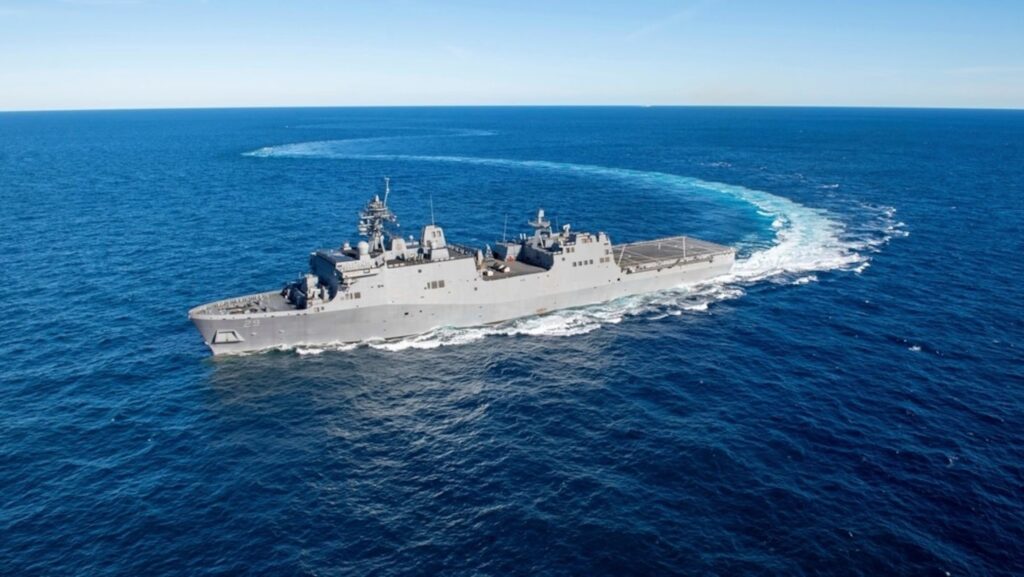
SAN DIEGO, Calif. — The U.S. Navy has approved the commissioning date for the future USS Richard M. McCool Jr. (LPD 29). 
 
The Navy will commission Richard M. McCool Jr., an amphibious transport dock, September 7, 2024 at Naval Air Station Pensacola in Pensacola, Florida. 
 
The naming of LPD 29 honors U.S. Navy Capt. Richard M. McCool Jr., who was awarded the Medal of Honor in 1945 for the heroism he displayed after his ship was attacked by kamikaze aircraft in the Battle of Okinawa. Despite suffering from shrapnel wounds and painful burns, he led efforts to battle a blazing fire on his ship and rescue injured sailors. LPD 29 will be the first of its name. 
 
Richard M. McCool Jr. is co-sponsored by Shauna McCool and Kate Oja, granddaughters of the ship’s namesake. As the co-sponsors, McCool and Oja lead the time-honored Navy tradition of giving the order during the ceremony to “man our ship and bring her to life!” At the moment, the commissioning pennant is hoisted and Richard M. McCool Jr. becomes a proud ship of the fleet. 
 
Richard M. McCool Jr. will be the Navy’s 13th San Antonio-class amphibious transport dock ship. 
 
Amphibious transport docks are used to transport and land Marines, their equipment, and supplies by embarked Landing Craft Air Cushion (LCAC) or conventional landing craft and amphibious assault vehicles (AAV) augmented by helicopters or vertical take-off and landing aircraft (MV-22). These ships support amphibious assault, special operations, or expeditionary warfare missions and serve as secondary aviation platforms for amphibious operations. 


Houthis strike M/T Wind in Red Sea

From U.S. Central Command, May 18, 2024 

TAMPA, Fla. – At approximately 1 a.m. (Sanaa time) May 18, Iranian-backed Houthis launched one anti-ship ballistic missile (ASBM) into the Red Sea and struck M/T Wind, a Panamanian-flagged, Greek owned and operated oil tanker. M/T Wind most recently docked in Russia and was bound for China. 

The impact of the ASBM caused flooding which resulted in the of loss propulsion and steering. A coalition vessel immediately responded to the distress call by M/T Wind, but no assistance was needed. The crew of M/T Wind was able to restore propulsion and steering, and no casualties were reported. M/T Wind resumed its course under its own power. 

This continued malign and reckless behavior by the Iranian-backed Houthis threatens regional stability and endangers the lives of mariners across the Red Sea and Gulf of Aden. 

May 19 U.S Central Command Update 

From U.S. Central Command, May 19, 2024 

TAMPA, Fla. – At approximately 9:35 p.m. (Sanaa time) May 18, Iranian-backed Houthis launched one anti-ship ballistic missile (ASBM) from a Houthi-controlled area in Yemen over the Gulf of Aden. There were no injuries or damages reported by U.S., coalition, or merchant vessels. 

This continued malign and reckless behavior by the Iranian-backed Houthis threatens regional stability and endangers the lives of mariners across the Red Sea and Gulf of Aden. 


Navy Establishes Unmanned Surface Vessel Squadron Three

NAVAL BASE CORONADO (May 15, 2024) – Global Autonomous Reconnaissance Craft (GARC) from Unmanned Surface Vessel Squadron 3 (USVRON 3) operate remotely in San Diego Bay ahead of the unit’s establishment ceremony. The 16-foot GARCs built by Maritime Applied Physics Corporation enable research, testing, and operations that will allow integration throughout the surface, expeditionary, and joint maritime forces. (U.S. Navy photo by MC1 Claire M. DuBois)

By Karli Yeager, Commander, Naval Surface Force, U.S. Pacific Fleet Public Affairs – May 17, 2024 

SAN DIEGO – Commander, Naval Surface Force, U.S. Pacific Fleet (CNSP) established Unmanned Surface Vessel Squadron (USVRON) Three at Naval Base San Diego during a ceremony, May 17. 

USVRON Three will oversee a fleet of small, unmanned surface vessels (sUSV) known as Global Autonomous Reconnaissance Craft (GARC).  

During the ceremony, Capt. Derek Rader assumed command of the newly established USVRON Three. 

“Our Sailors are the essential key for integration of unmanned surface vessels in the Navy and joint construct,” said Rader. “This will be accomplished through experimentation with the fleet testing and doctrine drafted by operators you see today, who embody and execute the warfighting that we need to achieve to enable the full potential of unmanned systems.” 

USVs, including the GARCs, will provide additional warfighting capability and capacity to augment the Navy’s traditional combatant force, providing commanders with a greater range of capabilities and employment options to increase the Fleet’s tactical and strategic advantages. The goal for USVs is to provide the fleet with operations in conjunction with carrier strike groups, surface action groups, or even independently. 

Manufactured by the Maritime Applied Physics Corporation, GARCs are 16-foot USVs that enable research, testing, and operations that will allow integration throughout the surface, expeditionary, and joint maritime forces. 

Commander, Naval Surface Forces U.S. Pacific Fleet Vice Adm. Brendan McLane delivered the keynote speech at the ceremony.

“With challenging obstacles to overcome, we have put the right team in place at USVRON Three, and I believe we have done just that,” McLane said. “The Navy is placing unmanned systems in the hands of 400 of our most talented warfighters to help integrate, scale, experiment, and employ these systems.”

USVRON Three will also incorporate the newest rating, the robotics warfare (RW) specialist into their teams. The rating was announced in February by the Chief of Naval Operations (CNO). They will enable Robotic Autonomous System (RAS) operations and maintenance at the tactical edge and be the subject matter experts for computer vision, mission autonomy, navigation autonomy, data systems, artificial intelligence, and machine learning on the RAS platforms. 

USVRON Three will report to Surface Development Group (SURFDEVGRU) One, under the direction of Commodore Shea Thompson.  

“There are currently no boundaries, and we have an incredible opportunity to determine what right looks like within our sphere of influence,” Thompson said. “And the SURFDEVGRU One and USVRON Three teams are manned by like-minded surface warriors who are making considerable strides in validating small USV capability while laying out a clear path to achieving full operational capability by a timeframe that matters”  

The mission of USVRON Three is to deliver the most formidable, unmanned platforms in the maritime domain. The squadron will be a cornerstone in building the foundational knowledge required to operate and maintain sUSV and will spearhead the development of TTPs for sUSV operations and sustainment. USVRON 3’s motto is “Victory Through Ferocity.” 

SURFDEVGRU 1 is responsible for the maintenance, training, and manning oversight for unmanned surface vessels (USV), Zumwalt-class guided missile destroyers, and the future USS Lyndon B. Johnson (DDG 1002). 

The mission of CNSP is to man, train, and equip the Surface Force to provide fleet commanders with credible naval power to control the sea and project power ashore. 


USS Leyte Gulf Returns From Final Deployment 

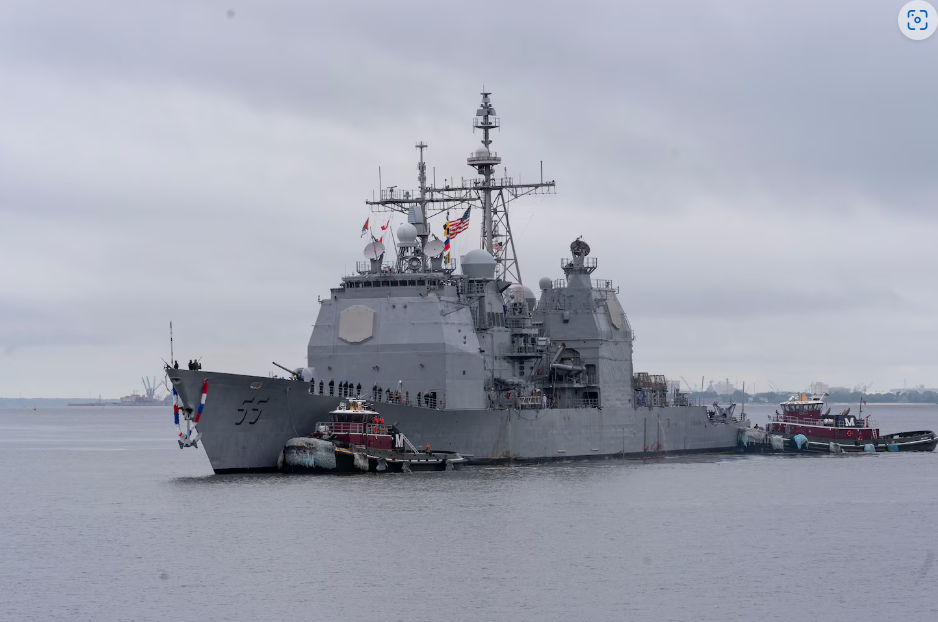
The guided-missile cruiser USS Leyte Gulf (CG 55) returns to Naval Station Norfolk, May 17, 2024, marking their final deployment. Leyte Gulf deployed to the 4th Fleet area of responsibility, seizing 6,470 kilograms of illicit-drugs, a semi-submersible, and conducted theater security cooperation visits. Constructed in 1985 and commissioned in 1987, Leyte Gulf is named after the decisive World War II battle in the Philippine Sea. (U.S. Navy photo by Mass Communication Specialist 2nd Class Manvir Gill)

By MC2 Porsha Thompson, 17 May 2024 

NORFOLK, Va. — The guided-missile cruiser USS Leyte Gulf (CG 55) returned to Naval Station Norfolk, May 10, 2024, marking their final deployment.  

Leyte Gulf departed Norfolk, Jan. 28, 2024, to conduct maritime interdiction and theater security operations in the U.S. 4th Fleet area of operations. 

 “The crew of Leyte Gulf is a model for maritime teamwork,” said Vice Adm. Doug Perry, Commander, U.S. 2nd Fleet.  “They partnered with Navy air assets and Coast Guard interdiction teams, showcasing 2nd Fleet’s ability to extend our presence and maintain homeland defense in other fleets. This is a profound final chapter for one of the Navy’s finest ships, and their crew should be proud of all they accomplished.” 

During their final deployment, Leyte Gulf embarked the “Valkyries” of Helicopter Maritime Strike Squadron (HSM) 50 and partnered with U.S. Coast Guard Law Enforcement Detachment (LEDET) 404.  

The Leyte Gulf team performed maritime interdiction operations and disrupted 4,100 kilograms of cocaine. They detected and seized a self-propelled semi-submersible containing 2,370 kilograms of illicit drugs, which was later destroyed during a sinking exercise. The LEDET boarded and took positive control of three vessels during interdiction operations and removed 15 narcotics traffickers from the narcotics trade. 

“I admire the resiliency of the crew aboard Leyte Gulf,” said Perry. “Their commitment to the mission in the South Atlantic enhances maritime security through sustained naval presence.” 

Leyte Gulf operated with regional partners in the 4th Fleet area and conducted theater security cooperation visits. These combined efforts aimed to strengthen maritime partnerships, enhance U.S. maritime posture, and deter threats of illicit drug trafficking. 

Named after one of World War II’s largest naval battles, “The Battle of Leyte Gulf” was fought in 1944 in the Philippine Sea. It was a decisive battle that pushed back Japanese naval forces. The ship, which would be forever known as Leyte Gulf, was constructed in 1985 and commissioned in 1987. 

“This ship is full of history. Each period brings its own far-off journeys, along with generations of Sailors who have manned the helm,” said Capt. Nathan Diaz, the commanding officer of Leyte Gulf. “Our last deployment was full of Sailors who made their own mark on the story of this great warship. Though our namesake comes from a battle long ago, the U.S. is still performing with a level of combat expertise and professionalism that we’ve always had as we protect the homeland.” 

U.S. 2nd Fleet, reestablished in 2018 in response to the changing global security environment, develops and employs maritime forces ready to fight across multiple domains in the Atlantic and Arctic in order to ensure access, deter aggression and defend U.S., allied, and partner interests. 


WASP ARG AND 24TH MEU COMPLETE JOINT FORCE’S MOST COMPLEX TRAINING 

ATLANTIC OCEAN- The Arleigh Burke guided missile destroyer, USS Cole (DDG 67), the Wasp Class amphibious assault ship USS Wasp (LHD-1) and the Harper’s-Ferry class amphibious landing dock USS Oak Hill (LSD 51) transit in formation ahead of the San Antonio Class transport dock USS New York (LPD 21) in the Atlantic Ocean on April 14, 2024. New York is underway in the Atlantic Ocean completing integrated naval training as part of the Wasp Amphibious Ready Group (WSP ARG)-24th Marine Expeditionary Unit (MEU). Carrier Strike Group (CSG) 4 and Expeditionary Operations Training Group (EOTG) work together with Joint and Allied teammates to mentor, train, and assess ARGs and MEUs in support of U.S. and Allied economic, security, and defense interests. (U.S. Navy photo by Mass Communication Specialist 2nd Class Jesse Turner)

BY COURTESY STORY 
13 May 2024 

ATLANTIC OCEAN – The Wasp Amphibious Ready Group (ARG) and embarked 24th Marine Expeditionary Unit (MEU) (WSP ARG-24th MEU) completed Composite Training Unit Exercise (COMPTUEX), May 12, 2024. The Arleigh Burke-class guided missile destroyer USS Cole (DDG 67) completed their COMPTUEX alongside the WSP ARG-24th MEU team, May 7. 
 
ARG-MEU COMPTUEXs bring Navy, Marine Corps, Joint Force, and State Department trainers together to exercise the capabilities of a combined Navy-Marine Corps team. The exercise represents the Department of the Navy’s commitment to deliver highly-capable, integrated naval forces to deter adversaries, reassure allies, secure the free flow of trade and commerce, and enable U.S. diplomatic engagement. 
 
“You must continue to train and be at your highest level of performance and competitive advantage every day,” said Vice Adm. Doug Perry, commander, U.S. Second Fleet and Joint Force Command Norfolk, who visited the amphibious assault ship USS Wasp (LHD 1), May 7. 
 
“While you are deployed, you are going to work extensively with our allies and partners, and your mission focus and leadership is critical. You are the men and women who directly support our national priorities and reinforce the rules based order that is critical to U.S. and Allied security.” 
 
The fleet commander’s visit was one in a series of high-level visits during the at sea training period which included the Senate Appropriations Committee – Defense Sub-Committee and the Offices of the Secretary of Defense for Policy, Personnel and Readiness, and Cost Assessment and Program Evaluation. 
 
During ARG-MEU COMPTUEXs, Carrier Strike Group 4 (CSG-4) and II Marine Expeditionary Force’s Expeditionary Operations Training Group (EOTG) work together to train, mentor, and assess Navy and Marine Corps forces to prepare them for global operations. 
 
“Our Navy and Marine Corps teams must be prepared for every contingency when they deploy,” said Rear Adm. Max McCoy, commander, CSG-4. “Our obligation is to drive scenarios that challenge the training audience and prepare the ARG-MEU to perform at the highest level across a wide range of missions from humanitarian assistance to amphibious assault. Our naval forces must be able to deliver unquestionable capability at the point of impact.” 
 
The exercise made full use of Live, Virtual, and Constructive (LVC) training to prepare for complex operations. The Navy and Joint Force developed an integrated LVC training environment that enables the services to execute high-end training earlier, using synthetic tools while operating live tactical systems. LVC also allows the force to rapidly explore and develop new multi-domain tactics with near real-time, continuous feedback. 
 
“There is nothing as important today as our obligation to train, mentor, and assess the Marines and Sailors of the WSP ARG-24th MEU,” said Col. Neil Berry, director, Expeditionary Operations Training Group, II Marine Expeditionary Force. “We often say the world gets a vote, though our mission with this team was to ensure that they – along with the Joint Force team – have the deciding vote when the nation calls.” 
 
The WSP ARG-24th MEU COMPTUEX exercise provided the environment for the team to execute the latest tactics, techniques, and procedures, informed by recent operations, and provides Navy type commanders and systems commands the data they need to improve future force generation. Feedback captured using the Root Cause Analysis Tool (RCAT), a Navy developed software tool, enables exercise assessors to deliver immediate recommendations to the training audience and actionable ‘external fixes’ to inform fleet-resourcing decisions to improve performance Fleet-wide. 
 
The WSP ARG-24th MEU spent eight days at sea completing training as a team, before beginning the COMPTUEX scenario. It was an opportunity for the team to integrate their processes and sharpen their collective skill sets before increasing complexity. 
 
“COMPTUEX was an invaluable opportunity to train as an integrated naval force,” said Capt. Nakia Cooper, commodore of Amphibious Squadron (PHIBRON) 4, WSP ARG. “We demonstrated the strength of our unique partnership with the 24 MEU, and our Sailors and Marines embodied the ‘One Team, One Fight’ mantra during the certification event.” 
 
During COMPTUEX, the WSP ARG-24th MEU team completed a variety of integrated events such as live-fire exercises, strait transits, maritime security exercises, amphibious landings, maritime interdiction, non-combatant evacuation operations, foreign humanitarian assistance, and counter-unmanned aerial systems (C-UAS) engagements. 
 
The team also exercised a transfer of authority from national authority to NATO authority under Naval Striking and Support Forces NATO (STRIKFORNATO) in Lisbon, Portugal. Transfers of authority are an increasingly common feature in COMPTUEXs, as well as in the operational fleet as the U.S. and NATO Allies continue to train and operate with one another to deter and defend adversary aggression. The STRIKFORNATO team provided command-and-control of the WSP ARG-24th, while concurrently leading vigilance activity Neptune Strike 24-1. 
 
“During COMPTUEX, the Marines and Sailors built an integrated ‘Team of Teams’ that showcased naval warfighting capability to assure our partners and allies and deter our potential adversaries” said Col. Todd Mahar, Commanding Officer, 24th MEU. “We are excited to get underway with our Shipmates and deploy forward as a ready force for our Nation.” 
 
Upon completion of COMPTUEX, the 24th MEU was designated as Special Operations Capable (SOC), signifying they demonstrated proficiency as a specially trained Marine Air Ground Task Force (MAGTF) capable of integrating with, enabling, and supporting SOF operations as part of their enhanced pre-deployment training program. The MEU (SOC) is a uniquely organized, trained, and equipped expeditionary force that provides geographic combatant commanders options for theater campaigning and crisis response. 
 
The exercise also served as a venue to expand upon existing capability in the Navy and Joint Force. 
 
For example, the WSP ARG-24th MEU became the first ARG-MEU team to train with the En-Route Care System (ERCS) and the Expeditionary Resuscitative Surgical System (ERSS). The ERCS and the ERSS are expeditionary medicine capabilities that provide a ready, rapidly deployable and combat effective medical forces to improve survivability across the full spectrum of care, regardless of environment. 
 
Similarly, U.S. Coast Guard Maritime Security Response Team (MSRT) East, USCGC Stone (WMSL 758), and USCGC Angela McShan (WPC 1135) participated in numerous events alongside the Navy and Marine Corps team to train and increase proficiency. 
 
ARG-MEUs are organized, trained, equipped, evaluated, and certified to conduct maritime expeditionary warfare and amphibious operations across the full range military operations. As a highly mobile, versatile, and integrated naval formation, the ARG-MEU offers geographic combatant commanders an organic combined arms force that remains forward deployed and capable of persistent competition. 
 
The WSP ARG consists of the Wasp-class amphibious assault ship USS Wasp (LHD 1), San Antonio-class amphibious transport dock ship USS New York (LPD 21), Harpers Ferry-class dock landing ship USS Oak Hill (LSD 51), and the embarked 24th Marine Expeditionary Unit. 
 
The 24th MEU is a rapidly deployable MAGTF that consists of Battalion Landing Team 1/8, the Ground Combat Element; Marine Medium Tiltrotor Squadron 365 (Reinforced), the Aviation Combat Element; and Combat Logistics Battalion 24, the Logistics Combat Element. 
 
Carrier Strike Group 4’s mission is to train, mentor, and assess carrier strike groups, amphibious ready groups, and independent deployers for global combat against peer competitors. You can find them on LinkedIn, Twitter (@CSG_4), and DVIDS. 
 
II Marine Expeditionary Force’s Expeditionary Operations Training Group (EOTG) mission is to train and evaluate deploying Marine Expeditionary Units (MEU) and other designated forces in select special individual and collective tasks, as well as their ability to conduct assigned mission essential tasks in order to prepare forces to support the geographic combatant commanders. 
 
To learn more about WSP ARG and 24th MEU Team of Teams visit their DVIDS feature page at https://www.dvidshub.net/feature/wasparg24thmeu 


SECDEF Announces Flag Officer Nominations 

U.S. Department of Defense, May 17,2024 

Secretary of Defense Lloyd J. Austin III announced today that the president has made the following nominations: 

Navy Rear Adm. Jeffrey T. Anderson for appointment to the grade of vice admiral, with assignment as commander, Sixth Fleet; commander, Task Force Six; commander, Striking and Support Forces NATO; deputy commander, U.S. Naval Forces Europe; deputy commander, U.S. Naval Forces Africa; and Joint Force Maritime Component commander Europe, Naples, Italy.  Anderson is currently serving as director of Operations, J-3, U.S. Indo-Pacific Command, Camp H.M. Smith, Hawaii. 

Navy Rear Adm. Christopher C. French for appointment to the grade of vice admiral, with assignment as judge advocate general of the Navy, Pentagon, Washington, D.C.  French is currently serving as deputy judge advocate general of the Navy, Pentagon, Washington, D.C. 

Navy Rear Adm. Nancy S. Lacore for appointment to the grade of vice admiral, with assignment as chief of Navy Reserve, N095, Office of the Chief of Naval Operations, Pentagon, Washington, D.C.  Lacore is currently serving as commandant, Naval District Washington, Washington, D.C. 

Navy Rear Adm. Scott W. Pappano for appointment to the grade of vice admiral, with assignment as principal military deputy assistant secretary of the Navy (Research, Development and Acquisition), Pentagon, Washington, D.C.  Pappano is currently serving as program executive officer, Strategic Submarines, Naval District Washington, Washington, D.C. 


U.S. Coast Guard Atlantic Area holds change-of-command ceremony 

US Coast Guard Atlantic Area Vice Admirals Nathan Moore and Kevin Lunday salute one another while Coast Guard Commandant Adm. Linda Fagan presides over a change-of-command ceremony, May 16, 2024, in Yorktown, Virginia. (U.S. Coast Guard photo by Petty Officer 2nd Class Brandon Hillard) 

From U.S. Coast Guard Atlantic Area, May 16, 2024 

PORTSMOUTH, Va. — Vice Adm. Nathan Moore relieved Vice Adm. Kevin Lunday as the U.S. Coast Guard Atlantic Area commander, Thursday, during a change-of-command ceremony held on Coast Guard Training Center Yorktown.  

Adm. Linda Fagan, commandant of the Coast Guard, presided over the ceremony.  

Lunday will report for duty in Washington, D.C. as the Coast Guard’s vice commandant. He served as the U.S. Coast Guard Atlantic Area commander, director of Department of Homeland Security Joint Task Force East (JTF-E), and Defense Force East commander from May 2022 to May 2024.  

While leading complex security operations from the Rocky Mountains eastward to the Arabian Gulf, he led the efforts to address substantial national and international challenges. His deployment of assets to the Arctic, South Atlantic, Africa, Mediterranean Sea, and the Middle East directly supported the Tri-Service Maritime Strategy and greatly enhanced cooperation with the joint force, allies, and partners.  

Pre-positioning of Coast Guard personnel and equipment during hurricane seasons saved lives, mitigated environmental disasters, and led to the expeditious restoration of the maritime transportation system, which is critical to the U.S. economy.  

Additionally, Lunday orchestrated the Coast Guard’s surge response to historic maritime migration levels along the U.S. Southeast maritime border. His expertise and adjudication of competing demands fostered an increased readiness posture and led to the deployment of additional personnel and surface assets. These actions were key to saving lives and preventing a deadly mass migration.  

As Director of JTF-E, he advanced joint operations and cross-component collaboration while spearheading modernization efforts, promoting interoperability among interagency partners, and championing innovative approaches to information-sharing. His efforts forged a sustainable joint architecture and galvanized Departmental unity of effort in an increasingly complex maritime environment.   

Vice Adm. Moore is reporting from U.S. Coast Guard Atlantic Area in Portsmouth, Virginia, where he served as the deputy commander. He previously served as the U.S. Coast Guard Seventeenth District commander, responsible for operations throughout Alaska, the North Pacific Ocean, the Arctic Ocean, and the Bering Sea. Other assignments include the assistant commandant for Engineering and Logistics (CG-4), responsible for all naval, aeronautical, civil, and industrial engineering and logistics for the service, and various operational and engineering assignments, including command afloat.   

Moore graduated from the United States Coast Guard Academy with a bachelor’s degree in naval architecture and marine engineering. He went on to earn two master’s degrees from the University of Michigan, one in naval architecture and marine engineering and the other in business administration. Most recently, he earned a third master’s degree in national resource strategy from the Eisenhower School.  

U.S. Coast Guard’s Atlantic Area command oversees all domestic Coast Guard operations east of the Rocky Mountains, including the Arctic, Atlantic, Gulf of Mexico, Caribbean, and out-of-hemisphere operations in Europe, Africa, and Southwest Asia. Atlantic Area encompasses five regional district commands, each tasked with running day-to-day operations within their areas of responsibility. Atlantic Area is responsible for coordinating and deploying cutters, aircraft, pollution response equipment, and thousands of personnel between districts when significant events occur. After major disasters, the area team assists districts by ensuring resources, equipment, and personnel surge to impacted areas for rescue and recovery efforts while also providing for other Coast Guard operations throughout the region.   

JTF-E coordinates and synchronizes DHS cross-component operations to target, dismantle, and disrupt illicit enterprises, prepare for and respond to mass maritime migration, and ready the DHS enterprise to respond to emerging threats along the Southeast maritime border.  

The change-of-command ceremony is a military tradition representing a formal transfer of authority and responsibility for a unit from one commanding or flag officer to another. The passing of colors, standards, or ensigns from an outgoing commander to an incoming one ensures that the unit and its members are never without official leadership, a continuation of trust.