POTTSTOWN, Pennsylvania — VideoRay LLC announced May 14 it has been awarded a $92.6 million, five-year contract for the continuous production, sustainment and development of the MK20 Defender remotely operated vehicle platform for the U.S. Navy’s Maritime Expeditionary Standoff Response (MESR).
This contract provides access to VideoRay’s Mission Specialist family of underwater robotics systems to support the Navy’s Explosive Ordnance Disposal Underwater Response Vehicle program and the MESR program of record. Administered by Naval Information Warfare Command, Pacific, the contract provides for the delivery and support of the Navy’s next-generation ROVs that will be used to conduct critical undersea missions to support our warfighters.
The MK20 Defender ROV, based on VideoRay’s Mission Specialist Defender, is a highly robust, man-portable, expeditionary ROV that offers modularity and an open architecture design that allows for the easy integration of third-party sensors, software applications, and versatile, field-swappable payload options to meet the Navy’s expanding needs for expeditionary mine countermeasure operations. Core technology onboard this platform has been developed by industry partners and includes: EOD Workspace control software and autonomy platform by Greensea IQ, Multibeam sonar and USBL positioning system by BluePrint Subsea, Doppler Velocity Log (DVL) for navigation by Nortek, and a two-function manipulator by Eddify, which combine to significantly expand vehicle capabilities while maintaining the size, weight and power specifications needed to meet the Navy’s challenging requirements.
Designed and built in Pottstown, Pennsylvania, and serviced from its Pottstown and San Diego offices, the Mission Specialist Defender has quickly become the cornerstone of VideoRay’s Mission Specialist family of products, boasting a rapidly growing number of domestic and international defense and commercial customers worldwide.
“This production contract with the U.S. Navy marks an exciting new chapter for VideoRay, acknowledging the dedication and hard work of our team to achieve this significant milestone,” said Chris Gibson, CEO of VideoRay. “We are grateful for the opportunity to collaborate with the Navy and to receive valuable feedback, which has been instrumental in continuously enhancing our next-generation Expeditionary EOD and MCM systems to meet the fleet’s requirements. We look forward to continuing our partnership with the U.S. Navy, along with our partners to advance our technology and capabilities to meet the needs of our defense and commercial customers alike worldwide.”
Navy Expands Suicide Intervention and Mental Health Services; Survivors Say More Must Be Done
Boatswain’s Mate Seaman Kalea Howe, assigned to the amphibious assault ship USS Wasp (LHD 1), poses and screams for a photo to personify feelings of anxiety and depression. This photograph was captured using multiple exposure techniques and was later used to accompany a story about depression for suicide prevention month. U.S. Navy | Mass Communication Specialist 1st Class Alora R. Blosch
“The reason I’m writing this is because I feel you are the only person that can make the changes necessary for others to not suffer the same fate I did,” Petty Officer 3rd Class Brandon Caserta wrote to his commanding officer. “If you can successfully take action and make the changes, you will prevent more suicides within the Navy.”
Brandon died by suicide June 25, 2018. That year, he joined a tragic roster of 68 U.S. Navy Sailors on active duty who took their own lives.
Before his death at age 21, the Peoria, Arizona, native wrote letters to his family, friends, supervisor and others that described toxic leadership and a hostile work environment. Stationed at Naval Station Norfolk while attached to Helicopter Sea Combat Squadron 28, he reported being hazed, bullied and sexually assaulted. Brandon felt the Navy had labeled him a failure. He asked for, but was denied, medical attention.
Brandon’s parents, Teri and Patrick Caserta, argue Brandon would be alive today had the military intervened to provide their son with confidential access to mental health services. Their advocacy in the aftermath of Brandon’s death led to passage of the Brandon Act, which the Department of Defense officially launched one year ago this month.
The Brandon Act requires the Navy and all military branches to make it easier for service members to ask for mental health treatment confidentially — for any reason, at any time and in any environment. Supervisors or commanders of service members who invoke the Brandon Act must quickly facilitate evaluations, assuring privacy.
“If you’re on a ship in the middle of nowhere and you need mental health care, it might take a day or two and happen by telemedicine or some other way,” Dr. Lester Martinez-Lopez, the assistant secretary of defense for health affairs, said in a Jan. 22, 2024, DoD News article on the Brandon Act. “But it doesn’t matter where you are. All you need to do is raise your hand and tell your supervisor and they will take care of that as soon as possible.”
The Brandon Act passed as part of the fiscal 2022 National Defense Authorization Act, signed into law by President Biden Dec. 27, 2021. The DoD implemented the policy May 5, 2023, giving the service branches 90 days to roll it out to all service members, starting with the active-duty components.
Along with the other services, the Navy has since reiterated that suicide prevention is a top priority and communicated about the self-referral process available under the Brandon Act. The Navy is taking other steps to reduce stigma associated with asking for mental health services and promote help-seeking behavior. Efforts include expanding virtual and in-person health, mental health and quality-of-life offerings, particularly those aimed younger enlisted service members, who data show are most at risk of death by suicide.
In 2022, the Navy began moving its Sailor Assistance & Intercept for Life (SAIL) suicide intervention program from an in-person model to a virtual model. The Navy completed the transition to fully virtual SAIL in January 2024. The virtual model is staffed with dedicated remote counselors from the Fleet and Family Support Center (FFSC). The Navy says more Sailors are now using the service, citing in the increased accessibility and privacy of virtual care and assistance. The program is operated by the Commander, Navy Installations Command (CNIC), which oversees 10 Navy regions, 70 bases and more than 43,000 employees.
By the end of 2024, the Navy plans to complete the expansion of FFSC’s virtual clinical counseling program, which will provide Sailors and their families in all 10 Navy regions with remote access to short-term assessments, treatment planning, clinical counseling, and referrals from licensed mental health professionals.
‘More Needs to be Done’
In a phone interview with Seapower magazine, Patrick and Teri Caserta commended Navy and other Pentagon leaders for their willingness to improve access to suicide interventions and other mental health services.
“The (virtual) SAIL program is a step in the right direction,” said Patrick, a 22-year retired U.S. Navy senior chief and naval counselor.
But, he added, “more needs to be done” to end military suicides, including expanding awareness of the Brandon Act and educating commanders that “if you violate the Brandon Act, you’re breaking the law.” Among the lawmakers overseeing Brandon Act implementation and spearheading related legislation in Congress is Sen. Tim Kaine (D-Virginia), whose state is the home of Naval Station Norfolk, where Petty Officer Caserta died.
“I’ve heard heartbreaking stories from many servicemembers and their families about mental health challenges, the lack of resources, and the stigma associated with asking for help,” Kaine told Seapower in a statement.
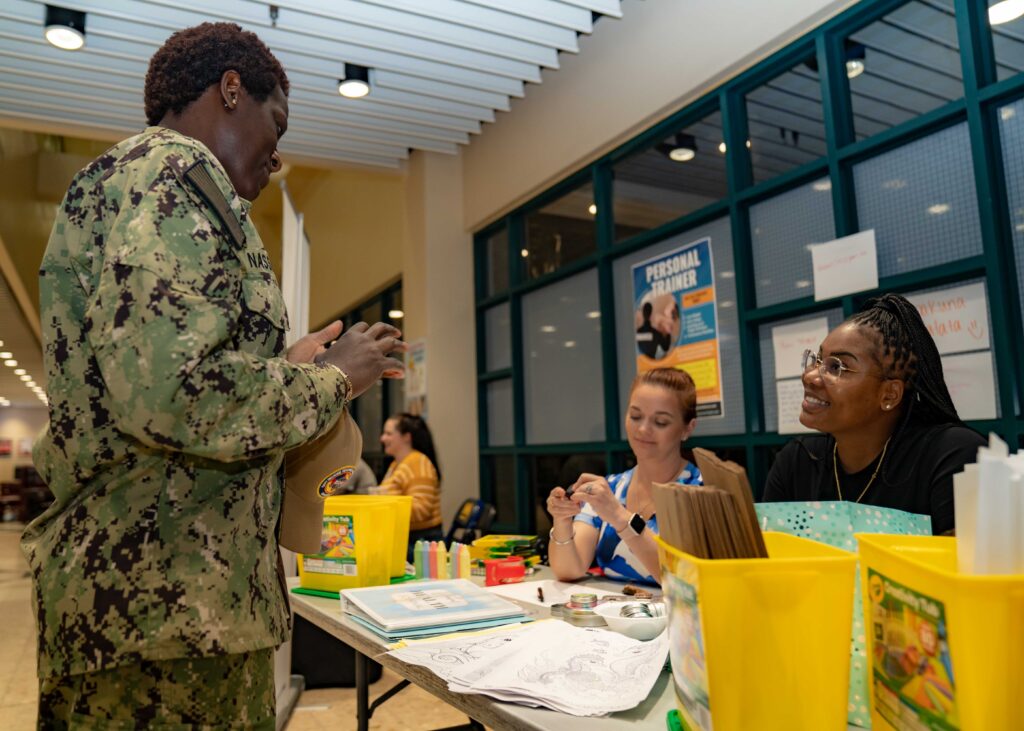
Members assigned to U.S. Naval Forces Central Command talk to a Sailor during a mental health awareness event in Bahrain, April 12, 2023. U.S. Army | Specialist Aaron Troutman
OIG Evaluation
Kaine, a member of the Senate Armed Services Committee and chair of its Seapower subcommittee, said he’s committed to expanding service members’ access to mental health care and to preventing military suicides, including assessing the effectiveness of Navy efforts to address this issue.
Pursuant to a directive Kaine and colleagues included in the fiscal 2023 national defense bill, the DoD’s Office of Inspector General in February 2024 launched an evaluation of the Navy’s suicide prevention and response efforts.
A Feb. 27 OIG memo said subjects of the evaluation include the Department of the Navy, Office of the Under Secretary of Defense for Personnel and Readiness and the Defense Health Agency in the National Capital Region. Evaluators plan site visits to Naval Station Norfolk as well as to Naval Base San Diego in California; Naval Base Kitsap in Bremerton, Washington; and Naval Station Pearl Harbor in Hawaii. OIG said it could add other locations to evaluate.
Under Navy policy, commanders must submit a SAIL referral after a Sailor experiences suicide ideation or attempts suicide and is evaluated by a medical treatment facility or emergency department, Cornealius L. Stamps, the SAIL clinical counseling program analyst, said in an email interview with Seapower.
A SAIL case manager must contact the referred Sailor within one day to offer assistance and care services. Sailors who accept services can receive virtual counseling from a remote SAIL or clinical counselor or see an FFSC clinical counselor in person.
SAIL’s move to a virtual model with dedicated case managers has coincided with an increase in Sailors accepting services, Navy-provided data shows. The percentage of Sailors referred to SAIL who accepted services rose from 46.5% in 2020 to 62.67% in 2023. To meet the demand for services, SAIL’s staff of case managers rose 42%, Stamps said.
It’s too early to say if these and other programs are reducing the number of miliary suicides. In all of calendar year 2022, 492 active-duty, National Guard and reserve service members died by suicide, according to the DoD. This was fewer than the 524 service members who died this way in 2021. Most military deaths by suicide occur among enlisted men under age 30.
More recent quarterly data showed no increase or decrease in Navy active-duty service member deaths by suicide, even as these deaths increased in the active Army, Marine Corps and Air Force. Those three services combined saw 19 more active-duty service member deaths by suicide in the first quarter of calendar year 2023, compared to the first quarter of calendar year 2022.
Stamps said the response to virtual SAIL so far is encouraging.
“Sailors have shared positive feedback about SAIL’s virtual services through the program’s anonymous surveys, during conversations with their case managers,” she said, noting, “we’ve also heard similar sentiments echoed by referring leaders.”
Sailors can also request SAIL services by contacting their local FFSC, a chaplain or another available mental health program. And although CNIC doesn’t oversee ship operations, Sailors aboard a ship without counseling services can ask their command to arrange SAIL services by phone.
“It’s well-known that military service is challenging and comes with unique stressors that those in the general public will never face,” Stamps said. “Recognizing that you need help and asking for it is a sign of strength.”
Greater Awareness
In addition to offering virtual SAIL and more remote counseling options, the Navy in July 2023 issued Brandon Act-related guidance and resources in a directive-type memo and fact sheet. The service issued a revised Navy Mental Health Playbook addressing mental health within commands and plans to update and send out additional marketing materials throughout the year. In January 2024, the Navy distributed to all commands the Suicide Related Behavior Response and Postvention Guide, streamlining suicide crisis response guidance and providing step-by-step instructions on the SAIL referral procedures.
Despite these efforts, Patrick and Teri Caserta said too many service members and military families still don’t know about the Brandon Act or how to access mental health services.
They’re working for change through the Brandon Caserta Foundation, making sure all service members and veterans get the help they need, without retaliation. They want new military recruits educated about the Brandon Act before service even begins. They want Brandon’s image on military posters with the message that it’s OK for Sailors and service members to seek care, for any reason. They want mental health counselors embedded at the unit level and for the military to establish a uniform response to this crisis.
Ultimately, they want to continue to share what Brandon’s experienced — to raise awareness about military suicide, empower service members and families and enact policy changes that will end military and veteran deaths by suicide.
“We know that Brandon’s story saves lives,” Teri Caserta said.
Sidebar:Navy Goes Virtual to Boost Sailors’ Access to Quality-of-Life Programming
To boost the quality of life and health of today’s Sailors, the Navy in late January launched a new Virtual Single Sailor Program (VSSP), a platform offering service members and their families worldwide remote access to electronic sports contests, fitness programs and other entertainment and wellness resources. “Obviously, the modern-day Sailor has changed in the way that they interact with information and each other,” said Lisa Sexauer, who is director of Fleet Readiness for Navy Installations and oversees the Navy’s Morale, Welfare and Recreation programs. “And so being able to reach them with useful information and also virtual dynamic programming — wherever the Navy operates and wherever their mission allows them to access that information — is kind of the brainchild behind it.”
Sailors can log onto the platform to virtually participate in esports, locate community-based recreational events, access workout builders and find vacation discounts and other resources.
“The real effort here is to create some connectedness and for people to build communities of support (and) friendships,” Sexauer told Seapower.
VSSP emerged from an ongoing effort to pilot- and focus-test quality-of life-programs that better meet the “desires and needs” of Sailors, she said, particularly those in the E-1 to E-6 enlisted paygrades. Along these lines, the Navy said earlier this year it is considering offering free highspeed Wi-Fi to all Sailors. This is pending the results of a February-September pilot test of the service at 12 permanent party unaccompanied housing locations at Naval Station Norfolk, NAVMEDCEN Portsmouth and Norfolk Naval Shipyard.
In early March, installation commanders also got the go ahead to implement 24/7 entry to staffed or unstaffed fitness facilities.
“If we require our Sailors to be physically fit and healthy so they can fulfill the Navy mission and deploy at a moment’s notice, then we must provide the facilities and resources for them to do so,” Vice Admiral Scott Gray, commander of Navy Installations Command, announced March 8. “Not only does this make sense, it is the right thing to do for the quality of life of our Sailors and other service members.”
CNO Welcomes USS Carney from Historic Middle East Deployment
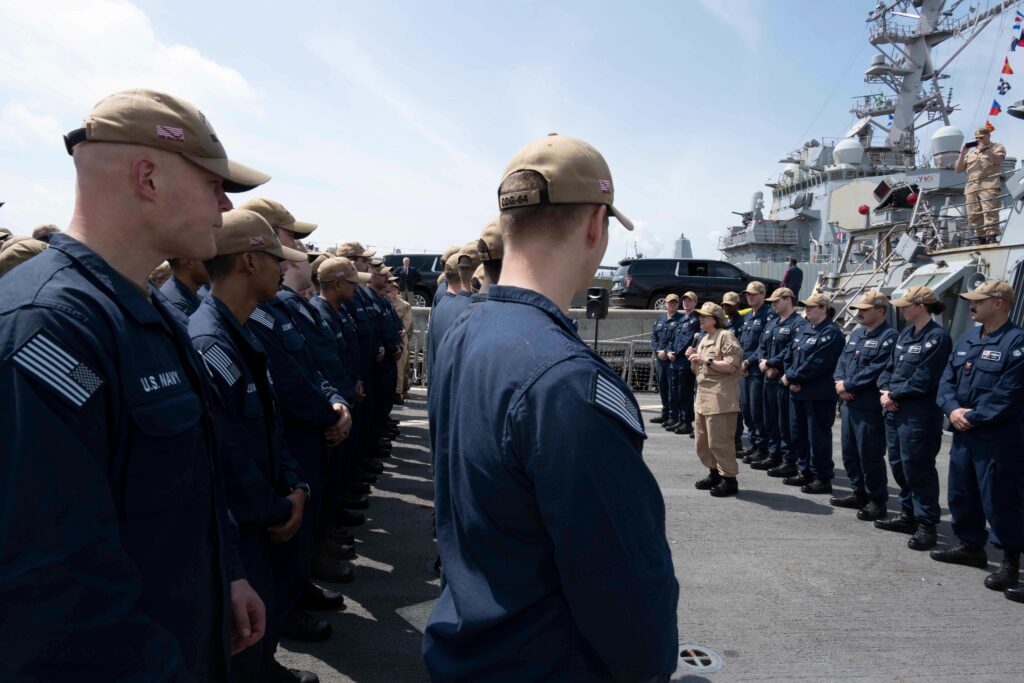
NORFOLK, Va. (May 10, 2024) – Chief of Naval Operations Adm. Lisa Franchetti welcomes the Arleigh Burke-class destroyer USS Carney (DDG 64) to Norfolk, Virginia, May 10. (U.S. Navy photo by MC1 Class William Spears)
NORFOLK, Va. (May 10, 2024) – Chief of Naval Operations Adm. Lisa Franchetti welcomed the crew of Arleigh Burke-class guided-missile destroyer USS Carney (DDG 64) to the United States from a historic deployment to the Middle East, May 10.
Carney conducted a brief stop in Norfolk for logistics before returning home to Naval Station Mayport later this month.
“I could not be more proud of what the Carney team has done since September. Called to action on the very first day that you entered the U.S. 5th Fleet, you conducted 51 engagements in 6 months,” said Franchetti. “You saved lives, ensured the free flow of commerce, and stood up for the rules-based international order and all the values that we hold dear. It has been eye-watering to watch, you are truly America’s Warfighting Navy in action.”
Carney was conducting routine operations in U.S. 6th Fleet when Hamas attacked Israel on Oct. 7. Carney entered the U.S. 5th Fleet area of operations on Oct. 18, ready to conduct operations in support of maritime stability and security in defense of U.S., Allies, and partner interests.
Throughout the ship’s seven-month deployment, Carney successfully destroyed Houthi-launched weapons, including land attack cruise missiles, anti-ship ballistic missiles, and unmanned systems. Additionally, Carney conducted two defensive strikes against Houthi targets in Yemen, destroying 20 targets, and successfully destroyed one Iranian-launched medium-range ballistic missile.
During her visit to the ship, CNO recognized 14 Sailors for their outstanding achievements while on deployment.
“As Surface Warriors, we train to this. We train to this level of readiness and boldness, with a clear commitment to the warfighting excellence that you all exhibited on the world stage for everyone to see. You did exactly what you were trained to do,” said Franchetti. “It is absolutely wonderful to be onboard today and have the opportunity to welcome you back and give you a great big Bravo Zulu – for a job incredibly well done.”
Carney departed Naval Station Mayport, September 27, 2023, on a scheduled independent deployment to the U.S. 5th and 6th Fleet areas of operation. While deployed, Carney predominately operated with the Dwight D. Eisenhower Carrier Strike Group, and initially operated with the Gerald R. Ford Carrier Strike Group upon arrival to the U.S. 6th Fleet.
May 11-12 CENTCOM Update
From U.S. Central Command
May 11, 2024
TAMPA, Fla. – At approximately 8:45 p.m. (Sanaa time) on May 10, Iranian-backed Houthis launched an uncrewed aerial system (UAS) over the Gulf of Aden from Houthi controlled areas in Yemen. A coalition aircraft successfully engaged the UAS. There were no injuries or damages reported by U.S., coalition, or merchant vessels.
Later, between approximately 4:30 a.m. and 4:45 a.m. (Sanaa time) on May 11, U.S. Central Command (USCENTCOM) forces successfully destroyed three UAS launched by Iranian-backed Houthis over the Red Sea from Houthi controlled areas in Yemen. There were no injuries or damages reported by U.S., coalition, or merchant vessels.
It was determined that these UAS presented an imminent threat to both coalition forces and merchant vessels in the region. These actions are taken to protect freedom of navigation and make international waters safer and more secure for U.S., coalition, and merchant vessels.
May 12, 2024
TAMPA, Fla. – At approximately 3:30 a.m.(Sanaa time) on May 12, U.S. Central Command (USCENTCOM) forces successfully destroyed one uncrewed aerial system (UAS) launched by Iranian-backed Houthis over the Gulf of Aden from Houthi controlled areas in Yemen. There were no injuries or damages reported by U.S., coalition, or merchant vessels.
It was determined the UAS presented an imminent threat to both coalition forces and merchant vessels in the region. These actions are taken to protect freedom of navigation and make international waters safer and more secure for U.S., coalition, and merchant vessels.
U.S. Coast Guard Awards Bollinger Shipyards Two Fast Response Cutters
From Bollinger Shipyards, May 13, 2024
LOCKPORT, La., — (May 13, 2024) – The U.S. Coast Guard has exercised a contract option to award Bollinger Shipyards (“Bollinger”) two additional Sentinel-Class Fast Response Cutters (FRC). This announcement brings the total number of FRCs awarded to Bollinger up to 67 vessels since the program’s inception. To date, the U.S. Coast Guard has commissioned 55 FRCs into operational service.
“We’re incredibly proud of our long history supporting the U.S. Coast Guard that now stretches four decades,” said Bollinger Shipyards President and CEO Ben Bordelon. “Our unique experience building for the Coast Guard is unparalleled and has shown time and time again that we can successfully deliver the highest quality and most capable vessels. We look forward to continuing our partnership with the Coast Guard.”
Both FRCs will be built at Bollinger’s Lockport, La facility that supports over 650 direct jobs in Lafourche Parish out of the nearly 4,000 shipbuilders supporting Bollinger’s 13 facilities across Louisiana and Mississippi.
Bordelon continued, “This program isn’t just an economic benefit for our region, but a national security priority that continues to enjoy the support of a bipartisan, bicameral coalition in the United States Congress. That being said, these additional vessels allow for the continued prosperity and economic wellbeing for over 650 families in South Louisiana. The hardworking men and woman of Bollinger Shipyards take tremendous pride in every single vessel we build and deliver for the U.S. government knowing we’re helping to keep our homeland safe.”
The FRC program has had a total economic impact of over $2 billion since inception in material spending and directly supports more than 650 jobs in Southeast Louisiana. The program has indirectly created 1,690 new jobs from operations and capital investment and has an annual economic impact on GDP of $202 million, according to the most recent data from the U.S. Maritime Administration (MARAD) on the economic importance of the U.S. Shipbuilding and Repair Industry. Bollinger sources over 271,000 different items for the FRC consisting of 282 million components and parts from 965 suppliers in 37 states.
The FRC is one of many U.S. Government shipbuilding programs that Bollinger is proud to support. In addition to the construction of the FRC, Bollinger is contracted to build the Polar Security Cutter (PSC) for the U.S. Coast Guard, the Towing, Salvage and Rescue Ship (T-ATS), the Auxiliary Personnel Lighter (APL), the newest oceanographic survey ship (T-AGS 67) and the Mine Countermeasures Unmanned Surface Vessels (MCM USV) for the U.S. Navy. Bollinger is also building three Regional Class Research Vessels (RCRV) for the National Science Foundation through Oregon State University. Bollinger also supports the nuclear-powered ballistic missile submarine program by building various platforms for General Dynamics-Electric Boat.
ABOUT THE FAST RESPONSE CUTTER PLATFORM
The FRC is an operational “game changer,” according to senior Coast Guard officials. FRCs are consistently being deployed in support of the full range of missions within the United States Coast Guard and other branches of our armed services. This is due to its exceptional performance, expanded operational reach and capabilities, and ability to transform and adapt to the mission. FRCs have conducted operations as far as the Marshall Islands—a 4,400 nautical mile trip from their homeport. Measuring in at 154-feet, FRCs have a flank speed of 28 knots, state of the art C4ISR suite (Command, Control, Communications, Computers, Intelligence, Surveillance, and Reconnaissance), and stern launch and recovery ramp for a 26-foot, over-the-horizon interceptor cutter boat.
Coast Guard Offloads More Than $185 Million in Illegal Narcotics During Fleet Week Miami
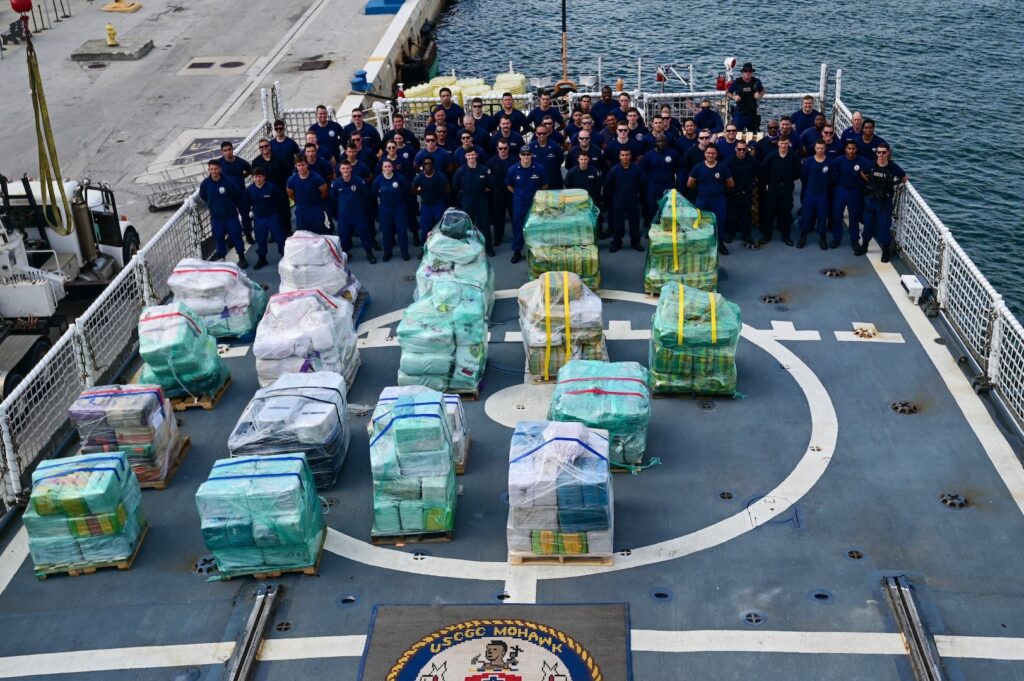
U.S. Coast Guard Cutter Mohawk (WMEC-913) crewmembers pose with approximately 18,000 pounds of illegal narcotics at Port Everglades in Fort Lauderdale, Florida, May 10, 2024. (U.S. Coast Guard photo by Petty Officer 2nd Class Ryan Estrada)
From U.S. Coast Guard 7th District, May 10, 2024
MIAMI – The crew of U.S. Coast Guard Cutter Mohawk (WMEC 913) offloaded more than 13,803 pounds of cocaine and 3,736 pounds of marijuana with a combined estimated street value of approximately $185 million in Port Everglades, Friday.
Coast Guard crews, working alongside interagency and international partners, interdicted the illegal drugs in the international waters of the Caribbean Sea and Atlantic Ocean during six separate cases.
“Our offload today represents the combined efforts of U.S. and allied military units from a Caribbean coalition of partners working together to deny drug trafficking organizations access to maritime smuggling routes,” said Cmdr. David Ratner, commanding officer of USCGC Mohawk. “I am especially proud of the hard work of the Mohawk crew, and grateful for the opportunity to operate with interagency and NATO partners in support of our National Security.”
The following assets and crews were involved in the interdictions:
USCG Cutter Mohawk (WMEC 913)
USCG Tactical Law Enforcement Team South (TACLET-South)
USS Leyte Gulf (CG 55)
U.S. Navy Helicopter Maritime Strike Squadron 50 (HSM 50)
Royal Netherlands Navy ship HNLMS Groningen (P 843)
Royal British Navy ship HMS Trent (P 244)
Joint Interagency Task Force South (JIATF-South)
Joint Task Force – East (JTF-E)
U.S. Customs and Border Protection Air and Marine Operations (CBP-AMO)
Along with the illicit narcotics, 10 suspected smugglers were apprehended and will face prosecution in federal courts by the U.S. Department of Justice.
The offload included contraband seized by Coast Guard law enforcement detachments deployed aboard HMS Trent, HNLMS Groningen, and USS Leyte Gulf, whose crew interdicted a self-propelled semi-submersible vessel in March. You can read more about that case here.
The fight against transnational criminal organizations requires a unity of effort in all phases, from detection and monitoring to interdiction and apprehension, through to criminal prosecutions by international partners and U.S. Attorneys’ Offices in districts across the nation.
The Joint Interagency Task Force South in Key West, Florida, conducts the detection and monitoring of aerial and maritime transit of illegal drugs. The law enforcement phase of counter-smuggling operations in the Caribbean is conducted under the authority of the Coast Guard 7th District, headquartered in Miami. The interdictions, including the actual boardings, are led and conducted by members of the U.S. Coast Guard.
U.S. Customs and Border Protection Air and Marine Operations deployed a National Air Security Operations MQ-9 Unmanned Aircraft System to Puerto Rico in coordination with JTF-E and JIATF-S reinforcement of the Eastern Caribbean Campaign, resulting in tremendous success. JTF-E’s Eastern Caribbean Campaign is a divergence from conventional strategies with a multi-dimensional view on security threats predominating in the region. The deployment highlighted threats emanating from the Eastern Caribbean contributing to the seizure of 25 metric tons of narcotics.
These interdictions relate to Organized Crime Drug Enforcement Task Forces (OCDETF) designated investigations. OCDETF identifies, disrupts, and dismantles the highest-level criminal organizations that threaten the United States using a prosecutor-led, intelligence-driven, multi-agency approach. Additional information about the OCDETF program can be found at https://www.justice.gov/OCDETF.
USCGC Mohawk is a 270-foot, medium endurance cutter homeported in Key West, Florida with a crew of 100. The cutter’s primary missions are counter drug operations, migrant interdiction operations, enforcement of federal fishery laws, and search and rescue in support of Coast Guard operations throughout the Western Hemisphere. Sister ship USCGC Seneca (WMEC 906) homeported in Portsmouth, Virginia, is participating in the inaugural Fleet Week Miami and is hosting free public tours. Visit the Fleet Week Miami website for more information: Fleet Week Miami.
Visit www.GoCoastGuard.com to learn more about active duty and reserve, officer and enlisted opportunities in the U.S. Coast Guard. Information on how to apply to the U.S. Coast Guard Academy can be found here.
DoD, STRATCOM, INDOPACOM Representatives Tour USS Zumwalt, Discuss Hypersonics
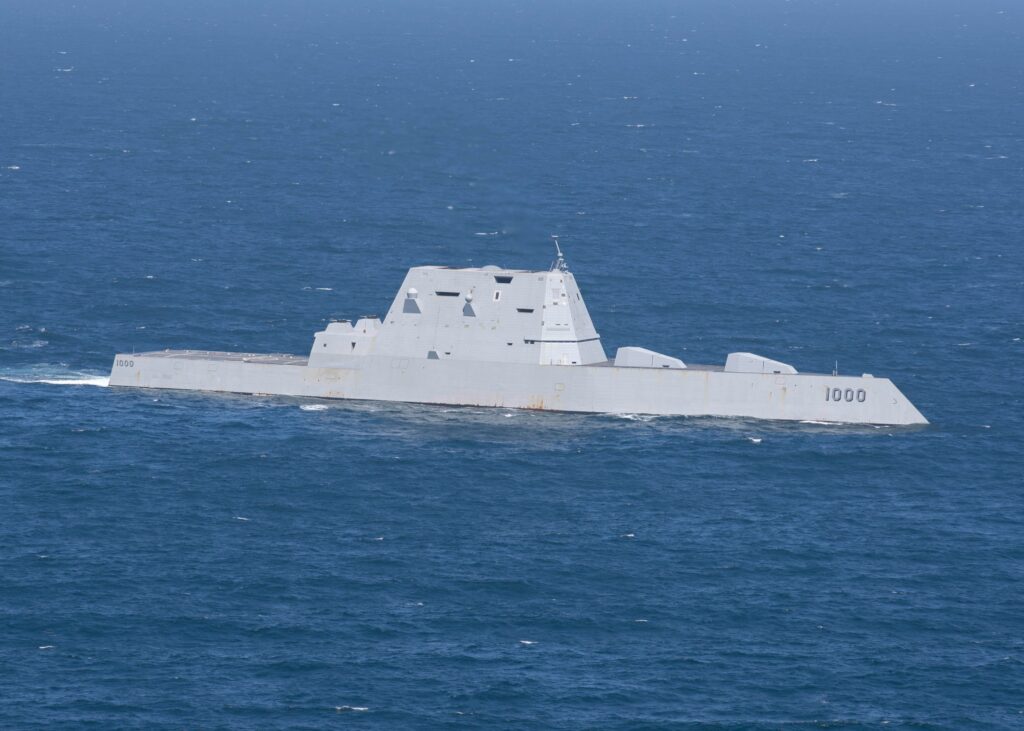
PACIFIC OCEAN (April 13, 2022) The Zumwalt-class guided-missile destroyer USS Zumwalt (DDG 1000) sails through the Pacific Ocean, April 13, 2022. (U.S. Navy photo by MC3 Christopher Sypert)
By Team Ships Public Affairs, May 8, 2024
PASCAGOULA, (April 12, 2024) – Combatant Command and OSD senior leaders visited SUPSHIP Gulf Coast to tour the USS ZUMWALT (DDG 1000) and receive an update on the Navy’s efforts to integrate the Conventional Prompt Strike weapon system into the DDG 1000 class. Mr. Robert J. Taylor, STRATCOM Director of Capability and Resource Integration, Dr. Martin Lindsey, INDOPACOM Science and Technology Advisor, and Dr. James Weber, Office of the Under Secretary of Defense for Research and Engineering, Principal Director for Hypersonics, joined Navy Program leaders for the visit on April 4, 2024.
“United States Strategic Command remains committed to ensuring the Conventional Prompt Strike Capability is rapidly integrated on ZUMWALT Class DDGs,” said Mr. Robert J. Taylor. “My team and I will continue to work across Combatant Commands, Offices of the Secretary of Defense, and the Navy to integrate this highly lethal platform into plans and operations to assure Allies and Partners while sending a strong deterrence message to our adversaries”.
USS ZUMWALT (DDG 1000) arrived at Huntington Ingalls Industries – Ingalls Shipyard (HII-Ingalls) on August 19, 2023, to enter a modernization period and receive technology upgrades including the integration of the Conventional Prompt Strike (CPS) weapon system. These upgrades, and the integration of the CPS weapon system, will help ensure Zumwalt remains one of the most technologically advanced and lethal ships in the U.S. Navy.
“The Navy / Industry team is moving with a sense of urgency to integrate CPS capability into USS ZUMWALT” said Rear Adm. Tom Anderson, Program Executive Officer (PEO), Ships. “Many steps have been taken and are on track to get this important player on the field on time.”
The unique design and advanced capabilities of the Zumwalt-class is well-matched with the CPS weapons system that enables precise and timely strike capability in contested environments. CPS is a non-nuclear hypersonic weapon system being designed and developed by the Navy’s Strategic Systems Programs (SSP) that will provide an intermediate range, prompt, conventional strike capability to the Department of Defense. The missile will be delivered to the Navy onboard ZUMWALT Class DDGs starting in the mid-2020’s and on Block V VIRGINIA Class SSNs starting in the early 2030’s, as well as to the Army as the Long Range Hypersonic Weapon (LRHW).
“Conventional Prompt Strike will deliver a cutting-edge capability and strategic options to our Armed Forces, supplementing our existing unparalleled capabilities,” Weber said. “The Navy is accelerating development and transition of this transformational warfighting capability.”
DOD Uses Unfavorable Sea Conditions to Gain Efficiencies on Gaza Aid Mission
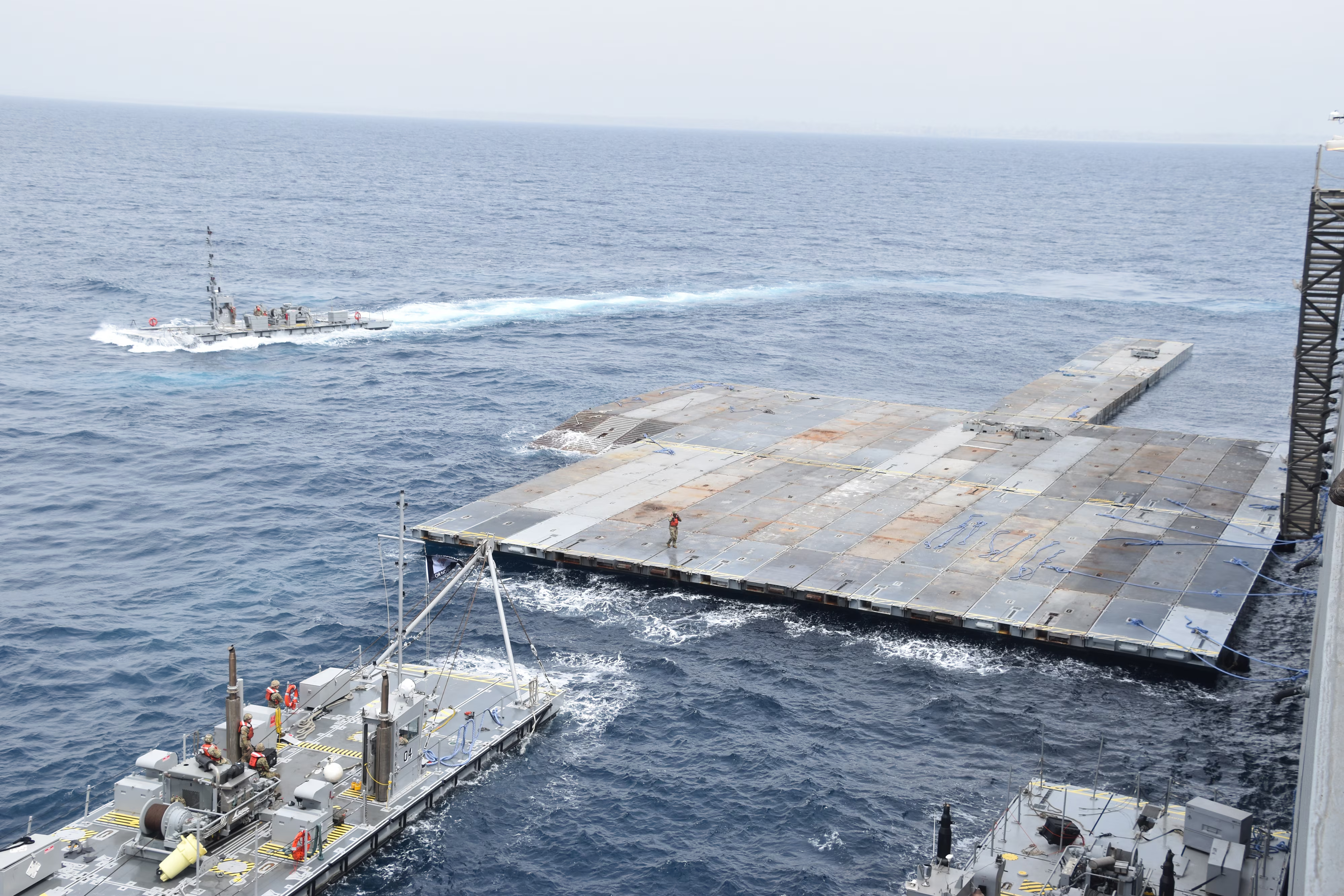
Pier-building begins Construction of the floating JLOTS pier in the Mediterranean is underway. The pier will support USAID and humanitarian partners to receive and deliver humanitarian aid to the people of Gaza. U.S. Transportation Command and U.S. European Command support the movement of humanitarian aid. U.S. Central Command
While unfavorable sea conditions have slowed deployment of two piers meant to deliver humanitarian aid into Gaza, the Defense Department has found a way to use the delay to its advantage and get ahead on the mission once it gets underway.
Earlier this week the Defense Department announced completion of the construction of two floating piers, which will be used to deliver humanitarian aid into Gaza.
Construction of the Joint Logistics Over-the-Shore, or JLOTS, system on the Mediterranean Sea was completed Tuesday. One floating pier will be deployed several miles offshore outside Gaza, while the other, called the Trident pier, or “causeway,” will be pushed onto and attached to the Gazan shore. Together they will be used to move humanitarian aid into Gaza.
Both of the floating piers, along with the MV Roy P. Benavidez — a large, medium-speed, roll-on, roll-off ship — are off the coast of Israel near the Port of Ashdod, about 18 miles north of Gaza. Unfavorable sea conditions prevent movement of the piers to their final location.
In the meantime, the MV Sagamore — a commercial cargo ship — has been loaded with humanitarian aid in Cyprus and has made its way to Ashdod. Instead of waiting for the piers to be deployed, humanitarian aid on the Sagamore will be moved to the Benavidez so that the Sagamore can go back to Cyprus to get more aid supplies, said Pentagon Press Secretary Air Force Major General Pat Ryder.
“In this period of time that we have before the pier becomes operational, we’re essentially using that time to get ahead,” Ryder said during a briefing today. “Since the Sagamore has been loaded with humanitarian assistance, by transloading that on to the Benavidez, the Benavidez is essentially in position to immediately start loading that onto the floating pier for subsequent shipment to the causeway and delivery to the shore.”
Because the Benavidez will remain near Gaza when the humanitarian mission begins, Ryder said, the Sagamore is free to go back to Cyprus to get additional aid.
Once the two floating piers are deployed, ships loaded with humanitarian aid will dock at the floating pier off the coast of Gaza and have their cargo unloaded onto trucks that are onboard Army-owned landing craft utility ships, or LCUs, and logistic support vessels, or LSVs.
The Army ships will then travel toward Gaza where they will meet up with the Trident pier. There, the trucks onboard the LCUs and LSVs will drive onto the pier and onto the shore of Gaza where the humanitarian aid supplies can then be staged for delivery inside Gaza. Ryder said non-U.S. civilian contractors will be responsible for driving those vehicles.
It’s expected that initially about 90 truckloads of supplies will transit the causeway each day and make their way into Gaza. When the operation reaches full capacity, as many as 150 trucks will make their way into Gaza daily.
“This is a complex operation which requires close coordination with many partners,” said Ryder. “The United States is joining an international community-backed effort, led by with support from the United Nations, the World Food Programme, the Republic of Cyprus, other partner nations and the to expand the delivery of humanitarian assistance via a maritime corridor to the people of Gaza.”
CNO Franchetti Conducts Outreach Visit to Chicago
Chief of Naval Operations Adm. Lisa Franchetti meets with Navy Reserve Officers Training Corps (NROTC) students at Northwestern University in Evanston, Illinois, May 9. Franchetti is a 1985 graduate of Northwestern University, where she received her commission through the NROTC program. U.S. Navy | Mass Communication Specialist 1st Class William Spears
CHICAGO — Chief of Naval Operations Admiral Lisa Franchetti traveled to Chicago to meet with high school Navy Junior Reserve Officers Training Corps (NJROTC) students from the Rickover Naval Academy, William Howard Taft High School and Corliss High School, NROTC college students in the Chicago Consortium, and community leaders, May 8-9.
The visit provided the CNO the opportunity to discuss her personal journey in the Navy and share leadership lessons, as well as to open students’ minds to what service in the Navy looks like.
“When I was in your shoes, I could never have imagined that I would be standing here today as the chief of naval operations. Life is not necessarily what we predict, and being open to possibilities that come along the way is really important,” Franchetti shared with an auditorium of nearly 500 NJROTC cadets. Paraphrasing Chester Nimitz, she added, “‘learn all you can, do your best, and don’t worry about the things you can’t control,’ because you never know what opportunities are going to come your way, and if you always take advantage of them, when doors start to open, you’ll be ready to walk through.”
Franchetti also spoke with Rickover Naval Academy faculty and members from the Chicago Board of Education and community leaders to educate them about the mission of the Navy and the value of service to the Navy and the nation.
“Every day about 110 U.S. Navy ships and 70,000 Sailors and Marines are underway — defending our nation, enabling the free flow of commerce and protecting sea lanes of communication,” Franchetti said. “It’s not just our ships, we operate from the seabed to space in cyberspace, and in the information environment.”
She added, “You may not think about it all the time, but freedom of the seas is really important. Ninety percent of our trade goes across the oceans. So when you order something online and it gets to your doorstep, it’s because we have a Navy out there … and it’s those Sailors and Marines that are protecting our way of life, and I couldn’t be more proud of our Navy team.”
CNO concluded her outreach visit at her alma mater of Northwestern University, where she attended a cook-out with Chicago Consortium NROTC students and members of the crew team.
Franchetti told them how a chance encounter with a group of NROTC students at a cookout during her freshman year changed the course of her life. She said she stopped by to say hi and see what they were doing. They said they were NROTC students and she could compete for a scholarship and get $100 a month and free textbooks. She talked to their lieutenant, who told her more about the mission and opportunities in the Navy and decided to sign up on the spot.
“I joined the Navy for free college, but I stayed for our mission,” Franchetti said. “I love being part of the Navy team. I love serving with amazing Sailors, amazing people all over the world, and getting to be that beacon of hope and democracy all around the world– and it has been an amazing journey.”
While visiting Northwestern University, CNO was one of seven alumni who were inducted into the 2024 Medill School of Journalism Hall of Achievement.
This was Franchetti’s first trip to the Chicago region as CNO.
Littoral OpTech Workshop Will Examine Operational, Geopolitical Challenges in Baltic Sea
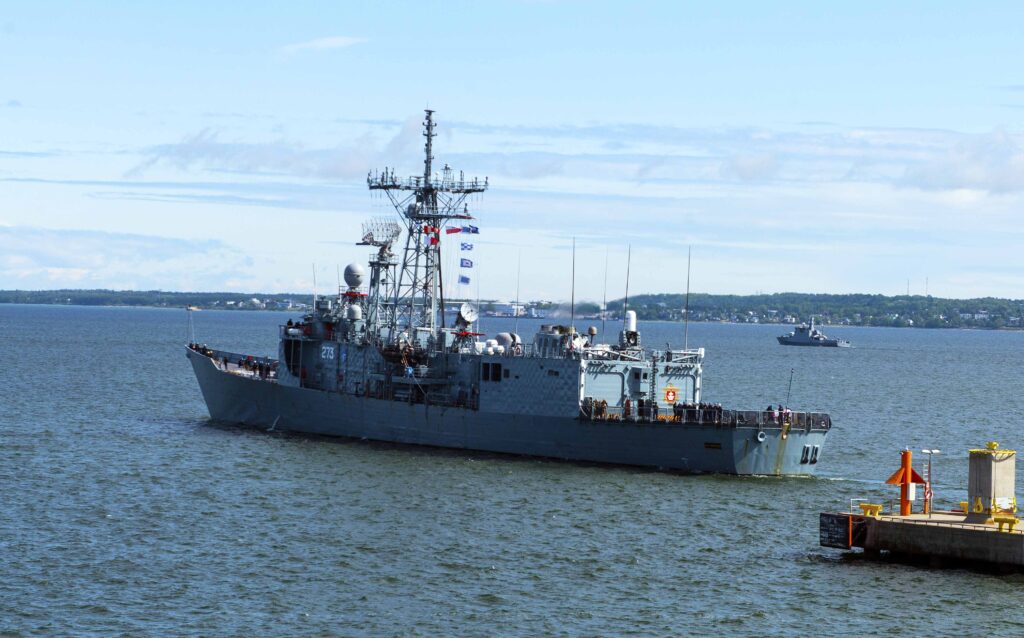
The Polish Navy, Oliver Hazard Perry-class guided-missile frigate ORP General Tadeusz Kosciuszko (273), departs for sea in support of BALTOPS 23. BALTOPS 23 is the premier maritime-focused exercise in the Baltic Region. U.S. Navy | Mass Communication Specialist 2nd Class Mario Coto
The 2024 Littoral OpTech workshop, an invitation-only event, will be held May 21-22 at the Polish Naval Academy in Gdynia, Poland. Participants will listen to a number of speakers and panels exploring the current trends in operational, economic and geo-political environment in and around the Baltic Sea.
According to retired Swedish Navy Captain Bo Wallander, the event moderator, Littoral OpTech workshops are typically two-day conferences that bring together key partners and advanced technical and operational expertise to explore and identify the technologies that will enable effective littoral operations.
“The workshops expand the growing global community of interest and garner stakeholder support for addressing the technical challenges in the world’s littorals,” Wallander said.
Wallander described the maritime littorals as “a very complex environment with limited space where it is easy to hide and difficult to detect targets. This means very short reaction times. The proximity to islands and shores means a broad spectrum of threats in all domains. The littorals are also characterized as having a great number of non-military actors like merchant ships, fishing and pleasure boats.”
Wallander referred to the Baltic Sea, in particular, as an “extreme littoral.”
“What makes the Baltic Sea special are the short distances in an east-west direction and the large archipelagos in both Finland and Sweden. There are different currents and counter currents; varying sea bottom topography, water salinity and temperatures,” he said.
Wallander said the workshop will focus on both operations, political issues and technologies with an emphasis on Northern Europe and the evolving security concerns in Northern Europe, as well as the importance of the fact that both Sweden and Finland have become NATO allies.
The last Littoral OpTech workshop was held in Helsinki, Finland, and also focused on the Baltic Sea. Besides the 2022 event in Finland, previous Littoral OpTech seminars, colloquiums and workshops have been held in Monterey, California; Stockholm, Sweden; Tokyo, Japan; Cartagena, Colombia; Halifax, Canada; and Souda Bay, Crete, Greece.
Wallander said the Polish Naval Academy is working together with the Swedish defense company Saab to host the 2024 workshop.
“The naval academy is located in a very a very significant historical area,” Wallander said. “Gdynia is also an important base for the Polish navy.”
“This area of the world continues to be of great geopolitical, economic and military importance,” Wallander said. “The Baltic Sea is both a very sensitive environment and an important transport link for the Russian Federation. Since the last OpTech event the war in Ukraine has raged on, and both Finland and Sweden have become full-fledged members of NATO.”
The Polish Naval Academy in Gdynia will host the 2024 Littoral OpTech workshop. Polish Naval Academy
Poland is situated on the Baltic Sea, with a 328-mile mostly sandy coastline. The country was under Soviet domination after World War II and was a charter member of the Warsaw Pact from 1955 to 1991. In 1999, Poland joined Czechia and Hungary to become the first former members of the Warsaw Pact to join NATO.
The Baltic Sea is an arm of the Atlantic Ocean enclosed by Denmark, Estonia, Finland, Germany, Latvia, Lithuania, Poland, Sweden and Russia, with a coastline of approximately 5,000 miles. Today, all of those countries are part of the NATO Alliance, except Russia. Russia’s Baltic Sea exclave of Kaliningrad is surrounded by Poland to the south and Lithuania to the north and east.
Polish Naval Academy
The Littoral OpTech workshop will be hosted by the Polish Naval Academy, which is named after the “the Heroes of the Westerplatte.” The academy offers both civil and military undergraduate and graduate study programs. The name refers to the 1939 battle at the Westerplatte peninsula when the Polish forces fought off a vastly superior German army. The battle is revered as a symbol of resistance in modern Poland.
The Polish navy was established in 1918. The academy was established soon after, in 1922. It has been in continuous operation, albeit under different names, ever since. The school is currently under the command of Rector-Commandant Rear Admiral Professor Tomasz Szubrycht.
The undergraduate and graduate courses are taught in Polish and English, and a number of international students attending the school. The military cadets receive commissions in the Polish military upon graduation, mostly in the navy. There are also serving officers working on graduate degrees.
Today, the Polish navy consists of about 12,000 commissioned and enlisted personnel, many of them serving abord the service’s 46 ships.
The Polish Navy’s two largest surface combatants ORP General Kazimierz Pulaski and ORP General Tadeusz Kościuszko, are the former U.S. Navy Oliver Hazard Perry-class guided missile frigates USS Clark (FFG 11) and USS Wadsworth (FFG 9). The service is ordering new Arrowhead 140 frigates, to be delivered by Polish Armament Group in cooperation with Babcock, U.K.