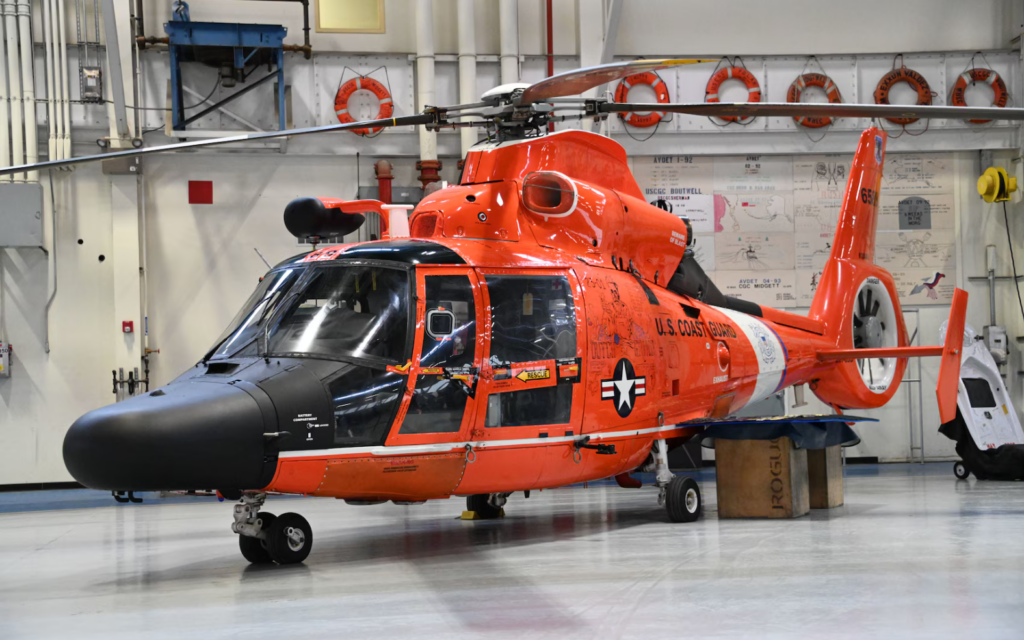
KODIAK, Alaska – The Coast Guard retired the Air Station Kodiak MH-65 Dolphin helicopter fleet during a ceremony, Tuesday.
Capt. Timothy Williams, commanding officer of Air Station Kodiak, presided over the ceremony honoring the 36 years of service the MH-65 Dolphin airframe and its crews provided to the Arctic region.
Air Station Kodiak currently has a rotary-wing fleet of six MH-60 Jayhawk helicopters. The unit will shift to a rotary-wing ship-and-shore based fleet of nine MH-60 Jayhawks in 2025.
Air Station Kodiak will be the fourth Coast Guard Air Station to transition to a single rotary wing fleet of MH-60 Jayhawk helicopters. Air Stations Borinquen, Traverse City, and New Orleans all recently completed similar transitions.
“For decades, the cutter and helicopter team were the core of the ALPAT mission,” said Cmdr. James Kenshalo, MH-65 Dolphin pilot. “Together they projected force and protection to the most extreme remote regions of our nation’s territories, operating beyond where help could reach. Countless lives have been saved because of these dedicated crews.”
Commissioned in January of 1988, the Alaksa Patrol (ALPAT) mission executed solely by MH-65 Dolphin aircrews provided Coast Guard Cutters with a reliable airborne asset during Alaska Patrols.
To read more about the Coast Guard MH-65 Dolphin and MH-60 Jayhawk helicopters click the following links:
RTX awarded $344M Contract to Modernize Electronics Unit for Standard Missile Development Program
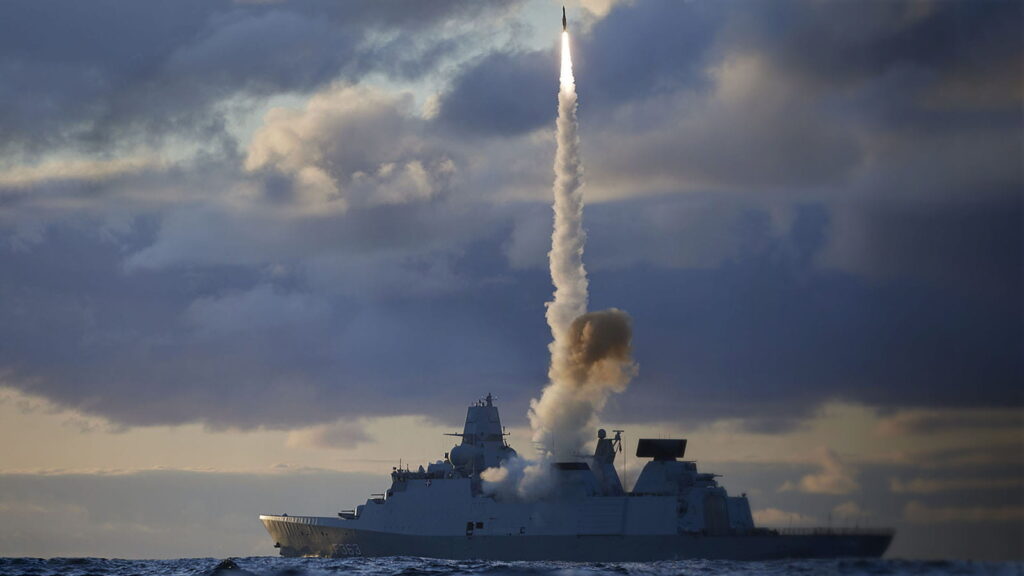
The SM-2 missile is primarily used by U.S. and allied navies for fleet air defense and ship defense.
Updates will allow for continued, rapid deliveries of Standard Missile variants to the U.S. and international fleets
TUCSON, Arizona (April 25, 2024) — Raytheon, an RTX (NYSE: RTX) business, has been awarded a $344 million contract for the development of two missile variants – the SM-2 Block IIICU and SM-6 Block IU – which will be based on a common guidance section, where the electronics and software that guide a missile to its target are housed.
The updated variants will share a newly designed guidance section, target detection device, independent flight termination system and electronics unit. This commonality will allow Raytheon to manufacture both missiles on a common production line, providing flexibility, scalability, and cost reductions.
“Upgrades under this contract will allow us to increase speed and efficiency in production of these weapon systems that are integral to the defense of the U.S. Navy and our allies,” said Kim Ernzen, president of Naval Power, Raytheon. “It’s also a very important step forward for our international customers, as this will be the first time that Standard Missile active radar technology will be fielded by the U.S.’s international allies.”
The development program is largely funded by Foreign Military Sales. The first users of these updated missiles will be the U.S., Australia, Canada, Japan, and Korea.
Work on this contract is being conducted in Tucson, Arizona. While the common sub-sections will be developed for both missile configurations under this award, there is a follow-on contract expected later this year which will complete the missile level qualification events as well as At-Sea flight tests specific to the SM-2 Block IIICU configuration.
CNO Franchetti: Navy Has a Lot to Offer Young People
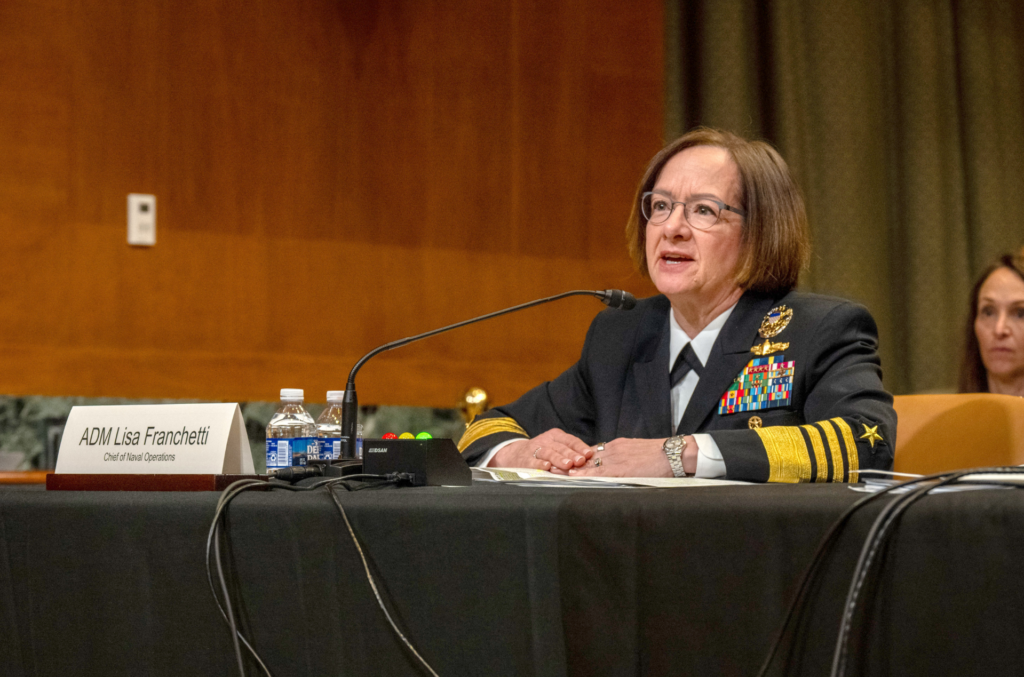
WASHINGTON (April 16, 2024) Chief of Naval Operations Adm. Lisa Franchetti delivers testimony at the Senate Appropriations Committee’s Subcommittee on Defense hearing on the fiscal year 2025 defense budget request in Washington D.C., April 16, 2024. (U.S. Navy photo by MCC Michael B. Zingaro)
April 24, 2024 | By C. Todd Lopez, DoD News
Recruiters across the military are challenged every day to bring young people into service. But the chief of naval operations said she thinks the Navy has what young people are looking for — if only they knew more about it.
“All the services are facing some challenges in recruiting, and it’s really broader than that,” said Navy Adm. Lisa Franchetti, who spoke yesterday at the Center for Strategic and International Studies. “It’s probably challenges in just propensity to serve, in general.”
One challenge the Navy has in recruiting, Franchetti said, is that so many young people are simply unaware of what it does.
“If you don’t live near a coast or you don’t live near a base, you may not really know what your Navy does every day,” she said. “So, talking a little bit about … operations in the Red Sea, keeping commerce flowing having your Amazon box get to your doorstep, there’s a lot of stuff that people don’t even recognize every day that your Navy is out there doing.”
Young people, part of Generation Z, are now of age to consider military service, and Franchetti said the Navy must consider what that generation values if they’re going to be convinced to enlist in military service.
“Thinking about what they value, what they’re looking for … in terms of wanting to understand why, wanting to understand the values of the organization, I think we have a really good story to tell, because we’re all about honor, courage, commitment, democracy … and the pursuit of all who threaten it,” she said. “But also, it’s about helping them become the best version of themselves … we offer a lot of opportunity, we have 150 different career specialties that they can go into.”
The Navy offers careers in nuclear engineering, cyber and medical, for instance. And most recently, a new career field in robotics has opened up, she said. And every career field is available to both men and women.
“You can really work in any field that you want to, so you can get some of your own skills, test out your own leadership abilities because we’re all leaders in the Navy,” Franchetti said. “I think those are good things for them to think about … I’d really like to have our sailors sell themselves. That’s the best way to do it.”
If the Navy can convince young people to enlist, Franchetti said, it’s equally important to ensure the Navy remains a place they want to stay, that they aren’t going to be disappointed with their choice to enlist. The admiral said the Navy is doing a lot to retain service members.
“We are also focusing on a lot of things that we know some of the younger people are interested in: making sure that folks have access to internet, making sure they have access to the gym, making sure they have access to health care, good-paying compensation, making sure they have a place to live that isn’t on the ship,” she said. “… A good quality barracks room, good quality food … that’s some of the work that we’re doing to make sure that we can be that world-class employer.”
NOAA to Break Ground for New facility at Naval Station Newport
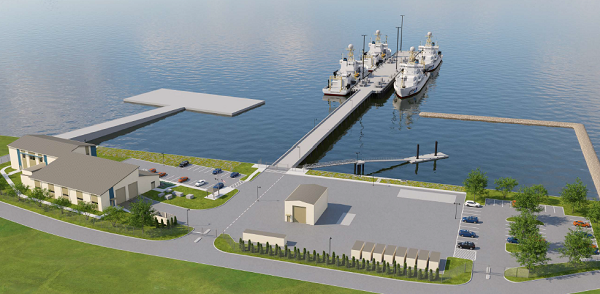
An illustration of the new NOAA marine operations center planned for Naval Station Newport in Rhode Island. (Image credit: Burns & McDonnell)
Apr. 24, 2024
NOAA Marine and Aviation Operations will hold a ceremony May 6 at Naval Station Newport in Rhode Island to break ground on a new facility that will serve as the future home of the NOAA Marine Operations Center-Atlantic. Four NOAA research vessels will be based at the new facility, which will also serve as the headquarters for NOAA’s Atlantic fleet.
In December 2023, the U.S. Navy, on behalf of NOAA, awarded $146,778,932 to Skanska USA, from New York, to build the new NOAA facility. Funded in part by the Inflation Reduction Act, it will include a pier that will accommodate four large vessels, a floating dock for smaller vessels, space for vessel repairs and parking and a building to be used for shoreside support and as a warehouse.
NOAA’s fleet of 15 research and survey ships are operated, managed and maintained by NOAA Marine and Aviation Operations. Ranging from large oceanographic research vessels capable of exploring the world’s deepest ocean, to smaller ships responsible for charting the shallow bays and inlets of the U.S. The fleet supports a wide range of marine activities, including fisheries surveys, nautical charting and ocean and climate studies. NOAA ships are operated by NOAA Corps officers and civilian professional mariners.
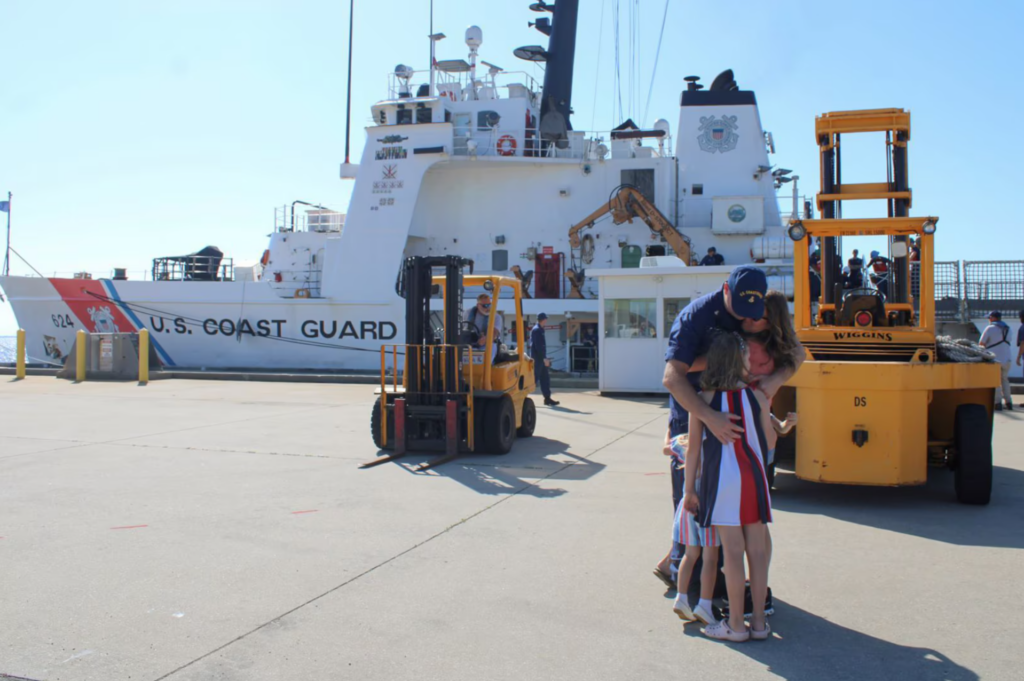
US Coast Guard Cutter Dauntless returns home after 61-day Operation Vigilant Sentry patrol
PENSACOLA, Fla. — The crew of U.S. Coast Guard Cutter Dauntless (WMEC 624) returned to their home port in Pensacola, Wednesday, following a 61-day patrol in the Windward Passage and Florida Straits. While underway, crew members conducted maritime safety and security missions to protect life at sea and deter illegal migrant voyages bound for the United States.
Dauntless deployed in support of Homeland Security Task Force – Southeast (HSTF-SE) and Operation Vigilant Sentry (OVS) while patrolling in the Coast Guard Seventh District’s area of responsibility. While underway, Dauntless worked alongside other Coast Guard assets and units to dissuade unsafe maritime migration and enforce U.S. law on the high seas.
During the patrol, a good Samaritan on a sailboat reported a disabled vessel using VHF-FM channel 16. Dauntless’ crew received notification and conducted a search and rescue mission over several hours on a moonless night while searching for the unlit boat. Eventually, the crew located the overloaded and disabled sail freighter with 65 Haitian migrants aboard, including several children. All 65 migrants were safely evacuated and transferred aboard Dauntless, where they received food, water and basic medical care. Dauntless worked with multiple surface and air assets to successfully carryout the search, rescue and repatriation of the migrants.
Migrants attempting to reach the United States through nonlegal channels, or who land on U.S. shores without authorization, are subject to removal and repatriation to their country of origin or departure. Consistent with U.S. policy, those who bypass or attempt to circumvent lawful immigration pathways face consequences including the potential of being barred from future lawful entry in addition to risking their lives unnecessarily.
“This case was a prime example of the humanitarian lifesaving mission we remain always ready for,” said Cmdr. Aaron Kowalczk, commanding officer of Dauntless. “The crew’s ability to find the vessel and then safely complete the rescue in the dark of night is just another example of the utmost professionalism and skill they show every day and is indicative of 56 years of exemplary service by cutter Dauntless and her crews.”
Established in 2003, HSTF-SE is the Department of Homeland Security-led interagency task force charged with directing operational and tactical planning, command and control, and functions as a standing organization to deter, mitigate, and respond to maritime mass migration in the Caribbean Sea and Florida Straits.
OVS is the 2004 DHS plan that provides the structure for deploying joint air and surface assets and personnel to respond to irregular maritime migration in the Caribbean corridor of the United States. Its primary objectives are to protect life at sea while deterring and dissuading mass maritime migration alongside our federal, state, and local partners.
Dauntless is a 210-foot, Reliance-class medium-endurance cutter originally built in 1967 and commissioned in 1968. The cutter’s primary missions are counter narcotics operations, migrant interdiction, living marine resources protection, and search and rescue in support of U.S. Coast Guard operations throughout the Western Hemisphere.
For information on how to join the U.S. Coast Guard, visit GoCoastGuard.com to learn about active duty, reserve, officer and enlisted opportunities. Information on how to apply to the U.S. Coast Guard Academy can be found here.
Electric Boat Competition Sparks Interest in Naval Science Careers
23 April 2024
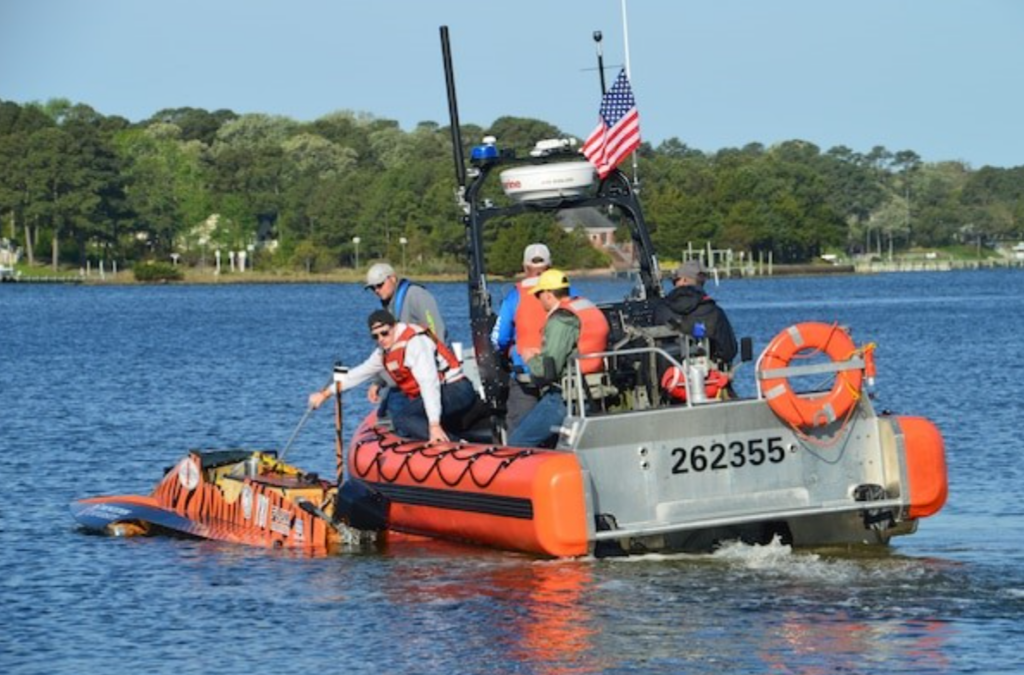
Student engineering teams from Princeton, Washington College and the University of Alabama have won first place in their respective events at the “Promoting Electric Propulsion” (PEP) boat races, sponsored by the Office of Naval Research (ONR) and the American Society of Naval Engineers (ASNE).
In just six years, this electric boat-building competition has grown from a single university to 34, with more than 200 students who took part in the five-mile races on Broad Bay in Virginia Beach. Dr. Steve Russell, program officer, Sea Warfare and Weapons department, said he launched the PEP competition with a colleague from ASNE, Dr. Leigh McCue, and Tim Cullis, Naval Sea Warfare Center Carderock, after seeing a public race by local hobbyists in the Chesapeake Bay.
“It gave us the idea this would be a good way for the Navy to get engineering students interested in electric propulsion, so we did it.”
Russell said they are reaching hundreds of science and engineering students every year. The PEP racing event not only offers students valuable learning experiences, it provides the Navy and Marines with a workforce for the future.
“The goal is to create a pipeline of graduating engineers who have worked on a suite of problems that are currently issues within the U.S. Navy. They come out of school after having designed and built a boat like this, and learning about high power electronics, propulsion, hull design, cooling and boat stability – the naval architecture parts of it,” Russell said. “So far, we’ve hired many of them into the warfare centers and our industry partners.”
The teams of college students come from universities all over the country. Some are very well known, like Princeton and Texas A&M, but others are much smaller and not necessarily easily recognized. That doesn’t mean the smaller universities aren’t as competitive. Russell said Washington College in Maryland came in first and second place, respectively, in the 2022 and 2023 manned race, as well as placing first in 2024.
“They don’t even have an engineering school. It’s just a group of students who go to school near the Chesapeake Bay and they built a couple of very good boats,” he said.
The PEP competition includes manned and unmanned boat races. Russell said the manned competition seems to be more exciting for the students. It is a race, after all – and they can go pretty fast. Most of the entrants, though, register for the unmanned competition. Regardless of which category the teams fall into, they are all involved in meaningful and, in some cases, record-breaking work.
“While we’re not really looking to use any of the techniques that the students come up with, their innovation has been very impressive. For example, the Princeton team last fall took their boat down to a river in North Carolina and beat the world record for electric boat speed on the water with an average speed of 114 mph,” Russell said. “What we’re really trying to do is to get them interested in solving Navy-related problems, and hopefully they will pursue careers in the Navy.”
It’s also become something of an industry event where the students are introduced to industry partners in the area. Since its inception in 2018, the PEP competition has helped recruit 44 engineering graduates for the Navy. Eleven others gained engineering positions with industry partners.
SECNAV Advocates Increased Legal Immigration to Increase Shipbuilder Workforce
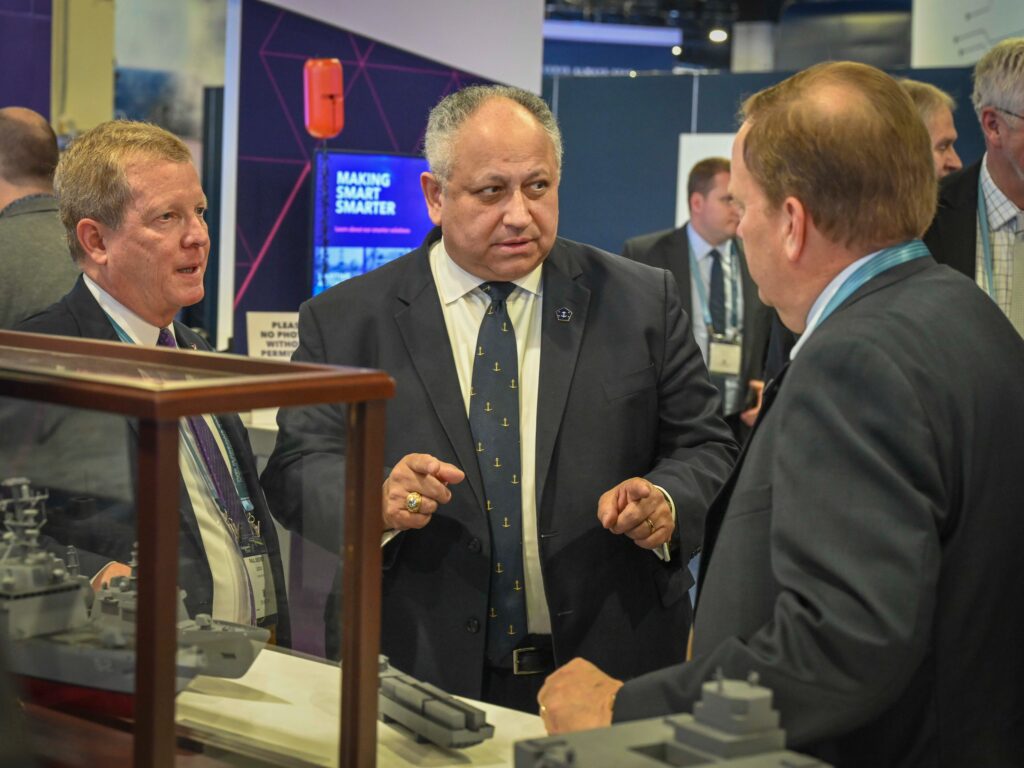
Secretary of the Navy Carlos Del Toro visits industry booths during the Navy League of the United States’ Sea-Air-Space Exposition 2024 at National Harbor, Maryland, April 9. U.S. Navy | MC2 Jared Mancuso
By Richard R. Burgess, Senior Editor
ARLINGTON, Va. — The secretary of the Navy said the shortage of workers in the U.S. shipbuilding industry could be partially alleviated by allowing more legal immigrants into the country to work in the shipyards.
Speaking April 23 at the Stimson Institute, a Washington think tank, SECNAV Carlos Del Toro acknowledged that supply chain issues caused by the COVID-19 pandemic negatively affected the ability on shipyards to meet delivery schedules of Navy ships, said he thought “the bigger problem than that … is actually the lack of blue-collar workers that we have in this country.
“Regretfully, we’re a pretty divided country politically, you might say, but it really is time for Congress to get together and pass comprehensive reform and increase the amount of legal immigration that we actually allow into this country [and] increase the amount of work visa programs that are authorized for blue-collar workers to come from other nations and actually do the work here as has actually existed since the founding of our government, very much so,” Del Toro said.
The SECNAV noted the current unemployment rate in many U.S. states is low, “but what we’ve got to do is open up the spigot a bit, basically, on legal immigration to allow blue-collar workers to come here and also to devote an enormous amount of resources into re-training individuals so they can actually work in our shipyards and be employed by the types of trades that are open to shipyard workers, for example.”
Del Toro noted the U.S. government will in the next five years “be pumping in $15 billion investment into the submarine industrial base alone and an additional billion-dollar investment into the surface industrial base as well.”
The SECNAV also noted that the atrophied U.S. commercial shipbuilding industry needs to be reinvigorated by a “whole-of-government effort around a national maritime statecraft.”
RTX Breaks Ground on $115M Expansion of Alabama Missile Integration Facility
The Arleigh Burke-class guided-missile destroyer USS Higgins (DDG 76) launches a Raytheon-built Standard Missile (SM) 2 from a forward launcher while operating in the Philippine Sea, April 5. U.S. Navy | MC1 Hannah Fry
HUNTSVILLE, Alabama – Raytheon, an RTX business, recently broke ground on a $115 million, 26,000 square-foot expansion of its Redstone Raytheon Missile Integration Facility, which will increase the factory’s space for integrating and delivering on critical defense programs by more than 50 percent.
The expansion will also bring an estimated 185 new jobs to the area, growing RTX’s employee footprint in Alabama to more than 2,200 people.
“This important investment in the Huntsville region will help us meet the growing needs of our military customers and service members,” said Raytheon President Phil Jasper. “It will also ready our operations to accelerate delivery of our vital counter-hypersonic solution.”
Raytheon’s Redstone facility is the final integration point for many missile programs for the U.S. Missile Defense Agency, U.S. Navy, and other defense customers. The facility currently handles integration of nine variants of the Standard Missile family, including Standard Missile-3 and Standard Missile-6, and will accommodate additional defense programs, including the Glide Phase Interceptor.
Coast Guard Interdiction Leads to the Apprehension of 3 Wanted U.S. Citizens
SAN JUAN, Puerto Rico — The crew of the Coast Guard Cutter Winslow Griesser interdicted an unlawful migration voyage in the Mona Passage, Friday.
Following the interdiction, Dominican Republic Navy authorities detained three U.S. citizens, who reportedly are affiliated with a criminal gang and wanted in connection with a July 2020 shooting at a residential community in Puerto Rico in which four people were killed.
The suspects are currently under the custody of the Dominican Republic ‘Dirección Nacional de Control de Drogas (DNCD) (United States Marshals Service Dominican Republic Foreign Field Office Fugitive Investigative Unit). United States Marshals Service Puerto Rico Fugitive Task Force for the District of Puerto Rico are coordinating the deportation of the three suspects.
Coast Guard watchtanders at Sector San Juan received notification Friday morning from the aircrew of a U.S. Customs and Border Protection Air and Marine Operations multi-role enforcement aircraft, reporting the sighting of a suspected migrant vessel, approximately 55 nautical miles northwest of Puerto Rico. Watchstanders diverted the Coast Guard Cutter Winslow Griesser to interdict the suspect vessel. Once on scene, cutter Winslow Griesser’s crew deployed their over-the-horizon small boat and stopped the 20-foot go-fast vessel that was carrying eight people and multiple cockfighting roosters. The migrants claimed to have departed from Dominican Republic on a voyage to Puerto Rico, however, they experienced engine malfunctions which forced them to return to Dominican Republic before being interdicted.
Working in coordination with the Dominican Republic Navy, cutter Winslow Griesser’s crew took the migrant vessel in tow and rendezvoused with a Dominican Republic Navy vessel, who embarked and received custody of the migrants.
Further investigation efforts by Dominican Republic Navy and Homeland Security Investigations (HSI) revealed three of the alleged migrants were U.S. citizens with active U.S. warrants.
“Our strong partnerships and daily collaboration between all federal partner agencies involved in this case as well as Dominican Republic Navy and Dominican law enforcement authorities resulted in the safe repatriation of five migrants and the apprehension of three wanted U.S. citizens,” said Lt. Vincente Garcia, Coast Guard liaison to the Dominican Republic. “These efforts are instrumental to achieving regional stability and safeguarding our nation’s southernmost maritime border from dangers and threats associated with unlawful migration and other prevalent illicit maritime activity.”
Migrants who are interdicted at sea or apprehended ashore will not be allowed to stay in the United States or a U.S. territory. Furthermore, anyone who arrives unlawfully may be declared ineligible for legal immigration parole options and be repatriated to their country of origin or returned to the country from where the voyage departed from.
The Coast Guard, along with its Homeland Security Task Force – Southeast partners, maintains a continual presence with air, land, and sea assets in the Florida Straits, the Windward Passage, the Mona Passage, and the Caribbean Sea. The HSTF-SE combined, multi-layered approach is designed to protect the safety of life at sea while preventing unlawful maritime entry to the United States and its territories.
Since Oct. 1, 2023, through March 31, 2024, the Coast Guard has carried out 28 unlawful irregular migration voyage interdictions in the Mona Passage and waters near Puerto Rico. Interdicted during this period, are 932 non-U.S. citizens including 890 Dominicans, and 41 Haitians and one Venezuelan.
Commander, U.S. Pacific Fleet Participates in Western Pacific Naval Symposium
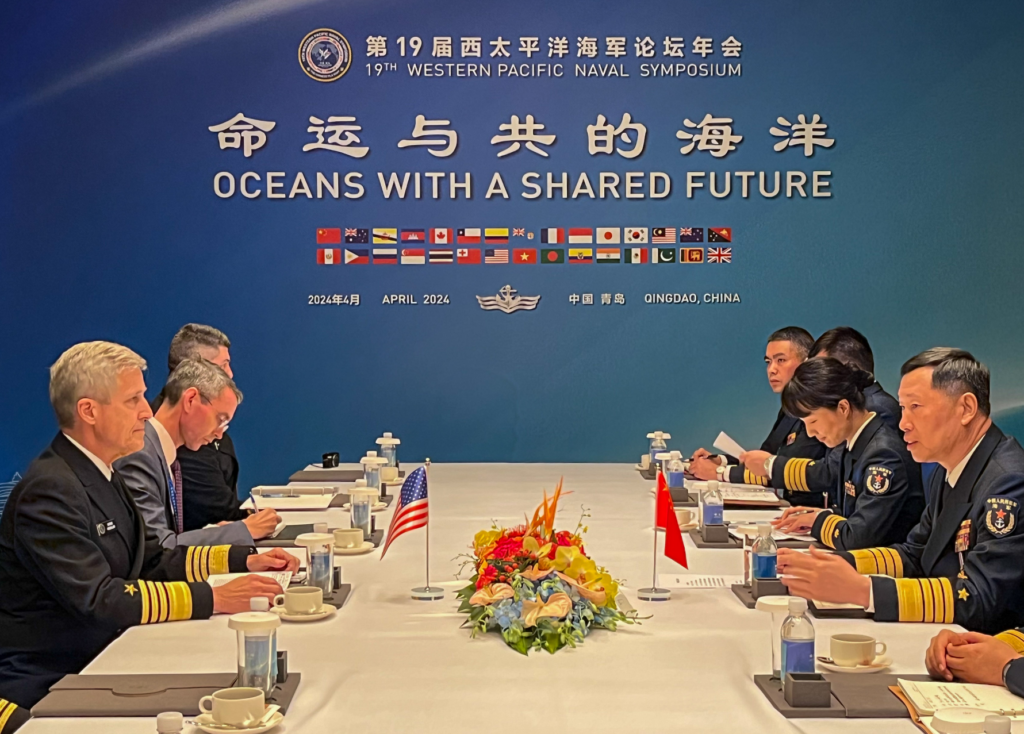
QINGDAO, China (April 21, 2024) Adm. Stephen Koehler, left, commander of U.S. Pacific Fleet, meets with Adm. Hu Zhongming, right, commander of the People’s Liberation Army Navy, at the Western Pacific Naval Symposium in Qingdao, China, April 21, 2024. Koehler met with Hu to discuss the increasing security challenges in the Indo-Pacific. (U.S. Navy photo)
3 April 2024
From U.S. Pacific Fleet Public Affairs
U.S. Pacific Fleet spokesperson Navy Commander Hayley Sims provided the following readout: U.S. Pacific Fleet Commander Adm. Stephen Koehler participated in the 19th Western Pacific Naval Symposium (WPNS), which was hosted this year in Qingdao, People’s Republic of China from 21-23 April.
WPNS is a multi-lateral organization with a history dating back to 1987. It includes 23 member and seven observer nations with maritime safety equities throughout the Western Pacific. Responsibility to host WPNS activities, including working groups and symposiums, is rotated annually among member countries on a volunteer basis. WPNS provides naval leaders the opportunity to discuss maritime matters of mutual interest while also giving the United States, allies, and partners an opportunity to underscore the importance of safe and responsible operations in support of a free and open Indo-Pacific.
Discussions during this year’s symposium included maritime issues, areas for cooperation, and military-to-military communication.
While at the symposium, Koehler met bilaterally with heads of Navy from Australia, Bangladesh, Chile, Colombia, France, Thailand, United Kingdom, and Vietnam to discuss the importance of continued multi-lateral exercises and combined operations that enhance interoperability and boost deterrence in support of a shared vision for a free and open Indo-Pacific region. Consistent with standard practice at WPNS, Koehler also met with host-nation representatives from the People’s Liberation Army Navy to discuss the importance of maintaining open lines of communication, operational safety, and regional security concerns.
Admiral Koehler is traveling throughout the region after assuming command of U.S. Pacific Fleet earlier this month. He first made stops to Japan and Republic of Korea where he met with senior officials to discuss the increasing security challenge in the Indo-Pacific and the importance of trilateral cooperation between Japan, Republic of Korea, and the United States to demonstrate the strength and resolve against those who challenge regional stability.