VideoRay Introduces New Entry-Level Mission Specialist Underwater Robot 
POTTSTOWN, Pa. – (April 1, 2024)   VideoRay, the world’s leading manufacturer of portable underwater robots, is proud to announce the launch of its new Mission Specialist Ally.  

Ally is the newest member of the Mission Specialist family, joining the ranks of the highly sought-after Defender, selected by the US Navy to support their Maritime Expeditionary Standoff Response (MESR) program, as well as the Pro 5.  

Ally offers a baseline Mission Specialist solution for those with challenging applications requiring a cost-effective solution.   The platform delivers a powerful alternative that allows users to expand their vehicle’s capabilities and add to their fleet as their budgets and needs evolve.  The new four-thruster ROV (Remotely Operated Vehicle) boasts an impressive 4-knot forward speed with lateral thrust capability to deliver agility and power, all in a compact design, with capabilities unmatched for its size and power consumption. 

Ally shares common components with all other Mission Specialist top side units, vehicles, tethers, and modules, for complete product line compatibility and expansion.  This enables customers operating VideoRay’s top-of-the-line Defenders to supplement their fleet with a lower-cost option. The versatile Ally can support operations with specific mission profiles and also serves as a source for readily available spares modules to help ensure mission uptime. 

The 300-meter (984 foot) rated Ally can be adapted to accept a round or square float configuration.  The square float allows the platform to carry additional payload and allows for topside or battery-powered operations, whereas the 30.48 cm (12-inch) round configuration is ideal for pipe and tunnel inspections. 

Ally’s base configuration features LED lights and VideoRay’s new Ultra 4K Smart Camera with onboard processing. Options include a unique spring-loaded vertical manipulator capable of lifting loads up to 9.5 kg (21 lbs), as well as a forward-looking sonar and DVL (Doppler Velocity Log) for customers requiring navigation. 

“We’re thrilled to introduce Ally to the market” announced Marcus Kolb, VideoRay’s Chief Innovation Officer.  “Ally provides customers who aspire to our world-renowned Mission Specialist technology with an entry-level ROV that can expand with their budget and needs – and can ultimately evolve into a top-of-the-line Defender. The fact that it shares common topside consoles and subsea modular components with our other Mission Specialist underwater robots delivers a huge advantage, allowing for cost-effective fleet expansion.  We can’t wait to begin delivering Ally to our customers in June.”  
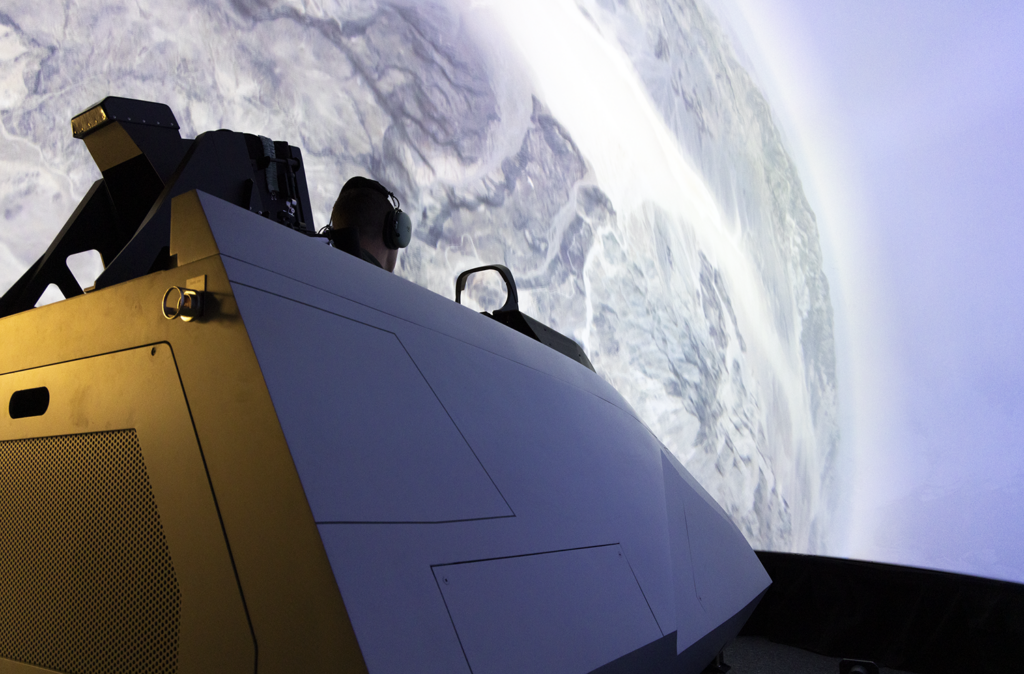


Navy and Air Force fighters to train as a joint force in NAWCAD’s Joint Simulation Environment 

A pilot tests a U.S. Air Force F-22 Raptor cockpit simulator headed for installation in the Naval Air Warfare Center Aircraft Division’s Joint Simulation Environment. The Navy installed a division of four Raptor cockpits alongside a division of eight F-35 Lightning cockpits in its advanced tactical trainer so Navy and Air Force fighter pilots can train as a joint force starting in 2024. (U.S. Navy photo by Terri Thomas)  

Naval Air Warfare Center Aircraft Division, Apr. 2, 2024 

PATUXENT RIVER, Md. — Navy and Air Force fighter pilots will begin training as a joint force at the Naval Air Warfare Center Aircraft Division (NAWCAD)’s Joint Simulation Environment (JSE) starting in 2024. 

NAWCAD installed a division of four U.S. Air Force F-22 Raptor cockpits into the Navy’s premier simulation test and training facility alongside its division of eight F-35 Lightning cockpits in January. 

“When America is engaged in conflict, the DOD will bring joint capability to bear from every service across all domains,” said NAWCAD Commander Rear Adm. John Dougherty IV. “We’ve replicated this ability in the Joint Simulation Environment, a force multiplier helping aviators deter aggression and—if necessary—prevail in conflict.” 

The new addition of fifth-generation fighter simulators brings Navy, Marine Corps, Air Force, and allied partners into the hyper-realistic digital range that consists of cockpits, domed simulators with 4K projectors, and aircraft software to enable pilots to fly wartime scenarios in a near-exact virtual environment. Tactical groups training in NAWCAD’s JSE fly more sorties over one week than they do over a year on open-air ranges. 

“Open-air ranges are extremely constrained with safety limitations that prevent warfighters from training like they’d fight,” said NAWCAD JSE Director Blaine Summers. “The JSE is where fifth-gen fighters train to hone their tactics and fight like their lives depend on it.” 

Developed by Navy engineers and industry partners, NAWCAD’s JSE is a powerful training and test facility designed to adapt and grow, utilizing hardware and software from actual DOD aircraft, weapons, and other defense systems. The JSE has all the equipment and experts needed to keep the facility running smoothly from its cockpits, to its software and simulators, to its mission debriefing rooms where pilots get feedback on their performance during training. 

In this highly realistic digital range, aviators experience the consequences of their mistakes, including mission failure, loss of systems, and even loss of life. The JSE enables pilots to learn those hard lessons, immediately adjust, fly again, and continue the learning process to become a highly capable tactical aviator. 

The JSE was initially designed to support F-35 Lightning’s operational testing as there was no way to safely and adequately represent real-world conflict on an open-air range. Today, the DOD is scaling the Navy’s technology for additional digital range facilities supporting programs like F-35, F-22, and E-2D. In addition, the DOD has made training in the JSE a formal part of the Navy’s Strike Fighter Tactics Instructor Program—commonly known as TOPGUN. 

Over the next year, NAWCAD will incorporate additional test and training cockpits including the F/A-18 Hornet, EA-18 Growler, and E-2 platforms to train fighters for future flight lines. The warfare center will also deploy its second training system onboard a Navy carrier, USS Abraham Lincoln (CVN 72). 

The Naval Air Warfare Center Aircraft Division employs more than 17,000 military, civilian and contract personnel. It operates test ranges, laboratories and aircraft in support of test, evaluation, research, development and sustainment of everything flown by the Navy and Marine Corps. Based in Patuxent River, Maryland, the command also has major sites in St. Inigoes, Maryland, Lakehurst, New Jersey, and Orlando, Florida.


U.S. Army Awards Lockheed Martin $483M JAGM, HELLFIRE Follow-on Production Contract

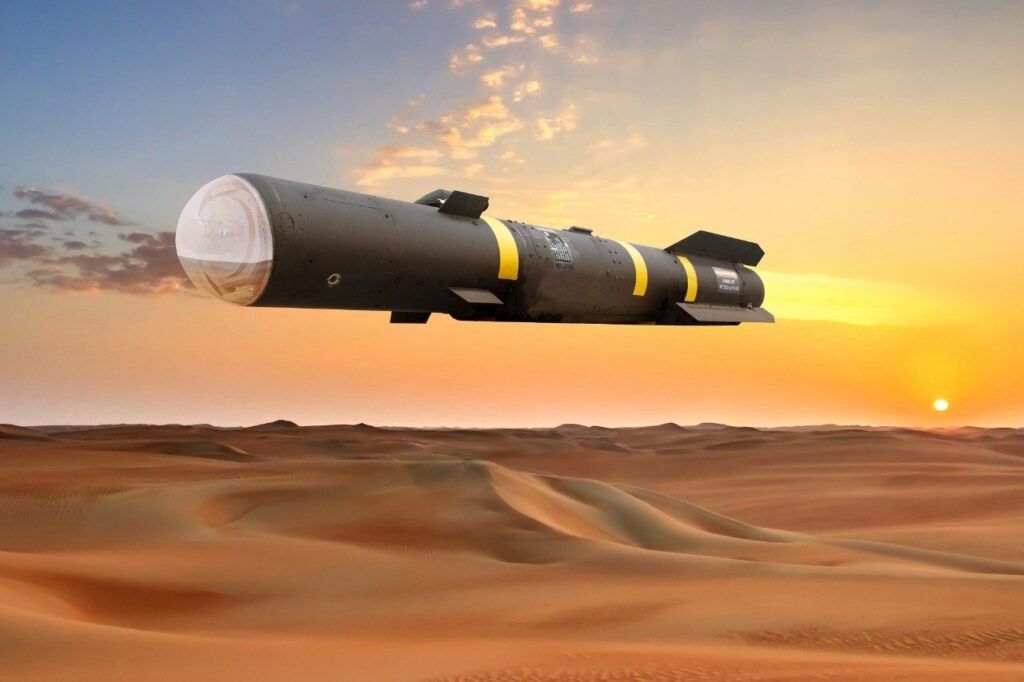
JAGM (Lockheed Martin)

ORLANDO, Fla., April 1, 2024 – The U.S. Army awarded Lockheed Martin (NYSE: LMT) a follow-on production contract for Joint-Air-to-Ground Missiles (JAGM) and HELLFIRE missiles with a Program Year 3 (PY3) award total value of $483 million.  

This contract will provide JAGM and HELLFIRE procurement and production support for the U.S. Army, U.S. Navy and international customers. This contract is the third follow-on award that is a part of a multiple-year award that was initially awarded in March 2023. The total contract award value is for up to $4.5 billion through 2025.  

“This follow-on contract signals the Army’s continued confidence in both the JAGM and HELLFIRE systems as premier defense capabilities when it comes to ensuring customer readiness worldwide,” said Joey Drake, program management director of Multi-Domain Missile Systems at Lockheed Martin Missiles and Fire Control.   

HELLFIRE currently has more than 30 FMS customers with new HELLFIRE international customer Poland included in the PY3 contract. This contract provides maximum flexibility to facilitate the procurement of both systems to multiple domestic and international customers, especially as the JAGM program anticipates a significant increase in international demand for the weapon system in coming years.  

“We will be able to continue to provide procurement and production support for both systems, which is important because both are critical multi-domain combat solutions that protect and defend our armed forces and allies against ever-changing global threats,” said Drake.  

Both the JAGM and HELLFIRE systems are designed and developed in Orlando, Florida. The weapon systems are manufactured across various Lockheed Martin facilities in Dallas, Texas; Orlando and Ocala, Florida; Archbald, Pennsylvania; and Troy, Alabama. With more than 140,000 missiles produced, JAGM and HELLFIRE continue to be the weapon of choice in critical, precision engagement opportunities. 


US Coast Guard Cutter Escanaba returns home after supporting Operation Vigilant Sentry

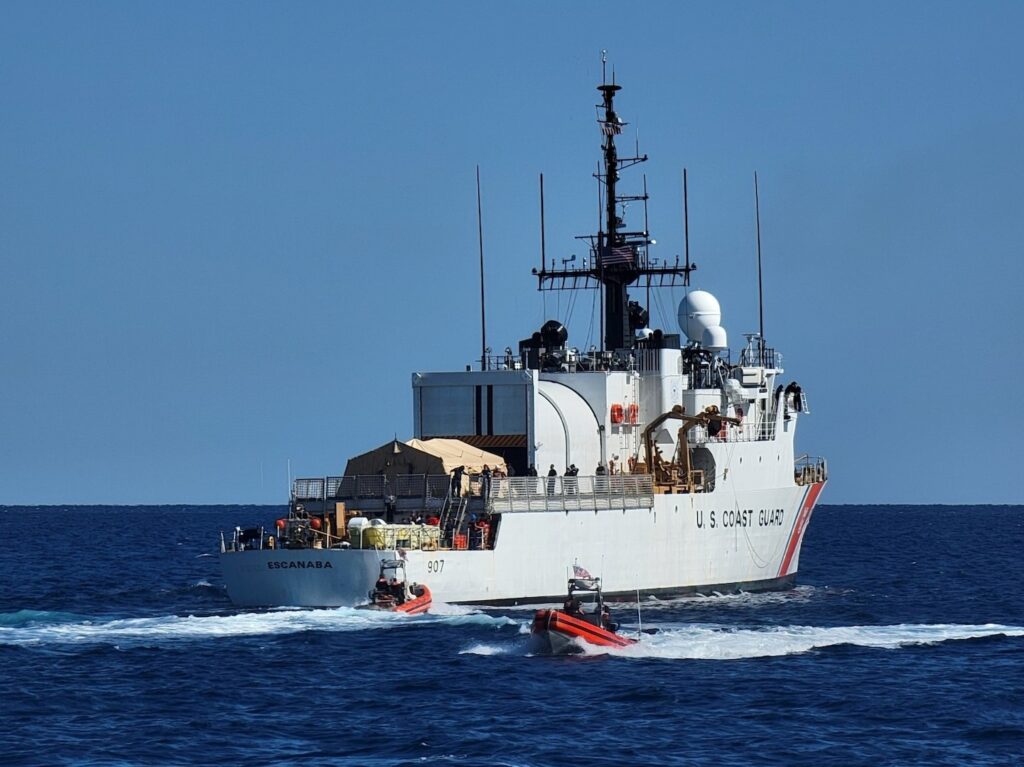
The crew of U.S. Coast Guard Cutter Escanaba (WMEC 907) conducts small boat personnel transfers with the U.S. Coast Guard Cutter Isaac Mayo (WPC 1112), in the South Florida Straits, Feb. 26, 2024. Escanaba’s crew contributed to the interdiction and repatriation of over 100 migrants from Haiti and Cuba while patrolling the Coast Guard Seventh District’s area of responsibility. (U.S. Coast Guard photo by Seaman Laura Holguin-Rojas)

U.S. Coast Guard Atlantic Area, April 1, 2024 

PORTSMOUTH, Va. —  The crew of U.S. Coast Guard Cutter Escanaba (WMEC 907) returned to their homeport in Portsmouth, Monday, following a 52-day patrol in the Florida Straits and Windward Passage.   

Escanaba’s crew contributed to the interdiction and repatriation of over 100 migrants from Haiti and Cuba while patrolling in the Coast Guard Seventh District’s area of responsibility. Escanaba deployed in support of the Homeland Security Task Force – Southeast initiative Operation Vigilant Sentry (OVS), which aims to disrupt and prevent unlawful migrant flow and human trafficking.  

OVS is the 2004 Department of Homeland Security plan that provides structure for deploying joint air and surface assets and personnel to respond to irregular maritime migration in the Caribbean corridor of the United States. Its primary objectives are to protect the safety of life at sea while deterring and dissuading irregular, unlawful maritime migration alongside our federal, state, and local partners.    

While on patrol, Escanaba served as the Commander Task Unit for operations between the Florida Keys, Cuba, and Haiti, coordinating the employment of numerous surface and air assets to aid in deterring illegal maritime migration ventures bound for the United States.  

“This is Escanaba’s first patrol this year,” said Cmdr. Jared Silverman, commanding officer of Escanaba. “The crew responded exceptionally to this extremely challenging mission; they handled each and every migrant with respect and care, and truly embodied the Coast Guard’s humanitarian mission.”    

Escanaba is a 270-foot, Famous-class medium-endurance cutter. Escanaba’s primary missions are counter-narcotics operations, migrant interdiction, living marine resources protection, and search and rescue in support of U.S. Coast Guard operations throughout the Western Hemisphere.  

For information on how to join the U.S. Coast Guard, visit GoCoastGuard.com to learn about active duty, reserve, officer, and enlisted opportunities. Information on how to apply to the U.S. Coast Guard Academy can be found here. 


Joint Effort to Clear Baltimore Bridge Debris Launches Over Weekend

April 1, 2024 | By Matthew Olay, DOD News  

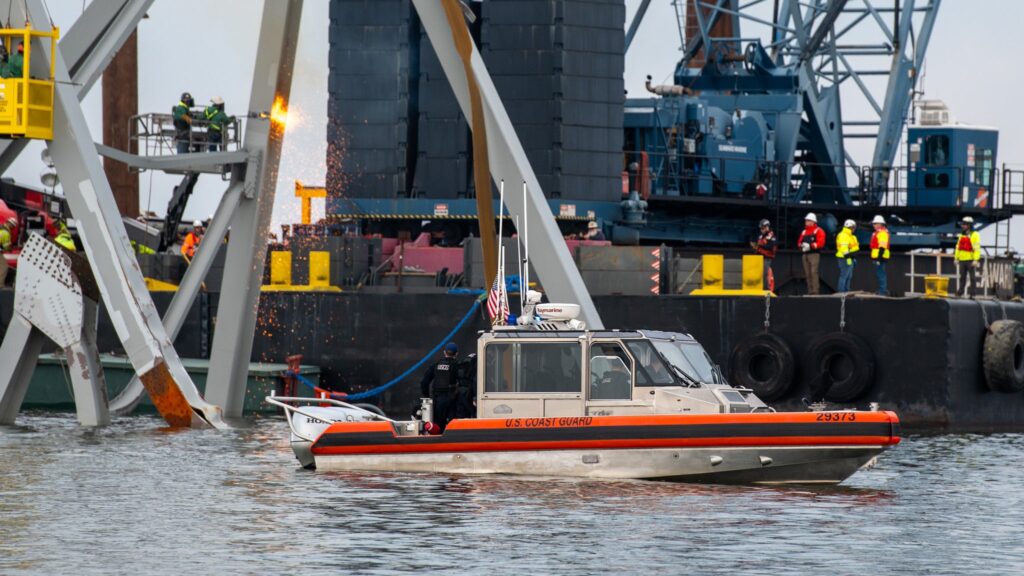
Multiple Defense Department assets teamed with state, federal and private sector agencies in Baltimore Harbor Saturday to begin removing wreckage from the Francis Scott Key Bridge collapse. 

“The continues to support the whole-of-government response in Baltimore. Through the Unified Command, the U.S. Coast Guard is coordinating this effort in collaboration with the U.S. Army Corps of Engineers, the U.S. Navy and many others,” Deputy Pentagon Press Secretary Sabrina Singh told reporters during a meeting today. 

Crews of highly trained demolition experts began cutting into the top portion of the collapsed bridge’s north side on Saturday, and the Army Corps of Engineers completed a required underwater survey — both necessary steps prior to removal of debris, Singh said. 

Meanwhile, Naval Sea Systems Command is aiding Unified Command’s efforts to clear out debris and reopen the harbor by contracting out the 1,000-ton lift capacity derrick barge Chesapeake, the 200-ton lift capacity revolving crane barge Ferrell and the 150-ton lift capacity crane barge Oyster Bay. All are on scene in Baltimore Harbor.   

An additional, 400-ton lift capacity barge is scheduled to arrive next week, according to a news release distributed this afternoon by Navy public affairs. 

On Sunday, Coast Guard Capt. David O’Connell, the federal on-scene coordinator for Key Bridge Response 2024, announced preparations for the establishment of a “temporary alternate channel on the northeast side of the main channel in the vicinity of the Francis Scott Key Bridge for commercially essential vessels,” according to a Key Bridge Response 2024 press release.  

“This will mark an important first step along the road to reopening the Port of Baltimore,” O’Connell said.

In addition to over 1,000 engineering, construction, contracting and operations specialists with the Corps of Engineers, the Coast Guard-led Unified Command’s additional components include assets from the Maryland Department of the Environment, the Maryland Transportation Authority, the Maryland State Police and a private sector crisis and emergency management consulting firm. 

” ready to assist in further efforts to provide immediate response, reopen the port, rebuild the bridge and support the people of Baltimore,” Singh said. 


US Coast Guard Cutter Hamilton completes four-month deployment, returns to homeport in Charleston

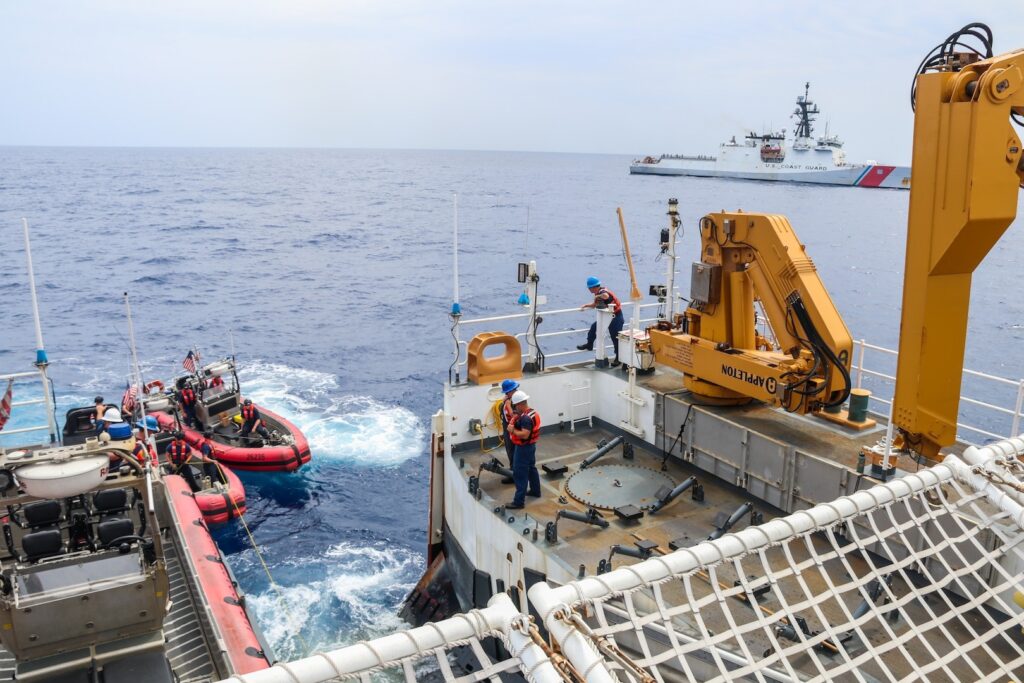
Crews from Coast Guard cutters Hamilton (WMSL 753) and Munro (WMSL 755) exchange cutter boats in the Pacific Ocean, March 12, 2024. Hamilton and Munro are national security cutters. (U.S. Coast Guard photo by Ensign Ray Corniel)

U.S. Coast Guard Atlantic Area, April 1, 2024 

NORTH CHARLESTON, S.C. — The crew of the U.S. Coast Guard Cutter Hamilton (WMSL 753) returned to their homeport in North Charleston, Friday, following a four-month maritime safety and security patrol in the Western Atlantic and Eastern Pacific Ocean.    

Patrolling in support of Homeland Security Task Force – Southeast’s Operation Vigilant Sentry and Joint Interagency Task Force – South’s (JIATF-S) counterdrug mission, Hamilton’s crew interdicted four vessels trafficking illicit narcotics, apprehended 10 suspected drug smugglers, rescued 47 migrants on an unsafe voyage at sea, and assisted six mariners in distress.     

While underway, Hamilton worked to counter illicit maritime activities, strengthen partner nation ties, and facilitate the safety of life at sea. Hamilton interdicted 7,448 pounds of marijuana from four drug trafficking ventures worth more than $7 million. In support of JIATF-S, Hamilton assisted Panamanian and Costa Rican partners with two additional interdictions for a combined 5,800 pounds of cocaine, worth approximately $76 million.      

On Christmas Eve, Hamilton’s crew spotted a U.S.-flagged sailing vessel with three people aboard, requesting assistance during rough seas. Hamilton sent over a rescue and assistance team to assist them with retrieving their adrift dinghy, restored their engines, provided medical aid, and escorted them safely back to Florida. In another case, Hamilton spotted a Panamanian fishing vessel’s crew waving for help. Hamilton deployed their rescue and assistance team to evaluate the nature of their distress. Once on-scene, they found three fishermen with their vessel adrift after fighting an engine fire. Hamilton provided medical aid and water while remaining on-scene until relieved by Panamanian authorities.    

“I am so proud of our crew’s flexibility, resiliency, and superb execution of duty,” said Capt. Justin Carter, commanding officer of Hamilton. “We accomplished every task asked of us, whether countering drug smugglers, responding to unsafe migrant ventures, or aiding mariners at sea. Performing these missions required expert operation and maintenance of our ship, boats, and aircraft, and our crew took care of each other through every challenge we faced.”     

Hamilton also conducted at-sea trainings with Coast Guard cutters Munro (WMSL 755), Bear (WMEC 901) and an MH-65 helicopter crew from the Helicopter Interdiction Tactical Squadron.      

Hamilton is one of four 418-foot National Security Cutters (NSC) homeported in Charleston. With its robust command, control, communication, computers, intelligence, surveillance, and reconnaissance equipment, the NSC is the most technologically advanced ship in the Coast Guard’s fleet. NSCs are a world-wide deployable asset that supports Department of Homeland Security, Department of Defense, and national objectives through drug interdiction, migrant interdiction, national defense, search and rescue, fisheries enforcement, and national intelligence collection.      

For more information about Hamilton, visit https://www.atlanticarea.uscg.mil/Area-Cutters/CGCHAMILTON/.    

For information on how to join the U.S. Coast Guard, visit GoCoastGuard.com to learn about active duty, reserve, officer, and enlisted opportunities. Information on how to apply to the U.S. Coast Guard Academy can be found here.    


April 1 Red Sea Update

U.S. Central Command, April 1, 2024 

TAMPA, Fla. – At 9 a.m. (Sanaa time) April 1, United States Central Command (CENTCOM) forces successfully destroyed an Iranian-backed Houthi terrorist unmanned surface vessel (USV) in self-defense.  

It was determined this USV presented a threat to U.S. and coalition forces and merchant vessels in the region. 

These actions are necessary to protect our forces, ensure freedom of navigation, and make international waters safer and more secure for U.S., coalition, and merchant vessels. 


NAS Sigonella Welcomes First MQ-4C Triton

Naval Air Station (NAS) Sigonella, Italy – The first MQ-4C Triton arrived at Naval Air Station (NAS) Sigonella, March 30, 2024.

By Lt. j.g. Andrea Perez, Naval Air Station Sigonella Public Affairs, March 31, 2024 

NAVAL AIR STATION SIGONELLA, Italy – The first MQ-4C Triton arrived to Naval Air Station (NAS) Sigonella, March 30, 2024. 

The MQ-4C’s arrival to the U.S. Sixth Fleet area of operations marks the second forward-deployed detachment for VUP-19.  A total of three detachments are planned when the program is fully operational.  Deployments like this enhance U.S. Navy interoperability with NATO Allies and partners. 

“The addition of the MQ-4C Triton, right here in Sigonella, is another milestone in the successful development of the Triton program,” said Capt. Aaron Shoemaker, Commanding Officer, NAS Sigonella. “We are proud to support VUP-19 [Unmanned Patrol Squadron (VUP) 19] as they integrate with the Fleet to expand the roles of unmanned aircraft systems operations in our region and beyond.” 

The MQ-4C Triton is the Navy’s newest Intelligence, Surveillance, and Reconnaissance Maritime Patrol asset and augments the capabilities of the P-8 Poseidon maritime patrol aircraft. 

To prepare for the arrival of the Triton in Italy, VUP-19 “Big Red” held a ceremony to celebrate the deployment and the opening of a new Triton hangar at NAS Sigonella, March 2.   

VUP-19, homeported in Florida at Naval Air Station Jacksonville and Naval Station Mayport, boasts more than 300 Sailors and officers from various aviation ratings and officer communities who maintain and operate the Triton around the world. Aircrew gather and process surveillance information utilizing data fusion tools that integrate sensor data from multiple aircraft into a comprehensive networked picture to further assist in building an accurate threat representation. 

VUP-19 achieved initial operation capability in September 2023 during its deployment to Andersen Air Force Base, Guam. 

Naval Air Station Sigonella provides consolidated operational, command and control, administrative, logistical and advanced logistical support to U.S. and other NATO forces. The installation’s strategic location enables U.S., allied, and partner nation forces to deploy and respond as required, ensuring security and stability in Europe, Africa and Central Command. 


March 30 Red Sea Update

U.S. Central Command, March 31, 2024 

TAMPA, Fla. – At 8:30 a.m. (Sanaa time) March 30, United States Central Command (CENTCOM) forces successfully engaged and destroyed two unmanned aerial systems (UAS) in Houthi-controlled areas of Yemen in self-defense. One was engaged over the Red Sea and the other was engaged on the ground prepared to launch. 

It was determined these unmanned aerial systems presented a threat to U.S. and coalition forces and merchant vessels in the region. 

These actions are necessary to protect our forces, ensure freedom of navigation, and make international waters safer and more secure for U.S., coalition, and merchant vessels. 


2nd Marine Aircraft Wing Marines receive last AV-8B Harrier pilot designations

An AV-8B Harrier II of Marine Attack Squadron 223. Photo by Senior Master Sgt. Joshua Allmaras 

2nd Lt. John W. Graham, 2nd Marine Aircraft Wing Public Affairs, 1 Apr 2024 

MARINE CORPS AIR STATION CHERRY POINT, N.C. — The AV-8B Harrier II Fleet Replacement Detachment (FRD), Marine Aircraft Group (MAG) 14, 2nd Marine Aircraft Wing (MAW), graduated the final two pilots to receive the 7509 Military Occupational Specialty (MOS) at Marine Corps Air Station (MCAS) Cherry Point, North Carolina, Friday.  

Capt. Joshua Corbett and Capt. Sven Jorgensen completed their final training flight at the FRD in order to receive the 7509 MOS, which is reserved for AV-8B Harrier II qualified pilots. The flight, a low-altitude close air support training sortie, represents the culmination of the Marines’ training at the FRD. 

“The significance of the last replacement pilot training flight in the Harrier community is that it is the beginning of the end for us as a community.” said Corbett. “The Harrier, more than many aircraft than I have come across, elicits an emotional response. For members of the public, members of the aviation community, members of the Marine community, and especially members of the Harrier pilot community, it’s bittersweet. All good things have to come to an end, and it’s our turn soon, but not yet.”  

The Harrier is a vertical/short takeoff and landing (VSTOL) tactical attack aircraft. The first AV-8B Harrier II arrived at MCAS Cherry Point in January 1984. In their 40-year presence in the eastern North Carolina region, 2nd MAW Harriers, and the 7509s that pilot them, have supported numerous operations across the globe, including Operation Desert Storm, Operation Allied Force in 1999 in the former Yugoslavia, Operation Enduring Freedom, and Operation Iraqi Freedom. Corbett’s and Jorgensen’s designation represents 2nd MAW’s continued operational transition from legacy fixed-wing tactical aircraft, such as the Harrier.    

As the Harrier transitions out of the Fleet Marine Force, its role is being filled by the F-35B Lightning II. Marine Attack Squadron (VMA) 223 will be the last Harrier squadron in the Marine Corps and is set to continue operating the platform through September 2026. Until then, the platform will continue to call MCAS Cherry Point home and execute deployed operations as part of Marine Expeditionary Units.  

“I am incredibly proud of the legacy of the AV-8B, both within Marine Aviation and here in eastern North Carolina.” said Lt. Col. Nathaniel Smith, the Commanding Officer of VMA-223. “Our platform is part of the fabric of eastern North Carolina, as countless Marines, sailors, and civilians have contributed to our success for decades. It is exciting to see our last two students graduate from the FRD and hit the fleet. Our team of pilots, maintainers, and supporting staff have done outstanding work in supporting both the FRD and VMA missions here at VMA-223, and I look forward to us continuing to support 2nd MAW and the MAGTF at home and overseas.”   

Both pilots will report to VMA-223 after completing the FRD syllabus.