Navy Resources Arrive in Baltimore to Support Key Bridge Efforts
By Navy Public Affairs, 1 April 2024
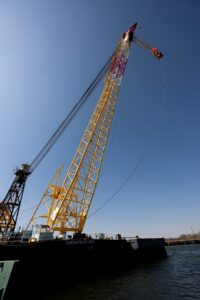
BALTIMORE – The Chesapeake, a 1000-ton lift capacity derrick barge, the Ferrell, a 200-ton lift capacity revolving crane barge, and the Oyster Bay, a 150-ton lift capacity crane barge have arrived to Baltimore Harbor. An additional 400-ton lift capacity barge is on track to arrive early next week. The barges, contracted through Naval Sea Systems Command (NAVSEA) will support the U.S. Coast Guard led Unified Command in its effort to clear and re-open the channel.
The barges will be used by the Navy’s Supervisor of Salvage and Diving (SUPSALV) to remove submerged portions of the Francis Scott Key Bridge. SUPSALV will accomplish the work in phases. Following an overall assessment, work will focus on disassembling and removing the bridge section by section. The disassembled pieces will be lifted onto barges, which will then be transported away.
An additional 12 crane and support vessels to include tugs, survey, dive and crew boats, are in the mobilization process and will arrive to Baltimore in the coming days. SUPSALV will manage the operation and use of all assets to provide centralized oversight of all salvage operations.
SUPSALV is a world leader in the ocean engineering discipline of marine salvage, towing, pollution control and abatement, diving and diving system safety, salvage equipment procurement and underwater ship husbandry.
RTX’s SM-6 intercepts ballistic missile target at sea
Test of enhanced software succeeds against sophisticated medium-range ballistic missile
PACIFIC MISSILE RANGE FACILITY, Hawaii (March 29, 2024) — A Standard Missile-6 (SM-6) built by Raytheon, an RTX (NYSE: RTX) business, intercepted a medium-range ballistic missile target at sea in its final seconds of flight, after being fired from the USS Preble (DDG 88). This test verified some of the missile’s enhanced capabilities when launched from a Baseline 9.C2 variant of the Aegis Combat System.
The SM-6 missile can perform anti-air warfare, anti-surface warfare and advanced ballistic missile defense at sea. This latest flight test, designated as Flight Test Aegis Weapon System (FTM)-32, involved the SM-6 Dual II (Block IA) configuration with newly qualified software that significantly enhances the missile’s capabilities for the U.S. Navy fleet.
“This test demonstrated that the latest versions of the SM-6 and combat system provide the critical capability to destroy an incoming sophisticated missile threat,” said Kim Ernzen, president of Raytheon Naval Power. “Raytheon is committed to ensuring our technology stays ahead of evolving threats and is available to sailors as quickly as possible.”
FTM-32 was the seventh flight test of the SM-6 against ballistic missile targets and the fourth test utilizing the Dual II (Block IA) configuration.
Deployed on U.S. Navy ships, SM-6 delivers a proven over-the-horizon offensive and defensive capability by leveraging the time-tested Standard Missile airframe and propulsion system. It’s the only missile that supports anti-air warfare, anti-surface warfare and sea-based terminal ballistic missile defense in one solution, and it’s enabling the U.S. and its allies to cost-effectively increase the offensive might of surface forces.
The U.S. Department of Defense has approved the sale of SM-6 to several allied nations.
Leidos-designed low-profile vessels participate in U.S. Army’s Project Convergence Capstone 4 exercise
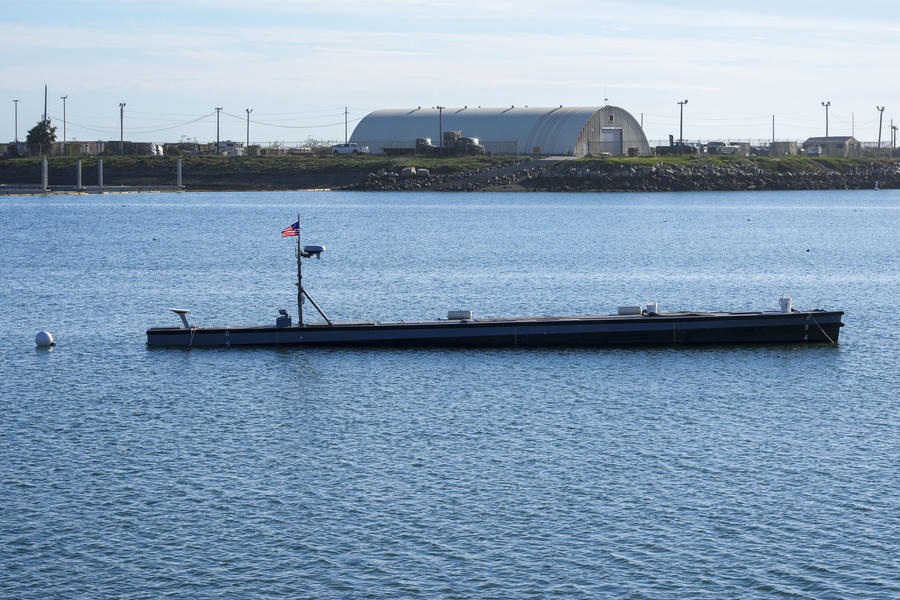
RESTON, Va. (March 29, 2024) – Two Leidos-designed uncrewed and autonomous-capable low-profile vessels (LPVs) recently participated in the Project Convergence Capstone 4 military exercises in California. Leidos (NYSE:LDOS), a Fortune 500 innovation company, delivered the vessels to the U.S. Marine Corps last year.
“Leidos once again designed and delivered innovative solutions with these LPVs, and it was great to see them participate in Project Convergence,” said Dave Lewis, Leidos senior vice president, Sea Systems Business Area. “The prototypes we’ve delivered will help create new disruptive logistics capabilities for the Marine Corps. Its low profile and long range are intended to help the vessels achieve a higher mission success rate supporting dispersed Marine fire units than conventional methods.”
The LPV’s low-to-the-water visual profile helps to reduce probability of detection. The vessels are intended to transport a logistics payload of up to five tons over a range of 2,000 nautical miles, and have been built to experiment with different autonomous control systems. The two LPV prototypes were delivered last year to the Marine Corps Warfighting Laboratory for testing and technical assessment. Their participation in the joint and multi-national Project Convergence Capstone 4 exercises represents the next stage of testing and experimentation with the vessels’ capabilities alongside warfighters.
Leidos designed the LPVs under contract with MilTech, a Montana State University research lab and an authorized National Government Partnership Intermediary.
The delivery of the LPV prototypes complements Leidos’ extensive maritime autonomy portfolio. Leidos-designed and built autonomous vessels recently completed joint naval exercises in the western Pacific as part of the Navy’s Integrated Battle Problem 23.2. Last year, Leidos was awarded a U.S. Navy task order to manage, operate and maintain the Navy’s Overlord and medium unmanned surface vessels.
U.S. Navy and JSDF conduct Tomahawk Land Attack Missile Training
By MC1 Ryan M. Breeden, U.S. 7th Fleet Public Affairs, March 29, 2024
YOKOSUKA, Japan – Sailors assigned to Surface Combat Systems Training Command (SCSTC) hosted members from the Japan Self-Defense Force aboard the Arleigh Burke-class guided missile destroyer USS McCampbell (DDG 85) and Commander, Fleet Activities Yokosuka, to conduct tomahawk land attack missile training, March 25-28.
The training provided Japan Maritime Self-Defense Force (JMSDF) and Japan Air Self-Defense Force (JASDF) officers with the knowledge required to coordinate shipboard cruise missile operations in route to Full Operational Capability.
The United States Ambassador to Japan, Rahm Emanuel, visited McCampbell to observe the shipboard portion of the training March 28.
“We are ahead of schedule, and that’s exactly what we have to do to keep up deterrence and maintain operations within this area of operations,” said Emanuel. “We will give our partners, our allies, the Japanese Navy, the capacity that their investing in. This is not a one and done, this is going to happen again.”
The training included classroom instruction, followed by a shipboard walkthrough and demonstration, aligned to the U.S. Navy cruise missile command curriculum.
“It was a privilege to conduct Cruise Missile Command training with our Japan Self-Defense Force counterparts over the past few days,” said Cmdr. Michael Arnold, Officer in Charge of SCSTC WESTPAC. “This training marks a significant milestone in Japan’s strategic acquisition of the Tomahawk Weapon Control System and our collaborative first step in mastering this new capability. Together, we fortify our alliance, demonstrating our united commitment to a free and open Indo-Pacific and upholding the principles that ensure regional peace, stability, and a rules-based international order.”
The week-long training provided participants with a hands-on overview of the Tactical Tomahawk Weapons Control System consoles and associated equipment, and participants were able to execute a simulated generic strike mission scenario.
U.S. 7th Fleet is the largest forward-deployed fleet in the world, and with the help of a network of alliances and partners from 35 other maritime-nations, the U.S. Navy has operated in the Indo-Pacific region for more than 70 years, providing credible, ready forces to help preserve peace and prevent conflict.
Joint operation leads to cocaine seizure in Bahamas
U.S. Coast Guard 7th District, March 29, 2024
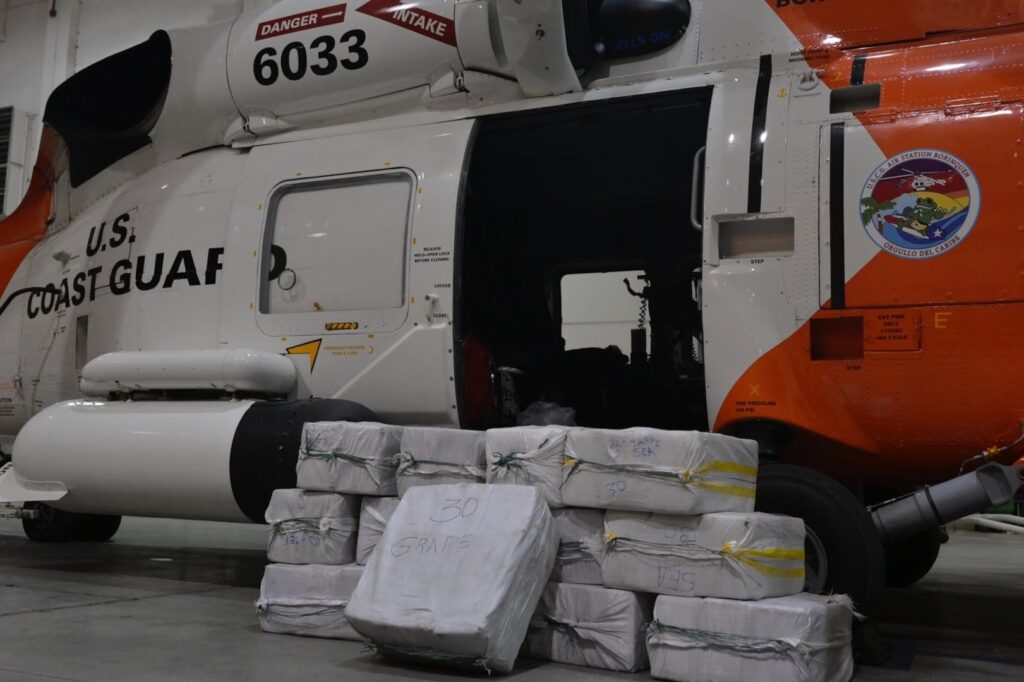
MIAMI – U.S. Coast Guard Air Station Borinquen aircrews assisted the Royal Bahamas Police Force and the U.S. Drug Enforcement Administration with the transfer and disposition of approximately 391 kilos of cocaine worth an estimated value of $7.5 million, Tuesday, at the Mayaguana Airport in The Bahamas.
Operation Bahamas Turks and Caicos partners collaborated to interdict the contraband.
The Royal Bahamas Police Force Drug Enforcement Unit coordinated with Mayaguana Airport Police and DEA agents to seize a suspected smuggling aircraft and discovered the contraband.
The RBPF took custody of a suspected smuggler and the RBPF public affairs and communication department reported that the case investigation is ongoing.
The drug bust follows the recent 2024 Northern Caribbean Security Summit held in The Bahamas earlier this month. The NOCSS was the third-annual meeting between executive and law enforcement leaders from the United States, The Bahamas, the Turks and Caicos Islands, and the United Kingdom. At the summit, leaders discussed ways to modernize, integrate, and position joint security relationships to confront the complex threats of the 21st century. NOCSS partners continuously work across the region to dismantle criminal networks, block malign actors, support strong judiciaries, and stop the trafficking of drugs, guns, wildlife, and people.
OPBAT is a partnership between the DEA, U.S. Coast Guard, U.S. Customs and Border Protection, the U.S. Department of State, and law enforcement entities of The Commonwealth of The Bahamas and the Turks and Caicos Islands to stop the flow of illicit narcotics through the Caribbean, destined for the United States or other jurisdictions. OPBAT assets also regularly assist with prosecuting human smuggling and search and rescue cases throughout its area of responsibility.
March 28 Red Sea Update
RED SEA (March 20, 2024) An aviation boatswain’s mate (handling) taxis an MH-60R Sea Hawk helicopter from the “Swamp Foxes” of Helicopter Maritime Strike Squadron (HSM) 74 aboard the Nimitz-class aircraft carrier USS Dwight D. Eisenhower (CVN 69) in the Red Sea, March 20, 2024. (U.S. Navy photo)
U.S. Central Command, March 28, 2024
TAMPA, Fla. – Between 6:00 and 10:56 p.m. (Sanaa time) on March 28, and for the second day in a row, U.S. Central Command successfully engaged and destroyed four unmanned aerial systems (UAS) launched by Iranian backed Houthi terrorists in Yemen. These UAS were aimed at a Coalition vessel and a U.S. warship and were engaged in self-defense over the Red Sea. There were no injuries or damage reported to U.S. or coalition ships.
It was determined these weapons presented an imminent threat to merchant vessels and U.S. Navy ships in the region. These actions are taken to protect freedom of navigation and make international waters safer and more secure for U.S. Navy and merchant vessels.
Kraken Forms PartnershipWith Auterion to Boost Autonomous Capabilities in Security Boat Sector
LONDON, U.K., and ARLINGTON Va. — Kraken Technology Group, a maritime technology leader specialising in the disruptive design and manufacturing of high-performance platforms, and Auterion, the company building the software-defined future for mobile robotics and powering the world’s leading drone manufacturers, have announced a strategic partnership to exponentially develop autonomous capabilities in the high-performance littoral security boat sector.
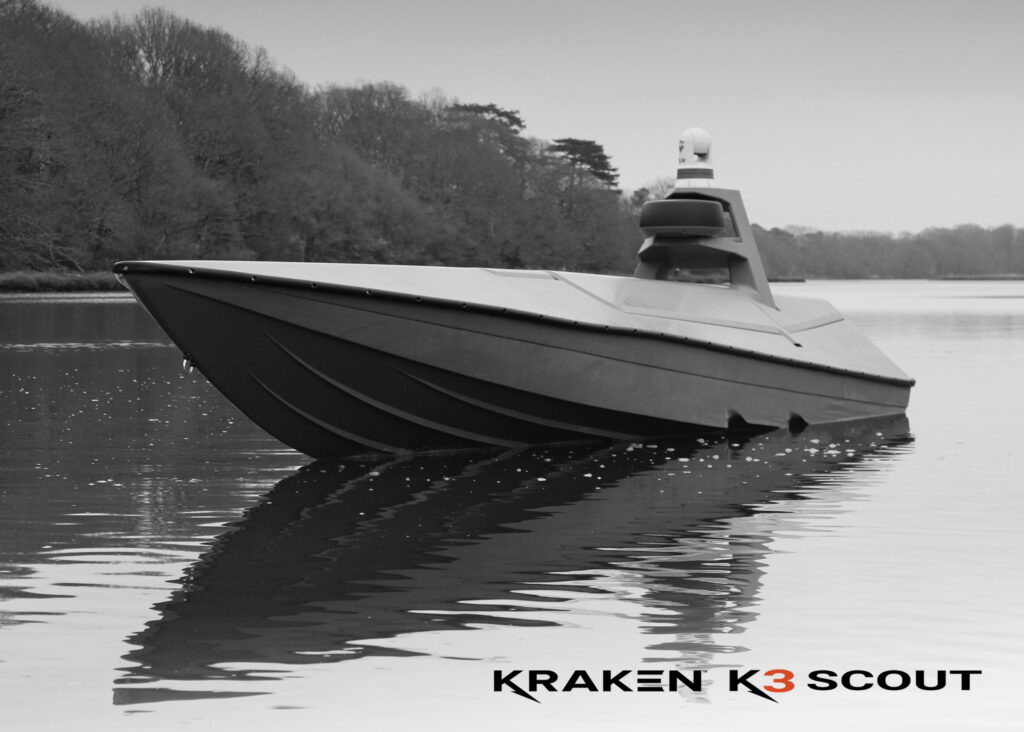
The partnership is focused around the development and implementation of modular, low-cost autonomy software and UxV systems for the maritime domain. The agreement will initially focus on integrated autonomy architecture for Kraken’s K3 SCOUT and K4 MANTA uncrewed platforms.
Auterion’s Skynode X, AuterionOS and numerous capability ‘Apps’ have already been developed and integrated into Kraken’s K3 SCOUT USV, which is currently undergoing open water sea trials. AuterionOS’ open software architecture unlocks the ability to create new apps as needed, continuously expanding Kraken’s ability to serve the wide variety of use cases necessary in maritime domains.
“We are thrilled to be able to extend our expertise into the maritime domain alongside like-minded pioneers and littoral platform experts Kraken. The work done and the progress achieved to date on the development of K3’s uncrewed capability has been impressive and visionary,” said Lorenz Meier, CEO at Auterion.
Mal Crease, Founder and CEO of Kraken Technology Group, said: “Collaborating with Auterion on the rapid development of the K3 SCOUT USV has opened our eyes to the size and scale of the technical transformation already underway and has already delivered unique capabilities in record time. We very much look forward to an exciting future transforming littoral manoeuvre with Auterion.”
U.S. Navy Delivers First P-8A Poseidon Aircraft for Increment 3 Block 2 Modifications
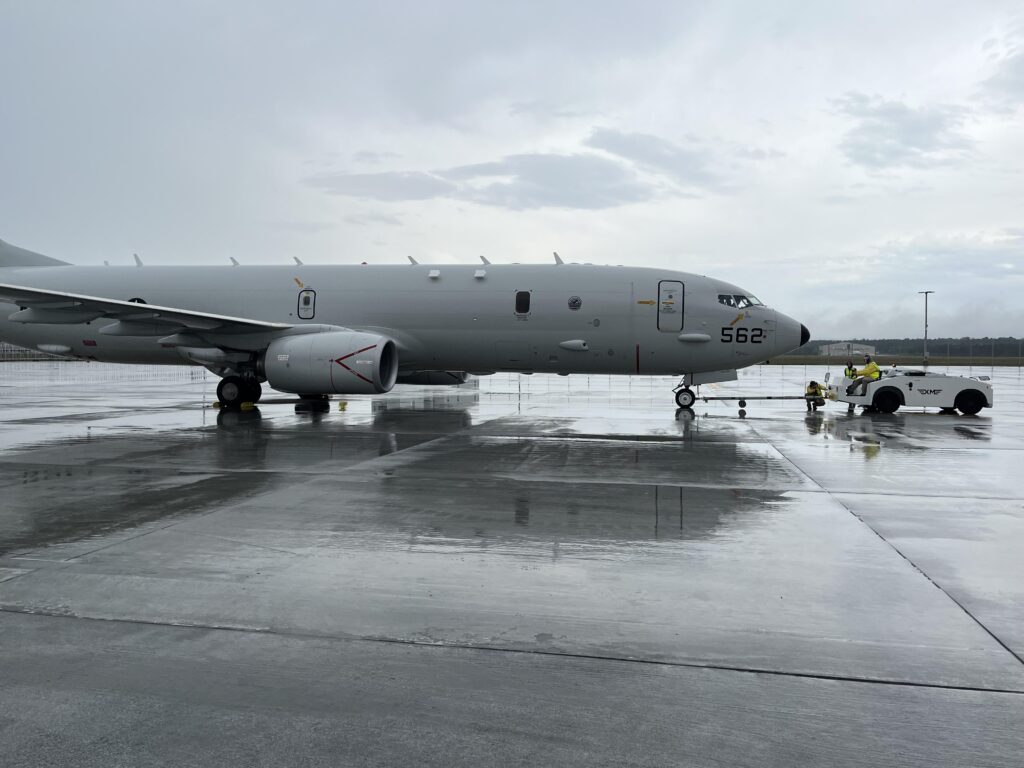
The U.S. Navy delivered the first P-8A Poseidon aircraft to be modified with Increment 3 Block 2 capabilities to Boeing on March 27. Modificationsare expected to be complete in late 2025.
NAVAL AIR SYSTEMS COMMAND, PATUXENT RIVER, Md. — The U.S. Navy delivered the first P-8A Poseidon aircraft to be modified with Increment 3 Block 2 capabilities to Boeing on March 27, enabling the fleet to be outfitted with the full anti-submarine warfare (ASW), anti-surface warfare (ASuW), and intelligence, surveillance and reconnaissance (ISR) capabilities outlined in the P-8A program’s evolutionary acquisition strategy.
The P-8A is the Department of Defense’s only long-range full-spectrum ASW, cue-to-kill platform, with substantial armed ASuW and networked ISR capabilities. Increment 3 Block 2 provides a significant upgrade to the P-8A airframe and avionics systems, and includes new airframe racks, radomes, antennas, sensors, and wiring. The modification incorporates a new combat systems suite with an improved computer processing and higher security architecture capability, a wide band satellite communication system, an ASW signals intelligence capability, a track management system, and additional communications and acoustics systems to enhance search, detection and targeting capabilities.
“Increment 3 Block 2 brings the capability that the P-8A was made for. These modifications will allow aircrews to search, locate and track the most advanced submarines in the world, enabling the fleet to pace the threat with the required capability and capacity to win the fight,” said Capt. Erik Thomas, program manager for the Maritime Patrol and Reconnaissance Aircraft program office, PMA-290. “This delivery demonstrates the PMA-290 team’s outstanding work ethic, professionalism and dedication to the fleet.”
Increment 3 Block 2 related modifications will begin at Boeing’s Maintenance, Repair and Overhaul hangar at Cecil Airport in Jacksonville, Florida. The first fleet aircraft modification is expected to be complete in January 2025.
“P-8A Increment 3 is the next step in the spiral evolution of Poseidon. By design, and through the efforts of NAVAIR and industry teaming, Increment 3 Block 2 represents the baseline configuration the Navy needs to address tomorrow’s high-end threat,” said Rear Adm. Adam Kijek, Commander, Patrol and Reconnaissance Group/Patrol and Reconnaissance Group Pacific.
In response to evolving threats around the world, future P-8A modifications will be implemented via a sequence of rapid capability insertion efforts that build upon this new Increment 3 Block 2 baseline.
As of March 2024, U.S. Navy fleet squadrons have taken delivery of 119 P-8A aircraft. P-8A active duty and reserve squadron transition training is complete for all 14 fleet squadrons and one fleet replacement squadron. In addition, the P-8A fleet has flown for more than 503,783 flight hours and recorded more than 440,558 landings.
PMA-290 manages the acquisition, development, support and delivery of the U.S. Navy’s maritime patrol and reconnaissance aircraft.
March 27 Red Sea Update
From U.S. Central Command, March 27, 2024
TAMPA, Fla. – Between 2:00 and 2:20 a.m. (Sanaa time) on March 27, United States Central Command successfully engaged and destroyed four long-range unmanned aerial systems (UAS) launched by Iranian-backed Houthi terrorists in Yemen. These UAS were aimed at a U.S. warship and engaged in self-defense over the Red Sea. There were no injuries or damage reported to U.S. or coalition ships.
It was determined these weapons presented an imminent threat to merchant vessels and U.S. Navy ships in the region. These actions are taken to protect freedom of navigation and make international waters safer and more secure for U.S. Navy and merchant vessels.
Unmanned Systems Help Coast Guard Members Navigate the Future
By David Santos, Coast Guard Academy External Affairs, March 27, 2024
U.S. Coast Guard leaders envision a future where Unmanned Aerial Systems (UAS) launched from Coast Guard cutters monitor air and surface contacts or fly autonomously inside large ships to inspect vessel tanks and other hazardous compartments.
Or, using sensors small enough to be installed on small UASs or Autonomous Underwater Vehicles (AUV), measure surface oil spill thickness and help direct assets to heavily impacted areas during oil spill responses.
These future scenarios are some of the strategic objectives outlined in the service’s Unmanned Systems Strategic Plan, which was released last year.
The Coast Guard has been exploring the use of long, medium, and short range unmanned aerial systems since 2008 to provide a cost effective way to increase the operational presence of the service in an increasingly complex maritime environment.
Today cadets, faculty, and staff members at the U.S. Coast Guard Academy are taking the next step in helping to make this vision of the future a reality.
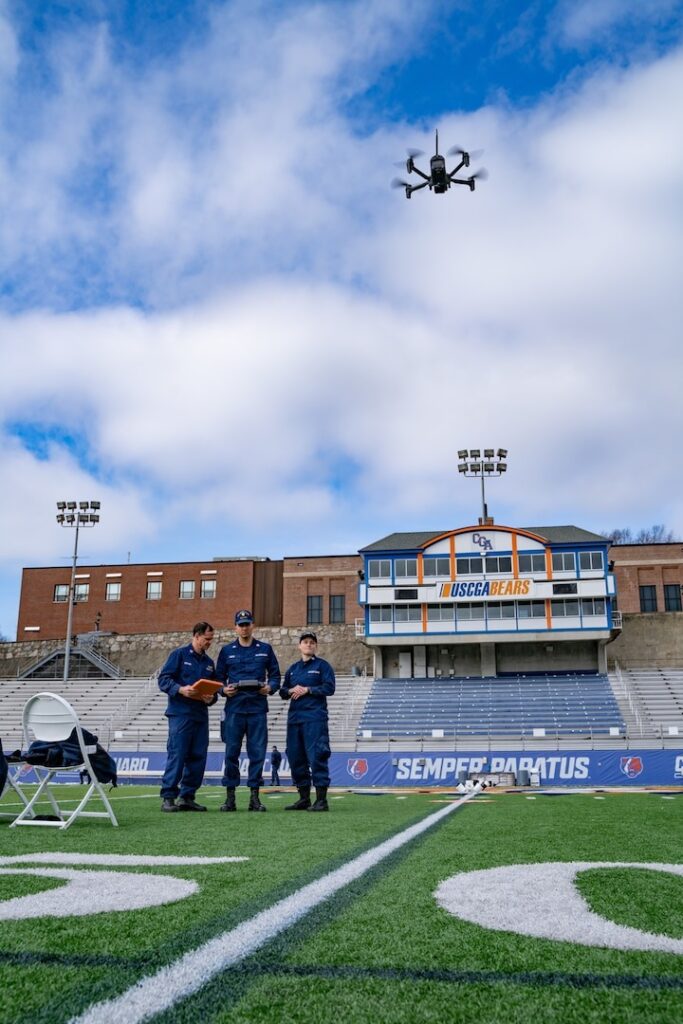
Capt. Brian Maggi and retired Capt. Daniel Burbank, faculty members from the Academy’s Engineering Department, are helping to build a network of licensed drone operators. Their goal is to increase the number of Coast Guard members capable of using the technology in the fleet to help bridge the gap between the huge responsibilities the service is tasked with and the limited resources it is given.
As qualified Short Range Unmanned Aerial System (SR-UAS) Instructor Pilots, Maggi and Burbank are currently teaching a course to help a wide range of Academy personnel complete all the requirements to earn the Coast Guard SR-UAS qualification by the end of the semester.
“The initial solicitation for this course resulted in 60 cadet responses,” Maggi said. “Many of our cadets are already experienced UAS pilots and know the capabilities of these systems better than we do. As Instructor Pilots, we can empower this group to help the Coast Guard innovate how UAS are integrated into operations and mission support. For the cadets and Coast Guard personnel with limited or no experience, the goal is to foster their curiosity to inspire them to grow into this community and create awareness of how these systems may be a force multiplier for all Coast Guard missions.”
“It’s very inspiring to see how quickly the cadets learn how to precisely fly the drones and how to use the high resolution electro-optical and infrared imagers for target detection and identification,” Burbank said. “They’ve got great ‘stick and rudder’ flying skills,” he adds, “and are innovative in the ways they use the dozens of flight and imagery modes to get the most benefit from system capabilities.”
Future plans call for establishing a 3-credit course that would teach cadets how to acquire imagery and video for engineering, science, and Coast Guard mission support. From there an expansion into the Cyber Systems and Operations Research & Data Analytics majors is planned to support the use of this technology in a variety of Coast Guard missions.
“Having come from an organization where human operators routinely use robotic systems to augment and extend their reach and vision, this feels much the same,” said Burbank, who completed several spaceflight missions as one of three Astronauts who have graduated from the Academy. “These systems with talented and trained humans-in-the-loop will make the Coast Guard much more effective just as they do NASA.”
As our maritime infrastructure and environment becomes more complex, Coast Guard personnel will be ready to employ unmanned systems to advance the safety and security of U.S. ports and waterways.