Milestone moves program closer to detailed design review
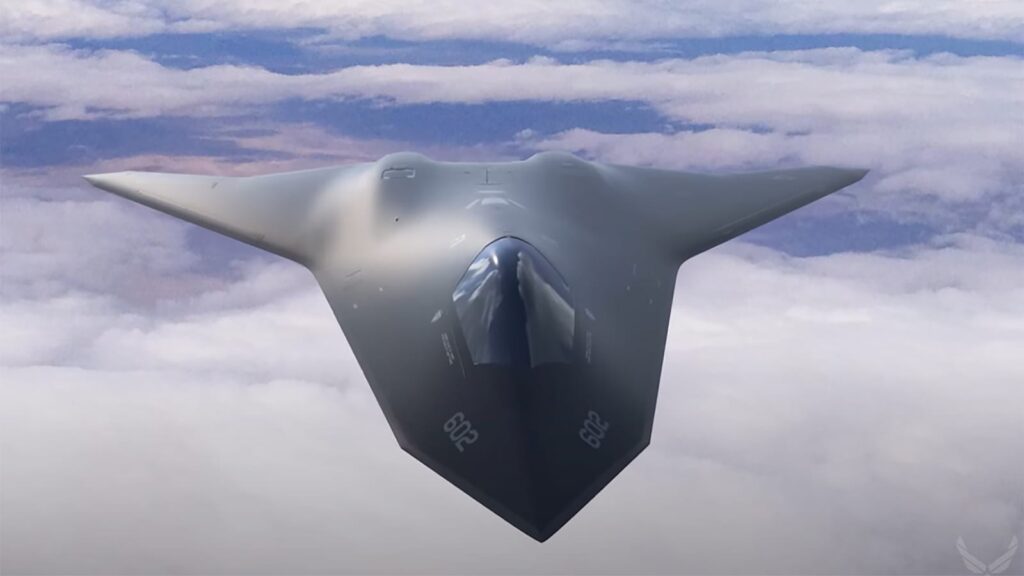
EAST HARTFORD, Conn., (Feb. 12, 2024) — Pratt & Whitney, an RTX business, has completed a critical assessment of its Next-Generation Adaptive Propulsion (NGAP) offering with the U.S. Air Force, moving the program closer to completing its detailed design review. The team is now working towards ground testing of its NGAP prototype, referred to as XA103, which is expected to occur in the late 2020s.
“We are embracing digital transformation with NGAP and changing the customer experience through the entire development process in order to rapidly and efficiently deliver these advanced adaptive engines,” said Jill Albertelli, president of Pratt & Whitney’s Military Engines business. “This technology is critical to maintaining air superiority, which is why Pratt & Whitney has made significant investments in research and development and advanced manufacturing. Continued government funding for sixth-generation propulsion development must remain a high priority to support critical platform milestones and warfighter readiness.”
The engine will enhance performance that is key to enabling future air dominance capabilities, which are needed to ensure the U.S. Air Force achieves air superiority and deters pacing challenges.
NGAP technologies will provide advanced survivability, fuel efficiency, and robust power and thermal management. These are necessary to enable the required range, weapon and sensor capability, and persistence future air dominance platforms will require to meet evolving operational needs.
CNO Visits Naval Surface Warfare Center Indian Head
INDIAN HEAD, Md. (Feb. 9, 2024) – Chief of Naval Operations Adm. Lisa Franchetti visited Naval Surface Warfare Center Indian Head Division (NSWC IHD), Feb. 9.
Franchetti’s visit provided her the opportunity to see firsthand how NSWC IHD, the Navy’s Arsenal, is foundational to the munitions industrial base and is gearing up to meet increased demand by partnering with the commercial industry.
“Indian Head is a critical part of our foundation, and I’m grateful for the work you do here,” said Franchetti. “I can tell that you’re focused on warfighting and that’s what matters – delivering lethality and decisive combat power.”
During the visit, CNO heard how NSWC IHD is built for production, engineering, research development, test and evaluation, and how that has resulted in significant capability development.
She also recognized and spoke with Sailors and civilians who work to bring cutting-edge technology to the Navy, including the newest underwater explosive in 40 years, enhancing the lethality of mines, torpedoes and novel missile engagements.
Franchetti received a brief on NSWC IHD’s energetics comprehensive modernization plan (ECMP) and how it is changing their business model with a focus on investments in improved safety and readiness, renovation and expansion, and state of the art modernization to optimize production tenfold.
During the brief, Mr. Ashley Johnson, NSWC IHD Technical Director, explained how NSWC IHD is a thought leader for the Department of Defense in this arena, executing public, private partnerships with the commercial industrial base to minimize capacity gaps and meet munitions demands.
“We need more players on the field, ready players, and that means munitions,” Franchetti said. “As we implement the ECMP and expand our munitions base we need to continue to tap into all of our resources across the joint force, with our industrial base, and our international partners.”
Franchetti concluded her visit by touring the warhead production floor, meeting the workforce and hearing directly from them about the mix, cast, cure operations from the beginning with inert preparation through the assembly, test and pack-out. She also heard how ECMP’s infrastructure investment makes the facilities much more reliable and increases readiness levels, unlocking latent capacity.
This was Franchetti’s first visit to NSWC Indian Head as Chief of Naval Operations.
3rd MAW Identifies Marines Killed in CH-53E Mishap
MARINE CORPS AIR STATION MIRAMAR, Calif. – (February 9, 2024)
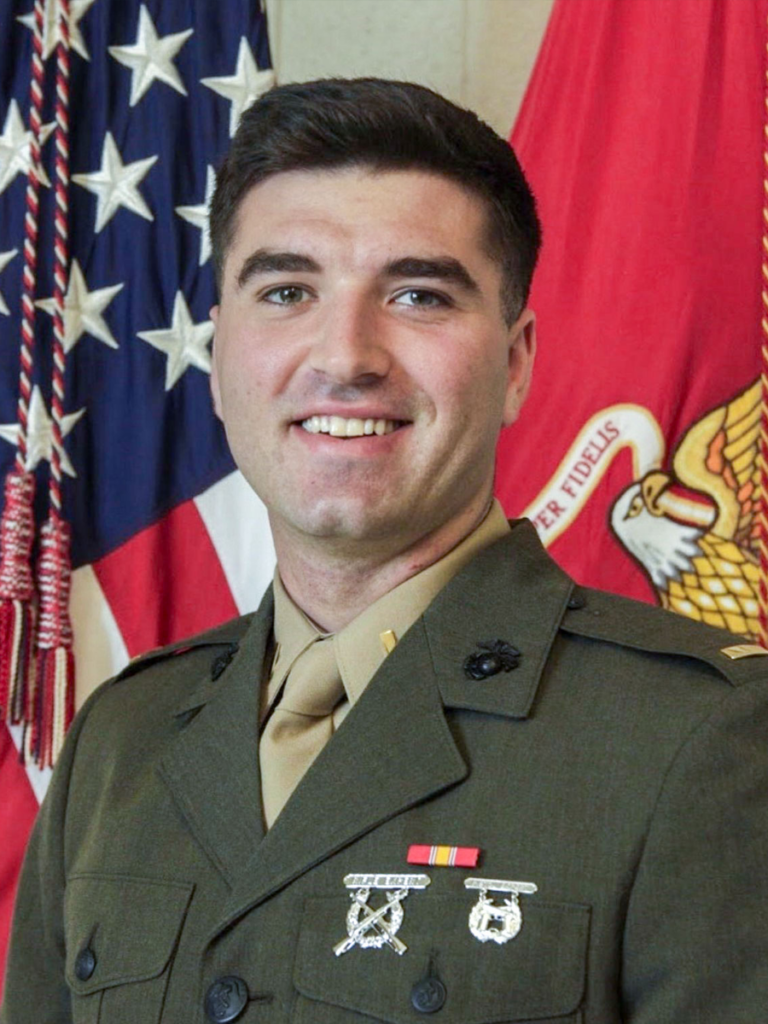
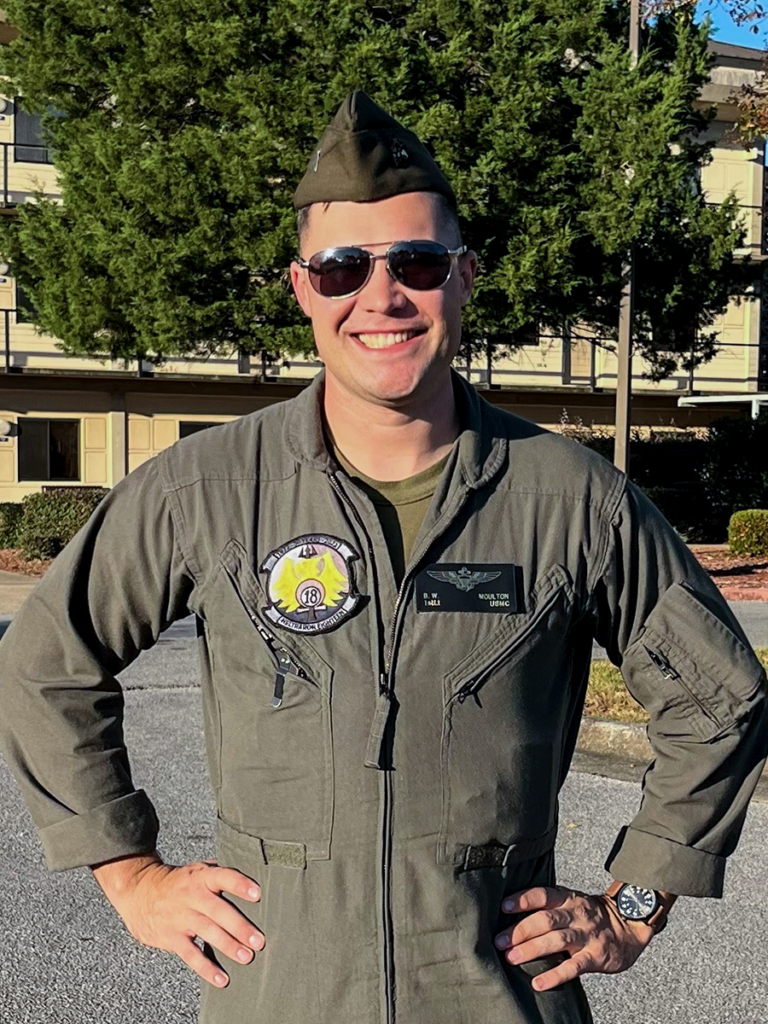
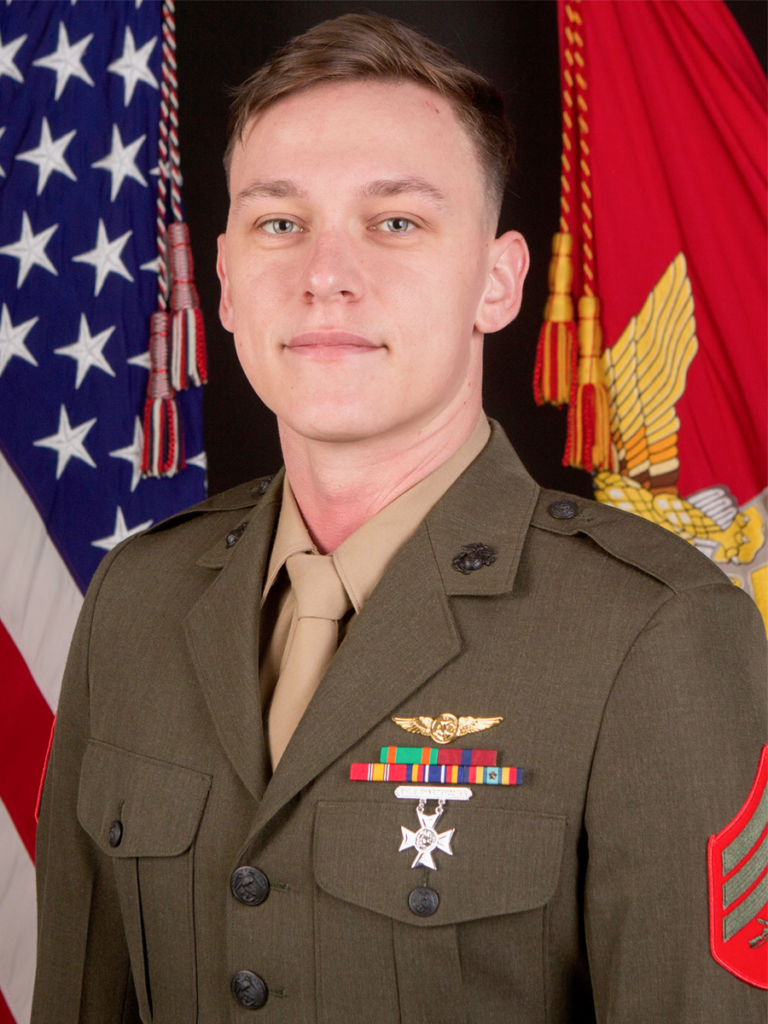
The five deceased Marines from the CH-53E helicopter mishap on February 6, 2024, have been identified. All were assigned to Marine Heavy Helicopter Squadron 361, Marine Aircraft Group 16, 3rd Marine Aircraft Wing and were based at Marine Corps Air Station Miramar, California. The identities of the Marines are below.
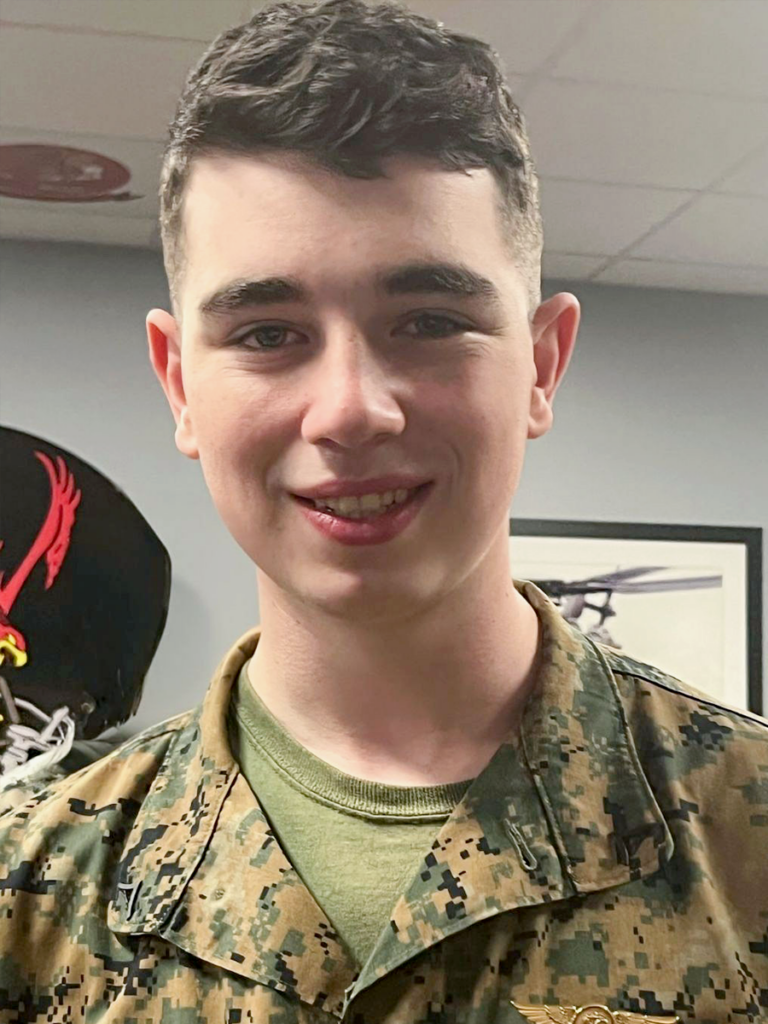
Lance Cpl. Donovan Davis, 21, of Olathe, Kansas, a CH-53E helicopter crew chief.
Sgt. Alec Langen, 23, of Chandler, Arizona, a CH-53E helicopter crew chief.
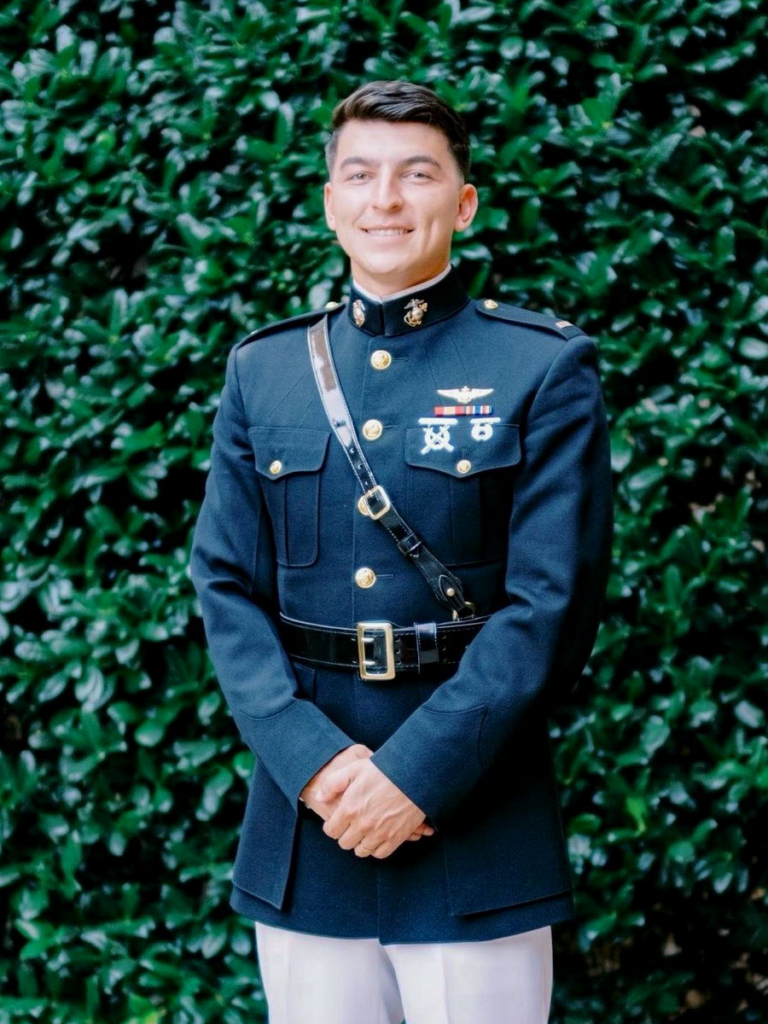
Capt. Benjamin Moulton, 27, of Emmett, Idaho, a CH-53E helicopter pilot.
Capt. Jack Casey, 26, of Dover, New Hampshire, a CH-53E helicopter pilot.
Capt. Miguel Nava, 28, of Traverse City, Michigan, a CH-53E helicopter pilot.
Additional information on the deceased:
Donovan Davis enlisted in the Marine Corps on September 3, 2019, and was promoted to the rank of Lance Corporal on January 1, 2024. His decorations include the Global War on Terrorism Service Medal, National Defense Service Medal, and a Sea Service Deployment Ribbon.
Alec Langen enlisted in the Marine Corps on September 14, 2017, and was promoted to the rank of Sergeant on October 1, 2022. His decorations include the Navy and Marine Corps Achievement Medal, Good Conduct Medal, Global War on Terrorism Service Medal, National Defense Service Medal, and two Sea Service Deployment Ribbons.
Benjamin Moulton commissioned in the Marine Corps on March 29, 2019, and was promoted to the rank of Captain on August 1, 2023. His decorations include the National Defense Service Medal.
Jack Casey commissioned in the Marine Corps on May 16, 2019, and was promoted to the rank of Captain on September 1, 2023. His decorations include the National Defense Service Medal.
Miguel Nava commissioned in the Marine Corps on May 26, 2017, and was promoted to the rank of Captain on November 1, 2021. His decorations include the Global War on Terrorism Service Medal, National Defense Service Medal and Sea Service Deployment Ribbon.
“We have been confronted with a tragedy that is every service family’s worst fear,” said Lt. Col. Nicholas J. Harvey, commanding officer of HMH-361. “Our top priority now is supporting the families of our fallen heroes, and we ask for your respect and understanding as they grieve. The Flying Tigers family stands strong and includes the friends and community who have supported our squadron during this challenging time. We will get through this together.”
At the time of the mishap, the CH-53E and crew were conducting routine flight training. The mishap is currently under investigation.
Out of respect for the friends and family of the deceased and the Marines and Sailors of HMH-361, please direct all questions to the 3rd MAW Communication Strategy and Operations office at [email protected].
USS McCampbell to Forward Deploy to Japan, Replace USS Antietam
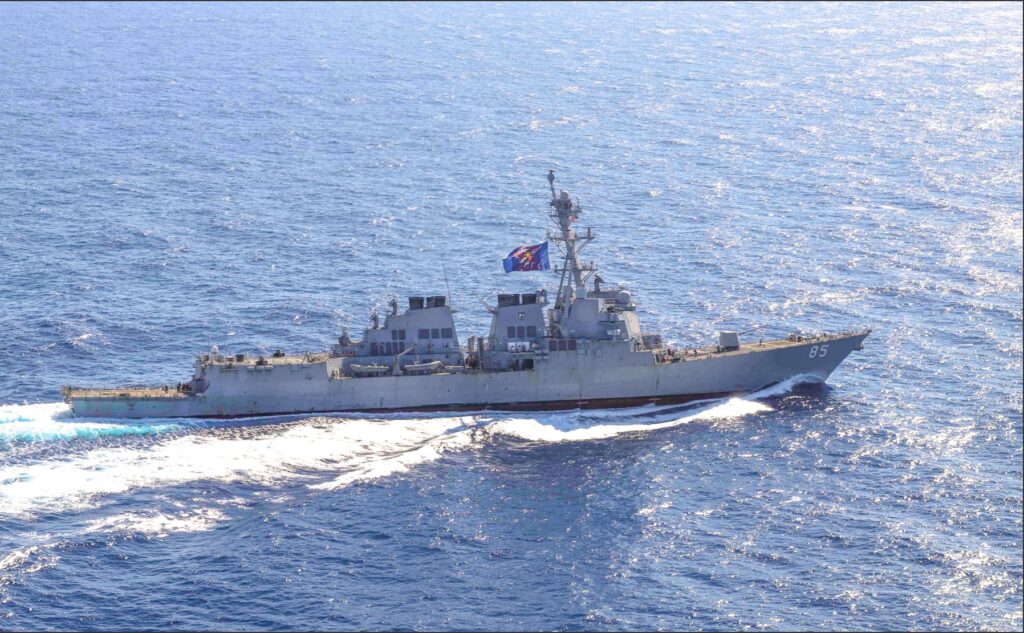
The Arleigh Burke-class guided-missile destroyer USS McCampbell (DDG 85) transits through the South China Sea. McCampbell is underway conducting operations in the Indo-Pacific region while assigned to Destroyer Squadron (DESRON) 15, the Navy’s largest forward-deployed DESRON and the U.S. 7th Fleet’s principal surface force. U.S. Navy | Naval Air Crewman 2nd Class Jack Ryan
The U.S. Navy announced that USS McCampbell (DDG 85) will forward deploy to Yokosuka, Japan. McCampbell will replace USS Antietam (CG 54), which will depart Yokosuka, Japan, and move to Pearl Harbor, Hawaii, as part of a scheduled rotation of forces in the Pacific. Upon arrival in Yokosuka, McCampbell will join Commander, Task Force 71/Destroyer Squadron (DESRON) 15, the Navy’s largest DESRON and the U.S. 7th Fleet’s principal surface force.
The forward presence of McCampbell enhances the national security of the United States and improves its ability to protect strategic interests. It will directly support the Defense Strategic Guidance to posture the most capable units forward in the Indo-Pacific Region.
The United States values Japan’s contributions to the peace, security and stability of the Indo-Pacific and its long-term commitment and hospitality in hosting U.S. forces forward deployed there. These forces, along with their counterparts in the Japan Self-Defense Forces, make up the core capabilities needed by the alliance to meet our common strategic objectives.
The security environment in the Indo-Pacific requires that the U.S. Navy station the most capable ships forward. This postureenables rapid response times for maritime and joint forces, and brings our most capable ships with the greatest amount of striking power and operational capability to bear.
Maintaining a forward-deployed naval forces capability with the most advanced ships supports the United States’ commitment to the defense of Japan and the security and stability of the vital Indo-Pacific region.
SAIC Awarded $80 Million U.S. Navy Contract for Heavyweight Torpedo Tests Sets
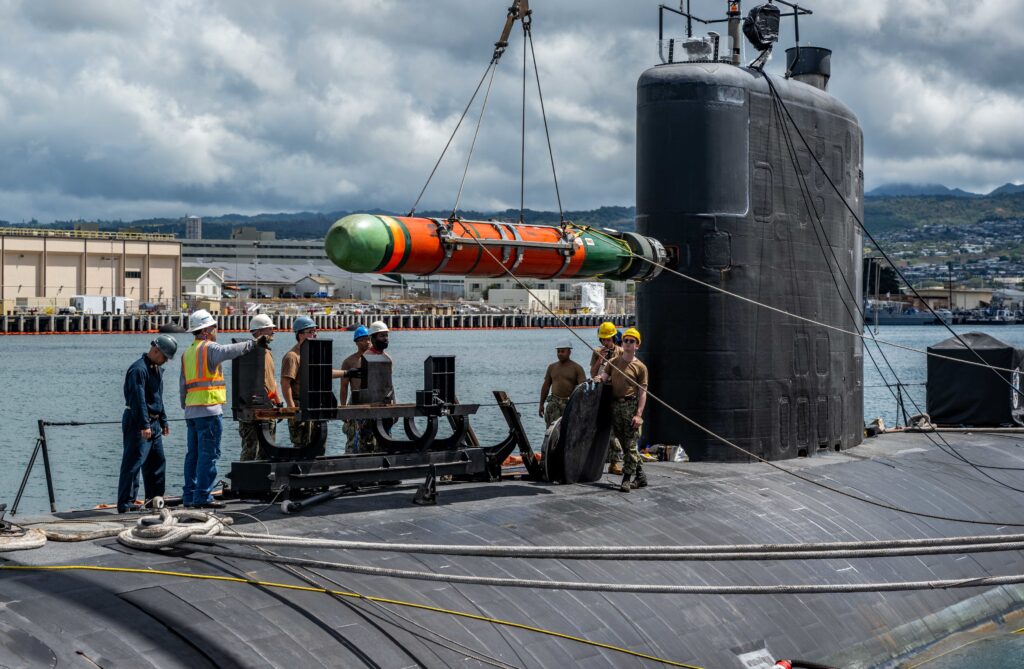
RESTON, Va.–(BUSINESS WIRE)– Science Applications International Corp. has been awarded a $80.5 million task order by the U.S. Navy for the completion of the MK710 TSTS design and then to produce and deliver MK 710 Torpedo System Test Sets (TSTS) to enhance the Navy’s capability to provide the Submarine force with high quality, tested and validated MK 48 heavyweight torpedoes.
“SAIC looks forward to expanding our support to the Navy’s heavyweight torpedo program,” said Barbara Supplee, executive vice president, Navy Business Group at SAIC. “This award further demonstrates the trust and confidence the Navy has placed on SAIC and our exceptional workforce’s heavyweight torpedo expertise.”
Under the five-year contract, SAIC will provide MK 710 TSTS which will be used to test and validate the integrity and operational status of warshot MK 48 heavyweight torpedoes prior to delivery to the Navy. The testing and validation of exercise torpedoes supports the training, tactics development and certification of torpedo upgrades for Navy.
SAIC is a leader in supporting the Navy’s heavyweight torpedo program providing MK 48 heavyweight torpedo Afterbody Tailcone and fuel tanks for warshot and exercise torpedoes for Naval Sea Systems Command (NAVSEA). In support of the Naval Undersea Warfare Center (NUWC) Division Newport, SAIC also handles testing and data collection for MK 48 heavyweight torpedoes, and MK 54 lightweight torpedoes.
To learn more about SAIC’s support of Navy torpedo testing and delivery, visit SAIC.com.
Lockheed Martin Delivers 75th APY-9 Radar for E-2D Advanced Hawkeye
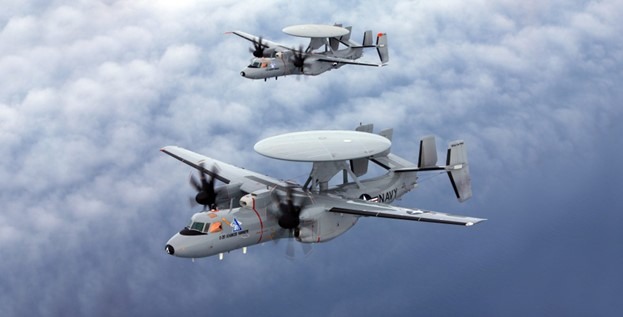
SYRACUSE, New York ꟷ Lockheed Martin, under contract to Northrop Grumman for the U.S. Navy’s E-2D Advanced Hawkeye, has delivered the 75th APY-9 radar that provides the U.S. Navy with information dominance through revolutionary sensor capability. More Hawkeyes have been built and delivered than any other AEW platform in the world.
“As the primary sensor for the E-2D, the APY-9 radar has a long legacy of providing agile deterrence for enhanced 21st century security,” stated Chandra Marshall, vice president of Lockheed Martin’s Radar & Sensor Systems business. “Our primary focus is to bring our military men and women home safely, and the APY-9 sets that bar for all other AEW radars.”
The newest Advanced Hawkeye variant is at the forefront of technological capability, due in large part to Lockheed Martin’s APY-9 radar. The Northrop Grumman-built E-2 has come to be known as the U.S. Navy’s “eyes of the fleet” because of its ability to simultaneously watch over air, land and sea. Any time a Navy carrier has aircraft airborne, there is an APY-9 radar at work, guarding the United States and its allies.
On Time and On Task
The U.S. Navy has funded 80 out of 86 aircraft in the current program of record. Japan has purchased 18 E-2D Hawkeyes and France has purchased three. With U.S. and international demand, the APY-9 is expected to be in production into the late 2020s, and in modernization and sustainment well into the 2040s.
Lockheed Martin has been a collaborator on the Northrop Grumman-built E-2D for over two decades. The E-2D Advanced Hawkeye platform delivers critical, actionable data to enable decision dominance for joint forces and first responders. These advances provide militaries with the necessary situational awareness to shorten the time between initial awareness and active engagement.
Sikorsky Completes Flight Tests of Three Hellenic Navy MH-60R Helicopters
OWEGO, N.Y.,Feb. 7, 2024 – Sikorsky, a Lockheed Martin company, has completed testing of the integrated mission systems and sensors aboard three MH-60R Seahawk helicopters purchased by the Hellenic Navy.
Completed in early December 2023, the tests verify each MH-60R aircraft is an efficient and effective air weapon system capable of performing anti-submarine and anti-surface warfare missions from land or naval ship.
“Commonality of these Hellenic Navy MH-60R Seahawk aircraft with 330 MH-60R and 250 MH-60S Seahawk aircraft, and with the global Black Hawk helicopter fleet, enables Sikorsky and the U.S. Navy to continue sustaining and upgrading this proven weapon system for maximum threat deterrence and operational capability,” said Sikorsky President Paul Lemmo.
Greece is the seventh country to receive the U.S. Navy’s MH-60R maritime helicopter. In Europe, Denmark operates nine MH-60R aircraft. Spain and Norway placed orders in 2023 for a combined 14 MH-60R aircraft.
Arrival in Greece The first three MH-60R aircraft will arrive in Greece during 2024 aboard U.S. Navy transport planes. Four additional aircraft will arrive in 2025 to complete the Hellenic Navy’s seven-aircraft purchase.
Hellenic Navy MH-60R aircraft will join 11 existing S-70B Seahawk aircraft at the Kotroni Naval Air Station. Known as Aegean Hawks, the older maritime helicopters were acquired direct from Sikorsky between 1994 and 2005.
NAVAL STATION NORFOLK, Virginia ꟷ The Arleigh-Burke class guided-missile destroyer USS McFaul (DDG 74) returned to Norfolk, Virginia, Jan. 4 after an eight-month deployment to the Atlantic Ocean and U.S. 5th Fleet areas of operations.
McFaul served as an independently deployed ship in the U.S. 5th Fleet area of operations and an air defense unit in the Gerald R. Ford Carrier Strike Group (GRFCSG) off the coast of Israel. McFaul completed 34 Strait of Hormuz transits to ensure freedom of navigation for commercial traffic in a highly transited and politically sensitive area of the world. McFaul also conducted 17 close escorts for maritime allies and assets, in support of U.S. maritime security objectives in the Middle East and Europe.
“USS McFaul is a family,” said Quartermaster 2nd Class Jose Vispo, a member of the ship’s crew. “Through the adversity and struggles, we still made it through with our chins held high. I believe that we were able to get through this very long deployment with such success because every member of the crew is treated like a brother or a sister. That family mentality turns any challenge, no matter how difficult, into a simple task. I think McFaul answered the call just as our namesake suggests: with courage, honor and sacrifice.”
In 250 days, the crew of McFaul conducted 26 replenishments at sea, sailed over 50,000 nautical miles and safely transferred over 5,500,000 gallons of fuel. McFaul transited the Atlantic Ocean and began patrols the Gulf of Oman and Southern Arabian Gulf after transiting through the Suez Canal.
“McFaul and Team 74 return to our families and loved ones today from a record-setting eight-month deployment to Fifth and Sixth Fleet Areas of Responsibility,” said Commander Antonia Shey, the commanding officer of McFaul. “During our 192 days in 5th Fleet, McFaul prevented the Iranian seizure of two motor tankers, completed an unprecedented 34 Strait of Hormuz transits, conducted rescue and assistance of distressed mariners, and escorted numerous merchant vessels to ensure free flow of commerce. Additionally, McFaul participated in joint and bi-lateral exercises strengthening partnerships and building relationships with five nations and the U.S. Air Force. The grit, determination, and hard work from every member of Team 74 contributed to McFaul’s successful deployment and I could not be prouder of Team 74.”
McFaul crew conducted maritime security operations and engaged with allied and partner nations in the 5th Fleet area of operations. McFaul navigated throughout the region providing assurance and deterring aggression, especially in the wake of the Oct. 7 terrorist attacks on Israel. While conducting patrols in the Gulf of Oman and Southern Arabian Gulf, McFaul conducted more than 130 hours of UAV operations. McFaul also hosted officers from the Kingdom of Saudi Arabia, participated in joint operations with the U.S. Air Force, operated at sea with a Qatari ship and joined bi-lateral exercises with the Omanis in order to strengthen ties in the region.
Strengthening partnerships during the deployment to the Naval Forces Central Command area of operations builds enduring relationships and emphasizes the shared commitment to promoting safety and stability within the region, while seeking opportunities to enhance interoperability as close allies.
The GRFCSG is on a scheduled deployment in the U.S. Naval Forces Europe-Africa area of operations, employed by U.S. 6th Fleet and U.S. 5th Fleet to defend U.S., allied, and partner interests.
The Gerald R. Ford Carrier Strike Group is comprised of its flagship and namesake, the Ford-class aircraft carrier USS Gerald R. Ford (CVN-78), Carrier Air Wing Eight (CVW-8), Destroyer Squadron Two (DESRON-2), the Ticonderoga-class guided-missile cruiser USS Normandy (CG-60), and the Arleigh Burke-class guided-missile destroyers USS Ramage (DDG 61), USS McFaul (DDG 74), and USS Thomas Hudner (DDG 116).
Coast Guard Cutter Resolute Returns Home, Offloads $55M Worth of Drugs in Tampa Bay
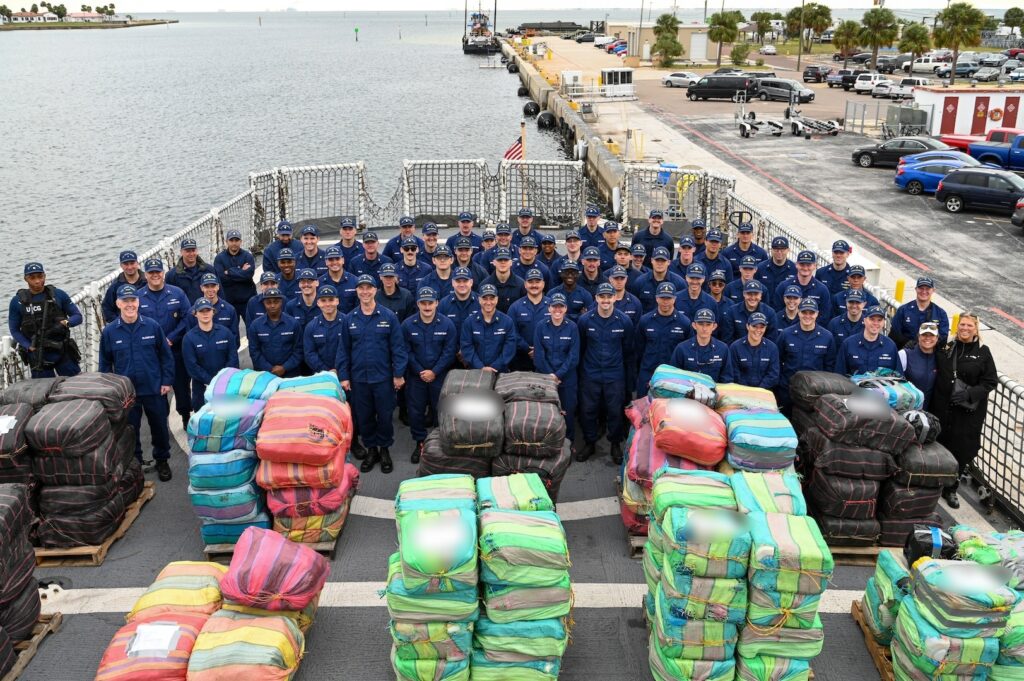
ST. PETERSBURG, Florida — Coast Guard Cutter Resolute (WMEC 620) and crew returned from a 60-day counterdrug patrol and offloaded approximately $55 million worth of illicit narcotics, Monday, in St. Petersburg.
Patrolling in support of Joint Interagency Task Force - South, the Resolute crew stopped two suspected drug trafficking ventures, preventing 6,565 pounds of marijuana and approximately 3,700 pounds of cocaine from entering the United States, and detained six suspected traffickers. The drugs were seized in the international waters of the Eastern Pacific Ocean.
Supporting the Resolute was an embarked MH-65 Dolphin helicopter and crew from the Coast Guard Helicopter Interdiction Tactical Squadron, and a law enforcement detachment from Tactical Law Enforcement Team - South.
During the patrol, Resolute’s crew met with Panama’s National Aeronaval Service to strengthen the partnership between the United States and Panama, and discuss strategies to combat illegal, unreported, and unregulated fishing.
“The pride and dedication of Resolute’s crew was evident throughout the entirety of our patrol,” said Cmdr. Matthew R. Kolodica, commanding officer of Resolute. “Despite being deployed throughout the holiday season, the crew served with professionalism. The result of their collected effort was an extremely successful patrol which kept $55 million dollars of drugs from reaching its intended destination. Every Resolute sailor and their loved ones should be proud; they are a living example of the Coast Guard’s motto, “Semper Paratus – Always Ready.” It is an honor to lead such a fine ship and crew.”
The fight against drug cartels in the Eastern Pacific Ocean and the Caribbean Sea requires a unity of effort in all phases, from detection and monitoring to interdiction and apprehension, through criminal prosecutions by international partners and U.S. Attorneys’ Offices in districts across the nation. Joint Interagency Task Force – South in Key West, Florida conducts the detection and monitoring of aerial and maritime transit of illegal drugs. The law enforcement phase of counter-smuggling operations in the Eastern Pacific Ocean is conducted under the authority of the Coast Guard 11th District, headquartered in Alameda, California, and the law enforcement phase of operations in the Caribbean is conducted under the authority of the Coast Guard 7th District, headquartered in Miami. The interdictions, including the actual boardings, are led and conducted by members of the U.S. Coast Guard.
These interdictions relate to Organized Crime Drug Enforcement Task Forces (OCDETF) designated investigations. OCDETF identifies, disrupts, and dismantles the highest-level criminal organizations that threaten the United States using a prosecutor-led, intelligence-driven, multi-agency approach. Additional information about the OCDETF program can be found at https://www.justice.gov/OCDETF.
Resolute is a 210-foot, Reliance-class medium endurance cutter homeported in St. Petersburg with a crew of 80. The cutter’s primary missions include law enforcement, search and rescue, protection of living marine resources, homeland security and defense operations, international training and humanitarian operations throughout the Western hemisphere.
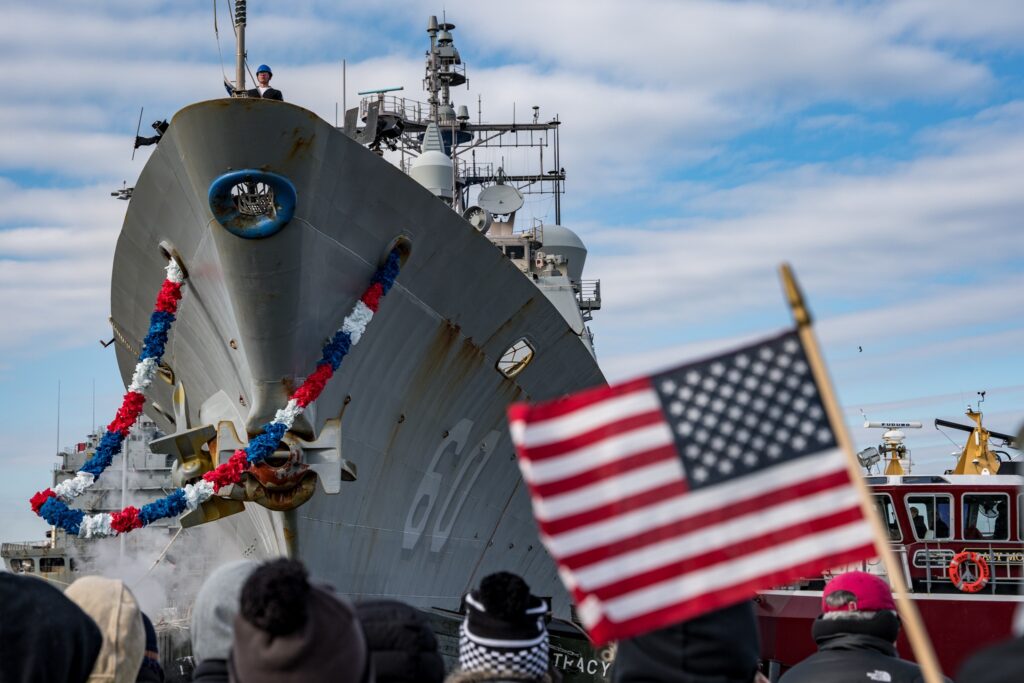
NAVAL STATION NORFOLK, Virginia ꟷ The Ticonderoga-class guided-missile cruiser USS Normandy (CG 60), part of the Gerald R. Ford Carrier Strike Group (GRFCSG), returned to homeport in Norfolk after an eight-month deployment to the U.S. Naval Forces Europe area of operations, Jan. 20.
Normandy steamed more 61,000 nautical miles while serving as the air defense commander for the strike group.
“From the North Sea to the Eastern Mediterranean, this deployment has enhanced and reinforced regional stability, as we worked with our allies and partners to uphold our mutual commitment to maritime security,” said Captain Errol A. Robinson, Normandy’s commanding officer. “Our Sailors expertly executed complex multi-ship maneuvers with our allies and tactically controlled aircraft and the airspace, while maintaining the material readiness of the ship. During my two tours aboard Normandy, as division officer and 23 years later as her commanding officer, I can say that my Sailors’ tireless and exacting performance was in keeping with Normandy’s 34 years of superb service.”
Over the course of 262 days, Normandy’s crew conducted over 40 replenishments-at-sea, and manned flight quarters 670 times. Normandy’s embarked air detachment, the “Spartans” of Helicopter Maritime Strike Squadron (HSM) 70, flew 393 sorties, totaling 1,132 hours flown.
Normandy’s culinary team prepared and served over 388,500 meals, which included over 68,619 pounds of fresh fruits and vegetables, 4,382 pounds of steak, 10,520 hot dogs, 3,207 pounds of bacon, 89,000 individual eggs and 800 pounds of coffee.
Throughout deployment, Normandy’s crew embraced numerous opportunities to strengthen partnerships with allied navies, hosting crew exchanges with the U.K. royal navy Duke-class frigate HMS Kent (F 78), the Italian navy Carlo Bergamini-class frigate ITS Carabiniere (F 593), the Turkish navy Gabya-class frigate TCG Gökçeada (F 494), and the first-in-class Hellenic navy frigate HS Elli (F 450). In addition to these crew exchanges, the 2023 deployment saw Normandy steam with frigates of the Croatian, Dutch, French, Norwegian, Polish, Spanish, and Swedish navies, demonstrating a shared commitment to promoting safety and stability in Europe.
Port visits in the U.S. 6th Fleet area of operations made Normandy’s Sailors de facto ambassadors, as the ship moored in Gothenburg, Sweden; Koper, Slovenia; Rijeka, Croatia; Aksaz, Türkiye; Bar, Montenegro; and Athens, Greece. Office calls to local navy leadership, and community relations events in nearly every country Normandy visited, bolstered valuable partnerships. In Bar, Montenegro, Normandy hosted Nicole Otallah, the charges d’affaires of the U.S. embassy in Montenegro, at a reception for Montenegrin civil and military leaders held on the ship’s flight deck.
Following the Oct. 7 Hamas attacks on Israel from the Gaza Strip, Normandy and the strike group were ordered to the Eastern Mediterranean by the secretary of defense to provide a constant and stabilizing presence that would prevent regional escalation of the conflict.
“For almost 70% of Normandy’s crew, this was their first deployment,” said Command Master Chief William Palmer. “That did not deter them from seizing opportunities to excel and gain further expertise in their fields. Normandy’s Sailors are returning home more accomplished and more resilient, and their families should be proud of the work they have done.”
The GRFCSG is comprised of its flagship and namesake, the Ford-class aircraft carrier USS Gerald R. Ford (CVN 78), Carrier Air Wing Eight (CVW-8), Destroyer Squadron Two (DESRON-2), the Ticonderoga-class guided-missile cruiser USS Normandy (CG-60), and the Arleigh Burke-class guided-missile destroyers USS Ramage (DDG 61), USS McFaul (DDG 74), and USS Thomas Hudner (DDG 116).
The squadrons of CVW-8 embarked aboard Gerald R. Ford are the “Tridents” of Helicopter Sea Combat Squadron (HSC) 9, the “Spartans” of Helicopter Maritime Strike Squadron (HSM) 70, the “Bear Aces” of Airborne Command and Control Squadron (VAW) 124, the “Ragin’ Bulls” of Strike Fighter Squadron (VFA) 37, the “Blacklions” of VFA-213, the “Golden Warriors” of VFA-87, the “Tomcatters” of VFA-31, the “Gray Wolves” of Electronic Attack Squadron (VAQ) 142, and the “Rawhides” of Fleet Logistics Support Squadron (VRC) 40.