USCGC Confidence Returns to Cape Canaveral After Patrol in the Windward Passage, Florida Straits
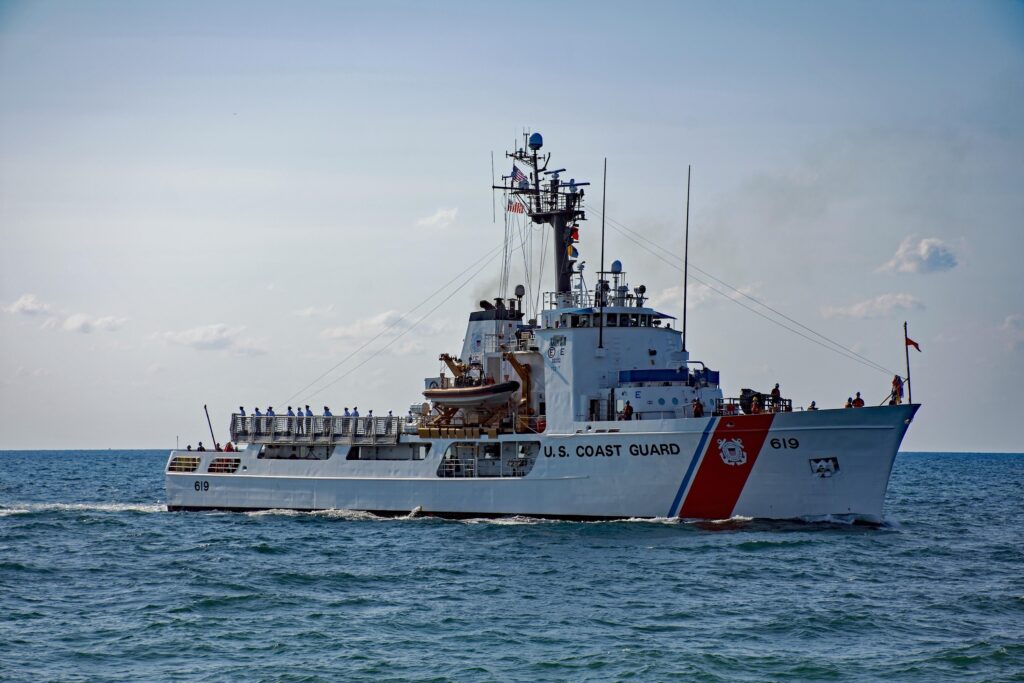
The Coast Guard Cutter Confidence is shown on a patrol in April 2018. The Confidence is a 210-foot medium endurance cutter homeported out of Cape Canaveral, Florida. U.S. Coast Guard
CAPE CANAVERAL, Florida — The crew of the U.S. Coast Guard Cutter Confidence (WMEC 619) returned to their homeport in Cape Canaveral on Jan. 26, following a 60-day deployment in the Windward Passage and Florida Straits.
Confidence worked to promote maritime safety and secure maritime borders, in support of Homeland Security Task Force – Southeast’s Operation Vigilant Sentry within the Coast Guard 7th District’s area of responsibility. During the patrol, Confidence’s crew interdicted and oversaw the humanitarian treatment and processing of 65 migrants from various countries of origin and assisted with one damaged vessel.
Confidence’s crew deterred two unsafe migrant ventures in the Windward Passage. Confidence escorted both vessels back to their countries of origin, ultimately ensuring safety of life at sea.
Confidence’s crew assisted a damaged American-flagged vessel low in fuel off the coast of Haiti. Confidence provided critical supplies to the vessel to ensure the safe voyage to its final destination.
“Confidence’s crew demonstrated exceptional commitment and skill throughout the patrol,” said Cmdr. Thomas Martin. “I am incredibly proud of the Confidence crew for exemplifying the cutter motto ‘Measure of Excellence’ in all facets of this patrol.”
Confidence is a 210-foot, Reliance-class medium endurance cutter. The cutter’s primary missions are counter drug operations, migrant interdiction, enforcement of federal fishery laws and search and rescue in support of U.S. Coast Guard operations throughout the Western Hemisphere.
HII Awarded Advanced Planning Contract for USS Harry S. Truman RCOH
USS Harry S. Truman. HII
NEWPORT NEWS, Virginia ꟷ HII announced its Newport News Shipbuilding division was awarded an advanced planning contract for the refueling and complex overhaul (RCOH) of the nuclear-powered aircraft carrier USS Harry S. Truman (CVN 75).
The contract, which has the total potential value of $913 million, includes engineering, design, material procurement and fabrication, documentation, resource forecasting and pre-overhaul inspections.
“Comprehensive planning is vitally important to the overall success of an engineering and construction project of this magnitude on the aircraft carriers that serve our nation,” said Rob Check, NNS vice president of in-service aircraft carrier programs. “This contract allows us to properly plan for each step in the overhaul process, from preparing for the ship’s arrival at NNS to its redelivery back to the Navy, so that Harry S. Trumanand its Sailors can continue to protect peace and prosperity around the world.”
Christened in 1996 and delivered to the Navy in 1998, USS Harry S. Truman will be the eighth Nimitz-class carrier to undergo RCOH, representing 35% of all maintenance and modernization completed during its 50-year service life.
Coast Guard Holds Groundbreaking Ceremony for New Base Charleston Campus
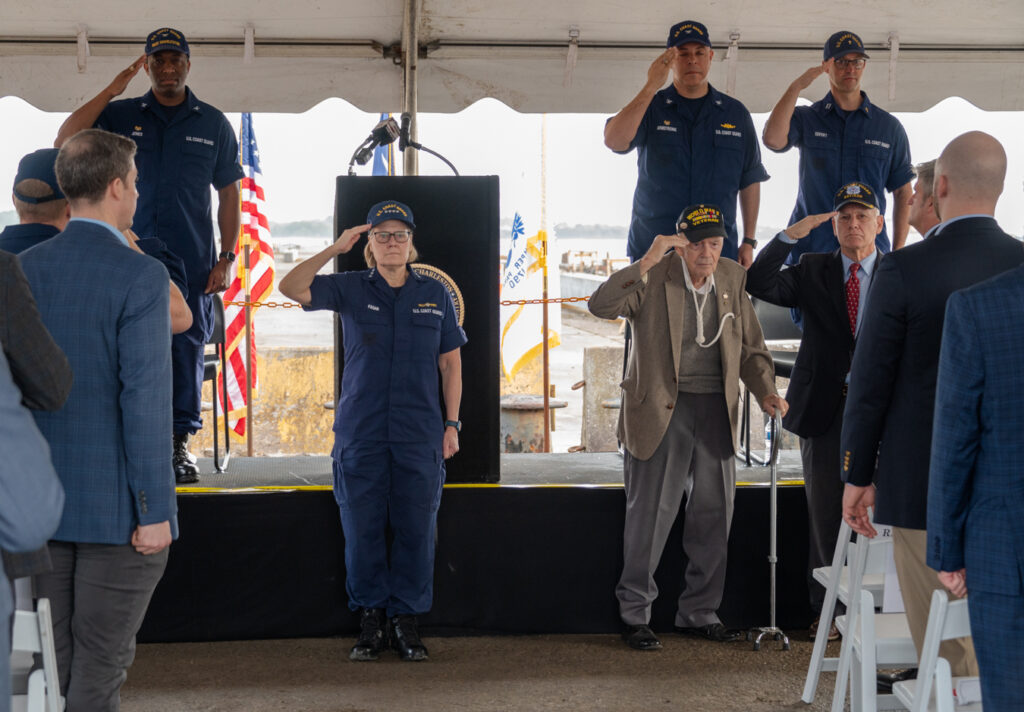
Adm. Linda L. Fagan, Commandant of the Coast Guard, and retired Senior Chief Petty Officer Thomas Gelwicks salute during the groundbreaking ceremony in North Charleston, South Carolina, Jan. 26. U.S. Coast Guard | Petty Officer 3rd Class Vincent Moreno
CHARLESTON, South Carolina — Coast Guard Base Charleston held a groundbreaking ceremony on Jan. 26 for a new 64-acre campus in North Charleston. Adm. Linda Fagan, Commandant of the Coast Guard, presided over the ceremony.
The 64-acre campus along the Cooper River will support the five Charleston-based national security cutters, their crews and the support personnel with completion expected in late 2026.
Marking a new trajectory for the Coast Guard in Charleston, Base Charleston is slated to become the service’s largest homeport and a base for global operations, training and support.
Since its commissioning in 2015, Base Charleston has delivered customer-focused premiere support to all Coast Guard members, assets, and mission partners from Northern Florida to South Carolina. Moreover, the base generates Coast Guard global operational readiness.
Growth estimates show that the Coast Guard workforce may double in the Charleston area by 2030 and continued prioritization and investment in the future of Base Charleston is needed to make this vision a reality.
As one of the original 10 homeports for the Revenue Cutter Service, the greater Charleston area has proudly supported members of the Coast Guard and its predecessor agencies for more than 230 years.
The Coast Guard footprint in Charleston includes eight major commands; Coast Guard Base Charleston, Coast Guard Sector Charleston, and the Maritime Law Enforcement Academy, as well as numerous tenant commands and personnel in supporting roles throughout the region.
Houthi Actions Threaten Economic Security of US, allies, Del Toro Says
Secretary of the Navy Carlos Del Toro speaks with Marines, Sailors and civilians from U.S. Army Garrison Stuttgart during a visit to U.S. Army Garrison Panzer Kaserne, Stuttgart, Germany, Jan. 22. U.S. Marine Corps | Cpl. Jacob Richardson
LONDON ꟷ Secretary of the Navy Carlos Del Toro defended recent U.S. and allied military actions against Houthi militants in the Red Sea, saying Houthi strikes against commercial shipping threaten freedom of navigation and the economic security of the United States and its allies.
“Iran ꟷ through its Houthi proxies ꟷ aims to impose real economic costs on the rest of the world by increasing shipping costs and maritime insurance rates, as well as the time it takes goods to reach their intended ports,” Del Toro said in a speech at the Royal United Services Institute here, the world’s oldest defense and security think tank.
“Make no mistake, these costs aren’t borne by Iran. Rather, they are a burden on the everyday American, Briton, and European, and are paid for at the gas pump, at the grocery store, at the pharmacy, not to mention the delays in the shipping of everyday household items.
“The Houthis’ actions in the Red Sea are sending reverberations across the global economy and are felt in almost every facet of our lives.”
He also noted they have come at a direct cost in U.S. Navy lives, as this week the service suspended the search for two missing Navy SEALs, Petty Officer First Class Christopher Chambers and Petty Officer Second Class Nathan Ingram, who were attempting to intercept Iranian lethal aid to the Houthis.
“We will honor these men and their ultimate sacrifice by continuing to counter Iran’s malign actions in our shared maritime commons as they attempt to spread their influence across the region, and across the world,” Del Toro said.
The Navy secretary spoke in London after first visiting allies in Germany and meeting with leaders from U.S. Africa Command and European Command. He said future security in the Atlantic hinges on the ability of the allies to address common challenges in the maritime domain.
“These challenges include adapting to the effects of climate change, deterring piracy, combatting narcotics and human trafficking, and countering illegal, unregulated and unreported fishing,” he said.
“We are committed to working with all of our Atlantic partners and allies ꟷ across Europe, Africa, as well as North, Central, and South America ꟷ to achieve lasting solutions that preserve our shared maritime economic resources. And as we look across the Atlantic, it is imperative that we also give due attention to the increased activity in the Arctic region.”
China’s “aggressive” foreign policy and illegal territorial claims are also threats, which will be challenged by the AUKUS security partnership between the U.S., the U.K. and Australia, which aims to equip Australia with new nuclear-powered submarines.
“As part of AUKUS, we will also begin deploying Virginia and Astute-Class submarines to Australia as a part of Submarine Rotational Force-West, based out of HMAS Stirling, providing a constant, forward presence of our undersea fleets,” Del Toro said.
Our presence at HMAS Stirling will be essential for developing vital skills necessary to establish, operate, and sustain the Royal Australian Navy’s future nuclear-powered submarine fleet.
Navy Launches Wi-Fi Pilot Program at Select Virginia Installations
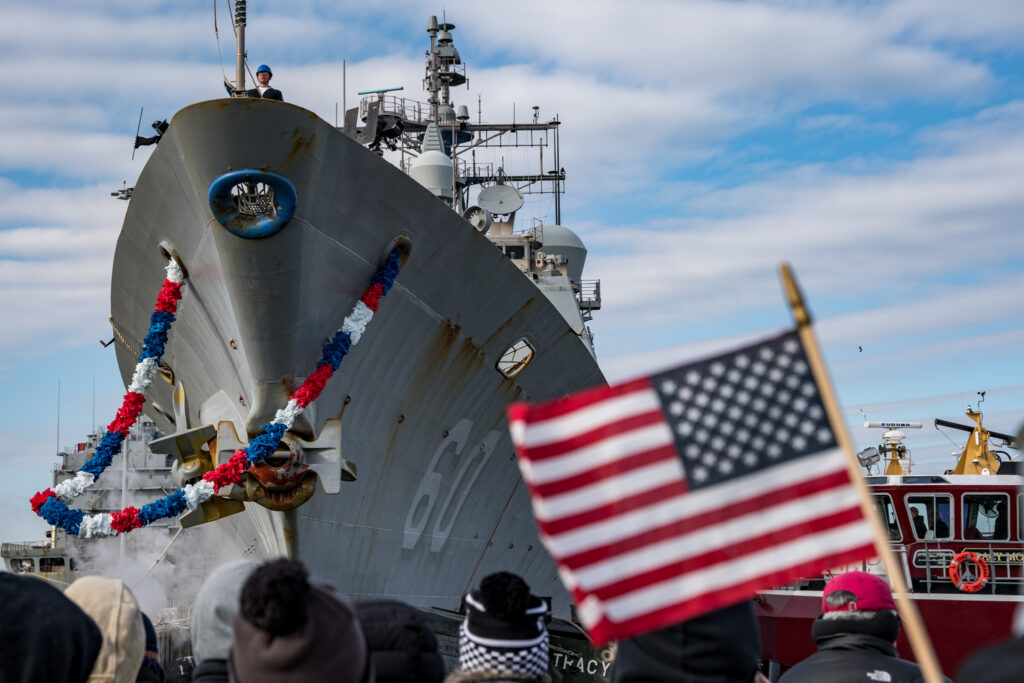
The Ticonderoga-class guided-missile cruiser USS Normandy (CG 60) returns to Naval Station Norfolk following an eight-month deployment, Jan. 20. Naval Station Norfolk is one of the locations for a new free Wi-Fi pilot program. U.S. Navy | Mass Communication Specialist 2nd Class Anderson W. Branch
WASHINGTON ꟷ Free Wi-Fi is expected to provide Sailors access to virtual entertainment as well as online training and higher education courses without having to pay out of their own pockets.
To determine if free Wi-Fi meets the needs and desires of Sailors residing in unaccompanied housing, the Navy is launching a pilot program at installations located in the Hampton Roads area of Virginia. Rollout will be completed by the end of February 2024.
“Conducting a pilot program will help us learn and ensure we deliver a service our Sailors will use and find value added. As we learn throughout the process, we will identify barriers and refine the Wi-Fi service before rolling it out to the wider Navy,” said Vice Adm. Scott Gray, Commander, Navy Installations Command (CNIC). “It is important we get it right to focus our precious resources to greatest effect.”
Sailors residing at 12 permanent party unaccompanied housing located onboard Naval Station Norfolk, Naval Medical Center Portsmouth and Norfolk Naval Shipyard will be able to access high speed Wi-Fi in their rooms and in common areas at no cost. Sailors desiring higher speed internet service may elect to pay an additional surcharge for augmented services or opt out altogether.
“We are excited to launch the Wi-Fi pilot program, and we are hoping Sailors find it useful and valuable to both their entertainment and career development needs,” said Leslie Gould, director of CNIC’s Fleet and Family Readiness, which is spearheading the pilot. “In addition to having access to online games, shows, and movies, Sailors will be able to complete required training, such as their General Military Training (GMT), and even take online courses offered by universities or colleges.”
Content accessed via the free Wi-Fi and subsidized speed upgrades will be filtered to prevent access to sites containing illegal activity, pornography, or gambling. Prices are as follows:
60 Mbps/5 Mbps – weekly on demand $10; month-to-month $20 (limited to 5 devices)
100 Mbps/10 Mbps – weekly on demand $15; month-to-month $30 (limited to 5 devices)
In addition to the above speed and rate charges, Sailors have the option to access unfiltered internet content for the following rates:
10 Mbps download/3 Mbps upload – weekly on demand $19.95 (limited to 1 device)
30 Mbps/5 Mbps – weekly on demand $34.95 (limited to 1 device); month-to-month $49.95 (limited to 3 devices)
60 Mbps/5 Mbps – month-to-month $59.95 (limited to 5 devices)
100 Mbps/10 Mbps – month-to-month $79.95 (limited to 5 devices)
The pilot program will wrap up at the end of September at which time the Navy will assess the success of the pilot based largely on Sailor utilization and feedback.
The Wi-Fi pilot is part of a new and larger program called the Virtual Single Sailor Program, which directly supports the Quality of Service of Sailors. The Virtual Single Sailor Program, or VSSP for short, enhances the lifestyle of the modern Sailor by providing a new virtual entertainment environment while supporting their overall health through access to fitness and nutrition content and other virtual resources. The VSSP website (www.NavyMWRSingleSailor.com) will go live on January 30.
Data Link Solutions to Provide BAE Systems’ FireNet Tactical Systems for US Navy
FireNet enables Joint All Domain Command and Control operations and will be provided to the U.S. Navy. BAE Systems
WAYNE, N.J. — The U.S. Navy has awarded Data Link Solutions, a joint venture between BAE Systems and Rockwell Collins Inc., a contract to provide small form factor Link 16 radios, which will be fulfilled using BAE Systems’ FireNet Link 16 tactical systems.
FireNet is a scalable, secure, and open system architecture communications solution with a unified tactical network to enable Joint All Domain Command and Control operations.
“We have developed a first-of-its kind small form factor system that enables full Link 16 connectivity. FireNet is scalable and modular to give our service men and women a battlefield advantage in network-centric environments across domains,” said Amber Dolan, director of Adaptive Communications and Sensing at BAE Systems. “Using the government’s program of record waveform, we can reduce lifecycle costs, quickly deliver updated capabilities, and enhance mission survivability across manned and unmanned fleets.”
The FireNet system is Crypto Modernization 1 compliant and offers the highest transmit power available in a SFF radio for current and future fleets. The system addresses size, weight, power, and cost demands and its applications can extend across rotary-wing aircraft, unmanned vehicles, maritime vessels and space platforms. It enables additional line-of-sight voice, data and network communications from very high frequency to S-Band.
Work on the FireNet system will take place at BAE Systems’ Wayne, New Jersey; Austin, Texas; Fort Wayne, Indiana; and Hudson, New Hampshire sites. Qualification and certification will begin in 2024.
Chesty XVI, Mascot of Marine Barracks Washington, Promoted to Lance Corporal
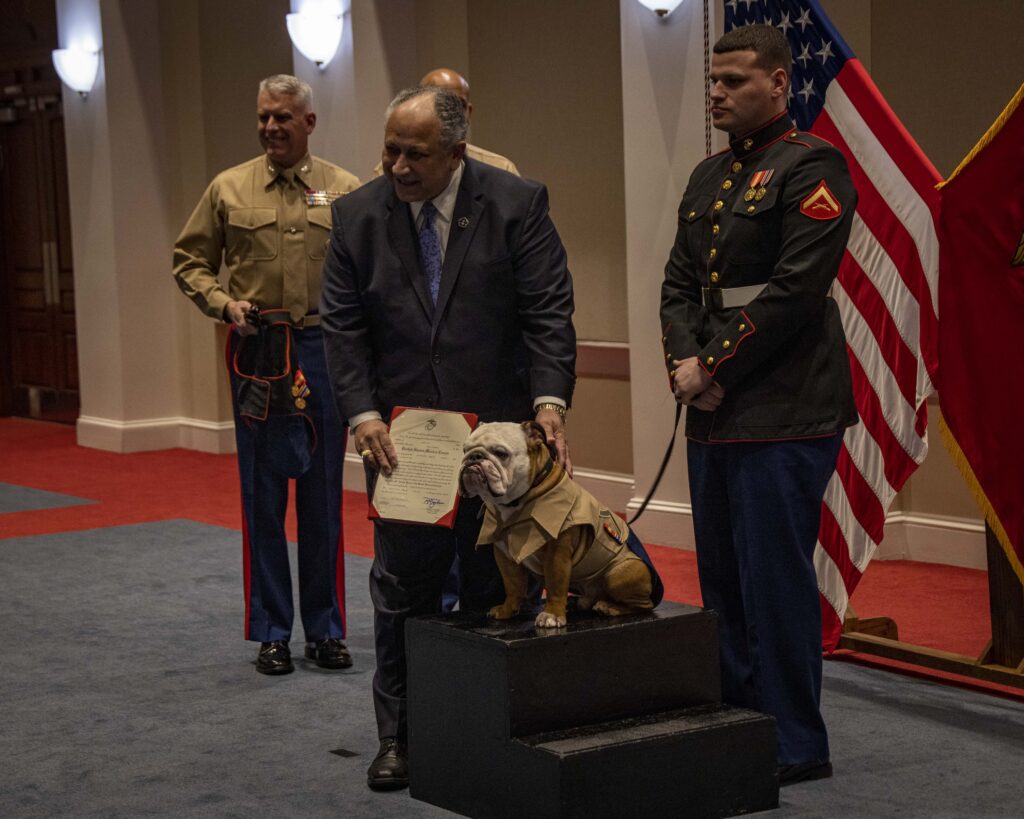
Chesty XVI, mascot of the Barracks, receives his promotion warrant during a ceremony at Marine Barracks Washington, Jan. 17. Chesty XVI was promoted to the rank of Lance Corporal by Carlos Del Toro, secretary of the Navy. U.S. Marine Corps | Lance Cpl. Chloe N. McAfee
In a momentous ceremony at Marine Barracks Washington last week, presided over by Secretary of the Navy Carlos Del Toro, Chesty XVI, the official mascot of Marine Barracks Washington, was promoted to the rank of Lance Corporal.
“At a time when our nation is being challenged in many different ways, we need Marines like each and every one of you to represent everything that’s great about this country,” Del Toro said. “And Chesty XVI represents everything that’s great about the Marine Corps.”
After the Battle of Belleau Wood, U.S. Marines adopted the moniker “devil dogs,” a term believed to have originated from the defeated Germans who, in awe of their tenacious adversaries, allegedly referred to them as “teufelhunden,” meaning hell hounds. Following World War I, the nickname gained prominence and began to feature prominently on Marine Corps recruitment posters, often accompanied by an iconic depiction of a scowling, helmet-clad English bulldog, symbolizing the indomitable spirit of the Marine Corps. While the nickname played a significant role in shaping the Marine Corps identity in the 20th century, it’s worth noting that there isn’t evidence to confirm its origin as a reference to the Marines by German troops.
Chesty XVI’s Pup Predecessors
During his tenure as the commanding officer of the Marine Barracks at Quantico, Virginia, Brig. Gen. Smedley D. Butler extended the nascent tradition by enlisting “Private Jiggs” into the Marine Corps on Oct. 14, 1922. Jiggs was born in Philadelphia on May 22, 1921, and boasted an impressive pedigree. The mascot experienced rapid promotions within the ranks, attaining the position of Sergeant Major on July 17, 1924.
Remaining true to custom, the Barracks welcomed Private First Class Chauncy into its ranks in 1956. Following Chauncy, Chesty I assumed the mantle, bearing the name in homage to the legendary Marine Lt. Gen. Lewis “Chesty” Puller, the most decorated Marine in the history of the Corps. Chesty I made his debut during the very first Evening Parade on July 5, 1957.
Over the years, numerous English bulldogs have faithfully served at the Barracks, with some receiving formal burial honors within the Barracks’ hallowed grounds. This enduring tradition underscores the profound connection between legend and the fighting spirit of every Marine, past and present.
Former U.S. Marine Keith Burns, who served as a Marine Barracks Washington mascot handler in 1998, had the opportunity to escort Chesty XI to the 80th anniversary of the Battle of Belleau Wood.
“As this battle was the birthplace of the mascot’s role, being there 80 years later with our mascot was humbling and awe-inspiring,” said Burns. “Being part of an ongoing tribute to our history and moniker of ‘devil dog’ made me feel even more connected to the Corps and served as a reminder of how our past continues to shape our present, and future.”
Chesty XVI enlisted in the Marine Corps February 2022. He relieved Chesty XV of his duties on May 6, 2022, and marched in his debut parade that evening.
Chesty XVI’s promotion to Lance Corporal not only embodies the Marine Corps’ legacy but also highlights the mission of Marine Barracks Washington to represent the Marine Corps to the nation. The “Oldest Post of the Corps” continues to stand as a keeper of tradition and beacon of the Marine Corps’ values, inspiring patriotism and showcasing the unwavering commitment of Marines who have served, are
Coast Guard Rescues 9 from Ice Floe on Lake Erie
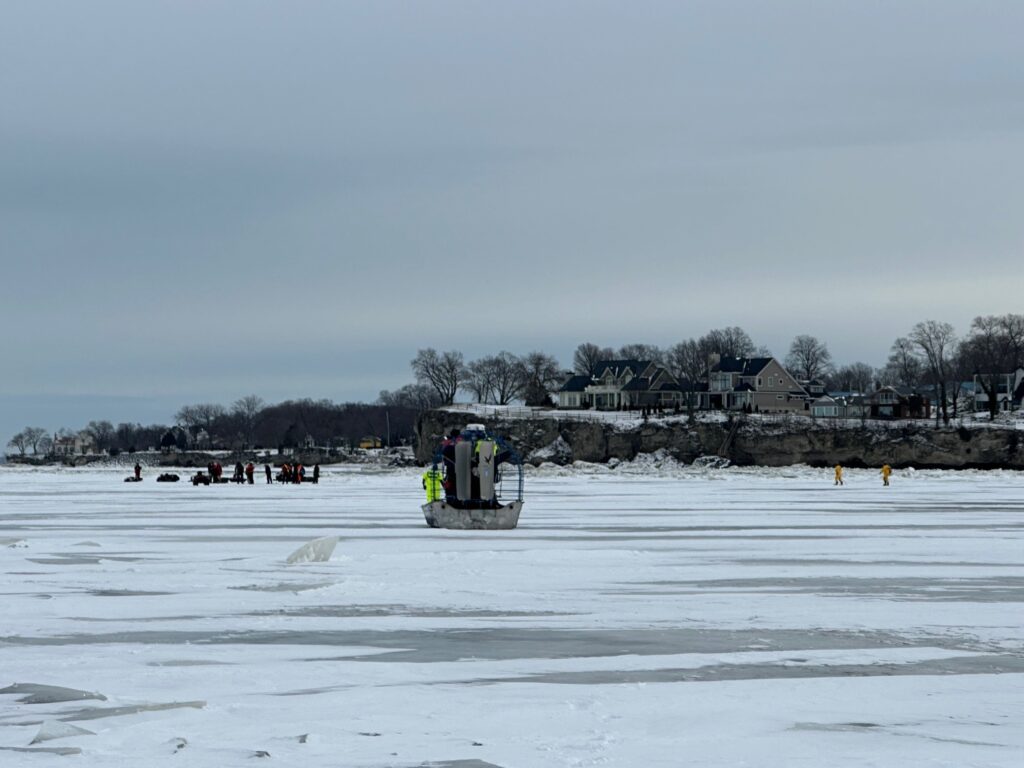
The Coast Guard rescued nine people from an ice floe on Lake Erie, near Catawba Island, Monday. U.S. Coast Guard
CLEVELAND — The Coast Guard rescued nine people from an ice floe on Lake Erie, near Catawba Island, on Monday, the service announced Jan. 23.
At 10:21 a.m., Coast Guard and local authorities responded to an initial report of more than 20 people on an ice floe a half mile offshore near Catawba Island, Ohio.
Coast Guard crews from Station Marblehead and Air Station Detroit responded in conjunction with the Put-in-Bay Fire Department and Ottowa County Sheriff’s Office.
The Coast Guard rescued nine people and four more were rescued by the Put-in-Bay Fire Department. Seven people were able to self-rescue via their own airboat. A total of 20 people were rescued from the ice floe.
“We are committed to public safety and want to remind everyone the importance of exercising caution around ice formations,” said Lt. Adeeb Ahmad, Sector Detroit public affairs officer. “Ice floes are unpredictable and can quickly become hazardous, particularly in windy conditions or strong currents. Always check local ice conditions before venturing out and be prepared for any emergencies. Your safety is our top priority.”
SECNAV Del Toro Meets with Key Leaders During Travel Through Europe
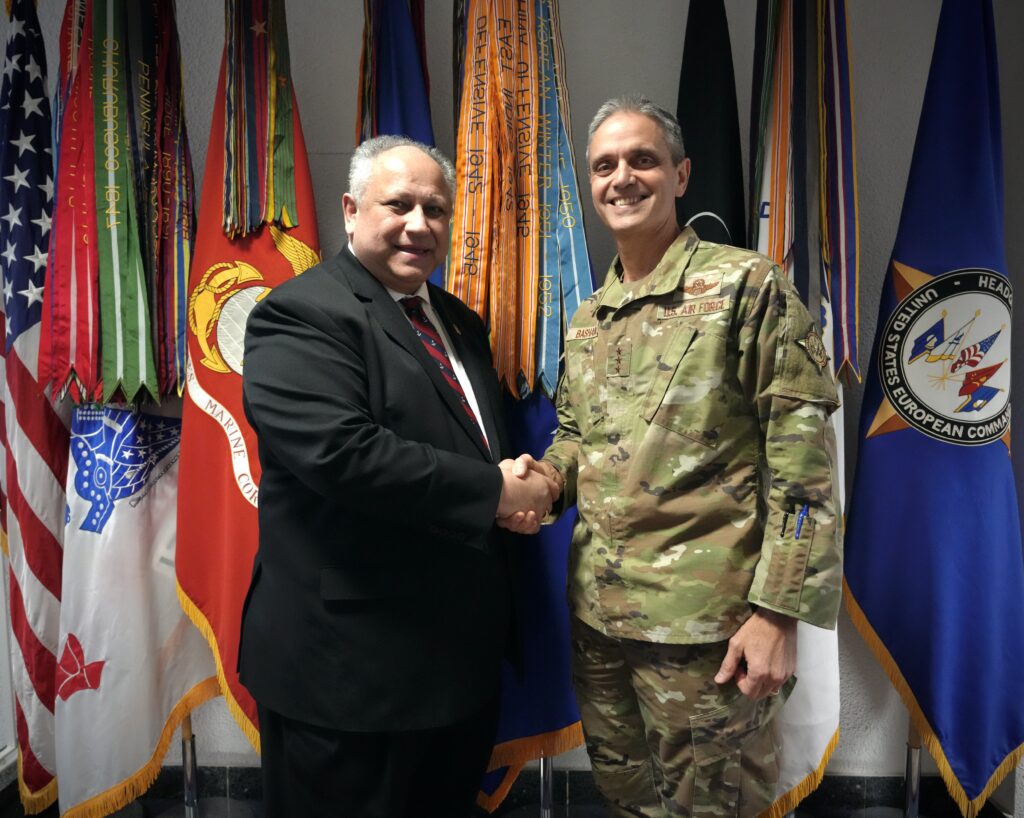
U.S. Air Force Lt. Gen. Steven Basham, U.S. European Command deputy commander, hosted U.S. Secretary of the Navy Carlos Del Toro during a visit to the command’s Stuttgart, Germany, headquarters Jan. 22. U.S. European Command | Staff Sgt. Aaron Daugherty
Secretary of the Navy Carlos Del Toro traveled to Stuttgart, Germany for key leader engagements, Jan. 21-22.
During his visit, Del Toro held an office call with U.S. Marine Corps Gen. Michael E. Langley, the sixth commander of U.S. Africa Command, met with senior Navy and Marine Corps officers and enlisted leaders, and participated in an AFRICOM roundtable. He discussed AFRICOM’s efforts to counter transnational threats and malign actors, strengthen security forces, and support partners in Africa using a 3D approach: diplomacy, development and defense.
Del Toro also met with U.S. Air Force Lt. Gen. Steven L. Basham, deputy commander, U.S. European Command, Patch Barracks. As the deputy commander for U.S. European Command, Basham is responsible for establishing and overseeing a warfighting headquarters that conducts a full range of multi-domain operations in coordination with allies and partners to support NATO, deter Russia, enable global operations and counter transnational threats to defend the U.S. homeland forward and fortify Euro-Atlantic security.
In addition, Del Toro met with the team at U.S. Marine Corps Forces, Europe and Africa (MARFOREUR/AF). Led by Maj. Gen. Robert B. Sofge Jr., MARFOREUR/AF works with sister U.S. services and NATO partners to facilitate European and African engagements in support of global campaigns, enhancing joint, and combined forces through NATO.
“There is nothing that we do on our Navy and Marine Corps team that is not done in concert with our allies and partners,” Del Toro said. “From the combatant commander all the way down to the most junior Sailor and Marine, our work abroad protects our way of life at home.”
While in Stuttgart, Del Toro held all-hands calls with Navy, Marine Corps, civilian personnel and their families to hear firsthand about their concerns and answer their questions. He also met with various servicemembers at each command to recognize their accomplishments.
“I’ve said it before, and it bears repeating. I am grateful for all you do for our Nation,” Del Toro said. “We’re facing challenging times, and I thank you for everything you do as we face significant threats to democracy around the world.”
Del Toro will travel to Berlin for additional engagements in the region before heading to the United Kingdom to deliver a speech at the Royal United Services Institute, the world’s oldest and the U.K.’s leading defense and security think tank.
US, Republic of Korea, Japan Navies Conduct Trilateral Exercise
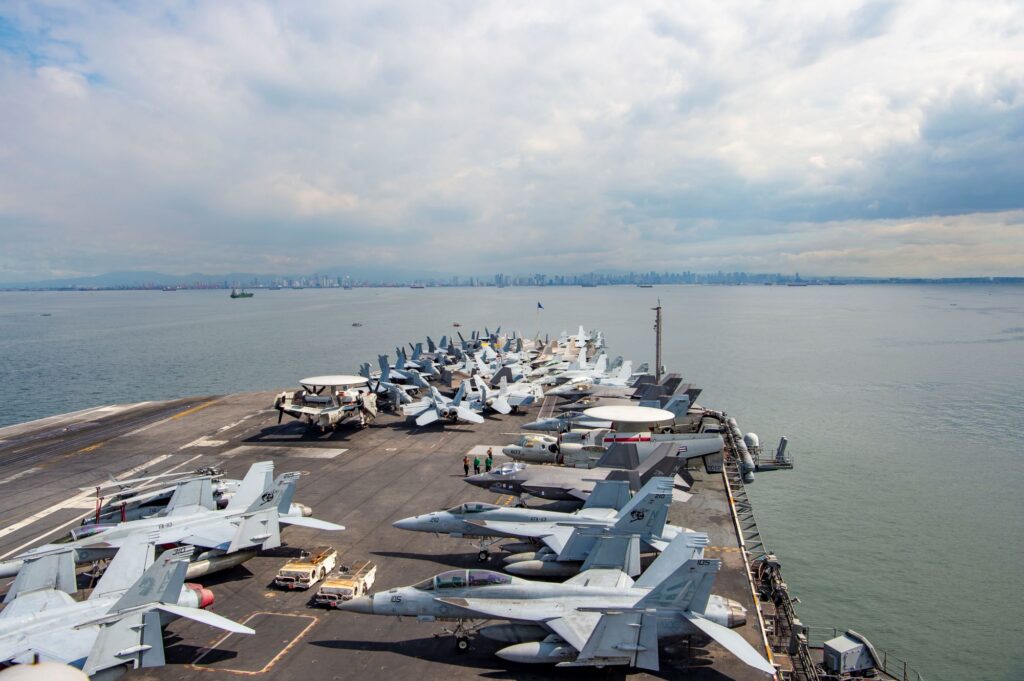
USS Carl Vinson (CVN 70), shown here anchored in Manila, Philippines in early January. The carrier later took part in a trilateral exercise with navies from Korea and Japan. U.S. Navy | Mass Communication Specialist 3rd Class Micheal Mensah
BUSAN, Republic of Korea — The U.S. Navy, the Republic of Korea navies and Japan Maritime Self-Defense Force executed a trilateral-naval exercise Jan. 15 to Jan. 17 south of Jeju Island, in international waters near the Korean Peninsula and Japan.
Commander, Naval Forces Korea participated with Carrier Strike Group (CSG) 1 aboard USS Carl Vinson (CVN 70) in the multi-day trilateral exercise that focused on integration, interoperability and readiness across multiple complex warfare areas.
“This exercise sharpens our combined skills and deepens our relationship with our partner nations,” said Rear Adm. Neil Koprowski, commander, CNFK. “Our close-knit teamwork with ROK and JMSDF is critical to the success of conducting combined maritime operations and training at sea.”
The collaborative exercise reflects shared values, through a trilateral commitment to deter aggression, and to maintain peace and stability on the Korean Peninsula.
The USS Carl Vinson, the flagship of CSG 1, kicked off the exercise Monday. The USS Carl Vinson previously conducted a trilateral maritime exercise with JMSDF and ROK on November 26, 2023.
These exercises support a free and open Indo-Pacific.
CNFK is the U.S. Navy’s representative in the Republic of Korea, it fosters enduring relationships with joint, combined, and multinational partners and strengthens combined maritime warfighting capability, interoperability, and readiness.