Delay to CVN 82 Buy Could Endanger Industrial Base, New Industry Report Says
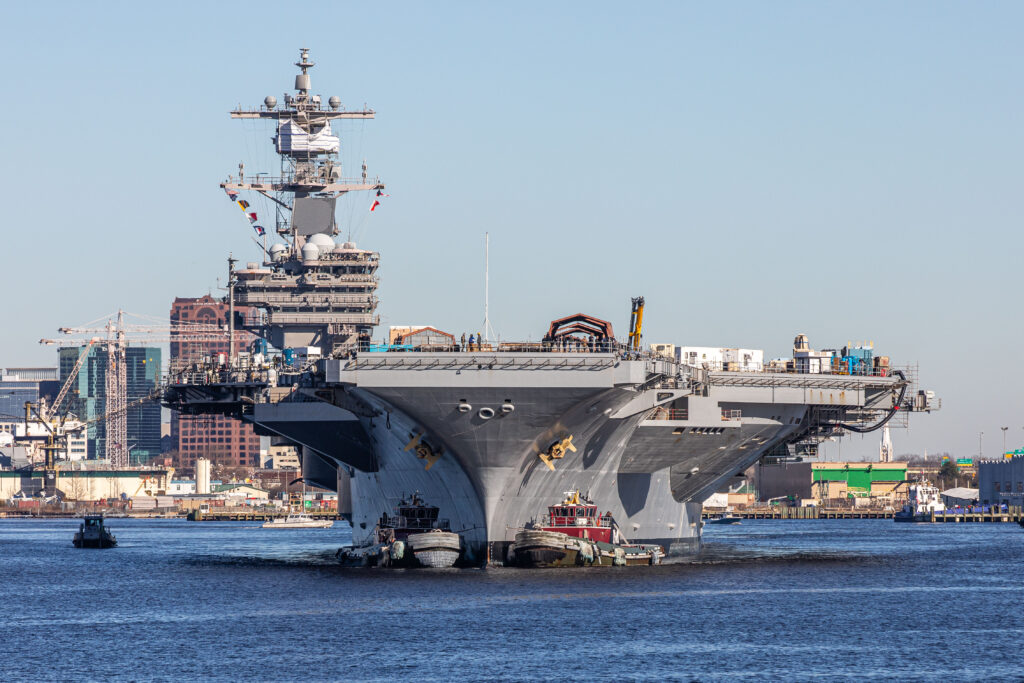
Norfolk Naval Shipyard welcomed USS George H.W. Bush (CVN 77) for a Planned Incremental Availability Jan. 11. The Navy should continue with two-ship buys for future carriers at regular intervals, a new industry report says. Norfolk Naval Shipyard | Shelby West

Delaying the next two-aircraft carrier buy beyond fiscal year 2028 would lead to sizable delays, growing cost and would have a serious impact on the shipbuilding industry and its supply base, according to a new report from the Aircraft Carrier Industrial Base Coalition (ACIBC).

“There are significant challenges that most of the companies in the supply base face,” ACIBC Chair Lisa Papini told Seapower, including “inflation, supply chain disruption and workforce issues.”

As was expressed last week by shipbuilder HII, the industry favors a “2-3-4” approach, with a two-carrier buy, three years of advance materials procurement and four years between carrier construction.

“Companies in the supply chain are planning work based on the stability of that schedule. When we maintain that schedule, that is when we are optimized and when we will perform at our best,” she said.

The ACIBC report notes that even a two-carrier buy in fiscal 28 means six years between the construction of CVN 81 and 82, and “nearly 50% of AP [advanced procurement] suppliers are already expected to have stopped continuous production [i.e., ‘go cold’] for their respective CVN material/equipment by then.”

Bumping the contracting for CVN 82 beyond fiscal 2028 would make things even worse, with 40% of carrier suppliers “saying they will need to lay off workers and/or deprioritize military shipbuilding and explore more commercial options,” the report says.

Papini said the delays and uncertainty are harmful to the industrial base, which is widespread ─ aircraft carriers are built and maintained with parts from more than 2,000 businesses in almost every state in the country.

A two-carrier buy means more lead time for raw material, which is now taking longer to procure than in the past, and also on the workforce itself, Papini said. “If we can place material on order earlier, that would help with the schedule.”

It would also help avoid “peaks and valleys” where shipbuilders become idle and are forced to lay off workers, which in turn makes the overall industry less attractive to workers.

“When that happens, we lose trained, highly qualified people,” she said. “And there’s a ramp-up period if we have to start up again. The workforce is at its best with steady, consistent funding and shipbuilding schedules.”

The decision on the buy for CVN 82 and 83 is expected to be in the next president’s budget, expected to be released soon. ACIBC is planning to conduct briefings on Capitol Hill in March with a second, more comprehensive report.

Papini said she welcomes the recent announcement from Secretary of the Navy Carlos Del Toro that he has ordered a comprehensive review of the Navy shipbuilding industry, with an interim progress review due in 45 days.

“He’s got a commitment in there that he is looking at recommended actions for achieving a healthy U.S. shipbuilding industrial base,” she said. “I think we’re talking about ways to achieve that, that’s hopefully what this survey is raising.”

The new study includes a look at three main major challenges to aircraft carrier suppliers, their impact and ways to resolve them, as drawn from a survey of suppliers across the country:

Inflation

  • Challenge: 95% have faced challenges due to rising costs from inflation
  • Impact: 79% have experienced raw material cost increases of at least 7%
  • Resolution: 91% regard multi-ship “block buys” critical to offsetting inflation and contributing to the health and future of their company.

Supply Chain Disruptions

  • Challenge: 91% have faced challenges as a result of material availability/delivery
  • Impact: 76% have experienced an increase in the amount of time it takes to build and deliver their products
  • Resolution: 64% regard earlier advanced funding critical to addressing increased material lead-times and meeting required in-yard dates.

Workforce Issues

  • Challenge: 85% have faced challenges hiring, training, and retaining their workforce
  • Impact: 32% believe workforce-related challenges have had a detrimental impact on their ability to fulfill contracts
  • Resolution: 76% believe 3- or 4-year centers are optimal build intervals with 60% saying operating under four-year construction intervals will enable the hiring, retention and training of a workforce.
USCGC Harriet Lane Holds Change of Home Port Ceremony

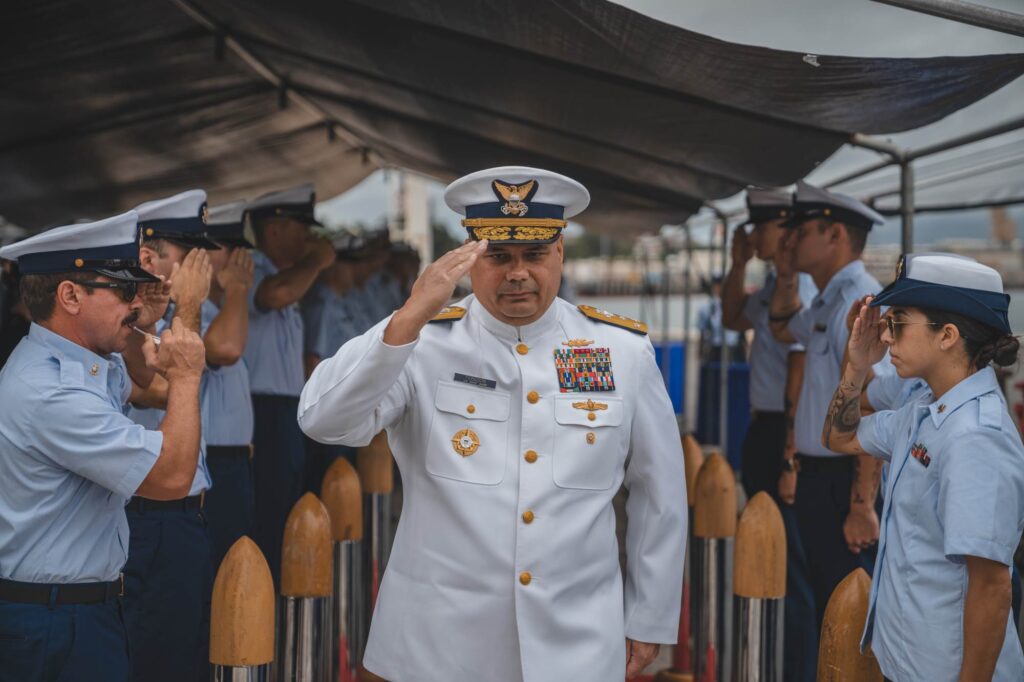
U.S. Coast Guard Vice Admiral Andrew Tiongson renders a hand salute while departing the change of home port ceremony at Joint Base Pearl Harbor Hickam, Jan. 16. Harriet Lane recently transferred to Hawaii from its former home port in Portsmouth, Virginia. U.S. Coast Guard | photo by Petty Officer 2nd Class Ty Robertson

HONOLULU – U.S. Coast Guard Cutter Harriet Lane (WMEC 903) and crew held a ceremony celebrating their recent home port shift to Joint Base Pearl Harbor-Hickam, Jan. 17, presided by Adm. Steven Poulin, vice commandant of the U.S. Coast Guard.

The Harriet Lane is U.S. Coast Guard Pacific Area’s newest Indo-Pacific support cutter. Harriet Lane and crew departed Coast Guard Base Portsmouth, Virginia, in November and arrived at Pearl Harbor, Hawaii, in December, after transiting more than 8,000 nautical miles for over 36 days.

The home port shift of Harriet Lane marks a significant milestone in strengthening the U.S. Coast Guard’s capabilities and relations with nations in the Pacific Ocean. As part of this historic home port shift, Harriet Lane will work alongside allies and partner nations within the Oceania region with a focus on advising, training, joint deployments, and capacity building to promote and model good maritime governance.

“The U.S. has long supported peace, security and stability in the Pacific Islands,” said Cmdr. Nicole Tesoniero, commanding officer of Harriet Lane. “Joining like-minded partners including Australia, New Zealand, and France, Harriet Lane stands ready to deliver sustained regional presence while signaling the Coast Guard’s commitment to be a steadfast partner in one of the world’s most dynamic economically significant regions.” 

“The presence of the Harriet Lane in the Pacific is significant,” said Vice Adm. Andrew Tiongson, commander, Pacific Area. “The demand for maritime governance has never been higher especially today in this dynamic region. Harriet Lane is a shining symbol of maritime governance, and it will make a positive impact in this world to align their operations with overarching strategies.”

“The Pacific stands out as a strategic and vital region for the United States,” said Poulin. “All Pacific nations must maintain sovereignty and must be able to enjoy their sovereign rights. The U.S. Coast Guard has unique capabilities and authorities that often make us the partner of choice, and we can meet the needs of other nations because we are flexible. We listen to what our partners and allies need and maintain strong relationships. This cutter reflects our enduring commitment to our partners.”

Harriet Lane, commissioned in 1984, is a 270-foot medium endurance cutter now homeported in Honolulu to support Coast Guard missions in the Pacific region. The service’s medium endurance cutter fleet supports a variety of Coast Guard missions including search and rescue, law enforcement, maritime defense, and protection of the marine environment.


BAE Systems Delivers First Production-Ready ACV Command Variant to U.S. Marine Corps

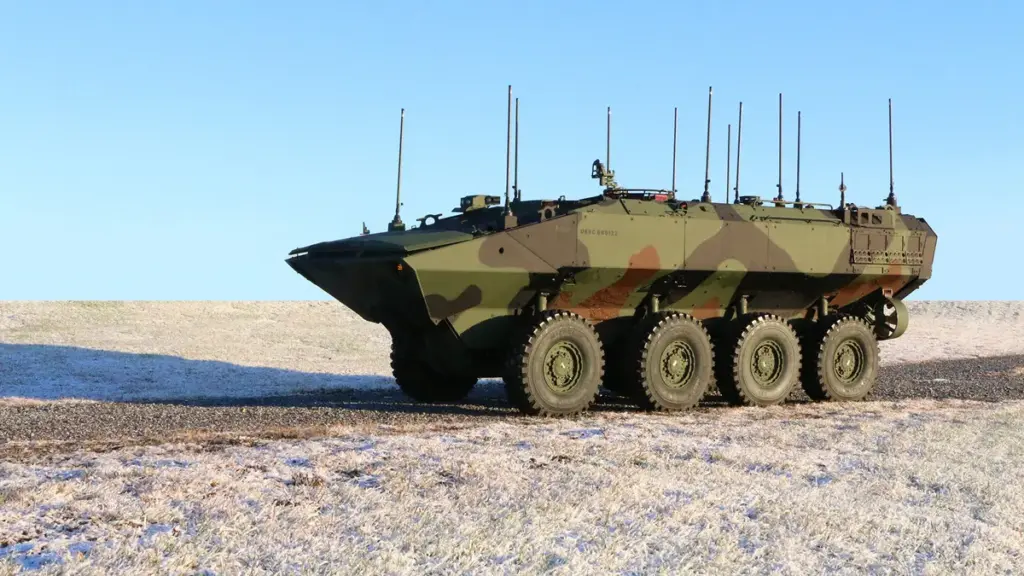
BAE Systems’ ACV-C variant. BAE Systems

STAFFORD, Va. — BAE Systems delivered the first Amphibious Combat Vehicle Command and Control (ACV-C) variant under the full-rate production contract to the U.S. Marine Corps.

The ACV-C will provide Marines with a mobile command center which enables situational awareness and operations planning in the battlespace. 

ACV-C provides true open-ocean and ship-to-objective amphibious capability, land mobility, survivability and ample growth capacity and flexibility to incorporate and adapt future technologies. Through previous studies with the Marine Corps, BAE Systems has proven that the ACV is truly customizable and has the built-in growth capacity to integrate future mission critical technologies, including new battle management capabilities, advanced communications, multi-domain targeting management, beyond-line-of-sight sensors, and manned-unmanned teaming (MUM-T) with autonomous and unmanned systems.

“We are thrilled to deliver this critical capability into the hands of Marines in the field,” said Garrett Lacaillade, vice president of the amphibious vehicles product line for BAE Systems. “As the Marines begin to familiarize themselves with the new ACV-C, BAE Systems and our strategic partner Iveco Defence Vehicles remain ready to fulfill any of the Corps’ critical amphibious warfighting needs to ensure the Fleet Marine Force is mission ready.”

The Marine Corps and BAE Systems entered full-rate production on the ACV program with a contract award in December 2020. Currently, two of the four ACV variants are in production today at BAE Systems facility in York, Pennsylvania: the ACV Personnel variant (ACV-P), which provides transport for 13 combat-loaded Marines and three crew, and the new ACV-C variant. Production Representative Test Vehicles are currently in production for ACV 30mm (ACV-30). ACV-30 is armed with a 30mm Remote Turret System that provides the lethality and protection Marines need while leaving ample room for troop capacity and payload.

The fourth variant on contract, the ACV Recovery variant (ACV-R) recently completed phase one of the design process. BAE Systems will deliver production representative test vehicles in 2025. ACV-R will provide direct field support, maintenance, and recovery to the ACV family of vehicles.

ACV production and support is taking place at BAE Systems locations in Stafford, Virginia; San Jose, California; Sterling Heights, Michigan; Aiken, South Carolina; and York, Pennsylvania.


SECNAV Del Toro Directs Comprehensive Navy Shipbuilding Review

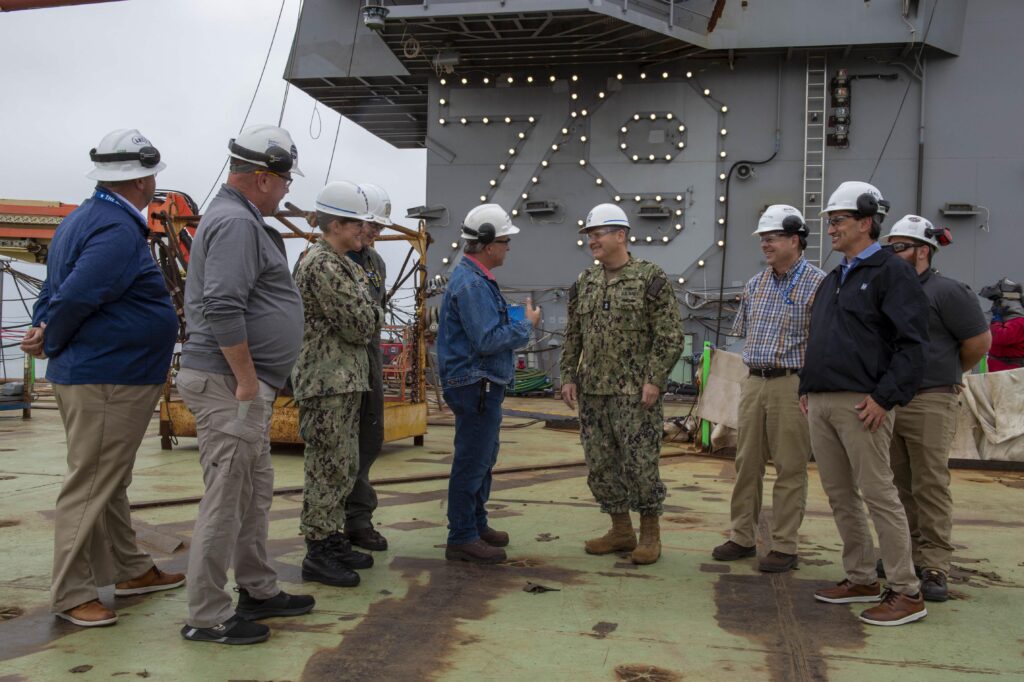
Rear Adm. Tom J. Anderson, then acting commander of Naval Sea Systems Command, discusses the construction status of pre-commissioning unit John F. Kennedy (CVN 79) with HII’s construction leadership team during a production progress visit in September 2023. U.S. Navy | Mass Communication Specialist 2nd Class Tyler Slavicek

Secretary of the Navy Carlos Del Toro has directed newly confirmed Assistant Secretary of the Navy for Research, Development & Acquisition Nickolas Guertin and Commander of Naval Sea Systems Command Vice Adm. James Downey to conduct a comprehensive analysis of the Navy shipbuilding portfolio.

The intent is to provide an interim progress review to Secretary Del Toro within 45 days. The purpose of the review is to provide an assessment of national and local causes of shipbuilding challenges, as well as recommended actions for achieving a healthier U.S. shipbuilding industrial base that provides combat capabilities that our warfighters need, on a schedule that is relevant. 

“I remain concerned with the lingering effects of post-pandemic conditions on our shipbuilders and their suppliers that continue to affect our shipbuilding programs, particularly our Columbia-class ballistic missile submarines and Constellation-class frigate,” Del Toro said. “The Department of the Navy has a strategic imperative requiring a whole-of-government effort to rebuild our nation’s comprehensive maritime power – a new Maritime Statecraft in which the Navy plays a vital role. The American public should know that the Department of the Navy is committed to developing, delivering, and sustaining the finest warfighting capability to our Sailors and Marines. We will continue to work with industry and all other stakeholders to strengthen our national shipbuilding capacity, both naval and commercial.”


New Air Defense System Advances Corps’ Air Dominance

U.S. Marines with Marine Corps Systems Command fire a Stinger Missile from a Marine Air Defense Integrated System (MADIS) at Yuma Proving Ground, Arizona, Dec. 13. U.S. Marine Corps | Virginia Guffey

YUMA PROVING GROUND, Arizona – The Marine Corps is one step closer to defeating unmanned aircraft systems. In December, Program Executive Officer Land Systems successfully tested the Marine Air Defense Integrated System, or MADIS, low-rate initial production model, hitting several launched drones during a live-fire test at the Yuma Proving Ground in Arizona.

The live-fire test subjected MADIS to actual battlefield scenarios, where it detected, tracked, identified, and defeated unmanned aerial threats. “MADIS can complete the entire kill chain, and we witness that during this event,” said Col. Andrew Konicki, program manager for Ground Based Air Defense. “It is a linchpin for mission success and our ability to neutralize airborne threats…which in turn, increases our lethality.”

MADIS is a short-range, surface-to-air system that enables Low Altitude Air Defense Battalions to deter and neutralize unmanned aircraft systems and fixed wing/rotary wing aircraft. Mounted aboard two Joint Light Tactical Vehicles, the system is a complementary pair. MADIS includes multiple disparate systems, including radar systems, surface-to-air missiles, and command and control elements. In layman’s terms, one detects, and the other attacks.

Drones continue to be a threat, especially with the emergence of easily accessible, commercial off-the-shelf products. MADIS uses real-time communication and coordination to destroy or neutralize low-altitude aerial threats in defense of the Marine Air Ground Task Force.

“The importance of countering UAS threats cannot be overstated,” said Konicki. “We see it all over the news. MADIS is the key. We’re excited to get this out to Marines.”

During the test, MADIS successfully tracked and hit multiple targets using the Stinger missiles and 30mm cannon. Information passed through the Common Aviation Command and Control System to the “fighting pair” of vehicles, executing the engagements while continuing to track other UAS targets.

“We’ve taken multiple disparate commercial off-the-shelf and government off-the-shelf technologies and put them together,” said Konicki. “This is a capability the Marine Corps has never had, and it was a challenge for the acquisition community. This test event shows we met that challenge.”

The program office has additional live-fire testing planned for new equipment training, system verification testing, and initial operational test and evaluation in FY24, prior to the start of fielding, said Maj. Craig Warner, product manager for Future Weapons Systems. The 3rd Littoral Anti-Air Battalion will be the first battalion in the Marine Corps to receive the MADIS.


Polar Security Cutter Must Overcome Shipyard Shortages Before it Can Break Ice

U.S. Coast Guard Cutter Polar Star (WAGB 10) is seen moored up next to HMAS Adelaide (L01) at HMAS Kuttabul, Sydney, Australia, Dec. 12, 2023. U.S. Coast Guard | Petty Officer 3rd Class Ryan Graves

ARLINGTON, Virginia ─ The polar security cutter, the Coast Guard’s planned next-generation icebreaker, has an obstacle to break through before it can begin breaking ice ─ a lack of welders and engineers in the shipbuilding industry.

Rear Admiral Chad L. Jacoby, the assistant commandant for acquisition and chief acquisition officer for the Coast Guard, brought up that concern while giving an icebreaker update at the Surface Navy Association’s national symposium on Jan. 11.

“We have one polar icebreaker, the Polar Star, right now. It’s almost 50 years old. And it’s pretty much breaking up McMurdo [McMurdo Station, Antarctica] every year, so it’s fully occupied,” he said. As a class of one the Polar Star has zero redundancy, “but we are doing a service life extension on that in order to be able to use the Polar Star until we can build a polar security cutter.”

The service has authorized three prototype fabrication units, “so welding has started,” Jacoby said. “But it’s an interesting challenge. … the availability of trades and the availability of engineers. So, while we’re welding, and we need to ramp up very rapidly certified welders on this EQ47 steel, which is very hard to work with, we also need to advance the global design at a rate where they meet in the future and we can authorize production.”

Those are both challenges, he said, acknowledging, “we are behind.”

Across all Coast Guard construction programs, “every shipyard says they’re going to hire 1,000 or 2,000 more people in order to execute the contracts that we have in place. They all happen to be on the Gulf Coast, so if you add up all those numbers, it’s probably physically impossible for every one of those individual shipyards to hire 2,000 more people in order to meet the production rates that we’re asking for. So, we are bumping up against probably a physical limitation of the number of workers and engineers out there.”

The future polar security cutters aren’t just icebreakers, Jacoby said.

“You may have noticed that I called the existing ship an icebreaker. The future ship is a polar security cutter and the distinction there is the polar security cutter is going to do way more than break ice. If you’re familiar with the national security cutter, it will have national security cutter-level capabilities: sensors, equipment, on a hull that can go anywhere in the world in any season. So, we’re not just breaking ice, we’re not just having presence, we’re going to be able to execute almost all Coast Guard missions up in the Arctic, down in the Antarctic, anywhere in the world.”


Navy Must Innovate to Meet its Challenges, Del Toro Says

Secretary of the Navy Carlos Del Toro speaks at the Surface Navy Association symposium. Seapower | Brett Davis

ARLINGTON, Virginia — The U.S. Navy will soon conduct a promised demonstration of a system to rearm ships while still at sea, Secretary of the Navy Carlos Del Toro announced June 10 at the Surface Navy Associations’ national symposium.

“Last year here at SNA, I announced that we would conduct an at-sea demonstration of ‘rearm at sea’ using the transportable rearming mechanism, called TRAM, at Port Hueneme. In this critical decade, the near-term deterrent effect of fielding TRAM in the fleet cannot be overstated,” Del Toro said.

In the year since, he said the funding was procured and preparations are being finalized for the test, “which I have directed to take place no later than this coming summer,” he said.

TRAM is designed to allow the rapid reloading of Vertical Launching System cells in up to sea state 5 — waves of eight to 13 feet — using the fleet’s existing interfaces. “This capability will herald nothing short of a revolution in naval surface warfare logistics,” he said.

“As TRAM delivers an at-sea reload missile capability to the fleet, we look forward to working with industry to improve our missile supply through efforts like the Naval Modular Missile program as well,” he said. “That program will use common components across the family of naval missiles, increasing our efficiency and resilience in manufacturing.”

The sea services are coping with aging equipment and facilities, sub-par recruitment and surging threats around the world — Del Toro noted the “pacing threat” of China, the ongoing threat of Russia and the newer threats from Iran-backed Houthi rebels in the Red Sea.

He and other speakers said the services are responding to these issues with innovative equipment, such as TRAM, closer ties with international partners and a renewed focus on the warfighter.

“To maintain a global, sustainable maritime posture, we must continue to innovate. Innovate,” Del Toro said. “The company, the enterprise that is not constantly innovating is dying on the grapevine.”

That includes new platforms such as the DDG (X) next-generation destroyer as well as a hybrid fleet that includes unmanned systems, such as have been demonstrated in real-world deployments by Task Force 59.

“Our hybrid fleet is not a distant vision anymore, or a hazy concept outlined on a napkin, uncertain and undefined. The hybrid fleet today is a tangible reality, operational and actively preparing to help dominate the battlespace in every way,” he said.

Navy plans also include strengthening partnerships with other nations, such as the ones who have signed up for Operation Prosperity Guardian to respond to Houthi attacks in the Red Sea.

“We simply cannot do this alone,” Del Toro said. “As history has taught us, the United States of America has flourished because of our many international partners, our friendships … by consistently deploying alongside our allies and partners abroad, we force our adversaries to face a stark reality — that a fight with the American naval forces and the forces of like-minded nations will be costly and ultimately unwinnable.”

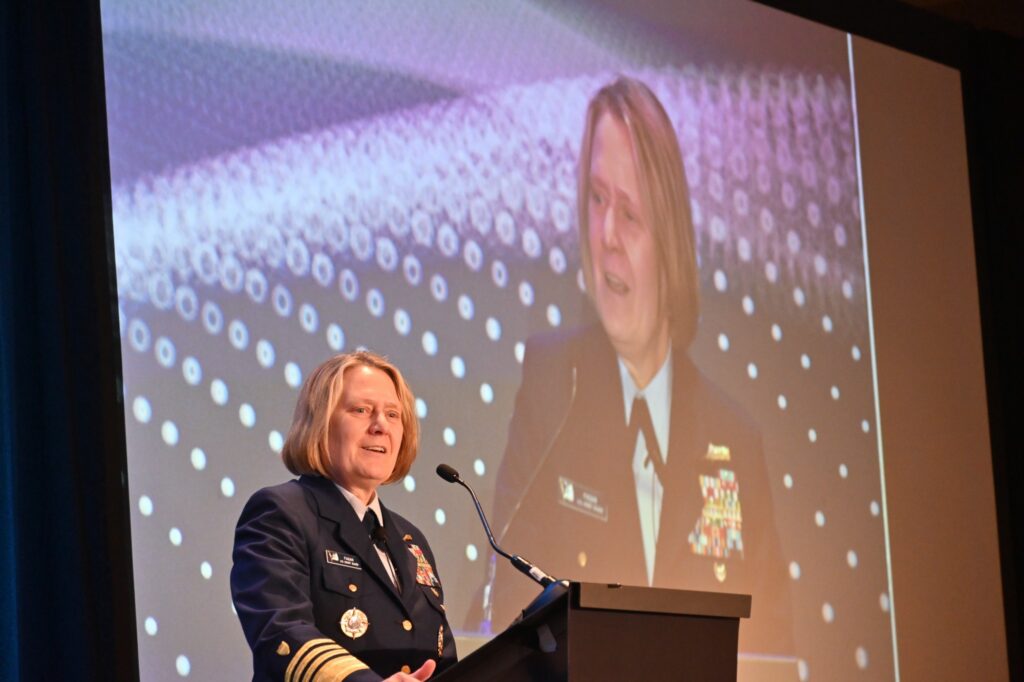
Coast Guard Commandant Linda Fagan speaks at the SNA symposium. Seapower | Brett Davis

Coast Guard Commandant

Coast Guard Commandant Linda Fagan also spoke Jan. 10 and also stressed the value of international partnerships for the Coast Guard as it maintains a strong presence in the Arctic and fights illegal, unreported and unregulated (IUU) fishing.

“In some regards, we’re like many of the world’s navies,” she said of the Coast Guard’s worldwide footprint.

One of those international tasks is the struggle against IUU, where ships from one nation illegally enter the exclusive economic zone of another country to steal fish or other sea life.

“It is a crime, it’s theft of natural resources, it erodes sovereignty, and there are nations who are operating with impunity and stealing from other nations, and the Coast Guard has a role in helping those nations enforce their own sovereignty and create capacity to counter that activity,” she said.

For example, the coast Guard’s fast response cutter Frederick Hatch just completed a 47-day expeditionary patrol to support Operation Blue Pacific, which includes operations with authorities from the Philippines, Palau and Papua New Guinea. The ship’s crew helped those nations take enforcement actions against ships fishing illegally in their waters.

Far from the balmy Pacific, the service also plays a key role in supporting shipping in the Arctic and Antarctica. This is challenging given that the service has only two functioning icebreakers, the heavy icebreaker Polar Star and the medium icebreaker Healy.

The service plans to buy three new polar security cutters to replace the aging Polar Star, which was commissioned in 1976 (Fagan herself served as an ensign on it).

While climate change means there’s less ice for longer periods of time in the Arctic, it’s still there, and “getting a polar security cutter fielded is an absolute top priority for the organization,” she said. “We’re on budget, we’re on contract for the polar security cutter.”

As with the Navy, the Coast Guard struggles with aging equipment (such as the Polar Star) and recruitment numbers that aren’t hitting the target. “The Coast Guard is not unique in our need for people,” she said.

At the beginning of COVID, recruitment went down and has stayed down. The service has invested in recruiters and “we have stopped that descent,” and the talent the Coast Guard is attracting is “bright, they are motivated, they know why they want to serve, they understand the value proposition of the Coast Guard,” she said.

There are ways the Coast Guard can deal with the shortage of personnel, including speeding the decommissioning of aging cutters, as well as making serving on ships more attractive, such as by adding communications services like SpaceX’s Starlink.

Fagan said when she served on the Polar Star, she basically disappeared for four months, calling her parents when the ship pulled into Australia. But recently, while Healy was in the Arctic, the CO was sending her photos of polar bears and walruses in real time.

“These are the kinds of investments that become critical for on-board lifestyles … crews want to be able to talk to their families and not disappear for four months,” she said. “This is the workforce that we’re on-boarding and we need to provide the tools that enable those kinds of engagements and expectations of the force.”

Navy Honors ‘Human Tugboat’ by Naming DDG 142 for Hero Charles French

Secretary of the Navy Carlos Del Toro announced Jan. 10 that the Navy’s newest destroyer, DDG 142, will be named after Petty Officer First Class Charles Jackson French, dubbed the “human tugboat” for an act of bravery in World War II.

On Sept. 5, 1942, French’s ship, the USS Gregory, was sunk by the Japanese navy during the battle of Guadalcanal. He gathered 15 injured shipmates and swam through the night to carry them to an island where they would be safe from capture,” defying the odds and the sharks with nothing but his own grit and compassion,” Del Toro said.

He was recommended for the Navy Cross for his actions, but received only a letter of commendation, which Del Toro said is “what I actually give out today for a really good PowerPoint presentation.”

Del Toro said the Navy is finally giving French his due, naming a rescue swimming training pool at Naval Base San Diego for him, and now, “with long overdue recognition,” DDG 142.


Peacetime Naval Planning Can be Crucial to Future Wartime Footing, CNO Says

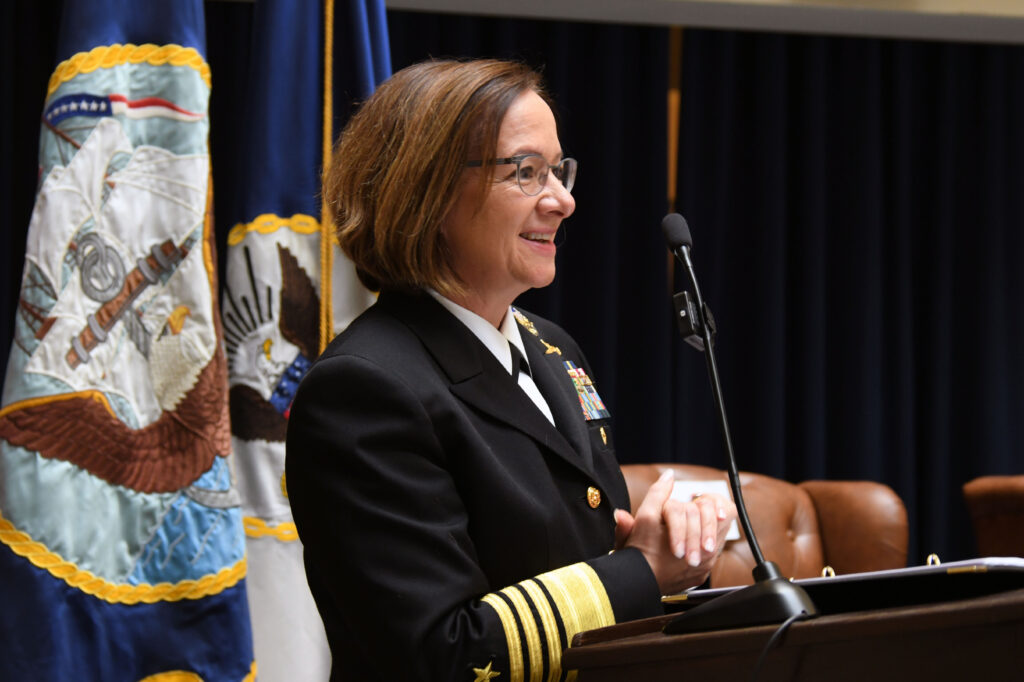
Chief of Naval Operations Adm. Lisa Franchetti, shown here speaking in December at Washington, D.C.’s historic Navy Yard. U.S. Navy | John Belanger

ARLINGTON, Virginia ─ The United States and its Navy are at a historical inflection point similar to ones it experienced in the past, and service officials and planners should respond the same way officials did then, said the Navy’s relatively new chief of naval operations, Admiral Lisa Franchetti.

Speaking Jan. 8 to the Surface Navy Association’s annual conference, Franchetti said the situation of the U.S. now is similar what was going on in the 1930s and 1970s. In both cases, visionary service leaders in peacetime looked ahead and prepared for war and built a Navy that was up to the task.

“I consider the 1930s and the 1970s as two decisive decades that sort of rhyme, in key ways, with where we are today,” she said. “… There are historical parallels that offer key lessons for us today.”

In the 1930s, the United States was still reeling from the Great Depression and had a shrinking shipbuilding base.

Fleet planners, their eyes on the threat from Imperial Japan, conducted a series of maneuvers, called fleet problems, to provide realistic training for Sailors. Planners also conducted extensive wargames. That let to a series of war plans that prompted the move from a fleet based on World War I battleships to a more integrated force that included aircraft carriers, dive bombers and torpedo bombers, all of which proved vital in World War II.

Ninety-five percent of the ships that fought in the war, including at the battles of Coral Sea and Midway, and in the Guadalcanal campaign, were fought with ships born from peacetime work.

“How we fight determines what we fight with. Warfighting concepts must drive the design of our warfighting platforms, our capabilities and our strategies,” Franchetti said.

In the 1970s, the Navy was a power projection force focused on supporting land troops in Asia amid a limited defense budget and high inflation. The nation had a hollowed-out shipbuilding industry and ended up with an aging fleet unprepared for escalating maritime competition from the Soviet Union.

Navy planners and leaders, including CNO Elmo Zumwalt and his successors, conceived of a fleet capable of global sea control, resulting in strategies that would “lay the intellectual groundwork” for the Navy’s weapons buys in the 1980s, which led to the introduction of the F/A-18 Hornet, the Los Angeles- and Ohio-class submarines, the Spruance and Arleigh Burke destroyers, Aegis, Harpoon and Tomahawk weapon systems, and others, she said.

Warfighting Lens

All of those systems were planned in peacetime but crucial when war came, Franchetti said, and the country is in a similar position now. She and other leaders are looking a new concepts, weapons and tactics through exercises and war games, as was done in the 1930s and 1970s, although now with advanced simulation technology.

“Today, our U.S. Navy is taking a similar approaching by viewing everything we do through a warfighting lens,” Franchetti said. “We have energized our wargaming enterprise at the Naval War College and at our Warfighting Development Center to empower leaders at all levels to think differently about how we need to operate in uncertain, complex and rapidly changing environments. Leaders who are ready to take initiative and be bold.”

The Navy is also undertaking fleet exercises and battle problems to develop and refine operational concepts to define the requirements for the future fleet, she said, including with Task Force 59, which has tested unmanned systems and other hardware and software in real-world situations.

“The actions taken during these respective decades remind us that we must be forward thinking in prioritizing our warfighting advantage, and that we must increase our capability and capacity in peacetime so we can be ready to surge effectively in war,” she said.


Caudle: Navy Must Boost Surge Capability to Face Peer Competition

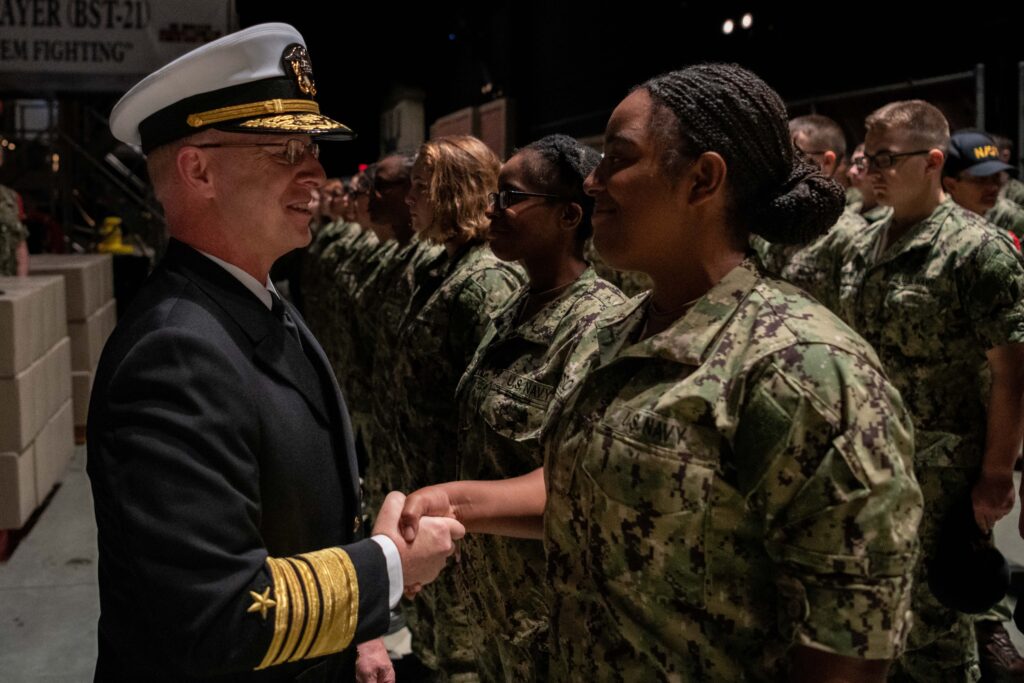
Adm. Daryl Caudle, Commander, U.S. Fleet Forces Command, congratulates recruits during a capping ceremony inside USS Trayer at Recruit Training Command last October. U.S. Navy | Mass Communication Specialist 2nd Class Christopher O’Grady

ARLINGTON, Virginia — The U.S. Navy must improve its workforce training, maintenance and surge capability to meet peer adversaries such as Russia and China, and is taking new steps to accomplish that goal, said Adm. Daryl Caudle, commander of U.S. Fleet Forces Command.

Speaking at the Surface Navy Association’s 36th National Symposium, Caudle said today’s joint force was shaped by a two-decade land war following a sustained peace after the end of the Cold War, and military leaders are now trying to “get the rudder over” to a multi-domain, high-speed, long-range warfare against potential enemies such as Russia and China, or both together.

“When we need to turn the volume up quickly on delivering combat power, the hardest spigot I own is and will always be inextricably related to building and developing human capital — our most precious resource — our warriors,” he said.

Caudle said he is focusing on Contingency Response Forces, those required to be ready to flow for combat within 30 days. “This is where I am applying my efforts. Readiness cannot be left at the pier, delayed in the shipyard, or undelivered on a production line. Further, it can’t be driven by empty recruiting stations or empty repair lockers.”

The Navy’s current Optimized Fleet Response Plan, or OFRP, “was not built to generate combat ready ships and air wings to meet the demand signal against peer adversaries,” Caudle said. “During peacetime force generation, the OFRP provides a steady supply of ready naval forces for a wide range of global presence operations. But it is not optimized to shift into high gear and generate, deploy, and regenerate a large surge of combat ready maritime forces.”

To help with that surge, Caudle’s office is developing the Global Maritime Response Plan, intended to give the chief of naval operations “a way to shift the Navy from peacetime to wartime” by bolstering some key organizations within the service, combining others and devolving or shutting down lower-priority commands and functions. It will also include having shell contracts in place, ready to fill out and execute.

“The Global Maritime Response Plan development is well under way,” Caudle said. “We are currently building out the Decision Support Matrices and the Response Conditions, or RESCONs, [think like DEFCON] that will be used to control how our Navy will be put on the required warfighting footing level to best support operational commanders.”

In some cases, he said, the effort simply involves compiling and codifying plans already in place at Navy organizations.

Working with Industry

The defense industry has gained traction in getting armaments and supplies to the fleet, Caudle said, one year after chastising the industry for falling behind in meeting defense needs.

“Despite the significant challenges we face with long-lead time parts, shipyard delays, less than optimal living conditions during maintenance periods, and personnel shortages across many rates and NECs, you all are just crushing it,” Caudle told SNA attendees. At last year’s event, he delivered a blunt warning to industry that he wouldn’t tolerate ordnance delays blamed on COVID or supply chain issues.

“To be honest, after I spoke at SNA last year, I wasn’t so sure how my remarks would be received, and even more important, acted on by the defense industrial base,” he said. “After voicing my displeasure about our inability to produce and deliver ordnance on time and in sufficient quantity, complete maintenance availabilities with modernizations efforts on time and on cost, and the need to be at flank speed to improve productivity, efficiency and build rates from our public and private shipyards to deliver new construction and overhauled ships to our fleet … instead of an adverse reaction, I think it really struck a chord with industry leaders, leaders within the Department of Defense, and with many congressional members who see the problems I identified in the same way.”

Caudle said he has been impressed with how many industry partners have reached out to his office and Navy program managers to step up production “through improvements using a ‘Get Real, Get Better’ approach in which we embrace the red together, self-assess together, and correct identified challenges together. Truly assessing weak areas and shifting rudder hard over and revving the gas to get back on PIM [plan of intended movement].”

In a separate interview with media, Caudle said after last year’s speech he worked with Vice Adm. Francis Morley, the principal military deputy assistant secretary of the Navy (research, development and acquisition) to bring in industry leaders that build munitions such as the Standard Missile and anti-ship missiles to “actually hear their perspective on places where we as the government could help them.”
Some solutions include multi-year contracts, how the Navy works with industry on quality control tests and test equipment improvements that need to be done.

“I probably overstated some things and got educated on some things, and I think they understood that we need these weapons, and their motivation to do that at pace was illustrated to me in spades,” he said.

In his remarks this year, Caudle cautioned that “while we have made some gains since my remarks last year at SNA, I would argue that we have not achieved the level of readiness, production, and deliveries required in both capabilities and capacity to claim we are ‘up on plane’ with a winning trajectory. Make no mistake about it — we face formidable threats on the horizon. And, while the nature of war never truly changes, these threats are fundamentally changing the character of how we prepare our Navy to fight.”


Raytheon’s Barracuda Sea-Mine Assassin Progresses in Development

ARLINGTON, Va. — Raytheon has completed the Technical Data Package for a sea mine destructor developed for the U.S. Navy as the test program continues, the company said in an interview with Seapower.

The Barracuda is a 26-pound, 48-inch-long anti-mine device housed in a tube the size of an A-size sonobuoy tube. When launched, the device is propelled by four small water jets that take the device to the datum of a suspected sea mine detected by the AQS-20C towed sonar. An acoustic communications data link buoy is released to which the device is tethered. Target updates, such as GPS coordinates, are transmitted to the device, which approaches the sea mine. A sonar and a camera mounted in the nose of the device enables a man-in-the-loop operator — for now — to confirm the mine. The device then is steered to the mine and detonated. Each Barracuda is a one-shot charge.

Since May 2023, Raytheon has been building 128 Barracudas for development, 63 for contractor trials and 65 for the Navy’s trials.

Dan Seamans, Raytheon’s director for mine warfare, including the AQS-20 sonar, the Airborne Mine Neutralization System, and the Barracuda at Portsmouth, Rhode Island, said the Navy has yet to finalize its decisions on what the launch platforms for the Barracuda will be. Candidates include the littoral combat ship’s mine-countermeasures mission package, including the Mine Countermeasures Uncrewed Surface Vessel. The company is building a surrogate launcher for the test program and will proceed to a tactical launcher.

The Navy awarded the initial design and development contract to Raytheon in 2018. The Navy’s spiral Critical Design Review of the Barracuda was completed in July 2023.

Low-Rate Initial Production for Barracuda is planned for fiscal 2027