USS Carney’s Success Showed Value of Aegis, SM-2, VLS, Alert Crew
By Richard R. Burgess, Senior Editor
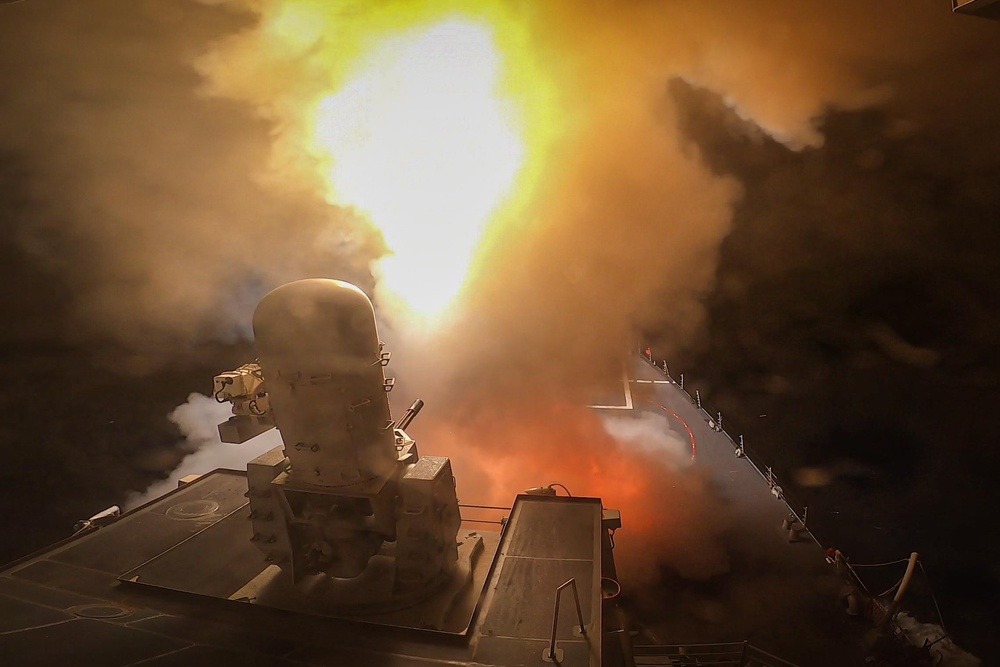
ARLINGTON, Va. — The event of the Arleigh Burke-class guided-missile destroyer (DDG) USS Carney (DDG 64) in intercepting and destroying on Oct. 19 four land-attack cruise missiles and several drones launched by Houthi forces over the Red Sea in Yemen was not routine, but it was a demonstration of naval operations and technology at its finest.
The Houthi missiles apparently were headed in the direction of Israel which had been engaged in combat with Hamas terrorists since Oct. 7. The Iran-backed Houthis have a history of using drones and missiles against Saudi petroleum infrastructure and U.S. Navy and other ships in the Arabian Sea.
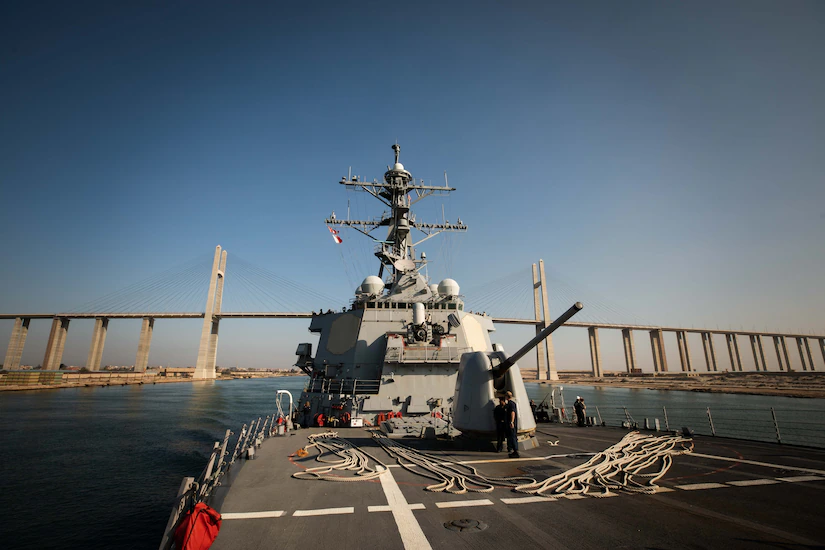
The USS Carney, based in Naval Station Mayport, Florida, is one of the U.S. Navy’s older destroyers, the 14th ship of its class, commissioned in 1996. It has since been equipped with ballistic-missile defense systems. At the time of the intercepts the ship was deployed to the Red Sea in support of operations of U.S. Central Command.
The Carney is equipped with the Aegis Combat System, a sophisticated digital, networked command-and-control system that links together the sensors and weapon systems of the ship. Its main sensor is the SPY-1 air search radar that enables the ship to detect, identify, track, and engage aerial targets and pass track data to other units. The Aegis system, which entered service in the 1980s, has been continuously upgraded to keep ahead of evolving threats.
The RIM-66 Standard SM-2 missile fired by the Carney entered service in 1979. It traces its developmental history from to the Terrier, Tartar, and Standard SM-1 family of surface-to-air missiles. The SM-2 already was combat proven in Operation Praying Mantis in the Persian Gulf in 1988, when an Iranian missile craft was damaged by one. More recently, in October 2016, the Arleigh Burke-class DDG USS Mason came under attack on three occasions by Houthi anti-ship missiles off the coast of Yemen. Of the seven missiles fired at the Mason, SM-2 missiles took down at least five of the missiles. The Houthi missiles scored no hits.
The Mason’s action also was the first air defense conducted by the Mk41 vertical launch system (VLS). The rapid-fire capability of a bank of Mk41 cells enables a DDG to take on multiple incoming missiles much more capably than with a single- or twin-arm launcher of previous years. The Carney’s VLS system enabled similar success last week.
Equipped with well-designed, proven technology from the U.S. defense industry, the Carney was able to perform its mission successfully. Weapon systems with developmental troubles usually dominate the press coverage. Carney was a showcase of systems that worked.
Last but not least, the Carney’s crew was alert and ready when the test came. Bravo Zulu to the Carney and the American bluejacket.
CORAS Wins Contract with the United States Naval Academy Leadership, Education, and Development Division
Release from CORAS
*****
MCLEAN, Va. – October 24, 2023: CORAS is proud to announce a contract with the United States Naval Academy (USNA) to develop and deliver a mobile-enabled application for its Leadership, Education, and Development (LEAD) Division. The mobile application requirement was envisioned and spearheaded by Captain Kevin Mullaney, USN, Ph.D., the Course Director and Leadership, Ethics, and Law department chair for the USNA. Named the Leaders Compass, the application is created through research in leadership development, decision-making, and moral psychology, and delivers a competency support framework for Midshipmen leader development across the institution.
“We are honored to support the US Naval Academy and its mission to cultivate the next generation of DoD Leaders,” said CORAS President and CTO Dan Naselius. “Aggregating data from all the USNA scoring areas into a mobile-enabled tracking format makes it possible for every Midshipman and Faculty to see how they are performing and growing – the familiar tracker format delivers a complete user experience and ensures buy-in at all levels. It is exciting to see how Navy and Marine Corps future leaders will be interacting with data in this way from the onset of their careers.”
“One of the advantages of the Leaders Compass system is that it integrates the entire developmental experience for Midshipmen across the 47-month journey at the Naval Academy,” CAPT Mullaney said. “We are fortifying the future fleet of officers by providing purposeful development in conjunction with assessments, making the data that we collect actionable and giving students access to robust developmental resources and curated experiences with the Naval Academy’s faculty and leadership.”
The Leaders Compass supports the assessment of Midshipmen in four (4) key areas: academic, professional/leadership development, physical, and competencies. It allows Midshipmen to track coursework and grades, chart performance in classes and training exercises, engage with coaches and faculty, and follow assigned work and goal progression. Peer review provides 360-degree feedback on leadership behaviors and relationship management. The Leaders Compass offers complete transparency and a level of engagement that keeps Midshipmen focused on their leadership journey from day one.
USNA faculty and staff also benefit from the Leaders Compass application. They have access to Midshipmen data on the scope and effectiveness of classes, training, development, GPA, Scores, materials, and events. On a comprehensive level, it also gathers collective data to assess and gauge program performance and effectiveness.
CORAS is already at work in the Department of Defense (DoD), managing an array of disparate data sources and bringing real-time interaction, data modeling, and predictive artificial intelligence (AI) to federal civilian and military agencies. CORAS manages some of the largest business challenges through proprietary solutions that offer flexibility to work with existing programs with proven business processes and no data lock-in. CORAS’ Enterprise SaaS solution manages the US Navy’s digital POM and supports various S&T portfolios and contracts that use data to solve complex business challenges. CORAS’ privately-owned solutions allow it to be an open data company that supports the preparation and readiness of data for AI and machine learning (ML) as well as putting teams in place that can gather the data and run models against it.
Alakai Defense Systems Awarded $30.7 Million Naval Air Warfare Center Aircraft Division Contract
Release from Alakai Defense Systems
*****
Alakai to provide multiple checkpoint explosive detection systems
TAMPA BAY, Fl.—October 24, 2023— Alakai Defense Systems Inc. announced that it was awarded a $30.7 million contract with the U.S. Naval Air Warfare Center Aircraft Division to provide multiple Checkpoint Explosive Detection Systems (CPEDS) as well as required training and product support.
Alakai Defense Systems’ CPEDS is an extreme standoff range explosive detection system. CPEDS is used for Entry Point Security and performs detection and identification of bulk, residue and trace quantities of explosives, homemade explosives, chemical warfare agents, toxic industrial chemicals and narcotics. CPEDS can be used for defense, security, and law enforcement applications. The system can be operated remotely, further isolating the operator from the threat chemicals or any potential blast radius.
CPEDS employs deep UV Raman spectroscopic detection methodologies to identify real-time threats. With expertise in laser-based sensing, threat sensing technology (UV, Vis, & IR), Alakai’s products feature patented, proprietary eye-safety technology.
“Our military and allies increasingly face dangerous, life-threatening environments,” explained Ed Dottery, President and CEO, Alakai Defense Systems. “I remain passionate in my mission to save lives and limbs from harm and our CPEDs provide some of the most advanced explosive detection technology ever developed to safeguard our Nation’s defenders.”
The contract was awarded on August 17, 2023, in support of the Naval Air Systems Command’s Security Cooperation Office. Work is to be completed by February 2027.
About Alakai Defense Systems Alakai Defense Systems, Inc. is a small, veteran owned high-tech company specializing in laser and electro-optical standoff threat detection sensors for defense & security applications. Founded in 2003, Alakai’s ongoing work includes research and development of laser-based trace material detection technologies for U.S. government agencies. For more information, visit www.alakaidefense.com or contact Alakai at [email protected].
Crowley Moves to Launch First-Ever LNG Bunkering at Panama Canal’s Pacific Side
Release from Crowley
*****
(JACKSONVILLE, Fla.; Oct. 24, 2023) – Global shipping and sustainable energy logistics leader Crowley is proceeding with plans to provide liquefied natural gas (LNG) bunkering services on the Pacific side of the Panama Canal, under the first permit issued by the Panama Maritime Authority (AMP) for the provision of such services.
Crowley’s advanced energy group will operate the innovative service to manage the ship-to-ship LNG transfer services. With a potential start date in 2024, Crowley is preparing to provide bunkering and related port solutions to safely deliver lower-emission LNG to vessels for fuel and cryogenic tank cooldown services at the canal.
“LNG is widely accepted as the most practical transitional alternative fuel for maritime shipping and to stay ahead of the rapid deployment of LNG-powered ships across the global market, Crowley is strategically growing its LNG bunkering operations across North and Central America,” said James Fowler, senior vice president and general manager, Crowley Shipping. “The Panama Canal will become a key location for vessels to take on LNG, and Crowley’s future Panamanian bunkering service will give international ship owners confidence to continue to adopt LNG across their fleets.”
A leader in U.S. LNG supply chain and engineering services, the Panama Canal location expands Crowley’s LNG solutions. In 2014, Crowley received the first small-scale LNG export license from the U.S. Department of Energy for LNG transportation from the U.S. into Free Trade Agreement (FTA) and Non-Free Trade (NFTA) countries. The company then pioneered small scale LNG transportation and engineering to Puerto Rico.
Crowley’s services expanded in 2022 with the opening of an LNG truck-loading terminal in Peñuelas, Puerto Rico. A 12,000 m3 (3.17 million gallons) LNG bunker barge, the largest in the U.S, is under construction with a long-term charter agreement with Shell to begin service in 2024 for ships on the U.S. East Coast.
Crowley has served Central America including Panama for more than 60 years with maritime and logistics services.
U.S. Navy Awards Bollinger Shipyards Contract to Build 4 Additional Mine Countermeasures Unmanned Surface Vessels
Release from Bolliger Shipyards
*****
Award builds upon Bollinger’s growing autonomous portfolio
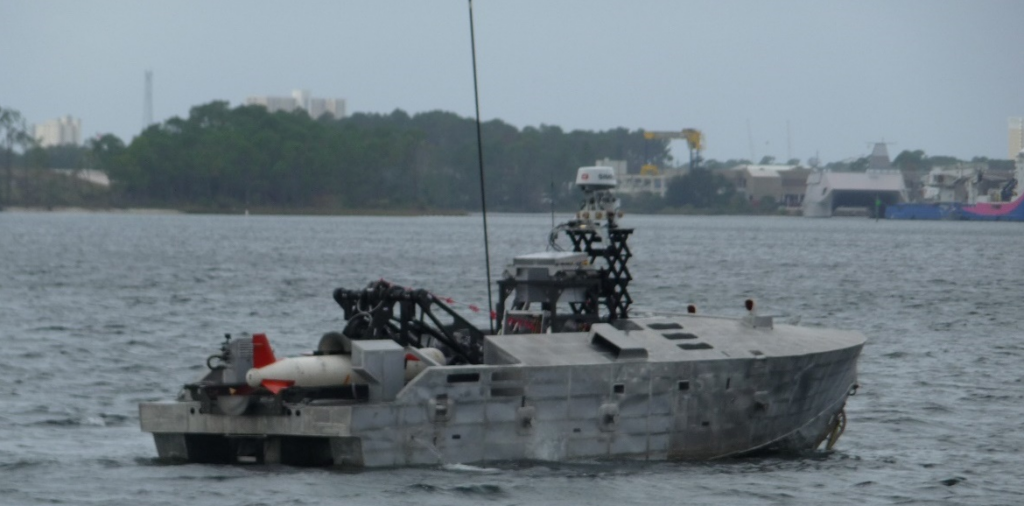
LOCKPORT, LA. — (October 23, 2023) – The U.S. Navy has awarded Bollinger Shipyards (“Bollinger”), a privately-held and leading designer and builder of military and commercial vessels, a contract to build four (4) additional Mine Countermeasures Unmanned Surface Vessels (MCM USV). This brings the total number of vessels under contract up to seven (7), with options for up to 18 more vessels.
“Bollinger is honored to be entrusted by the U.S. Navy to continue building the Mine Countermeasures Unmanned Surface Vessel program,” said Ben Bordelon, President and CEO of Bollinger Shipyards. “Our skilled workforce is second to none. We are proud to support and protect the men and women of the U.S. Navy with state-of-the-art, multi-mission unmanned surface vessels that can operate in the most challenging conditions.”
Bollinger was first awarded the contract to build the MCM USV program in April 2022. The MCM USV is an autonomous vessel capable of supporting minesweeping, mine hunting, and mine neutralization missions. Naval mines present a significant threat to U.S. naval operations and to U.S. and allied shipping in coastal waters, continental shelf waters, port approaches, and straits. The MCM USV program is key to replacing capabilities currently being undertaken by soon to be retired MCM-1 class Mine Countermeasures Ships and MH-53E helicopters.
Bollinger will continue to build the MCM USV program at Bollinger Shipyards’ Lockport, Louisiana, facility.
U.S. Coast Guard strengthens historic relationship with Philippines during landmark visit to Tacloban
TACLOBAN, Philippines — In a historic first, the USCGC Frederick Hatch (WPC 1143) visited partners in Tacloban, Philippines, from Oct. 19 to 23, 2023, and the crew conducted engagements marking a significant milestone in the enduring relationship between the United States and the Philippines.
This visit of several days coincided with the observance of the Battle of Leyte Gulf, a crucial event in World War II history where U.S. Coast Guardsmen were a significant part of the U.S. forces and among the first to hit the beaches as the U.S. sought to retake the Philippines.
“We are deeply honored to be part of this observance and to strengthen the bond between the United States and the Philippines,” said Lt. Patrick Dreiss, commanding officer of the USCGC Frederick Hatch. “It is a privilege to bring a U.S. Coast Guard Fast Response Cutter to the Philippines for the first time and to visit the historic city of Tacloban. My crew was excited to collaborate with the Philippine Coast Guard to deepen our connections with our fellow seagoing Service and explore this unique city and island.”
An advance team from U.S. Coast Guard District 14 and U.S. Coast Guard Forces Micronesia/Sector Guam held planning meetings in collaboration with the U.S. Embassy to prepare for this visit and the Battle of Leyte Gulf observance. Discussions revolved around mutual capabilities, training opportunities, and community engagement, part of the Coast GGuard’sOperation Blue Pacific mission.
While in Tacloban, the crew, with support from the Maritime Security Response Team West, hosted a subject matter expert exchange on maritime law enforcement with Philippine Coast Guard colleagues, observed the 79th Leyte Gulf Landing Anniversary, hosted local school children and government officials, held working meetings, and experienced the culture of the Eastern Visayas region of the Philippines.
“The expanded capabilities of the Fast Response Cutter represent more than just advanced technology; they symbolize the bridge of cooperation and goodwill between nations. The FRCs and their dedicated crews regularly play a pivotal role in international diplomacy. These vessels, along with their highly trained and professional crews, are ambassadors of peace and collaboration, said Capt. Nick Simmons, commander of U.S. Coast Guard Forces Micronesia/Sector Guam. “They foster understanding and trust across borders, making the seas safer not only for our own nations but for all nations that rely on the freedom of navigation and maritime security.”
This visit is part of the USCGC Frederick Hatch’s regularly scheduled expeditionary patrol as part of the ongoing Operation Blue Pacific. It follows previous interactions between the U.S. Coast Guard and the Philippine Coast Guard, including the recent arrival of the USCGC Stratton (WMSL 752) in Manila for professional exchanges and joint operations.
The visit of Pacific Area commander Vice Adm. Andrew Tiongson in April to discuss shared challenges and opportunities for partnership further exemplifies the U.S. Coast Guard’s commitment to the region. The Service’s role as a federal law enforcement agency and an armed forces branch uniquely positions the agency’s teams to conduct security cooperation operations supporting combatant commanders, upholding governance, and ensuring regional stability. Through Operation Blue Pacific, an overarching multi-mission Coast Guard endeavor, the Service seeks to promote security, safety, sovereignty, and economic prosperity in Oceania while strengthening relationships between partner nations in the Pacific.
The Tacloban visit underscores the shared strategic efforts toward a stable and prosperous Indo-Pacific and aligns with the Pacific Area Commander’s goals to prepare a ready force, generate combined effects, and uphold governance. It also supports U.S. Coast Guard District 14 and U.S. Coast Guard Forces Micronesia/Sector Guam’s commitment to be a trusted partner in Oceania and deliver operational excellence.
DOD Aims to Publish 1st National Defense Industrial Strategy
By December, the Defense Department hopes to issue its first-ever National Defense Industrial Strategy, which will be followed by DOD’s implementation plan, said Laura D. Taylor-Kale, assistant secretary of defense for industrial base policy.
Taylor-Kale, who spoke yesterday at the 2023 Defense Conference, was confirmed by the Senate in March as the first assistant secretary of defense for industrial base policy.
She advises the undersecretary of defense and other senior defense leaders on all matters pertaining to industrial base resilience, workforce development, innovation, investment and policy. And, she also is shepherding the strategy’s development.
That strategy will focus on creating a clear road map for how the department will prioritize and modernize the U.S. industrial base, she said.
“We’ve seen in the response to COVID and the conflicts in Ukraine and the Middle East that our industrial ecosystem needs to be ready to provide the capabilities … that the department needs,” Taylor-Kale said.
The goal, she said, is to work in partnership with industry, with the inter-agencies, with Congress and with allies and partners to make defense industrial policy work much more smoothly and strategically, she said.
“This strategy is meant to catalyze a generational change that will guide the department’s focus and policy development and programs and investment in the industrial base for the next three-to-five years,” she said.
The key areas of the strategy, she said, are:
Creating resilient supply chains
Having an industrial base that can produce capabilities, services and technologies that are needed at speed, scale and cost
Ensuring workforce readiness and development
Delivering flexible acquisitions
Building in metrics for measurable outcomes
Taylor-Kale said her office hopes to attract new, innovative, non-traditional companies into the industrial base, particularly those that connect dual-use technologies with the emerging needs of the warfighter.
“I want to emphasize that the task before us is really critical. Creating a modern defense industrial ecosystem will take all of us working together. Please come to us with your ideas. We want to partner with you. I want to partner with you to make this work. We in government cannot do this alone. And frankly, we’re not trying to do this alone,” she said, speaking to industry representatives in attendance.
DOD Responds to Attacks, Continues Efforts to Deter Spread of Israel-Hamas War
DOD assets in the Red Sea, Iraq and Syria responded to missile and drone attacks over the past two days, as U.S. service members look to deter groups from using the Israel-Hamas war as an opportunity to launch conflict that could engulf the region, Pentagon Press Secretary Air Force Brig. Gen. Pat Ryder said today.
Ryder also spelled out the steps Secretary of Defense Lloyd J. Austin III has taken to strengthen DOD posture in the region to bolster regional deterrence efforts.
Ryder said the crew of the guided missile destroyer USS Carney operating in the northern Red Sea earlier today shot down three land attack cruise missiles and several drones launched by Houthi forces in Yemen. “This action was a demonstration of the integrated air and missile defense architecture that we built in the Middle East and that we are prepared to utilize whenever necessary to protect our partners and our interests,” he said.
There were no casualties.
“We cannot say for certain what these missiles and drones were targeting, but they were launched heading north along the Red Sea potentially towards targets in Israel,” the general said.
Ryder also detailed drone attacks on U.S. facilities in Syria and Iraq. The al-Tanf garrison in Syria was targeted by two drones on Oct. 18. “U.S. and coalition forces engaged one drone destroying it while the other drone impacted the base resulting in minor injuries to coalition forces,” Ryder said. All of the injured returned to duty.
At the same time, early warning systems indicated a possible threat approaching the airbase at al-Assad. Base personnel sheltered in place as a protective measure. “Though no attack occurred, sadly, a U.S. civilian contractor suffered a cardiac episode while sheltering and passed away shortly thereafter,” Ryder said.
Separately in northern Iraq, U.S. forces engaged and destroyed a drone resulting in no injuries or damage.
Ryder said he will not detail what the American response to these provocations will be. “I will say that we will take all necessary actions to defend U.S. and coalition forces against any threat,” he said. “Any response, should one occur, will come at a time in a manner of our choosing.”
Ryder said U.S. forces deployed to the region are meant to deter any government or group from launching attacks under cover of the Israeli-Hamas war. The USS Gerald R. Ford Carrier Strike Group is in the eastern Mediterranean Sea and the USS Dwight D. Eisenhower Carrier Strike Group is crossing the Atlantic to join the Ford. The Air Force has also bumped up fighter presence to the region.
“By posturing these U.S. naval assets and advanced fighter aircraft in the region, we aim to send a strong message intended to deter a wider conflict, to bolster regional stability, and, of course, to make it clear that we will protect and defend our national security interests,” Ryder said.
Secretary Austin is continuing engagements with counterparts in the region and beyond. Just today, the secretary spoke with officials in the United Arab Emirates, Qatar, Saudi Arabia and Israel. “During these calls, he reiterated U.S. support for Israel’s right to defend itself from terrorist attacks, and also underscored the importance of safeguarding innocent civilians — both Palestinian and Israeli,” Ryder said.
Finally, Ryder said that systems the Israelis requested continue to flow into the country. These include precision-guided munitions, such as joint direct attack munitions, small-diameter bombs, 155-millimeter artillery ammunition and other categories of critical equipment. In addition, the United States is providing Iron Dome interceptors from stocks the United States has in Israel. In the days ahead, “we’ll be flying additional Iron Dome interceptors so that Israel has the capabilities they need to sustain their defense systems and protect their citizens and from rocket attacks,” Ryder said.
DOD Report Details Chinese Efforts to Build Military Power
The People’s Republic of China is continuing its efforts to overturn the international rules-based order and is building an increasingly effective military to further these aims, said a senior defense official speaking on background.
The official gave reporters a preview of the 2023 China Military Power Report that DOD delivered to Congress today. The annual report to Congress is based on the National Defense Strategy’s premise that China is the only competitor with the intent, will and capability to reshape the international order, said the official. “The 2022 National Defense Strategy identifies the PRC as increasingly capable military as the department’s top pacing challenge,” he said.
The report “charts the current course of the PRC’s national economic and military strategies, and offers insight into the strategy, its current capabilities, some of its operational activities, as well as its future modernization goals,” he said.
Communist leaders seek “the great rejuvenation of the Chinese nation,” by 2049 – the 100th anniversary of the Chinese Communist Party’s takeover of the world’s largest country.
Part of this effort is China is increasing military coercion, the official said. An example of this is the increasing numbers of unsafe intercepts of U.S., allied and partner vessels and aircraft operating in international air and seaways of the Indo-Pacific region. “Between the fall of 2021 and the fall of 2023, the United States documented over 180 instances of coercive and risky air intercepts against U.S. aircraft in the region,” the official said. When allies and partners are included, this jumps to more than 300 instances.
The report also covers China’s intensifying pressure campaign against Taiwan including Chinese ballistic missile overflights of Taiwan, increased flights into Taiwan’s self-declared air defense identification zone and the large-scale simulated joint blockade and simulated joint firepower strike operations done after a visit to the island by a U.S. congressional delegation.
Additionally, China’s deepening security ties with Russia are covered. In fact, as the official was detailing the content of the report, Chinese President Xi Jinping was meeting Russian President Vladimir Putin at a ceremony marking the 10th anniversary of the Belt and Road Initiative in China. The senior defense official said China sees its emergence as a great power as tied to the alliance with Russia.
The report also looks at the continued development of the Chinese military’s nuclear, space and cyberspace capabilities. “We see the PRC continuing to quite rapidly modernize and diversify and expand its nuclear forces,” he said. “They are expanding and investing in their land, sea and air-based nuclear delivery platforms, as well as the infrastructure that’s required to support this.”
The report estimates the Chinese had more than 500 operational nuclear warheads as of May 2023. “That is on track to exceed some of our previous predictions,” he said.
China is developing new intercontinental ballistic missiles. These may also be conventionally-armed missiles. “If developed and fielded, such capabilities would allow the PRC to threaten conventional strikes against targets in the continental United States, Hawaii and Alaska,” the official said.
According to the report, Chinese leaders are seeking to modernize People’s Liberation Army capabilities in all domains of warfare.
On the land, the PLA continues to modernize its equipment and focus on combined arms and joint training, the official said. The Chinese military is still a conscript force with two intakes a year. The military is working to field long-range fires and incorporate the capability into their doctrine.
At sea, China has the world’s largest navy with a battle force of more than 370 ships and submarines. The Chinese launched their third aircraft carrier in the past year and commissioned their third amphibious assault ship.
The PLA Air Force “is rapidly catching up to western air forces,” the official said. The air force continues to build up manned and unmanned aircraft and the Chinese announced the fielding of the H-6N – its first nuclear-capable, air-to-air refueled bomber.
The Chinese military has not been involved in a shooting war since 1979 and “this actually is one of the shortcomings that the PRC highlights and a lot of their own self assessments,” the official said. “They tried to address that, I think, by attempting to make their training and their exercises more realistic, to more closely approximate … actual combat type conditions.
“I think they tried to address it as well, by learning whatever lessons they can from other countries’ involvement in military conflicts,” he continued.
Chinese military leaders carefully studied military conflicts involving U.S. forces, Russian forces and others over the years. That is one of the key sources they draw upon to better understand how they need to prepare themselves for future combat operations. “Certainly, they’re watching very closely Russia’s war of aggression in Ukraine,” the official said.
The Chinese military is looking for bases overseas and looking to develop the resources needed to be a globally relevant force. They have established an overall logistics command and they are working hand-in-glove with the Belt and Road Initiative to gain access.
Finally, the report also discusses the dearth of contacts between U.S. and Chinese defense officials. “The PLA’s refusal to engage in military-to-military communications with the United States, combined with the PLA’s increasingly coercive and risky operational behavior, raises the risk of an operational incident or miscalculation spiraling into crisis or conflict,” the official said.
U.S. Coast Guard, Republic of Palau strengthen maritime partnership for regional stability
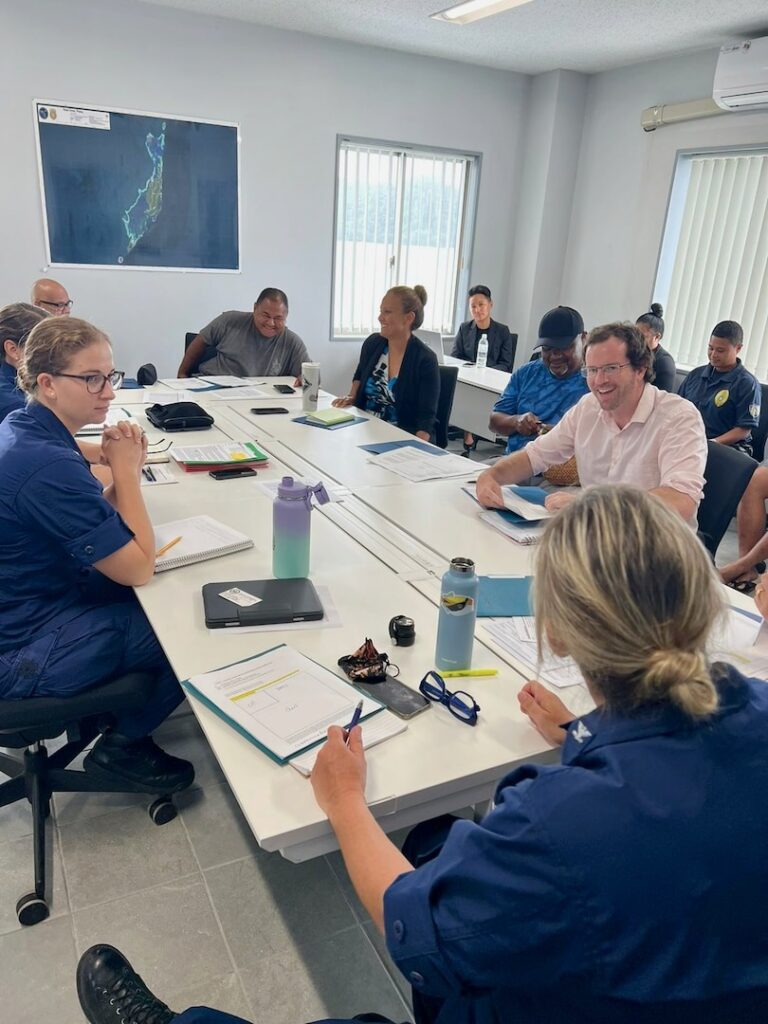
SANTA RITA, Guam — Following the signing of an expanded bilateral law enforcement agreement in August, during the Joint Heads of Pacific Security conference, representatives of the U.S. Coast Guard and the Republic of Palau embarked on a series of meetings and initiatives to advance maritime partnership and promote regional stability Oct. 6 to 13, 2023.
“Our work with Palau goes beyond signatures on an agreement; it’s about the actions we take together. It’s about standing side by side to safeguard our shared maritime environment and ensure regional security,” said Capt. Nicholas Simmons, U.S. Coast Guard Forces Micronesia/Sector Guam.
In a strategic effort to deepen collaboration and build stronger bonds, members of U.S. Coast Guard District 14 Legal and Intel, along with members of U.S. Coast Guard Forces Micronesia/Sector Guam’s Intel and Compact of Free Association departments, conducted an Enhanced Shiprider Tabletop Exercise in Palau with members of the government and local enforcement agencies. This tabletop exercise served as a platform for key stakeholders from both sides to lay the groundwork for future endeavors. They also met with the governor of the northernmost state, Ngaraard, Governor Sharp Sakuma, and the president of Palau Community College, Dr. Patrick Tellei.
Near future initiatives include:
– Palau Search and Rescue Exercise – Set to take place in early 2024, demonstrating our joint commitment to the safety of life at sea. – Enacting the Enhanced Agreement –U.S. Coast Guard asset crews in the region will seek to employ the enhanced bilateral agreement. – Ngaraard State Projects – Focusing on improving maritime safety by developing a better marking system for vessel traffic in Palauan waters. – Palau Community College – U.S. Coast Guard Academy presentation aimed at recruiting and fostering education among young talent while building skills for local residents to bring back to Palau.
The U.S. Coast Guard will also participate in the Palau Joint Committee Meeting scheduled for Nov. 15 to 17 in Palau, where, in addition to other items, discussions will consider the practical implementation of U.S. Coast Guard support to Palauan partners.
The Republic of Palau, known for its rich culture and stringent marine conservation laws, is committed to protecting its marine environment. With this partnership, the U.S. aims to support Palau’s efforts while also enhancing regional security.
About the Agreement
The enhanced bilateral agreement empowers the U.S. Coast Guard to enforce regulations in Palau’s exclusive economic zone (EEZ) without a Palauan officer present. It represents a significant step forward in our shared commitment to regional maritime security. However, it is essential to clarify that this agreement does not replace joint work with physical shipriders; instead, it augments enforcement capabilities.
This collaborative bilateral effort follows a similar agreement signed with the Federated States of Micronesia in October 2022. It is part of a broader strategy to strengthen regional security, including a bilateral defense agreement and bilateral maritime law enforcement with Papua New Guinea in May 2023, which enabled U.S. Coast Guard boarding officers alongside their Papua New Guinea counterparts to conduct boardings in PNG’s EEZ for the first time in over ten days at sea in August and September yielding four bilateral boardings, six observation reports, the identification of a vessel monitoring system violation and subsequent fine to the vessel operator by the PNG National Fisheries Authority.
Operation Blue Pacific
Through Operation Blue Pacific and Operation Rematau, led by U.S. Coast Guard Forces Micronesia/Sector Guam, the U.S. actively exercises maritime law enforcement agreements with Pacific Island Countries. These agreements reinforce maritime law enforcement operations, bolster maritime domain awareness, and contribute to security, safety, sovereignty, and economic prosperity throughout Oceania.
The U.S. Coast Guard’s shiprider program is a cornerstone of these efforts, aligning with the Pacific Partnership Strategy and embodying our commitment to maritime safety, security, and stewardship in Oceania.
“With this historic agreement and the ongoing collaboration, the U.S. reaffirms its presence in the Pacific, contributing to regional stability, security, and resilience. Collaborating with partners like Palau amplifies our ability to protect resources and maintain a free and open Blue Pacific for all nations that uphold the rule of law,” said Simmons.