Secretary of War Announces Marine Corps General Officer Nominations
From the Department of War, Feb. 25, 2026
Secretary of War Pete Hegseth announced today that the president has made the following nominations:
Marine Corps Brig. Gen. Robert B. Brodie for appointment to the grade of major general. Brodie is currently serving as deputy commanding general, III Marine Expeditionary Force and commanding general, 3d Marine Expeditionary Brigade, Okinawa, Japan.
Marine Corps Brig. Gen. Michael A. Brooks Jr. for appointment to the grade of major general. Brooks is currently serving as commanding general, Training Command, Quantico, Virginia.
Marine Corps Brig. Gen. Simon M. Doran for appointment to the grade of major general. Doran is currently serving as commanding general, Marine Corps Warfighting Lab, Quantico, Virginia.
Marine Corps Brig. Gen. Fridrik Fridriksson for appointment to the grade of major general. Fridriksson is currently serving as director, Manpower Management Division, Manpower and Reserve Affairs, Headquarters, Marine Corps, Quantico, Virginia.
Marine Corps Brig. Gen. Garrett R. Hoffman for appointment to the grade of major general. Hoffman is currently serving as director, White House Military Office, Washington, D.C.
Marine Corps Brig. Gen. Stephen J. Lightfoot for appointment to the grade of major general. Lightfoot is currently serving as commander, Naval Amphibious Forces Task Force 51 and commanding general, 5th Marine Expeditionary Brigade, Al Jasra, Bahrain.
Marine Corps Brig. Gen. Michael E. McWilliams for appointment to the grade of major general. McWilliams is currently serving as commander, Joint Enabling Capabilities Command, U.S. Transportation Command, Norfolk, Virginia.
Marine Corps Brig. Gen. David C. Walsh for appointment to the grade of major general. Walsh is currently serving as program executive officer, Air Anti-Submarine Warfare, Assault, and Special Mission Programs, Naval Air Systems Command, Patuxent River, Maryland.
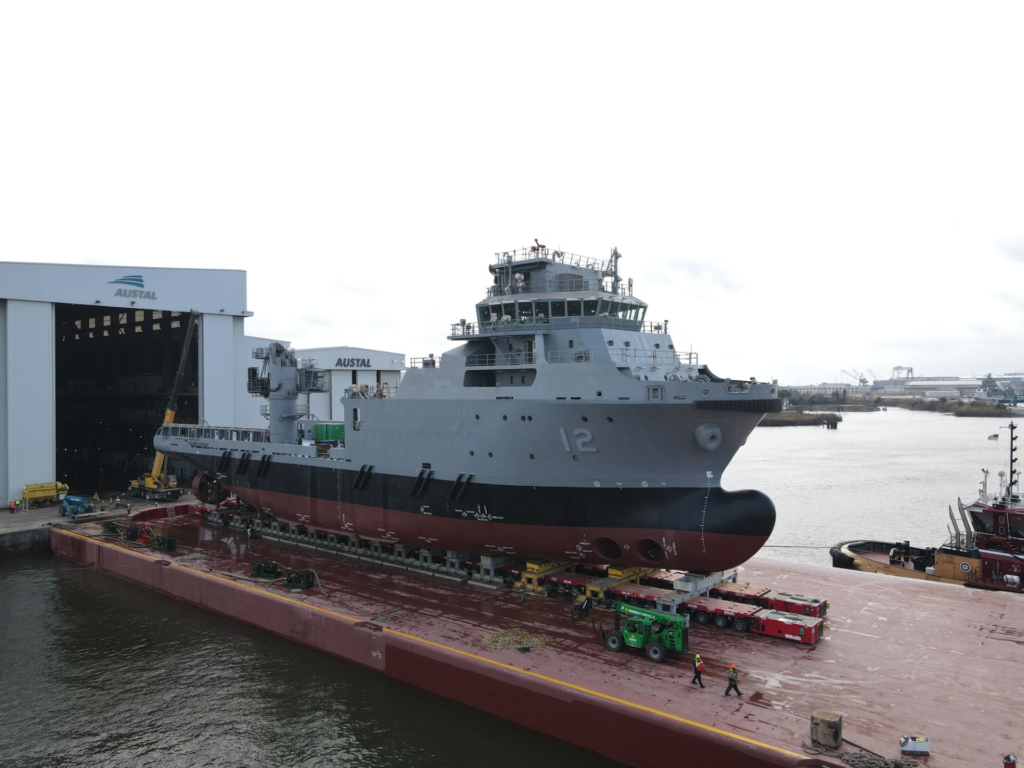
Austal USA Launches 2nd Navy T-ATS, the Future USNS Solomon Atkinson
MOBILE, Ala. –Austal USA successfully launched the company’s first ship of the year and second Navy Towing, Salvage, and Rescue Ship (T-ATS), future USNS Solomon Atkinson (T-ATS 12), on February 23. Named after a Native American who was a plankowner of the Navy SEAL teams and one of the service’s most decorated Alaska Native sailors, Soloman Atkinson is one of three T-ATS under construction at Austal USA and the first of two ships launched at Austal USA’s Mobile, Ala. ship manufacturing facility within less than a week.
“It’s always exciting to see these giants we build roll out of the assembly bay,” said Gene Miller, Austal USA’s interim president. “The completion of this milestone is the result of the hard work and dedication of our talented workforce and the strength of our maritime industrial partnerships key to success in this proven launch process. I am so proud of all they have accomplished.”
T-ATS will provide ocean-going towing, salvage and rescue capabilities to support fleet operations. T-ATS will be a multi-mission common hull platform capable of towing U.S. Navy ships and will have 6,000 square feet of deck space for embarked systems. The large, unobstructed deck allows for the embarkation of a variety of stand-alone and interchangeable systems. The T-ATS platform will combine the capabilities of the retiring Rescue and Salvage Ship (T-ARS 50) and Fleet Ocean Tug (T-ATF 166) platforms. T-ATS will be able to support current missions including towing, salvage, rescue, oil spill response, humanitarian assistance, and wide-area search and surveillance. The platform also enables future rapid capability initiatives such as supporting modular payloads with hotel services and appropriate interfaces.
With the ship over 75 percent complete at the time of launch, future USNS Solomon Atkinson will now prepare for her next major milestone, engine light off, as she gets ready for sea trials and delivery.
Secretary of War inducts Naval Aviator and Medal of Honor recipient into the Pentagon’s Hall of Heroes
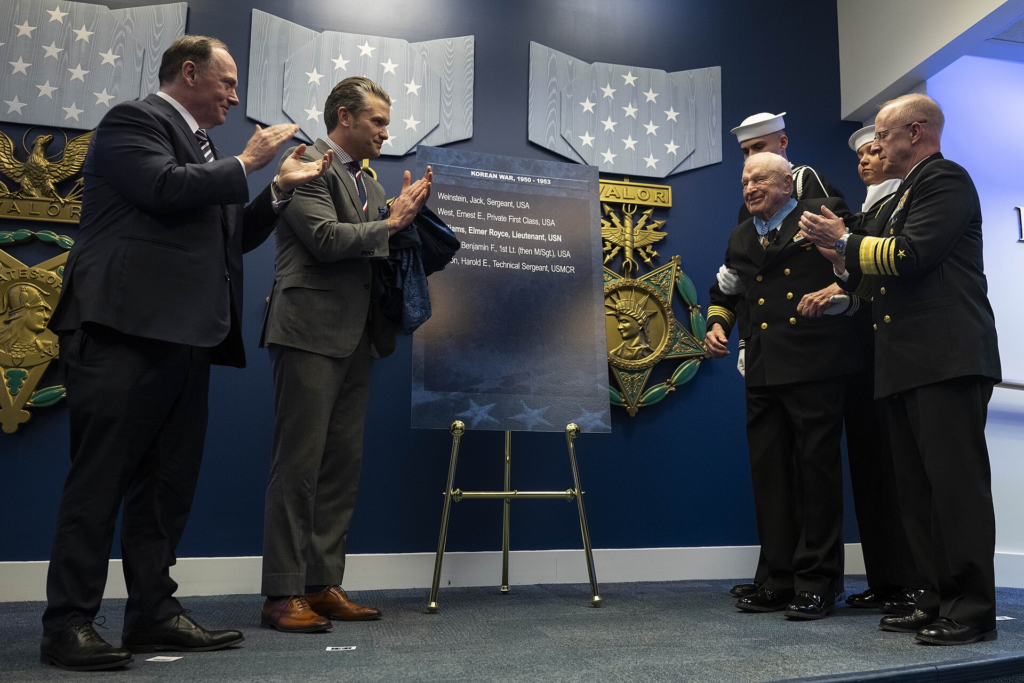
Secretary of War Pete Hegseth hosts Medal of Honor Recipient U.S. Navy Capt. Royce William’s Hall of Heroes induction ceremony at the Pentagon, Washington, D.C., Feb. 25, 2026. (DoW photo by U.S. Air Force Staff Sgt. Madelyn Keech)
From The Office of the Navy Chief of Information. Feb. 25, 2026
Last night President Donald J. Trump awarded retired Navy Capt. Elmer Royce Williams the Medal of Honor at the State of the Union address at the U.S. Capitol. Today, Secretary of War Pete Hegseth, Secretary of the Navy John Phelan, and Chief of Naval Operations Adm. Daryl Caudle inducted Williams into the Pentagon’s Hall of Heroes for his heroic actions during the Korean War.
“Captain Royce Williams did what warriors are called to do when the moment comes — he stood his ground, took the fight to the enemy, and protected his fellow Americans. Outnumbered, outgunned, and alone in the sky, he prevailed through sheer skill, courage, and will,” said Hegseth. “Today, we honor not just a remarkable dogfight, but a lifetime of quiet strength and service. Captain Williams embodies the fighting spirit of the United States Navy and the warrior ethos that keeps this Nation free.”
Williams was joined by an audience of family, friends, fellow Naval Aviators, and senior Navy leaders.
“Captain E. Royce Williams represents the very best of the United States Navy,” said Phelan. “On November 18, 1952, flying from USS Oriskany and outnumbered in the skies over North Korea, he chose to engage to protect the ships of Task Force 77 and the Sailors aboard them. In a 35-minute dogfight, he shot down three MiG-15s and severely damaged a fourth one. For decades, much of this story remained classified, but the facts never changed. His courage, airmanship, and devotion to duty saved lives and upheld the highest traditions of the Naval Service. Today, we are proud to formally recognize a Naval Aviator whose example will endure for generations.”
Yet when reflecting on that historic day and the recognition it brought, Williams did not speak of skill or courage, but of humility and faith.
“I know how momentous this moment is, and I never imagined myself or allowed myself to think it was going to happen to me,” Williams said. “I imagined it as God reaching in and dipping His hand in to pick somebody up for the most unusual reasons and displaying him in front of his fellow citizens.”
He continued, emphasizing that the honor was never something he expected or sought.
“And to be entirely amazed and appreciative for the accommodations and accolades. But that’s so unusual that you don’t fool around thinking that it’s ever going to come your way,” he said. “This is God doing something usual, with his finger in the pie, and with his influence. And what did I have to do with it? Well, I was the principal, in a way, that is receiving the recognition, but maybe some of that recognition misses the influence that really caused this special recognition.”
Williams was born in Wilmot, South Dakota and enlisted in the U.S. Army at 16 years old in Ortonville, Minnesota. Upon completion of basic training, he returned to Ortonville to train with his unit in a reserve status until he finished high school. Once he turned 17, Williams was eligible for the Naval Aviation Cadet program and joined the U.S. Navy where he began flight training in 1943. Among many other aviation platforms, Williams learned to fly the F9F-5 Panther jet and was assigned to active duty in the Korean War, during which he flew 70 missions. Williams went on to serve in the Vietnam War flying over 110 missions in the A-4 Skyhawk and F-4 Phantom from the USS Kitty Hawk (CV-63). Williams later served as the commanding officer of the command ship USS El Dorado (AGC-11) between September 1969 and January 1971. He retired from the U.S. Navy as a Captain in 1980.
His Medal of Honor is an upgrade of the Navy Cross he was previously awarded in January 2023, which was an upgrade to the Silver Star Medal he was previously awarded while assigned to the “Pacemakers” of Fighter Squadron 781 in 1953.
Joint Interagency Task Force Announces Counter-UAS Marketplace
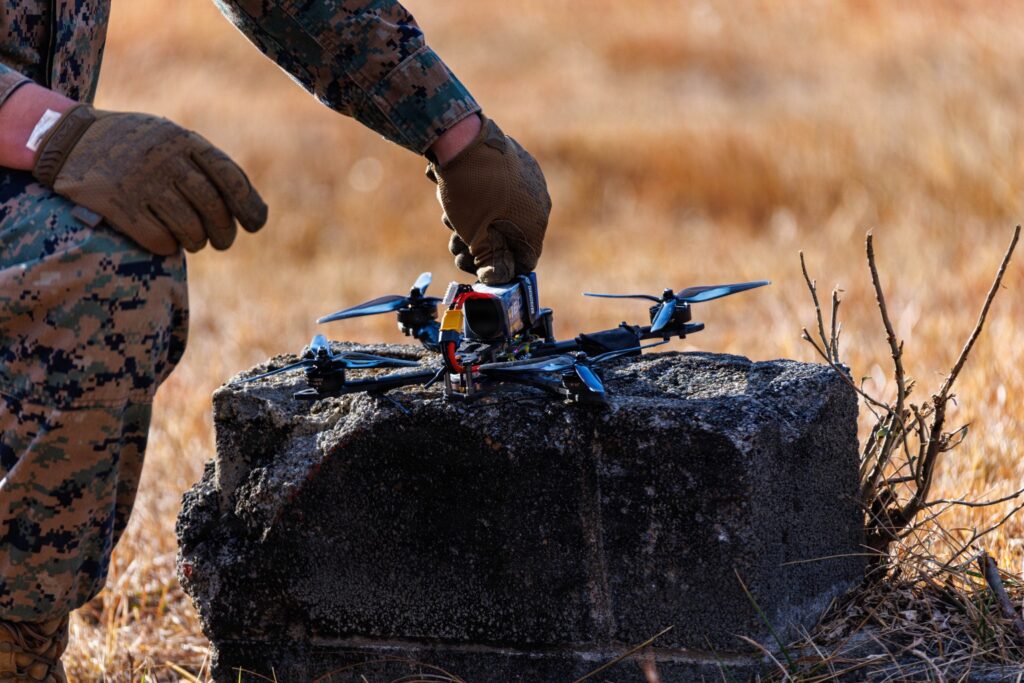
Marine Corps Lance Cpl. Bryen Z. Martinez, a military police officer assigned to the counter-unmanned aerial system’s counter-drone team, sets up a clay pigeon drone during a counter-UAS demo at The Basic School at Marine Corps Base Quantico, Va., Jan. 15, 2026.
By Joint Interagency Task Force 401, Feb. 24, 2026
Joint Interagency Task Force 401 announced today that its revolutionary counter-unmanned aircraft systems marketplace has reached initial operational capability.
The online platform, hosted on the common hardware systems electronic catalog, will revolutionize how the War Department and its interagency partners acquire critical counter-UAS technology.
The marketplace streamlines the process for users to identify and procure the right equipment to meet their specific needs, featuring a growing catalog of validated counter-UAS systems and components, with plans to include performance data from the task force’s authoritative test and evaluation repository. It allows customers to compare systems based on real-world performance against a variety of threats and in different environments.
“The JIATF 401 -UAS marketplace is a critical step forward in our whole-of-government approach to countering the threat of small drones,” said Army Brig. Gen. Matthew Ross, JIATF 401 director. “Our goal is to integrate sensors, effectors and mission command systems into a responsive, interoperable network that protects service members and American citizens alike.”
The marketplace is built on an established indefinite delivery, indefinite quantity contract, enabling customers to place orders immediately and significantly reducing the lengthy contracting process typically associated with defense procurement. The common hardware systems website provides an intuitive interface for users to browse available equipment, review technical specifications and compare pre-negotiated contract options.
“Building and maintaining the -UAS marketplace has been a collaborative effort focused on delivering a user-friendly and effective tool for the warfighter,” said Army Maj. Matt Mellor, the lead acquisitions specialist assigned to JIATF 401. “We’ve worked to create a platform that not only simplifies the procurement process but also provides the crucial data and expert support necessary for our customers to make informed decisions. This is about getting the best technology into the hands of those who need it as quickly as possible.”
The marketplace is actively expanding its inventory to include all validated counter-UAS equipment not already designated as a program of record. The common hardware systems electronic catalog already lists over 1,600 items, demonstrating its capacity to support a comprehensive, growing selection of counter-UAS solutions.
Access to the marketplace is available to users throughout the War Department and interagency partners via a common access card or other government-issued smart card.
CACI’s Spectral Program with the U.S. Navy Achieves Milestone C
RESTON, Va.–(BUSINESS WIRE)– CACI International Inc (NYSE: CACI) today announced the Spectral program has successfully completed rigorous review by the U.S. Navy’s Program Executive Office for Command, Control, Communications, Computers, and Intelligence (PEO C4I), achieving Milestone C. CACI partnered with PEO C4I’s Program Manager Warfare Battlespace Awareness and Information Operations Program Office (PMW 120), to achieve this historic accomplishment, marking the start of the program’s low-rate initial production (LRIP) and deployment phase, a defining step toward placing this critical electronic warfare (EW) technology in the hands of U.S. sailors.
“This recent milestone enables the delivery of modern, cutting-edge technologies that empower our warfighters to defend the nation from our adversaries and maintain decision superiority across every domain, especially the electromagnetic spectrum,” said John Mengucci, CACI President and CEO. “Our bold investments in technology and our world-class engineering team have led us to this critical milestone, a momentous leap forward for the Navy. I thank the Navy for entrusting CACI to strengthen their ability to defend the nation and prevail in contested environments, when it matters most – when the stakes are highest, and lives are on the line.”
As part of Milestone C, CACI and PMW 120 have executed several Iterative Capability Tests proving the functionality of the system which led to this decision by Milestone Defense Authority. Under the Spectral program, CACI will rapidly, and at scale, develop and deploy the next generation of shipboard signals intelligence and electronic warfare capabilities, effectively protecting warfighters from electronic attacks and adversarial threats.
Through software-defined systems and open architectures, CACI optimizes platforms with advanced electromagnetic warfare technologies that detect and exploit signals across the spectrum — enabling sensing, communications, and information operations.
Topping Out Ceremony Marks Investment in Future of Submarine Readiness
Stakeholders, engineers, and construction crew members pose for a group photo in front of the new Nuclear Regional Maintenance Department facility at Naval Submarine Base Kings Bay, Ga., Jan. 29, 2026. The group gathered to celebrate a topping out ceremony, marking a major construction milestone for the project. (U.S. Navy Photo by Yan Kennon)
From Jeffrey Hamlin, NAVFAC Public Affairs
A topping out ceremony was held Jan. 29 to mark a major milestone in the construction of a new facility for the Nuclear Regional Maintenance Department (NRMD) at Naval Submarine Base (NSB) Kings Bay, Georgia.
Hosted by Naval Facilities Engineering Systems Command (NAVFAC) Southeast, the event celebrated the placement of the final steel beam on the structure, symbolizing significant progress toward completion of a centralized, state-of-the-art facility designed to support critical maintenance and repair operations for Trident-equipped submarines.
A topping out ceremony is a tradition that dates back centuries to celebrate when a structure reaches its final height. While some ceremonies involve hoisting a tree or flag, the focus here was on the final beam itself, which was signed by the project’s stakeholders, engineers, and construction crews. Its placement serves as a powerful tribute to their hard work and signifies the successful completion of the structural phase.
“This topping out, just over a year after breaking ground, is a testament to the skill and dedication of our team,” said NAVFAC Southeast Executive Officer Capt. Elizabeth Durika. “This facility is a critical investment in our nation’s strategic deterrence, and this progress brings us one step closer to providing a state-of-the-art space to ensure our submarine force remains ready for decades to come.”
The construction has progressed rapidly since the project began. Lt. Cmdr. John Nurthen, construction management team leader, highlighted the significant accomplishments of the construction team.
“The sheer scale of work accomplished on this site is remarkable. Our partners have moved mountains, literally,” said Nurthen. “We removed and excavated over four feet of rock and soil from the entire project site, replacing nearly 35,000 cubic yards of unsuitable soils to create a stable foundation. We have erected over 530 tons of structural steel, drilled and placed nearly 3,000 concrete piles, and poured over 100,000 square feet of structural concrete. This milestone is a credit to the incredible effort of every worker on this project.”
The new $136 million facility was announced at a groundbreaking ceremony on Jan. 15, 2025. Its purpose is to consolidate NRMD operations, which are currently scattered across NSB Kings Bay in temporary locations and shared facilities. The centralized hub will include nuclear repair shops, ship services support areas, and applied instruction spaces, significantly enhancing communication and collaboration for the maintenance and repair of Trident-equipped submarines.
“Today’s milestone represents far more than the final beam being set in place; it marks a major step toward providing our skilled civilians and Sailors with a state-of-the-art workspace to support and sustain the nuclear propulsion plants that power our nation’s number one strategic deterrent,” said James Haas, director of the Nuclear Regional Maintenance Department. Haas emphasized the human element behind the achievement, adding, “This facility is an investment in our future and in the people who carry out this mission every day. We are grateful for the dedication of everyone in turning this dream into a reality.”
The project is being managed by NAVFAC Southeast with BL Harbert International as the primary contractor. It is scheduled for completion by December 2028.
Naval Facilities Engineering Systems Command Southeast, headquartered in Jacksonville, Florida, provides planning, design, construction, contracting, environmental services, public works, real estate and facility maintenance for the U.S. Navy, Marine Corps, Army, Air Force, Space Force, and other federal agencies across the Southeast. Its area of responsibility covers installations from Charleston, South Carolina, to Corpus Christi, Texas, and extends south to Guantanamo Bay, Cuba.
BAE Systems to install joint strike fighter capability aboard USS Iwo Jima
From BAE Systems Maritime Solutions. Feb. 23, 2026
BAE Systems’ Norfolk shipyard has received a $204.1 million U.S. Navy contract to provide maintenance services aboard the Wasp-class amphibious assault ship USS Iwo Jima (LHD 7).
Under the selected restricted availability (SRA) contract awarded, BAE Systems will upgrade shipboard systems to accommodate Joint Strike Fighter flight operations. Work aboard the 843-foot-long ship will begin in August.
“The USS Iwo Jima availability is welcomed work for our Norfolk shipyard team,” said David M. Thomas, Jr., vice president and general manager of BAE Systems Maritime Solutions Norfolk. “We are very familiar with performing modernization work aboard this class of ship. We will apply the lessons learned from current and past LHD-class work done within our shipyard.”
USS Iwo Jima is the third U.S. Navy ship named after the World War II battle. The current vessel was commissioned in June 2001.
The Norfolk shipyard is nearing completion of repairs aboard the lead ship of the amphibious assault ship class, USS Wasp (LHD 1).
BAE Systems Maritime Solutions is a leading provider of maintenance and modernization services to the U.S. Navy’s fleet of combatant ships; refit and hauling services for privately held leisure vessels and workboats; and fabrication services for U.S. submarine and ship builders. The company operates three full-service shipyards in California, Florida, and Virginia, and it employs a highly skilled, experienced workforce and a large team of suppliers and subcontractors.
Sigma Defense Secures 7-Year, $102M IDIQ Contract
From Sigma Defense
PERRY, Ga., Feb. 23, 2026 /PRNewswire/ — Sigma Defense is pleased to announce that SOLUTE, a Sigma Defense company, was awarded the Consolidated Afloat Networks and Enterprise Services (CANES) indefinite-delivery / indefinite-quantity contract for technical and programmatic services for networking, communications, and computer systems for Naval Information Warfare Center Pacific, San Diego, California. The three-year base contract is valued at $42M, and includes two, two-year option periods that can bring the overall value to $102M.
Ed Anderson, Sigma Defense Executive Vice President, stated, “We are excited for the opportunity to support CANES as the Navy’s foundational network environment afloat. Sigma Defense companies have a proven track record of systems modernization, software engineering and fleet support for the U.S Navy and this contract is the next step in delivering new capabilities for NIWC-PAC.”
Through CANES, Sigma Defense will support the design, integration, and testing of systems that are part of the CANES architecture, provide software engineering support, including development and updates for all CANES platforms, ensure systems modernization and provide fleet readiness support.
“Winning the CANES contract is a tremendous honor and a testament to our team’s deep commitment to advancing naval capability,” said Matt Jones, CEO Sigma Defense company. “We are proud to support the Navy’s mission by delivering secure, modernized network solutions that enhance fleet readiness and enable operational superiority across the globe.”
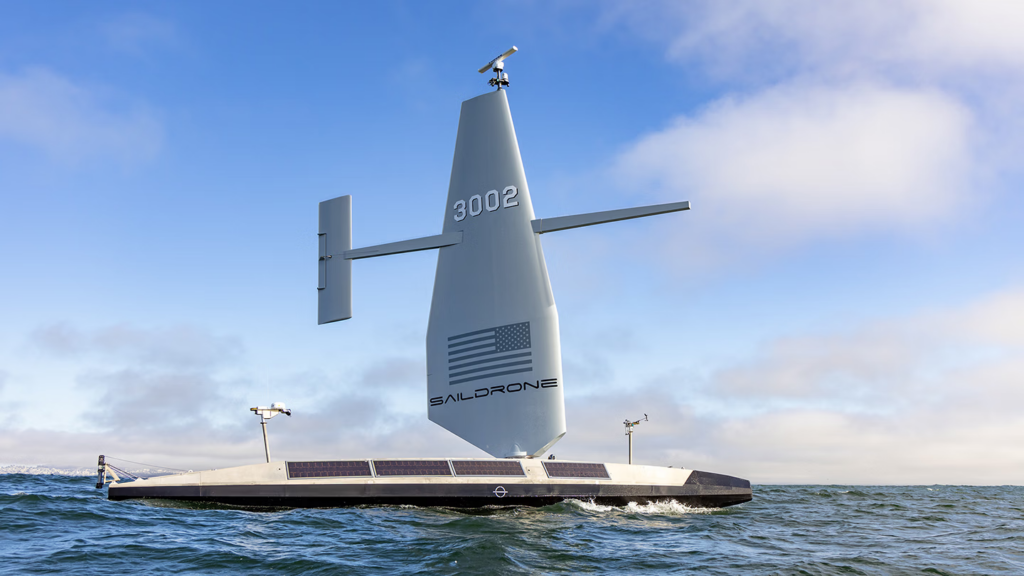
Woolpert, Saildrone Partner to Deploy Surveyor for NOAA Seafloor Mapping Project
From Saildrone, Feb. 24, 2026
The data collected will help enhance understanding of habitats, geohazards, and oceanographic conditions across 13,000 square nautical miles in the northwestern Pacific Ocean.
WASHINGTON — Woolpert and Saildrone have partnered to acquire and process bathymetric survey data for the National Oceanic and Atmospheric Administration (NOAA)’s Ocean Exploration and Office of Coast Survey in support of safe navigation and national ocean mapping initiatives, including the National Strategy for Mapping, Exploring, and Characterizing the United States Exclusive Economic Zone and Seabed 2030 initiative.
The Mariana Islands’ strategic location and vast marine ecosystems make it a critical region for monitoring and analysis. The data will be used by NOAA to help enhance its understanding of sensitive habitats, marine geohazards, oceanographic conditions, seafloor composition, and ecosystem management within the US exclusive economic zone in the vicinity of the Mariana Islands. It will also help expand taxonomic reference libraries for understudied marine organisms.
Woolpert, a leading provider of lidar and sonar bathymetry data, was selected by NOAA to map the seafloor off the eastern coast of the Mariana Islands. The firm partnered with Saildrone, which will use a 20-meter Saildrone Surveyor uncrewed surface vehicle designed for persistent maritime intelligence, surveillance, reconnaissance, and deep-ocean mapping.
The Saildrone Surveyor operates autonomously and delivers high-resolution bathymetric data in the world’s most challenging environments. Powered by a high-efficiency diesel engine augmented by the patented Saildrone Wing, the vehicle leverages auxiliary wind energy to maximize fuel efficiency. This dual-source power architecture enables the extreme range and persistence necessary for autonomous, long-duration deep-water ocean mapping.
This month, Saildrone began collecting high-resolution bathymetric data across the 13,000-square-nautical-mile area of the northwestern Pacific Ocean. Saildrone will transmit the data to Woolpert in near-real time for processing and final delivery.
“The seafloor mapping and exploration data that the Surveyor collects around the Mariana Islands will close critical bathymetric gaps in the United States’ exclusive economic zone,” said Brian Connon, vice president of ocean mapping at Saildrone. “The Surveyor’s ability to remain at sea for months at a time, regardless of weather conditions or sea state, makes it an ideal platform to carry out this vital work. Saildrone is proud to be working with both Woolpert and NOAA in these crucial efforts to better understand our ocean, marine resources, and ecosystem.”
Woolpert Maritime Market Director Dave Neff said the partnership shows how autonomous technologies are transforming the acquisition of hydrographic data for deep-ocean exploration.
“By integrating Saildrone’s mission portal with Woolpert’s automated survey production environment, we gain real-time visibility into acquisition progress and data quality—especially in deep-water regions that were once difficult and costly to access,” Neff said. “This collaboration shows how uncrewed systems and smart partnerships can expand what’s possible in ocean mapping.”
The contract is underway and is expected to conclude in May 2026.
The U.S. Coast Guard and Department of Homeland Security partner agencies interdict a suspected maritime smuggling vessel during coordinated operations south of San Clemente Island, California, Feb. 21, 2026. In total, crews interdicted five vessels and apprehended 62 aliens in under 90 minutes. (U.S. Coast Guard courtesy photo)
From U.S. Coast Guard Southwest District Public Affairs, Feb. 24, 2026
SAN DIEGO — The U.S. Coast Guard and Department of Homeland Security partner agencies, supported by the U.S. Navy, interdicted five suspected maritime smuggling vessels and apprehended 62 aliens during coordinated operations south of San Clemente Island, Saturday.
At approximately 12:30 p.m., watchstanders at the Sector San Diego Joint Harbor Operations Center received reports from a partner agency aircraft of three vessels suspected of smuggling illegal aliens, transiting northbound from Mexican waters. The vessels were described as 20-to-25-foot cuddy cabin-style boats carrying fishing gear and fuel barrels onboard.
The Coast Guard Cutter Haddock (WPB-87347) already on patrol in the area, launched a small boat crew to investigate the first vessel and conduct a boarding. Located approximately 26 miles south of San Clemente Island, the vessel was observed flying a U.S. flag and was compliant during the boarding. Haddock crews reported 10 aliens aboard the vessel, all claiming Mexican nationality.
A Department of Homeland Security partner agency aircraft located a second vessel of interest and directed a law enforcement crew to the vessel’s location, ultimately leading to a pursuit. Failing to comply with law enforcement commands to stop, warning shots were employed to compel the vessel’s compliance. The vessel complied, and 10 additional aliens were identified onboard, all claiming Mexican nationality. All 10 individuals were subsequently embarked aboard the Haddock.
A Department of Homeland Security partner agency vessel then stopped a third vessel suspected of smuggling illegal aliens. Nine additional aliens, all claiming Mexican nationality, were identified and safely embarked aboard the Haddock.
Additional reports of suspected smuggling vessels in the area prompted further response. A U.S. Navy helicopter and small boat crew from the littoral combat ship USS Augusta (LCS-34) with an embarked Coast Guard Maritime Law Enforcement Team (MLET) assisted in locating and interdicting a fourth cuddy cabin vessel. The Coast Guard MLET identified 16 aliens aboard the vessel, 14 claiming Mexican nationality and two claiming Colombian nationality. All 16 individuals were detained and transferred to the Sentinel-class Forrest Rednour (WPC-1129).
A fifth vessel was later intercepted by a Department of Homeland Security partner agency vessel, which employed warning shots to gain compliance after the vessel failed to obey law enforcement commands to stop. Seventeen aliens were aboard the vessel,16 claiming Mexican nationality and one claiming Guatemalan nationality. All were taken into custody.
In total, crews interdicted five vessels and apprehended 62 aliens in under 90 minutes. The Haddock and Rednour crews transported all aliens to Coast Guard Sector San Diego, where they were transferred to another Department of Homeland Security agency for further processing. One unaccompanied minor was identified among the group.
Department of Homeland Security partner agency personnel seized four of the five vessels. The fifth vessel, which was taking on water and determined to be unseaworthy, was left at sea.
The Coast Guard routinely conducts patrols alongside interagency and Department of War partners to detect suspected maritime smuggling operations and interdict illegal activity, while ensuring the safety of life at sea. This case is an example of the stellar partnerships and complex coordination required amongst all agencies involved.