Furuno Electronics Complement New NSMV Training Vessel “Empire State VII”
Release from Furuno
*****
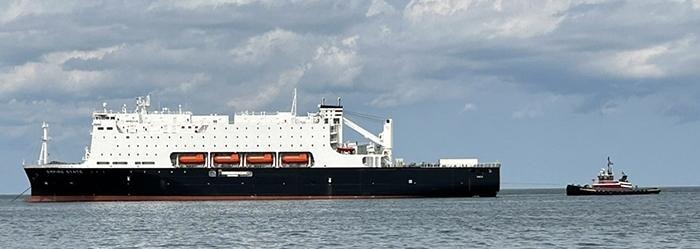
Orlando, FL - Philly Shipyard has delivered a new vessel purpose-built for training new cadets and officers who will ultimately crew both government and commercial-owned sealift ships. The 159.85-meter Empire State VII was built by TOTE Services, LLC under the NSMV (National Security Multi-Mission Vessel) program for the US Maritime Administration (MARAD) and boasts an incredible suite of quality Furuno marine electronics. The first of five new training vessels built in the United States for each of the state maritime academies in America, the Empire State includes a full training bridge and numerous training spaces, can accommodate over 600 cadets, and will be put into service at SUNY Maritime College in Fort Schuyler, N.Y. This remarkable training ship and instructional hub boasts a dual mission: facilitating the education of merchant mariners and providing vital aid in humanitarian and disaster relief operations during national crises.
The remarkable electronics suite aboard the Empire State includes redundant X-Band and S-Band Chart Radars, ECDIS stations, and multiple communications packages. The Furuno-built, industrial Linux-based operating system, dual redundant ethernet networks, and refined installation setup greatly simplified the project, allowing this sophisticated system to be ready to operate well ahead of schedule. Hundreds of hours were required to install and configure all of the Empire State’s components, and the new navigation and communications suite will provide a safe, steady, and versatile navigation and training workhorse for many years to come.
“The Empire State’s Integrated Navigation System is one of the largest and most comprehensive Furuno systems ever commissioned,” said Bill Haynes, Deep Sea Product Manager for Furuno USA, Inc. “Empire State sets a new standard for safety, functionality, and redundancy with dual bridges, three chart radars, ten multifunction workstations, Voyage Data Recorder, a complete acoustics suite, comprehensive Alert Management System, and dual GMDSS suites. Each workstation is ECDIS, RADAR, and CONNING capable, and both the navigation bridge and the training bridge have the tools they need to navigate safely and train our future navigation officers with the safest, most reliable, and functionally competent sensors and processors available.
“Furuno USA is very proud to have been selected to provide our equipment and services to support this fine vessel, and we’d like to thank the US Maritime Administration, TOTE Services, Philly Shipyard, and SUNY Maritime College for placing your trust in us.”
NSMV II, the second of the planned five vessels, is scheduled for delivery in 2024, and work is well underway for NSMV III and NSMV IV, with all five vessels to be completed and in service by 2026.
For more information on Furuno and their complete line of Marine Electronics, contact: Furuno U.S.A., 4400 N.W. Pacific Rim Blvd., Camas, WA 98607, or visit their website at www.FurunoUSA.com.
U.S. Navy breaks ground on new Regional Training Center (RTC) at IALR Campus
The new center will accommodate full-scale growth of the defense manufacturing training program, providing a pipeline of 800-1,000 skilled workers per year for high-demand jobs.
DANVILLE, Va. (October 11, 2023) – The United States Navy broke ground on a new regional training center for the Accelerated Training in Defense Manufacturing (ATDM) program in Danville today. The new 100,000-square-foot training facility, located on the campus of the Institute for Advanced Learning and Research (IALR), will allow more students to enroll in accelerated four-month training programs to help them reskill or upskill for high-paying jobs. Estimated to open by 2025, the Regional Training Center expects to graduate 800-1,000 students per year to fill critical vacancies across the defense industrial base.
The groundbreaking ceremony was held during the annual ATDM & U.S. Navy Additive Manufacturing Center of Excellence (AM CoE) Summit, which gathered the Navy, Office of the Secretary of Defense, state and local officials, and industry partners to increase awareness of these important initiatives and promote participation and contributions by industry and other stakeholders. This year, ATDM instructors and students were joined by Secretary of the U.S. Navy Carlos Del Toro and Rear Admiral Scott W. Pappano to celebrate the success of the past year and discuss goals going forward.
“The incredible progress made over the past year here in Danville, both in building the next generation of submarine builders at ATDM and in advancing the manufacturing technology we need to succeed at AM CoE, proved that we are on the right path,” said Rear Adm. Pappano, program executive officer, Strategic Submarines, U.S. Navy. “This past year established the foundation for the critical leaps forward we need in the coming years to scale both programs to ensure we have the skilled workforce with the technology and capabilities needed to build the Navy’s next generation of submarines.”
“The groundbreaking of the Regional Training Center is a key milestone in scaling ATDM by providing a dedicated training facility with the infrastructure and equipment necessary to reach our full capacity of training potential,” said Dr. Debra Holley, director of the ATDM program.
Darrell Daltan, chair of the Pittsylvania County Board of Supervisors, remarked that the construction of the Regional Training Center is a “win for our local economy, as it will bring up to 1,000 students a year to Danville and Pittsylvania County, and all of whom will live, work, and play here. By building its training facility in Danville, the Navy has provided a capital investment that further shows the growing prominence of this region in manufacturing and related industry sectors.”
“We are especially fortunate that the Navy has recognized the forethought of our local leaders who have worked over the years to create educational programs that emphasize the type of knowledge and skills needed for this program,” Dalton continued.
In partnership with the Industrial Base Analysis and Sustainment Program Office (IBAS) in the Office of the Secretary of Defense (OSD) and the Navy’s Program Executive Office (PEO) Strategic Submarines, ATDM trains workers in critical manufacturing skills to establish a steady and sustainable flow of workers into the SIB/DIB to fill critical skills gaps and labor shortages. The AM CoE directly supports the growth of our nation’s industrial base by using additive manufacturing for the production of submarine components to bolster naval shipbuilding and repair supply chains.
America’s defense industrial base (DIB) is still greatly in need of workers who can build and repair naval ships. The lack of workforce and manufacturing shortfalls in this area impact the material readiness of the current naval fleet; major maintenance and overhaul availability; and new construction. The construction of the “1 COLUMBIA + 2 VIRGINIA” naval ships beginning in FY26 will further stress the Submarine Industrial Base (SIB) and increase the need for qualified talent in the workforce. The AM CoE, which formally opened at last year’s summit, directly supports growth of our nation’s industrial base by scaling and maturing additive manufacturing technologies in the SIB. The technologies enable innovative production of submarine components to bolster naval shipbuilding and repair supply chains. As a result, the AM CoE will increase overall manufacturing capacity and close the supply-demand gap in critical marketspaces like castings, forgings, fittings, and fasteners.
The Institute for Advanced Learning and Research (IALR) has also been selected by the U.S. Navy Program Executive Office, Strategic Submarines (PEO SSBN) as the designated memorial location for the Ex-USS Buffalo (SSN 715) sail and the Ex-USS Providence (SSN 719) rudder to preserve and commemorate the history of these submarines and honor the service of their crews. This memorial demonstrates the strong partnership between the Navy and Accelerated Training in Defense Manufacturing (ATDM).
“Today marks a new chapter in the exciting growth of the ATDM program and further exemplifies the educational, workforce, and technological innovation that is taking place in Virginia. The investments made here are vital to the economic progress of the entire commonwealth,” said Telly Tucker, president of the Institute for Advanced Learning and Research, which leads the multi-year ATDM pilot project. IALR’s Center for Manufacturing Advancement is also home to the Navy’s AM CoE.
“The ATDM program marks a bold step forward,” said Danville City Councilman Lee Vogler. “This initiative stands at the forefront of addressing the challenges facing our defense industrial base and, by extension, our nation’s security.”
The sail was part of the Ex-USS Buffalo (SSN 715), a decommissioned United States Navy LOS ANGELES Class nuclear-powered attack submarine. USS Buffalo (SSN 715) was commissioned in November 1983, and decommissioned in January 2019. During that time, she saw most of her service in the Pacific area of operation.
The rudder hails from Ex-USS Providence (SSN 719), also a decommissioned United States Navy LOS ANGELES Class nuclear-powered attack submarine. Ex-USS Providence (SSN 719) was commissioned in July 1985. In August 2021, USS Providence was transferred from Naval Submarine Base New London in Groton, Conn., to Kitsap Naval Base in Bremerton, Wash., for decommissioning after 37 years of service.
To learn more about the new regional training center, or ATDM program classes and cohorts, please visit www.atdm.org.
CTF 150, U.S. Coast Guard Seize $25 Million in Illegal Drugs
Release from U.S. Naval Forces Central Command Public Affairs
*****
By U.S. Naval Forces Central Command Public Affairs | October 11, 2023
MANAMA, Bahrain —The U.S. Coast Guard Sentinel-class fast response cutter USCGC John Scheuerman (WPC 1146) seized about $25 million worth of illegal drugs from a stateless vessel while operating in the international waters of the Gulf of Oman, Oct. 3.
The cutter, working under the command of Combined Task Force (CTF) 150, seized 360 kilograms of methamphetamines, 107 kilograms of heroin and 1,961 kilograms of hashish from the vessel during an interdiction operation.
This event marks the second time in a month that CTF 150 has interdicted illicit narcotics at sea. Last month, the Royal Navy frigate HMS Lancaster (F229) seized more than 450 kilograms, or approximately $9.5 million, of illegal drugs including heroin and hashish during a CTF 150 operation in the Arabian Sea.
“This new seizure, the second since the French Navy took command of CTF 150 last July, again shows the commitment of Combined Maritime Forces working together to enhance maritime security in the Arabian Sea and Indian Ocean,” said French Navy Capt. Yannick Bossu, commander of CTF 150.
CTF 150 is one of five task forces under Combined Maritime Forces, the largest multinational naval partnership in the world. CTF 150 focuses on maritime security operations outside the Arabian Gulf.
Since 2021, Combined Maritime Forces has seized more than $1 billion in illegal drugs while patrolling waters across the Middle East.
The 38-nation naval partnership upholds the international rules-based order by promoting security and stability across 3.2 million square miles of water encompassing some of the world’s most important shipping lanes.
U.S. Coast Guard recovers remaining evidence from Titan submersible
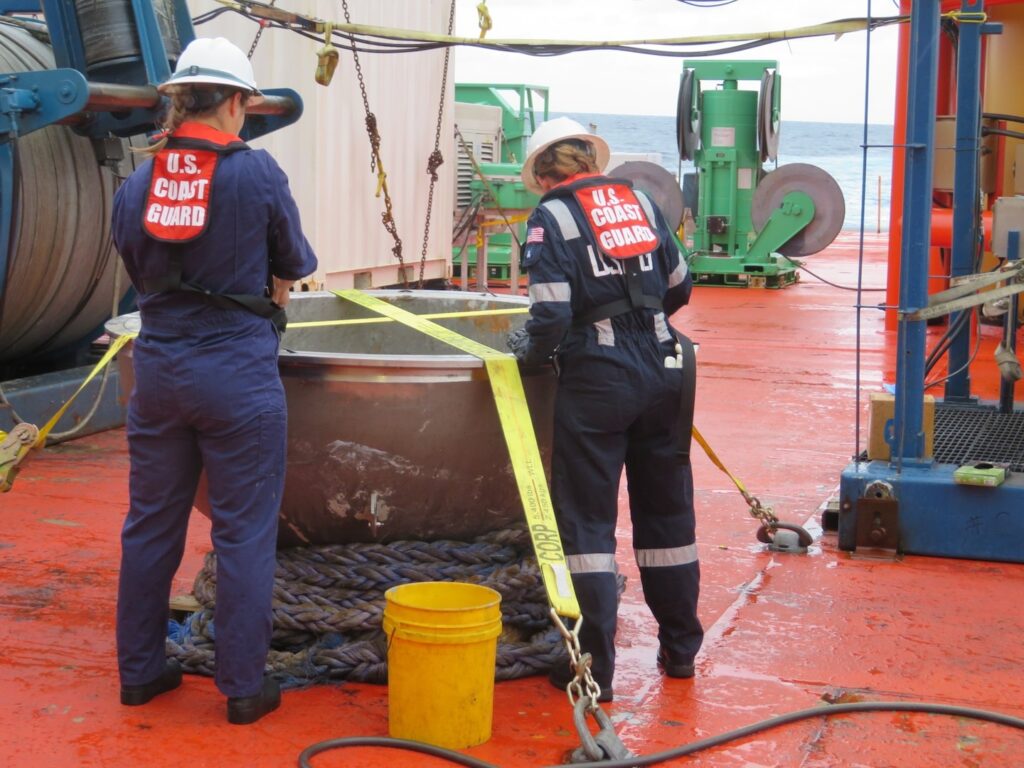
WASHINGTON – Marine safety engineers with the Coast Guard’s Marine Board of Investigation (MBI) recovered and transferred remaining Titan submersible debris and evidence from the North Atlantic Ocean seafloor, Oct. 4.
The salvage mission, which was conducted under an existing agreement with U.S. Navy Supervisor of Salvage & Diving, was a follow-up to initial recovery operations following the loss of the Titan submersible. Investigators from the U.S. National Transportation Safety Board (NTSB) and the Transportation Safety Board of Canada joined the salvage expedition as part of their respective safety investigations.
The recovered evidence was successfully transferred to a U.S. port for cataloging and analysis. Additional presumed human remains were carefully recovered from within Titan’s debris and transported for analysis by U.S. medical professionals.
The MBI is coordinating with NTSB and other international investigative agencies to schedule a joint evidence review of recovered Titan debris. This review session will help determine the next steps for necessary forensic testing.
The MBI will continue evidence analysis and witness interviews ahead of a public hearing regarding this tragedy.
Anyone wishing to provide information that may assist the Coast Guard MBI can submit it to [email protected]. Media may contact [email protected].
Dwight D. Eisenhower Carrier Strike Group to deploy
Release from the U.S. Navy Office of Information
*****
The Dwight D. Eisenhower Carrier Strike Group will depart on a regularly scheduled deployment, Oct. 13.
The flagship aircraft carrier USS Dwight D. Eisenhower (CVN 69), guided-missile cruiser USS Philippine Sea (CG 58) and guided-missile destroyer USS Gravely (DDG 107) are scheduled to depart from Naval Station Norfolk. USS Mason (DDG 87) will depart from Naval Station Mayport, Fla.
Along with the surface ships, the IKECSG is comprised of the Carrier Strike Group (CSG) 2 staff, the squadrons and staff of Carrier Air Wing (CVW) 3, Destroyer Squadron (DESRON) 22 staff and the Information Warfare Commander. In total, the strike group is a force of more than 5,000 Sailors, capable of carrying out a wide variety of missions around the globe.
Squadrons of CVW-3 include the “Gunslingers” of Strike Fighter Squadron (VFA) 105, the “Fighting Swordsmen” of Strike Fighter Squadron (VFA) 32, the “Rampagers” of Strike Fighter Squadron (VFA) 83, the “Wildcats” of Strike Fighter Squadron (VFA) 131, the “Screwtops” of Carrier Airborne Early Warning Squadron (VAW) 123, the “Zappers” of Electronic Attack Squadron (VAQ) 130, the “Dusty Dogs” of Helicopter Sea Combat Squadron (HSC) 7, the “Swamp Foxes” of Helicopter Maritime Strike Squadron (HSM) 74 and the “Rawhides” of Fleet Logistics Support Squadron (VRC) 40.
HII is Awarded $347 Million U.S. Navy Lionfish Small UUV Contract
Contract includes initial build of nine UUVs with potential for up to 200
MCLEAN, Va., Oct. 11, 2023 (GLOBE NEWSWIRE) — HII (NYSE: HII) announced today that its Mission Technologies division was awarded a contract to build nine small unmanned undersea vehicles (SUUV) for the U.S. Navy’s Lionfish System program. The contract has the potential to grow to as many as 200 vehicles over the next five years with a total value of more than $347 million.
The Lionfish System, based on HII’s REMUS 300, is a highly portable, two-person SUUV with an open architecture design and versatile payload options. In early 2022, REMUS 300 was chosen as the Navy’s official program of record for the next-generation SUUV.
Administered by Naval Sea Systems Command, this contract provides for the delivery and support of the Navy’s next generation SUUVs, as well as afloat and auxiliary support equipment and engineering services. The vehicles, incorporating the latest in autonomous and unmanned technology, will conduct critical undersea missions for the Navy.
“Lionfish provides increased capability and interoperability that aligns with the Navy’s undersea priorities, and we look forward to delivering next-generation vehicles that can readily adapt to and support a variety of mission needs,” said Andy Green, executive vice president of HII and president of Mission Technologies.
“We are pleased with the Navy’s decision to support a combat-proven technology, essential to the Navy’s undersea mission,” said Duane Fotheringham, president of Mission Technologies’ Unmanned Systems business group. “Our team is committed to delivering fully capable vehicles that will enhance the effectiveness of the warfighter against emerging threats.”
The Lionfish System was developed through an innovative process with the Department of Defense’s Defense Innovation Unit and the Navy that incorporated feedback from multiple user groups to uniquely meet the needs of the warfighters.
HII is the largest producer of unmanned undersea vehicles (UUV) worldwide. Serving customers in more than 30 countries, HII provides design, autonomy, manufacturing, testing, operations and sustainment of unmanned systems, including UUVs and unmanned surface vessels (USV).
Navy Hospital Ship Departs for Pacific Partnership 2024-1
San Diego (Oct. 11, 2023) – The Military Sealift Command hospital ship USNS Mercy (T-AH 19) departed San Diego, marking the beginning of Pacific Partnership 2024-1, Oct. 10.
The U.S. Navy will join allied and partner nation forces for the 19th iteration of Pacific Partnership, the largest annual multilateral disaster response preparedness mission conducted in the Indo-Pacific region. This annual maritime humanitarian and civic assistance mission focuses on improving disaster response preparedness, resiliency and capacity while enhancing partnerships with participating nations and civilian humanitarian organizations throughout the region.
For this year’s mission, medical and dental practitioners will be embarked on the 1,000-bed hospital ship. Aboard the Mercy, a combined 800 military and civilian personnel will support the multi-month mission led by U.S. Navy Capt. Brian Quin, PP24-1 mission commander, and Rear Adm. Mark A. Melson, PP24-1 executive agent under U.S. Pacific Fleet, and commander, Task Force 73.
“The Pacific Partnership mission teams work collectively each year with host and partner nations to strengthen existing regional interoperability, and increase disaster-response-capacity,” said Melson. “I am honored to be part of this year’s mission because this annual mission helps increase security and stability in the region, while fostering new and enduring friendships in the Indo-Pacific.”
The Pacific Partnership mission team aboard the Mercy will make stops in the Republic of the Marshall Islands, Solomon Islands, Palau, and the Federated States of Micronesia. Experts in the fields of engineering, medicine and disaster response will partner with each host to conduct civic-action projects, community health exchanges, medical symposiums, and disaster response training activities.
“This mission reflects the continued commitment to the region and dedication to disaster-response-readiness from the United States, our partners and allies, and the host nations,” said Quin.
Engagements between Pacific Partnership participants and host nations ensure the international community is better prepared to function together when responding to a disaster emergency by increasing capacity, enhancing regional partnerships, and increasing multilateral cooperation for disaster preparedness.
The Pacific Partnership began in response to one of the world’s most catastrophic natural disasters, the December 2004 tsunami that devastated parts of Southeast Asia. The mission has evolved over the years from emphasis on direct care to an operation focused on enhancing partnerships through host nation subject matter expert and civil-military exchanges.
TAMPA, FLORIDA (Oct. 7, 2023) – Arleigh Burke-class guided-missile destroyer USS Jack H Lucas (DDG 125) was commissioned at Tampa, Florida, Oct. 7.
DDG 125 is named for Pfc. Jack Lucas, who served in the U.S. Marines during World War II, earning the Medal of Honor for his heroism at Iwo Jima, when he was just 17 years old. He is the youngest Marine, and the youngest service member in World War II, to be awarded the United States’ highest military decoration for valor. In 1961, he returned to military service as a captain in the U.S. Army and trained younger troops headed for Vietnam. Lucas passed away on June 5, 2008, in Hattiesburg, Mississippi.
During the ceremony, guest speaker Under Secretary of the Navy, The Honorable Erik Raven wished the crew of Jack H Lucas fair winds and following seas as the ship begins its commissioned service.
“Commissioning the Jack H. Lucas means we continue to deliver fast, agile, and networked surface combatants to the Navy. The Jack H. Lucas is built to fight. It is a fast, maneuverable, versatile, and lethal ship – capable of tackling any mission it is given,” said Raven. “It will keep the Navy and Marine Corps adaptive and ready, and also uphold our commitment to maintaining the free flow of commerce, deterring military aggression, and facilitating quick responses to natural disasters across the globe.”
Ruby Lucas, one of the ship’s sponsors, and Jack’s wife at the time of his death, emotionally thanked the audience for coming to honor her husband before giving the order to “man our ship and bring her to life!” alongside co-sponsor, philanthropist Catherine B. Reynolds.
On behalf of the President of the United Sates and for the Secretary of the Navy, the 20th Sergeant Major of the Marine Corps, Sgt. Maj. Carlos Ruiz, USMC, placed the USS Jack H Lucas into commission.
“Something inside Lucas’ souls said, ‘I need to get to the fight.’ And fight he did,” Ruiz reflected. “The Navy and the Marine Corps team – our destinies are intertwined. The Navy, the ship, represents the perseverance of Americans. This beautiful ship represents the grit, the determination, of enlisted Marines, enlisted Sailors, and all of us that we will not give up until we win.”
“My charge to you and your team is to keep that tenacity, that toughness, and grit going because the challenges will keep coming,” Adm. Daryl Caudle, commander, U.S. Fleet Forces Command counseled Oster and his crew. “It will be hard, but I know that you and the 330 of the Navy’s finest Sailors are the team to do it. Your namesake, 17-year-old Medal of Honor recipient, Jack H Lucas, carried that same fiery passion.”
Capt. Brett Oster, Jack H Lucas’ commanding officer, recognized the driving force behind the ship’s namesake, and how his crew reflects that memory.
“There is something you can never, ever deny about Jack H Lucas. That man loved this country. That is why we’re here, because we love this country. You can never take that away – his dedication,” said Oster. “When you have a purpose, and you have dedication, and you have vision, and you have teamwork, anything that you set your sites on can come together.”
To cap off a week of special memories, three Sailors were meritoriously promoted at the close of the commissioning ceremony, Petty Officer First Class Boatswain’s Mate Victor Mejia, Petty Officer Second Class Boatswain’s Mate Lloyd Tillman, and Petty Officer Third Class Damage Controlman Ruben Rubio.
Today’s commissioning ceremony is the culmination of five years of work from everyone involved in the construction of Jack H Lucas, its operations, and all those involved in bringing the ship to life.
The city of Tampa and its residents welcomed the ship and its crew with events throughout the week. Along with other residents, family, and friends, the Tampa Lightening toured the ship to see the new technology aboard the first Flight III Arleigh Burke guided-missile destroyer. In turn the Lightening invited the crew on the ice not only to present their ship’s color guard, but to introduce the Jack H Lucas’ first, new chief petty officers. Local restaurants opened their kitchens to the ship’s culinary specialists, teaching the Sailors advanced techniques used for the chef’s dining rooms.
Honoring the whole of Lucas’ life, his widow Ruby, The Trail of Honor Foundation, and Flags of Honor Escort presented the ship with a vest adorned with his Medal of Honor. The vest traveled to Jack’s gravesite in Hattiesburg, Mississippi; numerous locations and Memorials to include the United States Marine Corps War Memorial and the World War II Memorial; the Never Forget Flag travelled to or thorough 20 states and the District of Columbia, amassing a total of 11,325.8 miles as part of Jack’s Vest Run before the presentation earlier this week.
The ship’s motto, “Indestructible” is reflection of Lucas’ survival, first on Iwo Jima and later from several other traumatic events after the war that rivaled his exploits as a Marine.
Arleigh Burke-class guided-missile destroyers are the backbone of the U.S. Navy’s surface fleet. These highly capable, multi-mission ships conduct a variety of operations, from peacetime presence to national security providing a wide range of warfighting capabilities in multi-threat air, surface and subsurface. The Flight III upgrade is centered on the AN/SPY-6(V)1 Air and Missile Defense Radar and incorporates upgrades to the electrical power and cooling capacity.
USS Jack H Lucas is the first AEGIS Weapon System, Baseline 10, to be commissioned. It integrates air and missile defense capability with the new AN/SPY6(V)(1) air and missile defense radar to provide significantly greater detection and tracking capacity among its warfighting capabilities across mission areas. Flight III also incorporates upgrades to the electrical power and cooling capacity, plus additional associated changes to provide enhanced warfighting capability to the fleet.
The mission of CNSP is to man, train, and equip the Surface Force to provide fleet commanders with credible naval power to control the sea and project power ashore.
Teledyne FLIR Defense Unveils New Black Hornet 4 Personal Reconnaissance System
Release from Teledyne FLIR Defense
*****
Next gen nano-drone builds on battle-proven Black Hornet 3 legacy;
Delivers improved range, endurance, signature and imagery data while providing covert situational awareness to warfighters
WASHINGTON, DC, October 10, 2023― Teledyne FLIR Defense, part of Teledyne Technologies Incorporated (NYSE:TDY), is introducing its new Black Hornet® 4 Personal Reconnaissance System at this week’s Association of the U.S. Army (AUSA) conference in Washington D.C.
Black Hornet 4 represents the next generation of lightweight nano-drones, building on its predecessor to deliver enhanced covert situational awareness to small units. A new 12-megapixel daytime camera with superior low-light performance, plus new high-resolution thermal imager, deliver crisp video and still images to the operator. At just 70 grams, Black Hornet 4 has a flying time of more than 30 minutes, range greater than two kilometers, and can fly in 25-knot winds. Flight performance has been augmented by new obstacle avoidance capabilities and an advanced battery.
Compared to small quad-rotor drones, the single rotor Black Hornet 4 unmanned aerial vehicle (UAV) has an extremely low visual and audible signature, enabling it to identify threats day or night without being detected. Able to launch in less than 20 seconds and well suited for missions in GPS-denied environments, the Black Hornet 4 UAV can be used to rapidly identify targets beyond visual line-of-sight and assess weapon effects in real-time.
“Black Hornet 4 takes the features and capabilities that made Black Hornet 3 world renowned to the next level,” said Dr. JihFen Lei, executive vice president and general manager of Teledyne FLIR Defense. “We’ve worked closely with customers and end users to make this system even more valuable for dismounted soldiers in need of situational understanding or engaged in covert operations, where precise and immediate intel is crucial.
“Black Hornet 4 is future-proof nano-drone technology,” Lei added.
FLIR Defense has delivered more than 20,000 Black Hornet PRS systems to military and security forces in over 40 countries. Black Hornet drones are currently being used in Ukraine through donations made by the British and Norwegian governments, where they have performed successfully in numerous missions under the harshest of environments.
The U.S. Army began acquiring Black Hornets five years ago as part of its Soldier Borne Sensor program and since then has placed orders totaling more than $125 million. In July, the Army awarded Teledyne FLIR a five-year contract worth up to $94 million for additional Black Hornet systems.
General Dynamics Electric Boat and the Metal Trades Council Agree to a New Contract
Release from General Dynamics Electric Boat
*****
GROTON, Conn. (October 6, 2023) – General Dynamics Electric Boat, a business unit of General Dynamics (NYSE: GD), and the Metal Trades Council (MTC) announced today union members ratified a new, five-year collective bargaining agreement. The MTC represents more than 3,400 employees in the skilled trades at the company’s Groton shipyard which includes welders, electricians, machinists, pipefitters, laborers, painters, transportation services and administrative support.
The agreement provides for significant increases in compensation and benefits, including:
General wage increases for all MTC members totaling 21.4% over the term of the contract.
Retention and sign on bonuses with the opportunity to earn up to $6,000.
A one-time, $2,500 contribution to the employee’s 401k retirement savings account.
Continuation of a comprehensive, competitive medical plan with modest premium and deductible increases.
Increases to vacation days and paid sick time for most members.
The contract is effective as of September 30, 2023.
“This is the largest wage package in more than 30 years and demonstrates the value we place on the skills and experience necessary to build the world’s finest submarines,” said Kevin Graney, president of General Dynamics Electric Boat. “This investment in our people complements investments by General Dynamics in our facilities and infrastructure and is a key element of our strategy to grow our production rate to deliver more submarines faster to the U.S. Navy.”
“Ratification of this robust contract is a five-year ironclad guarantee of economic security for the Electric Boat metal trades workforce, which they richly deserve. It also sends a powerful message to the Navy and Congress, who fund their work, that the Groton waterfront is in for the long haul as our nation grows its undersea fleet, a decades-long enterprise. Kudos to Peter Baker and the Metal Trades Council team, and Shawn Coyne from Electric Boat Human Resources who spent months hammering out the many details of this historic contract,” said U.S. Rep. Joe Courtney (CT-02).
“This new agreement will help attract and retain new employees while providing for the current membership,” said Peter Baker, president of the Metal Trades Council. “This will also provide Electric Boat with a stable workforce that will continue to build our nation’s defense. We want to thank the membership for their support throughout the negotiations process.”
Electric Boat is in the midst of an unprecedented expansion to increase production of Virginia-class fast-attack submarines and the Columbia class of ballistic missile submarines. The company is the prime contractor for the Columbia class, designated by the U.S. government as the nation’s number one defense priority. Electric Boat plans to hire 5,750 new employees in 2023. Interested applicants should visit EBCareers.com to see available positions.