Available with Company’s Market-Leading TENUM 1280 High-Performance Infrared Imager
ARLINGTON, Va.– Sep. 11, 2023– Leonardo DRS, Inc. (NASDAQ: DRS) announced today that it is releasing its next-generation 5-inch stabilized, multi-sensor EO/IR payload gimbal, with market leading high-definition nighttime imaging capability.
The Small Unmanned Aircraft System Tactical Agile Gimbal (STAG)-5 LLD gimbal is designed for small, unmanned aircraft systems, including common launch tube UASs, small tactical multirotor UAVs, and light fixed-wing aircraft and helicopters.
The STAG-5 LLD is the latest advancement in the DRS STAG-5 family of gimbals designed for Class 1 UAS platforms used across the U.S. military for a range of missions. The gimbal provides a combination of the newest small high-performance sensors including high-definition electro-optical, high-definition long-wave infrared, short-wave infrared, laser range finder and a laser target designator. The gimbal systems are highly stabilized, Modular Open Systems Architecture (MOSA) compatible, less than 6” diameter and weigh under five pounds. STAG-5 LLD delivers higher performance through significant savings in weight and volume over current competitor products.
The high-definition long-wave package includes the industry leading DRS TENUM 1280 10-micron uncooled camera core. TENUM is a commercial off-the-shelf sensor providing ultra-high resolution and long-range imaging performance in a small package.
“Adding this high-performance gimbal for day and night use to our STAG-5 family of systems provides the warfighter a market leading capability to improve airborne operations, including JTAC missions, from small, highly portable UAV platforms,” said Jerry Hathaway, senior vice president & general manager of the Electro-Optical & Infrared Systems business. “We are proud of our innovative team that developed this breakthrough capability, it offers UAS primes, operators, and end-users a new choice to improve their intelligence surveillance reconnaissance-targeting mission execution and effectiveness.
Kongsberg Maritime’s Promas propulsion system now available for navy vessels
The Promas propeller and rudder system delivers increased fuel efficiency, better manoeuvrability and extended range for naval platforms
DSEI 2023, 12th September 2023 – Kongsberg Maritime has concluded a research programme that shows its Promas propeller and rudder system can deliver a host of benefits for naval platforms including significant fuel savings, greater range and improved manoeuvrability.
Originally designed for commercial ships, Promas combines rudder and propeller into one propulsion system. Most naval twin-screw vessels use conventional rudders placed off-centre from the shaft centreline. Promas can deliver fuel savings of more than 5% which can translate into increased range, boosting the capability of naval platforms.
The research, carried out by Kongsberg’s Hydrodynamic Research Centre (HRC), has shown that naval vessels relying on traditional rudder and propeller systems can increase their efficiency and manoeuvrability with the adoption of the Promas propeller and rudder system.
The HRC tested and compared the Promas bulb-rudder system, and the conventional off-centre rudder system used by navies on a typical naval aft ship dummy design. The dummy design consisted of an open shaft configuration with V-bracket and high shaft inclination angle to produce a typical wake field for a naval twin screw vessel.
The tests compared propulsive efficiency, rudder forces, cavitation inception speed, cavitation, pressure pulses, and noise levels between Promas and conventional navy propulsion for ship speeds up to 25 knots. At 25 knots, the Promas system reduced power consumption by 6%. The rudder forces with Promas are also much higher. The system demonstrated less drag at small rudder angles and a higher lift at larger angles than a conventional navy system. This improves slow speed and harbour manoeuvring.
Patrik Kron, Kongsberg Maritime’s Chief of Naval Systems, said: “We’ve known for many years how Promas brings a quick improvement in efficiency for commercial operators, and this latest research demonstrates how these benefits can be offered to our governmental customers.
“By being able to demonstrate an improved efficiency of around 6%, for navies, this means their vessels are able to extend their range, something which can be crucial on longer missions.
“We know there is a large market for grey and light grey ships operating up to 25 knots, so our initial research has focussed on that speed range, but we’re continuing our research to consider how Promas could enhance the operational capability of combatants which operate at up to 30 knots”.
Undersea Technology Innovation Consortium Launches Inaugural ‘UTIC Challenge’ in AUKUS Countries
Academic Institutions in Australia, the United Kingdom, and the United States
are Invited to Participate
The Undersea Technology Innovation Consortium (UTIC) has announced the first UTIC Challenge. The inaugural challenge calls on academic institutions to propose innovative workforce development strategies in the undersea technology sector/field.
The challenge is open to teams from academic institutions located in Australia, the United Kingdom, and the United States and is designed to promote continued collaboration among the three nations participating in the AUKUS agreement.
In 2021, the AUKUS agreement established a tri-lateral security pact between Australia, the United Kingdom, and the United States. The agreement promotes information and technology sharing and fosters integration of related undersea technology science and technology, industrial bases, and supply chains.
“The partnership between Australia, the United Kingdom, and the United States is an opportunity to share both physical resources and intellectual capital to improve security and trilateral ties. Maintaining long-term growth and innovation within AUKUS will require developing the future workforce. Industry and academia will need to partner to build a solid foundation for the next generation of innovators and manufacturers,” stated U.S. Senator Jack Reed, Chairman of the Senate Armed Services Committee.
Participating teams will choose one of two categories for their response to the inaugural challenge. Based on their choice, teamswill submit a position paper outlining their approach and strategy. The two categories are:
Strengthening the training environment for current/future technologists who develop critical undersea technology.
Strengthening the training environment for manufacturing professionals who build and support undersea technology applications.
UTIC will choose at least one winning team per category. Each winning team will receive a $15,000 award to be used for related scholarships or similar academic program investments, and their submission will be published and recognized on underseatech.org.
“UTIC looks forward to collaborating with academic innovators to foster sustainable growth in the undersea technology workforce. AUKUS countries continually cultivate forward thinking, creative maritime defense professionals, and the goal of the UTIC Challenge is to expand upon this tradition,” said Molly Donohue Magee, UTIC executive director.
Timing for the challenge is:
Launch and Expressions of Interest – September 2023
Questions and Answers/ Submissions – October – December 2023
NAVAL STATION MAYPORT (Sept. 8, 2023) – Freedom-variant littoral combat ship (LCS) USS Milwaukee (LCS 5) was decommissioned in Mayport, Fla., September 8.
As an operational unit, Milwaukee and its crew played an important role in the defense of our nation and maritime freedom. Milwaukee and its Sailors were key to determine the operational success and deployment capabilities of today’s LCS platform.
During the ceremony guest speaker, Vice Adm. Dirk Debbink (USN, Ret), former chairman of Milwaukee’s commissioning committee wished the crew of Milwaukee fair winds and following seas as they bid farewell to their ship.
“We are all very proud of the way this ship served our Navy and our nation since that cold day in November 2015.” said Vice Adm. Dirk Debbink (USN, Ret), former chairman of Milwaukee’s commissioning committee. “She was the first true serial production ship of the Freedom Class, having incorporated literally hundreds of changes, lessons learned from Freedom and Fort Worth.”
Milwaukee and its Sailors contributed a tremendous amount of work and time to ensure success of the LCS program during the ship’s time in naval service. Milwaukee completed two successful deployments in April 2022 and June 2023. The ship deployed to U.S. Fourth Fleet and integrated with the embarked US Coast Guard Law Enforcement Detachment (LEDET), other US warships, Department of Defense, Department of Justice, Department of Homeland Security, and SOUTHCOM/JIATF-S. During their second deployment, Milwaukee and her embarked LEDETs, seized an estimated $30 million in suspected cocaine and three detainees during interdictions as sea, preventing 954kgs of cocaine from entering the United States. She also transported six detainees and case packages on behalf of USCGC BEAR in support of the counter-narcotic/interdiction mission. While deployed, Milwaukee provided maritime security presence enabling the free flow of commerce in key corridors of trade.
“Throughout the life of the ship, the Sailors that sailed Milwaukee led the way in training and operations that led to fleet improvements and culminated with operational success that supported national security objectives and demonstrated U.S. commitment to our allies.” said Cmdr. Jason Knox, Milwaukee’s commanding officer. “Not only can her Sailors be proud of their distinctive accomplishments, but the City of Milwaukee, Wisconsin can be proud of their ship, too.”
Milwaukee was designed by Lockheed Martin and constructed by Marinette Marine Corporation (Fincantieri) Marinette, Wisconsin, Milwaukee was commissioned November 21, 2015, in Lake Michigan at Milwaukee’s Veteran’s Park. Mrs. Sylvia Panetta, wife of former Secretary of Defense Leon Panetta, served as the ship’s sponsor.
USS Milwaukee (LCS 5) is the fifth United States Navy Warship named after the city of Milwaukee, Wisconsin. The ship represents the proud people of the Milwaukee community. Upon decommissioning, Milwaukee’s Sailors will receive follow-on orders to new assignments.
LCS are fast, agile, mission-focused platforms designed to operate in near-shore environments, winning against 21st-century coastal threats. LCS are versatile and are capable to support a broad spectrum of fleet missions and operate alongside regional navies and coast guards while supporting forward presence, maritime security, sea control, and deterrence missions around the globe.
This is the anniversary of the 9/11 terrorist attacks on America, and on the world.
Once again, it is a day to reflect and remember. In fact, we who experienced the events of that day in any way must remember and share, lest we not forget. If you don’t know about what happened that day, then you must become educated, and made aware of the events of that day in New York, Washington and Somerset County, Pennsylvania. It was an attack driven by hate, and an attack on all of us.
There is a saying that you die three times: when you take your last breath; when they cover your grave after your funeral; and when your name is uttered for the last time.
This is what I remember, and what I choose to reflect upon every year on this day. You will indulge me, I hope, because it is necessary for me to share this with others and share it every year on this day for as long as I can do so. It is the least I can do for a shipmate.
So, join me in saying his name: Michael Noeth.
*** Linseed oil:
Some things have an evocative smell.
When I was in command of the Naval Media Center in Washington, D.C., the executive officer of a ship based at Pearl Harbor – USS Russell (DDG 59) – called my staff at All Hands magazine in our Publishing Department. The XO had a Sailor aboard the ship who wanted to be a draftsman.
The “undesignated seamen” or SNs on a ship usually work in the deck force, chipping paint and handling lines. As they see what professional opportunities are available on board their ship, they can “strike” for a rating, like Radioman or Quartermaster. A “Striker Board” will convene and review the needs of the ship, and the desires of the individual. If the Sailor is squared away, has done a good job with the deck force and the ship needs a Quartermaster (QM), for example, he or she can strike for that rating, and becomes a QMSN.
Seaman Michael Noeth wanted to be a Draftsman. The DM rating was one of the smallest ratings in the Navy. There were very few of them compared to Gunner’s Mates or Machinist’s Mates, and certainly none aboard a surface combatant. In fact, today the rating has been disestablished and the functions combined into the Mass Communications Specialist (MC) rating.
In this case, the executive officer wanted to do something good for his Sailor. And this was extraordinary, because USS Russell was about to depart on deployment. In spite of the fact that the ship was about to be on cruise for six months, the XO called us and asked if his Sailor could come and work with us to learn the DM rating so he would be prepared to take the DM test for Third Class Petty Officer. If he passed, he could become a DM3. If not, he could return to the ship and eventually strike for another rating. For our part of the deal, we had to cover his travel expenses. We said yes.
There are never enough Sailors in the Deck Force, especially on deployment, but the XO wanted to help a Sailor. So, SN Michael Noeth came to work for us in the Publishing Department at the Naval Media Center in Washington, D.C.
He was placed under the expert tutelage of our Draftsman First Class (DM1) Rhea Mackenzie. Seaman Noeth quickly made himself at home in a back corner of the All Hands magazine production spaces. And it was here he set up his easels, canvasses a and paints. When I would come by — which was often, because I was always wandering around Building 168 to see all of the interesting stories and projects our people were working on — I could smell the linseed oil he used for his brushes long before I reached his work area. He would have various canvasses and illustrations in various stages of completion posted around his desk, as well as examples of artwork he admired or wanted to emulate.
As one of the 450 men and women of the Naval Media Center, he learned his trade from an experienced draftsman, created artistic content for All Hands magazine, and became a well-liked and contributing member of the command. At our Halloween party, he came in second place in our costume contest. He was a dead ringer “Alex” from Clockwork Orange, and was topped only by an even more convincing Cruella Deville from 101 Dalmatians.
Whenever I got near his work area, I would be greeted by the smell of his linseed oil, and I knew I would be in for some kind of surprise. Seaman Noeth painted the cover for several issues of All Hands magazine (such as the one with a cut-out porthole that opened to an ocean panorama. To see him tackle these assignments was a joy, probably because he was enjoying his work, and appreciative of the opportunity. On my visits, I would see the many versions and sketches he was working on, and I could see it all come together with the finished product.
He took the advancement exam and passed it. As his six-month temporary assignment came to an end, his command allowed him to transfer to my command on a permanent basis as they did not have any billets for a draftsman, and we did. Soon, he moved on to other Navy assignments as a Draftsman, all because his ship wanted to give him a chance to realize his dream, and my command wanted to help him get there. We felt good about helping him attain his goal. But most of all, because he was a Sailor who deserved it.
He did, indeed, become a talented Navy illustrator and draftsman. He served aboard amphibious assault ship USS Wasp (LHD 1), and was later assigned to the Navy Command Center where he skillfully created briefings and presentations for Navy leadership. He was doing just that on September 11, 2001, when terrorists forced an airliner to crash into that building.
We must not forget. So, I choose to remember a bright, ambitious, creative young striker today, and whenever I smell linseed oil.
Kongsberg Maritime, a global leader in marine technology and solutions, announces a ground-breaking Mission Bay Handling System for naval vessels
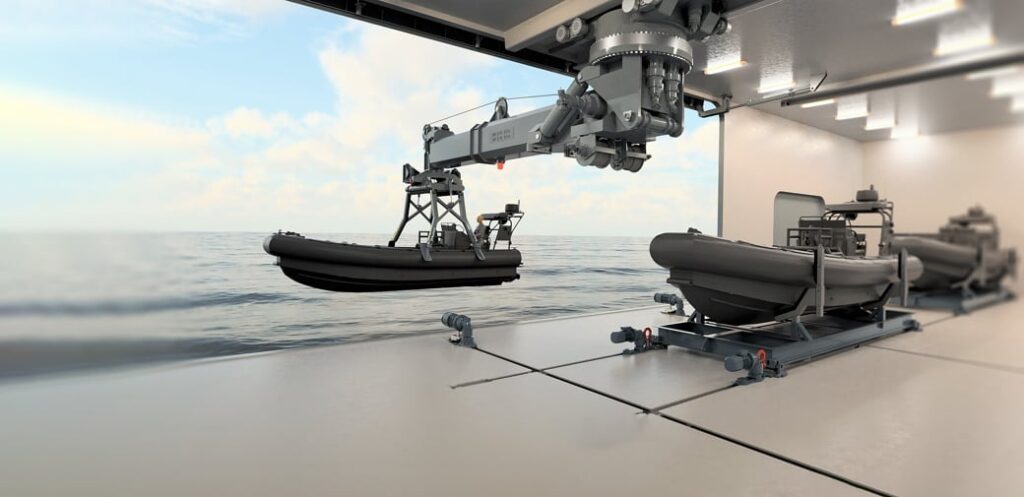
DSEI, London – 11th September 2023- With over 80 years of experience in providing cutting-edge solutions to the naval market, Kongsberg Maritime is setting a new standard in naval mission-sensitive versatility with its new Mission Bay Handling System.
The next-generation of surface combatants are poised to carry a diverse array of manned and unmanned off-board vehicles and modular mission packages. To meet these evolving demands, the Mission Bay Handling System has been designed to offer an adaptable and flexible integration solution suitable for a wide range of naval operations, both current and future.
The Mission Bay Handling System is a game-changer for naval forces worldwide, as it enables the efficient deployment and recovery of both manned and unmanned crafts, with a vast range of hull types and propulsion configurations, from both sides of the ship. In today’s rapidly changing battlespace, naval forces demand flexibility and multi-purpose ships. Thus, Kongsberg Maritime’s Mission Bay Handling System is one key to transforming naval capability.
Robert Breivik, Kongsberg’s Senior Sales Manager – Naval, emphasised the significance of modularity in naval operations, stating, “I speak to a lot of navies, and the one thing they all want is modularity. Navies want platforms that can easily be transformed to meet mission requirements, so the days of ships that are dedicated to a small range of tasks are over.”
The global security landscape is evolving more rapidly than ever before, with urgent requirements in areas like underwater surveillance and monitoring of seabed utility assets like pipelines and cables. Modern ships must be multi-role, which means carrying a growing suite of newer, high-tech in-sea assets. The Mission Bay Handling System is designed to swiftly, safely, and effectively transport these assets, and where relevant their crews, to and from the hangar aboard the ship.
The system is suitable for a wide range of naval ships and is widely scalable to fit the size of the mission bay. It consists of three key elements:
Overhead Frame System: Using a standardised interface with the ship, this comprises rails and an ‘interface unit’ that connects to a wide range of interchangeable tools, enabling quick tool changes without altering the core of the handling system. It offers both single and dual rail systems, with capacities up to 12 tonnes.
The Frame System is fixed to the deck above the mission bay, allowing in-sea assets to be suspended and easily moved from their storage spaces.
Multi-Purpose Hangar Crane: Handles 10’ and 20’ ISO containers up to 15 tonnes, rotating through 360 degrees and extending to the water level. This crane excels in the rapid deployment and retrieval of daughter craft up to 10 tonnes.
“Through our extensive experience from a lot of similar systems we have developed for subsea, oceanographic and research ships, this crane is not only very capable, but it gives navies options. It can handle cargo in standard shipping containers, and switch to deploying subsea and surface craft, quickly and safely,” adds Breivik.
Additionally, various Auxiliary Equipment is available to complement the two main handling systems: a Deck Skid System, containerised launch and recovery systems, cargo handling crane for containers, and an overhead auxiliary crane for lighter loads.
Key Benefits of the Mission Bay Handling System:
Clean Deck: No permanent tripping hazards or obstacles installed on the deck.
Modularity: Built from an interchangeable suite of flexible handling systems.
Adaptive: Designed to fit hangars with different dimensions and shapes.
Time and cost saving: Eases mobilization and demobilisation, eliminating costly rebuilds between each mission setup.
Kongsberg Maritime’s Mission Bay Handling System represents a major step forward in mission capabilities. It offers unmatched adaptability, efficiency, and safety, ensuring that naval forces are prepared to meet the challenges of the modern maritime battlespace.
GA-ASI Poised to Begin LongShot Flight Testing Phase
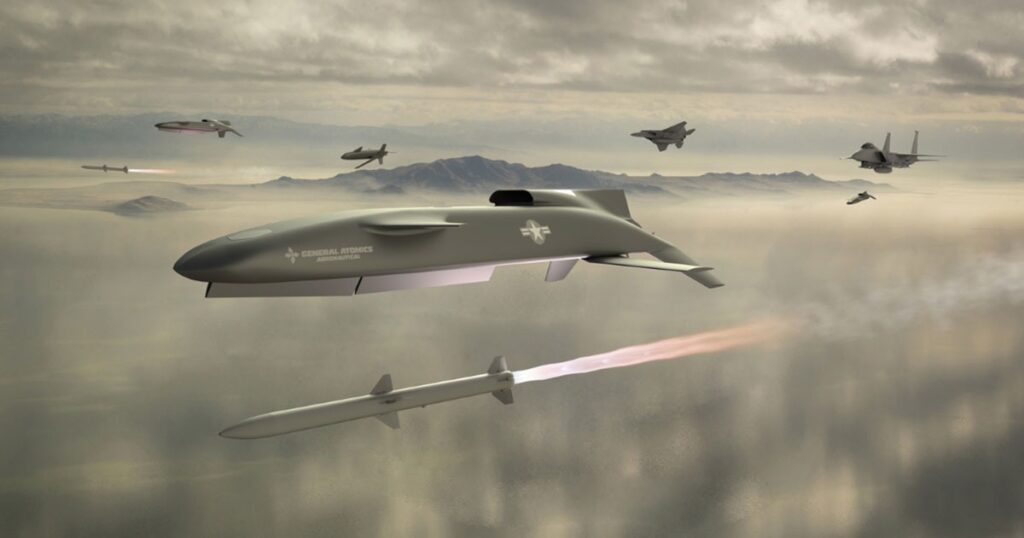
SAN DIEGO – 11 September 2023 – General Atomics Aeronautical Systems, Inc. (GA-ASI) is poised to begin the flight-testing phase on the Defense Advanced Research Projects Agency’s (DARPA) LongShot program. Begun in 2020, General Atomics was competitively awarded a contract to develop DARPA’s concept for disruptive air combat operations through demonstration of an air-to-air weapons capable air vehicle. The concept seeks to significantly increase engagement range and mission effectiveness of current 4th gen fighters and air-to-air missiles.
Over the last three years, GA-ASI has iterated on numerous vehicle designs to optimize performance and will complete the design enroute to flight testing in 2024. The testing will validate basic vehicle handling characteristics and lay the foundation for follow-on development and testing.
“We are extremely excited to get in the air!” said Mike Atwood, Senior Director of Advanced Aircraft Programs at GA-ASI. “Flight testing will validate digital designs that have been refined throughout the course of the project. General Atomics is dedicated to leveraging this process to rapidly deliver innovative unmanned capabilities for national defense.”
UMS SKELDAR and Ultra Maritime unveil UAS based anti-submarine warfare solution at DSEI 2023
Release from UMS SKELDR
*****
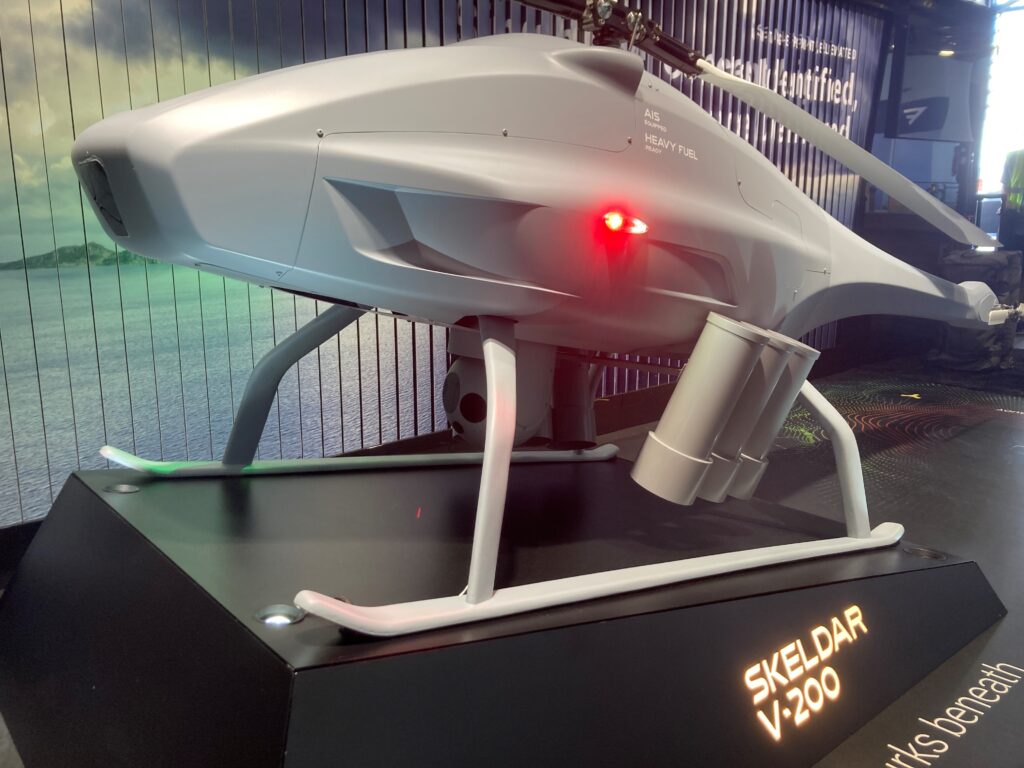
Monday 11th September 12:00 BST:UMS SKELDAR and Ultra Maritime are unveiling their jointly developed anti-submarine warfare (ASW) solution at DSEI 2023. The solution, a Rotary Wing UAS providing an ASW sonobuoy dispensing capability, is based on the SKELDAR V-200 Uncrewed Aircraft System (UAS) and was developed as part of a contract under the Canadian Department of National Defence’s (DND) Innovation for Defence Excellence and Security (IDEaS) program.
This innovative development allows the SKELDAR V-200 to be used to deploy sonobuoys for the purpose of tracking potentially hostile submarines operating in the open ocean or close to coastal areas that could pose a threat to the Royal Canadian Navy (RCN) or other forces.
“Until now, unmanned rotorcraft in the SKELDAR V-200’s weight class have been limited in their ability to identify hostile submersibles due to the lack of a sonobuoy dispensing capability,” says Richard Hjelmberg, Vice President of Business Development at UMS SKELDAR. “Only manned helicopters or larger fixed-wing unmanned aircraft with access to airfields could previously deploy sonobuoys. As a result, there has been a lack of a rapid ship-based responder that can support recognition efforts using passive sonobuoys, which is necessary for complementing ASW operations,” he explains.
Clifton Flint, Manager Global Business Development Sonobuoy Systems for Ultra Maritime, explains: “At Ultra, new technologies are being continuously assessed to find ways to counter the danger posed by hostile submarines. The gap in the available technologies led us to enter this program to create a viable alternative. This program has proven that deploying sonobuoys from Rotary Wing UAS with a compact logistical footprint is a practical and effective solution, adding another resource to the ASW toolbox for the benefit of the warfighter”.
Hjelmberg concludes: “We express our deep gratitude to Ultra Maritime for their invaluable collaboration and support during the development of this project. We are thrilled to showcase this groundbreaking solution at the DSEI event. The remarkable ability to respond swiftly, coupled with reducing the reliance on extensive crewed or unmanned aircraft, could potentially revolutionize how underwater autonomous systems enhance ASW operations.”
The solution is on display at UMS SKELDAR’s DSEI stand in Hall 5 on stand H5-343. To book a briefing slot with the UMS SKELDAR and Ultra Maritime teams at DSEI, contact Andy Parker ([email protected]) or Isabel Pedreira ([email protected]).
Philly Shipyard Delivers the First National Security Multi-Mission Vessel (NSMV), Empire State
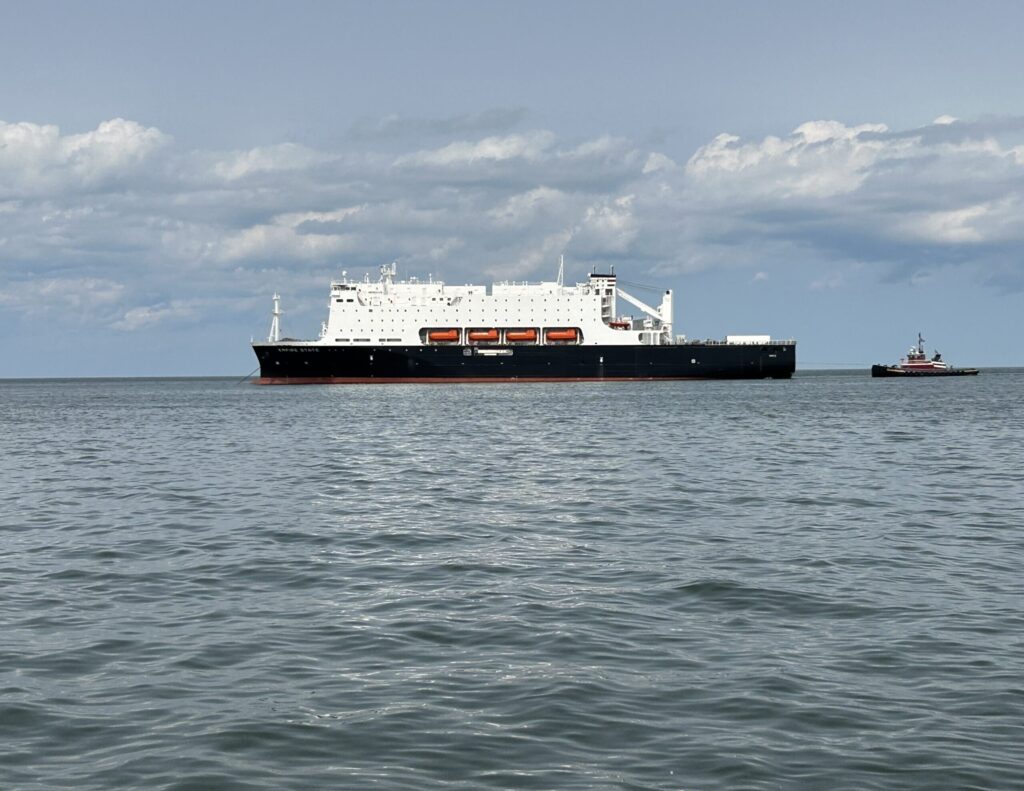
PHILADELPHIA – September 8, 2023 –Philly Shipyard, Inc. (“Philly Shipyard”), the sole operating subsidiary of Philly Shipyard ASA (Oslo: PHLY), today delivered the Empire State, the first of five new purpose-built, modern training vessels for America’s state maritime academies. The U.S. Department of Transportation’s Maritime Administration (MARAD) new vessel program – known as National Security Multi-Mission Vessels (NSMVs) – was designed to provide world-class training for America’s future mariners and to support humanitarian assistance and disaster relief missions in times of need. This first vessel, Empire State, was delivered to MARAD and will serve SUNY Maritime College.
“We are beyond proud to deliver the Empire State today, our first government newbuild in the history of Philly Shipyard.” said Steinar Nerbovik, President & CEO of Philly Shipyard. “We are honored to be trusted with this important project, and on behalf of all of our skilled workers, we are confident that the Empire State will provide a safe, reliable and state-of-the-art training platform for generations of future mariners.”
Philly Shipyard was awarded the contract to build the NSMVs by TOTE Services, LLC (“TOTE Services”), a U.S.-based company that was hired by MARAD to oversee the construction of the training vessels as the Vessel Construction Manager (VCM). The NSMV Program is the first government sponsored ship building program to utilize the VCM model. This model places the responsibility for the selection and oversight of the shipyard on a government contractor that utilizes commercial best practices to manage the project.
The next training vessel, NSMV II, destined for the Massachusetts Maritime Academy, is scheduled to be delivered in 2024. Meanwhile, the keel laying for NSMV III (Maine Maritime Academy) and steel cutting for NSMV IV (Texas A&M Maritime Academy) were recently completed. Construction of NSMV V (California Maritime Academy) will commence later this year with all vessels to be delivered by 2026.
“Today’s delivery of the Empire State is a historic moment for the American maritime industry made possible by the U.S. Government’s investments in our nation’s industrial base,” said TOTE Services President Jeff Dixon. “These investments are on full display as we look to build the next generation of domestic mariner training ships more cost effectively – and on schedule – using commercial innovation and best practices. We must also give credit to the dedicated and skilled workers at Philly Shipyard, whose tireless efforts in the face of unprecedented challenges helped make this milestone possible.”
The NSMV program is an important investment in America’s shipbuilding industry, which supports nearly 400,000 U.S. jobs. Each NSMV will feature numerous instructional spaces, a full training bridge, and accommodations for up to 600 cadets to train in a first-rate maritime academic environment at sea. State maritime academies graduate officers who manage vessels that help keep cargoes and our economy moving. Many of these merchant mariners also support U.S. national security by crewing military sealift vessels.
Today’s delivery of the Empire State marks the delivery of the first government ship built using the VCM contract model. This innovative approach enables shipyards to apply commercial best practices for design and construction to government vessels. There is growing interest in the VCM contract model and its potential applicability to government shipbuilding programs to reduce costs, accelerate delivery times, and build more vessels.
About Philly Shipyard
Naval Special Warfare Interoperates with USS John P. Murtha in Bering Sea
From Lt.j.g. Martin Carey, Naval Special Warfare Command
BERING SEA – East Coast based Naval Special Warfare Operators (SEALs) seamlessly integrated with USS John P. Murtha (LPD 26) during Operation Polar Dagger, in the Alaskan Arctic region, demonstrating special operations forces capability to operate in austere locations to defend critical infrastructure and strengthen interoperability in the region.
Operation Polar Dagger demonstrates the United States’ continued commitment to maintain mission readiness in various environments and to preserve capacity for follow-on operations. The integration of SEALs with Murtha, a San Antonio-class amphibious transport dock ship, underscored the flexibility and adaptability of the U.S. military in responding to the evolving strategic environment.
“Integrating U.S. Navy SEALs with the USS John P. Murtha during Operation Polar Dagger further prepares our forces to operate effectively in the extreme environment of the high-north – while contributing to our national security objectives,” said Naval Special Warfare Group 2 Commodore Capt. Bill Gallagher. “Naval Special Warfare’s ability to operate with fleet assets provides combatant commanders greater flexibility in deploying forces to counter emerging challenges in the region.”
The Murtha’s advanced capabilities and cutting-edge technology played a pivotal role in the successful deployment of SEALs and combat craft assault boats. Equipped with state-of-the-art command and control systems, the vessel offers unparalleled flexibility in orchestrating amphibious operations. Its well deck and specialized equipment facilitate swift and seamless launch and recovery of NSW assets, enabling precision missions even in challenging environments like the Arctic. This integration not only showcases the synergy between modern fleet assets and elite special forces but also underscores the U.S. Navy’s commitment to maintaining a technologically advanced and adaptable fleet.
“Amphibious transport dock ships, such as ours, have many unique capabilities that make them ideal platforms to support special operations forces,” said Capt. Doug Langenberg, commanding officer of USS John P. Murtha. “The amphibious Navy’s participation in Operation Polar Dagger in the High North allows us to test new capabilities and advance response options, giving our joint force an asymmetric advantage over our competitors in a maritime environment.”
During the operation, the SEALs deployed from the well deck of the Murtha in combatant craft assault boats in the Bering Sea, navigated to a remote island, conducted an over-the-beach patrol, and exfiltrated via helicopter. The joint operation underscored the strategic importance of the Arctic region, while also highlighting the United States’ commitment to employing a multi-faceted approach to homeland defense. Naval Special Warfare Group TWO produces, supports, and deploys the world’s premier maritime special operations forces to conduct full-spectrum operations and integrated deterrence in support of U.S. national objectives. For more information, visit https://www.nsw.navy.mil/