Navy Deploys Automated Energy Assessment Tools to the Fleet

Release from Naval Sea Systems Command 

***** 

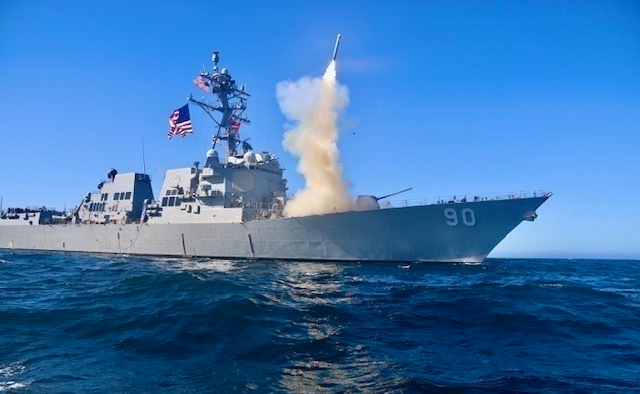
WASHINGTON, D.C. – Engineers at the Naval Sea Systems Command have achieved an important milestone with the installation of the Global Energy Information System (GENISYS) suite onboard DDG 51 Arleigh Burke-class guided missile destroyers.

The GENISYS suite includes a Shipboard Energy Assessment System (SEAS) and digital log books (eLogBook) to link fuel consumption, mission, and environmental data to provide operators afloat and ashore an integrated platform from which they can monitor and manage energy consumption across the Fleet.

“One of our main priorities at NAVSEA is digital transformation so that we can provide the best level of support to the Fleet,” said Peter McCauley, NAVSEA technical warrant holder for machinery integration and program manager for fleet energy management. “This initiative is a great example of how we are harnessing feedback from our Fleet commanders, leveraging innovation from the Navy’s Small Business Innovation Research Program, and linking it to other applications such as condition-based maintenance to drive a greater understanding of our onboard equipment to optimize operational excellence.”

The Shipboard Energy Assessment System integrates sensors and other sources of energy-related data from human and equipment performance trends to produce a real-time operational data model. The model then serves a command and control function as it delivers recommendations to inform operator actions pertaining to energy usage and availability.

The eLogBook provides Sailors with a smart logging capability for the bridge deck log, engineering log, daily fuel and water log to automate data collection directly into the Navy Energy Usage Reporting System. Combined with SEAS, data aggregation and reporting is significantly enhanced providing greater mission presence and awareness, operational decision-making, and more effective prioritization of energy investments.

“We now have the capability to align shipboard energy consumption against mission data at multiple levels, including individual ship, operational commander, homeport, ship class, or by the assigned Fleet,” said Capt. Megan Thomas, Naval Surface Force Atlantic’s force materiel officer.

Following rigorous field-testing earlier this year, both systems are now being installed on DDG 51 class destroyers where they will undergo testing and crew training before becoming operational later this year. Installation of the system onboard San Antonio-class amphibious transport dock ships is planned to commence in 2024.

NAVSEA is the largest of the Navy’s six system commands, responsible for the building, buying, maintaining, and inactivation of ships, submarines and systems for the U.S. Navy. The Naval Systems Engineering and Logistics Directorate (SEA 05) manages the engineering and scientific expertise, knowledge and technical authority necessary to design, build, maintain, repair, modernize, certify and dispose of the Navy’s ships, aircraft carriers, submarines and associated combat and weapons systems.


Insitu Announces Kinetic Capability for the Integrator Uncrewed Aircraft System 

Release from Insitu 

***** 

BINGEN, Wash., Sept. 6, 2023 – Insitu, A Boeing Company, announced a munitions program for its Integrator Uncrewed Aircraft System (UAS), which adds a highly sought-after strike capability to the platform’s unmatched payload portfolio and class-leading 24-hour flight endurance. 


Insitu collaborated with multiple weapons developers and U.S. Government agencies to enable the Integrator to deliver miniature, precision munitions and guide them to their targets. During September 2021, the RQ-21 Blackjack variant of the Integrator successfully delivered various inert kinetic payloads for a U.S. Navy test program. Testing of additional munitions remains underway. 


“Based on global events and the evolution of the modern battlefield, Insitu’s customers are demanding a kinetic strike capability,” said Vice President of Global Growth Abigail Denburg. “To meet this demand, we are actively partnering to test a variety of kinetic capabilities for the Integrator UAS, which will shorten the time from detection and identification to execution,” said Denburg. 


Integrator’s unique modular design enables it to carry multiple payloads during the same mission. It is a NATO Class 1 Small UAS (DoD Group 3 UAS) that carries up to 25 percent of its maximum gross takeoff weight as payloads distributed among its nose, payload bay, two wing trays, and two wing-mounted hardpoints. The nose is typically equipped with one of several intelligence, surveillance, and reconnaissance (ISR) turrets while the payload bay typically carries a synthetic aperture radar, a wide-area motion imagery sensor, a wide area maritime surveillance sensor, a communications relay payload, or one of several signals intelligence/electronic warfare payloads, which can be easily swapped in the field using common hand tools. Each of the munitions were developed as modular, self-contained payload bays that include the weapon(s) and the stores management system.  


“This modular capability builds on Integrator’s unique design and enables our end users to easily transition between kinetic and non-kinetic missions” added Denburg. 


Insitu will showcase some of these capabilities at MSPO in Kielce, Poland from September 5-8 and at DSEI in London, England from September 12-15. 


With three decades of experience, more than 3,500 uncrewed aircraft manufactured to date, and more than 1.4 million operational flight hours, Insitu continues to deliver the most advanced capabilities available to our global customer base in more than 35 countries and counting. Visit Insitu.com to learn more about the most capable, reliable, and combat-proven NATO Class 1 Small UAS on the planet. 


USS Shiloh departs Yokosuka, Japan after 17 years of Forward-Deployed Service 

Release from U.S. Seventh Fleet Public Affairs 

***** 

By Petty Officer 2nd Class Askia Collins 

YOKOSUKA, Japan  –  The Ticonderoga-class guided missile-cruiser USS Shiloh (CG 67) departed Yokosuka, Japan, on Sept. 5 to transit to its new homeport of Pearl Harbor, Hawaii, as part of a planned rotation of forces in the Pacific. 
 
Shiloh arrived on station at Yokosuka Naval Base in August 2006 to fulfill the obligations of the U.S.-Japanese ballistic missile defense program and to support operations within the U.S. 7th Fleet area of operations (AOO). 
 
“For nearly two decades, USS Shiloh provided our Forward-Deployed Naval Forces the agility and firepower to support our carrier operations, protect sea lanes, deter aggression, and reassure allies and partners across the Indo-Pacific,” said Capt. Adam Cheatham, commanding officer of Shiloh. “We’ve built long-lasting personal and professional relationships here in Japan that will stay with us forever. Shiloh’s contributions were significant, reinforcing valuable connections over shared visions of a free and open Indo-Pacific. 
 
“It’s sad to be leaving this place that means so much to us, but we believe USS Shiloh made a difference during her time forward-deployed to Yokosuka, and we are proud of that,” he continued. “On behalf of the crew, I want to offer my deep gratitude to the people of Japan and this community for their friendship over the years. It will never be forgotten.” 
 
In addition to serving in the 7th Fleet AOO, Shiloh deployed to the 5th Fleet AOO in support of operations Allies Refuge and Freedom Sentinel in 2021. 
 
U.S. 7th Fleet exercises operational control of its units through designated Task Forces or Task Groups. These groups are organized along domain and functional lines. Shiloh is assigned to Commander, Task Force (CTF) 70, the theater strike warfare commander and theater air and missile defense commander. 
 
CTF 70 is forward-deployed to the U.S. 7th Fleet area of operations in support of a free and open Indo-Pacific. U.S. 7th Fleet is the largest forward-deployed fleet in the world, and with the help of and network of alliances and partners from 35 other maritime nations, the U.S. Navy has operated in the Indo-Pacific region for more than 70 years; providing credible, ready forces to help preserve peace and prevent conflict. 


1st LAAD Battalion Reactivates in Hawaii 

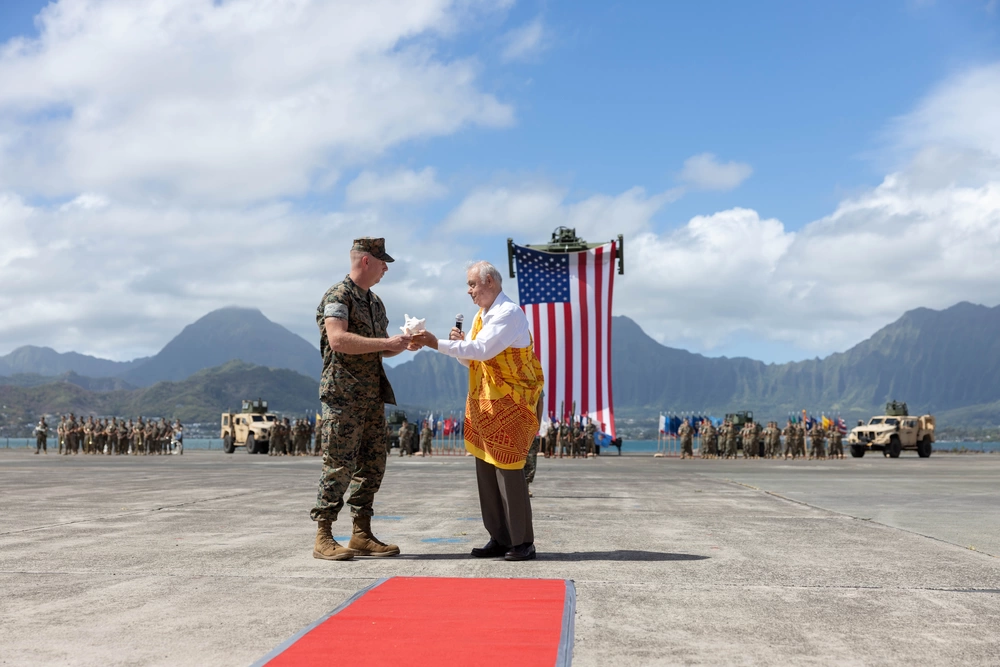
Photo By Lance Cpl. Clayton Baker | U.S. Marine Corps Lt. Col. Heath Phillips, commanding officer, 1st Low Altitude Air Defense (LAAD) Battalion, Marine Air Control Group 18, 1st Marine Aircraft Wing, receives a gift during a reactivation and designation ceremony at Marine Corps Air Station Kaneohe Bay, Hawaii, Aug. 31, 2023. Originally activated in July 1982 in Okinawa, Japan, the unit underwent two redesignations before folding its’ colors in Sept. 2007. The reactivation of 1st LAAD Battalion demonstrates forward progression toward force modernization in the INDOPACIFIC region. The primary mission of 1st LAAD Battalion is to deliver close-in, low-altitude, surface-to-air weapon capabilities. (U.S. Marine Corps photo by Lance Cpl. Clayton Baker) 

Release from the 1st Marine Aircraft Wing 

***** 

MARINE CORPS BASE HAWAII, HI, UNITED STATES 

08.31.2023 

MCAS KANEOHE BAY, Hawaii – Today, Headquarters and Service (H&S) Battery, 1st Low Altitude Air Defense (LAAD) Battalion, Marine Air Control Group 18, 1st Marine Aircraft Wing, reinstated their unit colors during a reactivation and designation ceremony. 
 
Originating as 1st Forward Area Air Defense (FAAD) Battery, initially established on July 1, 1982, in Okinawa, Japan, 1st LAAD Battalion previously underwent two redesignations. The first occurred in October 1986, when 1st FAAD battery was redesignated as the 1st LAAD Battalion. The second took place in May 1993, when the battalion’s size was reduced, leading to its designation as 1st Stinger Battery. 1st Stinger Battery was officially deactivated in Okinawa on Sept. 28, 2007. 
 
Today’s reactivation of 1st LAAD Battalion at Marine Corps Base Hawaii demonstrates progress toward force modernization with a significant increase in III Marine Expeditionary Force (III MEF), joint, and combined force capabilities. Originally designed to counter fixed wing and rotary wing enemy aircraft, the LAAD community now employs mobile, scalable air defense capabilities to counter not only manned aviation threats but also unmanned. This reactivation provides III MEF organic ground-based air defense assets against enemy aircraft and unmanned aerial systems (UAS) which enables their employment within the Indo-Pacific region without depleting resources from I or II MEF. 
 
The primary mission of 1st LAAD Battalion is to deliver close-in, low-altitude, surface-to-air weapon capabilities. When task-organized, the battalion also provides command and control forces for ground security in defense of the Marine Air-Ground Task Force (MAGTF) commander’s designated critical areas. “1st LAAD Battalion will provide a much-needed capability to III MEF in the defense of maneuver units, forward operating areas and command and control nodes. This capability will enable Marines to fight and win under contested airspace,” said Lt. Col. Heath A. Phillips, the commanding officer of 1st LAAD Battalion. 
 
Marine Corps Base Hawaii will primarily serve as a strategic hub for 1st LAAD Battalion. “We are honored to homebase in Hawaii,” Phillips added, “We will grow here; we will train here; but make no mistake about it, our work is west.” 
 
The battalion is taking a phased activation approach, slated to culminate in 2028, beginning with the H&S Battery today. H&S Battery will establish the foundation for onboarding future capabilities and subsequent battery activations. Alpha Battery is anticipated to activate in August 2024. 
 
1st LAAD Battalion looks forward to employing emerging capabilities in the Indo-Pacific in support of service, joint, allied, and partner forces. For more information about 1st LAAD Battalion please contact 1st Marine Aircraft Wing Communication Strategy and Operations, https://www.1stmaw.marines.mil/Subordinate-Units/Marine-Aircraft-Group-24/ 


Flag Officer Assignments 

Release from US Department of Defense

***** 

SEPT. 7, 2023 

The secretary of the Navy and acting chief of naval operations announced today the following assignments: 

Rear Adm. Eric C. Ruttenberg will be assigned as reserve deputy commander, U.S. Pacific Fleet, Pearl Harbor, Hawaii.  Ruttenberg is currently serving as reserve deputy for maritime operations, U.S. Pacific Fleet, Pearl Harbor, Hawaii. 

Rear Adm. Larry D. Watkins will be assigned as vice commander, U.S. Naval Forces Europe; vice commander, U.S. Naval Forces Africa; and Joint Forces Maritime Component Commander Europe, Naples, Italy.  Watkins is currently serving as deputy commander, Third Fleet, San Diego, California. 

Rear Adm. (lower half) Kenneth R. Blackmon, selected for promotion to rear admiral, will be assigned as vice commander, U.S. Fleet Forces Command, Norfolk, Virginia.  Blackmon is currently service as reserve director for maritime operations, U.S. Fleet Forces Command, Norfolk, Virginia. 

Rear Adm. (lower half) David H. Duttlinger will be assigned as deputy for naval construction force, Navy Expeditionary Combat Command, Virginia Beach, Virginia.  Duttlinger is currently serving as deputy commander, Naval Facilities, Washington, D.C. 

Rear Adm. (lower half) Robert C. Nowakowski, selected for promotion to rear admiral, will be assigned as deputy commander, Naval Education and Training Force Development, Pensacola, Florida.  Nowakowski is currently serving as reserve vice commander, U.S. Naval Forces, U.S. Central Command, Fifth Fleet, Manama, Bahrain. 

Rear Adm. (lower half) Mark A. Schafer, is assigned as commanding general, Special Operations Joint Task Force-Central, U.S. Central Command, Doha, Qatar.  Schafer recently served as commander, Navy Region Korea; commander, U.S. Naval Forces Korea; commander, Naval Component, United Nations Commander, Korea, Pusan, Korea. 


U.S. Coast Guard Cutter Tampa and Crew Return to Home Port Following 67-day Patrol in the Florida Straits and Windward Passage 

Release from U.S. Coast Guard Atlantic Area  

***** 

U.S. Coast Guard Cutter Tampa and crew return to home port following 67-day patrol in the Florida Straits and Windward Passage 

PORTSMOUTH, Va. — The U.S. Coast Guard Cutter Tampa (WMEC 902) and crew returned to their home port in Portsmouth, Tuesday, after a 67-day patrol in the Florida Straits and Windward Passage. 

Tampa deployed in support of Homeland Security Task Force – Southeast and Operation Vigilant Sentry within the Coast Guard Seventh District’s area of responsibility. During the patrol, Tampa’s crew conducted maritime safety and security missions while working with other Coast Guard cutters to detect, deter, and intercept unsafe and illegal maritime migration ventures bound for the United States. 

While underway, Tampa’s crew interdicted one migrant vessel attempting a dangerous and unlawful voyage toward the United States. Crew members contributed to the care and repatriation of 429 migrants during the patrol. 

“This was a rewarding first patrol as the commanding officer,” said Cmdr. Walter Krolman, commanding officer of Tampa. “To see the officers and crew, experienced and new, come together to complete the mission was amazing. As a team, we conducted drills and exercises and qualified members in new watch stations while meeting operational demands. Tampa controlled surface assets and coordinated air coverage to ensure the security of the southern maritime border. We worked successfully with Coast Guard, state and federal partners to save lives and prevent a mass migration event.” 

HSTF-SE serves as the Department of Homeland Security lead for operational and tactical planning, command and control, and acts as a standing organization to interdict illegal maritime migration attempts with federal, state and local partners. HSTF-SE continues enhanced enforcement efforts in support of OVS, the 2004 DHS plan to respond to irregular and unlawful mass maritime migration in the Caribbean Sea and the Florida Straits. 

Tampa is a 270-foot, Famous-class medium endurance cutter. The cutter’s primary missions are counterdrug operations, migrant interdiction, enforcement of federal fishery laws and search and rescue in support of U.S. Coast Guard operations throughout the Western Hemisphere. 

For information on how to join the U.S. Coast Guard, visit GoCoastGuard.com to learn about active duty, reserve, officer and enlisted opportunities. Information on how to apply to the U.S. Coast Guard Academy can be found here.  


Marine Corps Looking at Stealthy Autonomous Vessels for Logistics

***** 

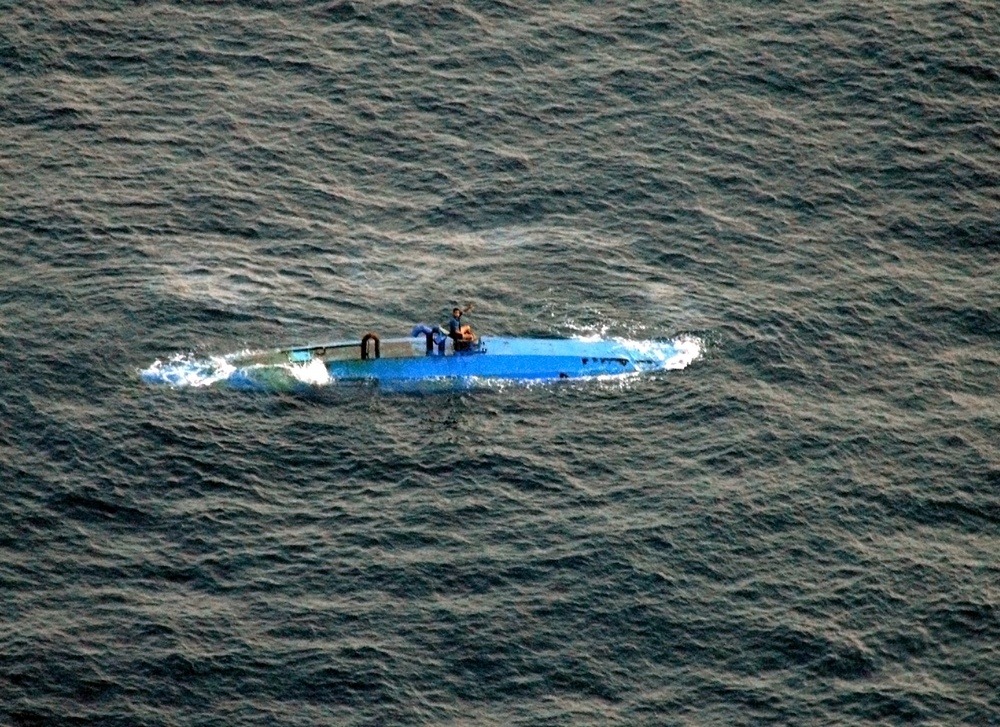
ARLINGTON, Va.—The U.S. Marine Corps is exploring a concept to enhance its ability to supply its forces its forces inside a contested environment: low-profile vessels used by drug-running cartels.  

The Corps, however, is looking at autonomous low-profile vessels (LPVs), said Lieutenant General Karsten Heckl, deputy commandant for Combat Development and Integration, speaking Sept. 6 at the Defense News Conference in Arlington, who advocated the use of autonomous unmanned systems wherever possible. 

Drug runners have built and used manned LPVs frequently over the last two decade to carry loads of illegal drugs from Latin America to the United States. The LPVs, called semisubmersibles, are fabricated in secret locations and, with a small crew, carry their payload along the transit lanes, trying to avoid visual and radar detection with their very low profiles. 

 “We just copy the drug lords down south running drugs,” Heckl said. “They are hard to find, so now we figure, hey, it works, right?  

The Marine Corps has recently focused on logistics in a contested environment as part of its Force Design 2030 to address the challenge of supplying its forces inside the enemy’s weapons engagement zone — inside the first island chain off China, for example. 

Heckl addressed the concept pairing it with uncrewed autonomy, noting the lower cost of unmanned systems without having to accommodate humans and the supplies and safety systems needed to sustain them. 

The required scale of autonomous LPVs is so far undetermined, but Heckl pointed to the success of an unmanned expeditionary fast ship (T-EPF) in autonomous operations. Austal built the Miliary Sealift Command’s 13th T-EPF, USNS Apalachicola — a fast catamaran logistics ship–with autonomous control systems to demonstrate the potential of autonomous operations of a ship of its size. 

“T-EPF 13 went out and did 1,500 nautical miles completely autonomously,” Heckl said. “They had human beings on board as back-ups, but what an amazing capability, a ship that can go 45 knots in Sea State 3 that can operate autonomously. Autonomous—from a logistics perspective—absolutely. 

“I want autonomous everything, if we can get there,” he said. 


U.S. Navy, Marine Corps Establish New Maritime Fires Executive Agent

Release from the Office of the Chief of Naval Operations 

***** 

06 September 2023

WASHINGTON — Deputy Chief of Naval Operations for Operations, Plans and Strategy Vice Adm. Gene Black, and Acting Marine Corps Deputy Commandant for Plans, Policies and Operations Maj. Gen. Roger Turner jointly announced the designation of a new executive agent (EA) for maritime fires, May 16, 2023. 

The new maritime fires EA will be a single entity to oversee maritime fires, and will improve the planning, coordination, execution and assessment of all-domain fires by the Navy and Marine Corps. In Department of Defense vernacular, “fires” are defined as “the use of weapon systems or other actions to create specific lethal or nonlethal effects on a target.” 

“This designation demonstrates a significant step forward in naval service integration, increasing maritime force readiness and lethality,” said Black. “This initiative will drive improvements and efficiencies to Navy and Marine Corps doctrine, organization, and training. It will enable us to deliver maritime fires with precision and timeliness in every domain, when required.”

Echoing Black, Turner added how a centralized EA facilitates U.S. Navy and Marine Corps integration. 

“This is naval integration in action. Maritime fires integration is absolutely something we have to get right and this is a great step forward for our services,” said Turner. “This designation is going to enable us to better leverage the full force of the Navy and Marine Corps team.” 

Commander, Pacific Fleet (PACFLT) has been selected to fill the role as EA. In that capacity, PACFLT is making a plan and identifying resources to support several lines of effort, including development of doctrine and policy, the maritime fires training continuum, and a campaign of learning through experimentation, war-games and exercises.  

An executive agent (EA) is a designation for a role with substantial responsibility to execute a noteworthy task or the function is particularly sensitive or complex. EAs are tasked to provide defined levels of support for either operational or administrative missions.


BAE Systems successfully flight tests next-generation vehicle management computer for the F-35 Lightning II

Release from BAE Systems 

***** 

Flight control technology upgrade maximizes processing power for added mission capabilities and safety enhancements 

ENDICOTT, N.Y. — Sept. 6, 2023 — BAE Systems’ next-generation vehicle management computer was successfully flight tested on the F-35 Lighting II aircraft. The test demonstrated a technology upgrade for all three F-35 variants that will increase computer performance and addresses obsolescence issues. Testing occurred at Naval Air Station Patuxent and Edwards Air Force Base.  

BAE Systems’ Vehicle Management Computer (VMC) enables advanced control modes and improves mission efficiency and safety. Its distributed architecture allows the aircraft to operate reliably with enhanced mission effectiveness in demanding environments. The upgraded VMC will not only help to mitigate obsolescence but will also improve safety, maintainability, and availability of the aircraft for the U.S. military and its allies. 

“The VMC provides the high integrity processing required to implement the advanced control algorithms that enable this platform’s critical missions,” said Corin Beck, director of Military Aircraft Systems for Controls and Avionics Solutions at BAE Systems. “This upgrade leveraged BAE Systems’ technology roadmap to ensure the F-35 will advance its mission management and flight control capabilities today and into the future.” 

This technology upgrade incorporates a quad-core advanced processor for both a high-performance and efficient solution. The new level of computing power allows for additional aircraft capabilities while reducing pilot workload. It also adds advanced mission capabilities to the VMC such as the Joint Precision Approach and Landing System (JPALS) and Auto Ground Collision Avoidance System (AGCAS). 

BAE Systems has more than 40 years of experience developing and integrating flight control technology for military and commercial platforms. Work on the VMC occurs at the company’s state-of-the-art engineering and manufacturing facility in Endicott, New York.   

BAE Systems is a major global partner to Lockheed Martin on the F-35 program. The company provides the VMC, electronic warfare system, active inceptor control system, and aft fuselage for each F-35 at manufacturing facilities in the U.S., U.K., and Australia. The company also delivers sustainability, technical support, and training services to keep the F-35s mission-ready.  


Flag Officer Announcements

Release from the U.S. Department of Defense 

***** 

SEPT. 6, 2023 

Secretary of Defense Lloyd J. Austin III announced today that the president has made the following nominations: 

Navy Rear Adm. Blake L. Converse for appointment to the grade of vice admiral, with assignment as deputy commander, U.S. Pacific Fleet, Pearl Harbor, Hawaii.  Converse is currently serving as deputy commander, U.S. Pacific Fleet, Pearl Harbor, Hawaii. 

Navy Rear Adm. Jeffrey T. Jablon for appointment to the grade of vice admiral, with assignment as deputy chief of naval operations for installations and logistics, N4, Office of the Chief of Naval Operations, Washington, D.C.  Jablon is currently serving as a special assistant to director, Navy Staff, Office of the Chief of Naval Operations, Washington, D.C. 

Navy Rear Adm. (lower half) Michael A. Brookes for appointment to the grade of rear admiral.  Brookes is currently serving as director, National Maritime Intelligence Integration Office; and commander, Office of Naval Intelligence, Washington, D.C. 

Navy Capt. Bryan E. Braswell for appointment to the grade of rear admiral (lower half).  Braswell is currently serving as commander, Naval Information Warfighting Development Center, Norfolk, Virginia.