Vestdavit fuels orders with US Navy through multi-davit deal for new class of oilers 
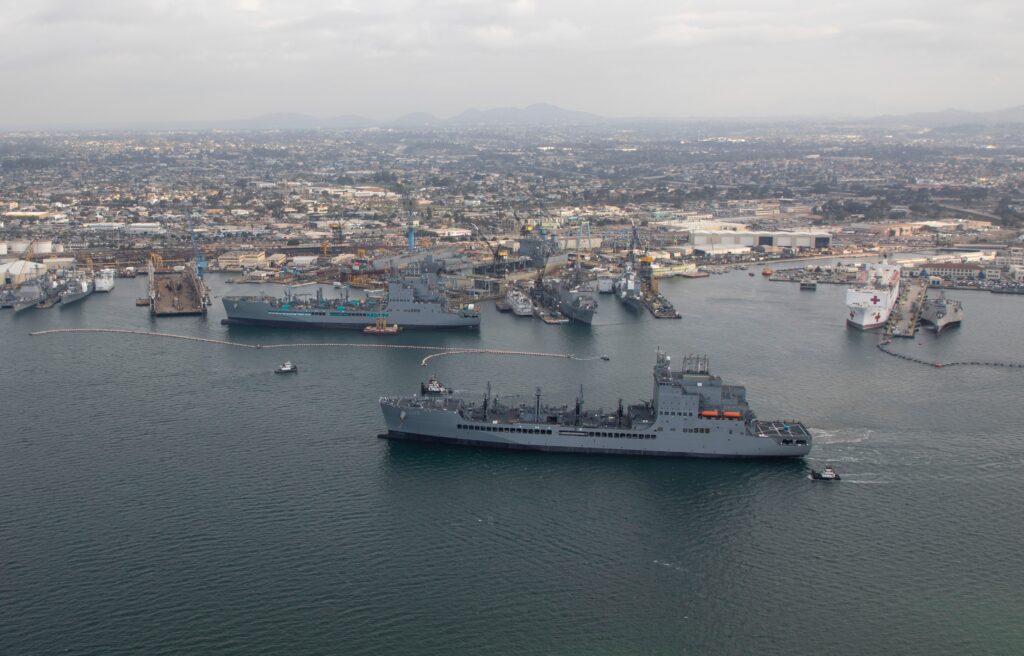
Vestdavit will deliver multiple davits for newbuild T-AO oilers under construction at General Dynamics NASSCO, with the first ship delivered, to be named USNS John Lewis, shown (foreground) at the San Diego yard during sea trials last year and others under construction in the background. Photo: General Dynamics NASSCO

Released from Vestdavit 

***** 

22 August 2023 

Davits supplied by Vestdavit are set to play an important role in efficient launch and recovery of fast craft to support refuelling operations at sea for the US naval fleet after the company was awarded a major contract for six vessels being built by General Dynamics NASSCO in the US. 

The contract covers delivery of a total of 12 high-specification PLRH-5000 davits to be installed on the John Lewis-class of T-AO oilers ordered by the US Navy at the shipbuilder’s San Diego shipyard, with two on each ship from T-AO 208 through T-AO 213 in the newbuild series. 

“This represents a significant order that further underpins our strong position in the US as our largest market and reflects the trust shown in the reliability of our davit solutions by the US Navy, which is one of our biggest customers in this market,” says Vestdavit Managing Director Rolf Andreas Wigand. 

Extensive newbuild programme 

He adds that Vestdavit is “really pleased to continue the relationship” with General Dynamics NASSCO, a unit of global aerospace and defence company General Dynamics, following its recent delivery of multi-boat davits for US Navy ESB-6 and ESB-7 ships also under construction at the yard. 

The US Navy has so far ordered a total of nine of the new class of T-AO oilers with a total contract value of $5.5 billion, of which the first was delivered last year, as part of an ongoing newbuild construction programme in which as many as 20 such vessels are planned. 

The 745-foot-long oilers, which will be operated by Military Sealift Command (MSC), are designed to transfer fuel to US Navy carrier strike groups operating at sea, with the capacity to carry 162,000 barrels of oil, a significant dry cargo capacity, aviation capability and a speed of up to 20 knots. 

These ships are dependent on high availability and efficient operation of boat handling systems for deployment of fast craft such as rescue boats in variable sea states to facilitate safe and reliable refuelling operations, according to Magnus Oding, General Manager of the Norwegian davit supplier’s US subsidiary Vestdavit Inc. 

High-specification davit features 

The PLRH-5000 single-point davits will be used to handle the US Navy’s seven-metre RHIBs (Rigid-Hull Inflatable Boats) and incorporate a range of motion compensation and safety features that allow them to function effectively also in challenging conditions with high sea states, he says. 

These include shock absorbers for removing peak loads, constant tension for safe and efficient recovery in rough weather, and guiding arms that act as an anti-pendulation device to keep the RHIB steady. 

The skid-mounted davit is delivered as a fully self-contained unit for ease of installation onboard ships, with a requirement only for welding in place, filling with hydraulic oil and connection to power supply. 

As well as naval applications, the DNV-classed davit type with lifting capacity up to 15,000kg is typically used on offshore patrol vessels, fishery protection and law enforcement vessels, and search and rescue vessels. 

Expanding naval orderbook 

The latest order adds to the tally of more than 2000 davit systems supplied by Vestdavit worldwide, including the US where it also counts the US Coast Guard and National Oceanic and Atmospheric Administration (NOAA) among its major clients, as well as several commercial customers. 

With a strong track record of davit deliveries to navies around the world, Wigand is confident orders from the defence sector will continue to grow in the coming years. 

“Constant product development and innovation in line with client requirements, supported by robust technology, means we are able to deliver on quality and reliability to meet the demanding standards of the naval market,” he says. 
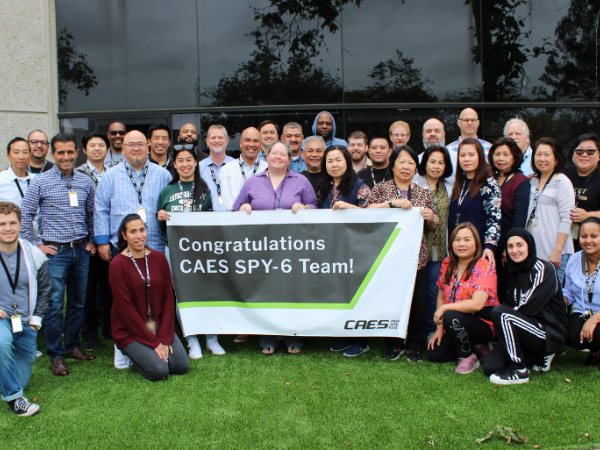


CAES Awarded $200M Contract for SPY-6 Radar Assemblies, Continues Partnership with Raytheon 

Release from CAES 

***** 

AUGUST 21, 2023 

Arlington, Va. — CAES, a leading provider of mission-critical advanced RF technology, has won a $200 million follow-on, full-rate hardware production and sustainment award from Raytheon, an RTX business. Under the contract, CAES will provide fully tested radar module assemblies for the U.S. Navy’s AN/SPY-6 family of radars. 

CAES has been a multi-year partner with Raytheon on the SPY-6 program, and has already begun delivering hardware. This follow-on, multi-year award demonstrates the continued, strong partnership between CAES and Raytheon, and our demonstrated capacity to provide the SPY-6 radar with reliable components and meet the U.S. Navy fleet’s needs for many years to come. 

“SPY-6 is one of the most advanced naval radars in production, and CAES is proud to contribute to the performance and reliability of this system,” said Mike Kahn, CAES President & CEO. “We look forward to our continued work with Raytheon to provide our military with this critical capability.” 

SPY-6 is the U.S. Navy family of radars that performs air and missile defense on six classes of ships. SPY-6 can defend against ballistic missiles, cruise missiles, hostile aircraft and surface ships simultaneously and offers several advantages over legacy radars, such as greater detection range, increased sensitivity and more accurate discrimination. 

Partnering with customers, CAES facilities are capable of manufacturing complex microwave and millimeter wave solutions for electronic warfare, radar and other mission critical needs. Learn more about CAES’ advanced capabilities here

About CAES 
CAES is a pioneer of advanced electronics for the most challenging defense and aerospace trusted systems. As a leading provider of advanced RF technology to the United States aerospace and defense industry, CAES delivers high-reliability RF and digital solutions that enable our customers to ensure a safer, more secure planet. On land, at sea and in the air, CAES’ extensive experience in the RF market and enhanced manufacturing capabilities are at the forefront of mission-critical military and aerospace innovation. www.caes.com 


U.S. Coast Guard Cutter Munro arrives in Japan, conducts training and engagements with Japan Coast Guard 

Release from U.S. Coast Guard Pacific Area 

***** 

Aug. 21, 2023 

YOKOSUKA, Japan — The U.S. Coast Guard Cutter Munro (WMSL 755) arrived in Yokosuka, its first international port visit while deployed in the Indo-Pacific Aug. 6. 

While in Yokosuka, Munro’s crew hosted several members of the Japan Coast Guard for professional exchanges including showcasing the Munro’s small boat and aerial capabilities, and search-and-rescue operations. The visit enabled members from both services to discuss shared mission objectives and shared maritime security challenges. 

“We are thrilled to have the opportunity to meet with the Japan Coast Guard and share each other’s successes,” said Capt. Rula Deisher, Munro’s commanding officer. “It is a privilege for Munro and crew to work alongside our partners to support a free and open Indo-Pacific.” 

In May of 2022, the U.S. Coast Guard and Japan Coast Guard formally expanded cooperative agreements through a memorandum of understanding. The new perpetual operation is an expansion of an agreement made in 2010, focusing on maintaining a free and open Indo-Pacific. The 2022 agreement is named SAPPHIRE, which stands for Solid Alliance for Peace and Prosperity with Humanity and Integrity on the Rule of law-based Engagement. 

The Munro, a 418-foot national security cutter, departed its homeport, Alameda, California, June 23 for a months-long deployment to the Western Pacific. 

Operating under the tactical control of the U.S. 7th Fleet, the cutter and crew will engage in professional exchanges and capacity-building exercises with partner nations while patrolling the region in support of maritime security. Munro follows on the heels of the U.S. Coast Guard Cutter Stratton (WMSL 752), who recently completed an Indo-Pacific patrol

Munro is operating as part of Commander, Task Force (CTF) 71, U.S. 7th Fleet’s principal surface force. CTF 71 is responsible for the readiness, tactical and administrative responsibilities for forward-deployed Arleigh Burke-class guided-missile destroyers as well as any surface unit conducting independent operations in the region. 

U.S. 7th Fleet is the U.S. Navy’s largest forward-deployed numbered fleet, and routinely interacts and operates with allies and partners in preserving a free and open Indo-Pacific region. 

U.S. Coast Guard Pacific Area is responsible for U. S. Coast Guard operations spanning across six of the seven continents, 71 countries and more than 74 million square miles of ocean. It reaches from the shores of the West Coast of the United States to the Indo-Pacific, Eastern Pacific, Arctic and Antarctic regions. Pacific Area strives to integrate capabilities with partners to ensure collaboration and unity of effort throughout the Pacific. 

As both a federal law enforcement agency and an armed force, the U.S. Coast Guard is uniquely positioned to conduct defense operations in support of combatant commanders on all seven continents. The service routinely provides forces in joint military operations worldwide, including the deployment of cutters, boats, aircraft and deployable specialized forces. 

Commissioned in 2017, Munro is one of four Coast Guard legend-class national security cutters homeported in Alameda, California. National security cutters are 418-feet long, 54-feet wide, and have a 4,600 long-ton displacement. They have a top speed more than 28 knots, a range of 12,000 nautical miles, endurance of up to 90 days and can hold a crew of up to 170. 

National security cutters feature advanced command and control capabilities, aviation support facilities, stern cutter boat launch and increased endurance for long-range patrols to disrupt threats to national security further offshore. 


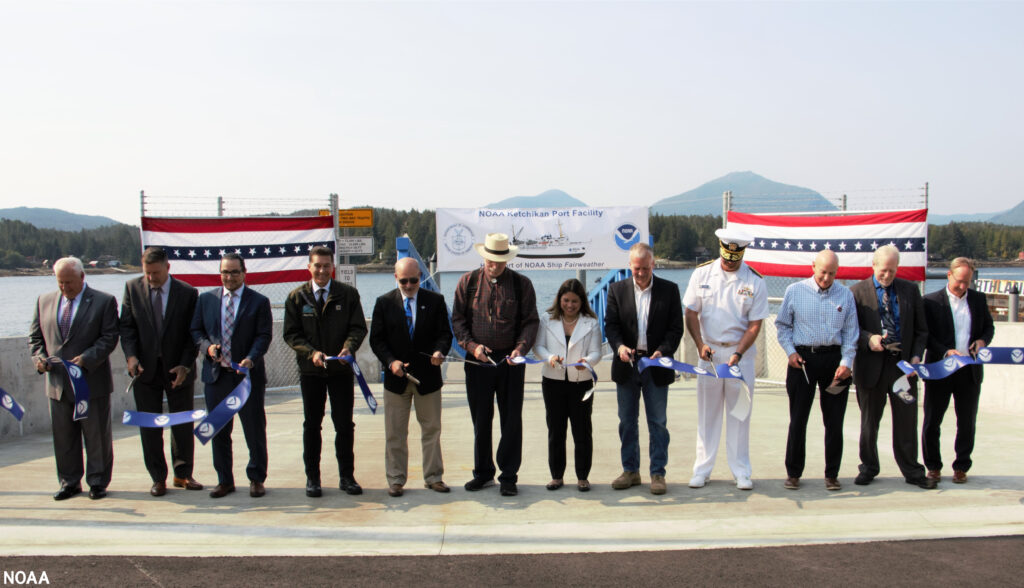
NOAA cuts ribbon on renovated Ketchikan, Alaska port facility 

A long line of special guests, including NOAA Administrator Dr. Rick Spinrad (5th from the left), participate in a ribbon-cutting ceremony for the NOAA-renovated port facility in Ketchikan, Alaska, on August 21, 2023. (Image credit: NOAA Office of Marine and Aviation Operations)

Release from NOAA 

***** 

August 21, 2023 

Today, federal, tribal, state and local officials joined NOAA leadership to cut the ribbon on the agency’s newly renovated port facility in Ketchikan, Alaska. The celebration was held to dedicate the facility and recognize the important partnerships in the area. 

The facility will provide vessel support for NOAA research ships. The facility will also support NOAA Ship Fairweather, which is homeported in Ketchikan. 

“Having a home base for NOAA to operate from in Alaska is integral to our science, and mission to ensure safe navigation and the growth of our blue economy,” said NOAA Administrator Rick Spinrad, Ph.D. “This facility incorporates the latest green technology and is climate-ready with a state of the art floating pier to accommodate not only Ketchikan’s tidal flux, but future sea level changes.” 

NOAA Marine and Aviation Operations awarded an $18.7 million contract in April 2021 to Alaska-based Ahtna Infrastructure & Technologies, LLC to make major improvements to the facility. The project, which was partially funded by the state of Alaska, includes the construction of a new office building, floating pier, and boat ramp. Additional improvements include updated power, sewer, communications, and water utility systems for servicing visiting ships. 

“This state of the art facility positions us to better support emerging technologies, such as uncrewed systems, and be more efficient in our operational readiness for Alaska-focused science,” said Rear Adm. Chad Cary, deputy director of the NOAA Commissioned Officer Corps and NOAA Marine and Aviation Operations. “It also positions us closer to the Arctic, which will continue to grow in importance for our fisheries and seafloor mapping missions.” 

The 15 research and survey ships operated, managed and maintained by NOAA Marine and Aviation Operations, comprise the largest fleet of federal research ships in the nation. NOAA ships range from large oceanographic research vessels capable of exploring the world’s deepest ocean, to smaller ships responsible for charting the shallow bays and inlets of the U.S. The fleet supports a wide range of marine activities, including fisheries surveys, nautical charting and ocean and climate studies. NOAA ships are operated by NOAA Corps officers and civilian professional mariners


HII Christens Guided Missile Destroyer Ted Stevens (DDG 128) 

Release from HII 

***** 

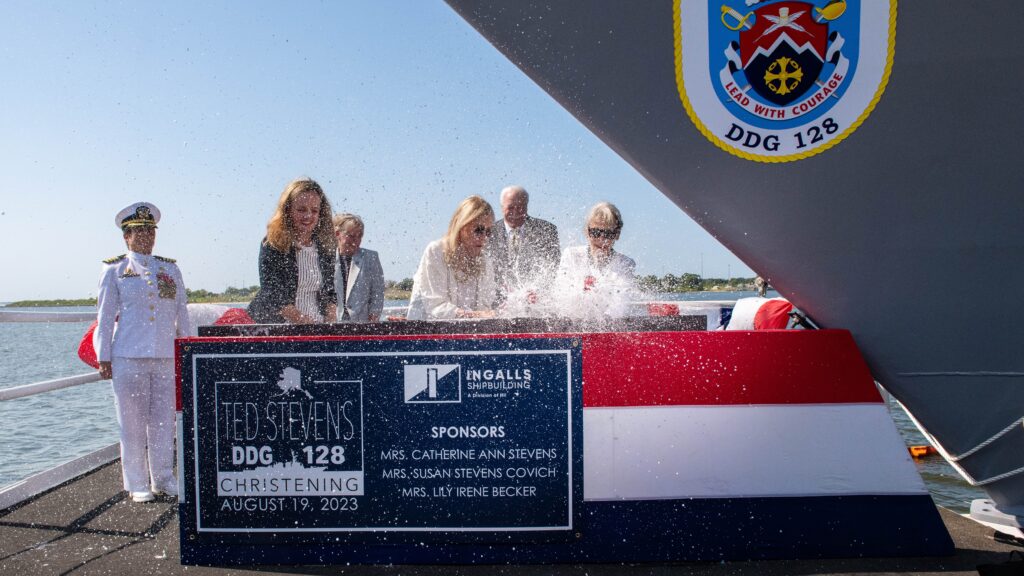
PASCAGOULA, Miss., Aug. 19, 2023 (GLOBE NEWSWIRE) — HII (NYSE: HII) christened today pre-commissioning unit Ted Stevens (DDG 128) at the company’s Ingalls Shipbuilding division. 

The ship’s name honors former U.S. Sen. Ted Stevens, who served as a pilot in World War II and later as a senator representing Alaska. At the time he left office in 2009, he was the longest serving Republican senator in U.S. history. 

“From Alaska to Mississippi we are connected as a community of shipbuilders, sailors and servants by both the passion of our shipbuilders, who have brought us to this point in construction, and also by the late Sen. Ted Stevens and his passion for service,” Ingalls Shipbuilding President Kari Wilkinson said. “We are grateful to everyone that is part of our community and this mission and especially to the U.S. Navy for entrusting us with doing the work that we do here.” 

Honorable Sean O’Keefe, 69th secretary of the Navy, 10th administrator of NASA and former staff member of Sen. Ted Stevens was the keynote speaker. 

A photo accompanying this release is available at: https://hii.com/news/hii-christens-guided-missile-destroyer-ted-stevens-ddg-128/.

“To the captain and her crew, lead with courage (the motto of the ship), the courage to be determined, the courage to be diligent and to be focused on mission,” O’Keefe said. “I am supremely confident that the spirit of Ted Stevens will be standing watch with you during the performance of your duties around the globe. This ship has the great good fortune to have three extraordinary co-sponsors who are sure to pass on their admirable qualities and the culture of this amazing instrument of national power.” 

Ted Stevens is co-sponsored by the late senator’s wife, Catherine Ann Stevens, and his daughters Susan Stevens Covich and Lily Irene Becker. Together, the three sponsors officially christened the ship. 

Becker represented the family by providing remarks and paying tribute to her late farther. 

“My family and I pay tribute to the captain and crew,” Becker said. “We know you will be prepared with the best systems and will carry the spirit of Alaska and the determination of Ted Stevens with you. Captain Hays, we know you and your crew will lead with courage.” 

Additional information about the ship and its sponsors is available at: https://hii.com/events/ted-stevens-ddg-128-christening/.

Ingalls has delivered 35 Arleigh Burke-class destroyers to the U.S. Navy including the first Flight III, USS Jack H. Lucas (DDG 125), in June of this year. In addition, Ingalls has four Flight IIIs currently under construction including Ted Stevens (DDG 128), Jeremiah Denton (DDG 129), George M. Neal (DDG 131) and Sam Nunn (DDG 133). 

Flight III Arleigh Burke-class destroyers built for the U.S. Navy incorporate a number of design modifications that collectively provide significantly enhanced capability. DDG 128 will include the AN/SPY-6(V)1 Air and Missile Defense Radar (AMDR) and the Aegis Baseline 10 Combat System that is required to keep pace with the threats well into the 21st century. Arleigh Burke-class destroyers are highly capable, multi-mission ships and can conduct a variety of operations, from peacetime presence and crisis management to sea control and power projection. Guided missile destroyers are the backbone of the U.S. surface fleet and are capable of fighting multiple air, surface and subsurface threats simultaneously. 


U.S. Coast Guard Forces Micronesia Sector/Guam’s Fast Response Cutters bolster Pacific Partnership Strategy and strengthen Pacific Island Country relations 

Release from U.S. Coast Guard 14th District 

***** 

Aug. 18, 2023 

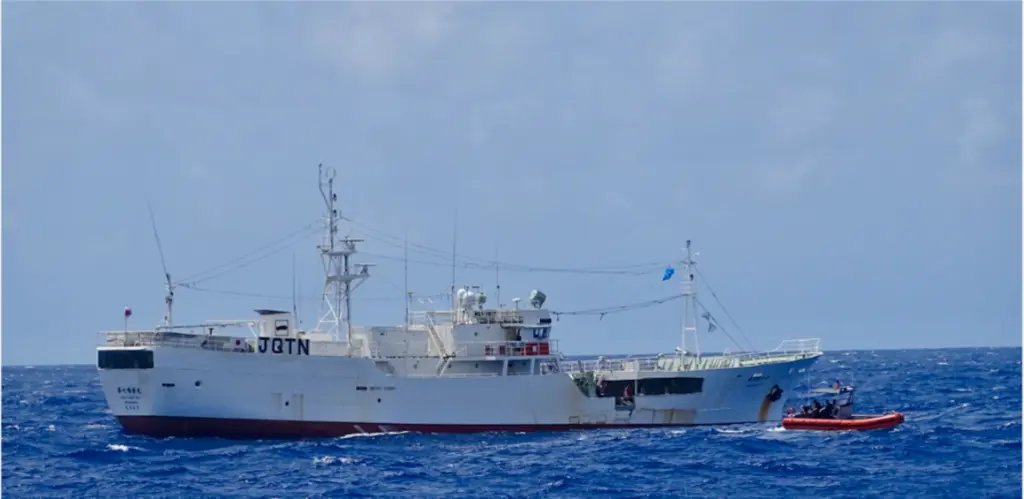
SANTA RITA, Guam — In a robust display of maritime commitment, U.S. Coast Guard Forces Micronesia/Sector Guam’s Fast Response Cutters conducted four patrols over 44 days, enhancing safety and prosperity in the Pacific Islands region while combatting illicit maritime activity, including illegal, unregulated, and unreported fishing and the illegal and unsafe transport of passengers. 

The crews of USCGC Frederick Hatch (WPC 1143), USCGC Myrtle Hazard (WPC 1139), and USCGC Oliver Henry (WPC 1140): 
 
– Conducted seven boardings and five observation reports. 
– Completed over 20 training evolutions. 
– Qualified 18 new shipboard members. 
– Supported the investigation into the transport of 11 people aboard an overloaded vessel transiting to Guam from the Commonwealth of the Northern Mariana Islands on an illegal charter following their rescue by DoD partners.  
– Supported operations such as Operation Blue Pacific, Operation Rematau, Operation Nasse, and Operation Koa Moana. 
 
“Our Fast Response Cutter crews exhibit both efficacy and presence as a consistent and trusted partner in the region. Our Pacific Island Country partners’ warmth and regard for the Coast Guard is a testament to the strong connections we have nurtured over the years. It is our commitment to the people of the Pacific Island Countries to protect Oceania and its resources for them from undue strategic competition that would undermine those relationships and destabilize the region,” said Cmdr. Greg Sickels, deputy sector commander of U.S. Coast Guard Forces Micronesia/Sector Guam.  
 
Operational Achievements and Highlights 
 
– USCGC Frederick Hatch (June 21 – July 2 and July 18 – Aug. 3): Enhanced international relations, streamlined boarding processes, qualified new personnel, and improved communication with FSM Maritime Police. 
 
– USCGC Myrtle Hazard (July 3 – 16): Strengthened connection with CNMI, ensured maritime law enforcement presence in less patrolled areas, and enhanced collaboration with customs and public safety departments. 
 
– USCGC Oliver Henry (July 18 – 23): Increased U.S. presence, enforced fishing regulations, and fostered crew readiness with weapons proficiency and collaboration. 
 
These accomplishments underscore the U.S. Coast Guard’s pivotal role in promoting maritime governance, ensuring good relations, and fostering strategic competition in the Pacific Islands region. The U.S. Coast Guard remains a consistent and reliable partner, working collaboratively with Pacific Island Countries to achieve shared objectives and bolster regional security. 
 
Operation Rematau, an integral part of Operation Blue Pacific, is spearheaded by the U.S. Coast Guard Forces Micronesia/Sector Guam. This initiative fosters security, safety, sovereignty, and economic prosperity throughout Oceania. Rematau translates to “people of the deep sea” and embodies the Coast Guard’s unwavering commitment to safeguarding the people of this region. 
 
The U.S. Coast Guard actively exercises 12 bilateral maritime law enforcement agreements with Pacific Island Countries, reinforcing maritime law enforcement operations and domain awareness in the region. In October 2022, the Service, on behalf of the U.S., signed the first enhanced bilateral agreement with the Federated States of Micronesia. This landmark agreement builds on the existing shiprider arrangement, allowing the U.S. Coast Guard to conduct boardings in the FSM’s exclusive economic zone with prior approval working with the FSM National Police, but without an FSM officer physically present. This expansion significantly amplifies the FSM’s capacity to protect its sovereignty and resources across an area spanning 1 million square miles and more than 600 islands. Boardings have already been conducted under this enhanced shiprider agreement, attracting interest in similar arrangements from other nations in the area. 
 
In May 2023, the U.S. signed a new bilateral agreement with Papua New Guinea, richly endowed with natural resources like gold, copper, oil, and natural gas. While its formal sector focuses on exports of these commodities, most of its people rely on subsistence agriculture. As of 2020, agriculture, forestry, and fishing reportedly account for nearly 19 percent of PNG’s GDP. The agreement aligns with the PNG government’s efforts to safeguard their islands and 1.2 million square miles of EEZ, which are vital to their economic well-being. Recently ratified by their parliament, this partnership, at the request of the Papua New Guinea government, further extends the reach and impact of maritime law enforcement efforts. In line with this initiative, a U.S. Coast Guard cutter from Guam will be collaborating with Papua New Guinea to enact their new agreement shortly, continuing to foster security and collaboration across the Pacific. 
 
U.S. Coast Guard Forces Micronesia/Sector Guam comprises more than 300 members based in Guam and the Commonwealth of the Northern Mariana Islands spread across shoreside and afloat units committed to maritime safety, security, and stewardship in Oceania.  
 
For more information on the U.S. Coast Guard Forces Micronesia Sector/Guam’s operations and achievements, please visit the official DVIDS account at https://www.dvidshub.net/unit/USCG-FMSG


Coast Guard Cutter Dauntless Returns Home Following 42-day Multi-Mission Patrol 

Release from U.S. Coast Guard Atlantic Area 

***** 

Aug. 19, 2023 

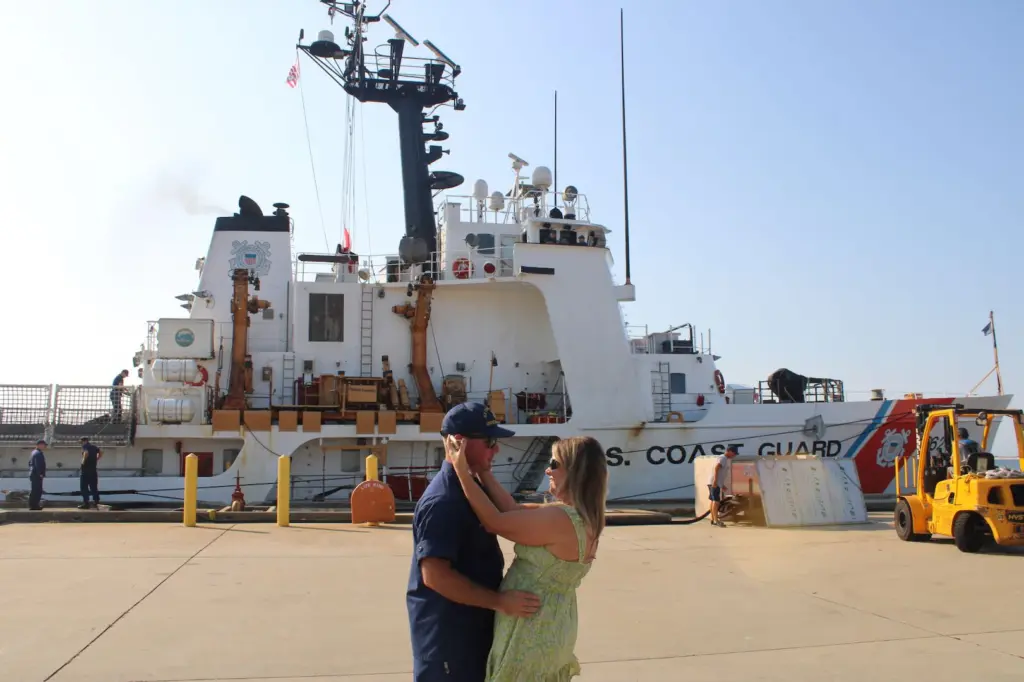
PENSACOLA, Fla. – The crew of the U.S. Coast Guard Cutter Dauntless (WMEC 624) returned to their homeport in Pensacola Saturday following a 42-day patrol in the Windward Pass. 

Operating under the Seventh Coast Guard District’s area of responsibility in support of Operation Vigilant Sentry and Homeland Security Taskforce — Southeast, Dauntless’ primary mission was deterring dangerous, illegal migration. 

Notably, Dauntless’ crew contributed to the protection of life at sea by detecting an overloaded 60-foot vessel with 274 persons aboard. Dauntless worked with other Coast Guard assets to safely interdict the vessel at sea and handle the subsequent care and repatriation of the individuals. 

In addition, the Dauntless crew also supported the Coast Guard’s counterdrug mission by detecting one go-fast vessel suspected of carrying illegal narcotics in Haitian waters.  

“I am extremely impressed with the crew’s excellent performance during the ship’s first patrol in more than nine months following an extended maintenance period,” said Cmdr. Aaron Kowalczk, commanding officer of Dauntless. “The Dauntless’ crew continues to provide for the safety of mariners and the enforcement of maritime laws and treaties.” 

Dauntless is a 210-foot Reliance-class medium endurance cutter. The cutter’s primary missions are counter-narcotics operations, migrant interdiction, living marine resource protection, and search and rescue in support of U.S. Coast Guard operations throughout the Western Hemisphere.   


Navy, Marine Corps Conclude Large Scale Exercise 2023 

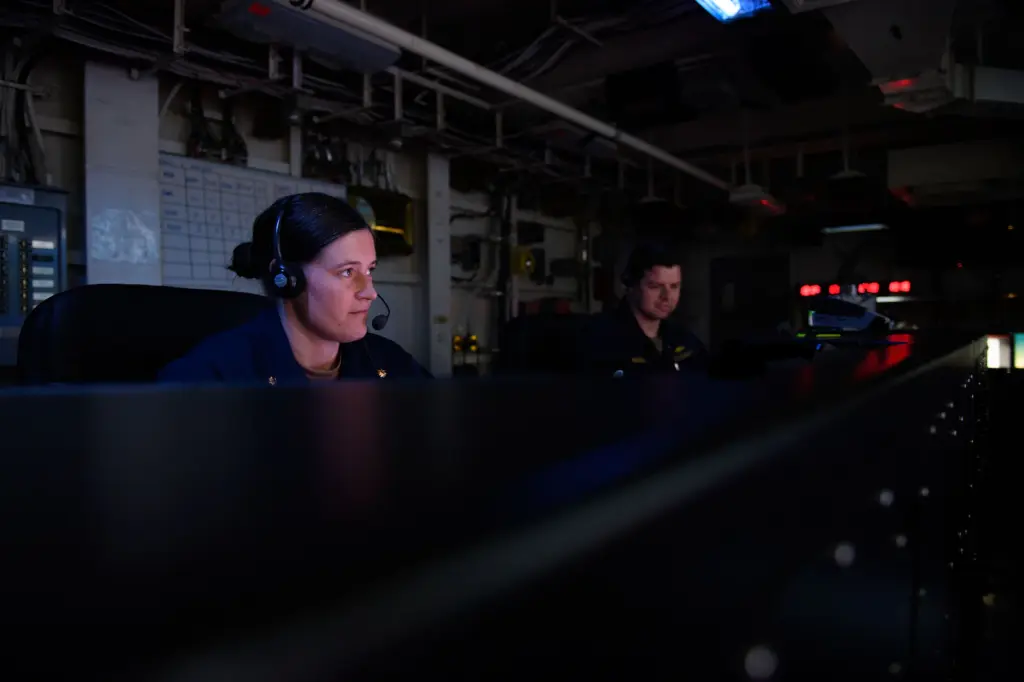
NORFOLK, Va. (Aug. 9, 2023) Lt. Cmdr. Christine Tyndall, from San Jose, California, and Lt. Steven McGhan, from Merritt Island, Florida, stand watch during Large-Scale Exercise (LSE) 2023 aboard the Nimitz-class aircraft carrier USS Dwight D. Eisenhower (CVN 69). LSE 2023 is a live, virtual, and constructive, globally-integrated exercise designed to refine how we synchronize maritime operations across multiple fleets, in support of the joint force. (U.S. Navy photo by Mass Communication Specialist 2nd Class Mo Bourdi/Released)

Release from U.S. Fleet Forces Command 

***** 

18 August 2023 

NORFOLK, Va. – More than 25,000 Sailors and Marines across the globe participated in the U.S. Navy and U.S. Marine Corps-led Large Scale Exercise (LSE) 2023, Aug. 9-18. 
 
One of the largest exercises for the maritime services, LSE 2023 is a live, virtual and constructive, globally-integrated exercise designed to refine the synchronization of maritime operations. 
 
During a media roundtable, the commanders of U.S. Fleet Forces Command, U.S. Pacific Fleet, U.S. Naval Forces Europe and Africa, and Marine Forces Command highlighted LSE 2023 as the leading exercise in how the Navy and Marine Corps further improves their ability to fight on land, air, sea, space, and cyberspace in order to maintain a military force that is most effective in peacetime and more powerful in war. 
 
“We have a responsibility and a duty to be able to respond globally to threats and vulnerabilities to peer adversaries and competitors,” said Adm. Daryl Caudle, commander U. S. Fleet Forces Command. “And the way you get great at that is to practice with exercises like LSE 2023.” 
 
LSE 2023 spanned 22 time zones and included participants from U.S. Fleet Forces Command, U.S. Pacific Fleet, U.S. Naval Forces Europe-Africa Command, Marine Forces Command, U.S. Marine Corps Forces Europe and Africa, U.S. Marine Corps Forces Pacific, and seven U.S. numbered Fleets: Second, Third, Fourth, Fifth, Sixth, Seventh, and Tenth. 
 
The integration of fleet operations with emerging technologies played a key role in refining and validating Distributed Maritime Operations (DMO) capabilities. 
 
“The United States is a global power that has global interests. We have allies and partners around the world. We routinely sail, fly, and operate in international spaces,” said Adm. Stuart Munsch, commander, U.S. Naval Forces, Europe and Africa. “You put that all together, and we have a responsibility to be able to operate globally, effectively, and that’s what we’re doing. We demonstrate that to assure our allies and partners, and we demonstrate it to deter adversaries.” 
LSE 2023 reinforced a culture of learning and increased warfighting readiness by merging real-world operations with virtually constructed scenarios to create a realistic training environment that allowed Sailors and Marines to train the way we fight, regardless of geographic boundaries. 
 
“This is an exercise where we can bring all of our experiences together and learn from each other,” said Lt. Gen. Brian Cavanaugh, commander, Marine Forces Command. “I’ve learned a tremendous amount from Admirals Caudle, Paparo, and Munsch, as well as General Jurney and General Sofge, and you don’t get that until you come together and do an exercise like this. The challenges we encountered during LSE 23 only help us in our continuum of learning – from the tactical unit, up through the highest levels of decision making.” 
 
LSE 2023 incorporated live units underway ranging from aircraft carriers to submarines, shore logistic support units, and more than 30 virtual units. This included pier-side participation from ships as well as training facilities and staff headquarters from around the world. 
 
From the strategic level with combatant commanders down to the hands-on training on the tactical level, this exercise encompassed a wide range of training for the Navy and Marine Corps. 
 
“We are a global, responsive Navy operating dynamically within the joint force, ready to respond to threats against our nation,” said Adm. Samuel Paparo, commander, U.S. Pacific Fleet. “Our competitors are increasingly cooperating and operating further afield. This underscores the importance of exercises like LSE to hone our ability to find, track and monitor potential threats and coordinate globally.” 
 
The U.S. Navy and U.S. Marine Corps will incorporate lessons learned from LSE 2023 into the planning of its next large scale exercise iteration which will take place in 2025. 
 
To read the full transcript from the media roundtable with LSE 2023 commanders visit:

https://www.usff.navy.mil/Press-Room/Press-Releases/Article/3498119/large-scale-exercise-2023-commanders-interview-transcript/ 


Bangor Dry Dock Recertifies, Completing Seismic Mitigation Work

Workers help guide a hydraulic anchor drilling rig, February 16, 2023, as part of the seismic mitigation effort at Puget Sound Naval Shipyard & Intermediate Maintenance Facility.(U.S. Navy Photo by Wendy M Hallmark)

Release from U.S. Pacific Fleet 

*****

From Courtesy Story

BREMERTON, Wash. – Interim seismic mitigation efforts, which began Feb. 15 on the Trident Refit Facility Delta Pier in Bangor, have been completed.

In January of this year the Navy restricted submarines from entering certain dry docks in the Pacific Northwest (both at Puget Sound Naval Shipyard & Intermediate Maintenance Facility and Trident Refit Facility- Bangor) because of seismic concerns identified in recent studies. The Navy team rapidly deployed and implemented a repair technique using dry dock wall reinforcing tie downs.

The three dry docks where tie downs were installed have been recertified. Repairs to the full length of the Bangor dock walls have been completed and the dock was recertified August 10. PSNS & IMF’s Dry Dock 5 was recertified June 30 to dock USS Connecticut (SSN 22) and Dry Dock 4 was recertified April 28 to dock USS Pennsylvania (SSBN 735).

“The completion of seismic mitigations at the TRF Bangor dry dock is an incredible milestone,” said Capt. JD Crinklaw, commander, PSNS & IMF. “For the past six months, thousands of personnel have dedicated themselves to ensuring all three dry docks were safely and efficiently brought back into operation, so we could continue our mission. I am incredibly grateful to the team of experts who helped us reach this objective and ensure the readiness and resilience of the Navy’s fleet.”

Construction efforts include drilling holes for the installation of anchors inside the dry dock walls to enhance structural integrity and ensure the safety of the workforce, community, environment, and submarines. The mitigation efforts updated existing emergency response plans to better address the chance of a catastrophic earthquake, along with improved early-warning employee notification systems in the dry docks.

Experts from private industry, Naval Sea Systems Command, Naval Facilities Engineering Systems Command, TRFB and PSNS & IMF planned and implemented the structural upgrades, with an eye on the Navy’s future needs and in support of the mission to deliver modern, fully-mission capable warships on-time, every time, preserving our national security.

“The upgrades done at Delta Pier will provide the Navy with critical sustainment operations, for our submarines, in the years ahead,” said Capt. Mike Eberlein, commanding officer, Trident Refit Facility-Bangor. “When I look at the amount of work done over the last few months, the precision of that work, and the speed and efficiency of the professionals involved, I am amazed at the capabilities of the Navy to conduct our national security mission.”

These short-term mitigation actions did not affect the nation’s strategic deterrent capability or the ability of the fleet to continue its overall mission. PSNS & IMF remains the primary provider for the maintenance, repair, modernization, inactivation and disposal of ships, submarines, and nuclear-powered aircraft carriers in the Pacific Fleet.

Based on future planned improvements to Dry Dock 6, and differences in ship design and the size of aircraft carriers, it was determined immediate seismic mitigations are not required. Aircraft carrier maintenance at PSNS & IMF remains unaffected.

The need for mitigations in the remaining docks will be determined once current efforts are complete and may include stability enhancements for submarine availabilities.

For questions related to this release, please contact the Navy Office of Information at 703-697-5342 or [email protected].


Navy to Christen Guided-Missile Destroyer Ted Stevens (DDG 128)

Release from U.S. Dept. of Defense 

*****

18 August 2023

The Navy will christen the future USS Ted Stevens (DDG 128) during a 9:00 a.m. CDT ceremony on Saturday, Aug. 19, in Pascagoula, Mississippi. 

ShapeThe principal address will be delivered by the Honorable Sean O’Keefe, 69th Secretary of the Navy and 10th Administrator of NASA.  Remarks will also be provided by the Honorable Russell Rumbaugh, Assistant Secretary of the Navy (Financial Management and Comptroller); Vice Admiral Jeffrey Hughes, Deputy Chief of Naval Operations for Warfighting Development; and Kari Wilkinson, executive vice president of Huntington Ingalls Industries and president of Ingalls Shipbuilding. The ship’s sponsors are Catherine Ann Stevens, Susan Stevens Covich, and Lily Irene Becker, the wife and daughters of the ship’s namesake. In a time-honored Navy tradition, the sponsors will christen the ship by breaking a bottle of sparkling wine across the bow.

The ship’s namesake, Ted Stevens, was a U.S. Senator from Alaska who served the Senate and the Solicitor of the Interior Department for over 40 years. He was a strong supporter of the Navy and Marine Corps. 

This is the first U.S. Navy ship to honor Stevens and will be the third Flight III upgrade ship. 

Arleigh Burke-class destroyers are the backbone of the U.S. Navy’s surface fleet, providing protection to America around the globe. These highly capable, multi-mission ships conduct various operations, from peacetime presence to national security, providing a wide range of warfighting capabilities in multi-threat air, surface, and subsurface domains. These elements of seapower enable the Navy to defend American prosperity and prevent future conflict abroad.

Media may direct queries to the Navy Office of Information at (703) 697-5342. More information on guided-missile destroyer programs can be found at:  https://www.navy.mil/Resources/Fact-Files/Display-FactFiles/Article/2169871/destroyers-ddg/