BOLLINGER SHIPYARDS Cuts Steel on Prototype Module of First US-Built Heavy Icebreaker in 50 Years 

Release from Bollinger Shipyards

*****

Prototype module will become the foundation of new Polar Security Cutter 

PASCAGOULA, Miss., — (August 9, 2023) – Bollinger Shipyards LLC (“Bollinger”) has begun cutting steel at Bollinger Mississippi Shipbuilding in Pascagoula, MS on the first of eight prototype modules that will become the foundation of the first U.S. Coast Guard Polar Security Cutter (PSC), USCGC Polar Sentinel (PSC-1) – the first heavy icebreaker to be built in the United States in 50 years.   

“Today marks a significant step for both Bollinger Shipyards and the United States,” said Ben Bordelon, President and CEO of Bollinger Shipyards. “After over 50 years, we’re back to building heavy icebreakers. We’re honored that responsibility lies with Bollinger. Beginning work on the first Prototype Fabrication Assembly Unit is an important step closer toward commencing construction on the first Polar Security Cutter. This isn’t just an important milestone for our company, it’s also an important step for our national defense. Simply put, the United States is back in the icebreaker business.” 

The hull of a heavy polar icebreaker is required to be much thicker than other Coast Guard cutters because of the pressure exerted on the ship by the surrounding ice. Therefore, before the full construction process on the PSC program begins, the prototype modules test the new systems, processes, people, and tools that are required to work with the specialized steel. The lessons learned from building the prototype module will be used to help ensure design completeness and improve the quality and efficiency of the manufacturing process. 

“We’re relearning how to build this type of ship,” said PSC program manager Capt. Eric Drey. “It’s the first heavy icebreaker built by our nation in 50 years. It’s not just a big day for the Coast Guard, but a big day for the nation.” 

Each module requires approximately four months of labor, during which time Bollinger will continue recruiting and training additional members of the workforce to manage the transition to production of the lead hull as the prototype modules are completed. 

The Coast Guard’s operational polar icebreaking fleet currently consists of one heavy icebreaker, the 399-foot Coast Guard Cutter Polar Star that was commissioned in 1976, and one medium icebreaker, the 420-foot Coast Guard Cutter Healy that was commissioned in 1999. 

ABOUT the Polar Security Cutter (PSC) program 

The U.S. Coast Guard requires polar icebreaking capability to support the country’s economic, commercial, maritime and national security needs in the Polar Regions. The new Polar Security Cutters (PSCs) will be national assets that will ensure access to both polar regions and be capable of executing key Coast Guard missions, including defense readiness; marine environmental protection; ports, waterways and coastal security; and search and rescue. The ships will operate worldwide and face the range of extreme environmental conditions found in the polar, tropical and temperate regions. 
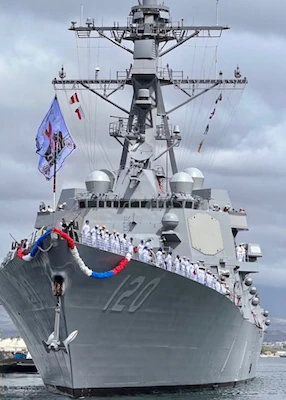


USS Carl M. Levin (DDG 120) Arrives Home 

Release from Commander, Naval Surface Group Mid-Pacific

***** 

07 August 2023 

PEARL HARBOR, HI, UNITED STATES – The Navy’s newest Arleigh Burke-class guided-missile destroyer, USS Carl M. Levin (DDG 120), and its crew arrived at the ship’s new home port of Pearl Harbor, Hawaii, Aug. 7. 
 
USS Carl M. Levin is the first naval ship named in honor of Michigan’s longest serving senator, the late Carl M. Levin, for his years of service as a longtime member and chairman of the Senate Armed Services Committee. 
 
Levin began his career as an attorney, professor, and assistant attorney general in Michigan and was elected to the Senate in 1979. Levin chaired the Senate Armed Services Committee from 2001 – 2003 and from 2007 until his retirement. He was Michigan’s first Jewish senator and the state’s longest-serving senator, serving for 36 years before retiring in 2015. 
 
“USS Carl M. Levin honors the legacy and achievements of a great American senator who always placed service of others above self,” said Cmdr. Kelly Craft, Carl M. Levin’s commanding officer. “Symbolized in U.S. steel, the crew has worked tirelessly to bring her to life and sail her to our homeport of Pearl Harbor, Hawaii. We are proud to join our comrades in the defense of Hawaii, ready to take on any challenge and always remain tenacious in the fight.” 
 
During Carl M. Levin’s transit to Hawaii, the ship made port calls to major naval ports including Newport, Rhode Island., Norfolk, Virginia, Mayport, Florida, and San Diego, California. Additionally, the crew stopped in Oranjestad, Aruba, before continuing through the Panama Canal and visiting Manta, Ecuador. Throughout their journey, Carl M. Levin accomplished numerous certifications and evolutions including, underway replenishments at sea, flight quarters, gun shoots, small boat operations, and many more. 
 
The ship was christened on Oct. 2, 2021 at the Bath Iron Works in Bath, Maine, and commissioned in on June 24, 2023, in Baltimore. 
 
The mission of Commander, Naval Surface Group Middle Pacific is to manage the overall warfighting capability of the Surface Combatant Force homeported at Joint Base Pearl Harbor-Hickam, Hawaii; to coordinate the manning, operations, combat systems, engineering, maintenance, training, logistics, administration, and support of assigned units to achieve the highest levels of combat readiness. 
 
As in integral part of U.S. Pacific Fleet, U.S. 3rd Fleet operates naval forces in the Indo-Pacific in addition to providing realistic and relevant training necessary to execute the U.S. Navy’s timeless roles of sea control and power projection. U.S. 3rd Fleet works in close coordination with other numbered fleets to provide commanders with capable, ready forces to deploy forward and win in day-to-day competition, in crisis, and in conflict. 

PEARL HARBOR, HI, UNITED STATES – The Navy’s newest Arleigh Burke-class guided-missile destroyer, USS Carl M. Levin (DDG 120), and its crew arrived at the ship’s new home port of Pearl Harbor, Hawaii, Aug. 7. 
 
USS Carl M. Levin is the first naval ship named in honor of Michigan’s longest serving senator, the late Carl M. Levin, for his years of service as a longtime member and chairman of the Senate Armed Services Committee. 
 
Levin began his career as an attorney, professor, and assistant attorney general in Michigan and was elected to the Senate in 1979. Levin chaired the Senate Armed Services Committee from 2001 – 2003 and from 2007 until his retirement. He was Michigan’s first Jewish senator and the state’s longest-serving senator, serving for 36 years before retiring in 2015. 
 
“USS Carl M. Levin honors the legacy and achievements of a great American senator who always placed service of others above self,” said Cmdr. Kelly Craft, Carl M. Levin’s commanding officer. “Symbolized in U.S. steel, the crew has worked tirelessly to bring her to life and sail her to our homeport of Pearl Harbor, Hawaii. We are proud to join our comrades in the defense of Hawaii, ready to take on any challenge and always remain tenacious in the fight.” 
 
During Carl M. Levin’s transit to Hawaii, the ship made port calls to major naval ports including Newport, Rhode Island., Norfolk, Virginia, Mayport, Florida, and San Diego, California. Additionally, the crew stopped in Oranjestad, Aruba, before continuing through the Panama Canal and visiting Manta, Ecuador. Throughout their journey, Carl M. Levin accomplished numerous certifications and evolutions including, underway replenishments at sea, flight quarters, gun shoots, small boat operations, and many more. 
 
The ship was christened on Oct. 2, 2021 at the Bath Iron Works in Bath, Maine, and commissioned in on June 24, 2023, in Baltimore. 
 
The mission of Commander, Naval Surface Group Middle Pacific is to manage the overall warfighting capability of the Surface Combatant Force homeported at Joint Base Pearl Harbor-Hickam, Hawaii; to coordinate the manning, operations, combat systems, engineering, maintenance, training, logistics, administration, and support of assigned units to achieve the highest levels of combat readiness. 
 
As in integral part of U.S. Pacific Fleet, U.S. 3rd Fleet operates naval forces in the Indo-Pacific in addition to providing realistic and relevant training necessary to execute the U.S. Navy’s timeless roles of sea control and power projection. U.S. 3rd Fleet works in close coordination with other numbered fleets to provide commanders with capable, ready forces to deploy forward and win in day-to-day competition, in crisis, and in conflict. 


GA-ASI Advances Ecosystem for Autonomously Operational UCAV

Release from General Atomics

*****

SAN DIEGO – 09 August 2023 – General Atomics Aeronautical Systems, Inc. (GA-ASI) advanced its ability to operationalize the Unmanned Combat Air Vehicle (UCAV) ecosystem by combining advanced autonomy and government-provided human-machine interface (HMI) hardware. A GA-ASI-owned Avenger® Unmanned Aircraft System (UAS) was paired with “digital twin” aircraft to autonomously conduct Live, Virtual, and Constructive (LVC) multi-objective collaborative combat missions. 

The flights, which took place on July 13, 2023, from GA-ASI’s Desert Horizon Flight Operations Facility in El Mirage, Calif., demonstrate the company’s commitment to maturing its UCAV ecosystem for Autonomous Collaborative Platforms (ACP). The ecosystem’s goal is to rapidly integrate best-of-breed capabilities in areas such as Artificial Intelligence (AI), mission-relevant interfaces, and other capabilities from third-party providers at the speed of relevance for 21st century conflicts. 

The team demonstrated Manned-Unmanned Teaming (MUM-T) using the U.S. Air Force’s Project FoX system, which included a touchscreen tablet for fighter cockpits. The tablet provided control and monitoring of advanced autonomy while it conducted a multi-objective combat mission consisting of LVC entities. Mission autonomy capabilities focused on optimized search and signature management. Search optimization autonomy behaviors were provided by Scientific Systems Company, Inc. (SSCI). These skills were integrated into and orchestrated by government-furnished equipment (GFE) autonomy core architecture enhanced by GA-ASI. The flexibility of the GFE autonomy core software stack enabled rapid, seamless integration of one of SSCI’s multi-UAS behaviors. Autonomous trajectories were calculated by SSCI algorithms and subsequently communicated to GA-ASI’s autonomy core for translation to vehicle routes. SSCI provided an array of behaviors using its Collaborative Mission Autonomy suite where the software adapts to mission contingencies such as system failures, connectivity dropout, and combat losses to ensure successful tactical execution.  

“The concepts demonstrated by these flights set the standard for operationally relevant mission systems capabilities on UCAV platforms,” said GA-ASI Senior Director of Advanced Programs Michael Atwood. “Our integration of the emerging FoX system accelerates speed to ramp for emerging collaborative air-to-air capabilities. The combination of airborne high-performance computing, sensor fusion, human-machine teaming, and AI pilots making decisions at the speed of relevance shows how quickly GA-ASI’s capabilities are maturing as we move to operationalize autonomy for UCAVs.” 

The signature management skill, based on deep reinforcement learning, was developed by GA-ASI. Skill development leveraged GA-ASI’s novel Reinforcement Learning (RL) architecture that was designed using agile software methodology and industry-standard tools such as Docker and Kubernetes. Commanded using the FoX tablet, the RL agent navigated to an operator-identified target while minimizing the radar cross section (RCS). This MUM-T, facilitated via open mission system (OMS) messages and alignment to the newest government architectures, demonstrated real-time operator tasking and supervision of an autonomous platform as it conducted its mission. 

The team used a government-furnished autonomy core engine and the government-standard OMS messaging protocol to enable communication between the RL agents and the LVC system. Utilizing government standards such as OMS will make rapid integration of autonomy for UCAVs possible. In addition, GA-ASI used a General Dynamics EMC2 to run the autonomy architecture. EMC2 is an open architecture Multi-Function Processor with multi-level security infrastructure to run the autonomy architecture, demonstrating the ability to bring high-performance computing resources to UCAVs to perform quickly tailorable mission sets depending on the operational environment.  

GA-ASI is demonstrating its commitment to maturing an autonomy infrastructure to enable rapid integration and validation of third-party tactical software applications from an App Store and maintaining safety of flight. This is another in an ongoing series of autonomous flights performed by GA-ASI using internal research and development funding to prove out important AI/ML concepts for UAS. 


Fairbanks Morse Defense, Oak Ridge National Laboratory Collaborate on Developing Alternative Fuel Technology for Marine Engines 

Release from Fairbanks Morse Defense 

***** 

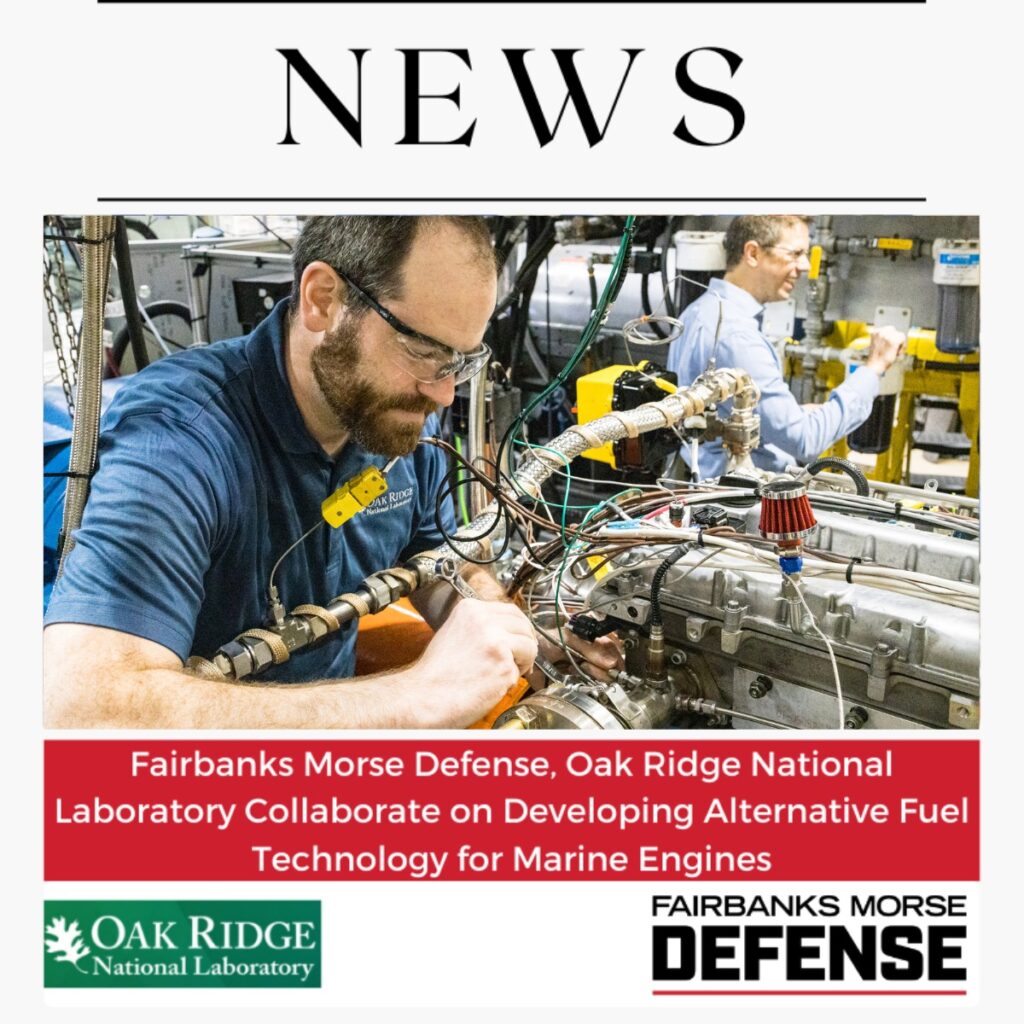
BELOIT, Wis. – August 8, 2023 – Oak Ridge National Laboratory (ORNL), the Department of Energy’s largest multidisciplinary laboratory, and Fairbanks Morse Defense (FMD), a portfolio company of Arcline Investment Management, have entered into a Memorandum of Understanding (MOU) to collaborate on the development and integration of alternative fuel technologies aimed at reducing the marine engine’s reliance on fossil fuels. FMD will incorporate the research and development conducted at ORNL into its engine design technology.  

Marine engines heavily rely on diesel fuel, which constitutes a significant annual expense for the Department of Defense (DOD). However, global decarbonization efforts are expected to limit the availability of diesel fuel and drive-up costs. In anticipation of this shift, the DOD is exploring options to transition its marine engine technology to low-lifecycle carbon fuels (LLCF) such as methanol, ammonia, hydrogen, and biodiesel. 

“Oak Ridge is a leader in decarbonization research, clean energy technology development, and defense manufacturing,” said Moe Khaleel, Associate Laboratory Director for National Security Sciences. “Collaborating with a trusted national security partner like Fairbanks Morse Defense will enable us to translate our scientific expertise into deployable technologies for the Department of Defense.” 

Under the terms of the MOU, ORNL will leverage its research and development expertise, while FMD will contribute its power and propulsion design and manufacturing proficiency to promote the use of LLCFs in marine engines. FMD will define the performance and durability requirements and design testing components, while ORNL will provide research support in combustion strategies for LLCFs, high-temperature materials, additive manufacturing, elastomer compatibility, and corrosion. 

“As climate change impacts our global waterways, these changing and unpredictable impacts directly affect our ability to protect the freedom of the seas,” said George Whittier, FMD CEO. “We’re fully committed to supporting the Department of Defense’s 2030 decarbonization goals with fuel and engine technologies that will create a more sustainable future for the Navy, and we look forward to working with ORNL to explore these possibilities.” 

Additional partnership intentions from the MOU include the following:  

  • Collaborating on program development to identify and secure external research and development opportunities. 

  • Establishing a single-cylinder research engine laboratory dedicated to exploring breakthroughs in areas such as safe fuel handling, LLCF combustion strategy, and experimental engine hardware configurations. 

  • Supporting alternative fuel combustion development strategy through modeling studies that employ advanced analytics such as computational fluid dynamics simulations using high-performance computing resources.  


Fourth New England-based Fast Response Cutter to be commissioned in Portland

Release from Coast Guard 1st District 

***** 

Aug. 8, 2023 

Fourth New England-based Fast Response Cutter to be commissioned in Portland 

PORTLAND, Me. — The Coast Guard Cutter John Patterson (WPC-1153) is scheduled to be commissioned during a ceremony Thursday at 10 a.m. 

The Coast Guard’s newest cutter was accepted by the Coast Guard on May 11, 2023 and will be the fourth of six Fast Response Cutters homeported in Boston. 

The Sentinel-class fast response cutter (FRC) is designed for multiple missions, including drug and migrant interdiction; ports, waterways and coastal security; fishery patrols; search and rescue; and national defense. The Coast Guard has ordered a total of 65 FRCs to replace the 1980s-era Island-class 110-foot patrol boats. The FRCs feature advanced command, control, communications, computers, intelligence, surveillance and reconnaissance equipment; over-the-horizon cutter boat deployment to reach vessels of interest; and improved habitability and seakeeping. 

John C. Patterson was born in 1834 to a local farm couple in Howell, New Jersey. Patterson volunteered as a private in New Jersey’s 14th Militia Regiment during the Civil War. He demonstrated superior leadership under pressure and quickly promoted into the officer grades where he rose to the rank of brevet brigadier general. After the war, in 1870, Patterson signed on as a surfman at the U.S. Life Saving Station in Sandy Hook, New Jersey. John Patterson served a total of 16 years in the Life-Saving Service, starting as junior-most surfman and rising to the rank of keeper. He was a keeper at two different stations and a member of the Life-Saving Service’s Advisory Board. Even after his 1886 retirement from the Service, Patterson continued to serve his community of Ocean Grove until his death. 


Office of Naval Research, NIWC Pacific host 26th international RoboSub Competition

Release from Naval Information Warfare Center, Pacific 

***** 

Office of Naval Research, NIWC Pacific host 26th international RoboSub Competition 

07 August 2023 

From Mason Piedfort, Naval Information Warfare Center, Pacific 

SAN DIEGO – The Office of Naval Research (ONR) and Naval Information Warfare Center (NIWC) Pacific hosted RoboNation’s 26th international RoboSub Competition at NIWC Pacific Transducer Evaluation Center (TRANSDEC) July 31 – Aug. 6. 

ShapeStudent participants from across the globe built robotic submarines designed to overcome simplified versions of challenges relevant to the autonomous underwater vehicle (AUV) field.

“The Navy employs unmanned systems in every domain — in the air, on the sea, and under the sea,” said Vice Chief of Naval Operations Adm. Lisa Franchetti, who attended Aug. 2. “The innovation and creativity we see through programs like RoboSub push the imagination of what is possible in unmanned platforms. These competitors represent the leaders of the future who will bring solutions to some of our most difficult challenges in the fleet and industry.” 
 

This year 35 teams represented five countries: the U.S., Canada, Bangladesh, India, and Singapore. Teams are affiliated with high schools, university undergraduate and graduate programs, and non-profit organizations. 
 
Though teams compete for various amounts of prize money, cross-team cooperation is common at RoboSub, in what RoboNation Program Manager Julianna Smith called a spirit of “cooperatition,” a combination of cooperation and competition. 
 
In the spirit of cooperatition, Team Inspiration, a local team affiliated with non-profit organization Advancing Science, Technology, and Art, hosted a visiting team who arrived to the competition early for dinner at a teammate’s home in the San Diego suburbs. 
 
“It’s rewarding to work with the other teams,” one Team Inspiration member said. “We get to learn from them and then pass that knowledge down to younger teams, not just here at RoboSub but at all the robotics events we do. We help mentor kids interested in robotics both locally and globally and check in with them on Zoom and Discord often.” 
 
The Ohio State University team helped several teams with mechanical fixes throughout the competition. “Of course we want to win, but not because one of the competitors had an issue we could have helped them fix,” one student team leader said. 
 
Students from local team “SDSU Mechatronics,” affiliated with San Diego State University, drove back and forth from their facility to retrieve spare parts for other teams. “When I first joined RoboSub, I worried that it would be overly competitive, but the atmosphere is completely different,” an SDSU Mechatronics team member said. “One of the best parts of RoboNation events is that all the schools help each other out — and as a local team, we want to be a part of that.”  
 
Teams submitted pre-event technical design documentation before arriving at the TRANSDEC. During the competition, volunteer judges evaluated the teams’ performances in underwater autonomy challenge tasks, team presentations, and system assessments. Judges inspected vehicles for design, craftsmanship, technical innovation, and visual impact. 
 
“From my perspective as both the Chief of Naval Research [CNR] and the Naval Science, Technology, Engineering, and Math [STEM] Executive, RoboSub is truly a valuable and important event for fostering greater naval innovation,” said CNR Rear Adm. Kurt Rothenhaus, who also visited the competition Aug. 2. “Not only do we get to meet the next generation of talented scientists and engineers, but we also introduce them to some of the most pressing challenges faced by our Sailors and Marines. This is especially prevalent as autonomous systems and capabilities play an increasingly important role in current and future battlescapes.” 
 
In one of the six challenges, autonomous underwater vehicles navigated through one of two gates; in another, the vehicles dropped path markers into bins and earned bonus points for dropping markers in bins coinciding with the gate passed through earlier. 
 
“Teams have been in the pool at TRANSDEC nearly non-stop,” said Travis Moscicki, NIWC Pacific lead for RoboSub, on the third day of the competition. “Hands down, the number one indicator of performance is time spent in water. This highlights the exact reason we hold the event — there is no substitution for experience.” 
 
Moscicki, who holds a doctorate in ocean engineering, participated in RoboNation robotics competitions as a student before his employment at NIWC Pacific. Now he’s getting to watch how teams evolve year after year. “One team pointed out that at last year’s event they encountered many gremlins (engineer speak for an issue!), but they weren’t sure how to solve them,” he said. “This year, they are still encountering gremlins, but are finding they have solutions. Progression is what RoboSub is all about.” 
 
This year, the National University of Singapore team took first place for the second year in a row, Brac University from Bangladesh took second place, and the University of Alberta from Canada took third place in the autonomy task challenges. Teams also won awards for design documentation, mentorship, ingenuity, data sharing, and “cooperatition.” 
 
NIWC Pacific hosted RoboSub from 2002 to 2019. This year marked the competition’s return to the TRANSDEC pool, which contains six million gallons of water and is 300 feet by 200 feet in size. Its design eliminates all extraneous man-made or natural biologic noises and permits precise control of surface and underwater conditions. 
 
NIWC Pacific and ONR research, develop, and deliver integrated capabilities to the fleet. Both regularly contribute to STEM outreach programs which help develop talent and partnerships for the future. 
 
“The Navy is built on the keel of STEM education, leveraging scientific understanding, critical thinking and problem-solving skills to take us where we need to go,” Franchetti said. “Our Sailors and civilians are out there every day developing, operating and maintaining the most complex ecosystems of warfighting functions; integrating propulsion, power, weapons, combat and information systems we need remain the greatest Navy in the world.” 


SECNAV Names Future Navajo-Class Towing, Salvage, and Rescue Ship Solomon Atkinson 

Release from the Secretary of the Navy Public Affairs 

***** 

07 August 2023 

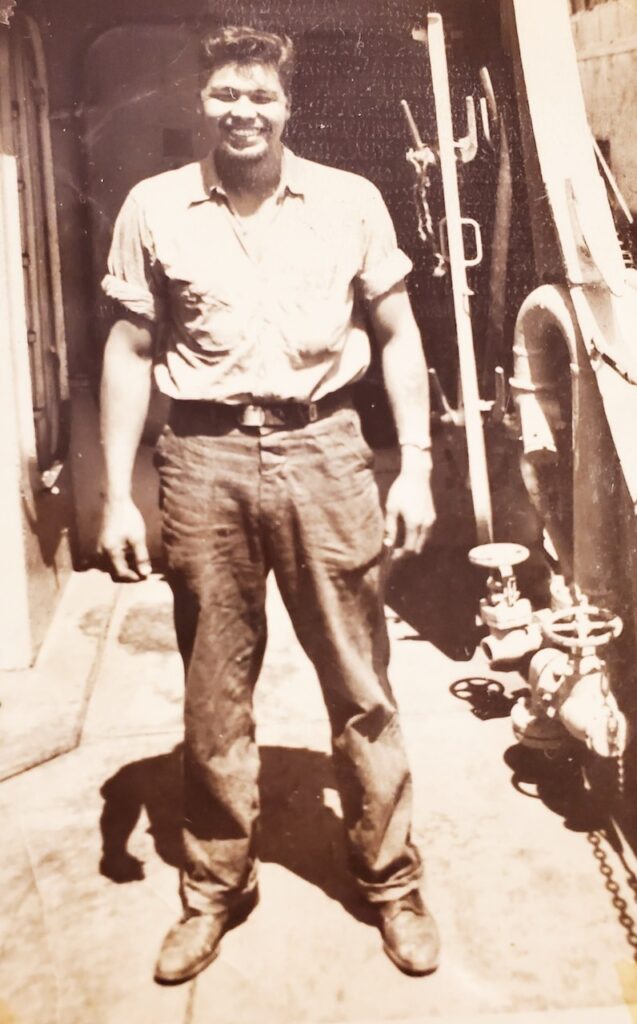
Secretary of the Navy (SECNAV) Carlos Del Toro announced today that a future Navajo-class Towing, Salvage, and Rescue (T-ATS) ship will be named in honor of Solomon Atkinson, a pioneering Navy SEAL and an Alaskan Native of the Metlakatla Indian Community, Annette Islands Reserve. Del Toro made the announcement on the Metlakatla’s Founders Day, Aug. 7. 

ShapeThe name selection of USNS Solomon Atkinson (T-ATS 12) follows the tradition of naming towing, salvage, and rescue ships after prominent Native Americans or Native American tribes.    

“I am honored to name the next T-ATS after Solomon Atkinson, a man who achieved many firsts, even in the face of adversity, and continued to lead,” said Del Toro. “Atkinson’s achievements as a SEAL have left behind an enduring legacy, not just in the Special Warfare Community, but with our nation’s astronauts as well. I am pleased to ensure that his name will extend globally to all who views this great ship.” 

Born in 1930 in Metlakatla, Alaska, Solomon Atkinson was raised by his parents on the sole Indian Reserve in Alaska. Atkinson worked as a commercial fisherman before enlisting in the U.S. Navy in 1952. A year later, Atkinson volunteered for the underwater demolition teams and became a frogman, the precursor to present day SEALs. In 1962, Atkinson became one of the first Navy SEALs and was a plank owner for SEAL Team 1. As a SEAL, he deployed to Korea and completed three combat tours in Vietnam. His Vietnam service-related awards include a Bronze Star, a Navy Commendation Medal with Combat “V,” and a Purple Heart. Atkinson also had the distinction of training numerous astronauts, including Neil Armstrong and Buzz Aldrin, in underwater weightless simulations at the Underwater Swimmers School in Key West, Florida. Atkinson retired from active naval service in 1973 as a Chief Warrant Officer 4 and returned to Metlakatla, where he continued to serve his people and state on the Indian Community Council and Board of Education, as founder and president of the first veterans’ organization on Annette Island, and as mayor of Metlakatla. Upon his passing in 2019, an honor guard from SEAL Team 1 served as pallbearers at his funeral. 

“Chief Warrant Officer 4 Solomon “Sol” Atkinson embodied the spirit of dedication to family, community, and country,” said Rear Adm. Keith Davids, commander, Naval Special Warfare Command. “His pioneering role as one of the first U.S. Navy SEALs, and his unwavering commitment to service both in and out of uniform, serves as an inspiration for the entire Naval Special Warfare community. Naming the USNS Solomon Atkinson in his honor is a testament to his remarkable legacy and the enduring impact he has left on NSW, the Navy, and the nation.” 

Along with the ship’s name, Del Toro announced the sponsors for the future USNS Solomon Atkinson as his widow, Joann Atkinson and their two daughters, Michele Gunyah and Maria Hayward, who, in their role, will represent a lifelong relationship with the ship and crew. 

“There exists a long-held Tsimshian tradition, ‘akadi lip a’algyaga sm’ooygit,’ loosely translated ‘a chief never speaks for himself’,” said sponsor, Maria Hayward. “Through all of his time as a U.S. Navy UDT and SEAL, as well as a leader of veterans and Native Alaskans, Sol lived this ethos. And, here today, in the shadow of Sol’s death, he holds to it still. Thank you to the U.S. Navy for speaking to Solomon’s honor and helping his family and fellow Frogmen shout his legacy to the seven seas!” 

Navajo-class ships will provide ocean-going tug, salvage, and rescue capabilities to support Fleet operations. The current capabilities are provided by Powhatan-class T-ATF Fleet Tugs and Safeguard-class T-ARS Rescue and Salvage vessels, which began reaching the end of their expected service lives in 2020. Navajo-class ships will be capable of towing U.S. Navy ships and will have 6,000 square feet of deck space for embarked systems.  

More information on our towing, salvage, and rescue ship programs can be found here.  


3,000 Sailors and Marines Arrive in Middle East aboard USS Bataan, USS Carter Hall

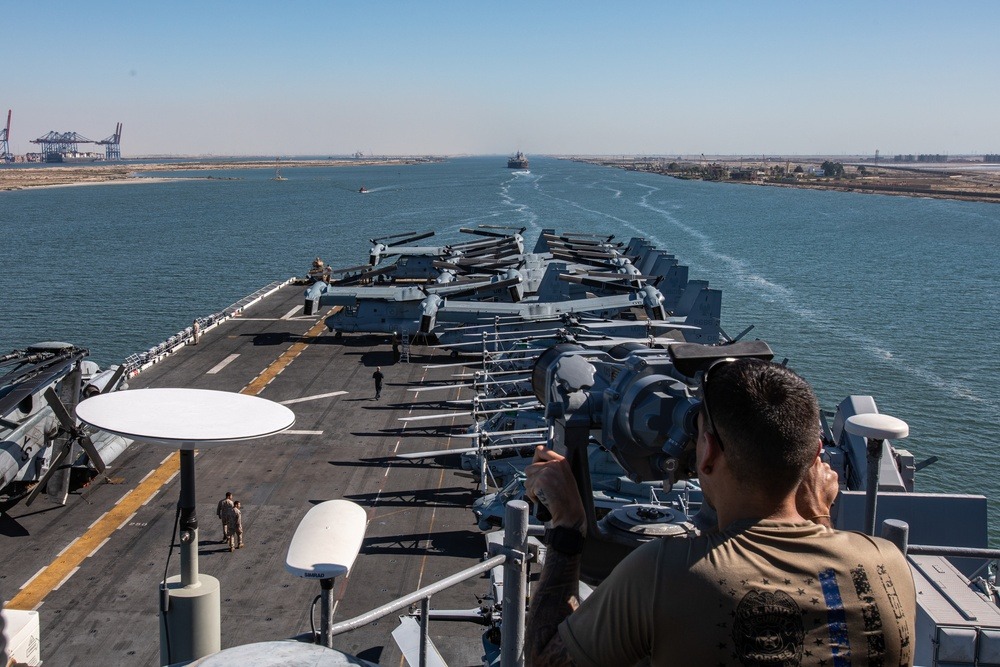
A U.S. Navy sailor from USS Bataan (LHD 5) stands watch as the amphibious assault ship transits the Suez Canal with the 26th Marine Expeditionary Unit (MEU), Aug. 6, 2023.

Release from U.S. Naval Forces Central Command Public Affairs 

***** 

From U.S. Naval Forces Central Command Public Affairs 

MANAMA, Bahrain – More than 3,000 U.S. Sailors and Marines of the Bataan Amphibious Ready Group (ARG) and 26th Marine Expeditionary Unit (MEU) arrived in the Middle East, Aug. 6, as part of a pre-announced Department of Defense deployment. 

Amphibious assault ship USS Bataan (LHD 50) and dock landing ship USS Carter Hall (LSD 50) entered the Red Sea after transiting from the Mediterranean Sea through the Suez Canal. Bataan ARG/26th MEU units bring to the region additional aviation and naval assets, as well as more U.S. Marines and Sailors, providing greater flexibility and maritime capability to U.S. 5th Fleet.  

An amphibious assault ship can carry more than two dozen rotary-wing and fixed-wing aircraft, including MV-22 Osprey tilt-rotor aircraft and AV-8B Harrier attack jets in addition to several amphibious landing craft. A dock landing ship also supports operations for various rotary-wing aircraft, tactical vehicles and amphibious landing craft.  

The Bataan ARG departed Norfolk, Virginia on July 10 with Amphibious Squadron 8, Fleet Surgical Team 8, Tactical Air Control Squadron 21, Helicopter Sea Combat Squadron 26, Assault Craft Unit 4, Beach Master Unit 2 and the 26th MEU. 

The 26th MEU, based in Camp Lejeune, North Carolina, is capable of conducting amphibious missions, crisis response and limited contingency operations to include enabling the introduction of follow-on forces and designated special operations. 

The U.S. 5th Fleet area of operations encompasses approximately 2.5 million square miles of water space and includes the Arabian Gulf, Gulf of Oman, Red Sea, parts of the Indian Ocean and three critical choke points at the Strait of Hormuz, Suez Canal and Strait of Bab al-Mandeb. 


U.S. Nuclear-Powered Submarine Visits Western Australia, First Since AUKUS Announcement

Release from U.S. 7th Fleet 

***** 

04 August 2023 

ROCKINGHAM, Western Australia (Aug. 4, 2023) – USS North Carolina (SSN 777) docked at HMAS Stirling, a naval base in Western Australia, today following participation in Talisman Sabre 2023. 

This marks the first visit by a Virginia-class submarine to the country since the leaders’ announcement of the Australia, United Kingdom, and United States (AUKUS) Optimal Pathway. 

Initially announced in September 2021, the AUKUS partnership is designed to bolster the security and defense capabilities of the three nations and promote security in the Indo-Pacific region. 

“North Carolina’s presence in HMAS Stirling is an example of the United States’ full commitment to the AUKUS partnership starting with a promised increase in SSN port visits to Australia in 2023,” said Mr. Abe Denmark, Senior Advisor for AUKUS to the Secretary of Defense. “These port visits are an essential step for Australia to build the necessary operational capabilities and skills to steward and operate its own fleet of nuclear-powered attack submarines.” 

The Optimal Pathway is a phased approach that represents an ambitious plan to provide Australia with a conventionally-armed, nuclear-powered submarine capability at the earliest possible date while ensuring Australia’s capacity to safely operate, maintain and regulate this technology, and setting the highest standards for nuclear non-proliferation.  

  • Phase One includes increased SSN port visits aimed to expand Australia’s knowledge of SSNs ahead of establishing Submarine Rotational Force-West (SRF-W) as early as 2027. SRF-W will start a rotational presence of up to four Virginia-class submarines (US), and one United Kingdom Astute class submarine at HMAS Stirling. 
  • Phase Two begins in the early 2030s, pending approval from the U.S. Congress, with the United States selling Australia three Virginia class submarines, with the potential to sell up to two more if needed. 
  • Phase Three sees the combination of a base British submarine design and advanced United States technology to deliver SSN-AUKUS, the future attack submarine for both Australia and the United Kingdom. Australia plans to deliver the first Australian-built SSN-AUKUS in the early 2040s. 

“Australia, the United Kingdom, and the United States share a long history of security cooperation around the world,” said Rear Adm. Chris Cavanaugh, Commander, Submarine Group (CSG) 7. “I am impressed every day by our ability to work together seamlessly during undersea warfare training and operations.” 
 
CSG 7 directs forward-deployed, combat-capable forces across the full spectrum of undersea warfare throughout the Western Pacific, Indian Ocean, and Arabian Sea. 

U.S. 7th Fleet is the U.S. Navy’s largest forward-deployed numbered fleet, and routinely interacts and operates with allies and partners in preserving a free and open Indo-Pacific region. 


GA-ASI Mojave STOL UAS Completes First Dirt Operation

Release from General Atomics
 

***** 

Mojave Demonstrates Takeoff and Landing Versatility on Unimproved Surface 

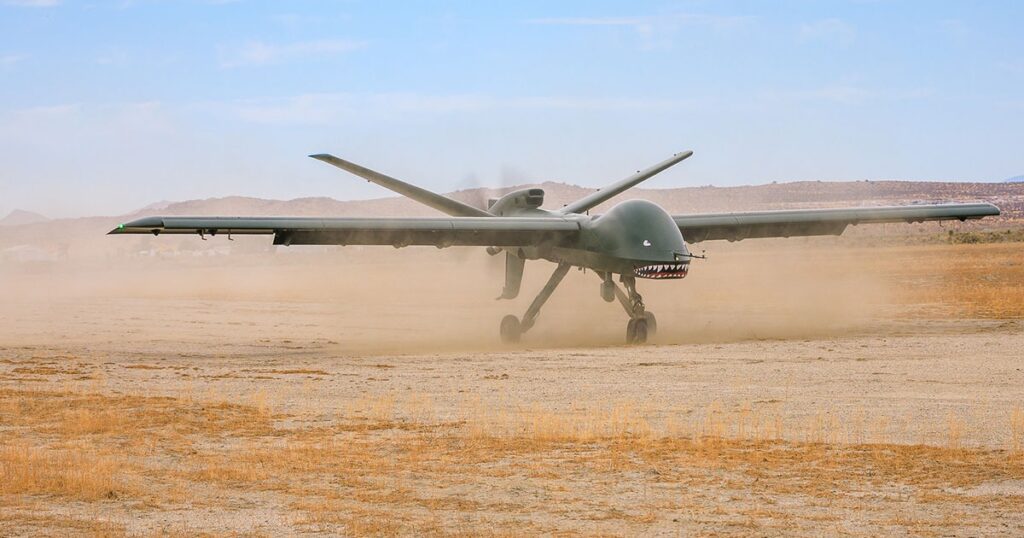
SAN DIEGO – 03 August 2023 – On August 1, 2023, General Atomics Aeronautical Systems, Inc. (GA-ASI) completed multiple successful takeoffs and landings with its Mojave Unmanned Aircraft System (UAS) on a dirt strip near El Mirage, Calif. 

The ability to take off and land on unimproved surfaces demonstrates Mojave’s departure from traditional fixed-wing aircraft’s dependance on prepared runways. This new capability provides greater versatility and allows the aircraft to operate in areas previously deemed unsuitable for UAS operations. 

“Being able to execute missions in austere locations with runway independence opens the operational envelope for commanders across all services and geographic locations,” said GA-ASI President David R. Alexander. “Mojave can do this while retaining significant advantages in endurance and persistence over Vertical Takeoff and Landing (VTOL) and manned aircraft.” 

The flight tests were the first-ever Short Takeoff and Landing (STOL) on a dirt surface for Mojave. Takeoffs were performed in as little as 586 feet; and short landings were completed in as little as 335 feet. The tests were primarily focused on gathering terrain feedback using Mojave, not achieving the shortest distances possible.  

Tracing its lineage from the MQ-1C Gray Eagle and MQ-9 Reaper, Mojave is a technical demonstrator with STOL capability, making it a versatile expeditionary UAS. Adhering to Modular Open System Approach (MOSA) principles, Mojave leverages the modernized avionics, data links, sensor integration, and laptop ground control station of GA-ASI’s Gray Eagle 25M program. These features – along with Mojave’s enlarged wings with high-lift devices, combat-proven 450-HP turbine engine, and ruggedized landing gear – make it ideal for semi-improved surfaces with a small ground support footprint.   

            Mojave provides options for forward-basing operations without the need for typical airport runways or infrastructure, so it can be rapidly deployed from and recovered to non-traditional discrete locations. To extend operational reach, Mojave can fit into a C-130 and be rapidly assembled and employed. These innovations make Mojave the perfect UAS to perform Reconnaissance, Surveillance, and Target Acquisition (RSTA), attack, and contested logistics support missions.  

Designed to be rapidly deployable and expeditionary, Mojave’s tailored features include a ruggedized airframe that enables operations in austere conditions and weatherization that enables flight in wider environmental windows. Robust wing storage means it can carry up to 16 Hellfire or equivalent missiles, assorted munitions, Launched Effects (LEs), or logistical resupply pods. Mojave can provide greater operational flexibility while still being equipped with a multi-sensor suite that includes Electro-Optical/Infrared (EO/IR), Synthetic Aperture Radar/Ground Moving Target Indicator (SAR/GMTI), Electronic Intelligence (ELINT), and Signals Intelligence (SIGINT) to support land or maritime missions throughout Joint All-Domain Operations (JADO). 

To see a video of the Mojave dirt operation, click here