ALAMEDA, Calif. — The 2003 Cyber Protection Team (CPT) was established, Tuesday, at Coast Guard Island as the third CPT command and unit in a ceremony held by Coast Guard Cyber Command (CGCYBER).
Vice Adm. Peter W. Gautier, Deputy Commandant for Operations presided over the ceremony. 2003 CPT’s mission is to provide assess, threat hunting, and incident response capabilities to the Marine Transportation System (MTS).
2003 CPT is the first CPT geographically detached unit from CGCYBER and is continuing to staff its team to receive full operational capability certification by United States Cyber Command (USCYBERCOM) in Spring 2024.
“The Coast Guard continues to have ever-growing threats in cyber space,” said Lt. Cmdr. Kenneth Miltenberger, CPT 2003 commanding officer. “Events like the Colonial Pipeline cyber-attack have demonstrated the ever-growing threats we face in cyber space – 2003 CPT stands ready to prevent, reduce, and respond to those threats in our critical marine infrastructure.”
The MTS is part of the Transportation Systems Critical Infrastructure sector as declared by the Cybersecurity and Infrastructure Security Agency (CISA). Notably, the MTS overlaps with several other critical infrastructure sectors that have a maritime nexus, which makes CPTs an invaluable asset for defending public infrastructure throughout the United States and its territories. The MTS consists of over 3,500 maritime facilities, and to date, USCG CPTs have assisted over 50 partners in the MTS. The CPTs also routinely participate in joint operations with federal agencies to include CISA and the FBI, as well as the Department of Defense.
Miltenberger is the first commanding officer for CPT 2003. His previous tours include branch chief of the CGCYBER Cyber Operational Assessments Branch where he established the Coast Guard’s Cyber Red Team, an elite team that performs cyber threat emulation on Coast Guard networks to proactively discover vulnerabilities and evaluate network defenses. He has also served at Coast Guard Headquarters where he managed enterprise technologies, and as a deck watch officer aboard U.S. Coast Guard Cutter Kukui (WLB 203).
HII Authenticates Keel of Virginia-Class Attack Submarine Oklahoma (SSN 802)
NEWPORT NEWS, Va., Aug. 02, 2023 (GLOBE NEWSWIRE) — HII’s (NYSE: HII) Newport News Shipbuilding (NNS) division authenticated the keel today for Virginia-class attack submarine Oklahoma (SSN 802).
“We enjoy participating in Navy traditions like this one because they remind us of the important role we play in our nation’s defense,” NNS President Jennifer Boykin said. “The nuclear submarines we build help ensure our peace and freedoms, and we take great pride in being a nuclear shipyard.”
The ship’s sponsor is Mary “Molly” Slavonic, an Oklahoma native. Slavonic has long supported both the state of Oklahoma and the Navy. She worked alongside her husband, former acting Under Secretary of the Navy Greg Slavonic, in building the USS Oklahoma (BB 37) Memorial in Pearl Harbor, Hawaii, to honor the 429 sailors and Marines who died aboard the battleship during the Dec. 7, 1941 attack on Pearl Harbor.
During Wednesday’s authentication, NNS welder Alex VanCampen etched Slavonic’s initials onto a metal plate, signifying the keel of SSN 802 as being “truly and fairly laid.” The metal plate will remain affixed to the submarine throughout its life.
“I am deeply honored to be the sponsor for Oklahoma, named in honor of my beloved home state,” Slavonic said. “This milestone marks the beginning of what will be a lifelong bond between my family and Oklahoma, including the incredible shipbuilders constructing her and the brave sailors who will serve aboard this mighty submarine.”
Oklahoma is the 29th Virginia-class fast attack submarine, the first of Block V and the 14th to be delivered by NNS.
“This time-honored tradition celebrates the hard work of thousands of shipbuilders from HII who have been working on Oklahoma, the first Block V Virginia-class submarine,” said Cmdr. Aaron Stutzman, commanding officer of the pre-commissioning unit. “This important step brings to life Congress’ charge in our constitution to maintain a Navy. I am very grateful for the opportunity to be Oklahoma’s first commanding officer, training our sailors to work alongside the shipyard community building Oklahoma and to be ready to take the world’s most technologically-advanced submarine to sea.”
NNS is one of only two shipyards capable of designing and building nuclear-powered submarines for the U.S. Navy. The advanced capabilities of Virginia-class submarines increase firepower, maneuverability and stealth.
ACV Transition Training Unit Certifies First Marines
CAMP Pendleton, Calif. — A Marine Corps-established Amphibious Combat Vehicle Transition Training Unit at the Assault Amphibian School graduated 29 Marines Tuesday, July 25, after completing the new Operational Certification (OPCERT) course at Marine Corps Base Camp Pendleton, California. This course brought the total of trained and certified Marine Amphibious Combat Vehicle operators to 59 with the inclusion of graduates from a successful pilot course last month.
Additionally, a total of 19 Marines has since graduated from the TTU’s new Maintainers Certification (MAINTCERT) course between the pilot and first official course.
The OPCERT and MAINTCERT courses, piloted in May and June 2023 respectively, were approved as rigorous and standardized programs that ensure Marines possess the technical knowledge, skills, and proficiency required to safely operate, maintain, and employ the ACV. The proficiency evaluation and validation standards developed by the TTU will be sustained on an enduring basis through entry-level ACV operator, maintainer, and unit leader training and advanced training for Marines as they progress through their career.
“This is an important milestone in the development of our assault amphibian Marines and the transition to this key platform,” said Brig. Gen. Farrell Sullivan, commanding general, Training Command. “U.S. Marines are the nation’s premier naval expeditionary force, and retaining this forcible entry capability is a key component of providing options to our nation’s leaders. I’m proud to see Amphib Assault Marines successfully contributing to our combat capability and leading their community through this milestone.”
Marine Corps visits Potential Site of Future Medium Range Intercept Capability Missile Facility
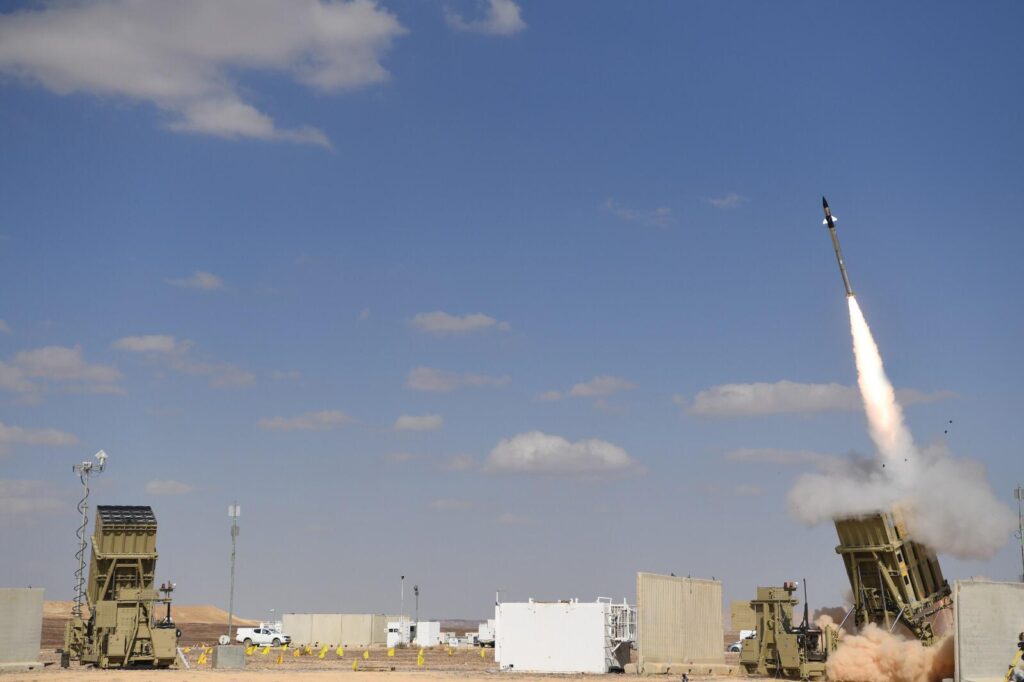
U.S. Marines at the White Sands facility in New Mexico test a new prototype system for Medium Range Intercept Capability using TAMIR IRON DOME interceptors. Spokesperson Department at the Israeli Ministry of Defense
Release from Program Executive Office Land Systems
*****
July 26, 2023
By PEO Land Systems
Camden, Arkansas — The Program Executive Officer Land Systems, Ground Based Air Defense Program Manager recently visited Camden, Arkansas, to discuss the possibility of producing the Iron Dome Tamir missile and future Americanized version known as Sky Hunter for the Medium Range Intercept Capability program. The discussions, held July 19, included representation from Raytheon, Rafael and Raytheon Rafael Systems better known as R2S. During the discussions, R2S detailed the concept of the production facility and provided a tour of the potential site.
“This will be a great thing for the Medium Range Intercept Capability program and for the USMC, if this occurs,” said PM GBAD Don Kelley. The production of the Tamir/Sky Hunter within the United States not only will provide American built Sky Hunters, but a possible second source of Tamir missiles for the Israeli Missile Defense Organization.
Since 2018, the Marine Corps GBAD Program Office has been developing MRIC to counter cruise missile threats. The system includes the Common Aviation Command-and-Control System and a mini–Battle Management Control system for the Tamir missile, along with the AN/TPS-80 Ground/Air Task Oriented Radar.
MRIC completed a series of successful live-fire tests in September 2022. The Milestone Decision Authority met in December 2022 and provided authorization to conduct the certification process, with the first platoon made ready to deploy in fiscal year 2025.
A follow on decision by the Marine Corps would potentially procure up to three batteries between fiscal 2025 – 2027.
WASHINGTON - August 4 marks the birthday of the Naval Nuclear Propulsion Program, a joint Department of Navy and Department of Energy organization responsible for all aspects of the Navy’s nuclear propulsion, including research, design, construction, testing, operation, maintenance, and ultimate disposition of naval nuclear propulsion plants.
In 1946, shortly after the end of World War II, Congress passed the Atomic Energy Act, which established the Atomic Energy Commission to succeed the wartime Manhattan Project and gave it sole responsibility for developing atomic energy. At this time, Capt. Hyman G. Rickover was assigned to the Navy Bureau of Ships, the organization responsible for ship design.
Rickover recognized the military implications of successfully harnessing atomic power for submarine propulsion and knew it would be necessary for the Navy to work with the AEC to develop such a program. He and several officers and civilians were sent to the AEC laboratory at Oak Ridge, Tennessee, for a year to learn the fundamentals of nuclear reactor technology.
Although theories of nuclear power were understood, the technology to build and operate a shipboard nuclear propulsion plant did not exist. There were several reactor concepts; the real challenge was to develop this technology and transform the theoretical into the practical. New materials had to be developed, components designed, and fabrication techniques worked out. Furthermore, installing and operating a steam propulsion plant inside the confines of a submarine and under the unique deep-sea pressure conditions raised a number of technical difficulties. Faced with these obstacles, the team at Oak Ridge knew that to build a naval nuclear propulsion plant would require a substantial commitment of resources and a new level of Government and Industry commitment.
Rickover returned to Washington and used every opportunity from his post at Navy Bureau of Ships to argue the need to establish a Naval Nuclear Propulsion Program. On August 4, 1948, the Navy created the new Nuclear Power Branch (Code 390) with Rickover as its head within the Bureau’s Research Division.
Just seven years later, Rickover and his team put the world’s first nuclear-powered submarine, USS Nautilus (SSN 571) to sea. Three years later, on Aug. 3, 1958, Nautilus accomplished the impossible when the ship reached the geographic North Pole, 90 degrees North. Cmdr. William Anderson was in command and had a crew of 116 Sailors aboard.
“Such a journey was previously unthinkable,” said Adm. Frank Caldwell, Director of the Naval Nuclear Propulsion Program. “But this single event demonstrated the awesome, asymmetric advantage that nuclear power afforded our submarines and America’s national defense. The Nautilus could go to any ocean in the world, anytime, and remain there virtually as long as desired.”
Ten years after the program started, the Navy was sailing four fully-operational nuclear-powered submarines and building the first nuclear-powered aircraft carrier, USS Enterprise (CVN 65), with eight reactor plants. In the next two years, the first strategic ballistic missile submarine, USS George Washington (SSBN 598) went on its first strategic deterrent patrol.
Over the last 75 years, Naval Reactors has operated 273 reactors plants, taken 562 reactor cores critical including 33 different designs, and steamed more than 171 million miles with over 7,500 reactor years of safe operations. The Naval Nuclear Propulsion Program and the Navy’s nuclear-powered warships have demonstrated clear superiority in defending the United States – from the Cold War to today’s unconventional threats and strategic competition – Naval Reactors ensures the American Sailor and the nuclear-fleet are ready to fight and win the nation’s wars.
There is no substitute for presence and nuclear-powered aircraft carriers remain the most survivable and versatile airfields in the world, while nuclear-powered fast attack and large payload submarines hold adversaries at risk in both contested seas and open oceans. Today, the Navy operates 99 reactors and 79 nuclear-powered warships – including the largest, most capable warship ever built, USS Gerald R. Ford (CVN 78) which is on its maiden deployment in European waters, underway on nuclear power.
“It’s an exciting time in the Naval Nuclear Propulsion Program; we are fully embracing our responsibility to continue powering maritime dominance for the next 75 years,” said Caldwell.
Diving Deep into Naval History, Navy Diving Executive Steering Committee Celebrates Origins of U.S. Navy Diving Community
SHERIDAN LAKE, British Columbia (March 14, 2023) Divers conduct an emergency search procedures drill under the ice of Sheridan Lake, British Columbia, while participating in an Ice Diving Exercise (ICEDIVEX) involving Mobile Diving and Salvage Unit (MDSU) 1 and the Canadian Armed Forces’ Fleet Diving Unit Pacific, March 14, 2023. The ICEDIVEX enhanced interoperability between U.S. and Canadian diving units by accomplishing joint technical diving and unit-level training evolutions. MDSU-1 is a component of Explosive Ordnance Disposal Group (EODGRU) 1 that provides combatant commanders the expeditionary capability to clear ports, piers and waterways; assist vessels in distress; and conduct salvage of ships, aircraft and other objects from the water. (U.S. Navy courtesy photo) 230314-N-N2422-0003
VIRGINIA BEACH, Va. – They may dive the world over, but the humble beginnings of U.S. Navy divers first began on August 1, 1882 in local waters off of Newport, Rhode Island according to Navy leaders who recently voted on establishing an official birth date for the community.
The Navy’s diving executive steering committee, comprised of officers and senior enlisted leaders across warfare communities who have a vested interest in Navy diving and undersea operations, worked closely with Naval History and Heritage Command, the Naval Undersea Museum, Navy Diving and Salvage Training Center, and the Man in the Sea Museum, a military diving museum, to research the origins of the U.S. Navy diving inception date.
“Recognizing the birthday of Navy diving gives the entire diving community an opportunity to not only honor our proud lineage but also take a moment to reflect on the monumental contributions of brave pioneers such as William Badders and Robert Barth, along with trailblazers of professional achievement such as Carl Brashear and Mary Bonnin, who have contributed significantly to where we are today,” said Master Chief Navy Diver Will Wittman, Navy Expeditionary Combat Command force master diver. “Understanding the arc of our evolution from a single class of six students at the Newport Torpedo School in 1882 to the innovation and capability I have known through the course of my career is truly humbling for me to reflect upon.”
During their research, the committee learned Gunner’s Mates served as some of the Navy’s first divers. The introduction of the torpedo revolutionized naval warfare and prompted the need for additional undersea training to support testing and recovery of the ordnance. In turn, the Navy established a new course of instruction in Newport to provide the most relevant training for the emerging undersea technology at the time.
Historians from the Navy’s museums corroborated this information with reports from the Secretary of the Navy’s archives from 1882-1883. An excerpt from the report described the new course of instruction in “submarine diving.” According to the documents, six gunners reported on August 1, 1882 for a three-day course directed by the Bureau of Ordnance.
Rear Adm. Brad Andros, commander, Navy Expeditionary Combat Command, said recognizing the inception date for the Navy Diving community not only marks a momentous occasion in naval history but also increases diving community connectedness.
“I’m honored to join Navy divers across the service in commemorating our community, past and present,” said Andros. “Navy divers are tasked with some of the most difficult and dangerous missions in the world and must be able to operate in extreme environments, under intense pressure, and with a high degree of precision. Our teammates have routinely embraced this challenge throughout our 141-year history, and I anticipate the entire force will continue to rise to the occasion and adapt to new threats, challenges, and adversaries for years to come.”
According to Naval History and Heritage Command, since their inception, Navy divers have been involved in nearly every major conflict throughout history and have been a forerunner for advancing the diving and underwater operations industry through technology and tactics. In peacetime or in combat, U.S. Navy divers have rose to the occasion, including seven divers who have been awarded the Medal of Honor, the nation’s highest military award.
For Master Chief Navy Diver Jeremy Sylvest of the Navy’s Recruiting Command, August 1 now presents an opportunity to inform the next generation of Navy Sailors what a career in diving offers.
“The Navy is always looking for motivated, creative, disciplined, problem-solving candidates to serve as Navy Divers and contribute to the excellent culture we continue to build,” said Sylvest. “A career in Navy diving offers opportunities for travel and adventure, a unique working environment, specialized training, and the chance to lead and build teams. Navy diving is the best kept secret in the Navy.”
Diving capabilities are not solely restricted to the Navy Diver rating as many other ratings receive specialized dive training to complete their missions including Seabees, special operators, explosive ordnance disposal technicians, engineers, medical personnel, and mass communication specialists.
Navy divers support a number of missions in the Navy including mobile diving and salvage, ship husbandry, research and development, submarine operations and undersea rescue missions, special warfare, expeditionary mine countermeasures, anti-terrorism and force protection, and underwater photography and videography.
While this year’s commemorative events will be celebrated locally at individual commands, the diving community is focused on planning a global event for 2024 that will encompass Navy diver participation from across the world.
“I’m honored to be a part of this community and look forward to advancing our capability with all service and international partners, along with welcoming new leaders of tomorrow into our fold as we honor our historic roots each year,” said Wittman.
PASCAGOULA, Miss., July 28, 2023 (GLOBE NEWSWIRE) — HII’s (NYSE: HII) Ingalls Shipbuilding division announced today the successful completion of acceptance sea trials for the U.S. Coast Guard‘s newest national security cutter, Calhoun (WMSL 759). During the trial, the ship spent time proving the ship’s systems including performing numerous tests in the areas of propulsion, electric plant, and mission systems.
“Our joint Ingalls and Coast Guard team has completed another successful sea trial, and I am pleased to say NSC 10 performed well,” Ingalls Shipbuilding President Kari Wilkinson said. “Our shipbuilders are now one step closer to delivering this highly capable and advanced cutter to the U.S. Coast Guard.”
For over two decades, Ingalls Shipbuilding has designed and built the Coast Guard Legend-class national security cutters. These ships are capable of embarking and supporting a wide range of Coast Guard, Navy and NATO missions. National security cutters have proven to be ideal platforms for drug interdiction, global illegal fishing, disaster relief and defense support operations.
“It’s an honor to see the hard work of our shipbuilders come to fruition during a sea trial, and I couldn’t be more proud of the team,” Ingalls Shipbuilding NSC Program Manager Amanda Whitaker said. “We stand ready to deliver Calhoun and provide our Coast Guard partners with this tremendous national security asset.”
NSC 10 is named to honor Charles L. Calhoun, the first master chief petty officer of the U.S. Coast Guard. Calhoun served in the U.S. Navy for three years during World War II and was honorably discharged in 1946 as a torpedoman’s mate petty officer 2nd class. He enlisted in the Coast Guard that same year and held varying positions of leadership over the course of his career.
Ingalls has delivered nine Legend-class national security cutters to the Coast Guard further enabling their important missions around the globe.
Leidos announces strategic collaboration agreement with Microsoft
Companies pledge collaboration aimed at expediting the development of advanced cloud technology.
(RESTON, Va.) July 31, 2023 – Leidos (NYSE:LDOS), a FORTUNE® 500 science and technology leader, today announced it has entered into a strategic collaboration agreement with Microsoft aimed at leveraging each company’s unique strengths in the market to accelerate artificial intelligence (AI) transformation for new and existing customers in the public sector. A near-term priority for co-development is in the area of generative AI solutions to support organizational efficiency, enhanced productivity and cross domain applications.
“Leidos is continuously exploring opportunities to accelerate solving our customers’ hardest problems,” said Steve Hull, Executive Vice President, Enterprise and Cyber Solutions Operation, Leidos. “This agreement will help enable co-innovation utilizing the latest cloud and AI technologies.”
Leidos recently completed a successful migration of 20 critical support applications from an on-premise data center to Microsoft’s Azure Government cloud environment in support of the U.S. Navy. This migration was part of Leidos’ ongoing support of the Department of the Navy’s Next Generation Enterprise Network (NGEN) Service Management, Integration, and Transport (SMIT) program, enabling the Navy to monitor, maintain, and secure the Navy and Marine Corps Intranet (NMCI) with increased efficiency and collaboration without compromising security.
“Our collaboration with Leidos will help accelerate adoption of cloud-driven solutions to improve our customers’ operations,” said Angela Heise, Corporate Vice President, Worldwide Public Sector, Microsoft. “Leidos’ expertise in national security operations coupled with Microsoft’s advanced cloud, cyber, and AI technologies will enable our two organizations to develop innovative solutions to address a wide range of complex challenges faced by public sector organizations around the world.”
Leidos and Microsoft are committed to building a partner ecosystem that can identify customer challenges and work together responsibly and efficiently to solve them.
Romania Seeks Former Marine Corps Assault Amphibious Vehicles
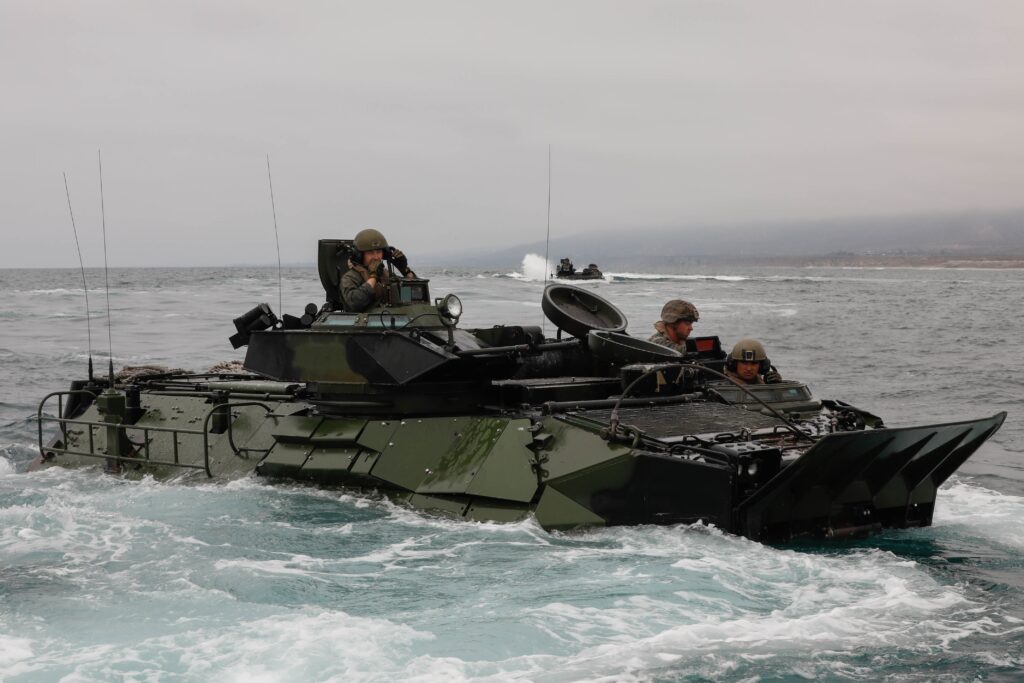
CAMP PENDLETON, Calif. (June 30, 2021) U.S. Marines with Co. A, 1st Battalion, 5th Marines, 1st Marine Division (1st MARDIV), and Co. B, 3d Assault Amphibian Battalion, 1st MARDIV, prepare to evacuate a P7/A1 assault amphibious vehicle (AAV) during a surf qualification at Marine Corps Base Camp Pendleton, California, June 30, 2021.
Romania Seeks Former Marine Corps Assault Amphibious Vehicles
By Richard R. Burgess, Senior Editor
ARLINGTON, Va. —The U.S. State Department has approved a possible sale of AAV7 assault amphibious vehicles to the Government of Romania, the Defense Security Cooperation Agency (DSCA) said in a July 2 release.
Romania has requested the sale of 21 AAV-7s, including 16 AAVP-A1 personnel carrier versions, three AAVC-7A1 command vehicles, and two AAVR-7A1 recovery versions. The sale also would include armament, thermal sights, spare parts, manuals, data package, engineering support, ad other support. The total cost of the sale would be an estimated $120.5 million.
The AAV-7 family of vehicles, built by BAE Systems, is being replaced in the U.S. Marine Corps by the Amphibious Combat Vehicle (ACV) family, also built by BAE Systems. The AAV-7 entered Marine Corps service in 1972.
A contract to deliver the vehicles and support to Romania in the event the sale is finalized has not yet been identified.
Romania, a member of NATO that borders the Black Sea, has increasingly joined in military ties and exercises with the United States.
U.S. Department of Transportation Announces First Ships Enrolled in the Tanker Security Program
Creation of the program meets an urgent DOD need and grows the U.S.-flagged fleet
WASHINGTON – Today, the U.S. Department of Transportation’s Maritime Administration (MARAD) announced that nine ships have been enrolled in the Tanker Security Program (TSP). TSP establishes a fleet of active, commercially viable, militarily useful, privately owned product tank vessels of the United States that will meet national defense and other security requirements and maintain a United States presence in international commercial shipping.
The TSP will strengthen the U.S. supply chain and improve the movement of liquid fuel products while creating good-paying jobs. The TSP will also support American-owned, American-flagged, and American-crewed commercial product tankers operating in international commercial shipping. The program will ensure the Department of Defense (DoD) has assured access to critically needed product tankers capable of loading, transporting, and storing on-station bulk petroleum refined products to support national economic security.
“Today we are announcing the first ships to join the Tanker Security Program, which will help strengthen both our supply chains and our national security by delivering fuel to our armed forces around the world while creating hundreds of good jobs for American mariners,” saidU.S. Transportation Secretary Pete Buttigieg.
“The TSP accomplishes two key maritime sealift objectives: it grows our U.S.-flagged fleet and it significantly expands our ability to deliver vital fuel supplies to support military missions across the globe,” said Maritime Administrator Ann Phillips. “Implementation of the TSP is a significant milestone for MARAD and the U.S. maritime industry.”
The companies selected for enrollment are Overseas Shipholding Group, Inc. (three tank vessels); Crowley-Stena Marine Solutions, LLC. (three tank vessels); and Seabulk Tankers, Inc. (three tank vessels).
All of the companies have signed operating agreements. Of the enrolled vessels, four are under U.S. flag and are now operating in the program, and five are working with the assistance of the U.S. Coast Guard to expedite reflagging to U.S. registry to begin operating under TSP agreements. Each tank vessel enrolled will receive a maximum $6 million per year payment, prorated on a monthly basis for qualified service as participants in the program. The vessels will operate in U.S. foreign commerce and be available for use by the United States during times of war or national emergency.
MARAD published a solicitation in the Federal Register on July 25, 2023, seeking applications for enrollment in TSP from qualified companies. The program is authorized for up to ten tankers and MARAD seeks to fill the remaining operating agreement with a qualified vessel. MARAD published notices in the Federal Register seeking applications for enrollment from qualified participants. To qualify for the program, proposed vessels have to qualify as Medium Range product tankers between 30,000-60,000 deadweight tons with fuel carrying capacity of 230,000 barrels or more, be less than 10 years of age, and available to commit to an emergency preparedness agreement for the duration of the program’s authorization. All vessel operators selected for the TSP are required to be enrolled in MARAD’s sexual assault and sexual harassment prevention and response policy program Every Mariner Builds A Respectful Culture (EMBARC).