Navy establishes the Maritime Cyber Warfare Officer (MCWO) Designator — 1880

Release from Naval Information Forces Public Affairs Office

***** 

27 June 2023 

SUFFOLK, VA. – The Navy has announced the establishment of the Maritime Cyber Warfare Officer (MCWO) Designator via Naval Administrative Message (NAVADMIN) 143/23.  
 
The 2023 National Defense Authorization Act (NDAA), signed into law on Dec. 23, 2022, directed the Secretary of the Navy, in coordination with the Chief of Naval Operations, to establish a cyber warfare operations designator for officers within 180 days after enactment of the NDAA. 
  
Previously, the Navy has utilized officers within the Information Warfare (IW) community, including Cryptologic Warfare (CW) and Information Professional (IP) to fill billets across the Cyber Operations Forces (COF).  The establishment of MCWO will allow officers to build expertise and professional experience within the COF. 
  
Vice Adm. Kelly Aeschbach, commander of Naval Information Forces and the Navy’s Information Boss, explained how the Navy developed its plan to establish the MCWO designator. 
  
“The Navy is committed to meeting current and future cyber capability requirements.  Naval Information Forces and key leaders in IW domain closely examined the IW construct and determined it did not adequately support multiple tours in the cyber mission area.  Creation of the MCWO designator creates a career path for those officers to specialize in the cyber mission and develop their unique and critical skillset.” 
  
The establishment of the MCWO designator is a major milestone in expanding the Navy cyber mission and recognizes the critical need for cyber specialization among the Navy officer line community.  MCWOs are experts in cyberspace operations, focused on both Offensive Cyberspace Operations (OCO) and Defensive Cyberspace Operations (DCO). 
  
“IW Officers have been absolutely critical to addressing threats in cyberspace – ensuring our Navy and joint force stay in competition,” continued Aeschbach.  “The Navy is committed to developing cyber specialization and skill sets among the MCWO Community to pace this competition, and to prevail in conflict if they are ever called to do so.” 
  
NAVIFOR’s mission is to generate, directly and through our leadership of the IW Enterprise, agile and technically superior manned, trained, equipped, and certified combat-ready IW forces to ensure our Navy will decisively DETER, COMPETE, and WIN. 
  
For more information on NAVIFOR, visit the command Facebook page at Https://Www.Facebook.Com/NavalInformationForces/ or the public web page at Https://Www.Navifor.Usff.Navy.Mil.  


Bell H-1 Fleet Surpasses Half a Million Flight Hours 

A U.S. Marine Corps AH-1Z Viper helicopter, with Marine Light Attack Helicopter Squadron (HMLA) 469, fires an Air Intercept Missile (AIM-9 Sidewinder missile) during a live-fire training event near Okinawa, Japan, Sept. 29, 2020. HMLA-469 conducted a live-fire exercise using AIM-9 Sidewinder missiles to improve proficiency with the weapon system. (U.S. Marine Corps photo by Cpl. Ethan M. LeBlanc)

Release from Bell Textron 

***** 

FORT WORTH, Texas (June 28, 2023) – The current H-1 fleet of AH-1Z Vipers and UH-1Y Venoms reached a major flight milestone by surpassing the 500,000-flight hour mark. Nearly 400 AH-1Z and UH-1Y helicopters, built by Bell Textron Inc., a Textron Inc (NYSE:TXT) company and operated by the U.S. Marine Corps and their allies, combined to achieve the milestone. 

“The H-1 continues to be the premier example of a family of aircraft that can do more with less and deliver unmatched interoperability and expeditionary agility,” said Mike Deslatte, Bell H-1 vice president and program director. “We are thrilled to reach this tremendous milestone and excited for the future of both the Viper and the Venom as they continue to grow in number and capability around the world.”   

The H-1 Viper and Venom provide tremendous versatility to the fleet. Both variants demonstrated integration with advanced weapons and datalink capabilities.  

“We are proud that the first 500,000 flight hours of the UH-1Y and AH-1Z included constant deployments to austere deserts, numerous types of naval vessels, and frigid cold environments in support of U.S. and allied service members on the ground and at sea,” said Nate Green, Bell H-1 program manager. “With the Viper and Venom sharing 85 percent commonality of parts, a major advantage of this program is that a single readiness improvement or capability upgrade can often support both aircraft.”  

Bell supports the future of H-1s through its work on the Marine Corps Structural Improvement Electrical Power Upgrade (SIEPU) program. Structural and electrical modifications optimize the aircraft to improve mission capabilities, aircrew safety, and interoperability. Bell is currently working to increase the electrical power capacity on the platform, which will allow the airframe to support the integration of additional capabilities for years to come.   

“This milestone highlights the crucial missions our customers have accomplished with the H-1 during this time. Congratulations to the U.S. Marine Corps and their allies on this tremendous milestone. Bell is proud to be your partner on this platform,” added Deslatte. 

Bell provides diverse and comprehensive services to H-1 squadrons, including parts, maintenance, training, on-site field representatives, and data analytics, supporting worldwide operations. 


Nimitz Carrier Strike Group Returns to San Diego from Deployment 

230628-N-KU796-1026 San Diego (June 28, 2023) U.S. Navy Sailors prepare to man the rails of the aircraft carrier USS Nimitz (CVN 68). Nimitz arrives in San Diego concluding a seven-month deployment to U.S. 3rd and 7th Fleet areas of operations (AO). Nimitz’s presence in U.S. 3rd and 7th Fleet AOs reinforced the United States’ commitment to fly, sail and operate wherever international law allows in support of a free and open Indo-Pacific region. (U.S. Navy photo by Mass Communication Specialist 2nd Class Samuel Osborn)

Release from U.S. Pacific Fleet 

***** 

28 June 2023 

SAN DIEGO, Calif. – Ships from the Nimitz Carrier Strike Group (Nimitz CSG) returned to San Diego June 28, concluding a seven-month deployment to U.S. 3rd and 7th Fleet areas of operations (AO). 

 Sailors assigned to Ticonderoga-class guided-missile cruiser USS Bunker Hill (CG 52), Arleigh Burke-class guided-missile destroyer USS Decatur (DDG 73) and the embarked air wing of Carrier Air Wing (CVW) 17 returned home with the arrival of USS Nimitz (CVN 68) in San Diego. Nimitz will depart San Diego for its return to homeport in Bremerton, Washington at a later date. 
 
Hawaii-based ships attached to Carrier Strike Group (CSG) 11, Arleigh Burke-class guided-missile destroyers USS Chung-Hoon (DDG 93) and USS Wayne E. Meyer (DDG 108), returned to homeport on June 20 and 27, respectively. 
 
“For seven months, the Nimitz Carrier Strike Group demonstrated our ironclad commitment to partners and allies in the Indo-Pacific region,” said Rear Adm. Jennifer Couture, commander, CSG-11. “During this deployment, Sailors of every rank and rate displayed a vigorous work ethic and a humble devotion to duty and I want to thank them and their families for their sacrifice. I am humbled to serve alongside determined professionals and observe their excellence at every level. Our strike group returns home stronger, smarter, and more resilient than ever before.” 
 

While in the U.S. 7th Fleet AO, CSG-11 conducted deterrence and presence operations; multinational exercises; integrated multi-domain training; long-range maritime strike exercises; anti-submarine warfare; information warfare operations; air defense operations; multiple ship navigation; and formation maneuvering and refueling-at-sea operations. U.S. 7th Fleet is the U.S. Navy’s largest forward-deployed numbered fleet. 
 
Nimitz executed six port calls – Guam; Singapore; Busan, South Korea; Laem Shabang, Thailand; Sasebo, Japan and Pearl Harbor, Hawaii – and hosted two formal “Big Top” receptions in South Korea and Thailand. The aircraft carrier also embarked foreign dignitaries, military officials, ambassadors, and international media, and operated with the joint force and several nations, including Australia, Canada, France, Japan, the Philippines, Republic of Korea and Singapore. Alongside allies and partners, the Nimitz CSG’s presence in U.S. 7th Fleet reinforced the United States’ commitment to fly, sail, and operate wherever international law allows in support of a free and open Indo-Pacific region. 
 

Nimitz – the oldest-serving U.S commissioned aircraft carrier in the world – completed its 350,000th arrested aircraft landing on April 22, 2023 while sailing in the South China Sea. The milestone was piloted in an F/A-18F Super Hornet from the “Fighting Redcocks” of Strike Fighter Squadron (VFA) 22 by Capt. Craig Sicola, Nimitz commanding officer, and Cmdr. Luke Edwards, commanding officer of VFA 22. Nimitz is the first active U.S. aircraft carrier to reach this milestone. 
 
Nimitz’s embarked air wing consisted of the “Fighting Redcocks” of Fighter Attack Squadron (VFA) 22, “Mighty Shrikes” of VFA-94, “Kestrels” of VFA-137, “Blue Diamonds” of VFA-146, “Sun Kings” of Carrier Airborne Early Warning Squadron (VAW) 116, “Cougars” of Electronic Attack Squadron (VAQ) 139, “Battlecats” of Helicopter Maritime Strike Squadron (HSM) 73, “Screamin’ Indians” of Helicopter Sea Combat Squadron (HSC) 6 and “Providers” of Fleet Logistic Support Squadron (VRC) 30. 


BAE Systems and ELTA Systems, Ltd. successfully test manned-unmanned teaming requirements on Amphibious Combat Vehicle

Release From BAE Systems

STAFFORD, Virginia — June 28, 2023 — BAE Systems has successfully tested manned- unmanned teaming (MUM-T) on the Amphibious Combat Vehicle (ACV) C4UAS as a technology demonstration using IAI/ELTA Systems Ltd’s Rex MK II Unmanned Infantry Combat Support System. The teaming technology enhances mission effectiveness through greater situational awareness and decision making capabilities.

The successful demonstration of MUM-T capabilities shows the versatility of the built-in growth capacity in the ACV C4UAS. The ability to incorporate MUM-T into mission planning expands mission parameters and tactical sphere while decreasing the risk to human and technological assets in uncertain or hostile environments.

“This is an exciting next chapter to show the growth potential of the ACV C4UAS,” said Garrett Lacaillade, vice president of the Amphibious Vehicles product line for BAE Systems. “Pairing an unmanned system like the Rex provides increased situational awareness, supports mission success, and reduces the risk to our Marines.”

The ACV is an adaptable amphibious platform built to meet the operational needs of the Marine Corps, allowing space for new capabilities as technology evolves such as reconnaissance, electronic warfare, anti-air, and uncrewed aerial systems (UAS) systems integration. Built in partnership with Iveco Defence Vehicles, the ACV is a unique mix of true open-ocean amphibious capability, land mobility, survivability, payload, and growth potential.

The Rex MK II system is an unmanned autonomous vehicle that provides direct support to maneuvering infantry units. It can perform a variety of tasks including tactical logistic support, tactical intelligence, surveillance, and reconnaissance (ISR), operating lethal weapons through target acquisition and evacuating wounded Marines.

ACV production and support is taking place at BAE Systems locations in: Stafford, Virginia; San Jose, California; Sterling Heights, Michigan; Aiken, South Carolina; York, Pennsylvania; and, Phoenix, Arizona.

For more information, please contact:
Michelle Tiemeyer, BAE Systems
Mobile: 717-645-6553
[email protected]


HII’s Ingalls Shipyard Has Capacity for More Navy Shipbuilding

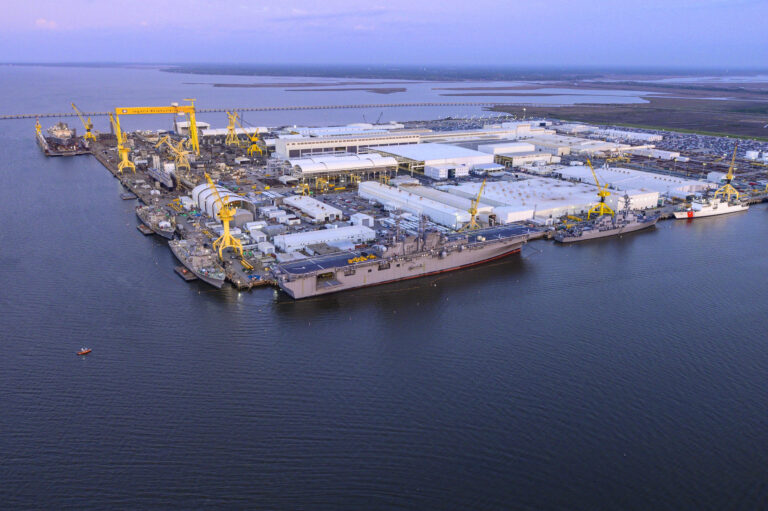
An aerial image of HII’s Ingalls Shipbuilding.

*****

ARLINGTON, Va. — HII’s Ingalls Shipyard is always looking for opportunities for more shipbuilding work and its yard has the capacity to take on more work, a senior company official said, including future awards of new classes of frigates and medium landing ships.

“We’re looking at all of our opportunities, said George Nungesser, Ingalls’ vice president for Program Management, speaking June 27 to reporters during the Modern Day Marine expo in Washington, noting that Ingalls is interested in being a second construction shipyard for the Constellation-class guided-missile frigates currently being built by Fincantieri’s Marinette Marine shipyard in Wisconsin. “We know surface combatants!”

The Ingalls shipyard builds Arleigh Burke-class guided-missile destroyers (DDGs), San Antonio-class amphibious platform dock ships, and America-class amphibious assault ships for the U.S. Navy and Legend-class national security cutters (NSCs) for the Coast Guard.

The company delivered the first Flight III Arleigh Burke-class DDG, the future USS Jack H. Lucas (DDG 125), June 27, and the 10th NSC, the future USCGC Calhoun (WMSL 759) began its first sea trials the same day.

Asked if Ingalls was interested in bidding on the Navy’s future medium landing ship (LSM) program, Nungesser said, “We’re always interested in future ship classes, future endeavors. With a legacy of over 85 years, we’re pretty agile. We will continue to monitor the program development of that particular program and look forward to working with the Navy to see where this goes, when it something comes out as an RfP [Request for Proposals].”

Nungesser said the Ingalls shipyard currently has excess capacity, noting that the company has invested more than $1 billion in Shipyard of the Future initiatives that were completed last year. He noted that hiring and retaining the work force is a more challenging aspect industry-wide, and that Ingalls has funded a number of initiatives with local educational institutions to attract young people toward the shipbuilding trades.

“We do not meet the needs of our customers without our work force, and we are pleas with the trends that we are seeing in terms of hiring, retention, and developing talent,” he said.

“What we need — including our defense industry base — is a strong, consistent demand signal from the government to keep this shipbuilding industry healthy and responsive,” he said. “A strong demand signal enables companies to plan for the future, to hire, to train, and retain a skilled work force, and also promote investment in new equipment, facilities, and technologies.


HII Delivers First Flight III Destroyer Jack H. Lucas (DDG 125) to U.S. Navy 

Release from HII

***** 

June 27, 2023 

PASCAGOULA, Miss. (June 27, 2023) — HII’s (NYSE: HII) Ingalls Shipbuilding division delivered the first Flight III Arleigh Burke-class guided missile destroyer, Jack H. Lucas (DDG 125), to the U.S. Navy today. Delivery of DDG 125 represents the official transfer of the ship from the shipbuilder to the Navy. 

“Delivering the first Flight III ship reflects the relentless efforts of our shipbuilders and those of our Navy and supplier partners,” said Kari Wilkinson, president of Ingalls Shipbuilding. “We are committed to maintaining a consistent and resilient destroyer production team in order to be ready to support the Navy and our country.” 

Jack H. Lucas (DDG 125) is the first Flight III Arleigh Burke-class destroyer being built for the U.S. Navy by Ingalls and incorporates a number of design modifications that collectively provide significantly enhanced capability. DDG 125 contains a myriad of offensive and defensive weapons designed to support maritime defense needs well into the 21st century. Flight III configured destroyers include the AN/SPY-6(V)1 Air and Missile Defense Radar (AMDR) and the Aegis Baseline 10 Combat System that is required to keep pace with the threats of the future. 

Ingalls has delivered 35 destroyers to the U.S. Navy including DDG 125, with four Flight IIIs currently under construction including Ted Stevens (DDG 128), which is scheduled to be christened in August. Additionally Jeremiah Denton (DDG 129), George M. Neal (DDG 131) and Sam Nunn (DDG 133) are under construction at Ingalls.  

Arleigh Burke-class destroyers are highly capable, multi-mission ships and can conduct a variety of operations, from peacetime presence and crisis management to sea control and power projection, all in support of the U.S. military strategy and the joint force. Guided missile destroyers are the backbone of the U.S. surface fleet and are capable of fighting multiple air, surface and subsurface threats simultaneously. 


Austal USA Awarded U.S. Navy T-ATS 15 Contract

Release from Austal USA

*****

JUNE 20, 2023

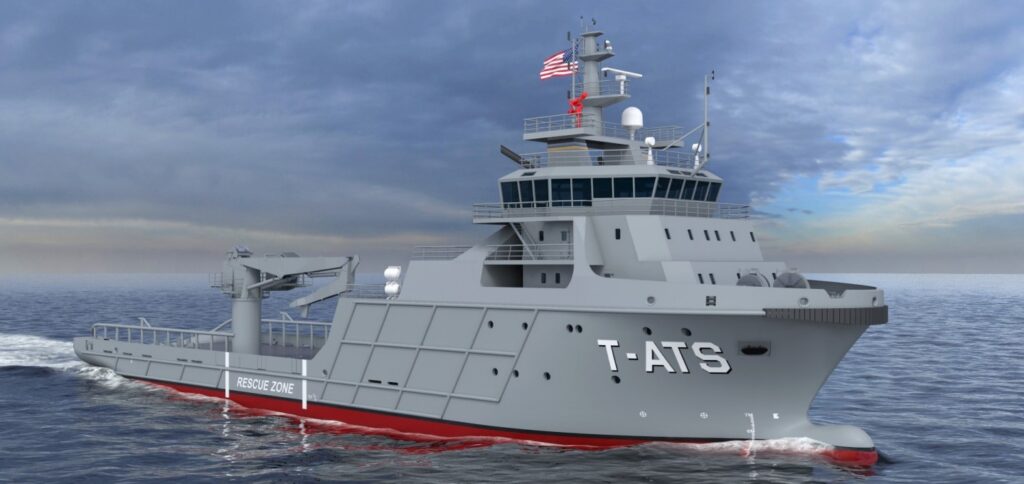
Mobile, Ala. – Austal USA was awarded a $79.2 million U.S. Navy contract option for the construction of T-ATS 15, a Navajo-class Towing, Salvage, and Rescue Ship. With the award, the company is now under contract for five T-ATS, with T-ATS 11 and T-ATS 12 under construction on Austal’s state-of-the-art steel assembly line.

T-ATS will provide ocean-going tug, salvage, and rescue capabilities to support U.S. Navy fleet operations and will be a multi mission common hull platform capable of towing heavy ships. These ships will also be able to support current missions, including oil spill response, humanitarian assistance, and wide area search and surveillance.

“Construction of the T-ATS program is well underway at Austal USA. We are very pleased with the performance of our steel panel line,” Austal USA President Rusty Murdaugh said. “This contract award, bringing our total T-ATS program to five ships, illustrates the Navy’s continued confidence in our team’s demonstrated ability to deliver valuable capability on-budget and on-schedule.”

Austal USA will utilize its proven ship manufacturing processes and innovative methods that incorporate lean manufacturing principles, modular construction, and moving assembly lines to build these ships, all housed under the company’s state-of-the-art enclosed steel production facility. Construction on T-ATS 15 will commence in early 2024 with delivery planned for the end of 2027.

In addition to T-ATS, Austal USA began construction earlier this month on the Navy’s Auxiliary Floating Dry Dock Medium. These two programs along with the contracts awarded for the U.S. Coast Guard Heritage-class Offshore Patrol Cutters and the Navy’s TAGOS-25 ocean surveillance ships will keep the company’s steel production facility busy producing quality vessels for our Nation’s defense many years into the future.


USCGC Vigilant returns from Eastern Pacific patrol, conducts international collaboration 

Release from U.S. Coast Guard Atlantic Area 

***** 

June 27, 2023 

CAPE CANAVERAL, Fla. – The USCGC Vigilant (WMEC 617) returned home to Cape Canaveral, Sunday, following a 50-day patrol in the Eastern Pacific Ocean and Florida Straits. 

Patrolling in support of Joint Interagency Task Force South, Vigilant worked alongside other Coast Guard cutters, Department of Defense and Department of Homeland Security units, and international partners to conduct counter drug operations with the assistance of an aviation detachment from a Coast Guard Helicopter Interdiction Tactical Squadron. 

During the patrol, Vigilant’s crew disrupted illegal narcotics smuggling, interdicting more than 2,000 pounds of illicit drugs. While in theater, Vigilant interdicted two drug-smuggling vessels and apprehended five suspected traffickers, contributing directly to U.S. Coast Guard objectives to combat transnational criminal organizations. 

In addition, Vigilant led a two-day engagement and joint training exercise with the Ecuadorian Coast Guard in the Galapagos Islands, Ecuador. The purpose of the exercise was to strengthen ties with international partners and promote regional stability and security. 

“I’m extraordinarily proud of this crew and continually impressed by their professionalism and tenacity,” said Cmdr. Jay Guyer, Vigilant’s commanding officer. “Drug trafficking generates violence and instability in the region. Interdicting these shipments and working with an important partner like Ecuador, helps bring security and stability to our nation and to our partners.” 

Vigilant is a 210-foot Reliance-class medium-endurance cutter. The cutter’s primary missions are counter drug operations, migrant interdiction, enforcement of federal fishery laws and search and rescue in support of U.S. Coast Guard operations. The medium endurance cutters fall under the command of the U.S. Coast Guard Atlantic Area. Based in Portsmouth, Virginia, U.S. Coast Guard Atlantic Area oversees all Coast Guard operations east of the Rocky Mountains to the Arabian Gulf. In addition to surge operations, Atlantic Area also allocates ships to deploy to the Caribbean and Eastern Pacific to combat transnational organized crime and illicit maritime activity. 

For information on how to join the U.S. Coast Guard, visit GoCoastGuard.com to learn about active duty, reserve, officer, and enlisted opportunities. Information on how to apply to the U.S. Coast Guard Academy can be found here


Coast Guard offloads more than $23 million in illegal narcotics in San Juan, Puerto Rico 

Release from U.S. Coast Guard 7th District 

***** 

June 27, 2023 

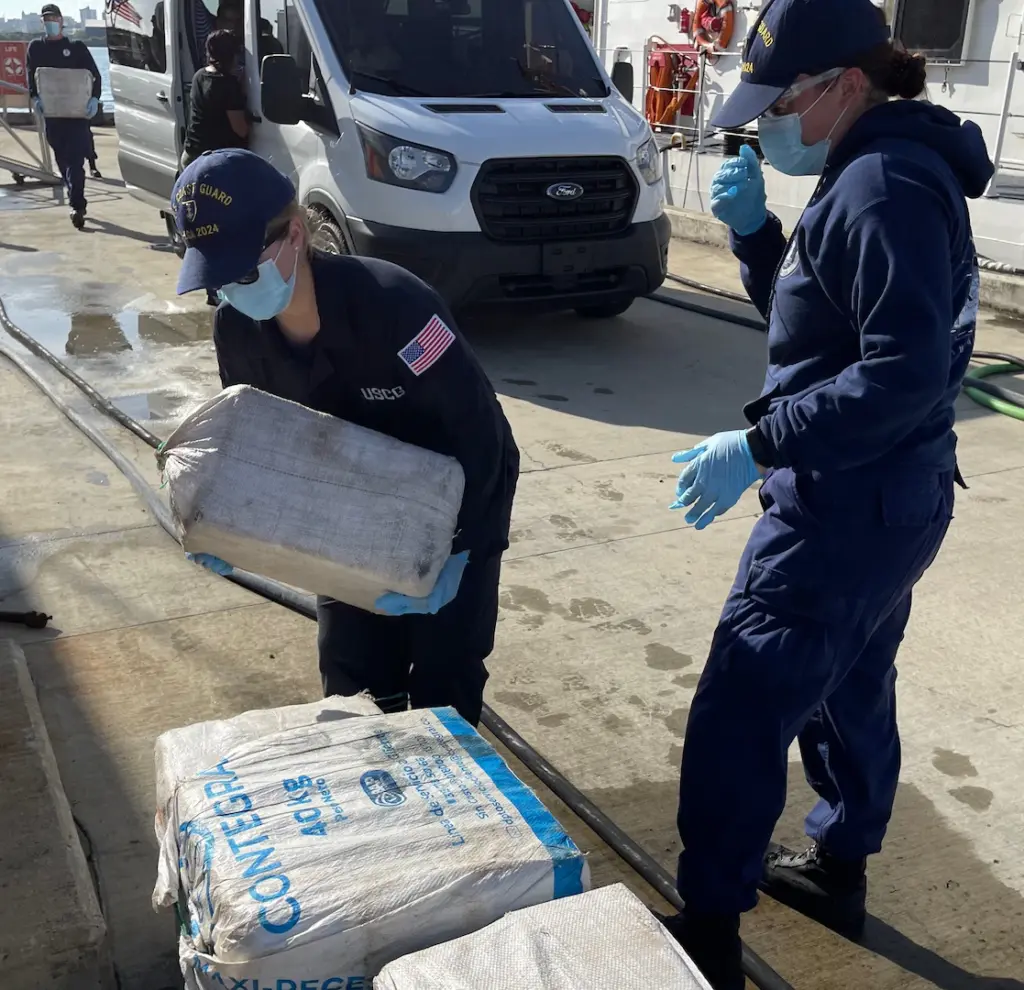
SAN JUAN, Puerto Rico — The crew of Coast Guard Cutter Joseph Napier (WPC 1115) offloaded more than 2,024 pounds of cocaine worth more than $23 million in San Juan, Puerto Rico, Monday. 

The offloaded drugs were interdicted by the Coast Guard Cutter Joseph Napier and U.S. Customs and Border Protection multi-role enforcement aircraft June 18, 2023, in Caribbean Sea international waters south of Puerto Rico. 

“This crew never ceases to amaze with their dedication and relentless work ethic, especially our pursuit team who swiftly interdicted and stopped another drug-smuggling vessel from making it to Puerto Rico,” said Lt. DeVonte Weems, Coast Guard Cutter Joseph Napier commanding officer. “This was a smooth interdiction made possible by the great work of the Napier crew, U.S. Customs and Border Protection Caribbean Air & Marine Branch, and Sector San Juan Command Center personnel.” 

“The commitment and resolve of the Coast Guard and our U.S. and local law enforcement partners in interdicting drug smuggling vessels at sea is unwavering,” said Capt. José E. Díaz, Coast Guard Sector San Juan commander.  “Our guardians risk their lives daily to safeguard the people of in Puerto Rico and the U.S. Virgin Islands from this threat and prevent illegal narcotics from reaching U.S. shores.” 

Along with the illicit narcotics, four suspected smugglers, one Colombian, one Dominican Republic and two Venezuelan nationals, were apprehended and face prosecution by the Department of Justice in the U.S. Federal District Court in Puerto Rico. 

The Transnational Organized Crime Division of the U.S. Attorney’s Office for the District of Puerto Rico is leading the prosecution for this case, while Special Agents supporting the Caribbean Corridor Strike Force are leading the investigation. 

The interdiction is the result of multi-agency efforts involving the Organized Crime Drug Enforcement Task Force (OCDETF), the Caribbean Border Interagency Group and the Caribbean Corridor Strike Force. OCDETF identifies, disrupts, and dismantles the highest-level criminal organizations that threaten the United States using a prosecutor-led, intelligence-driven, multi-agency approach. Additional information about the OCDETF Program can be found at https://www.justice.gov/OCDETF.For breaking news, follow us on Twitter. For additional information, find us on Facebook and Instagram. 

Cutter Joseph Napier is a 154-foot fast response cutter that is homeported in San Juan, Puerto Rico. 


Keel Authenticated for the Future USNS Point Loma 

Release from Naval Sea Systems Command

***** 

June 27, 2023 

By Team Ships Public Affairs 

Mobile, AL – The keel for the future USNS Point Loma, Expeditionary Fast Transport Ship (EPF 15), the second of the Spearhead-class EPF Flight II configuration, was laid at Austal USA, June 27. 

The keel-laying ceremony represents the joining together of a ship’s major modular components on land, and is a significant milestone in ship production. The keel is authenticated with the ship sponsors’ initials etched into a ceremonial keel plate that is later incorporated into the ship. EPF 15’s sponsor is Mrs. Beth Asher. 

“The keel laying is the beginning of a ship’s journey, and we look forward to the many milestones ahead,” said Program Executive Office, Ships Strategic and Theater Sealift Program Manager Tim Roberts. “EPF 15 will build on the capabilities established by the Flight I configuration, providing a wide variety of mission tools, when and where our fleet needs support.” 

EPFs operate in shallow waterways. These versatile, non-combatant transport ships are used to quickly move the troops, military vehicles, and equipment needed to support: 

  • Overseas contingency operations 
  • Humanitarian assistance 
  • Disaster relief 
  • Special operations forces efforts 
  • Theater security cooperation activities 

  • Emerging joint sea-basing concepts 

The Flight II is a modified configuration that allows the ship to deploy as a fast transport or with Role 2 enhanced (2E) medical capability, or both. Medical capability includes an intensive care unit, ward beds, limited X-ray, laboratory, and dental support. Additional capabilities which support the ship’s medical mission include V-22 flight operations and the ability to deploy 11-meter rigid hull inflatable boats. 

As one of the Defense Department’s largest acquisition organizations, PEO Ships is responsible for executing the development and procurement of all destroyers, amphibious ships, sealift ships, support ships, boats and craft.