USS Carl M. Levin Commissions in Baltimore
From Commander, Naval Surface Force, U.S. Pacific Fleet Public Affairs

*****

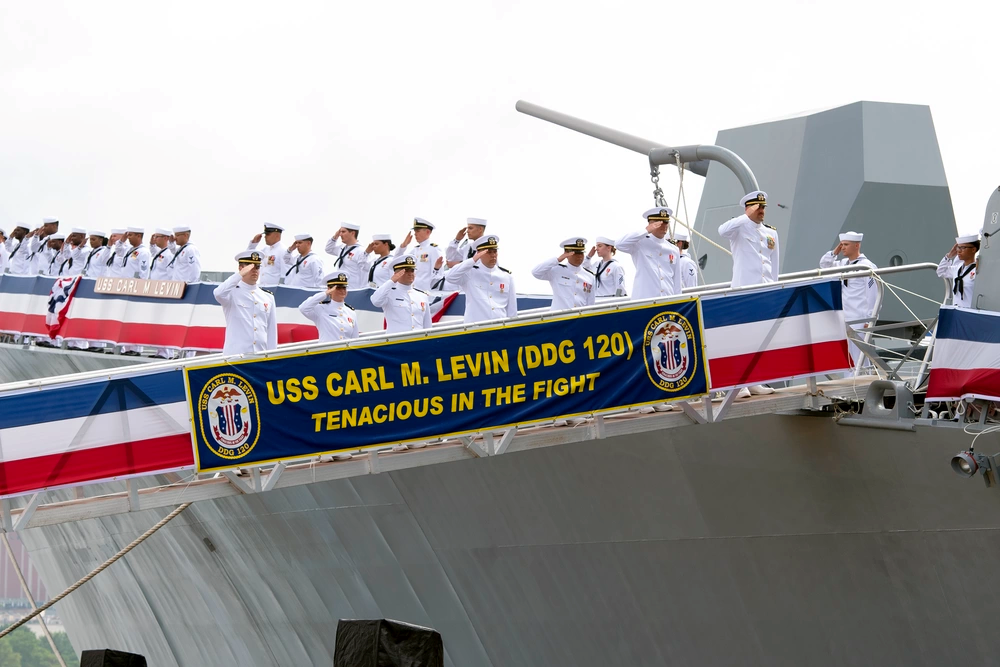
Baltimore, MD — The U.S. Navy commissioned its newest Arleigh Burke-class guided-missile destroyer USS Carl M. Levin (DDG 120), June 24 in Baltimore.

The Honorable Carlos Del Toro, the 78th Secretary of the NavyPrinciple, was the principal speaker.

“It is imperative that we, the United States of America, stand ready to support our international partners and our allies as we confront common challenges,: said Del Toro. “In order to do so, our nation needs to maintain a strong joint force. Our nation needs to maintain a strong Navy and Marine Corps as the foundation upon which the success of that joint force exists. This ship before you and our entire naval fleet supports not just the strike force, but our entire nation by guaranteeing our unencumbered access to a free and open maritime commons and serves as the lifeblood of our economy.”

Guest speakers for the event also included Adm. Michael M. Gilday, 32nd Chief of Naval Operations; the  Honorable Justin Williams, Deputy Mayor, City of Baltimore, Maryland; Rear Adm. Thomas J. Anderson, Program Executive Officer, Ships; and Mr. Charles F. Krugh, President, General Dynamics Bath Iron Works.

“Senator Levin lived a life of service with integrity, and his example inspires us as we commission this ship with this crew today,” Gilday said. “The men and the women of the USS Carl Levin represent some of the best and the brightest in our Navy. They are ready! They are prepared to go into harm’s way if required and they will carry out the orders of our nation.”

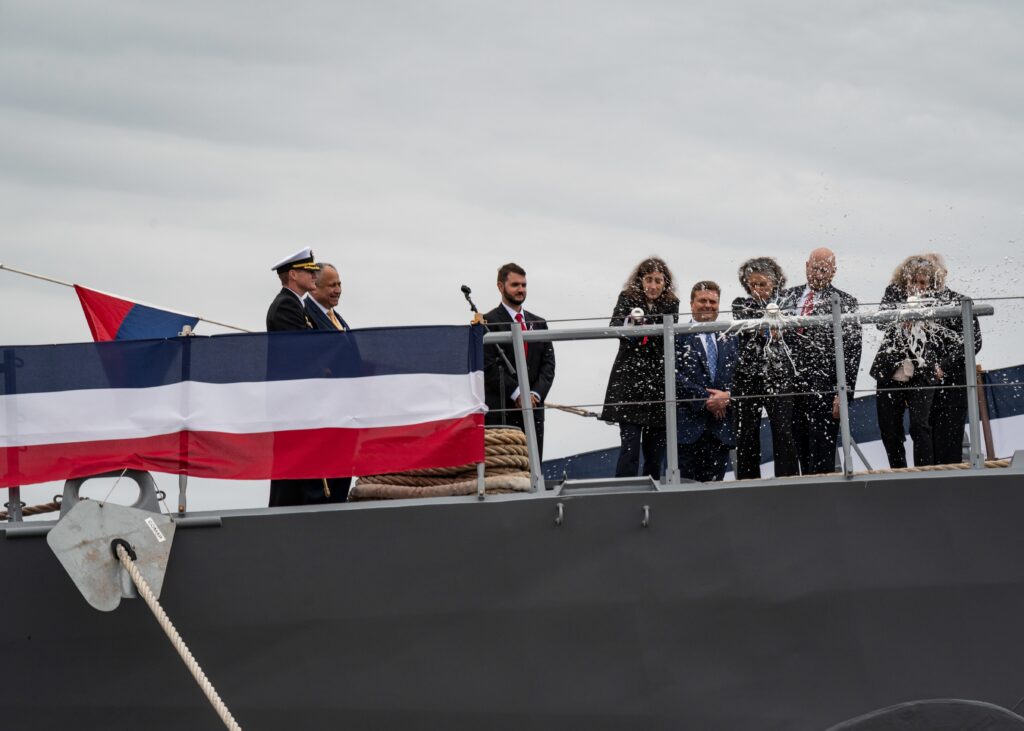
The ship’s sponsors are Sen. Carl M, Levin’s three daughters, Kate Levin Markel, Laura Levin, and Erica Levin.  All three sponsors participated in the keel laying, mast stepping, and christening ceremonies.

Gilday continued, “To the ship’s sponsors, Senator Levin’s daughters Kate, Laura, and Erica, thank you for your family’s support to our Navy and to our Sailors. It is not lost on us that the man that we call professor, Assistant Attorney General, and Senator, you call Dad. Thank you for sharing his legacy with us and we hope that you feel welcome as extended members of our big Navy family.”

Laura Levin spoke on behalf of herself and sisters Kate and Erica to recall their father’s life of service.

“Dad noted that for more than 50 years, Senate Armed Services Committee members had managed to work through their disagreements to pass the Defense Authorization bill with bipartisan support for a single reason. As Dad put it, those who served in the military ‘have inspired us, year after year, to come together across lines of party and ideology to support them,” Laura reflected. “They not only protect us, they unite us.’ So as we gather to send off this great ship, the three of us remember our Dad by thanking and congratulating the entire crew of the USS Carl M. Levin who protect us and also unite us.”

During the ceremony, USS Carl M. Levin’s commanding officer Cmdr. Kelly Craft, reported the ship ready. Sen. Levin’s daughters, Kate Levin Markel, Erica Levin, and Laura Levin, gave the traditional order to “Man our ship and bring her to life!”

“It’s been an honor and a privilege to have served as the Commanding Officer of a Pre-Commissioning Unit. It was amazing being able to sail down the Kennebec and out to sea for the first time,” Craft said. “There’s nothing like being able to bring the crew together and accomplish the mission. We’ve still got thousands of miles to travel before we make it to our home port of Hawaii, but I know this crew is the right crew for the job. They will remain tenacious in the fight, and they will lead this ‘greyhound’ to be the most feared warship in the world.”

Deputy Mayor Justin Williams’ pride in Baltimore’s Navy connection was evident. “From the days of clipper ships traversing the high seas during the revolutionary war…our city’s legacy has been long intertwined with the Navy’s legacy.” He continued, “as we commission the USS Carl Levin, we pay homage to the generations of sailors and shipbuilders who call Baltimore home. This mighty vessel will carry the torch of Baltimore’s naval legacy.”

The USS Carl M. Levin is the first naval ship named in honor of Michigan’s longest serving Senator, the 

late Carl M. Levin for his years of service as a longtime member and chairman of the Senate Armed Services Committee (SASC). 

Levin began his career as an attorney, professor, and assistant attorney general in Michigan and was elected to the Senate in 1979. He was Michigan’s first Jewish senator and the state’s longest-serving senator, serving for 36 years before retiring in 2015. In the Senate, his top priority was the economic well-being of Michigan families. He was a consistent voice for support of American manufacturing and was one of the Senate’s strongest advocates for policies that would help American manufacturers compete globally.

As chairman of SASC, Levin focused on taking care of the men and women of the military and their families, supporting pay raises and improvements in treatment and other policies for wounded warriors. He led oversight efforts to improve efficiency and reduce cost overruns in expensive weapons programs. Levin also supported military action to eliminate the al-Qaida threat in Afghanistan, investigated Pentagon spending practices, and played a key role in overturning the “Don’t Ask, Don’t Tell” rule that prohibited gay service members from openly acknowledging their sexual orientation before 2011.

Arleigh Burke-class guided-missile destroyers are the backbone of the U.S. Navy’s surface fleet. These highly capable, multi-mission ships conduct a variety of operations, from peacetime presence to national security providing a wide range of warfighting capabilities in multi-threat air, surface and subsurface.

The mission of CNSP is to man, train, and equip the Surface Force to provide fleet commanders with credible naval power to control the sea and project power ashore.

The ship will transit to her homeport at Joint Base Pearl Harbor-Hickam, Hawaii.

For more news from Naval Surface Forces, visit DVIDS – Commander, Naval Surface Force, U.S. Pacific Fleet, and Commander, Naval Surface Force, U.S. Pacific Fleet.

For additional information about the ship, visit USS Carl M. Levin (DDG 120).
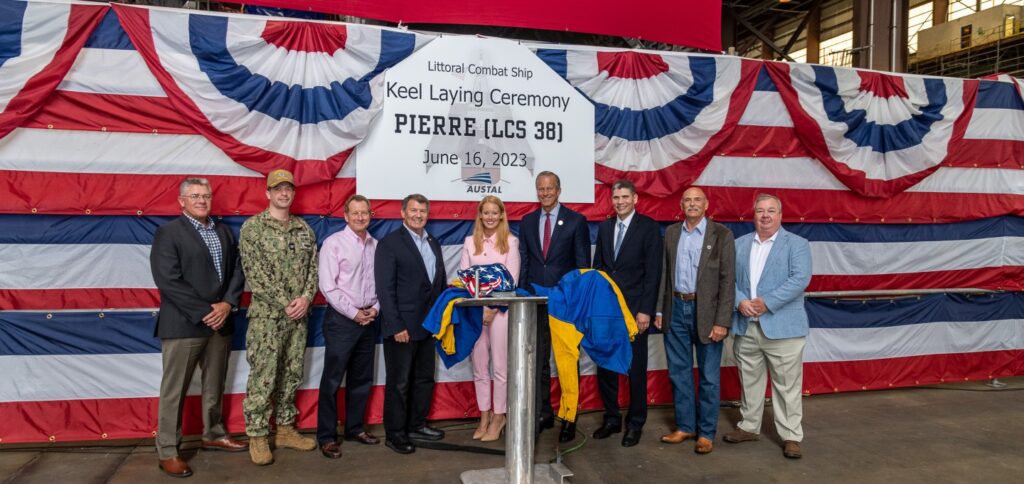


Austal USA Celebrates Keel Laying for the Future USS Pierre (LCS 38) – The Final Independence LCS

Release from Austal USA 

***** 

JUNE 19, 2023

MOBILE, Ala. – Austal USA hosted a keel laying ceremony late last week for the future USS Pierre (LCS 38) Independence-variant Littoral Combat Ship at the company’s Gulf Coast shipyard.  Ship sponsor Larissa Thune Hargens, with the assistance of Hon Tran – a 13-year Austal USA veteran A-class welder, authenticated the keel by welding her initials into a keel plate that will be welded to the hull of the ship. 

The future USS Pierre is the final Independence-variant Littoral Combat Ship being built by Austal USA in Mobile, Ala.  LCS 38 is the second U.S. Navy ship named for the South Dakota capital city. The original USS Pierre (PC-1141) was a submarine chaser built during World War II. 

“Keel laying represents a major milestone in the construction of a ship,” said Dave Growden, vice president of new construction. “While every keel laying we celebrate is special, this one has added significance as it starts to close the line of a highly successful program.”  

The ceremony was widely attended by community and Navy leaders and Austal USA shipbuilders. Notably, in a strong statement of support for the future USS Pierre, from the South Dakota delegation, Senator John Thune and Senator Mike Rounds attended the event along with the Mayor of Pierre, Mayor Steve Harding. 

“This is a special honor for the city of Pierre and all of South Dakota,” said Thune. “It’s also a good day for the Navy and the men and women of our joint forces. I’m particularly humbled, of course, to have had the privilege of introducing my daughter Larissa as the ship’s sponsor – a proud dad moment.” 

Hargens, a native of South Dakota, graduated from Bethel University. The call to serve runs deep in her family, Hargens is involved with a non-profit incentive program that helps limited-income pregnant women in Sioux Falls, her father is U.S. Senator John Thune and her grandfather was awarded the Distinguished Flying Cross for extraordinary achievement while participating in aerial flight in Fighting Squadron 18 (VF-18) on the USS Intrepid (CV-11) during World War II. 

“I am so honored and grateful for this incredible opportunity to sponsor the future USS Pierre,” stated Hargens. “It is a privilege to be a part of this time-honored tradition and to have my initials welded to a plate that will become a part of the ship’s keel. I look forward to participating in the important milestones throughout the life of the USS Pierre, and to building a lifelong relationship with the ship and the sailors that will make up her crew. May God bless the USS Pierre.” 

Independence-variant Littoral Combat Ships are fast, optimally-manned, mission-tailored surface combatants that operate in near-shore and open-ocean environments, winning against 21st-century coastal threats. Austal USA has delivered 17 LCS to the Navy since 2009, most of which have been deployed with the Pacific Fleet. The shallow-draft Independence-variant LCS have been opening up places for the Navy to operate where they had not been for years. The ship’s steerable water jets allow for effective maneuverability in and out of austere ports. With the capacity to deploy Naval Strike Missile and employ mine counter measure the ship can conduct key missions throughout the Pacific making them a highly functioning platform.  

Pierre is planned for delivery in fiscal year 2025 and will be homeported in San Diego, Calif., along with the other Independence LCSs that have been delivered to the fleet.  


HII is Awarded Contract Modification for Aircraft Carrier John F. Kennedy (CVN 79) 

Release from HII

***** 

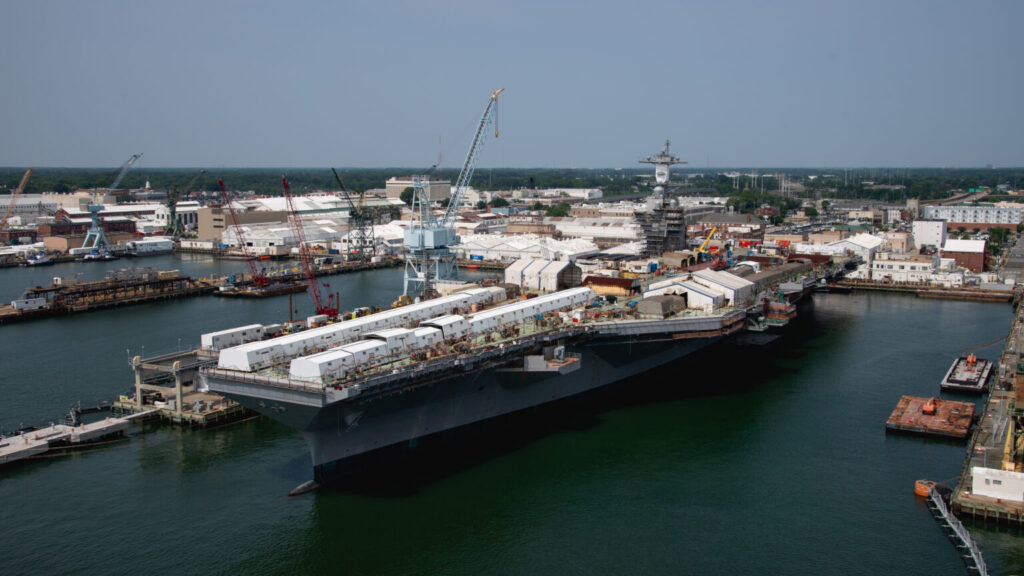
NEWPORT NEWS, Va., June 23, 2023 (GLOBE NEWSWIRE) — HII (NYSE: HII) announced today that its Newport News Shipbuilding (NNS) division has received contract modifications totaling $393.3 million from the U.S. Navy to shift the delivery strategy for the aircraft carrier John F. Kennedy (CVN 79). 

The contract action announced today revises the delivery approach for the second Gerald R. Ford-class aircraft carrier, shifting work previously planned for Post-Shakedown Availability (PSA) completion at NNS into the baseline construction contract. Under the new delivery strategy, John F. Kennedy will now deliver to the Navy July 31, 2025. 

“The contract modification reflects extensive collaboration with the Navy, as we have supported their decision to change the delivery strategy,” said Lucas Hicks, NNS vice president for John F. Kennedy (CVN 79) new construction aircraft carrier program. “This strategy will decrease post-delivery work required and increase ship capability and readiness at delivery. We understand the importance of Kennedy and look forward to delivering this mission-ready capability to the Navy.” 

A photo accompanying this release is available at: https://hii.com/news/hii-is-awarded-contract-modification-for-aircraft-carrier-john-f-kennedy-cvn-79 

Kennedy continues the legacy of highly capable nuclear-powered aircraft carrier platforms. Ford-class enhancements incorporated into the design include an enhanced flight deck, improved weapons handling systems and a redesigned island, all to support increased operational efficiency and reduced manning requirements. The Ford-class also features a new nuclear power plant, increased electrical power-generation capacity, and growth margin for future technologies. 

Thousands of shipbuilders and suppliers from across the country are supporting the construction of Kennedy at NNS, which is the nation’s sole designer, builder and refueler of nuclear-powered aircraft carriers. Two other Ford-class aircraft carriers are currently under construction at NNS: Enterprise (CVN 80) and Doris Miller (CVN 81).


Elbit America Selected for U.S. Navy Information Warfare Research Project

Release from Elbit America

***** 

The company’s autonomous system of systems prototype will be used to find, fix and track maritime targets 

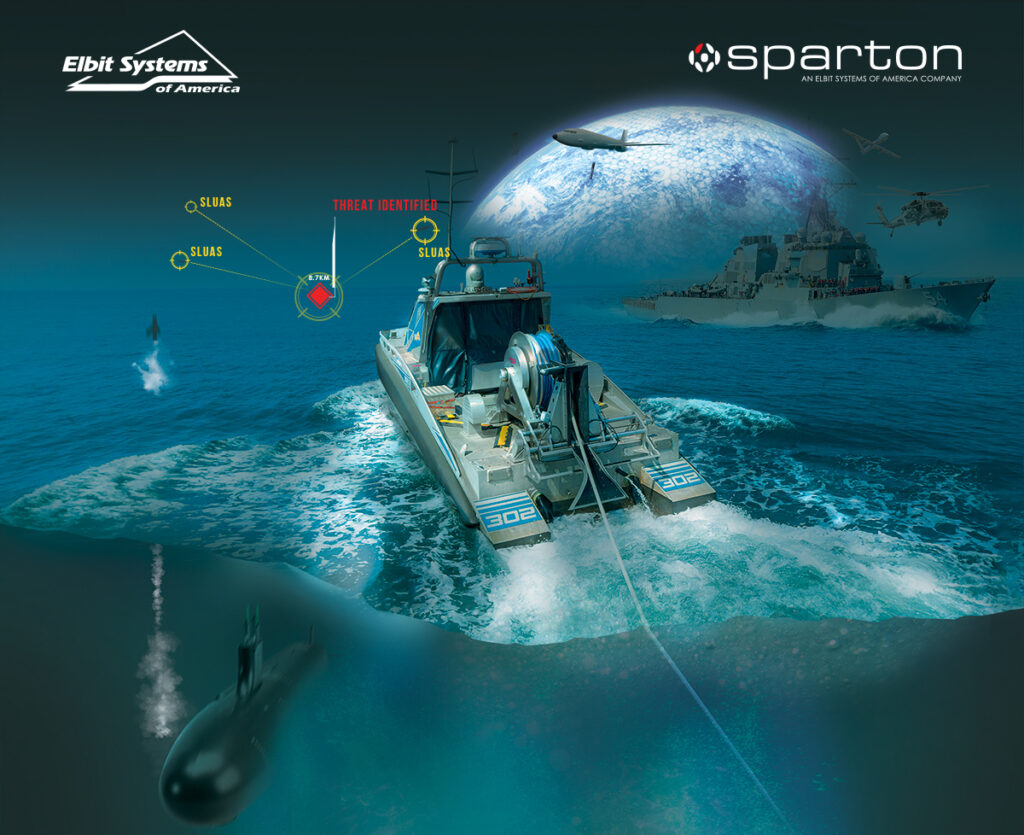
FORT WORTH, TEXAS – JUNE 26, 2023 – Elbit Systems of America (Elbit America) has been awarded a prime contract by the Naval Information Warfare Center Pacific (NIWC Pacific) to develop and demonstrate an autonomous maritime target tracking capability as part of the United States Navy’s Information Warfare Research Project (IWRP). The company will test its prototype in a series of at sea demonstrations over the next twelve months.  

The IWRP supports implementation of the Naval Operational Architecture to enable Joint All Domain Command and Control (JADC2), and ensure connectivity of U.S. and allied forces across land, air, sea, space, and cyberspace. Elbit America’s autonomy prototype will extend the reach of those forces by leveraging attritable systems to covertly find, fix and track maritime targets, as directed by operational commanders.  

Elbit America’s prototype includes various solutions and expertise from across its enterprise, including Sparton and Logos Technologies subsidiaries, as well as partners, Alare Technologies, and Nauticus Robotics. The prototype leverages unique autonomy, artificial intelligence, automatic target recognition, and undersea payload delivery capabilities.  

“Elbit America’s advanced prototype will enhance distributed maritime operations by employing attritable multi-domain unmanned systems that can collaborate autonomously to identify and report targets of interest, while operating in contested environments,” said the company’s Vice President of Maritime Business Jeff Hoyle.  

“Our selection as a prime contractor for the Navy’s Information Warfare Research Project validates that our company’s portfolio is in alignment with the U.S. National Defense Strategy. We are committed to strengthening our country’s national security and we’re investing in critical maritime technologies such as unmanned systems and sensors, attritable payloads, and undersea connectivity solutions to ensure that we can continue to innovate capabilities most needed by our customers,” said the company’s President and CEO Raanan Horowitz.   


U.S. Coast Guard completes first patrol following Typhoon Mawar to safeguard those at sea, enhance maritime security in Mariana Islands

Release from U.S. Coast Guard 14th District

***** 

SANTA RITA, Guam — Serving partners in the Northern Mariana Islands and Guam, the USCGC Oliver Henry (WPC 1140) crew returned to Guam in time for Father’s Day, completing a patrol from June 12 to 18 in the Mariana Islands. 
 
During the patrol, the Oliver Henry crew dedicated efforts to serve neighbors in the Commonwealth of the Northern Mariana Islands (CNMI) and Guam while actively countering potential illegal maritime activity and standing ready to respond rapidly to any at-sea emergencies.  
 
The Oliver Henry crew played a vital role as the search and rescue response cutter during a dedicated five days in the CNMI, accumulating 119 operational hours. Additionally, the crew spent a day on the high seas east of the CNMI, ensuring expanded coverage to counter illegal fishing and bolstering regional security efforts. 
 
Capt. Nick Simmons, commander of U.S. Coast Guard Forces Micronesia, highlighted the importance of service to our northern communities, stating, “We are dedicated to maintaining strong partnerships in the area and deterring illegal maritime activity. We also take the safety of those on the water seriously. Our presence and collaborative efforts in the CNMI reaffirm our commitment to the safety and security of our maritime environment and the well-being of our communities.” 
 
Acting on information from local partners, the crew made their presence off Saipan known and effectively deterred those seeking to come to Guam through an unannounced entry, preventing the departure of an estimated 30 people from Saipan. The U.S. Coast Guard’s focus in this matter is the safety of life at sea and preventing illegal charters. Both issues threaten lives through the potential overloading of vessels, a lack of compliance with safety requirements and licensing, and risky behavior when operating vessels. 
 
The Oliver Henry crew also executed a law enforcement boarding of opportunity on the high seas under the authority of the Western and Central Pacific Fisheries Commission, specifically on a Chinese-Taipei flagged long liner. The boarding team performed their duties, observing no violations or records of transshipment. Additionally, the patrol provided valuable training opportunities by hosting two temporary duty members from Guam-based units, contributing to the overall development and readiness of Coast Guard personnel. 
 
Lt. Raymond Cerrato, commanding officer of Oliver Henry, commended the crew’s exceptional performance, emphasizing the significance of joint operations and recognizing individual crewmember achievements stating, “The success of our patrol stems from the dedication and teamwork displayed by the USCGC Oliver Henry crew. By conducting law enforcement boardings, offshore gunnery exercises, and providing training opportunities, we demonstrated our crew’s exceptional capabilities and commitment to serving the people of CNMI and Guam.” 
 
In recognition of individual achievements, the commanding officer frocked one crewmember to the next higher pay grade, and the team bid farewell to two departing members, acknowledging their dedication and contributions to the regional mission.  
 
The recent patrol of the Oliver Henry underscores the U.S. Coast Guard’s steadfast commitment to safety at sea, upholding maritime security, fostering partnerships, and maintaining interoperability in the Western Pacific. The U.S. Coast Guard plays a vital role in ensuring a safe and secure maritime environment by serving neighbors, countering illegal activities, and responding rapidly to emergencies. 
 
For more news on U.S. Coast Guard Forces Micronesia/Sector Guam and its ongoing efforts, please visit https://www.dvidshub.net/unit/USCG-FMSG or subscribe to https://www.dvidshub.net/alerts/unit/7900. You can also visit us on Facebook and Instagram at @USCGForcesMicronesia.  


Pacific Marines F-35cs Fly From California To Australia For First Time

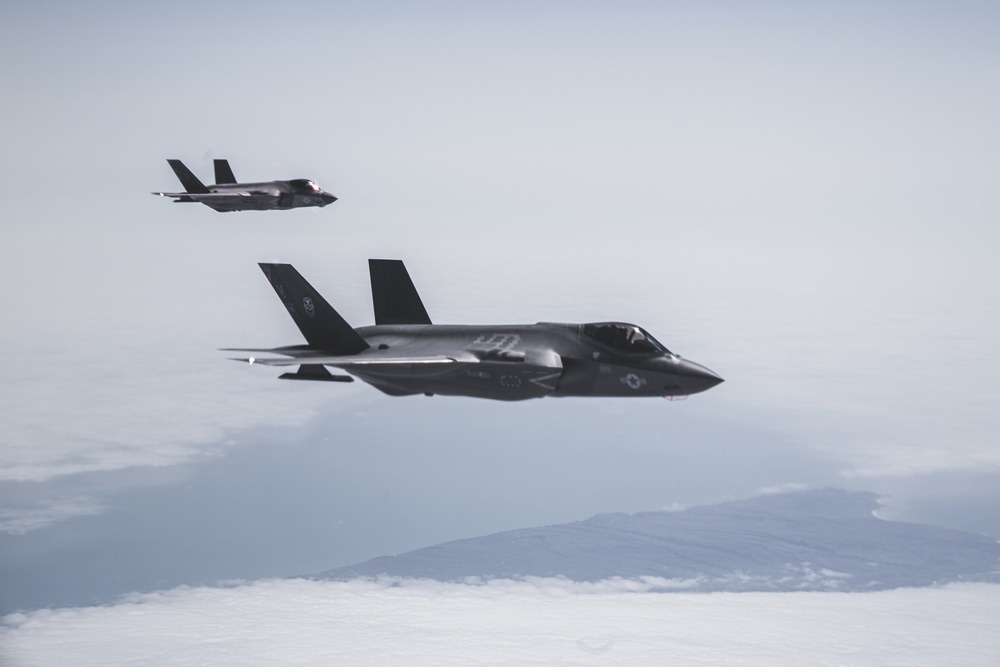
U.S. Marine Corps Lt. Col. Michael O’Brien, center, the commanding officer of Marine Fighter Attack Squadron (VMFA) 314, Marine Aircraft Group (MAG) 11, 3rd Marine Aircraft Wing (MAW), and Maj. Robert Ahern, an F-35C Lighting II pilot assigned to VMFA 314, prepare to conduct aerial refueling over the Pacific Ocean, June 17, 2023. VMFA-314 flew four F-35C Lightning IIs from Marine Corps Air Station Miramar, California to Williamtown, Australia to train alongside Allies and partners in the Indo-Pacific region. Ahern is a Mechanicsburg, Pennsylvania, native, and O’Brien is a Harrisburg, Pennsylvania, native. (U.S. Marine Corps photo by Lance Cpl. Gadiel Zaragoza)

Release from U.S. Marine Corps Forces Pacific 

***** 

June 23, 2023 

ROYAL AUSTRALIAN AIR FORCE BASE WILLIAMTOWN, NSW, Australia – This week, U.S. Marine Corps F-35C Lightning II aircraft flew from California to Australia for the first time for training and operations in the region. Four jets from Marine Fighter Attack Squadron (VMFA) 314, Marine Aircraft Group (MAG) 11, 3rd Marine Aircraft Wing (MAW) departed Marine Corps Air Station Miramar, California, June 17, and arrived at Royal Australian Air Force (RAAF) Base Williamtown, New South Wales, Australia, June 22.

The jets flew a total of approximately 7,800 miles, conducting four stopovers en route. They were supported with cargo and personnel transport by a U.S. Marine Corps KC-130J Super Hercules from Marine Aerial Refueler Transport Squadron (VMGR) 352, MAG-11, 3rd MAW, and supported with refueling by U.S. Air Force KC-135 Stratotankers from the 171st Air Refueling Wing, Pennsylvania Air National Guard, and 141st Air Refueling Wing, Washington Air National Guard.

“The VMFA-314 Black Knights are beyond excited to bring the first land-based I MEF fifth-generation stealth fighters all the way from California to Australia. Over the past year, we’ve trained in our own Marine Corps F-35Cs with the Royal Australian Air Force F-35As and E-7 Wedgetails in the U.S., and now it is time to train with our valued Allies on their side of the globe,” said Lt. Col. Michael O’Brien, commanding officer, VMFA-314.

VMFA-314 trained with RAAF No. 3 Squadron and their F-35As in Hawaii in December 2022 during exercise Pacific Edge 23. The two units also trained together in the Joint Simulation Environment at Naval Air Station Patuxent River, Maryland, in February 2023.

The VMFA-314 detachment is slated to conduct unit-level and bilateral integrated training at RAAF Base Williamtown through mid-July.

“This movement and the training to come not only demonstrate the force mobilization capability of the F-35C, but the advanced stage of tactical and logistical interoperability between the RAAF and USMC. We have a long history of security cooperation dating back to World War II, and we are now focused on strengthening our relationship while integrating our most capable, cutting-edge platforms as well,” O’Brien said.  

The Marines and aircraft of VMFA-314 are the first element of a larger U.S. Marine Corps footprint from I Marine Expeditionary Force based in San Diego, California, slated to arrive for training in the region.


USCGC Bear (WMEC 901) returns home following 65-day deployment

Release from U.S. Coast Guard Atlantic Area 

***** 

June 22, 2023 

USCGC Bear (WMEC 901) returns home following 65-day deployment 

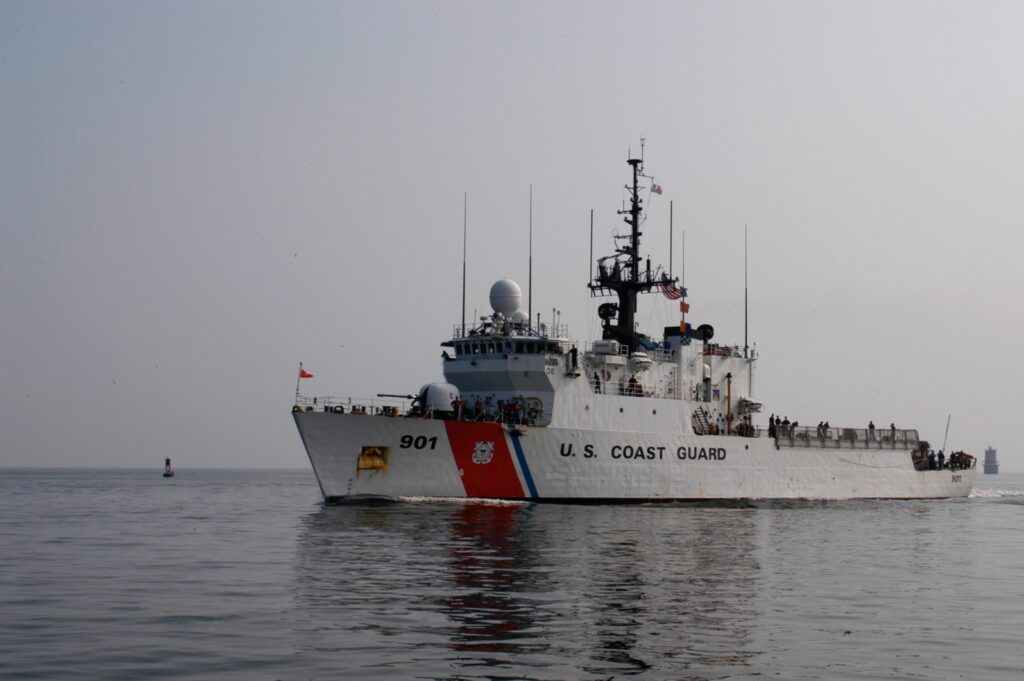
PORTSMOUTH, Va. – The USCGC Bear (WMEC 910) returned home to Coast Guard Base Portsmouth, Thursday, following a 65-day Caribbean Sea patrol. 

While underway in the Seventh Coast Guard District’s area of responsibility and in support of Joint Interagency Task Force–South, Bear conducted six counterdrug interdictions and seized a total of 8,558 pounds of cocaine worth an estimated $97 million. 

Bear conducted counterdrug operations as part of a multi-faceted approach to combatting illicit narcotics trafficking across maritime borders. Part of this effort included other Coast Guard assets, a Helicopter Interdiction Tactical Squadron aircrew from Jacksonville, Florida, and a deployable specialized forces unit from the Pacific Tactical Law Enforcement Team. 

Bear also conducted vertical replenishment with the U.S. Navy vessel Little Rock (LCS-9). Little Rock deployed its MH-60 Seahawk helicopter and crew to successfully deliver 5,566 pounds of seized cocaine to Bear’s flight deck. Bear moored in Miami, last Friday, and offloaded the combined 14,153 pounds of cocaine worth an estimated $186 million. 

Interdictions in the Caribbean Sea are performed by members of the U.S. Coast Guard under the authority and control of the Seventh District, headquartered in Miami. Each case will be prosecuted in a court of law. 

For more news on the Coast Guard’s presence in the Caribbean please visit here

For information on how to join the U.S. Coast Guard, visit www.GoCoastGuard.com to learn about active duty and reserve, officer and enlisted opportunities. Information on how to apply to the U.S. Coast Guard Academy can be found at www.uscga.edu


Navy to Commission Guided-Missile Destroyer Carl M. Levin

BATH, Maine (Oct. 2, 2021) Secretary of the Navy (SECNAV) Carlos Del Toro observes as the ship sponsors christen the Arleigh Burke-class guided-missile destroyer USS Carl M. Levin (DDG 120), Oct. 2, 2021, at General Dynamics Bath Iron Works shipyard. The ship’s namesake, late U.S. Sen. Carl M. Levin, retired in 2015 and was the longest-serving senator in Michigan history. (U.S. Navy photo by Mass Communication Specialist 2nd Class T. Logan Keown)

Release from the U.S. Navy Office of Information 

***** 

23 June 2023 

The Navy will commission its newest Arleigh Burke-class guided missile destroyer, USS Carl M. Levin (DDG 120), during a 10:00 a.m. EDT ceremony on Saturday, June 24, in Baltimore, Maryland. 

The Honorable Carlos Del Toro, Secretary of the Navy, will deliver the commissioning ceremony’s principal address. Remarks will also be provided Admiral Michael Gilday, Chief of Naval Operations; the Honorable Justin Williams, deputy mayor of the City of Baltimore; and Mr. Charles F. Krugh, president, General Dynamics Bath Iron Works.  The ship’s sponsors are Senator Levin’s daughters, Kate Levin Markel, Erica Levin, and Laura Levin. 

The ship’s namesake served in the U.S. Senate for 36 years from 1979-2015. As the longest serving senator in Michigan state history, Levin became a staunch supporter of the armed services through his work and leadership as Chairman and Ranking Member of the Senate Committee on Armed Services. Levin passed away on July 29, 2021. 

The ship, which will be homeported at Joint Base Pearl Harbor-Hickam, will be the 72nd Arleigh Burke-class destroyer to be commissioned, with 17 additional ships currently under contract for the DDG 51 program. The ship is configured as a Flight IIA destroyer, which enables power projection and delivers quick reaction time, high firepower, and increased electronic countermeasures capability for anti-air warfare. The USS Carl M. Levin is 509.5 feet long and 59 feet wide, with a displacement of 9,496 tons. It will be homeported in San Diego.  

Media may direct queries to the Navy Office of Information at (703) 697-5342. More information on guided-missile destroyer programs can be found at:  https://www.navy.mil/Resources/Fact-Files/Display-FactFiles/Article/2169871/destroyers-ddg/ 

The ceremony will be live streamed at: https://www.dvidshub.net/webcast/31729. The link becomes active approximately ten minutes prior to the event (9:50 a.m. EDT) 


Northrop Grumman Manufactures Two Thousandth Solid Rocket Motor for US Navy’s Trident II D5 Progam

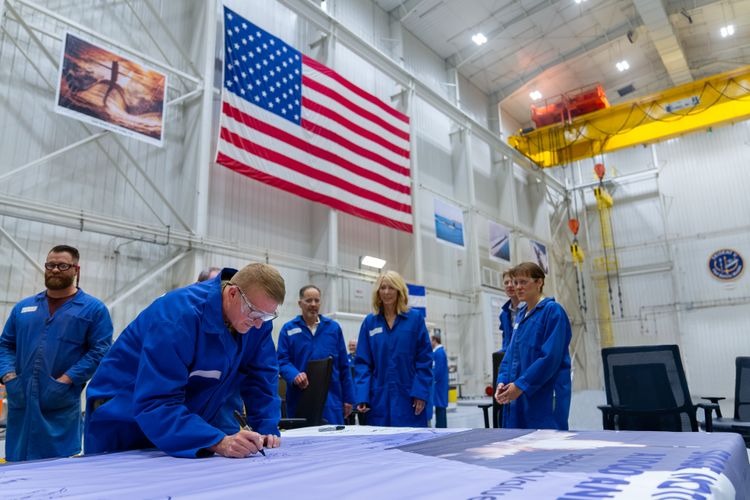
Vice Admiral Johnny R. Wolfe, director of strategic systems programs, U.S. Navy, signs a Trident II D5 Banner in a manufacturing facility where the systems solid rocket propulsion is built. (Photo Credit: Northrop Grumman)

Release from Northrop Grumman 

***** 

MAGNA, Utah. – June 22, 2023 – Northrop Grumman Corporation (NYSE: NOC) has successfully manufactured two thousand solid rocket motors for the U.S. Navy’s Trident II D5 Submarine Launched Ballistic Missile (SLBM) system with the completion of first-stage A1000 and second-stage B1000 motors. 

Northrop Grumman has manufactured: 

  • More than 800 first-stage tactical motors 
  • More than 800 second-stage tactical motors 
  • More than 370 third-stage tactical motors since assuming the scope of work in 1996 
  • And successfully cast over 86 million pounds of propellant for D5 motors 

The system is provided to the U.S. Navy by prime contractor Lockheed Martin, which develops and produces the missile and support equipment. It has completed 190 successful flight tests since deployment with no motor failures. The Trident II D5 missile will continue to serve as the seaborne leg of the U.S. Nuclear Triad for decades to come. 

Expert: 
Wendy Williams, vice president, propulsion systems, Northrop Grumman: “Our customers rely on our solid rocket motors to conduct their most important missions. The unmatched reliability, record-breaking mission success and planned life expectancy of the Navy’s SLBM system speaks to the design of the propulsion and our ability to consistently produce critical motors.” 

Details on Trident II D5: 
The Trident II D5 SLBM is a three-stage, solid-fuel, inertially guided missile with a range of 4,000 nautical miles. The missile is launched by the pressure of expanding gas within the launch tube. When the missile broaches the waterline, it enters the boost phase, expending its first, second and third-stage rocket motors. Northrop Grumman manufactures solid-propulsion boost motor systems for all three stages of the Trident II missile under a contract from prime contractor Lockheed Martin. 

For nearly 70 years, Northrop Grumman has partnered with Lockheed Martin and the Navy to provide solid rocket motors for the SLBM system. Completion of motors A1000 and B1000 represents the longevity of the Trident II D5 program, the nation’s commitment to deterrence and the role of the company’s solid rocket propulsion as an essential national security asset. 

As part of the celebration of this milestone, U.S. Navy Vice Admiral Johnny Wolfe, Director for Strategic Systems Programs, visited Northrop Grumman’s Bacchus, Utah, campus where the Trident II D5 motors are cast and assembled. 

“The unmatched reliability and performance of our sea-based nuclear deterrent is made possible by a dedicated team of military, civilian and industry partners who bring expertise and dedication to a truly extraordinary mission,” said Vice Admiral Wolfe. “The propulsion systems and their performance are critical to the success of that mission.” 

Northrop Grumman and its legacy companies have supported the Navy’s deterrence mission for over six decades, supplying propulsion for the nation’s Fleet Ballistic Missile submarine-launched systems starting with Polaris, Poseidon C3, Trident I C4 and then Trident II D5, which is less than halfway through its expected service life. 


USS Wyoming Successfully Tests Trident II D5LE Missiles

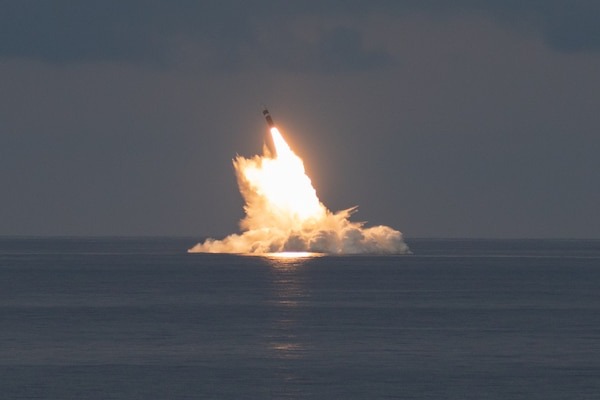
ATLANTIC OCEAN (Sept. 17, 2021) An unarmed Trident II D5LE missile launches from the Ohio-class ballistic missile submarine USS Wyoming (SSBN 742) off the coast of Cape Canaveral, Florida, during Demonstration and Shakedown Operation (DASO) 31. This launch was part of the U.S. Navy Strategic Systems Program’s DASO certification process. The primary objective of DASO is to evaluate and demonstrate the readiness of the SSBN’s Strategic Weapon System (SWS) and crew before operational deployment following the submarine’s engineered refueling overhaul. (U.S. Navy photo by Chief Mass Communication Specialist David Holmes/Released)

Release from U.S. Strategic Command 

***** 

Sept. 18, 2021 

This successful test was part of a Demonstration and Shakedown Operation, designated DASO-31. The primary objective of a DASO is to evaluate and demonstrate the readiness of the SSBN’s Strategic Weapon System (SWS) and crew before operational deployment following the submarine’s engineered refueling overhaul. 

“The DASO test, and others like these, underscore our readiness and capability for 21st Century Strategic Deterrence,” said Rear Adm. Thomas E. Ishee, USSTRATCOM director of Global Operations. “SSBN crews undergo constant training and regularly planned testing to ensure the weapons systems remain ready and reliable. The Sailors and support element who make up the silent service prove every day they are capable and prepared to protect America and its allies.” 

This launch marks 184 successful missile test flights of the Trident II (D5 & D5LE) SWS. 

“Today’s [Sept. 17] test demonstrates the unmatched reliability of our sea-based nuclear deterrent, which is made possible by a dedicated team of military, civilian and industry partners who bring expertise and dedication to the mission that is truly extraordinary,” said Vice Adm. Johnny R. Wolfe, director of the Navy’s Strategic Systems Programs. Further, “This same team is now developing the next generation of the Trident Strategic Weapon System, which will extend our sea-based strategic deterrent through 2084.” 

The Trident strategic weapon system is highly accurate and reliable. The Trident II (D5) missiles recently underwent a life extension program to address potential impacts from aging and obsolescence. The life-extended missiles – Trident II (D5LE) – are now being deployed to the Fleet and will serve for the remaining service life of U.S Ohio-class and United Kingdom Vanguard-class SSBNs, and as the initial load-out for the U.S. Columbia-class and U.K. Dreadnought-class SSBNs. 

USS Maine (SSBN-741) successfully executed the Navy’s last DASO in February 2020 off the coast of San Diego, California. The Navy’s most recent flight test – a Commander’s Evaluation Test – was a series of four launches in February 2021 off the coast of Florida.  Each of these flight tests were of the life-extended Trident II (D5LE) missiles. 

Flight test missiles are not armed, and safety of the public and the crew conducting the mission is paramount.  The launches were conducted from the sea, the missile flew over the sea, and landed in the sea. At no time did the missile fly over land.  

The missile test was not conducted in response to any ongoing world events, nor as a demonstration of power. Test launches – including DASOs – are scheduled years in advance. 

A credible, effective nuclear deterrent is essential to our national security and the security of U.S. allies. Deterrence remains a cornerstone of national security policy in the 21st century.   

Strategic Systems Programs is the Navy command that provides cradle-to-grave lifecycle support for the Navy’s strategic weapon systems. This includes training, systems, equipment, facilities and personnel responsible for ensuring the safety, security- and effectiveness of the nation’s Submarine Launched Ballistic Missile (SLBM) Trident II (D5LE) strategic weapon system.  

SLBMs are the sea-based leg of the nation’s strategic nuclear deterrent Triad that also includes the U.S. Air Force’s intercontinental ballistic missiles (ICBM) and nuclear-capable bombers.  Each part of the Triad provides unique capabilities and advantages.    

The sea-based leg makes up the majority – approximately 70 percent – of the U.S.’s deployed strategic nuclear deterrent Triad. The SLBM is the most survivable leg of the triad, provides a persistent presence, and allows for flexible concepts of operations.