USS Detroit Deploys to Support Regional Cooperation and Security

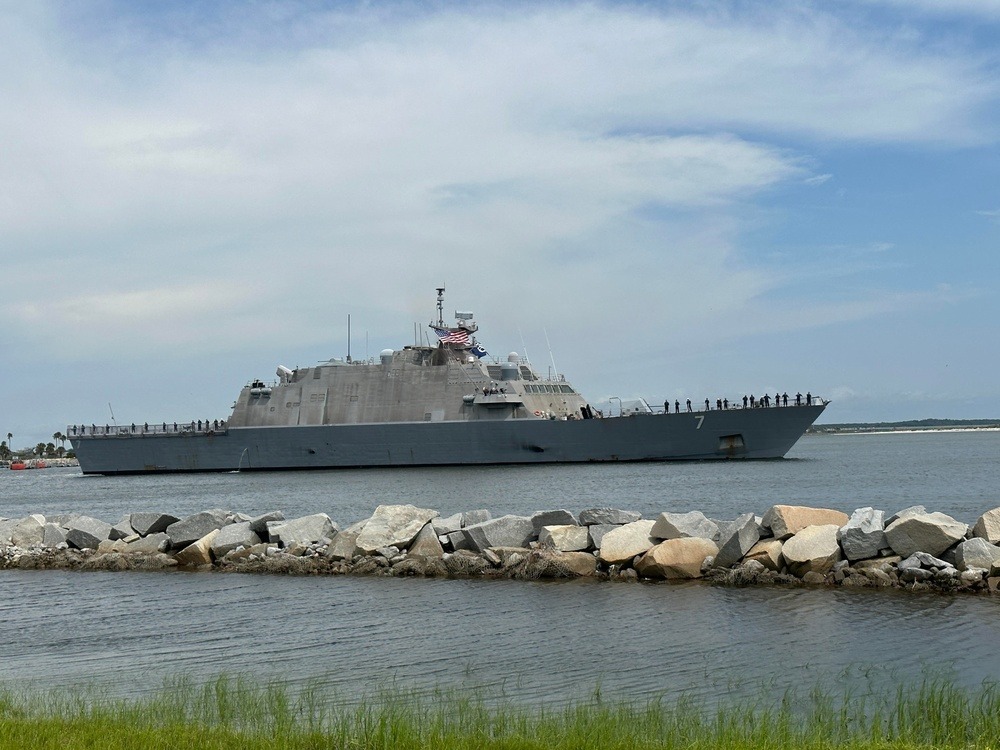
Photo By Lt. Anthony Junco | NAVAL STATION MAYPORT, Fla. — The Freedom-variant littoral combat ship USS Detroit (LCS 7) deployed to support Regional Cooperation and Secuity. Detroit is one of 4 ship assigned to Surface Division 21.  see less | View Image Page

Release from Littoral Combat Ship Squadron TWO 

***** 

MAYPORT, FL, UNITED STATES 

06.21.2023 

Story by Lt. Anthony Junco 

MAYPORT, Fla. – The Freedom-variant littoral combat ship USS Detroit (LCS 7), along with Helicopter Sea Combat Squadron (HSC) 28, detachment 11, got underway June 21 to support operations in U.S. Southern Command area of responsibility. 
 
Detroit will support counter-narcotics operations in the Caribbean and Eastern Pacific. Detroit’s operations will involve practical exercises and exchanges with partner nation maritime services, supporting U.S. 4th Fleet interoperability and reinforcing the U.S. position as the regional partner of choice. 
 
“We look forward to building upon the successes of USS Milwaukee (LCS 5) and USS Little Rock (LCS 9) in our return to the U.S. Southern Command area of responsibility,” said Cmdr. Kyle Hickman, commanding officer of Detroit. “The crew has been extremely dedicated in its preparation and is ready for 4th Fleet tasking.” 
 
The deployment of an LCS to the region aims to demonstrate the U.S. commitment to regional cooperation and security. The LCS’s shallow draft provides unparalleled opportunities for port access, making the ship an ideal vessel for these types of engagements. 
 
Detroit will initially be manned by its crew of more than 100 Sailors, including a U.S. Coast Guard law enforcement detachment; and an aviation detachment, who will operate an embarked MH-60 helicopter. 
 
“The crew executed a very difficult training cycle,” said Cmdr. Bruce Hallett, executive officer of Detroit. “They exceeded all expectations.” 
 
LCS is a fast, agile, mission-focused platform designed to operate in near-shore environments, winning against 21st-century coastal threats. It is capable of supporting forward presence, maritime security, sea control, and deterrence. 


Textron Puts Its Cottonmouth ARV to the Test for the Marine Corps

***** 

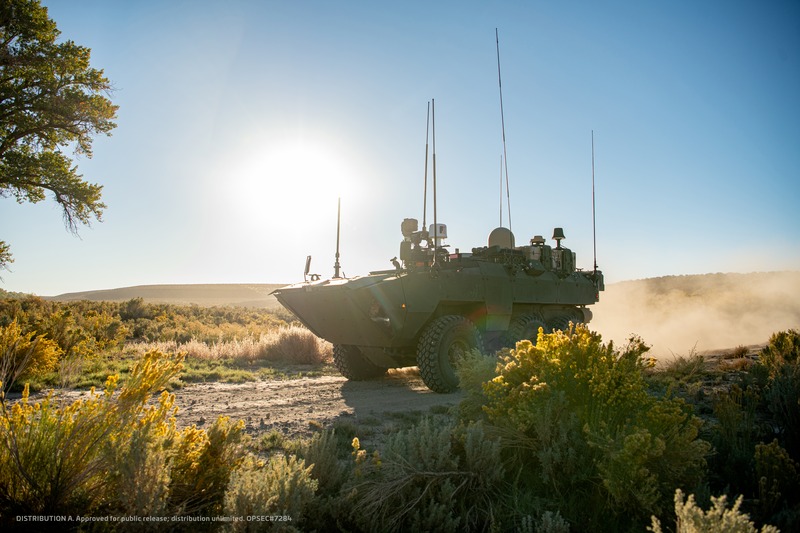
ARLINGTON, Va. — Textron has been demonstrating the capabilities of its Cottonmouth candidate for the U.S. Marine Corps’ Advanced Reconnaissance Vehicle (ARV) competition and has been granted funding to continue testing through calendar year 2023.

The ARV is to be an amphibious, wheeled armored vehicle to replace the Corps’ current Light Armored Vehicle in its reconnaissance battalions. It is to be equipped as a node in the command-and-control network during expeditionary operations and is to be able to serve as a battlefield quarterback, deploying sophisticated full-spectrum sensors and unmanned systems — including unmanned aerial vehicles and unmanned surface vessels—and manned/unmanned teaming.

Textron built and demonstrated an earlier concept demonstrator vehicle, called Alpha, mainly to demonstrate its automotive performance in terrain. The company followed with a company-owned Cottonmouth prototype, in which integration of government-furnished systems was accomplished. The prototype Cottonmouth was mission delivered to the Nevada Automotive Test Center for testing by the Marine Corps in December 2022.

During 2020-2021, Textron built the Alpha prototype with company funding.

“We ran the same test profile that we believed the Marines were going to run on what became our prototype deliverable for their testing under the contract agreement,” said David Phillips, Textron’s senior vice president, Land and Sea Systems, in a June21 interview with Seapower. “We had de-risked it from the standpoint of automotive, rugged, reliable, ran it through all of the cross-country, smoke testing, various different soil types, so that we could submit our proposal to the Marine Corps with actual data, not just paper.”

In September 2021, Textron began fabrication of the deliverable prototype at its Slidell, Louisiana, facility, and began systems integration work at its Hunt Valley, Maryland facility, where “we were able to test out components before actually installing them in the vehicle. The biggest difference between the Alpha prototype — which was mainly automotive — and what delivered and are testing now is the integration of all the capability: all the government furnished radios, communications equipment, computers, cyber, all of the things that make the vehicle a system,” Phillips said.

In September 2022, Textron delivered a “replica systems integration lab” to the Naval Information Warfare Systems – Atlantic in Charleston, South Carolina.

The prototype Cottonmouth was mission delivered to the Nevada Automotive Test Center for testing by the Marine Corps in December 2022.

“The vehicles have performed very well with the Marines,” Phillips said, of the automotive and durability testing it went through. “It accumulated a thousand miles across the variety of relevant Marine Corps mission profiles.”

Phillips said that the prototype’s electronic systems currently are being tested by the Marine Corps Tactical Systems Support Activity, including “sensing and disseminating data across the battlefield, and beyond the battlefield to the fleet and higher headquarters.”

The ARV prototype was able to operate and communicate with a Group 2 unmanned aerial system at a distance of 50 kilometers, he said, noting that the prototype has accrued 500 hours of testing of the electronic systems.

The vehicle’s swim characteristics “in the plunging surf” were successfully tested at Camp Pendleton, California. In the water the ARV is propelled by waterjets geared to the vehicle’s Cummings diesel engine, said Zach Bupp, Textron’s program director, Land Systems.

The Textron ARV is a “clean-sheet design,” Phillips said, saying that it was the best way for the Marine Corps to have its Tier 1 and 2 requirements met, as well as the “vast majority of their lower-tier requirements.”

He characterized the Textron design as revolutionary rather than evolutionary.

Phillips said that size and weight are critical requirements because of transportability, noting that four Textron ARVs — at 37,00 pound each — could be carried on of the Navy’s LCAC 100-class ship-to-shore connectors.

The Textron ARV rides on six wheels rather than eight, which Philips said reduced the weight and complexity of the vehicle and prosed no problems with operations in the terrain in which it was tested.

He also said his company is doing trade studies of subsystems that could be installed on the Cottonmouth to create a family of systems that could be deployed in an ARV-centric reconnaissance battalion.

Philips said the government’s Milestone B decision for selection and to authorize low-rate initial production is expected during the first or second quarter of calendar year 2025.


New CNR Takes Helm at Office of Naval Research

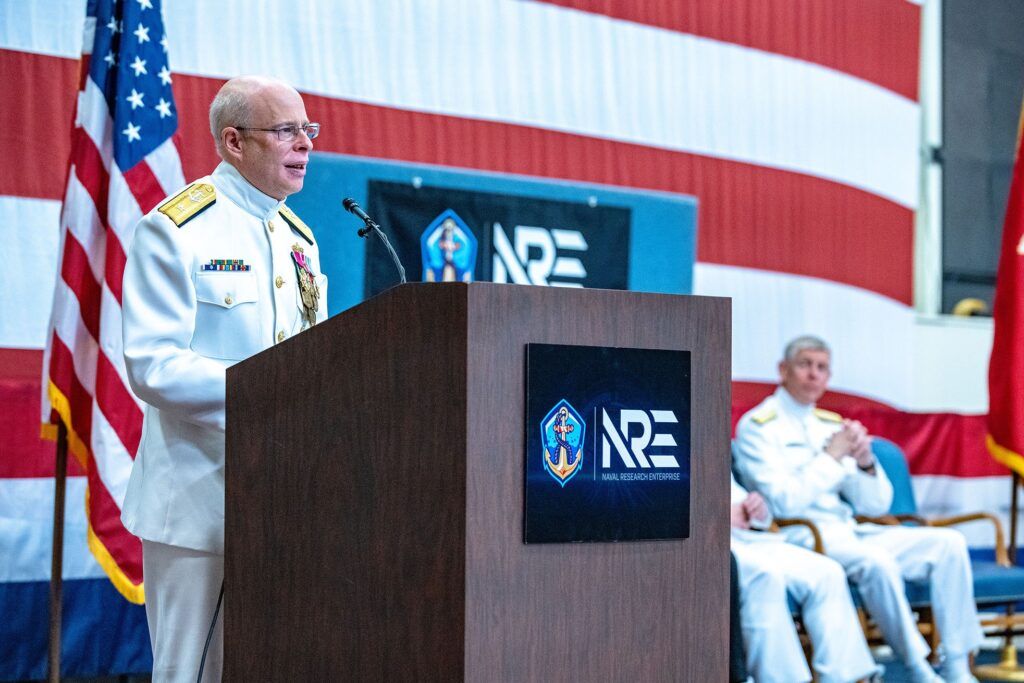
Chief of Naval Research (CNR) Rear Adm. Kurt Rothenhaus addresses the audience during a change-of-command ceremony for the Office of Naval Research on June 16, 2023. Held at the Naval Research Laboratory in Washington, D.C., the event saw Rothenhaus succeed Rear Adm. Lorin Selby, who retired after a distinguished naval career, as CNR. (U.S. Navy photo by Michael Walls)

Release from the Office of Naval Research 

***** 

New CNR Takes Helm at Office of Naval Research

For Immediate Release: June 21, 2023
By Warren Duffie, Jr., Office of Naval Research

ARLINGTON, Va.—The Office of Naval Research (ONR) ushered in a new era of leadership on Friday, June 16, as Rear Adm. Kurt Rothenhaus — was sworn in as the new Chief of Naval Research (CNR).

The change-of-command ceremony took place at the Naval Research Laboratory in Washington, D.C. Remarks were given by  the Hon. Frederick Stefany, assistant secretary of the Navy for Research, Development and Acquisition, as well as Adm. Daryl Caudle, commander, U.S. Fleet Forces Command.

ONR supports science efforts around the world, from basic and conceptual research to applied research and quick-turnaround technologies requested by Sailors and Marines. Established in 1946 by public law, ONR’s mission is to “plan, foster and encourage scientific research in recognition of its paramount importance as related to the maintenance of future naval power, and the preservation of national security.”

“I’m excited by the opportunity to serve the Navy and nation as chief of naval research,” said Rothenhaus. “ONR is a vital organization ensuring the Sailors and Marines we have the privilege of serving have the weaponry and technology needed to prevail, now and in years to come. I feel a sense of urgency, as we face increasingly capable potential adversaries.”

Concurrent with the duties of CNR, Rothenhaus will also serve as the Naval STEM (science, technology, engineering, mathematics) Executive.

He takes ONR’s helm after serving as the program executive officer, Command, Control, Communications, Computers and Intelligence (PEO C4I).

Rothenhaus succeeds Rear Adm. Lorin Selby, himself a decorated submarine commander, naval engineer and acquisition officer, who is retiring after a distinguished naval career.

“ONR has an inspiring history of groundbreaking scientific achievements,” said Rothenhaus. “I’m honored to join the team — its sense of mission and passion for innovation are exceptional. I look forward to continuing the terrific work and strategic agility that Rear Adm. Selby and the ONR team have accomplished during his time as CNR.”

Selby had a remarkable tenure as CNR. He assumed his role in 2020 during the COVID-19 pandemic and he implemented a vision for reimagining naval power — “the small, the agile and the many,” which involves small, unmanned, autonomous platforms that can be constructed, tested and adapted quickly; can be built in large numbers; and are less expensive than larger platforms.

To spur faster, more collaborative and more effective testing and experimentation, Selby promoted the ONR-sponsored SCOUT initiative, a multiagency campaign to identify new ways to bring novel capabilities to warfighter challenges, experiment with them in realistic operating conditions, and operationalize them in partnership with the fleet and force.

Selby also helped lead efforts to revitalize the Department of the Navy’s Naval STEM Coordination Office, and he emphasized greater virtual and remote-learning activities in order to remove geographic barriers, increase the number of students reached, and bolster its commitment to diversity.

Warren Duffie Jr. is a contractor for ONR Corporate Strategic Communications.


GA-ASI SELECTS SCIOTEQ TO SUPPORT DETECT AND AVOID PROGRAM  

Release from General Atomics 

***** 

PARIS – 20 June 2023 – As General Atomics Aeronautical Systems, Inc. (GA-ASI) continues towards its development goal of earning Technical Standard Order (TSO) authorization from the FAA for its internally developed Detect and Avoid (DAA) system, the company has selected Belgium-based ScioTeq to supply a certified processor and display for its DAA solution. ScioTeq is a proven avionics supplier that was identified as a possible strategic partner at GA-ASI’s Blue Magic Belgium event in 2020. 

Earning FAA certification for its DAA system will help GA-ASI’s unmanned aircraft systems (UAS) achieve authorization to operate in non-segregated airspace, which will provide greater access for GA-ASI customers to conduct both military and civil missions. Certification of GA-ASI’s DAA capability is an important milestone for its new MQ-9B certifiable UAS. MQ-9B is designed to integrate safely and operate seamlessly in civil airspace, and the aircraft is fitted for the DAA system. 

“GA-ASI’s DAA system is a key capability for our latest MQ-9B SkyGuardian® and SeaGuardian® platforms,” said GA-ASI President David R. Alexander. “We have made a significant investment in developing a core DAA capability, which distinguishes us from our competitors. This includes an air-to-air radar that enables flexible operations in all classes of airspace for our MQ-9B customers. We are pleased to work with ScioTeq and continue our close relationship.” 

The partnership will introduce a new generation of visualization computing by incorporating ScioTeq’s certified Next-Gen PU-5200 Avionics Display Computer platform and Projected CAPacitive (PCAP) touch-based Rugged Display Unit RDU-4047 into GA-ASI’s Ground Control Station. ScioTeq’s unique MOSArt® software platform facilitates the integration of GA-ASI’s DAA application on the ScioTeq hardware. 

“ScioTeq has long been delivering 24-inch mission displays for the MQ-9B Certifiable Ground Control Systems, and we are now excited to expand our long-term partnership with General Atomics Aeronautical through this latest collaboration,” said Robb Gibbs, CEO of ScioTeq. 

MQ-9B SkyGuardian is revolutionizing the long-endurance RPAS market by providing all-weather capability and certification with full compliance to STANAG 4671, the NATO UAS airworthiness standard. SeaGuardian is the maritime derivative of the MQ-9B and remains the first UAS that offers multi-domain Intelligence, Surveillance, Reconnaissance, and Targeting (ISR&T) as an internal payload that can search the ocean’s surface and depths in support of Fleet Operations.  

GA-ASI is striving to obtain the first ever TSO-C211/212 authorization by the end of 2025 using the latest guidance published in RTCA/DO-365/366, Minimum Operational Performance Standards for Detect and Avoid Systems.   


Leidos’ MACH-TB program successfully completes 1st test launch

Release from Leidos 

***** 

WALLOPS ISLAND, VA (June 18, 2023) – Leidos (NYSE: LDOS), a Fortune 500® technology, engineering and science solutions and service leader, announced its Dynetics team has successfully completed a large-scale test for its MACH-TB program. The Multi-Service Advanced Capability Hypersonic Test Bed (MACH-TB) program is meant to increase the speed of testing for all commercially available hypersonic systems. The program also called for the creation of an experimental glide body (EGB) that will allow the team to gather data on and validate performance of hypersonic glide body components. 

“This successful test has demonstrated first hypersonic insertion of a payload from a commercial launch vehicle and the team is ready to move forward into the next phase of this program,” said Leidos CEO Tom Bell. “It took our MACH-TB team only 49 days to create this innovative technology demonstration, which highlights our ability to deliver on promises.”

The inaugural launch took place on June 17 at 9:24 p.m. UTC from Rocket Lab’s Launch Complex 2 at Virginia’s Mid-Atlantic Regional Spaceport within NASA’s Wallops Flight Facility. Rocket Lab was selected by Leidos to provide hypersonic test launch capabilities under the MACH-TB project awarded by Naval Surface Warfare Center (NSWC) Crane through the Strategic and Spectrum Missions Advanced Resilient Trusted Systems (S2MARTS)

“Today marks a significant milestone in our commitment to pushing forward the boundaries of hypersonic innovation,” said Dr. Angie Lewis, NSWC Crane Technical Director. “Our approach will accelerate progress so that the nation has the right capabilities to counter and address the threat landscape today and throughout this decisive decade.”

The next phase of the program will expand upon this successful test to develop additional opportunities to increase the U.S.’ cadence of hypersonic flight testing in support of technology maturation.

“This cutting-edge technology has yet to be developed and is breaking new ground for an important and necessary sector of our industry,” concluded Bell.” Leidos is proud to manufacture a test bed that can provide the U.S. with an advantage in the great power competition.”


RTX awarded $264 million US Navy modification contract to produce AIM-9X missiles 

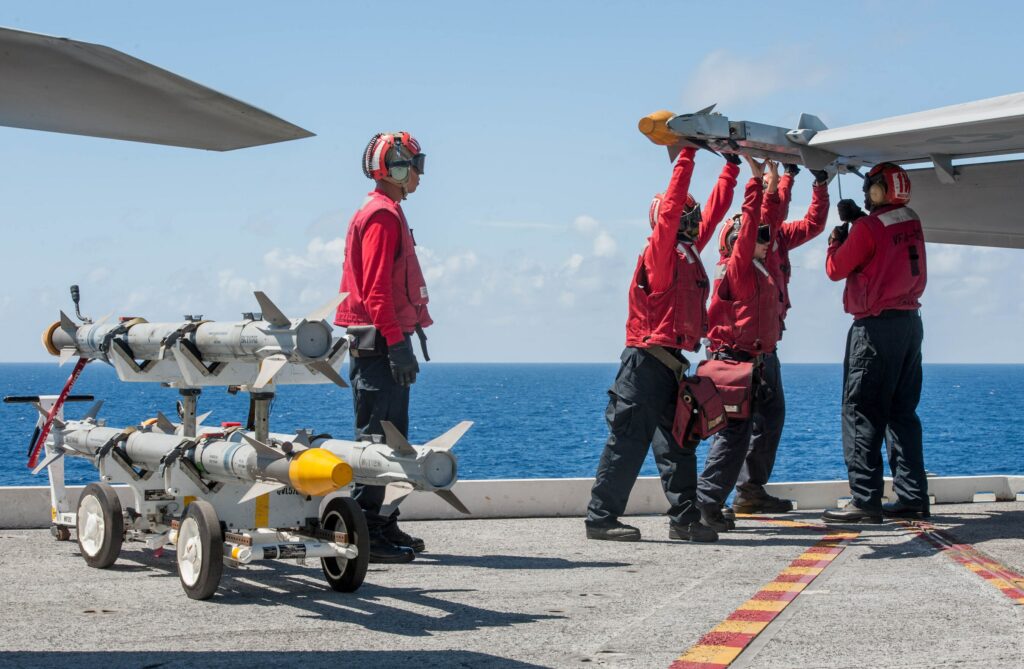
Sailors remove an AIM-9X® SIDEWINDER® air-to-air missile from an F/A-18F Super Hornet on the flight deck of the of the U.S. Navy’s only forward-deployed aircraft carrier, USS Ronald Reagan (CVN 76). (Photo: U.S. Navy)

Release from Raytheon Missile and Defense

***** 

June 19, 2023 

TUCSON, Ariz., June 19, 2023 /PRNewswire/ — RTX (NYSE: RTX) was awarded a $264 million modification to a production Lot 23 contract originally awarded in December 2022. Under the modification, Raytheon, an RTX business, will produce and deliver 571 AIM-9X® SIDEWINDER® missiles and associated parts for the U.S. Navy, U.S. Air Force, and foreign military sales customers. 

“AIM-9X is the world’s most advanced, combat-proven infrared missile, providing advanced capabilities to the U.S. and our international allies,” said Kim Ernzen, president of Naval Power at Raytheon. “The weapon’s versatility and inherent growth potential makes it a triple-threat missile offering an unmatched level of lethality and survivability to counter threats.” 

Included in the modification, Raytheon will also provide captive air training systems, containers, spare assets, and related kits and support equipment. The majority of work will be performed within the continental U.S. and is expected to be completed in August 2026. 

The AIM-9X SIDEWINDER missile is a triple-threat missile that can be used for air-to-air engagements, surface-attack, and surface-launch missions without modifications. A U.S. Navy-led joint program with the U.S. Air Force, the AIM-9X SIDEWINDER also has 31 Foreign Military Sales partners. The advanced infrared-tracking, short-range missile is combat proven in several theaters around the world. 


General Dynamics Electric Boat Christens Submarine Iowa (SSN 797) 

Release from General Dynamics Electric Boat 

****** 

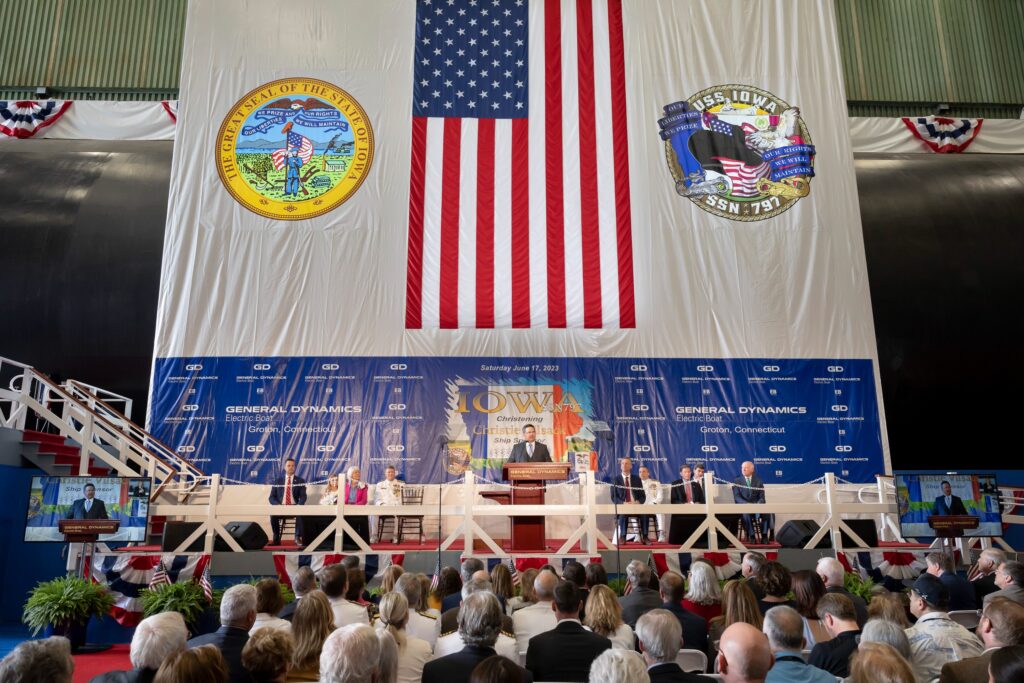
GROTON, Conn. (June 17, 2023) – General Dynamics Electric Boat christened the Virginia-class submarine Iowa (SSN 797) today at its shipyard in Groton, Conn. Electric Boat is a business unit of General Dynamics (NYSE: GD). 

“I am proud of Electric Boat’s shipbuilders, and thank them for the skills, capabilities and commitment they bring to their work every day, resulting in this magnificent ship,” said Kevin Graney, president of General Dynamics Electric Boat. “Along with their dedication and hard work, Electric Boat’s shipbuilders have a long history of innovation. We invest in cutting-edge tools and technology to deliver advanced capabilities in acoustic superiority, enhanced stealth, innovative weapons and new missions. We are committed to helping the U.S. Navy outpace our adversaries and ensure our nation’s continued dominance in the undersea domain.”  

Christie Vilsack, an Iowa educator and advisor with a 50-year career in education and public service, serves as the ship’s sponsor.  

“In the name of the United States, I christen thee Iowa. May God Bless her and all who sail in her,” she declared before breaking a bottle of sparkling wine from Iowa on the ship’s hull to commemorate the christening.  

The christening took place in the shipyard’s Virginia-class assembly building in front of an audience of more than 3,000 people, including Electric Boat shipbuilders, members of the ship’s crew, U.S. Navy personnel and government officials. The event was viewed live at numerous watch parties across the state of Iowa. 

The keynote address was delivered by Under Secretary of the Navy Eric Raven. 

“The Iowa will join the fleet at a critical time when our nation will need the most capable, most ready, most agile, and most lethal undersea fighting force to strengthen our nation’s ability to keep the peace, or restore it, through decisive action,” he told the crowd. “Iowa will add next-generation capabilities to our Joint Force. She will also be one of the first specifically designed and built to accommodate female and male service members, a commitment to supporting a culture of inclusion.” 

Iowa is the 24th submarine in the Virginia class, designed for the full range of 21st-century mission requirements, including anti-submarine and surface ship warfare and special operations support.  

Electric Boat and its partner Newport News Shipbuilding share constriction of the Virginia class in a teaming agreement. Iowa is the 12th submarine in the class to be delivered by Electric Boat. 

The submarine will be the fourth U.S. Navy warship to carry the name Iowa and succeeds the battleship USS Iowa (BB 61). Commissioned in 1943, the ship transported President Franklin Delano Roosevelt to numerous international conferences before transferring to the Pacific Theatre to support the island-hopping campaigns and the Japanese Surrender at Tokyo Bay. The ship is now a museum vessel at the Port of Los Angeles.   

A video of the ceremony along with more information on the Iowa is available at ebchristenings.com. 

General Dynamics Electric Boat designs, builds, repairs and modernizes nuclear submarines for the U.S. Navy. Headquartered in Groton, Connecticut, the company employs more than 20,500 people. More information about General Dynamics Electric Boat is available at www.gdeb.com


U.S. Coast Guard Cutter Alert returns home after 61-day counternarcotics patrol in Eastern Pacific

Release from U.S. Coast Guard Pacific Area 

*****

June 16, 2023 

U.S. Coast Guard Cutter Alert returns home after 61-day counternarcotics patrol in Eastern Pacific 

ASTORIA, Ore. – The U.S. Coast Guard Cutter Alert (WMEC 630) and crew returned to homeport Friday, after a 61-day counternarcotics patrol in the Eastern Pacific. 

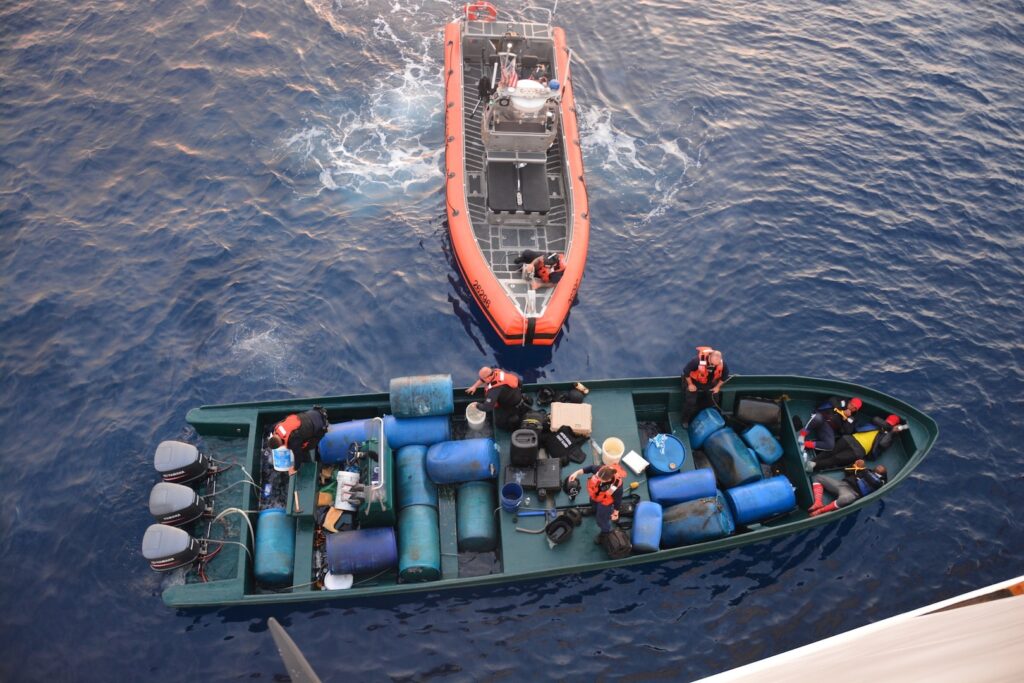
On May 26, a U.S. Customs and Border Protection Marine Patrol Aircraft crew notified the Alert crew of a suspected “go-fast” vessel. The Alert crew launched the deployed Helicopter Interdiction Tactical Squadron MH-65 Dolphin helicopter and aircrew along with the cutter’s small boat and law enforcement boarding team. 

The Alert’s law enforcement boarding team interdicted the suspected go-fast vessel and suspected drug smugglers, discovering more than 2,600 kilograms of cocaine with an approximate value of $75 million. 

“I couldn’t be prouder of the Alert’s crew. They fought through significant adversity to complete an outstanding patrol, one that each crewmember can look back at and know that we fully embodied our motto, “Semper Paratus,” said Cmdr. Matthew Kolodica. “As I look back over my years in command, this tour was both challenging and very rewarding, I will miss the Alert and crew as I transfer to the Coast Guard Academy. That said, I know with the arrival of Cmdr. Lee Crusius this summer that the cutter and crew will be in good hands well into the future.” 

Kolodica will depart the Alert and be the director of Professional Maritime Studies at the Coast Guard Academy in New London, Connecticut. 

The fight against drug cartels in the Eastern Pacific Ocean requires unity of effort in all phases from detection, monitoring and interdictions, to criminal prosecutions by international partners and U.S. Attorneys in districts across the nation. The law enforcement phase of counter-smuggling operations in the Eastern Pacific Ocean is conducted under the authority of the 11th Coast Guard District, headquartered in Alameda, Calif. The interdictions, including the actual boardings, are led and conducted by members of the U.S. Coast Guard. 

The Alert, commissioned in 1969, is a 210-foot Reliance-class medium endurance cutter stationed on the West Coast, and performs a variety of missions to protect Americans and American interests in the Northern and Eastern Pacific Ocean. 


NSWC Panama City engineers help Republic of Korea develop air-cushion vehicle

Release from Naval Sea Systems Command 

***** 

June 16, 2023 

NSWC Panama City engineers help Republic of Korea develop air-cushion vehicle 

By Naval Surface Warfare Center Panama City Division Public Affairs 

Naval Surface Warfare Center Panama City Division (NSWC PCD) is helping cement relationships with U.S. allies in the Indo-Pacific region via Foreign Military Sales (FMS) Programs that also help our own Navy innovate. 

NSWC PD Expeditionary Systems Division, FMS, Air Cushion Vehicles Program is supporting the Republic of Korea (ROK) Navy as they develop an Air Cushion Vehicle (ACV). The ROK “Landing Ship Fast II (LSF-II),” shares size and design features of the U.S. Navy’s Landing Craft Air Cushion (LCAC). 

The LSF-II is a 90-metric ton hovercraft with a top speed of 40 knots. LSF-II crafts 633 and 634 will join two earlier LSFs already in service with the ROK Navy. As first-in-class for the LSF-II, crafts 633 and 634 serve as prototypes of the redesigned LSF concept; a total fleet of 18 LSF-IIs is planned. 

NSWC PCD personnel helped modify the Navy’s LCAC Command, Control, Communication, Computers, and Navigation (C4N) System for use on ROK’s domestically produced LSF-II. 

ROK’s Defense Acquisition Program Administration (DAPA) first requested modified Navy C4N systems for LSF-II craft 633 and 634, funded under FMS case KS-P-GRL, from the NAVSEA International Fleet Support Program Office in 2018. Due to similarities between the ROK Navy LSF-II and the U.S. Navy LCAC, the modified C4N system was feasible from a technical perspective. In April 2019, the NSWC PCD team used the mature baseline of the USN’s LCAC C4N system to begin redesigning a C4N system for the LSF-II craft. 

For the ROK variant, the NSWC PCD C4N system team remapped the communication links between the craft’s subsystems and the C4N system, and then modified all of the software to accept and process the inputs. The team also developed LSF-II- specific craft drawings. Even with an established Navy baseline, this extensive work required the USN and ROK teams work together to find and track all the changes needed to make the C4N system fit and operate within the LSF-II. 

Initial component deliveries started in early 2021, while Hanjin Shipbuilding and Construction (HJSC) was still constructing the craft at Yeongdo Shipyard in Busan, ROK. The Panama City C4N system team has provided onsite subject matter expertise to support HJSC with installation, software integration, and startup of the C4N systems since April 2022. The first two C4N systems were completed and delivered in mid-2022. 

Korea’s Hanjin Shipyard successfully initiated the main engines and inflated the bags within the skirting system on LSF-II Craft 633 for the first time December 9, 2022. This significant milestone demonstrated a core C4N capability for controlling the engine functions used to get up “on-cushion,” providing lift and propulsion for the craft. Panama City personnel Bill Chong and Randy Martin were there. 

“One of the more challenging parts of starting this project was more about terminology association. For instance, the USN views the Control, Alarm, and Monitoring System (CAMS) as a subset of the C4N system,” said Martin, NSWC PCD team electrical engineer. “ROK Navy’s CAMS terminology encompassed all of the USN C4N system, in addition to all electrical components inside the command module. It took some time before we saw eye-to-eye in terms of what we were providing to ROK Navy.” 

FMS Program Manager Robert Woodall, also from NSWC PCD, credited one engineer’s Korean language skills with helping overcome potential obstacles. 

“Some of the biggest barriers were language, cultural, and time differences that made communication with the Koreans difficult for reviewing and updating the C4N design package,” said Woodall. “For most of the modification program, we were doing this on a bi-weekly basis. Fortunately, we have an excellent electronics engineer, Chae “Bill” Chong, on the team who also happens to be fluent in Korean.” 

Chong played a vital role as the USN team’s main interpreter – an experience that also taught him about Korean business culture. 

“Working with the Koreans to provide C4N capabilities for their ACV [LSF-II] has been very rewarding and exciting. One of the most striking differences in working with them is the level of respect displayed by Koreans,” said Chong. “They always bowed and shook our hands – using both hands – as they greeted us. They always did their best to show their appreciation and gratitude working with U.S. Navy. Looking at the LSF-II Craft 633 going through a sea trial at Chinhae, Republic of Korea, I saw how far the project has come along with the many challenges we all had to overcome due to the COVID-19 pandemic. I’m so proud to be representing U.S. Navy support in this FMS effort and to be a part of this amazing NSWC PCD team.” 

With the continued success of the C4N system development, the U.S. / ROK partnership has grown into an expanded FMS purchase agreement for four additional systems; another 12 systems may be added in a follow-on FMS procurement. This long-term working partnership with the ROK team to mature the LSF-II’s C4N system, and the follow-on logistics support needed for continued upgrades, will strengthen collaboration for decades. 

Developing the C4N system for the ROK customer also benefits the USN LCAC program, by addressing hardware obsolescence issues that have been on the horizon for Navy logistics. 

“Obsolescence is a continuous problem we have to deal with,” said USN C4N Technical Area Expert Bill Buffkin. “With the C4N baseline we are using, we had already resolved some of those issues that would have impacted the Koreans, and since then, we have come up with other solutions that will benefit the U.S. Navy. It is much more efficient to have one team keeping up with this technology for both parties.” 

David Mercer, C4N software engineer, explained that this development has enabled exploration of new design alternatives for features and improvements to Navy hovercraft. 

“Working on the Korean system has given us an opportunity to perform improvements to our software implementation and processes,” said Mercer. “We are working with continuously evolving software and cybersecurity requirements, which are present for the Korean system as well, and by working on the Korean applications it has become a multiplier that benefits both Korea and the USN to keep to the forefront for both for performance and maintainability.” 

NSWC PCD will provide in-country technical support for integration and grooming of the C4N systems while the ROK shipyard completes construction and conducts sea trials for LSF-II 633 and 634 throughout Fiscal Year 2023. 


Coast Guard offloads more than $186 million in illegal narcotics

Release from U.S. Coast Guard 7th District 

***** 

June 17, 2023 

Coast Guard offloads more than $186 million in illegal narcotics 

Coast Guard Seventh District 

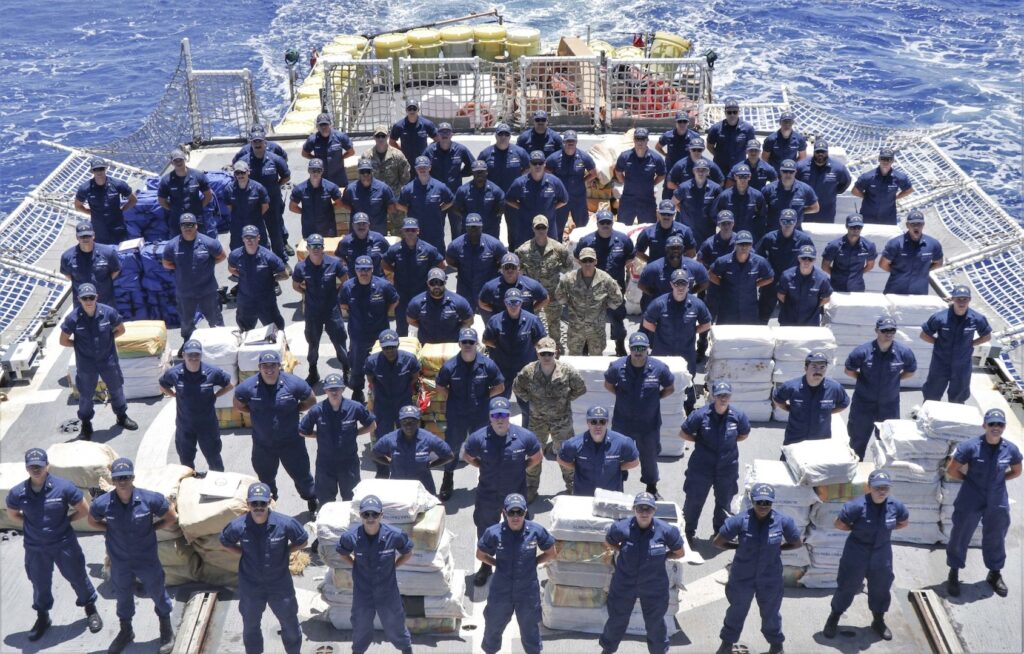
Miami— The crew of Coast Guard Cutter Bear (WMEC 901) offloaded more than 14,153 pounds of cocaine worth more than $186 million in Miami, Friday. 

The offloaded drugs were interdicted during nine separate cases in the international waters of the Caribbean Sea and the Atlantic Ocean as a result of efforts by crews from: 

  • USCG Bear (WMEC 901) 
  • USCG Helicopter Interdiction Tactical Squadron (HITRON) 

  • USS Little Rock (LCS-9) 
  • USCG Tactical Law Enforcement Team-Pacific 
  • USCG Tactical Law Enforcement Team-South 
  • USCG Donald Horsley (WPC-1117) 
  • USCG Air Station Borinquen HC-144 aircrew 

  • A U.S. Customs and Border Protection, Air and Marine Operations (AMO) aircrew  

“The contraband offloaded today represents the professional expertise and dedication of U.S. defense and law enforcement agencies working together to combat the flow of illicit drugs through the Caribbean Region into the United States,” said Lt. Peter Hutchison, duty enforcement officer at Coast Guard District Seven. ”This teamwork is imperative to the identification, interception, and seizure of vessels engaged in illicit trafficking and a testament to the hard work of these crews.” 

Along with the illicit narcotics, 12 suspected smugglers were apprehended and face prosecution in federal courts by the Department of Justice. 

Detecting and interdicting illegal drug traffickers on the high seas involves significant interagency and international coordination. The Joint Interagency Task Force South in Key West, Florida conducts detection and monitoring of aerial and maritime transit of illegal drugs. Once interdiction becomes imminent, the law enforcement phase of the operation begins, and control of the operation shifts to the U.S. Coast Guard throughout the interdiction and apprehension. Interdictions in the Caribbean Sea are performed by members of the U.S. Coast Guard under the authority and control of the Coast Guard’s Seventh District, headquartered in Miami. 

For breaking news, follow us on Twitter. For additional information, find us on Facebook and Instagram