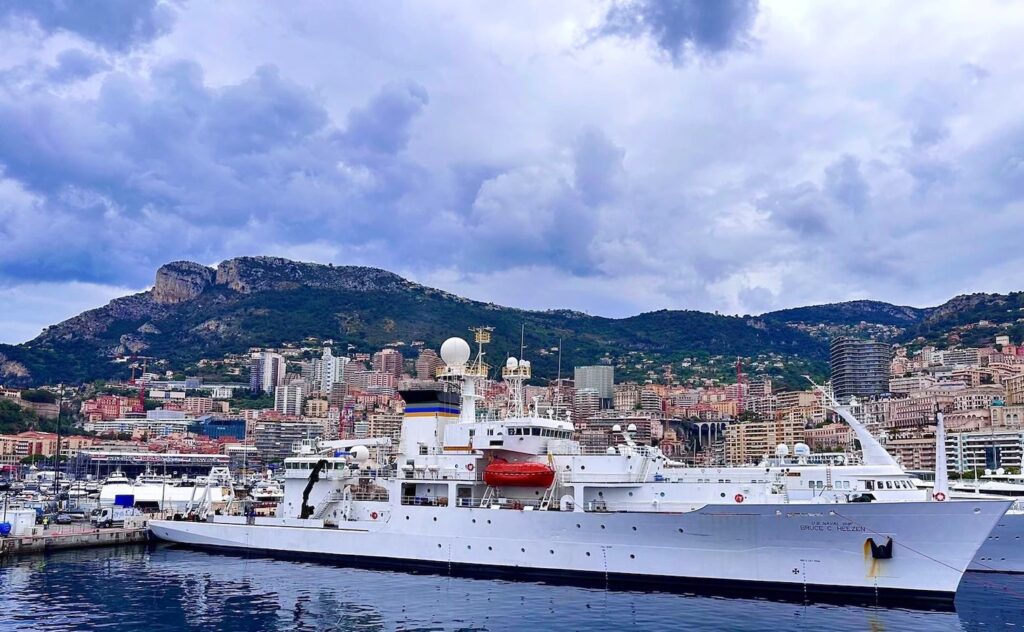
USNS Bruce C. Heezen (T-AGS 64) arrives in Monaco for IHO Assembly 2023 
Release from Naval Oceanography Public Affairs Office 

***** 

By Naval Oceanography Public Affairs Office 

MONACO CITY, Monaco  – The Pathfinder-class oceanographic survey ship USNS Bruce C. Heezen (T-AGS 64) arrived in Monaco City, Monaco, May 1, 2023, for a scheduled port visit to participate in the International Hydrographic Organization (IHO) Assembly 2023. 

The Assembly is formed by the representatives of 98 Member States. It meets every three years to provide general guidance on the functioning and work of the Organization, as well as taking decisions of technical and administrative nature. 

The ship’s presence in Monaco is a demonstration of the U.S. Navy’s continued commitment and support to the European region and reinforces the strong bond between the United States and Europe. 

Naval Oceanography operates the T-AGS class of ships, owned and operated by Military Sealift Command, to conduct scientific work such as oceanography, hydrography, and many other scientific fields from the ocean floor to the stars. 

The U.S. and Monaco, along with the IHO, are committed to working together and improving collaboration on the collection of scientific data to help create a safer ocean for all. 

Bruce C. Heezen will host a reception later this week to support the US delegation in hosting representatives from many of the countries participating. 

The International Hydrographic Organization works to ensure that all the world’s seas, oceans, and navigable waters are surveyed and charted, thereby supporting the safety of navigation and the protection of the marine environment. It coordinates the activities of national hydrographic offices and sets standards in order to promote uniformity in nautical charts and documents. It issues survey best practices and provides guidelines to maximize the use of hydrographic information. 

Naval Oceanography has approximately 2,500 globally distributed military and civilian personnel, who collect, process, and exploit environmental information to assist Fleet and Joint Commanders in all warfare areas to guarantee the U.S. Navy’s freedom of action in the physical battlespace from the depths of the ocean to the stars. 


Bollinger Shipyards to Refit NOAA Ship Ronald H. Brown 

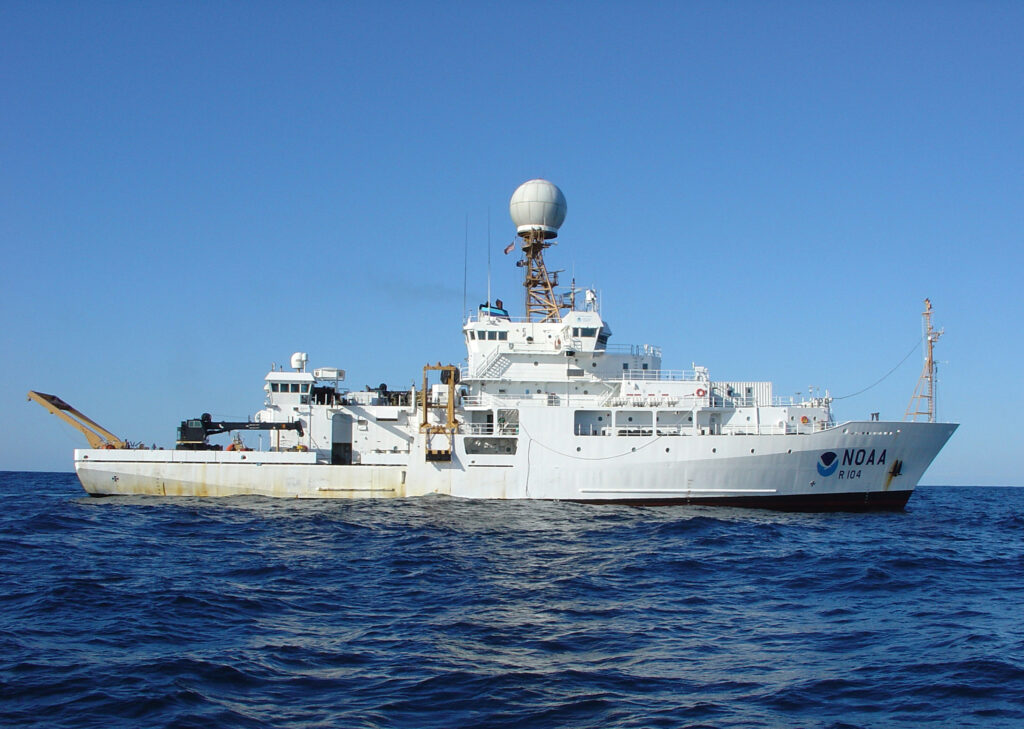
Side view of NOAA Ship Ronald H. Brown underway. Image courtesy of Wade Blake/NOAA.

Release from Bollinger Shipyards 

***** 

At 274 feet, the Ronald H. Brown is the largest ship in the NOAA fleet 

Refit will create 100 jobs at Bollinger Mississippi Repair 

Work is scheduled to be completed by summer 2024 

PASCAGOULA, Ms., — (May 2, 2023) – Bollinger Shipyards has begun fabrication at its newly acquired Mississippi repair facility, Bollinger Mississippi Repair, in preparation to refit the National Oceanic and Atmospheric Administration (“NOAA”) Ship Ronald H. Brown, the largest ship in NOAA’s fleet. The overhaul is expected to extend the life of the vessel, first launched in 1996, by an additional 15 years. Work is scheduled to be complete by summer 2024.  


“Here on the Gulf Coast, we’re intimately familiar with the breadth and importance of NOAA’s mission, so we’re proud to be entrusted to extend the service life of the Ronald H. Brown,” said Ben Bordelon, President and CEO of Bollinger Shipyards. “The refit will be performed by our team at our newly acquired Bollinger Mississippi Repair facility, which is capable of executing projects from simple to the most complex, and doing so with the highest levels of quality, support and service in our industry. We look forward to supporting the NOAA mission with a vessel that will continue to serve as a platform for cutting-edge research and exploration for many years to come.” 


“NOAA Ship Ronald H. Brown is a global class vessel supporting scientific research to increase our understanding of climate and the ocean,” said NOAA Commissioned Corps Capt. Amanda Goeller, Commanding Officer of NOAA Marine Operations Center – Atlantic. “These repairs, system overhauls and modernization will allow the ship to continue operating for many years to come.”  


The refit of the 27-year-old ship will be performed at Bollinger Mississippi Repair in Pascagoula, Mississippi, adding an additional 15 years to the original 30 year expectant service life of the vessel. During the refit modification, the propulsion system will largely be replaced with new more environmentally friendly diesel generators, renewal of the bow thruster and propulsion motors, new switchboards, control systems, and alarms. Additional ship systems that are scheduled to be upgraded include the potable water plants, sewage plant, uncontaminated seawater sampling system, HVAC systems, tank level indicators, navigational components, radar renewals, overhead lighting, and ballast and exterior fuel tank vent renewals. Bollinger will replace much of the ship’s piping, along with steel as identified by the American Bureau of Shipping (ABS). 


The vessel refit is scheduled to be completed and redelivered to NOAA in August 2024. 


To perform the work, over 100 jobs will be created at Bollinger Mississippi Repair, where the company will be looking to hire Pipefitters, Pipe Welders, Shipfitters, Ship Welders, Riggers, Scaffold Builders, and other production support positions. Additional positions need to be filled to continue repair work on semi-submersible rigs and marine vessels on drydock and at the wet dock.  


The ship is named to honor the late Ronald H. Brown, the first African American to serve as Secretary of Commerce. Brown made it his mission to generate jobs and provide opportunities for ordinary Americans, and he was an ardent supporter of the NOAA fleet. He was killed in a plane crash on April 3, 1996, while on a trade mission to Bosnia. 


100+ RI Students Connect with Industry, Explore Careers in Defense

Release from SENEDIA 

***** 

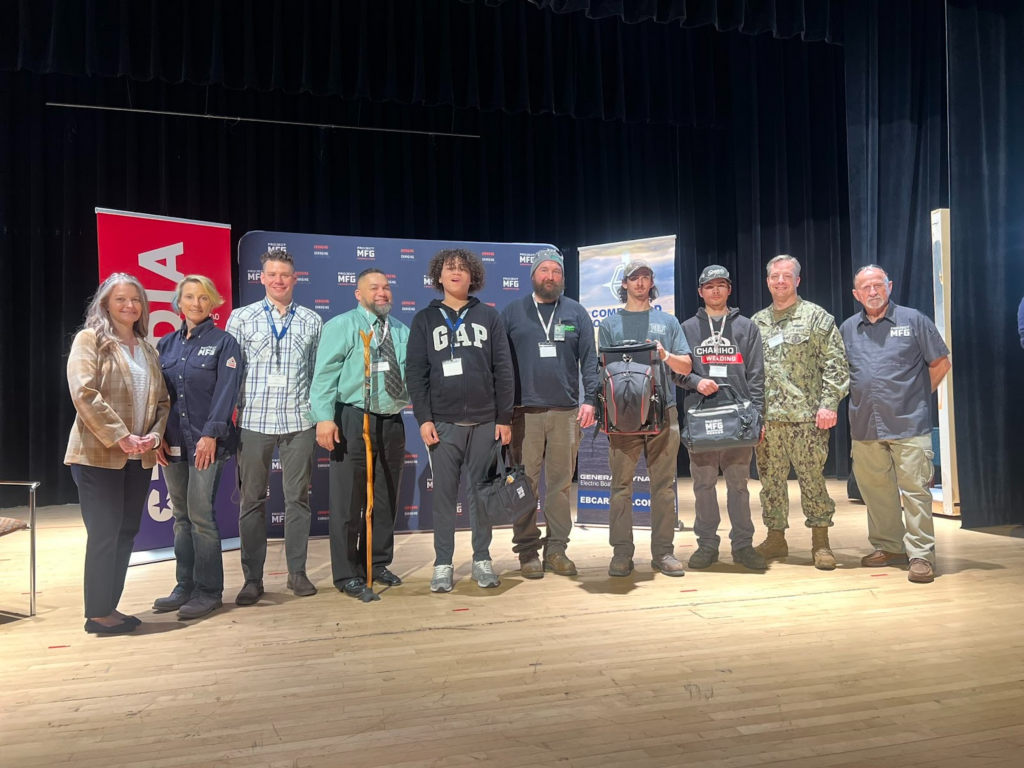
Providence, RI – Project MFG, SENEDIA, the alliance for defense tech, talent, and innovation, and General Dynamics Electric Boat hosted the inaugural Project MFG Rhode Island Maritime Welding Competition yesterday at the Providence Career & Technical Academy. At the event, Trey Lazauskas from CHARIHOtech was awarded first prize for successfully welding a model submarine. 
 
This collaborative effort, which drew more than 100 students from the region, was organized to raise awareness about high-skill, high-tech, high-wage careers in submarine shipbuilding and maritime manufacturing, including welding, machining, and logistics. In addition to a career expo where students could learn more about opportunities in the industry, more than a dozen employers were on site to engage with and begin recruiting students.  
 
“The workers we will need in the future to build the submarines we are contracting for today are only in elementary school. That’s how significant and sustained the demand is for fostering the pipeline for next-generation talent,” said Shawn Coyne, vice president of Human Resources at General Dynamics Electric Boat. “We have to engage young people early and often, showcasing the benefits and sense of purpose behind careers in defense, and offer them hands-on learning opportunities like Project MFG.” 
 
The full day event featured elected leaders and dignitaries—including Senate Armed Services Committee Chairman Senator Jack Reed, who got an up-close look at the “welding wars.” Reed was also joined by Senator Sheldon Whitehouse and Congressman Seth Magaziner, who underscored the importance of the defense economy to Rhode Island. 
 
The event allowed students from high school CTE programs to gain real-world experience and exposure to leaders and employers in the defense manufacturing space. As part of Project MFG Connect, a career exploration event, representatives from local career and technical education programs, industry experts, and employers came together to showcase the careers available in the industry. The next-generation workforce in turn had the opportunity to network with and hear from government officials, defense business leaders, industry partners, and members of the armed forces who discussed the critical trade skills needed for defense manufacturing.  
 
“Including events like Project MFG Connect is imperative for the future. We want to show potential students how challenging and rewarding manufacturing jobs are,” said Ray Dick, Project MFG founder. “Connecting young students from the local community and showcasing the exciting opportunities available right at home is an important part of our mission and one of the ways we promote the prestige of manufacturing.” 
 
Project MFG’s Maritime Welding Competition featured four technical training programs with 16 local competitors. Competitors were tested on skills required for shipbuilding while completing a challenging air pressure vessel project. 
 
“I want to congratulate all of the students and schools that participated and took this opportunity to explore the important careers related to submarine shipbuilding,” said Molly Donohue Magee, executive director of SENEDIA. “These students are our future manufacturing workforce, filling the needed high-tech, high-demand, high-wage jobs to help ensure our national security.” 
 
Competitors raced against a two-hour clock to finish a challenge that tested skills required for shipbuilding. They were cheered on by the U.S. Navy Department of Defense, and industry partners, leaders, and government officials. After showcasing their skills, the top three welders were announced: Trey Lazauskas of CHARIHOtech in first place; Asa Hoxie, also of Chariho High School, in second place; and Giovanni Lacap of PCTA in third place. 
 
In addition to the competitors, program participants included PCTA students from the welding program and several other CTE programs in the Construction, Engineering, Computer Science and Transportation industry clusters, along with 60 students representing Mount Pleasant, Hope, Central, Juanita Sanchez, and 360 High Schools and the Newcomers’ Academy. Many of the student attendees have already secured full-time job offers at Electric Boat. 
 
“The Office and Career and Technical Education at PPSD is thrilled to partner with SENEDIA, Electric Boat and General Dynamics to create high wage/high growth opportunities for our graduates,” said Brett Dickens, CTE director of the Providence Public Schools. 

SENEDIA, the alliance for Defense tech, talent, and innovation, is a catalyst for thought leadership, technical innovation, and workforce development. SENEDIA connects, convenes, and partners to support talent, innovation, and growth. For more information on SENEDIA, please visit www.senedia.org.


Navalist: Investment in Carrier Air Wings Needed to Keep Carriers Relevant

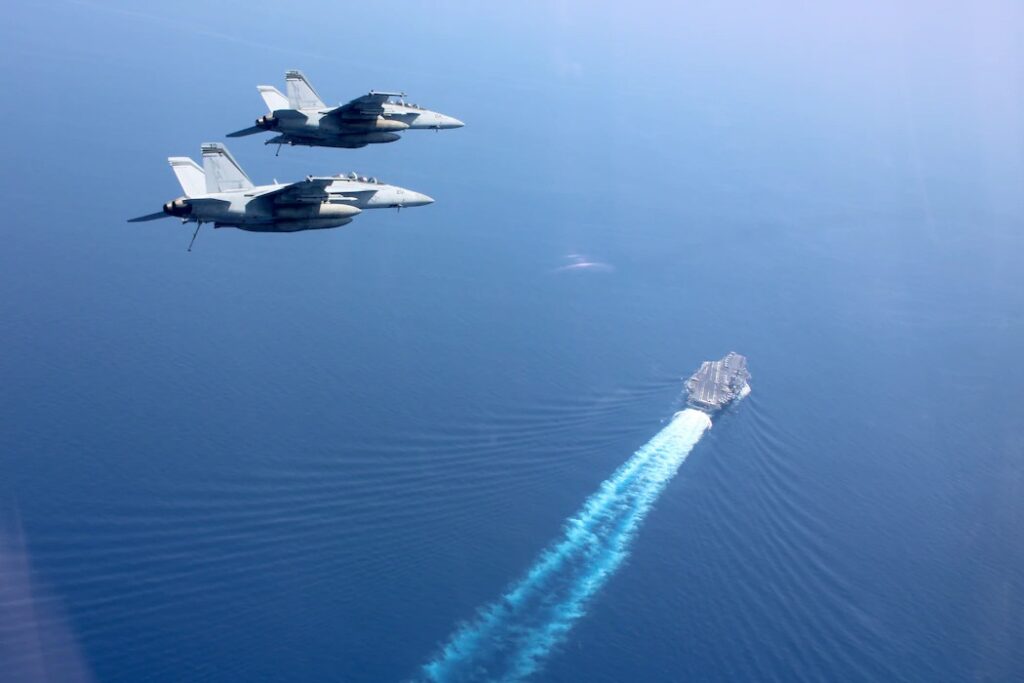
SOUTH CHINA SEA (April 22, 2023) F/A-18F Super Hornets from the “Mighty Shrikes” of Strike Fighter Squadron (VFA) 94 fly in formation above the aircraft carrier USS Nimitz (CVN 68) during an all-domain joint exercise, demonstrating unique theater-wide multi-discipline high-end warfighting capability, maritime superiority, power projection, speed of maneuver and readiness. VFA-94 is attached to the Nimitz Carrier Strike Group, currently underway in U.S. 7th Fleet area of operations conducting routine operations. 7th Fleet is the U.S. Navy’s largest forward-deployed numbered fleet, and routinely interacts and operates with allies and partners in preserving a free and open Indo-Pacific region. (U.S. Navy photo)

***** 

ARLINGTON, Va. — The U.S. Navy’s aircraft carrier force is losing relevance because of a lack of investment in the aircraft that it carries, a naval analyst said. 

“We are a carrier-based force, so we have the 11 aircraft carriers mandated by law,” said Dr. Jerry Hendrix, senior fellow of the Sagamore Institute, a retired Navy captain, and former director of the Navy History and Heritage Command, speaking May 1 at an event at the Hudson Institute, a Washington think tank. “We built our navy around the aircraft carrier ever since the Battle of Midway. It is the preeminent platform in our navy. And yet, because of the lack of investment in the carrier air wing itself, the carriers themselves are losing their relevance.” 

“We’re actually seeing this in wargame activities, whether it’s wargames in the commercial or civilian sector or academic sector or whether the things we’re hearing out of the Pentagon, where the carriers are having lesser and lesser roles to play in some of these wargames,” Hendrix said. “So, if you want the carrier to remain relevant as a centerpiece, you have to make significant investments in that carrier air wing to get to a long-range, penetrating strike capacity back that will allow those carriers to operate in anti-access/area-denial environments.” 

Hendrix also said the Navy needs to look hard at the force mix between the Atlantic and Pacific regions. He said he believes a greater submarine capacity is needed in the Pacific region than necessarily in the Atlantic, despite the fact that the primary Russian naval threat is its attack submarine force. 

He noted the Navy’s return to building frigates, with the Constellation-class guided-missile frigate now under construction.  

“We need to have the frigate be a frigate, providing presence, convoy escort,” he said. “Don’t ask every frigate to be a destroyer and don’t ask every destroyer to be a cruiser and a battleship — it’s what we’ve done in recent years. We need to look at that small-end, small-capacity, small surface combatants and drive more investment into whether it’s manned or unmanned, getting back out there to be able to operate in small, confined spaces but also build more platforms at a cheaper price.” 

Hendrix indicated that he sees the traditional carrier strike group as needing to be re-thought. 

“I would see us really departing from the tried and the true, the standard method of one carrier, two cruisers, four destroyers, and two attack submarines,” he said. “I want to see the fleet of the future look significantly different than the fleet of today. In fact, if it doesn’t, we’ve made a strategic mistake at that point.” 


George Washington to replace Ronald Reagan as the forward-deployed carrier in Japan in 2024 

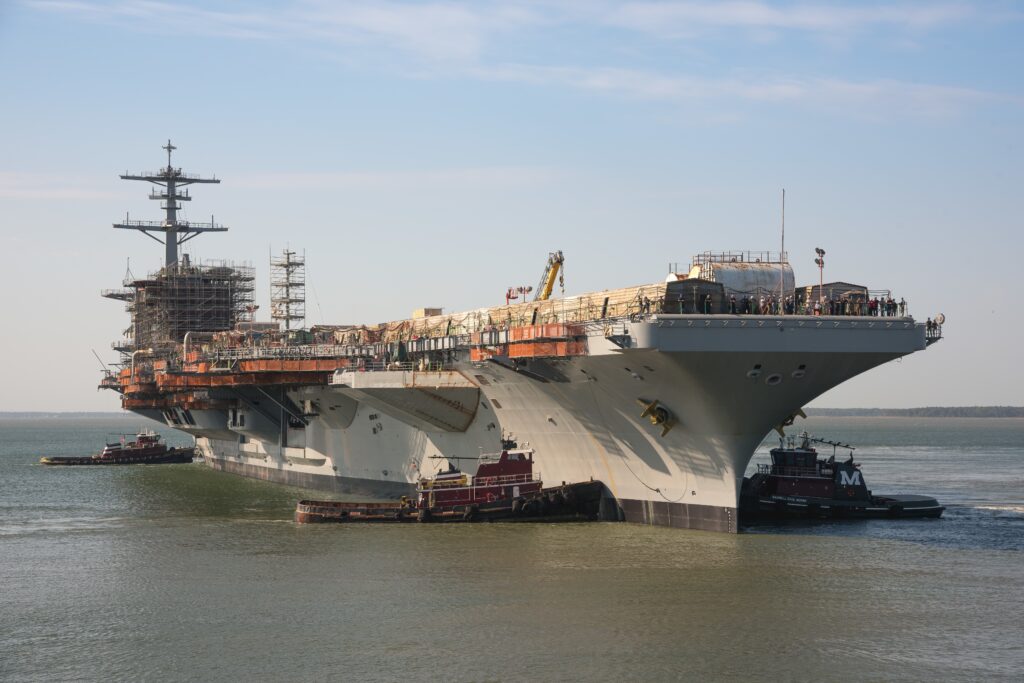
190930-N-N0101-122 NEWPORT NEWS, Va. (Sept. 30, 2019) The aircraft carrier USS George Washington (CVN 73) is helped out of a drydock at Newport News Shipbuilding after completing a refueling and complex overhaul (RCOH). In addition to defueling and refueling its power plant, George Washington completed major structural updates to the island, mast and antenna tower; all aircraft launch and recovery equipment has been upgraded; the ship’s hull has been repainted, including sea chests and freeboard; the propeller shafts have been updated and refurbished propellers installed. (U.S. Navy photo courtesy of Huntington Ingalls Industries by Ashley Cowan/Released)

Release from Commander, Naval Air Forces 

***** 

28 April 2023 

In coordination with the government of Japan, Nimitz-class aircraft carrier USS George Washington (CVN 73) will return to U.S. 7th Fleet, replacing USS Ronald Reagan (CVN 76) as the forward-deployed Naval Forces-Japan (FDNF-J) aircraft carrier, forward-deployed to Fleet Activities Yokosuka, Japan in 2024.  
 
This marks the second time George Washington has served as the FDNF-J aircraft carrier, arriving in Japan in 2008 as the first nuclear-powered aircraft carrier to be forward-deployed to Japan before being relieved by Ronald Reagan in 2015. 
 
Prior to George Washington’s return to Japan in 2024, Ronald Reagan will depart Yokosuka and relocate to Bremerton, Washington, to conduct a scheduled docking planned incremental availability period at Puget Sound Naval Shipyard & Intermediate Maintenance Facility after completing nearly a decade of service in the Western Pacific. 
 
More details will be announced closer to the actual movement of the carriers. 
 
The United States values Japan’s contributions to the peace, security and stability of the Indo-Asia-Pacific and its long-term commitment and hospitality in hosting forward-deployed U.S. forces. These forces, along with their counterparts in the Japan Self-Defense Forces, make up the core capabilities needed by the alliance to meet our common strategic objectives. 
 
George Washington is currently undergoing refueling and complex overhaul (RCOH) at Newport News Shipbuilding-Huntington Ingalls Industries. RCOH is a multi-year project performed only once during a carrier’s 50-year service life that includes refueling the ship’s two nuclear reactors, as well as significant repairs, upgrades, and modernization. Ronald Reagan, the flagship of Carrier Strike Group 5, is currently forward deployed to the U.S. Navy’s 7th Fleet area of operations. 


NPS, Stanford Doerr School of Sustainability Team Up for Department of the Navy’s Latest Climate Tabletop Exercise

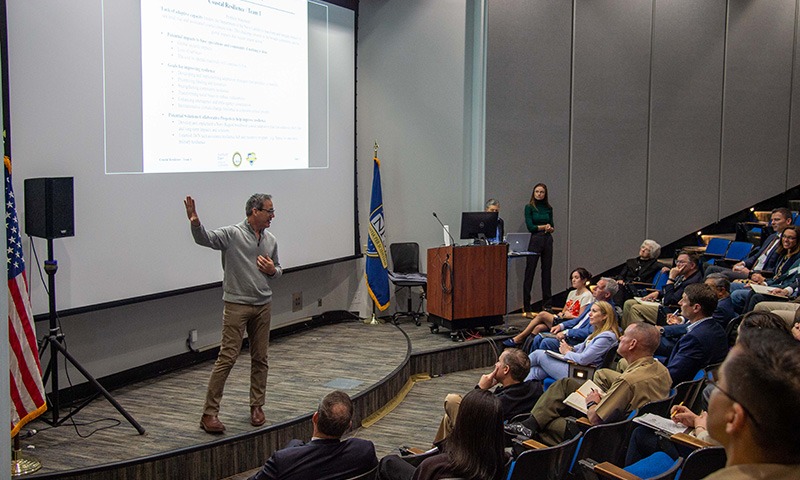
Kevin Mulligan of Google Public Sector briefs the findings from one of the teams participating in the Department of the Navy Climate Tabletop Exercise II at the Naval Postgraduate School (NPS). The exercise, held in partnership with the Stanford Doerr School of Sustainability, brought together Mulligan and other participants from the Department of Defense, federal agencies, non-governmental organizations, and the private sector to identify problems and potential solutions in support of the Navy’s climate strategy.

Release from Naval Postgraduate School 

***** 

MONTEREY, Calif. – The Naval Postgraduate School (NPS) hosted the second Department of the Navy (DON) Climate Tabletop Exercise (DON Climate Action II) in partnership with the Stanford Doerr School of Sustainability, April 27-28.   

The tabletop exercise convened participants from the Department of Defense, federal agencies, Congress, think tanks, non-governmental organizations, and the private sector to generate solutions in support of DON’s comprehensive climate strategy, “Climate Action 2030,” and broader sustainability goals. Under a recently realized academic partnership, NPS and the Doerr School will pursue identified solution sets in order to provide concrete actions and outcomes to advance the DON’s climate priorities and sustainability initiatives.   

“For the Department of the Navy, climate readiness is mission readiness: it makes us better warfighters,” said Meredith Berger, Assistant Secretary of the Navy for Energy, Installations and Environment (EI&E) and the Navy’s Chief Sustainment Officer. “Our installations – whether at home or abroad – are where warfighting begins, our power projection platforms. We exercised elements and generated actions that ensure that these platforms are survivable and that the coastal communities that we call home are just as resilient.”  

During the two-day event, participants concentrated on three focus areas – water security, energy security, and coastal resilience – and briefed their results to a group of senior leaders including Berger, NPS President retired Vice Adm. Ann Rondeau, and Dr. Arun Majumdar, dean of the Doerr School of Sustainability.  

The six exercise teams – two for each focus area – worked to identify problem statements, challenges, and specific solutions. A common outcome among all team members was a deeper resolve, commitment to action and further collaboration.  

Each team also spoke to the need to lowering barriers to establish and strengthen partnerships between DOD, industry, academia and civic leaders to leverage the combined talents and resources towards a shared goal of protecting our communities and people. The senior evaluation group committed to supporting these efforts and the applied research necessary to inform purposeful solution development with new incentives to stimulate investments.  

Additionally, 90 days from the conclusion of the exercise, NPS will coordinate a plan of action and milestones across participant stakeholders on how to accomplish the following solutions identified during the exercise:  

  • Establish a partnership agreement between the Department of the Navy and the Port of San Diego to add the sharing of data and testing to improve climate resilience using the Port’s Blue Economy project.  
  • Ensure installations have personnel identified to develop, manage, and advance their water policies with a focus on looking across the fenceline and viewing water as a shared resource.   
  • Develop a master plan framework that directly connects climate risk with readiness and mission assurance.   

“The direction we have received from the President and our nation’s defense leadership is clear – climate action is a national security imperative,” said Rondeau. “Our future Navy and Marine Corps warfighters must be prepared to address and account for the effects of climate change in their operational planning. Here at NPS, we are proud to work with the Doerr School of Sustainability to address these challenges and seek out climate solutions that will benefit not only the Department of the Navy, but our nation as a whole.”  

The collaborative effort involving DON leadership and two prominent California educational institutions is the latest example of the Navy’s commitment to pursue climate-informed solutions.  

In May 2022, the Navy released “Climate Action 2030,” building on a decades-long foundation of climate action, and setting the DON on a course to meet national and global targets to reduce the threat of climate change. In this strategy, Secretary of the Navy Carlos Del Toro identified climate change as “one of the most destabilizing forces of our time, exacerbating other national security concerns and posing serious readiness challenges.” He charged the DON with building a climate-ready force by increasing climate resilience and reducing the climate threat.  

One month later, the Navy held its first Climate Tabletop Exercise in Washington, D.C., examining the impacts of climate change on Navy and Marine Corps missions, readiness, and warfighting capacity.  

DON Climate Action II not only built upon the outcomes and lessons learned from the inaugural effort, it also capitalized on the Educational Partnership Agreement (EPA) between NPS and the Stanford Doerr School of Sustainability, finalized in December 2022. Faculty from both institutions came together during the exercise to focus on coastal resilience and operational readiness in a world impacted by climate change.  

“Building solutions to the challenges of climate change depends on turning knowledge and innovation into impactful solutions,” said Majumdar. “This tabletop exercise – along with the broader collaboration between Stanford University and the U.S. Navy – allows us to identify the connections and gaps in our knowledge. It then provides a forum for taking this wealth of insights, data, and information and laying the groundwork for solutions that make a difference.”  

Berger is visiting NPS as part of a series of visits across the country from Earth Day to Arbor Day to demonstrate the work of the Department of the Navy and the EI&E portfolio to highlight the importance of Communities, Climate Action, and Critical Infrastructure.  

The Naval Postgraduate School provides defense-focused graduate education, including classified studies and interdisciplinary research, to advance the operational effectiveness, technological leadership and warfighting advantage of the Naval service. For additional information, visit NPS online at https://nps.edu


Berger: Lack of Amphibs Left AFRICOM with No Sea-Based Option for Sudan Evacuation

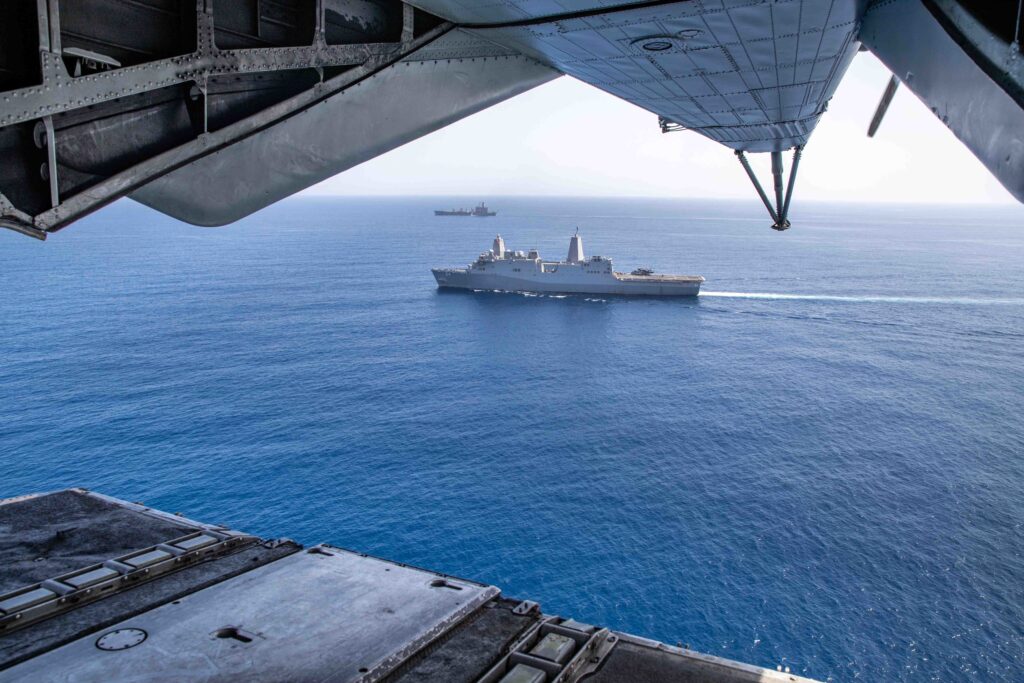
MEDITERRANEAN SEA (April 30, 2022) The San Antonio-class amphibious transport dock ship USS Arlington (LPD 24), center, and the Military Sealift Command Henry J. Kaiser-class fleet replenishment oiler USNS Laramie (T-AO 203), background, sail through the Mediterranean Sea while conducting a replenishment-at-sea, April 30, 2022. Arlington, assigned to the Kearsarge Amphibious Ready Group, is on a scheduled deployment under the command and control of Task Force 61/2 operating in U.S. Sixth Fleet in support of U.S., Allied and partner interests in Europe and Africa. (U.S. Navy photo by Mass Communication Specialist 1st Class John Bellino)

***** 

WASHINGTON — The presence of an amphibious ready group (ARG), with a Marine expeditionary unit (MEU)embarked, gives a regional combatant commander an option to respond to a crisis ashore. When the United States government decided to evacuate its embassy in Sudan on April 23, last week, no ARG-MEU was available in the region. 

Similarly, if the United States government had decided that projecting a force ashore in Sudan was needed to protect or evacuate some 15,000 Americans in Sudan, it would have had few options.  

To Marine Corps Commandant General David. H. Berger, testifying April 2 before the House Armed Services Committee, the Sudan crisis is an example of the lack of a crisis response capability that the Navy and Marine Corps amphibious warfare forces, if nearby, could have provided to the combatant commander, in this case, Marine General Michael E. Langley, commander, U.S. Africa Command (AFRICOM).  

To Berger, the crisis illustrated yet again why the nation’s need for 31 [large and medium amphibious warfare ships] to provide the crisis response and deterrence capabilities needed by U.S. combatant commanders.  

Berger was referring to the statutory requirement in the 2023 National Defense Authorization Act for the Navy to sustain a fleet of a minimum of 31 amphibious warfare ships. Without such a force, there would be occasions when response would be lacking. 

“We would have gaps during the year when we would not have an at-sea capability for the combatant commander when something happens,” Berger said. “We would not be deterring; we would not be in a position to respond. In places like Türkiye or places like Sudan, I feel like I let down the combatant commander, because General Langley needs options. He didn’t have a sea-based option. That’s how we reinforce embassies. That’s how we evacuate them. That’s how we deter. 

“It opens up risks for the combatant commander,” Berger said. “We have to have 31 [large and medium amphibious warfare ships] at a minimum; nothing less.” 


Flag Officer Assignments

Release from the U.S. Defense Department

***** 

The secretary of the Navy and chief of naval operations announced the following assignments: 

Rear Adm. Thomas J. Moreau will be assigned as vice director, J-4, Joint Staff, Washington, D.C.  Moreau is currently serving as director, Supply, Ordnance and Logistics Operations Division, N4L, Office of the Chief of Naval Operations, Washington, D.C. 

Rear Adm. Christopher J. Sweeney will be assigned as director, Warfare Development, N72, Office of the Chief of Naval Operations, Washington, D.C.  Sweeney is currently serving as commander, Carrier Strike Group Eleven, Everett, Washington. 

Rear Adm. Thomas S. Wall will be assigned as deputy chief of staff, Submarines, Maritime Command Headquarters; commander, Submarines, NATO; and deputy commander, Submarine Group Eight, Northwood, United Kingdom.  Wall is currently serving as deputy/reserve deputy commander, Submarine Force, Atlantic, Norfolk, Virginia.  

Rear Adm. (lower half) Tracy L. Hines will be assigned as deputy director, Information Warfare, U.S. Space Command, Peterson Space Force Base, Colorado.  Hines is currently serving as Navy cyber security division director, Office of the Chief of Naval Operations, Washington, D.C. 

Rear Adm. (lower half) Gregory C. Huffman will be assigned as senior military official, Guam/Commonwealth of Northern Mariana Island/Federated States of Micronesia/Republic of Palau/U.S. Indo-Pacific Command, Apra, Guam.  Huffman is currently serving as commander, Carrier Strike Group Twelve, Norfolk, Virginia. 

Rear Adm. (lower half) Christopher D. Stone will be assigned as commander, Expeditionary Strike Group Seven; commander, Task Force Seven Six; and commander, Amphibious Force, Seventh Fleet, Okinawa, Japan.  Stone is currently serving as special assistant to the vice chief of naval operations, Washington, D.C. 

Rear Adm. (lower half) Derek A. Trinque, selected for promotion to rear admiral, will be assigned as director, Strategy, Policy, Programs, and Logistics, J5/4, U.S. Transportation Command, Scott Air Force Base, Illinois.  Trinque is currently serving as commander, Expeditionary Strike Group Seven; commander, Task Force Seven Six; and commander, Amphibious Force, Seventh Fleet, Okinawa, Japan. 

Rear Adm. (lower half) Kurt J. Rothenhaus will be assigned as chief of naval research, Arlington, Virginia.  Rothenhaus is currently serving as program executive officer, Command, Control, Computers, Communications and Intelligence, Naval Information Warfare Systems Command, San Diego, California. 

Rear Adm. (lower half) Michael S. Sciretta will be assigned as director, Maritime Operations, U.S. Fleet Forces Command, Norfolk, Virginia.  Sciretta is currently serving as commander, Standing NATO Maritime Group Two, Naples, Italy. 


USNA, NSAA RELEASE INSTALLATION RESILIENCY PLAN

Release from the U.S. Naval Academy 

***** 

ANNAPOLIS, Md. – The U.S. Naval Academy (USNA) and Naval Support Activity Annapolis 
(NSAA) released its jointly developed installation resiliency plan, associated project portfolio, and 
phased execution plan, April 27, 2023.  

Completed in 2022 and in alignment with the Secretary of the Navy’s priorities, this plan provides an 
integrated adaptation framework, project portfolio, and year-to-year execution strategy that will mitigate 
the combined effects of land subsidence, sea level rise, ground-water change, coastal flooding/storm 
surge and inadequate stormwater management at the Naval Academy to the year 2100. 

“Sea level rise and land subsidence are increasingly impacting operations at the Naval Academy,” said 
Vice Adm. Sean Buck, the Naval Academy’s 63rd superintendent. “The bottom line is that we are 
dealing with increasing amounts of water on the Yard every year and the projections show that the 
effects of climate change are an existential threat to the Naval Academy.” 

The combined effects of sea level rise, coastal flooding (e.g., nuisance and storm surge), groundwater 
inundation, land subsidence, and surface water flooding from extreme weather events will continue to 
intensify, and a proactive, integrated adaptation strategy is warranted to address these threats as directed 
by the Department of the Navy Climate Action 2030 strategy.  

The plan uses most recent sea level rise projections, as recommended by the USNA Sea Level Rise 
Advisory Council (SLRAC) and the DoD Regional Sea Level database. It recommends a variety of 
complementary adaptation and resilience projects that will work together to provide protection of the 
campus.   

“The study provides information and a project portfolio that needs to be accomplished over the next 
forty-plus years,” said Navy Capt. Tom McLemore, NSAA public works officer. “We must now balance 
the information from the study with conditions of the existing infrastructure to create a program of 
projects that balances the mission of the Academy, funding availability, and the risks associated with 
rising seas.” 

Projects are requirements-based and phased over time, beginning in 2023 and continuing through 2065, 
resulting in a short-term, mid-term and long-term portfolio of projects. Actual execution of the plan will 
depend on available funding. One of the first major projects of the plan, raising seawalls in the vicinity 
of Farragut Field and Santee Basin, was funded this year and construction efforts are underway. 

“The expertise of our faculty and staff on the Sea Level Rise Advisory Council has been a key factor in 
our ability to build a plan that is consistent with scientifically accepted science in this field as well as 
with our daily operations and mission requirements,” said Naval Academy Deputy for Facilities and 
Construction Sara Phillips.   

In addition to the work done building the plan, solutions continue to be refined through faculty-led 
midshipman research projects.  

“There are many opportunities to create resilience at the Academy and we are invested in finding the 
most efficient and effective ways to do that as we move into the realities of climate change and its 
impacts here in Annapolis,” Phillips said. 

The resilience plan, which includes an integrated adaptation framework, project portfolio, and phased 
execution plan, as well as an executive summary, can be found on the Naval Academy website: 

The Department’s Climate Action 2030 strategy document can be found at: 

 For more information about the Naval Academy, please see www.usna.edu or our Facebook page. 


Marine Corps announces ACV Transition Training Unit

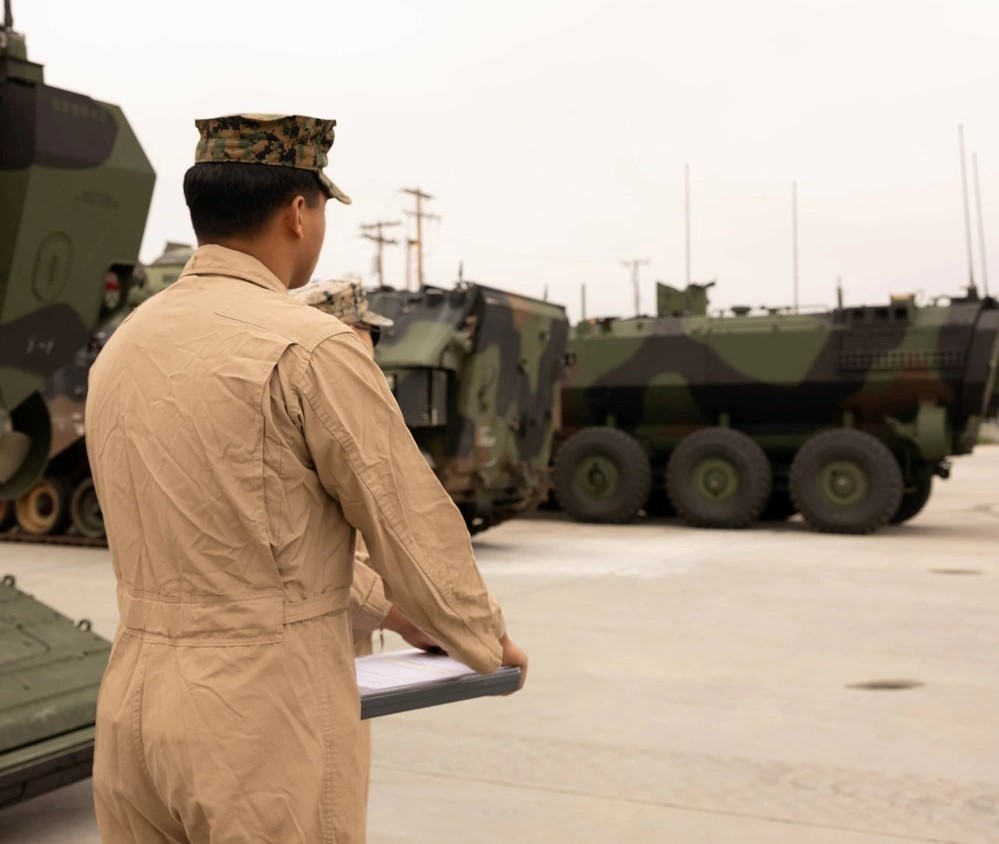
Photo By Sgt. Alexandra Munoz | U.S. Marine Sgt Jonathan Alvarez, an evaluator with the Amphibious Combat Vehicle Transition Training Unit, watches an ACV at Marine Corps Base Camp Pendleton, California, Apr. 11, 2023. The ACV TTU is composed of a cadre of experienced assault amphibian Marines working to create a standardized program to certify Marines to operate and maintain ACVs. As part of a Headquarters Marine Corps initiative, once operational, the ACV TTU will certify ACV crewmembers, vehicle commanders, maintainers, and unit leadership on the safe operation, maintenance, supervision, and employment of the ACV. (U.S. Marine Corps photo by Sgt. Alexandra Munoz

Release from Marine Corps Communications Directorate 

***** 

WASHINGTON, DC, UNITED STATES 

04.19.2023 

Story by Capt. Ryan Bruce 

HEADQUARTERS MARINE CORPS – A Marine Corps-established Transition Training Unit at the Assault Amphibian School is developing a rigorous and standardized program to ensure that Amphibious Combat Vehicle Marines possess the technical knowledge, skills, and proficiency required to safely operate, maintain, supervise, and employ the ACV. 
 
The decision to stand up the TTU came after the Marine Corps identified significant differences between the safe operating procedures of the ACV and its predecessor, the Assault Amphibious Vehicle. Preliminary findings from recent mishap investigations recommend that ACV operators receive more training focused on the internal mechanical systems of the ACV and how the platform differs from the AAV. 
 
“We are clear eyed about the need to get this right,” said Gen. David H. Berger, Commandant of the Marine Corps. “Our Marines deserve no less, and our Nation depends on it. Amphibious operations, to include the use of ship-to-shore connectors, are a foundational aspect of the Marine Corps. Our Marines will be trained safely and to the highest standard to ensure we remain the Nation’s premier expeditionary force in readiness.” 
 
The TTU is staffed by a hand-selected cadre of experienced and proficient ACV operators, maintainers, and trainers, augmented by other subject-matter experts from across the Marine Corps. 
 
The TTU is currently consolidating ACV lessons learned and best practices into an updated, continuous skills validation program. Upon program approval, the TTU will evaluate and re-certify ACV operators and maintainers previously trained on the ACV platform. 
 
“We are developing a program focused on performance-evaluated measurements associated with the safe operation of the ACV both on land and in water,” said Col. Howard Hall, the TTU officer-in-charge who is leading actions on the ground to stand up the unit. “The exceptional intensity and professionalism exhibited by the Marines of the TTU combined with the coordination and support of leaders at all levels across the Marine Corps is a testament to our commitment to facilitating the ACV transition and leveraging its impressive capabilities. This training will lay the foundation for future Assault Amphibian School and assault amphibian battalion proficiency.” 
 
The TTU’s proficiency evaluation and validation standards developed by the TTU will be sustained on an enduring basis through entry-level ACV operator, maintainer, and unit leader training and advanced training for Marines as they progress through their career. 
 
“It is not enough to put a check in a box when it comes to safe operation and maintenance of the ACV,” added Maj. Jim Agostino, the TTU operations officer, and a former 3d AABn company commander. “We are looking to certify Marines in the technical operation of the vehicle from each crew station, to ensure they possess the requisite skills of operating the ACV safely and have a firm foundation to enhance their capability in follow-on training.”