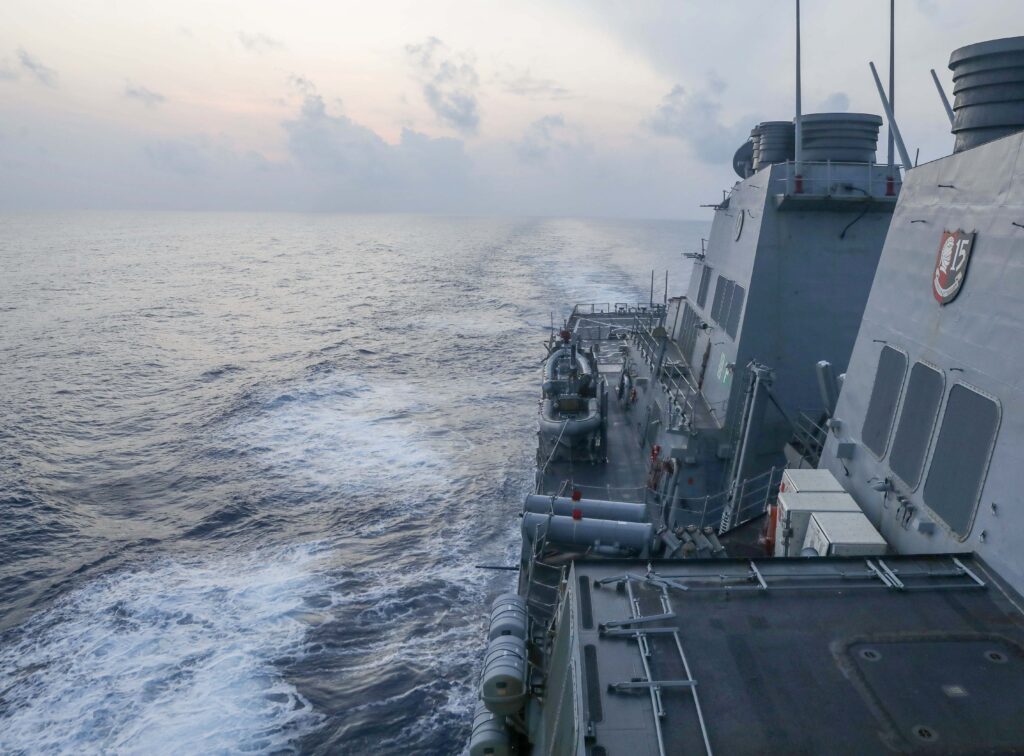
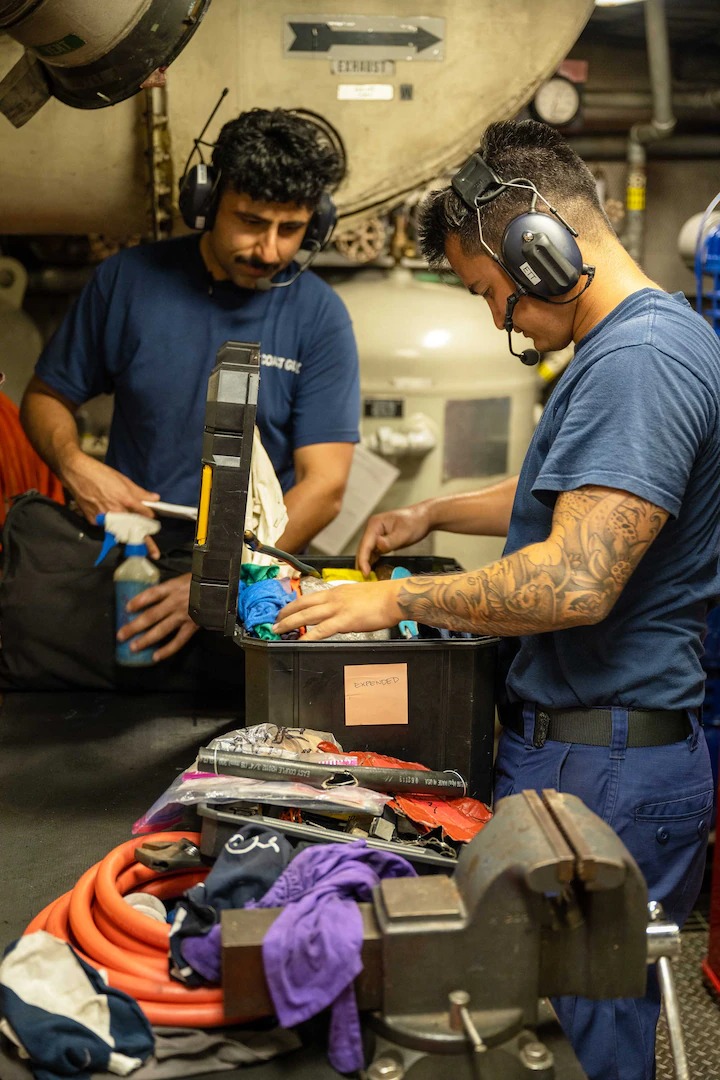
Today, the Department of Defense (DoD) released its annual Freedom of Navigation (FON) Report for Fiscal Year 2022. During the period from October 1, 2021, through September 30, 2022, U.S. forces operationally challenged 22 different excessive maritime claims made by 15 different claimants throughout the world.
Excessive maritime claims are inconsistent with international law as reflected in the Law of the Sea Convention. They include a variety of restrictions on the exercise of navigation and overflight rights and other freedoms. Unlawful maritime claims – or incoherent theories of maritime entitlements – pose a threat to the legal foundation of the rules-based international order. If left unchallenged, excessive maritime claims could limit the rights and freedoms enjoyed by every nation.
Upholding freedom of navigation as a principle supports unimpeded lawful commerce and the global mobility of U.S. forces. DoD’s freedom of navigation operations (FONOPs) demonstrate that the United States will fly, sail, and operate wherever international law allows.
DoD’s regular and routine operational challenges complements diplomatic engagements by the U.S. State Department and supports the longstanding U.S. national interest in freedom of the seas worldwide.
Each year, DoD releases an unclassified summarized FON Report identifying the broad range of excessive maritime claims that are challenged by U.S. forces. It also includes general geographic information to describe the location of FON assertions while still maintaining operational security of U.S. military forces. This report demonstrates U.S. non-acquiescence to excessive maritime claims —wherever they may be.
As long as restrictions on navigation and overflight rights and freedoms that exceed the authority provided under international law persist, the United States will continue to challenge such unlawful maritime claims.
The United States will uphold the rights, freedoms, and lawful uses of the sea for the benefit of all nations—and will stand with like-minded partners doing the same.
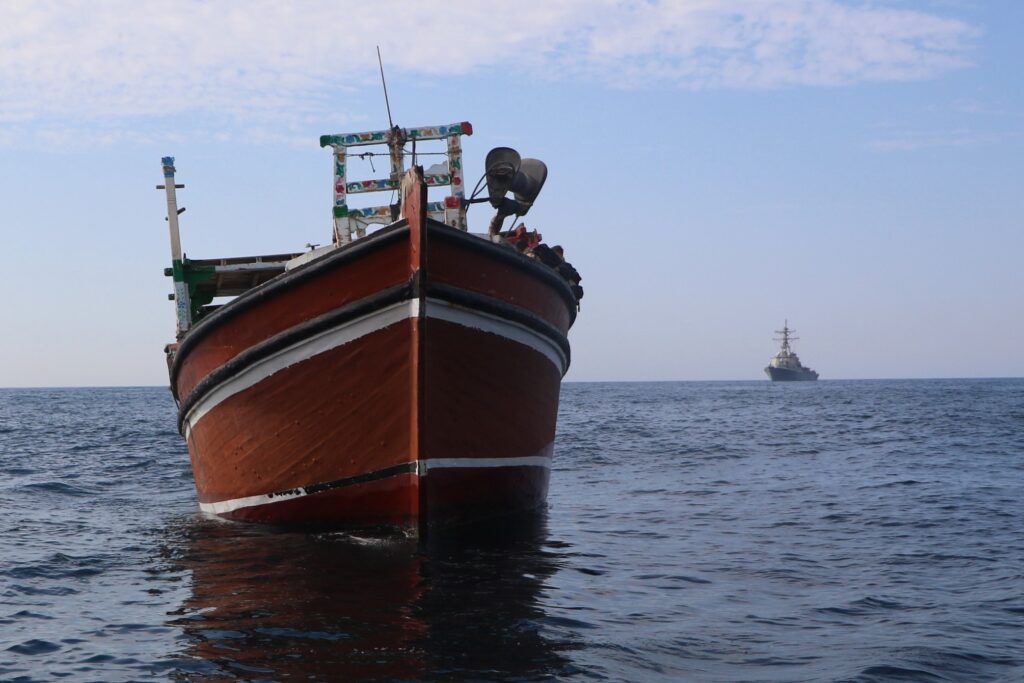
MANAMA, Bahrain — A U.S. Navy guided-missile destroyer interdicted a fishing vessel attempting to smuggle $42 million in illegal drugs while transiting the Gulf of Oman, April 21.
USS Paul Hamilton (DDG 60) was operating in support of Combined Task Force (CTF) 150 when it discovered the fishing vessel smuggling 802 kilograms of methamphetamine and 1,000 kilograms of hashish. CTF 150 is one of four task forces under Combined Maritime Forces, a multinational naval partnership consisting of 38 nations.
Before U.S. Navy and Coast Guard members from Paul Hamilton seized the vessel, five smugglers on board attempted to discard 50 bags of methamphetamine weighing 35 pounds each by throwing the drugs overboard. Some of the bags were able to be recovered from the water.
The vessel’s crewmembers identified themselves as Iranian nationals.
“This was outstanding work by the entire Paul Hamilton team,” said Capt. Anthony Webber, commander of Task Force 55 and responsible for overseeing U.S. maritime surface operations in the Middle East. “These interdictions remove illicit narcotics from the high seas and help deter destabilizing activity in regional waters.”
In 2023, maritime forces supporting CTF 150 have seized illegal drugs worth a combined estimated U.S. street value of $150 million, adding to record-breaking drug interdictions by U.S. and international naval units in 2021 and 2022 totaling $1 billion in value.
“I am incredibly pleased with the performance of our Sailors,” said Cmdr. Jake Ferrari, commanding officer of Paul Hamilton. “We remain committed to delivering consistent maritime security and countering illicit activities and contraband smuggling in the region.”
CTF 150 conducts maritime security and counter-terrorism operations in the Gulf of Oman and Indian Ocean to disrupt criminal and terrorist organizations and their related illicit activities, including the movement of personnel, weapons, narcotics and charcoal. These efforts help ensure legitimate commercial shipping transits the region free from non-state threats.
Combined Maritime Forces is the largest multinational naval partnership in the world whose partner forces operate in the Red Sea, Gulf of Aden, Northern Arabian Sea, Gulf of Oman, Indian Ocean and Arabian Gulf to promote regional security and stability.
General Lists Marine Corps VTOL Development Priorities for Congress
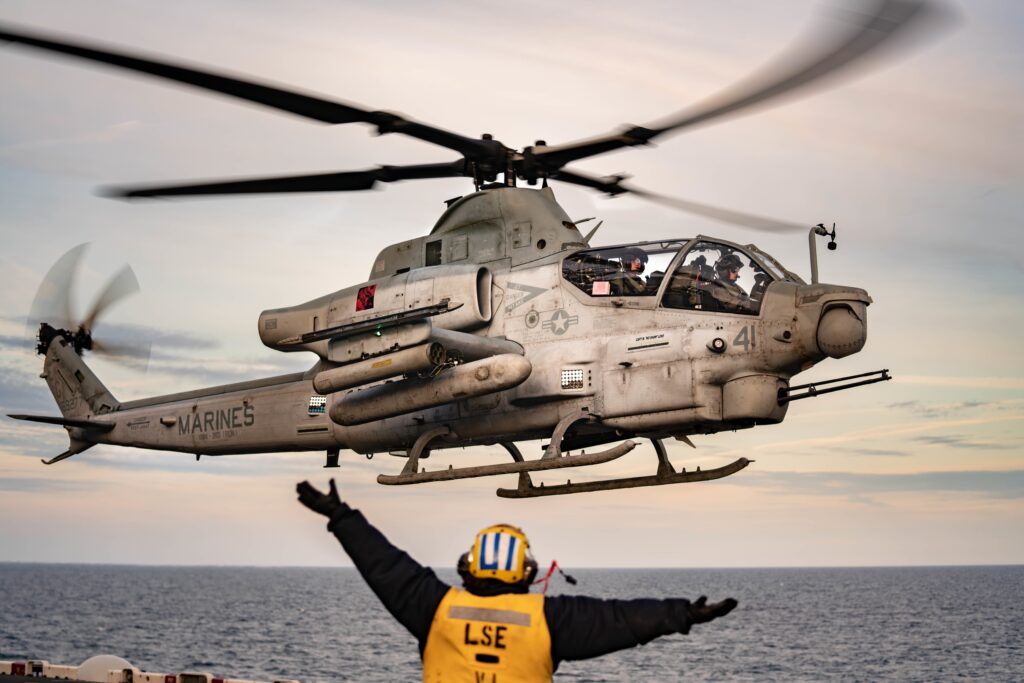
BALTIC SEA (May 18, 2022) U.S. Marine Corps Capt. Ryan Mortensen and Capt. Jeffrey Jaeckel, both AH-1Z pilots assigned to the Aviation Combat Element, 22nd Marine Expeditionary Unit, take-off during flight operations aboard the amphibious assault ship USS Kearsarge (LHD3) in the Baltic Sea, May 18, 2022. The Kearsarge Amphibious Ready Group and embarked 22nd Marine Expeditionary Unit are participating in the Estonian-led exercise Siil 22 (Hedgehog 22 in English). Siil 22 brings together members of the Estonian Defense Force and Sailors and Marines under Commander Task Force 61/2 to enhance Allied interoperability and preserve security and stability in the Baltic region. (U.S. Marine Corps photo by Staff Sgt. Brittney Vella)
*****
WASHINGTON — The Marine Corps general in charge of aviation requirements detailed for Congress the service’s priorities for vertical takeoff and landing (VTOL) platforms during testimony regarding the 2024 defense budget hearings.
“Our VTOL Family of Systems has three lines of effort,” said Lieutenant General Michael S. Cederholm, deputy commandant for aviation, testifying April 19 before the Tactical Air and Land Forces subcommittee of the House Armed Services Committee.
“The first one is logistics,” Cederholm said. “We’re looking at a risk-worthy, unmanned logistics connector. We’re in the process of developing and working through our process and Initial Capabilities Requirement Document right now. That’s gone through and is sitting at the MROC [Marine Requirements Oversight Council] for decision.”
Cederholm said the second line of effort “is attack/strike. We have taken a different approach because we’re at different stages of modernization. The Marine Corps is in a unique position — a good one. The relative health of our fleet and the nascent age of our fleet of H-1s [AH-1Z and UH-1Y helicopters] and V-22s. We’re just transitioning to the 53Kilo [CH-53K helicopter]. This gives us an opportunity to — in the future — not wait but very expeditiously and thoroughly explore the intersection point between budget, requirements, and future capabilities. We can look at the attack/strike role and what are the advances in teaming, autonomy; advances in lethality and survivability.”
The general listed the third line of effort, “is to replace our extant platforms like the MV-22 when it ages out with the Next-Gen Assault Support.”
Cederholm said he “is excited [about] where the Marine Corps is. We have a sense of urgency, but we also have time to be thorough in our approach to unmanned in the future.”
Flight Ops in Washington, D.C. — A Century Ago!
Flight Ops in Washington, D.C. — A Century Ago!
By David F. Winkler
In his book Selling Sea Power: Public Relations and the U.S. Navy, 1917-1941, Ryan Wadle lamented that following World War I, the Navy’s culture inhibited its leaders from publicly advocating for a strong navy to defend the nation and interests abroad. The Washington Naval Conference of 1921–22, which led to the scrapping of battleships under construction and other tonnage restrictions, should have served as a wake-up call. Yet the Navy maintained its public reputation as “the Silent Service.” Instead, Navy leadership looked for others to champion sea power. This past October 27 marked the centennial of Navy Day. Long credited as a Navy League of the United States initiative, Navy Day fell on the birthday of the recently deceased President Theodore Roosevelt — a staunch supporter of sea power. In Selling Sea Power,Wadle exposed the behind-the-scene role of the Office of Naval Intelligence to coordinate with the Navy League to create a day of national sea power celebration.
The Navy’s First Aircraft Carrier
One naval leader who broke the silent-service mold was Rear Admiral William Moffett. Recently selected to head the new Bureau of Aeronautics (BuAer), Moffett found his new fiefdom was being challenged by Brigadire General Billy Mitchell, who argued for a consolidation of Army and Navy air components into a new service along the lines of what had been accomplished in Britain with the establishment of the Royal Air Force towards the end of World War I. In his advocacy for a separate service, Mitchell was a publicity-generating machine and exploited the aerial bombings of decommissioned German and American battleships off the Virginia Capes to argue his case before Congress.
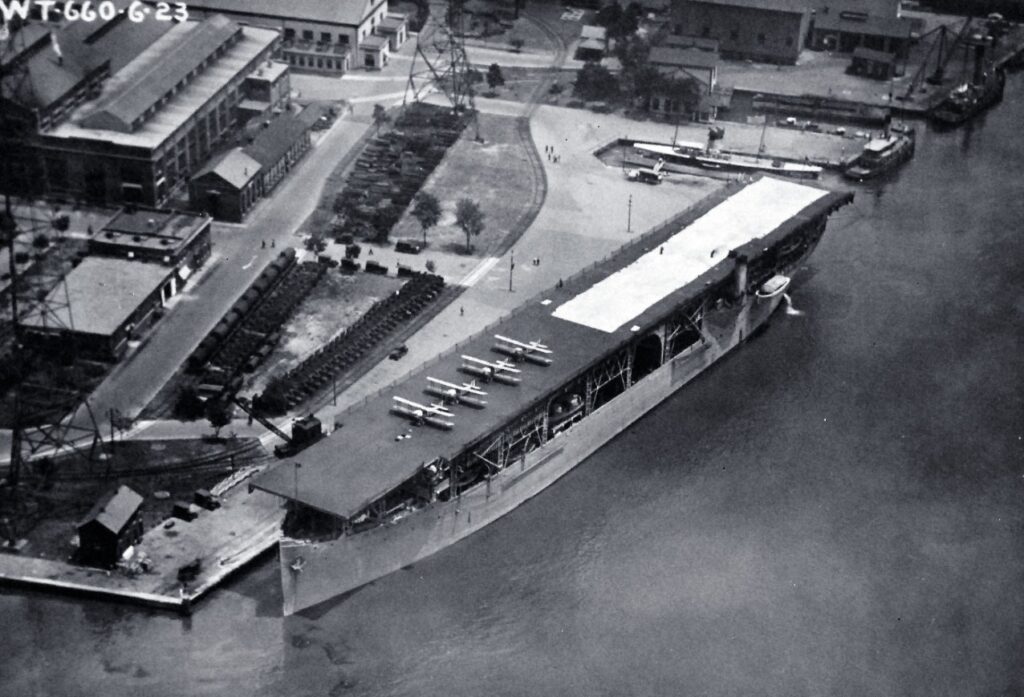
Fortunately for Moffett, his publicity toolbox had recently taken on a big addition with the recommissioning of the former collier USS Jupiteras the Navy’s first aircraft carrier, USS Langley. With the first launching and landing of airplanes occurring just prior to the first Navy Day in October 1922, Moffett made sure camera crews from all major media outlets were on hand to capture the events. As for that first Navy Day celebration in Norfolk, Langleywelcomed thousands of visitors who desired to see the ship they had been reading about in the newspapers.
With cold weather arriving, Langleyleft for Pensacola to further develop flight operation protocols and increase capacity to land and launch ever larger and heavier aircraft. When warmer weather returned to the Mid-Atlantic, Langleydeparted Pensacola to return to Norfolk, anchoring at Hampton Roads late on May 28. The next morning Langleymoored starboard side to pier 2 at the Naval Operating Base in Norfolk. Captain S.H.R. Doyle departed the ship for the nation’s capital to meet with Moffett and other Navy officials to preview a forthcoming ploy to impress national leaders and the public about naval aviation during annual Shriners Week celebrations scheduled for mid-June in the nation’s capital. Moffett had already arranged for an impressive static display of 10 naval aircraft including NC-4 to be placed around the base of the Washington Monument. Flyovers would be conducted by Anacostia- and Quantico-based Navy and Marine Corps aircraft. Moffett wanted Langley’s planes to join the mix. Earlier in May the BuAer chief had recommended to the CNO, Admiral Robert E. Coontz, that Langleybe part of the showcase as the flight demonstrations would put, “the accomplishments of the Navy and naval aviation before the people throughout the country.” Upon completion of the meetings, Doyle returned to Norfolk to prepare his ship for a relatively short journey.
Departing Norfolk on the morning of June 1, Langleyreached the mouth of the Potomac River at 3 p.m. with the minesweeper Sandpiperfollowing astern. Not desiring to arrive in the nation’s capital before sunrise, Langleyanchored off Blackstone Island off Southern Maryland at 10:30 p.m. and then raised the hook just before 4 a.m. to proceed upriver. At 8:20 a.m. wind conditions were acceptable to launch four aircraft piloted by Lieutenant Commander Griffin, Lieutenant Dillon, Lieutenant James R. Kyle, Jr., and Boatswain Feher to fly ahead to NAS Anacostia. At 9:23 a.m., with Mount Vernon and the tomb of the first president off the port beam, Langleyrendered honors as prescribed in Navy Regulations. At 11:11 a.m., Langleymoored starboard side to the berth at the Washington Navy Yard. Waiting ashore were the four pilots who had flown off three hours earlier.
USS Langley Wows Washington
On Sunday, June 3, the crew of the Langleywelcomed 1,198 Washingtonians and others to tour their unique vessel. The next day, Langleycasted off from the Navy Yard and proceeded to a spot off Hains Point, a short distance away from the Army War College at Fort McNair. Once anchored, the presidential yacht Mayflowercame alongside. In addition to President Warren G. Harding, Moffett, the Navy’s General Board and several other dignitaries worked their way up to the flight deck to observe Lieutenant Commander Griffin, Lieutenant Brow, Ensign C.D. Palmer, and Boatswain Feher take off and land with their Navy biplanes. With the flight demonstration’s successful conclusion, the visiting dignitaries departed, and Langleyreturned to the Navy Yard.
On Tuesday, Langley’s flight demonstrations recommenced off Hains Point as the Shriners Convention kicked off with a parade of 25,000 marchers and one of Langley’s Vought aircraft, pulled along by 30 of the ship’s crew. Flight operations continued for the next few days with only minor weather disruptions. Following another weekend at the Navy Yard with heavy visitation, the Mayflowercame alongside during a torrent of rain. Captain Doyle again welcomed the president and members of his cabinet for a Monday tour lasting 45 minutes. At 4:02 the next morning, Langleyhauled in lines from the Navy Yard dock for the last time as she headed down the Anacostia and the Potomac to return to Hampton Roads that evening. Following an overnight anchoring, Langleyonce again returned to Naval Operating Base for some maintenance and repair work.
Back in Washington, President Harding felt “stronger than ever” about the Navy’s plans for fleet aviation and reconfirmed his support for funding to convert the planned battlecruisers Lexingtonand Saratoga into operational aircraft carriers. Moffett appreciated presidential support, but it was Congress who paid the bills. To further press his case to Congress and other internal and external constituencies, Moffett became open to the concept of transitioning Langleyfrom an experimental to an operational carrier. Admiral Coontz formalized the concept when, on June 25, 1923, he signed the notice titled “Naval Aeronautical Organization for Fiscal Year 1924.” Put into place just six days prior to the start of the 1924 fiscal year, the document, drafted by Moffett’s bureau, spelled out intent to transfer Langleyto San Diego to serve as flagship for the Commander, Aircraft Squadrons, Battle Fleet. In the interim, the CNO directed “…Langleywill conduct flying-off and flying-on experiments with operating allowance of airplanes previously authorized.”
Ironically, the success of Langley’s visit to Washington undermined the timetable for getting the ship to the West Coast. Nearly two weeks prior to Coontz signing off on the 1924 plan for aeronautics, the CNO’s biweekly operations conference that brought together representatives of the various bureaus featured Langleyas the lead item. Citing the success of the experimental carrier’s DC port call, the minutes recorded: “We are now trying to arrange a trip for the Langleyalong the New England Coast this Summer for exhibition purposes.” With port visits to New York, Newport, Portland, Portsmouth, and Boston, Langleywould sell the viability of naval aviation to tens of thousands of onlookers who gasped in amazement as biplanes continuously lifted off and then turned around and landed on the ship that eventually gained the moniker “The Covered Wagon.”
David F. Winkler provides content for the weekly Tuesday Tidings naval history e-letter sent out by the National Maritime Historical Society. Visit www.seahistory.org to get on the distribution list.
Sources: Ryan D. Wadle, Selling Sea Power: Public Relations and the U.S. Navy, 1917-1941, University of Oklahoma Press (2019); Deck Logs USS Langley National Archives Washington DC.
Saab Receives Order for U.S. Anti-Submarine Warfare Training Target
*************
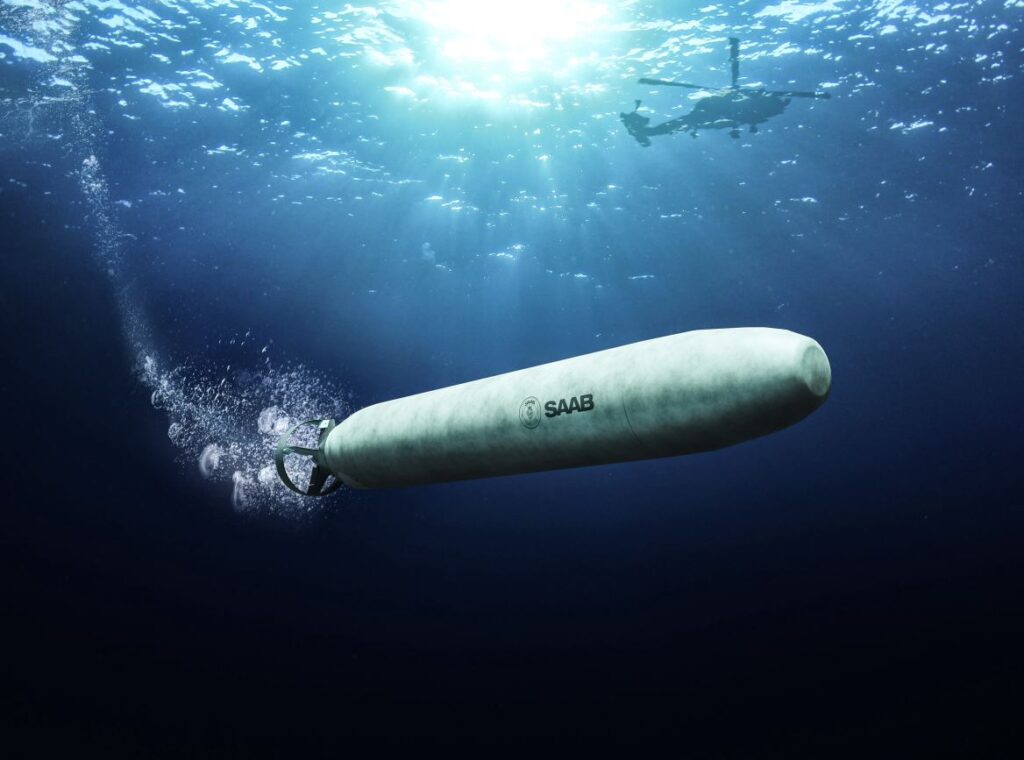
The U.S. Naval Undersea Warfare Center Division, Newport has awarded Saab the first production order for the Expendable Mobile Anti-Submarine Warfare Training Target (EMATT). This contract follows an award from September 30, 2022 to perform modernization and validation testing of the EMATT system. This production order has a value of approx. USD $9 million (100 million SEK), which was booked in Q1 2023. The overall EMATT contract has a potential value of USD $173 million (1.79 BSEK) over a 10-year ordering period.
Under the current order, Saab will manufacture 1,200 EMATT units for the U.S. Navy from its new production facility in Cranston, Rhode Island.
“This award validates the trust and confidence the U.S. Navy has placed in Saab to deliver on our commitments. Our EMATT system has significant improvements over the legacy design, including a next generation electronics architecture along with significantly improved navigation and control. We are pleased to work with our subcontractors SyQwest, Massachusetts Institute of Technology (MIT), and OASIS, a subsidiary of Thayer Mahan, on the improved MK39 EMATT,” said Erik Smith, President and CEO of Saab in the U.S.
The MK39 EMATT is a less than 25 pound sonobuoy-size device programmed for various anti-submarine warfare training scenarios. As a small, expendable system, Saab’s EMATT is an important enhancement to the U.S. Navy’s training program, providing improved reliability and significant cost savings for the US Navy customer. The MK39 EMATT incorporates a technology refresh into the design and provides the U.S. Navy, as well as several allied navies, a robust acoustic exercise target to train sonar operators from naval surface ships, submarines, and aircraft.
Carl Vinson Carrier Strike Group Completes Group Sail in Hawaiian Islands Operating Area
PACIFIC OCEAN – Group Sail is an integrated training exercise conducted between units assigned to Carrier Strike Group (CSG) 1. The exercise reintegrated the strike group and provided an opportunity to enhance excellence and increase the lethality and tactical proficiency of U.S. Navy units operating in the 3rd Fleet area of operations.
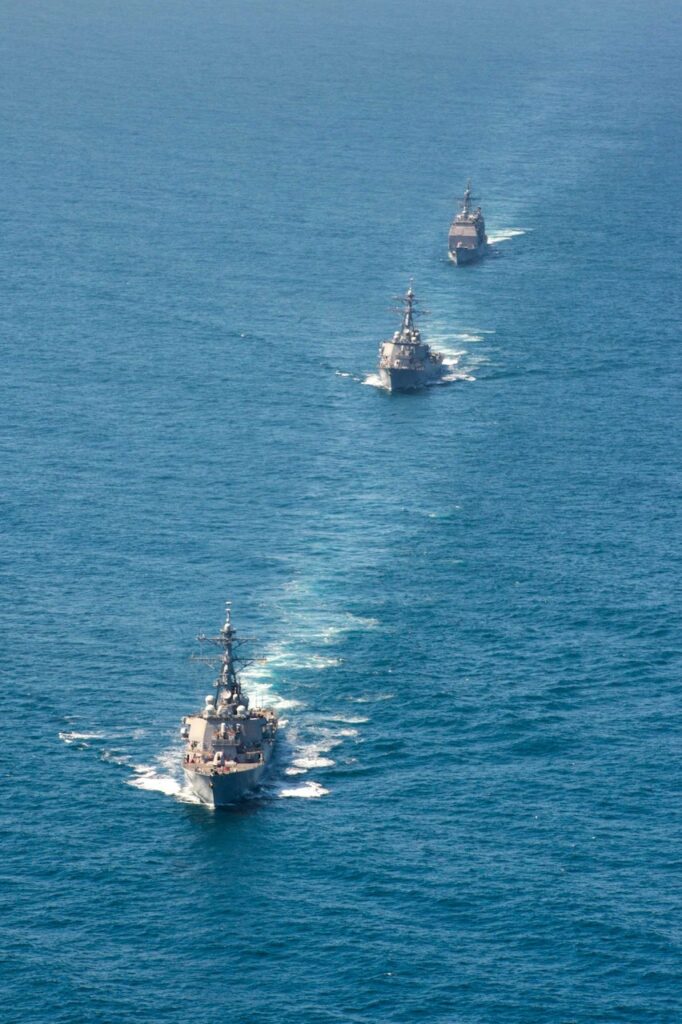
Led by its flagship, USS Carl Vinson (CVN 70), units assigned to CSG-1 engaged in cross-functional training across multiple domains for maximum effectiveness, including enhanced maritime security operations, anti-submarine warfare operations, flight operations, replenishments-at-sea and counter piracy operations, to hone in on maritime integrated-at-sea operations and combat readiness.
“In Group Sail we rehearsed and integrated under the direction of Carrier Strike Group 15. During this underway we achieved some important firsts, and we are setting the course for future strike groups to scale these achievements,” said Rear Adm. Carlos Sardiello, commander, CSG-1.
“I am especially proud that the strike group and carrier air wing achieved Blue Water Certification during this phase of training; an achievement that usually comes later in the readiness cycle. This certification means we can choose to operate in any ocean around the world, today.”
The ships and aircraft of the Vinson CSG, made up of more than 5,000 collective Sailors, executed surface and air engagements in a complex maritime environment to demonstrate the strike group’s ability to deliver powerful maritime force in order to respond to coercive behavior from those who seek to challenge the rules-based international order or destabilize the Indo-Pacific.
“We are providing U.S. Pacific Fleet with a ready, resilient, combat-credible force and underscoring to our competitors that today is not the day to test us,” said Sardiello.
Integrated maritime engagements and operations are part of the group’s routine presence in the Indo-Pacific. The Vinson CSG last conducted a Group Sail in 2021 in the Southern California operating area.
CSG-1 consists of aircraft carrier USS Carl Vinson (CVN 70), Destroyer Squadron (DESRON) 1, Carrier Air Wing (CVW) 2, Ticonderoga-class cruiser USS Princeton (CG 59) and the Henry J. Kaiser-class Fleet replenishment ship USNS Pecos (T-AO 197). Participating DESRON-1 ships included the Arleigh Burke-class guided-missile destroyers USS Hopper (DDG 70), USS Kidd (DDG 100), USS Sterett (DDG 104), and USS William P. Lawrence (DDG 110).
Participating CVW-2 squadrons included the “War Hawks” of Strike Fighter Squadron (VFA) 97, the “Bounty Hunters” of VFA-2, the “Stingers” of VFA-113, the “Golden Dragons” of VFA-192, the “Gauntlets” of Electronic Attack Squadron (VAQ) 136, the “Black Eagles” of Airborne Command and Control Squadron (VAW) 113, the “Titans” of Fleet Logistics Multi-Mission Squadron (VRM) 30, the “Black Knights” of Helicopter Sea Combat Squadron (HSC) 4, and the “Blue Hawks” of Helicopter Maritime Strike Squadron (HSM) 78.
For more news from CSG-1, visit www.dvidshub.net/unit/CSG1.
Admiral: Analysis of Alternatives for MH-60 Helo Replacement Completed
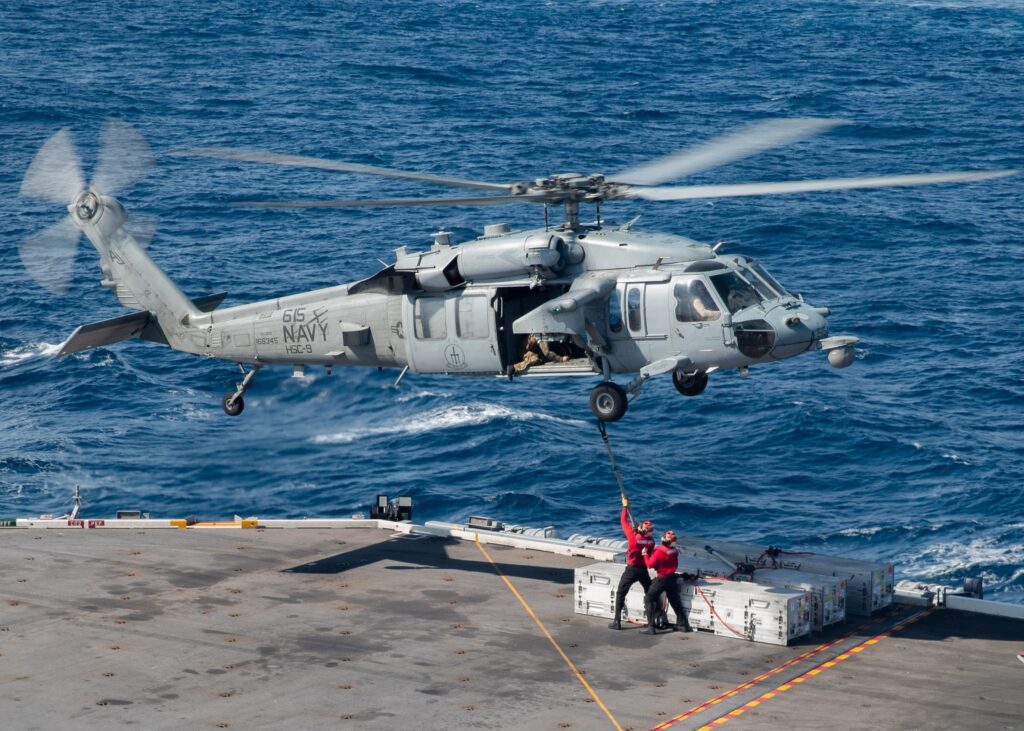
ATLANTIC OCEAN (March 31, 2023) Sailors assigned to the first-in-class aircraft carrier USS Gerald R. Ford’s (CVN 78) weapons department, attach an ammunition crate to an MH-60S Knighthawk, attached to the “Tridents” of Helicopter Sea Combat Squadron (HSC) 9, during an ammunition on-load with USNS Medgar Evers (T-AKE 13), March 31, 2023. Gerald R. Ford is underway in the Atlantic Ocean conducting routine operations and training in order to maintain readiness. As the first-in-class ship of Ford-class aircraft carriers, CVN-78 represents a generational leap in the U.S. Navy’s capacity to project power on a global scale. (U.S. Navy photo by Mass Communication Specialist 2nd Class Nolan Pennington)
*****
WASHINGTON — The U.S. Navy has completed analysis of its options for future rotorcraft to replace the service’s MH-60R and MH-60S Seahawk helicopters and has forwarded the analysis to the Office of the Secretary of Defense.
Rear Admiral Andrew J. Loiselle, director, Air Warfare Division, testifying April 19 before the Tactical Air and Land Forces subcommittee of the House Armed Services Committee, said the Analysis of Alternatives for the Navy’s version of Future Vertical Lift (FVL) has been forwarded to the OSD’s Cost Assessment and Program Evaluation (CAPE) office.
“Once [CAPE] is done with that sufficiency assessment, then we will absolutely move on to selecting a preferred alternative for the Navy, and all the costing and acquisition documentation necessary to reach a Milestone A, likely in about the [fiscal] ’25 time frame,” Loiselle said.
The admiral said the Navy’s FVL effort, “is about five years behind the Army, as far as an acquisition program goes. […] That fits with when we expect service life to be expired in our Sierra [MH-60S] and Romeo [MH-60R] fleet. “
The Navy has service-life extension programs underway or planned for both types of helicopters. The MH-60S extension is to extend their service lives from 10,000 flight hours to 12,000 flight hours, about seven years, into the 2030s.
Loiselle said a service life extension for the MH-60R can be delayed until the 2030s because the Navy has some new-production MH-60Rs in storage that can be brought into service.
Loiselle said the Navy is tuned in to the Army’s FVL efforts and is predominately focused on mission systems.
He noted that of the Army’s planned airframes, the Future Long-Range Assault Aircraft (FLARA) is too large for the flight decks of the Navy’s destroyers and the Future Attack Reconnaissance Aircraft (FARA) is, “too small for our needs, so I don’t see a direct correlation to our requirements to theirs, however, that does not mean we will not have numerous opportunities.”
Wittman Statement on the Navy’s 30-Year Shipbuilding Plan
*****
WASHINGTON, D.C. – Today, Congressman Rob Wittman (VA-01), Vice Chairman of the House Armed Services Committee, released the following statement in response to the Navy’s recently released 30-year shipbuilding plan:
“With this 30-year shipbuilding plan, the Navy demonstrates that it has lost its way. It trades decisive and bold decision-making for endless studies, vast short-term risk, and fails to reckon with the threats we face. The future of our nation’s fleet is not a multiple-choice test in which the Navy can choose ‘all of the above.’ At no point do any of the three plans deliver a path to generating 31 traditional L-class amphibs, as required by law. Our destroyers and frigates are short-changed. Two of the proposed plans would shrink the amphibious fleet in total to just 26 ships by FY35. Within the Davidson window—the period between now and 2027 where we anticipate the greatest risk of Beijing moving to forcibly reunify with Taiwan – each of the plans results in our attack submarine fleet contracting to 48 subs by FY26 and only one of the provided alternatives reaches the requirement of 66 submarines FY49. Additionally, our undersea vertical launch system capacity, surface VLS capacity, and torpedo capacity are all set to decline between now and 2030. This is unacceptable.”
Congressman Rob Wittman represents the 1st District of Virginia. He serves on the House Natural Resources Committee and the House Armed Services Committee, where he serves as the Vice Chairman of the full committee and as the Chairman of the Tactical Air and Land Forces Subcommittee.
Coast Guard Cutter Active returns home following a 76-day counternarcotics patrol in the Eastern Pacific
Coast Guard Cutter Active returns home following a 76-day counternarcotics patrol in the Eastern Pacific
PORT ANGELES, Wash. — The U.S. Coast Guard Cutter Active (WMEC 618) and crew returned to Port Angeles following a 76-day, 12,000-mile counternarcotics patrol in the equatorial Eastern Pacific Ocean.
In February, the cutter and crew departed Port Angeles to operate on behalf of Joint Interagency Task Force South (JIATF-S), a multi-national and multi-agency task force designed to detect and deter transnational organized criminal activity operating in international waters off the coasts of North and Central America.
The Active’s crew operated in a region comprising more than 42 million square miles of ocean, extending from the U.S. maritime boundary line between California and Mexico and reached latitudes south of Costa Rica. The crew detected and successfully interdicted three illegal narcotics shipments during their patrol.
On March 1, the Active and crew located and intercepted a target of interest go-fast vessel off the coast of central Mexico, utilizing aerial and surface tactics. The vessel’s operators were detained by the Mexican Navy (SEMAR), who participated in the pursuit. The pursuit lasted more than 27 hours, resulting in Active’s crew recovering over 960 kilograms of cocaine worth an estimated $28 million.
In international waters off southern Costa Rica, on March 7, Active’s bridge crew detected a suspected vessel operating near the cutter. The crew quickly mobilized their resources and successfully intercepted a go-fast vessel operated by four individuals. Near the interdiction site, Active’s crew discovered more than 100 packages of illegal narcotics, worth an estimated $3.5 million.
On multiple occasions during the patrol, the Active and crew assisted the U.S. Coast Guard Cutter Waesche (WMSL 751) with operational and logistical support. This assistance allowed Waesche to continue its operations and mission objectives with minimal interruption, amplifying presence, and coverage in the region with multiple Coast Guard platforms on patrol.
In keeping with its namesake, Active’s crew demonstrated environmental stewardship, rescuing three sea turtles entangled in abandoned and adrift fishing tackle.
“I am extremely proud of how our crew performed throughout this patrol,” said Lt. Erick Jackson, Active’s operations officer. “No matter the time of day or type of mission, our teams worked together to achieve operational success.”
“Active’s crew truly seized on the opportunity presented by the NAMSI event to strengthen our skills while building interoperability with partner nations,” said Cmdr. Brian Tesson, Active’s commanding officer. “I cannot be more impressed by the performance, professionalism and resilience of the Active crew throughout the entirety of this patrol.”
Additionally, the Active and crew conducted eight days of joint operations with the U.S. Coast Guard Cutter Benjamin Bottoms (WPC 1132) and HMCS Edmonton of the Royal Canadian Navy. The three vessels operated as a multi-national surface action group (SAG) to increase detection and interdiction capabilities. The joint operations allowed for extensive communication and coordination training for Active who functioned as the SAG commander. Highlights include Active conducting an astern refueling at sea of the Benjamin Bottoms, and a successful interdiction of a go-fast vessel operated by seven personnel over 200 miles off the coast of Mexico. Each asset in the SAG was critical to this successful multi-national effort which resulted in the seizure of an estimated $22 million worth of cocaine.
The Active is a 210-foot medium endurance cutter commissioned in 1965. The cutter routinely conducts fishery patrols, counternarcotics operations, law enforcement patrols and search and rescue activities. Active has also participated in several high-profile missions, including the clean-up efforts in response to the Exxon Valdez oil spill in 1989.