Unmanned Surface Vessel Transits Strait of Hormuz with U.S. Coast Guard
Release from U.S. Naval Forces Central Command Public Affairs 

***** 

Unmanned Surface Vessel Transits Strait of Hormuz with U.S. Coast Guard 

19 April 2023 

From U.S. Naval Forces Central Command Public Affairs 

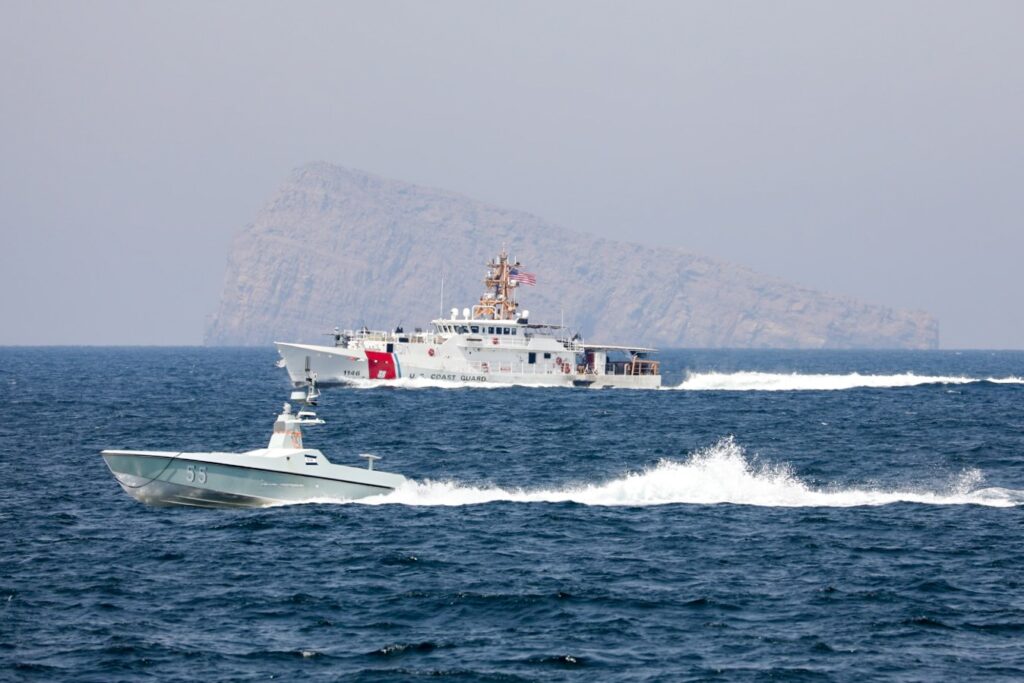
MANAMA, Bahrain – An unmanned surface vessel from U.S. 5th Fleet transited the Strait of Hormuz with two U.S. Coast Guard cutters, April 19, demonstrating the continued operational integration of unmanned and artificial intelligence systems by U.S. maritime forces in the Middle East. 

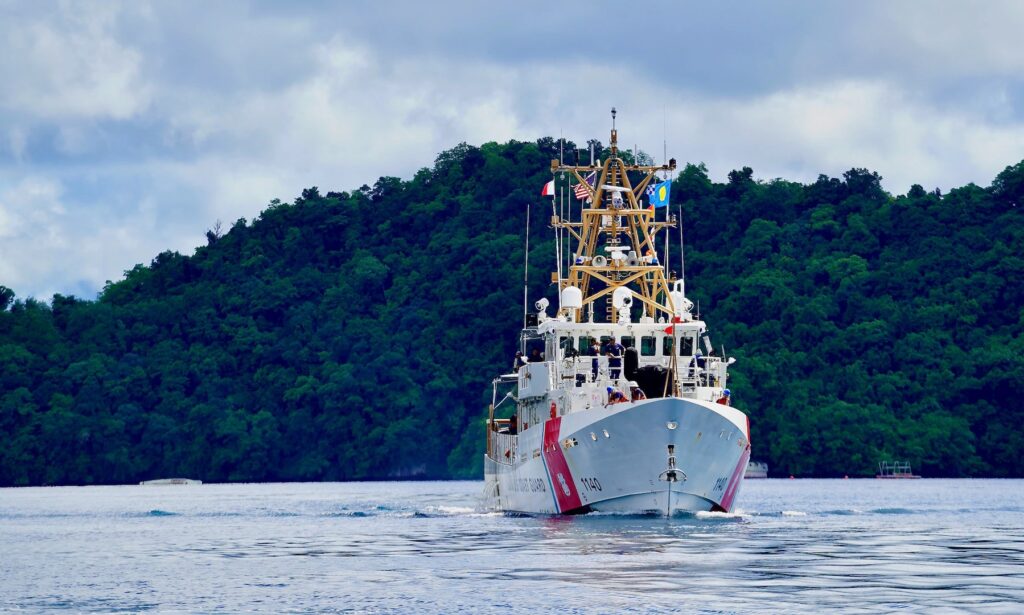
USCGC Charles Moulthrope (WPC 1141) and USCGC John Scheuerman (WPC 1146) transited one of the world’s most strategically important straits with an L3 Harris Arabian Fox MAST-13 unmanned surface vessel. The three vessels sailed south from the Arabian Gulf and through the narrow Strait of Hormuz before entering the Gulf of Oman. 

“I am proud to be a part of this great partnership between the U.S. Coast Guard and Navy in the Middle East. We often work side-by-side as one team with a common mission to provide security and safeguard the seas,” said Lt. Trent Moon, John Scheuerman’s commanding officer. 

U.S. 5th Fleet established a unit called Task Force 59 in September 2021 to integrate unmanned systems and artificial intelligence into regional maritime operations. Since its launch, the task force has deployed a suite of new unmanned systems from operational hubs in Jordan and Bahrain. 

In December, Task Force 59 launched an Aerovel Flexrotor unmanned aerial vehicle from USCGC Emlen Tunnell (WPC 1145) while operating in the Arabian Gulf. The launch marked Task Force 59’s first from a U.S. Coast Guard vessel at the time. 

“We are on the cutting-edge of integrating advanced unmanned technology into our maritime patrols. Our crews are excited to help lead these efforts with our Navy counterparts,” said Lt. Stephen Hills, Charles Moulthrope’s commanding officer. 

U.S. 5th Fleet is leading regional efforts to increase vigilance in surrounding waters that include more than 5,000 miles of coastline from the Suez Canal, around the Arabian Peninsula, through the Strait of Hormuz and into the Arabian Gulf. The integration of unmanned platforms and sensors alongside crewed ships from the United States and regional partners enhances this capability. 

The two Coast Guard cutters and Arabian Fox transited the Strait of Hormuz while operating in support of the International Maritime Security Construct, an 11-nation coalition led by the United States that focuses on maritime operations near key waterways in the Middle East. 


U.S. Marine Corps Activates Second F-35C Squadron

Release from 3rd Marine Aircraft Wing 

***** 

SAN DIEGO, CA, UNITED STATES 

04.15.2023 

Story by 2nd Lt. Andrew Baez 

3rd Marine Aircraft Wing   

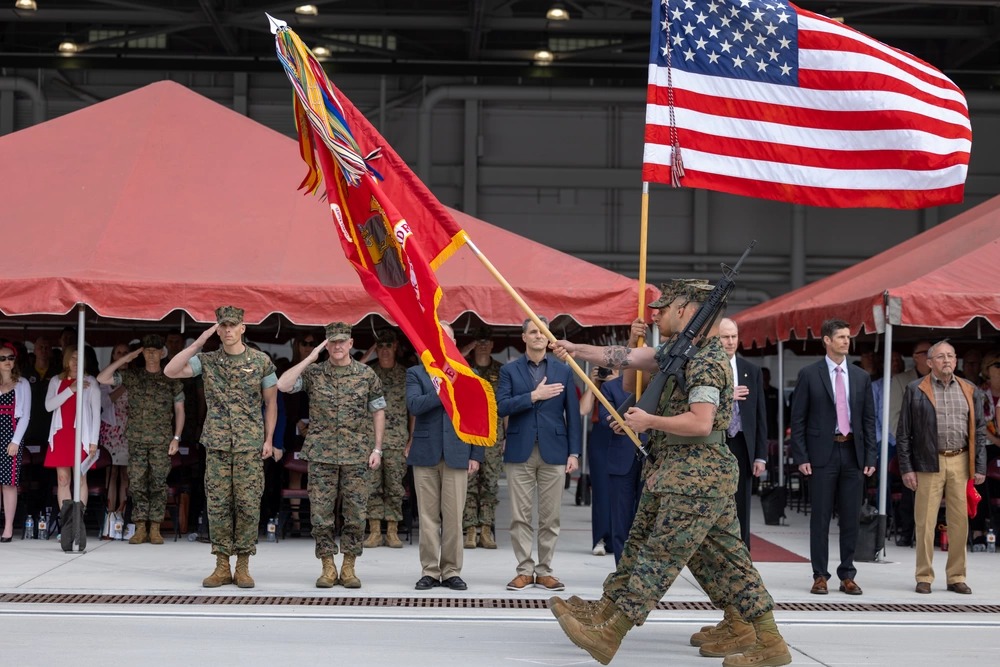
MARINE CORPS AIR STATION MIRAMAR, Calif. – Third Marine Aircraft Wing (MAW) reactivated Marine Fighter Attack Squadron (VMFA) 311, an F-35C Lightning II squadron, at Marine Corps Air Station (MCAS) Miramar, California, April 14, 2023. VMFA-311 is the U.S. Marine Corps’ second F-35C squadron. The F-35C is a land and/or carrier-based platform boasting long-range flight and high weapons payload capabilities. Formerly VMA-311, the Tomcats have made their mark on Marine Corps aviation for decades, and now will continue their legacy. 
 
Notable Tomcats veterans include Ted Williams and John Glenn. Ted Williams left a Major League Baseball career for service in World War II and Korea, and later was inducted into the Baseball Hall of Fame. John Glenn was a distinguished fighter pilot in World War II and Korea, who later became an astronaut and public servant. 
 
Third MAW Commanding General Maj. Gen. Bradford J. Gering is also a Tomcat. “Having twice served in VMA-311, the Tomcats hold a special place in my heart,” Gering said. “We are extremely excited to add another F-35C squadron to 3rd MAW. The range and operational flexibility that VMFA-311 will bring to I Marine Expeditionary Force is impressive and adds to our warfighting capacity in every domain.” 
 
The Marine Corps is undergoing a key transition to the F-35 to maintain its advantage in future conflicts, thereby deactivating VMA-311 on Oct. 15, 2020. The reactivation of VMFA-311 marks the transition for the squadron to the F-35C Lightning II, which brings its unique capabilities to 3rd MAW as a long-range compliment to their existing aviation assets. 
 
“The F-35C brings a long-range fighter/attack platform with the most advanced stealth and sensor capabilities in the Marine Corps,” said Lt. Col. Michael P. Fisher, the commanding officer of VMFA-311. “The Harrier was a great weapon that served the Marine Corps well and has been replaced with a more advanced and capable platform. The F-35 was designed for the near-term and future fight.” 
 
The reactivation supports the 2022 Marine Corps Aviation Plan, which outlines ongoing modernization efforts across Marine aviation. The plan prioritizes readiness, reinforces the importance of flying from the sea, and refocuses on manpower, support to logistics and modern capabilities. 
 
“We are taking an aggressive approach to build capabilities that will move, sustain, and support the individual Marine while making the force more lethal, effective, and survivable,” said then-Deputy Commandant for Aviation Lt. Gen. Mark R. Wise in the 2022 plan. 
 
The Tomcats, a notable squadron of “firsts” for Marine Corps aviation, originally commissioned in 1942 as Marine Attack Squadron (VMA) 311 as a at Marine Corps Air Station Cherry Point, North Carolina, where it first deployed in support of the World War II island hopping campaign. 
 
The squadron led the way for Marine Corps aviation in many groundbreaking events: it was the first Marine squadron to use fighter aircraft for dive bombing missions, flew the first Marine combat mission with jets in 1950 during the Korean War, was the first Marine squadron to employ the AV-8B Harrier in combat during Operation Desert Shield, the first to fly combat missions in Afghanistan during Operation Enduring Freedom, and participated in the first combat sortie of Operation Iraqi Freedom in 2003. 
 
“This reactivation is not about the aircraft, it’s about the people,” said Col. Shannon M. Brown, commander of Marine Aircraft Group 11. “Looking at what this squadron did over the years is impressive considering its 13 Navy Unit Commendations. The Tomcats are all about fighting and winning and now this legacy is entrusted to Lt. Col. Fisher.” 
 
“We will never forget where we came from,” Fisher said in his remarks. “Let’s make history.” 
 
Imagery from the ceremony will be available at: www.dvidshub.net/unit/3MAW. 


Senator Grills SECNAV on Amphib Ship Plans

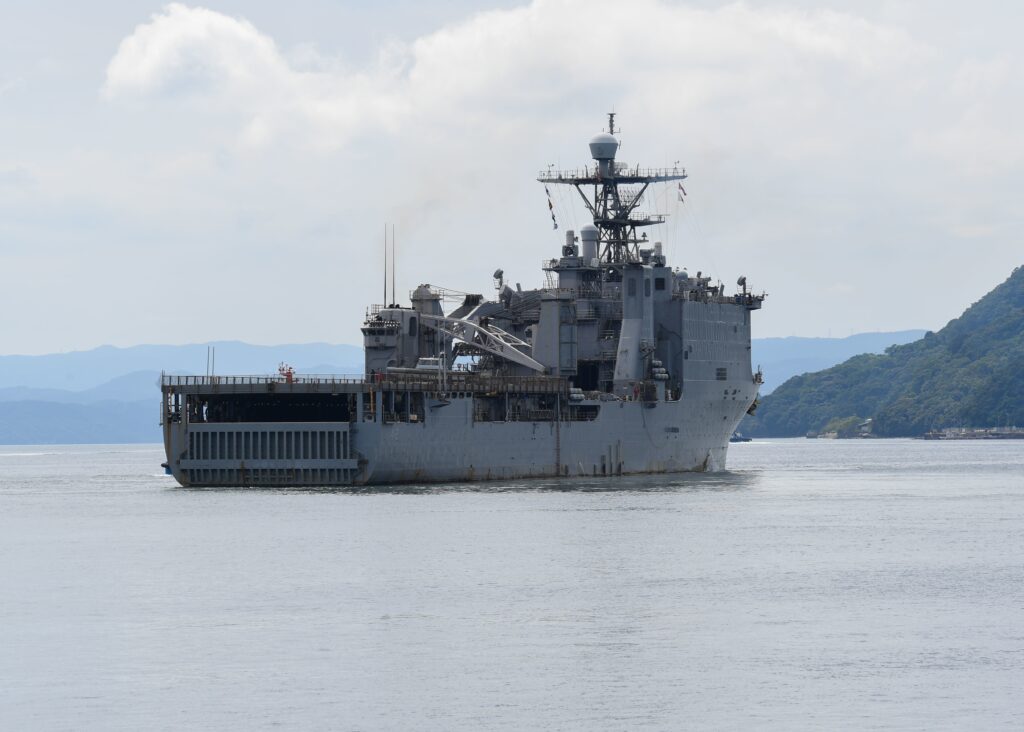
SASEBO, Japan (Sept. 15, 2021) The amphibious dock landing ship USS Germantown (LSD 42) departs Commander, Fleet Activities Sasebo, Japan (CFAS), Sept. 15, 2021. Germantown will shift home ports from Sasebo to San Diego after serving as a forward-deployed ship in U.S. 7th Fleet since Jan. 5, 2011. (U.S. Navy photo by Mass Communication Specialist 3rd Class Jasmine Ikusebiala)

***** 

ARLINGTON, Va. — A senator used a congressional hearing to point out that the Navy would be violating the law by letting the number of amphibious warships drop below a Congressionally mandated level of 31 in fiscal year 2024. 

The President’s 2024 budget calls for the decommissioning of three Whidbey Island-class old dock landing ships and not procuring any Flight II San Antonio-class amphibious transport dock ships (LPDs) over the next five years to replace them. The National Defense Authorization Act (NDAA) of 2023 requires the Nay to maintain a fleet of 31 large and medium-size amphibious warfare ships. 

In an otherwise convivial April 18 hearing of the Senate Armed Services Committee, Sen. Dan Sullivan (R-Alaska), a reserve Marine Corps colonel, confronted Navy Secretary Carlos Del Toro about the Navy’s shipbuilding plans.  

“The 30-year [shipbuilding] plan shows that the Navy has no intention of meeting this statutory requirement, ” Sullivan said, noting that he worked with Marine Corps Commandant General David H. Berger to legislate the requirement into the law, the National Defense Authorization Act (NDAA) of 2023, a requirement which Berger affirmed during the hearing. 

During the hearing, Sullivan read an excerpt from the law: “The naval combat forces of the Navy shall include not less than 11 operational aircraft carriers and not less than 31 operational amphibious warfare ships of which not less than 10 shall be amphibious assault ships.” 

The senator said he sympathized with Berger’s awkward position.  

“I want to compliment the commandant,” Sullivan said. “It’s not easy to be sitting next to your boss saying, ‘We need this.’ Your boss obviously doesn’t agree, General.” 

Taking note of all of the planned studies and analysis on the subject, Sullivan declared all of it irrelevant in that the requirement has been set in law.  

“The Congress of the United States did the balancing, Mr. Secretary, working with the Marine Corps,” Sullivan said. […] You are violating the law. Would you come before this committee and say, ‘Sorry, we’re not going to do 11 carriers’? […] You can’t do it sir. I simply find it unacceptable that that we’re all just letting you say, ‘Eh, maybe that was a suggestion by the Congress.’ It wasn’t a suggestion; it was a mandate.” 

Sullivan pursued the issue further.  

“Why are you violating the law?” he asked. “And why does your shipbuilding plan have no remote interest for the next 3 years, as far as I can tell, of hitting the statutory mandate that we told you to hit. I have no idea what your answer is going to be, but you need to follow the law, sir. What’s the answer?” 

“Senator, as a member of the executive, it is my responsibility to follow the law,” Del Toro said. “It’s also my responsibility to ensure that we just don’t waste taxpayer money on vessels, for example, that will never see the light of day.” 

“This Congress has given you multi-ship procurement authorities in the past three NDAAs,” Sullivan said. “This is the third year in a row that amphibs are not being procured with this cost-saving authority. So, it’s a little rich when you talk to me about taxpayer savings when you’re not using the ability to save money that we gave you on amphibs. … I’m requesting that you come back to this committee soon and tell us how you’re going to follow the law. That’s your only option, Mr. Secretary.” 

“Senator, you have my commitment that I will come back to you with a statement on how we can fix this,” Del Toro said. “Yes, sir, it is my intent to follow the law. […] As we develop the president’s budget for ’25, I will look at that as an option that we can pursue to get us back on track with multi-ship procurement for LPDs.”  

“It’s not an option for you, Mr. Secretary,” Sullivan replied. “The committee, the Congress, the President have spoken. […] This is a big issue, and right now the secretary of the Navy is ignoring the Congress of the United States. This is unacceptable.” 


Leidos to Develop Autonomous Uncrewed Aerial Resupply System for U.S. Marine Corps

Release from Leidos 

***** 

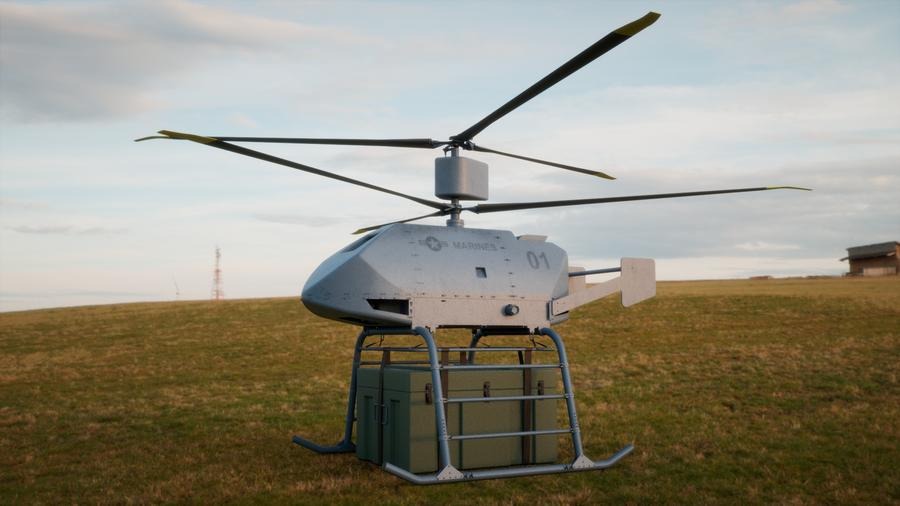
RESTON, Va. (April 18, 2023) – Leidos (NYSE:LDOS), a FORTUNE 500 science and technology leader, was recently awarded a new prime contract to develop an uncrewed aircraft system (UAS) that can autonomously resupply forward-deployed ground forces. The firm-fixed-price, multiple-award contract has a period of performance of 18 months to build a single prototype for the Marine Corps.  

“Leidos leads the industry in taking cutting-edge innovations and making them mission-ready today,” said Tim Freeman, Leidos senior vice president and Airborne Solutions operations manager. “The ability to autonomously deliver hundreds of pounds of supplies over long ranges will be a game-changer for the warfighter. We look forward to demonstrating how the Leidos’ SeaOnyx solution will help deliver a logistics advantage to the Marines and other branches of the military.” 

Under the contract, Leidos will develop, deliver and demonstrate an autonomous medium unmanned logistics system – air (MULS-A) prototype. The prototype will then be used to perform a logistics distribution mission at the tactical edge of the battlefield. The goal of the project is to demonstrate a prototype UAS that can carry a logistics payload between 300 and 600 pounds to a combat area with a radius of 25 to 100 nautical miles. The work will be performed at locations in Colorado, Ohio, Oregon, California, Nevada and Arizona.  

Leidos teamed with Phenix Solutions to design the SeaOnyx prototype. Phenix is a non-traditional, veteran-owned small business defense contractor that develops UAS aircraft for a variety of missions.  


Sea Cadets at Sea: Tall Ship Sailing in Southern California


Dover AFB supports US Navy MQ-4C Triton mission in Guam

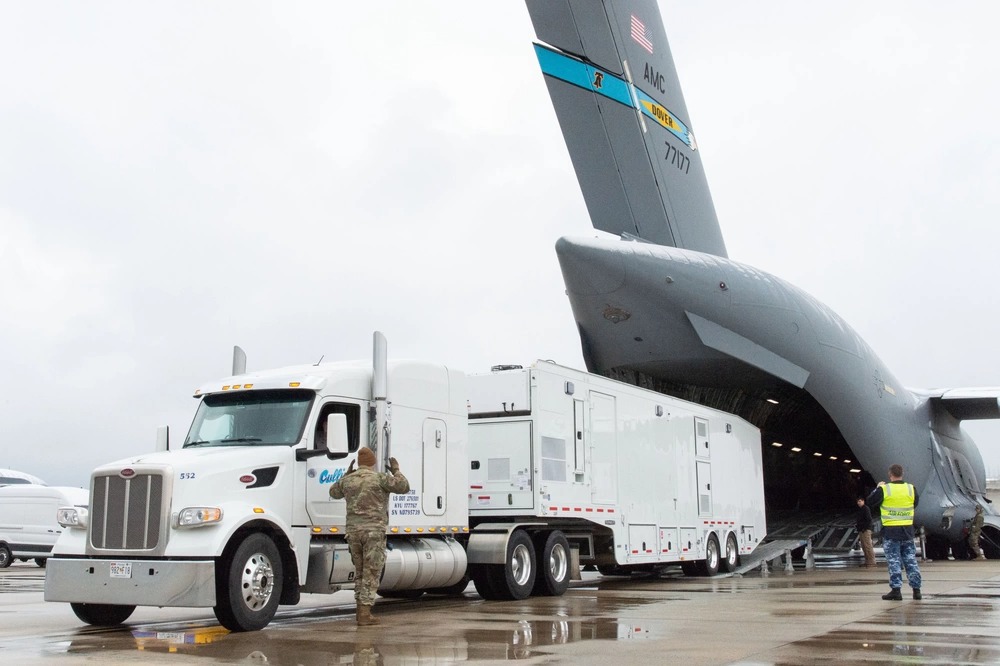
Photo By Roland Balik | Senior Airman Joel Dooley, 436th Aerial Port Squadron expediter, marshals a Mobile Remote Quick Look trailer onto a C-17 Globemaster III at Dover Air Force Base, Delaware, Feb. 1, 2023. The RQL trailer was transported to Andersen AFB, Guam in support of the U.S. Navy MQ-4C Triton Orbit 1 operation. The MQ-4C is an unmanned aerial vehicle operated by the U.S. Navy for maritime patrol supporting intelligence, surveillance and reconnaissance operations. (U.S. Air Force photo by Roland Balik)

Release from 436th Wing Public Affairs 

***** 

DOVER AIR FORCE BASE, DE, UNITED STATES 

04.13.2023 

Story by Roland Balik

Release from 436th Wing Public Affairs 

DOVER AIR FORCE BASE, Del. – Teamwork between the U.S. Air Force, U.S. Navy and Royal Australian Air Force facilitated the shipment of Forward Operating Base equipment and a Mobile Remote Quick Look trailer to Andersen Air Force Base, Guam, in support of MQ-4C Triton Orbit 1 operations, Feb. 1, 2023. 
 
The MQ-4C is an unmanned aerial vehicle operated by the U.S. Navy for maritime patrol supporting intelligence, surveillance and reconnaissance operations. Additionally, the RQL trailer is a self-contained secure facility that will store ISR data and make it available to the intelligence community. 
 
A Mobile RQL trailer and palletized FOB equipment arrived at Dover AFB, Delaware, Jan. 30, to be inspected and weighed during a joint inspection conducted by 436th Aerial Port Squadron special handling personnel and members assigned to the Persistent Maritime Unmanned Aircraft Systems Program Office (PMA-262) Triton, Naval Air Station Patuxent River, Maryland. 
 
“This lift is in direct support to the standup of U.S. Navy Triton capability in Guam in support of the 7th Fleet,” said RAAF Squadron Leader Stephen Grimmer, PMA-262 ground segment execution lead. “Triton is a cooperative program between the U.S. Navy and RAAF. This is a significant milestone for the Triton program as we stand up the capability.” 
 
The trailer and pallets were loaded on a C-17 Globemaster III assigned to the 436th Airlift Wing and flown by an aircrew from the 3rd Airlift Squadron. 
 
“The coordination between representatives from Dayton T. Brown Inc., Northrop Grumman Corporation, Naval Air Systems Command, RAAF and the 436th APS regarding airlift requirements started about a month prior to execution,” said Tech. Sgt. Daniel Romeyn, 436th APS capability forecaster. “Coordination efforts from the Aerial Port included scheduling truck delivery appointments for cargo, cargo build-up requirements, a joint inspection, base access and customer service with the shipper.” 
 
Upon becoming fully operational in the Pacific theater of operations, the RQL trailer will be operated by the U.S. Navy’s Unmanned Patrol Squadron 19, aided by field service representatives which support the 7th Fleet. 
 
Later this year, Grimmer and his team will oversee the standup and installation of Triton ground segments at RAAF Edinburgh, Adelaide, South Australia. 
 
“We have worked closely together with our partners from the RAAF over the last several years to deliver the MQ-4C Triton aircraft to Australia,” said U.S. Navy Capt. Josh Guerre, PMA-262 program manager. The MQ-4C Triton will significantly improve Australian and U.S. capabilities in the region, enhancing our joint ability to respond to regional challenges—including humanitarian assistance and disaster relief.” 


USCGC Oliver Henry returns to Guam after strengthening partnerships in Oceania during mission to combat illegal fishing in Pacific

Release from U.S. Coast Guard Forces Micronesia/Sector Guam 

***** 

USCGC Oliver Henry returns to Guam after strengthening partnerships in Oceania during mission to combat illegal fishing in Pacific 

U.S. Coast Guard Forces Micronesia/Sector Guam 

SANTA RITA, Guam — The crew of USCGC Oliver Henry (WPC 1140) returned to Guam on April 9, 2023, following a 30-day expeditionary patrol in support of the Pacific Islands Forum Fisheries Agency’s Operation 365 and Operation Rematau to stop illegal, unreported, and unregulated fishing in the Pacific. 
 
Among the significant elements of this expeditionary patrol: 
• Patrolled 5,250 nautical miles over 30 days 
• Dedicated 23 days on scene within exclusive economic zones of the partner nations of the Republic of Palau and the Federated States of Micronesia, with four days in the high seas pocket between FSM and Papua New Guinea, east of Palau, and one day within the high seas off the west side of Palau 
• Completed nine boardings on foreign-flagged fishing vessels under the authority of the Western and Central Pacific Fisheries Commission, with 12 potential violations discovered 
• Completed five bilateral boardings on foreign-flagged fishing vessels under the authority of the embarked Palauan shiprider in Palau’s domestic fishing zone; no violations discovered 
• Executed four port visits in Yap, FSM, and Koror, Palau, exercising a hub and spoke model of operations with three of four port visits to Koror, allowing for increased time spent on the mission in the region rather than on transits to and from a patrol area 
• Completed six shoreside engagements, including hosting 80 students from Palau schools, conducting a damage control subject matter exchange with the crew of the PSS Kedam, and visiting Satawal, FSM 
• Completed one underway engagement, conducting a passenger exchange and joint sail with the crew of the FSM-based FSS Tosiwo Nakayama (P901) 
 
“The return on investment for our partners and the nation through the use of the Fast Response Cutters and the U.S. Coast Guard in this region is undeniable, and we hear that demand signal loud and clear,” said Capt. Nick Simmons, commander of U.S. Coast Guard Forces Micronesia/Sector Guam. “We are continuing to adapt how we conduct these longer patrols, far from home, with a platform originally designed for U.S. mainland near-coastal operations of a week to 10 days at sea. Basing out of a partner’s port for multiple legs, rather than island hopping over a longer distance, gives us more time with fewer transit days in these harder-to-reach locations, more time spent building relationships in country, and better support and recovery for our crews.” 
 
A major highlight of the patrol was the engagement on the FSM island of Satawal. Home to about 500 inhabitants, the community hosted its first Pwo – Master Navigator Indoctrination Ceremony since 2007. The Oliver Henry crew, by invitation, held a dialogue and observed local customs with the Piailug family and other elders. A small team of the commanding officer, an engineer, an electronics technician, and a hospital corpsman joined local chiefs to discuss regional topics and challenges in such a remote and austere location. 
 
In 1976, Pius Mau Piailug, a master navigator from Satawal, Yap State, Micronesia, navigated the famous traditional sailing canoe Hōkūle’a on its first voyage without navigation instruments in over 600 years on the ancestral Polynesian sea route from Hawai’i to Tahiti. Subsequently, he taught Hawaiians and other Polynesians the art of navigating guided only by the signs of land, stars, birds, and patterns of waves. He passed away in 2010. The Oliver Henry team spent time with his surviving family. The gathering included master navigators from Hawaii, Saipan, and FSM. Only a handful of master navigators are alive today. 
 
In support of the Pacific Islands Forum Fisheries Agency’s Operation 365 and Operation Rematau, which nests under the U.S. Coast Guard’s Operation Blue Pacific, the crew patrolled through the seas off Palau, conducting bilateral shiprider boardings. They subsequently patrolled the high seas pocket south of the Federated States of Micronesia, discovering a dozen discrepancies and potential violations in the use of vessel monitoring systems, required markings, exemption permits to transship fish, and logging of catch under the requirements set forth by the Western and Central Pacific Fishing Commission. 
 
“It’s a good feeling for the boarding team to know we’re making an impact by documenting these potential violations and educating fishing crews on the requirements,” said Lt. Freddy Hofschneider, commanding officer of Oliver Henry. “On every vessel, the crews met us with respect, positive interest, and a desire to correct deficiencies. Several captains told us this was their first boarding by the U.S. Coast Guard.” 
 
The crews of Oliver Henry and the Tosiwo Nakayama conducted a joint patrol near Yap State in support of Operation 365, part of the FFA’s ongoing regional monitoring control and surveillance operations to counter IUU fishing in the Pacific. OP365 requires the concerted and consistent effort of all 17 Pacific Island Forum Fisheries Agency member nations and the four members of the Pacific Quadrilateral Defence Coordination Group countries, Australia, France, New Zealand, and the United States, to be successful. 
 
“The crew enjoyed conducting a professional exchange, including navigation and seamanship training during a close-quarters formation steaming with our colleagues aboard the FSS Tosiwo Nakayama before they pulled into Yap,” said Hofschneider. “In Palau, we were glad to exchange best practices for damage control with our friends at the Division of Maritime Security ahead of their next underway period.” 
 
In Palau, the Oliver Henry crew hosted over 80 students from Emmaus-Bethania High School and the Palau Community College for tours and demonstrations at the port. This visit followed presentations on the U.S. Coast Guard and IUU fishing by the U.S. Coast Guard Forces Micronesia Compact of Free Association liaison officer and maritime advisor. The following day members of the Oliver Henry engineering department worked through damage control drill administration and planning with personnel from the PSS Kedam. The Forces Micronesia team, joined by operations specialists from the Joint Rescue Sub-Center in Guam, subsequently conducted search and rescue training. 
 
“U.S. Coast Guard Forces Micronesia and our cutter crews are dedicated to serving our partners by providing valuable requested training and resources to meet their needs. The SAR training came at the request of Palau following a recent high-profile search and rescue case,” said Simmons. “Again, we appreciate the efforts of the U.S. embassies and our Australian Pacific Maritime Security Program partners to make these shared multilateral operations possible to increase regional security and prosperity.” 
 
Operation Rematau is how U.S. Coast Guard Forces Micronesia Sector Guam supports the overarching Coast Guard endeavor Operation Blue Pacific to promote security, safety, sovereignty, and economic prosperity in Oceania. Rematau means people of the deep sea, and the effort reaffirms the position shared by the Pacific Island Forum leaders that securing the future requires long-term vision and a carefully considered regional strategy for the Blue Pacific Continent. The operation reinforces the U.S. commitment to working together to advance Pacific regionalism based on the Blue Pacific narrative. It supports U.S. national security objectives while bolstering maritime governance and security. 
 
The Oliver Henry is the 40th 154-foot Sentinel-class Fast Response Cutter named for Oliver T. Henry, Jr., an enlisted African American Coast Guard member first to break the color barrier of a then-segregated Service. 
 
It homeports in Guam, working with U.S. Coast Guard Forces Micronesia/Sector Guam, which comprises nearly 300 personnel to provide a significant portion of the U.S. Coast Guard’s enduring regional presence in Oceania. 

For more U.S. Coast Guard Forces Micronesia/Sector Guam news, visit us on DVIDS or subscribe! You can also visit us on Facebook or Instagram at @USCGForcesMicronesia or Twitter @USCGFMSG.  


Navy to Christen Future U.S. Navy Ship Cleveland

Release from the Department of Defense 

************* 

The Navy will christen and launch the newest Freedom-variant Littoral Combat Ship, the future USS Cleveland (LCS 31), during a 10:00 a.m. CDT ceremony on Saturday, April 15, in Marinette, Wisconsin.  This event marks the last planned side-launch of a ship at the Fincantieri Marinette Marine, Marinette, Wisconsin Shipyard.  Follow-on ships are planned to be launched using a shiplift system. 

The principal speaker Mr. Andrew Haeuptle, director of Navy staff, will deliver the ceremonial principal address. Remarks will also be provided by Rear Adm. Thomas Anderson, program executive officer, ships; Mr. Austin Davis, senior policy advisor, City of Cleveland, Ohio; Mr. Steve Allen, vice president, small combatants and ship systems, Lockheed Martin Integrated Warfare Systems and Sensors; and Mr. Mark Vandroff, chief executive officer, Fincantieri Marinette Marine. Mrs. Robyn Modly, wife of former Acting Secretary of the Navy and Cleveland native, the Honorable Thomas B. Modly, will break a bottle of sparkling wine across the bow to symbolically christen the ship. 

“This christening is a significant milestone for the future USS Cleveland, the ship’s sponsor Mrs. Robyn Modly, and the prospective crew,” said Secretary of the Navy Carlos Del Toro. “LCS 31 will be another step closer to joining our fleet, sailing the open seas, continuing to defend our nation, and representing the strong connection our Navy has with the city of Cleveland.” 

Cleveland is the 16th and final Freedom-variant LCS and the fourth ship to be named in honor of the city of Cleveland, Ohio. Previous USS Cleveland’s were the World War I cruiser (C 19), the World War II light cruiser (CL 55), and the Vietnam-era amphibious transport dock (LPD 7), decommissioned in 2011. 

The Littoral Combat Ship (LCS) class are fast, optimally-manned, mission-tailored surface combatants that operate in near-shore and open-ocean environments, winning against 21st-century coastal threats. LCSs integrate with joint, combined, manned, and unmanned teams to support forward presence, maritime security, sea control, and deterrence missions around the globe. 

The LCS class consists of two variants, Freedom and Independence, designed and built by two separate industry teams. The Freedom variant team is led by Lockheed Martin (for the odd-numbered hulls, e.g. LCS 1). It is a steel monohull design constructed by Lockheed Martin in the Fincantieri Marinette Marine Corporation’s shipyard in Marinette, Wisconsin. 

Media may direct queries to the Navy Office of Information at (703) 697-5342. More information on the Littoral Combat Ship Program can be found at: https://www.navy.mil/Resources/Fact-Files/Display-FactFiles/Article/2171607/littoral-combat-ship-class-lcs/


CNO Gilday and Connecticut Congressman Visit General Dynamics Electric Boat

April 13, 2022 

From Chief of Naval Operations Public Affairs 

GROTON, Conn. – Chief of Naval Operations (CNO) Adm. Mike Gilday traveled to Groton, Connecticut, April 13, and visited General Dynamics Electric Boat with Rep. Joe Courtney (D-Conn.). 

During the visit, they met with Electric Boat leadership, received program briefs, and toured shipyard facilities. 

“We’re working side by side with Congress and industry to build the most ready and lethal fleet we can,” said Gilday. “Today’s visit is an important opportunity to see the progress and improvements being made by our industry partners in New England.” 

Upon arrival, Gilday and Courtney were met by Mr. Kevin Graney, president of General Dynamics Electric Boat. Throughout the afternoon, the leaders discussed shipbuilding, talent management and workforce development, capacity, and capabilities. 

General Dynamics Electric Boat designs, builds, repairs, and modernizes nuclear submarines for the Navy—to include work on the Navy’s new Columbia-class. These new ballistic missile submarines will replace the Ohio-class variant as the Navy’s contribution to the nuclear triad, which remains the most survivable leg of the U.S. strategic nuclear deterrent force. 

“Whenever we talk about ‘the Arsenal of Democracy,’ our defense industrial base needs to be the centerpiece of that discussion,” said Gilday. “The work being done here in Connecticut is vitally important to our Navy, and I’m incredibly appreciative of the team’s collaborative efforts.”  

Gilday last visited Groton in February 2022.


SECNAV Unveils Concepts for Planned Navy Museum

Release from Navy History and Heritage Command 

**************** 

14 April 2023 

From NHHC Public Affairs 

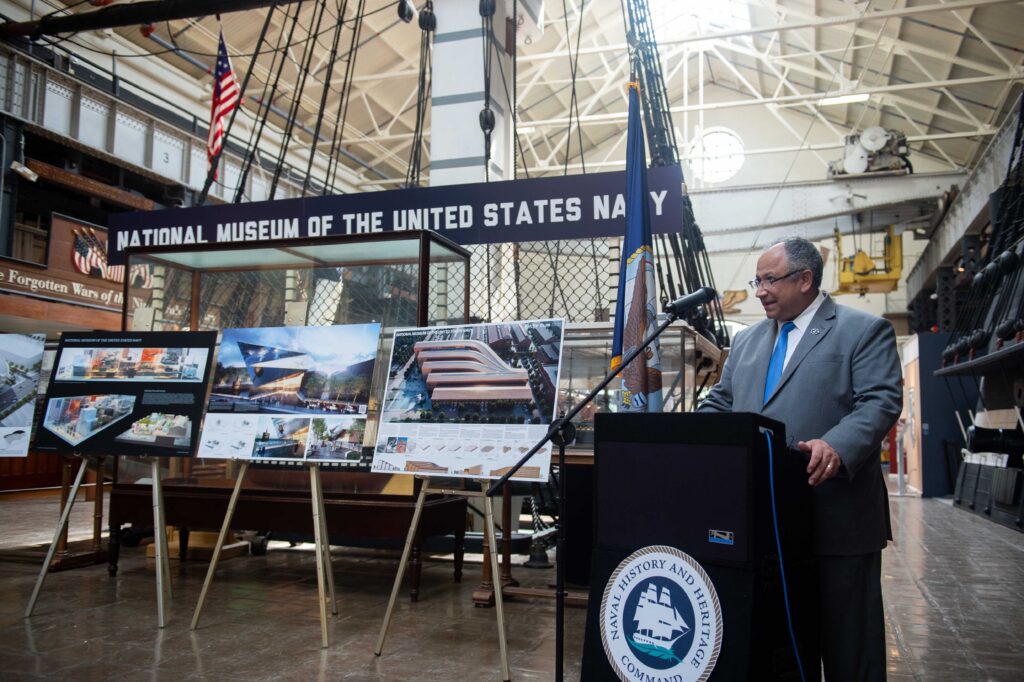
WASHINGTON NAVY YARD - Secretary of the Navy Carlos Del Toro unveiled conceptual renderings from five architecture firms at the National Museum of the U.S. Navy, finalizing the Navy’s Artistic Ideas competition, an effort to explore the possibilities for the planned Navy museum. 

Following the SECNAV’s October announcement of the preferred location for the Navy’s planned museum, Naval History and Heritage Command moved forward with its conceptual development phase and initiated the ideas competition in an effort to explore the full realm of artistic ideas that might be incorporated into a new museum. 
 
The competition sought concepts and ideas for the planned project from a broad range of individuals and architecture firms. Following the initial announcement in December, 80 firms expressed interest in participating; 37 firms then submitted qualifications, and finally, the Navy selected five architecture firms as finalists: Bjarke Ingels Group, DLR Group, Frank Gehry Partners, Perkins & Will and Quinn Evans. 
 
Since January, the firms developed their unique submissions of conceptual ideas to include a museum entrance, an atrium, a ceremonial courtyard, and the incorporation of some of the Navy’s larger artifacts, like a Corsair aircraft, a Swift Boat, and the sail of a submarine. 
 
“We are pleased to display five visions for the future of the National Museum of the U.S. Navy,” said Secretary of the Navy Carlos Del Toro, “while each concept is different, all of them show how we might celebrate our Navy’s accomplishments, honor our veterans and point the way toward the Navy’s future.” 
 
The Navy envisions a future museum that would offer greater public access that could include a new building and the potential renovation of existing historical buildings. The planned museum campus would consist of approximately 270,000 square feet and include about 100,000 square feet of net gallery space. 
 
“The concepts unveiled today are a crucial step in exploring what is possible for the new National Museum of the U.S. Navy,” said NHHC Director Samuel J. Cox, U.S. Navy rear admiral (retired). “We’ll tell the story of the Navy’s history as it continues to unfold, and the ideas developed by our finalists herald a new way of honoring that history by inviting visitors to participate.” 
 
“These concepts mark an important step in the museum building process,” according to Charles Swift, Acting Director of the Museum of the United States Navy, who oversaw the competition. 
 
“These ideas and concepts show what might be possible for a new museum,” said Swift. “We have a number of steps we need to complete before determining a final design, and that first step is having a conversation with America: our Navy, our veterans and our nation, about what we’ve presented today.” 
 
The firms’ concepts are available here: https://www.history.navy.mil/content/history/nhhc/news-and-events/multimedia-gallery/news-photos/nmusn-concepts/nmusn-concepts.html. 
 
The final canvases from the competition will remain on display for public viewing at the Navy’s National Museum on the Washington Navy Yard. Access hours are limited because of museum’s consolidation. Visit http://www.history.navy.mil/content/history/museums/nmusn.html for hours and access guidance. NHHC plans additional public showcases this summer. 
 
Anyone wishing to share ideas or to comment on these Navy museum concepts can find us on Facebook: https://www.facebook.com/NMUSN 

or email: [email protected] 

 
NHHC, located at the Washington Navy Yard, is responsible for preserving, analyzing, and disseminating U.S. naval history and heritage. It provides the knowledge foundation for the Navy by maintaining historically relevant resources and products that reflect the Navy’s unique and enduring contributions through our nation’s history and supports the fleet by assisting with and delivering professional research, analysis, and interpretive services. NHHC comprises many activities, including the Navy Department Library, the Navy Operational Archives, the Navy art and artifact collections, underwater archeology, Navy histories, 10 museums, USS Constitution repair facility, and the historic ship Nautilus.