U.S. Goal: Maintaining Extended Presence in Arctic’s Harsh Environment
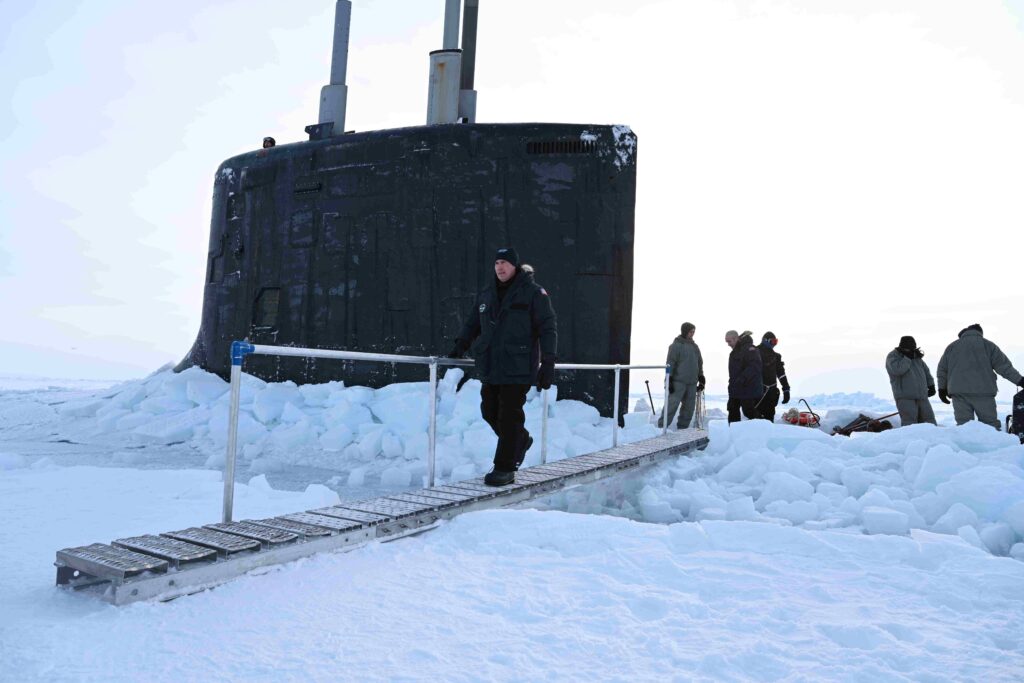
NATIONAL HARBOR, Md. — U.S. Navy and Coast Guard officials say maintaining a reliable presence in the Arctic, by ship, aircraft or submarine, is crucial to protecting American interests and sovereignty in the High North.

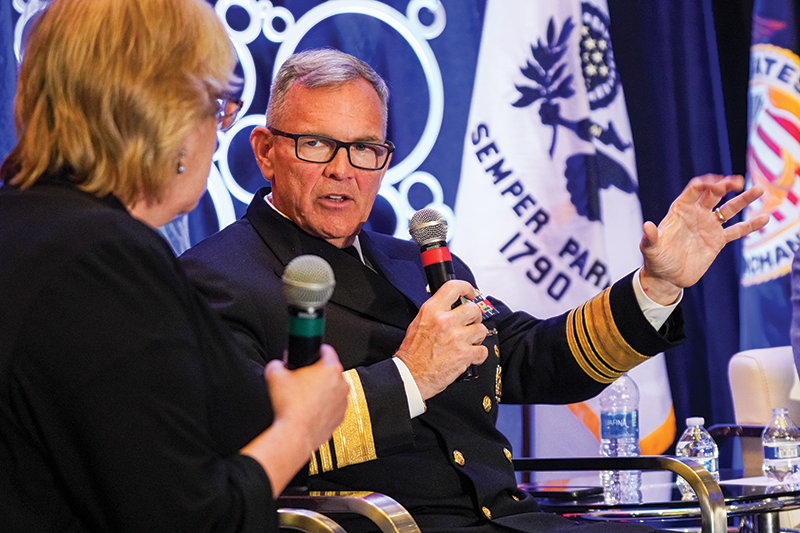
However, Coast Guard Vice Commandant Admiral Steven Poulin said maritime patrol planes and ice breakers aren’t enough to achieve his “top priority’’ of forward presence in the Arctic’s hostile environment.

Speaking on an Arctic strategy panel April 3, Poulin said consideration of the supply and repair needs of those systems and the care of the men and women who crew those systems requires investment in infrastructure to support forward basing. Both Poulin and another panel member, Vice Admiral William Houston, Commander of Naval Submarine Forces and the U.S. Atlantic Fleet, agreed there were three U.S. strategic objectives in the Arctic: sovereignty, safety, and security. They also agreed that to accomplish them U.S. Arctic maritime operations must extend beyond Alaskan waters.

Allies and partners that share values like freedom of navigation, environmental concerns and the rule of law are needed, especially since the United States has only two ice breakers and no deepwater ports or air bases bordering the Arctic Ocean. Kodiak, Alaska near the Bering Sea, is a thousand miles from Alaska’s Arctic coast.

Melting Arctic sea ice due to climate change has been opening new sea lanes, untapped fisheries, and previously unreachable petroleum, natural gas, and mineral deposits across the top of the world.
The Arctic is “an area of increasing human activity” and “increasing global competition, whether it’s for resources, access or presence. And so, for us, the key is good governance, a rules-based order that increases stability for the region. It’s also about protecting America’s sovereignty and sovereign rights,” Poulin said.

Russia has increased its military presence along its Arctic coast, reopening Cold War era bases and building several new ones. China, which styles itself a “near Arctic nation,” has made several scientific expeditions in the region and has conducted at least one naval exercise with Russia inside U.S. territorial waters.

Houston said Navy submarines have plied polar waters since 1947, and U.S. submarines, aircraft and other surface vessels have conducted 100 exercises like ICEX and Northern Edge with the United Kingdom, France, and Canada among other nations’ navies. U.S. submarines are now stopping in Tromso, Norway to pick up supplies and drop off and pick up crewmembers.

Both Poulin and Houston said communications at high latitudes was a challenge. The Navy is investing “a quarter of a billion dollars” in the Arctic where communications is absolutely key, said Houston. “If you cannot communicate, you can get yourself in a lot of trouble.” The Navy has no surface vessels with ice hardened hulls. The Coast Guard’s first polar security cutter, a heavy, armed ice breaker, is not expected to be available for years. Poulin said the Coast Guard was hoping for delivery in Fiscal 2026.
Textron Developing New Unmanned MAGNUSS Minesweeping Technology

*************** 

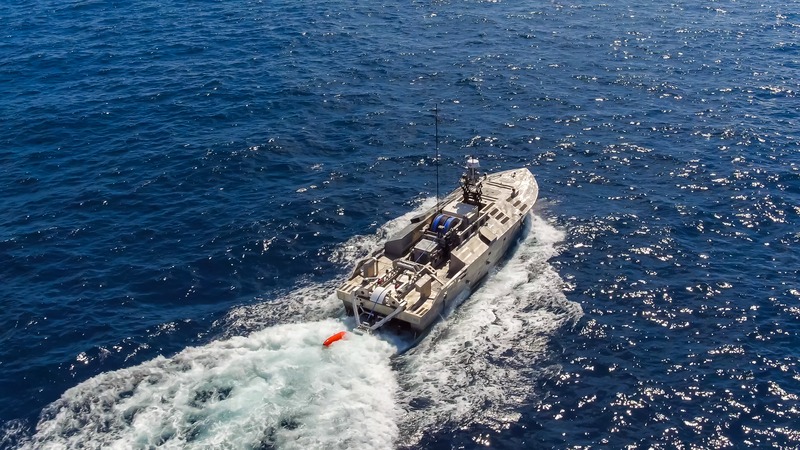
ARLINGTON, Va. — The technology to sweep sea mines without endangering Sailors has made another advance with a recent contract award to Textron Systems Corporation for the development of the Magnetic and Acoustic Generation Next Unmanned Superconducting Sweep (MAGNUSS) system for the Mine-Countermeasure Unmanned Surface Vehicle (MCM USV). 

The MAGNUSS system includes a high-temperature superconducting magnetic source with an advanced acoustic generator, designed to defeat magnetic- and acoustic-triggered sea mines by spoofing them. 

The $20.8 million contract award from the Office of Naval Research (ONR)-sponsored Future Naval Capability effort calls for the “development, fabrication, and demonstration” of the MAGNUSS payload, according to the Defense Department contract announcement, which also said that the payload “is expected to transition to the Naval Sea Systems Command program” for the MCM USV.   

Textron earlier developed the Unmanned Influence Sweep System (UISS), a towed cable with a magnetic and acoustic minesweeping system designed to be deployed by an MCM USV. The UISS is a mission module of the Mine Countermeasures Mission Package for the U.S. Navy’s littoral combat ships. 

Minesweeping with Magnets 

David Phillips, Textron Systems’ senior vice president for Sea Systems and Land Systems said in a March 23 interview with Seapower that the MAGNUSS offered, “a different, unique way to sweep mines” with a modular “non-towed, zero-drag system that sits within the unmanned surface vessel and basically spoofs mines through acoustics and magnetics.” 

Phillips said that the UISS towed sensor sweep cable was less effective in shallow water because it can get damaged by or tangled or snagged in underwater obstacles, including such objects as crab traps. These factors affected the life of the tow cable, and hence a concern with the cost of replacing it.  

He also said the UISS magnetic generator was heavily influenced by the salinity of the water, with lower performance in low-salinity water. He noted that these factors would be of no concern with a payload within the hull of a USV that would no longer need to deploy and retrieve a tow cable. 

Applying a magnetic field through water, the salinity affects the level of resistance, said Tim Livelsberger, Textron Systems’ systems engineer for the project, during the interview. “The more salt you have, the easier it is for the power to flow through. The less salt that you have, the more power you need to generate to maintain that magnetic field. 

“This technology simplifies the operations for the Sailors and increases the envelope where they can operate at and what salinity levels [they can operate in],” Livelsberger said.  

Under the contract, Textron will be working to provide a low-risk, advanced development model of the MAGNUSS that will be put through a demonstration for the Navy using a company-owned Common USV like those the company delivered to the Navy for the UISS program. 

Operational Testing 

Phillips said that following the demonstration, options exist for furthering the Technical Readiness Level and the maturity into Engineering Development Models.   

The MAGNUSS high-temperature superconducting magnetic source is built by American Superconductor and the advanced acoustic generator is built by General Dynamics Applied Physical Sciences

Livelsberger said that the CUSV has gone through Initial Operational Test and Evaluation of the MCM mission package with the littoral combat ship with the UISS and the AQS-20 mine-hunting system.  

He said the Navy’s requirements for the MAGNUSS were essentially the same as for the UISS. 

Livelsberger said that one of the major challenges with using a super-conducting magnetic system is the interoperability of the MAGNUS with the CUSV, shielding the USV’s instrumentation and electronic systems from the intense magnetic field generated by the source. He said the magnetic source leverages the technology used to degauss large warships. 

Last year, Textron’s CUSV was equipped with anti-submarine warfare identification and tracking systems to participate in the Robotic Experimentation and Prototyping Using Maritime Uncrewed Systems, a multi-national exercise conducted in Portugal. 


Navy Commissions First LCS with New GE Composite Engine Enclosure

NATIONAL HARBOR, Md. — The littoral combat ship (LCS) commissioned April 1 is the first equipped with the new lightweight gas turbine engine enclosure designed by GE Marine to provide greater safety and more comfortable engineering spaces for Sailors, a GE Marine official said.

Steve Rogers, director of Marketing and Business Development for GE Marine Engines, told Seapower in an April 3 interview at the Navy League’s Sea-Air-Space Expo in National Harbor, said that the Independence-class littoral combat ship USS Santa Barbara (LCS 32) is the first LCS to be fitted with the new lightweight composite-material enclosure for its engines.

“Traditionally what the Navy has used is a is a steel base on which it sits and then an enclosure with steel walls. So … loud, noisy, hot,” Rogers said. “Now it’s a single forward composite piece for the walls and the roof. So, you don’t have rust maintenance and things like that. But more importantly, [there’s] 60% less airborne noise in the engine room.”

Rogers said the temperature of the enclosure walls, “is anywhere from 25 to 50 degrees cooler. So, a lot less heat is being ejected into the engine room and the Sailors have more access, better access to the engine.”

He said the composite enclosure is 2.5 tons lighter than the steel enclosure with the same footprint, providing ship designers with the flexibility to devote more weight capacity to fuel, payloads, or other uses. The new enclosure meets the Navy’s standards for fire protection and toxicity.

The U.S. Navy will be installing the composite enclosures on its Flight III Arleigh Burke-class guided-missile destroyers and Constellation-class guided-missile frigates. The enclosure also is being installed on the Finnish Navy’s Pohjanmaa-class corvettes.

Rogers said his company has seen no supply chain issues with producing the composite enclosure, pointing out that composite material is made five miles from the plant where the enclosure is made.

GE Marine Engines is working to improve the efficiency of its gas turbine engines while maintaining the same power output and reliability, Rogers said, also noting that the company is working to meet power requirements for warships to deploy such systems as laser weapons.

He said GE Marine Engines is expanding its global network — maintenance, repair, and overhaul (MRO) facilities and service technicians — to meet the requirements of its far-flung customers. The company maintains MROs in Canada, Germany, India, Italy, Japan, and South Korea.


Coast Guard Uses New Tech for Oil Spill Response

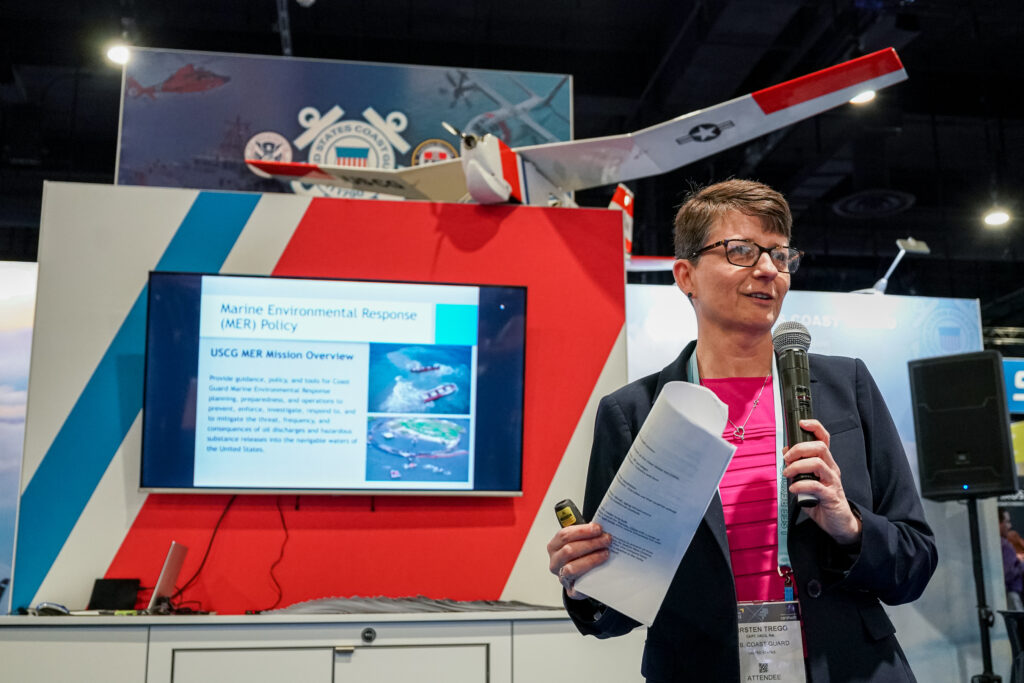
Kirsten Trego talks about the USCG – Oil Spill Response: Tech Effort on the Horizon in the exhibit hall.

When most people think of the U.S. Coast Guard, they envision daring rescues at sea. But the USCG has a variety of lesser-known but equally important duties, said USCG Capt. (Ret.) Kirsten Trego.

During the Monday morning presentation, “USCG Oil Spill Response: Tech Efforts on the Horizon,” Trego discussed how the Coast Guard is the federal on-scene coordinator for oil-discharge cleanup in the coastal zone. That zone not only includes the nation’s shores, but also rivers, waterways, the Great Lakes and more.

“If something happens, we’re the best prepared,” she said.

The USGS has a 30-person team dedicated to oil-spill responses. One of the team’s focuses is working with the oil and gas industry, state and local governments, federal agencies and academia to research how oil spills are evolving and how best to deal with them.

Trego said these research initiatives include the Great Lakes Oil Center of Expertise, which is dedicated to research, training and testing focused on freshwater and cold-weather conditions during an oil-spill response.

The Coast Guard is also increasingly relying on uncrewed systems to more quickly and safely respond to spills, Trego said. New technology like sub-surface remote sensing uses long-range autonomous underwater vehicles to detect oil under ice in the Great Lakes. There is also an air focus, including remote-sensing unmanned aircraft systems (UAS).

“And where the fun is, is the NOAA MESDIS Marine Pollution Surveillance Program from space,” Trego said. Remote-sensing UAS can see oil spills from space, characterize them and report the data.

Trego anticipates more UAS involvement in oil-spill responses in the future. “In the changing landscape of more oil exploration and more risk, traditional methods are no longer viable,” she said. “When spills happen, we need to be ready and available to handle them.”


Panelists Discuss Challenges in Navigating Space as a Warfighting Domain

Space may have been the final frontier for the Starship Enterprise, but it’s the current frontier for the worlds’ fighting forces. As nations race to conquer this military high ground, the U.S. Department of Defense and private industry are increasingly working together to ensure American warfighters’ place in space now and in the future.  

During the Monday afternoon panel, “Space: The 5th Warfighting Domain,” four representatives from the military and industry discussed the following questions from moderator Theresa Hitchens, a reporter with Breaking Defense, and audience members. 

We’ve heard a lot about how the threat environment is changing. What keeps you up at night in that regard?

VADM Jeffrey Trussler, USN, deputy chief of naval operations for information warfare, N2/N6, Office of the Chief of Naval Operations/Director of Naval Intelligence, said he’s concerned about both the expanded use of the RF spectrum and China’s efforts in space.

Because the Navy is reliant on RF, it needs to look at the best ways to use the RF spectrum as the space layer proliferates, he said.

Meanwhile, China has made its intentions for space supremacy public knowledge, and that’s earned the attention of the Department of Defense.

“I’ve never seen a department more focused on an adversary and what we need to do,” Trussler said. “The work we’re doing in space, we’re going to move out and move out fast.”

Derek Tournear, PhD, executive director, Space Development Agency, discussed resiliency. His company launched 10 satellites on Sunday as part of its effort to put hundreds of small satellites in the sky rather than a few large ones that are easier to shoot down. Tournear said Space Development Agency is also concerned about common mode failures, especially cyberthreats, RF spectrum threats, and supply-chain threats.

Steven Butow, director, space portfolio, Defense Innovation Unit, said from a commercial standpoint, economic security and national security are intertwined. That makes it important to work across all levels of government for financial stability.

How do you deal with overclassification?

Butow said an argument can be made that moving fast is more effective than locking down information for long periods of time.

“Industry knows how to lock down information, but also how to release it and commoditize it,” he said.

Ed Zoiss, president, space & airborne systems, L3Harris Technologies, said a private company can be a matchmaker when its customers are working on similar classified technologies.

Trussler believes the problem isn’t just overclassification. “Even our simple acquisition processes give information to China,” he said. “It’s about how we share information and doing it right. It’s not as simple as overclassification.”  

Tournear made the case for selectively releasing information. “We can’t deter if can’t talk about it. Thirty years ago, we couldn’t say ‘national reconnaissance office,’ but the Soviets already knew we had it,” he said. “We need to make sure we know what we need to protect, but also talk about what we’re doing so there’s a deterrence factor.”

LEO (low earth orbit) has thousands of satellites. How concerned are you about debris, signal interference and collision?

“Two thoughts: Space is congested, and space is big — it depends on the orbital regime,” Tournear said. There can be unintended consequences to mitigating congestion, but he believes that policies that promote being a good steward in your orbital slot can be effective.  

Butow pointed out that there are more planes in the U.S. airspace than satellites in LEO, but the planes are regulated. That’s why he thinks it’s important that a space traffic commission be formalized and adopted on a global scale.


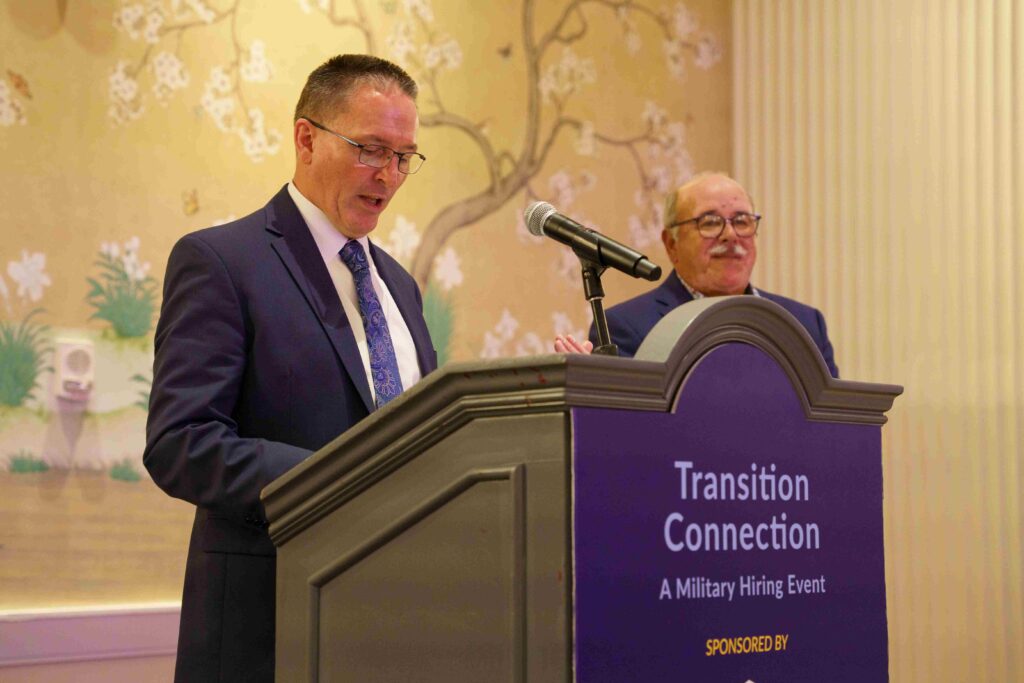
Transition Connection Provides Career Support for Service Members

Over a million men and women serve as active-duty members of our military, with an additional 800,000 in reservist roles. Every year, approximately 200,000 of those service members transition out of the military and into civilian roles. That transition is not always easy.

Transition Connection is an important hiring and networking event that links everyone in the military community, from enlisted service members to veterans to military spouses and civilians, with organizations looking for the caliber of employees that come from having a strong military connection. 

Navy League CEO Mike Stevens kicked off the event, introducing Dr. Ernie Rosado, Director of Military Outreach for Columbia Southern University. The Navy League has recently partnered with Columbia Southern to offer a new scholarship for military spouses that grants 60 credit hours towards any degree program at CSU.

“You folks are critical in this next process for all these folks that are transitioning,” said Rosado. “I know you will match that individual that has been protected by the military for years. And now they’re stepping out and they’re by themselves with their families. So, help them out. Let’s do a good job today,” he said.

During the four-hour event, members of the military had the opportunity to meet with some of the leading employers seeking to make offers to individuals that are either transitioning out of military service, trying to find a job that offers flexibility for military families on the move, or looking for out-of-the box options and support for civilian employment.

First time participants from American Systems commented on the big turnout and were excited to assist service members with the hiring process. “We support a number of different types of programs throughout the country and enterprise,” said Ed Wakeley and Chris McBeth of American Systems. “I support mostly Navy waterfront programs,” commented McBeth. “So engineering, training of getting ships ready to get back out to the South China Sea.”

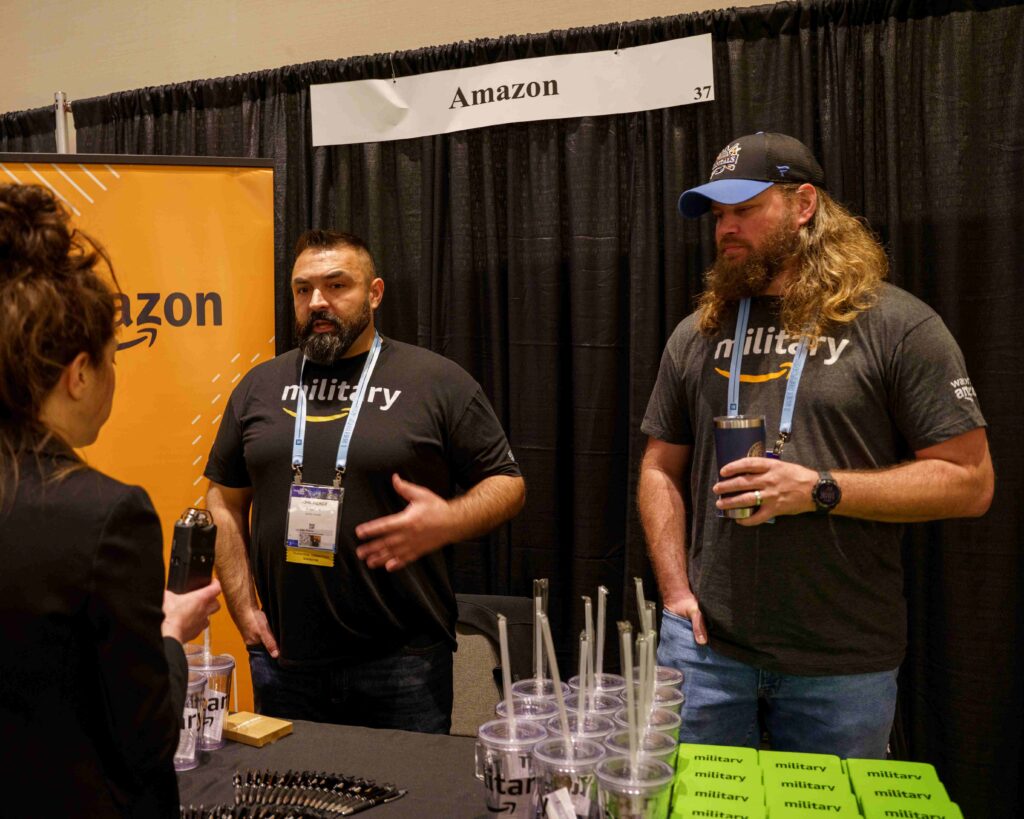
Amazon, a regular Sea-Air-Space participant, have pledged to hire 100,000 transitioning service members, veterans, and spouses over the course of five years, said representatives John Pierce and Matt McGury. “As transitioned service members and advocates, we’re here to help answer questions [and] give guidance,” said Pierce. He also stressed that many of the roles at Amazon are a good fit because they utilize similar skill sets. “A lot of our data center positions are cleared facilities […] operations mission critical facilities, very similar for military individuals. The skill sets that they offer work very well within our teams and the jobs that we have,” Pierce said.

Laura Hatcher, a 31-year Navy veteran turned photographer, wasn’t at the event to hire, but to provide professional headshots to attendees at no cost. “This is my second career, and the majority of my clients are transitioning veterans, because that’s what I went through,” Hatcher said. “I understand it. And I love these kinds of events, mainly because you get to stay in the community and [help] a lot of people that are looking for jobs,” she said.


HII Dedicated to STEM

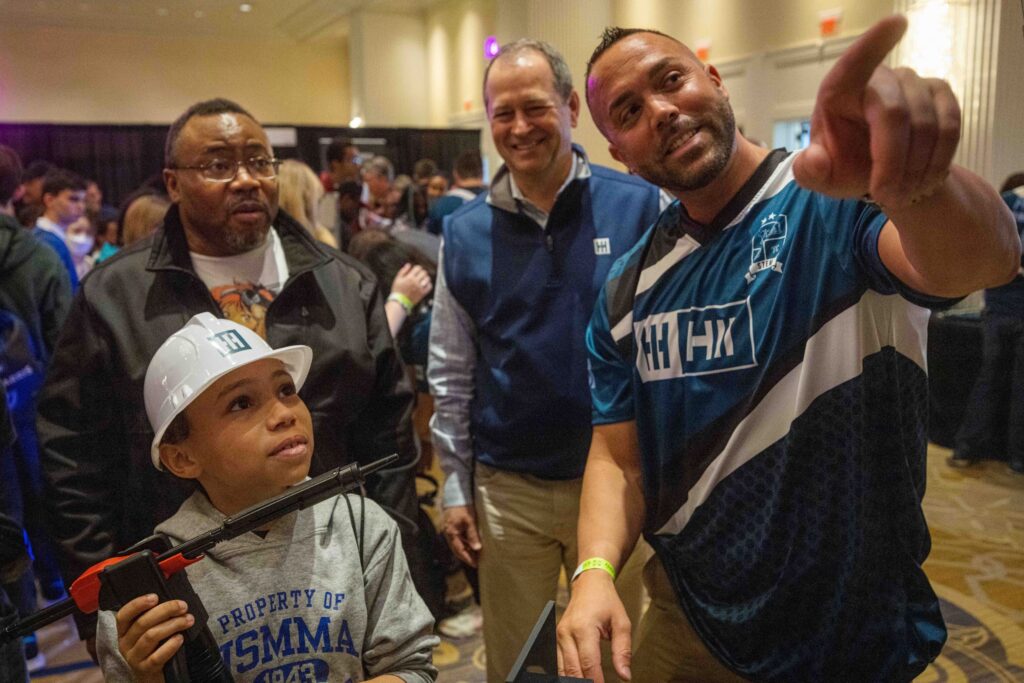
Amidst a maze of colorful exhibition booths, a bustling stream of kids and parents explore cutting edge tech, including 3D printers, tablet-controlled robots, rocket testing stations, and hands on (literally!) electricity experiments.

America’s largest shipbuilder, HII, is at the center of it all with a huge variety of interactive exhibit stations and lots of smiles from their enthusiastic staff. Grant Ronquillo and Kelsie Rountree (mechanical engineer and trade school coordinator for HII, respectively) both talked about the fun being at the Navy League Expo, grinning as they watched kids learn how to weld in a virtual reality simulator.

President and CEO of HII, Chris Kastner, also spoke with Seapower about HII’s dedication to STEM, including a rigorous internship program. “We have a good conversion rate from our interns, especially our technical interns, because we actually give them real work to do when they come into the company,” he said. “They’re not just doing busy work.”

But ultimately, HII’s focus is on the benefit to the larger community.

“If we don’t invest our communities, in STEM, and make sure we have technical talent that can work in the shipyards, then we’re not doing the right thing for the community,” said Kastner.


Building a City

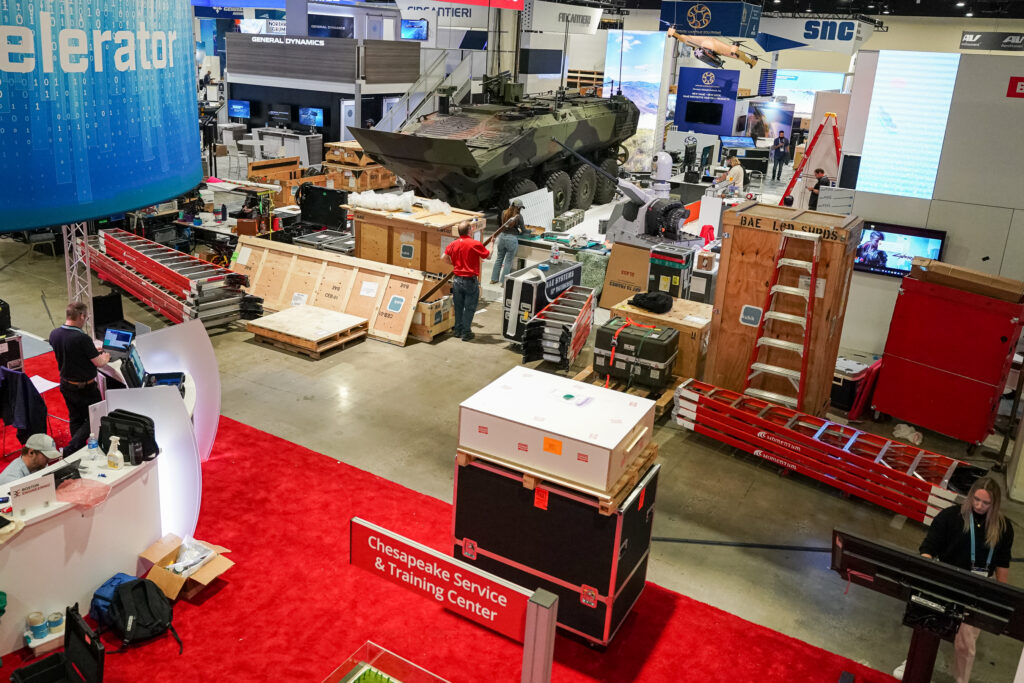
The Exhibit Hall under construction.

Armchair experts and motivational speakers the world over are fond of saying that Rome wasn’t built in a day. Less an historical account of Roman expediency, the saying is meant to convey the idea that great things take time. Civilizations don’t happen overnight. And certainly, building a city represents a commitment to an idea.  

The sprawling city you see before you here at Sea-Air-Space 2023 also wasn’t built in a day. But close. It took three. 

Last Thursday, these exhibit halls were empty shells. Footsteps rang across football-field expanses, voices echoed, and dust motes — not bands — played in ballrooms. We got to work. Everyone, from Navy League staff to contractors and vendors, to exhibit builders, to operations and logistics experts rolled up their sleeves and began the process of turning nothing into something. And not just any something, but something amazing. 

The exhibition booths themselves are an incredible feat on their own. They showcase possibilities, and in many cases, fantastic realities of technology and innovation that will bulwark our sea services and support their missions in the years to come. The panel discussions and other events are built as well, and not only with the physical infrastructure of microphones, lights, speakers, and chairs. Our Navy League team built these events with dedication, with people, and with a commitment to an idea.  

Our idea is this: What if we amass the best and brightest together for three days once a year, put our collective heads together, and create real solutions that affect the viability of our seapower. What if we change our world. What if.  

Welcome to our city.  


Q&A with Naval Supply Systems Command

Seapower magazine interviews Vice Commander Kurt J. Wendelken 

What are the roles of the Naval Supply Systems Command? 

  1. NAVSUP and the Supply Corps conduct and enable supply chain, acquisition, operational logistics and Sailor & family care activities with our mission partners to generate readiness and sustain naval forces worldwide to prevent and decisively win wars. 

How is the era of great power competition affecting NAVSUP’s roles and responsibilities? 

  1. As Navy’s end-to-end supply chain integrator, NAVSUP is working hard to maximize efficiencies and effectiveness in Navy’s supply chains. One major initiative is Naval Sustainment System-Supply (NSS-S). Naval Sustainment System (NSS) is a combination of commercial best practices, process improvements, governance and oversight to maximize efficiencies and effectiveness within available means. NSS-Supply embraces industry best practices tailored for specific Navy needs and fleet operations in order to reduce maintenance turnaround times, increase end-to-end velocity of spares, repairs, and reduce costs.   

Why does the Navy’s supply chain need the transformation of the Naval Sustainment System-Supply? 

  1. NSS-Supply seeks to strengthen Navy’s supply chain in order to increase readiness, thus enhancing combat capability and creating a model of sustainment that will allow the Navy to effectively generate readiness and sustain global navy power. 

How does NAVSUP fit in the Navy’s push for more distributed maritime operations and in the Marine Corps’ expeditionary advance base operations? 

  1. Combined with the most robust, end-to-end logistics doctrine that the world has ever seen, NAVSUP provides uninterrupted (despite contested environment) supply chain management, bulk and aviation fueling capability, material handling equipment, contracting, hazardous material management, household goods and vehicle processing and postal operations to fleet, installation and other service components throughout every area of operations. 

How will management of the supply chain be more integrated and streamlined with the warfighting commands? 

  1. By extension, NSS-Supply embraces industry best practices tailored for specific Navy needs and fleet operations in order to reduce maintenance turnaround times, increase end-to-end velocity of spares, repairs, and reduce costs. 

What major segments of the supply chain are not owned by NAVSUP? How does the Defense Logistics Agency’s roles compare with those of NAVSUP? 

  1. NAVSUP and the Supply Corps conduct and enable service specific supply chain, acquisition, operational logistics, and Sailor & family care activities with our mission partners to generate readiness and sustain naval forces worldwide to prevent and decisively win wars. The Defense Logistics Agency is the DoD executive agent for specific classes of supply that are common across the military services like food, fuel, construction material, and medical supplies. They also provide extensive warehousing services across DoD.  

What are that current challenges that NAVSUP faces with the defense industry in executing the supply chain? 

  1. Executing an effective naval supply chain is increasingly challenging, in part due to the Defense Department’s pressure on industry to become lean. We now face raw material shortages, weapon systems obsolescence, a shrinking skilled labor pool, excessive acquisition lead times, and a dwindling sub vendor base with a heavy reliance on sole source vendors. Maintaining our current warfighting edge requires better collaboration and transparency with industry. We need to invest in sustainment up front, consider where prepositioning materials makes sense, and work better to reverse the current trends deteriorating material lead times. 

What new technologies look promising in aiding NAVSUP in streamlining the supply chain? 

  1. NAVSUP manages Navy’s globally distributed, highly complex, and increasingly digital supply chains. LOG IT and Supply Chain systems are critical enablers in generating and sustaining readiness. NAVSUP is proactively taking steps to deliver modern digital solutions that support real-time operations to include system modernization, leveraging internet of things (IOT) technology and machine learning/artificial intelligence to improve asset visibility. 

What can be done to expand competition among suppliers? 

  1. NAVSUP contracting offices attempt to enhance competition through early outreach in an effort to identify as many potential sources as possible. The use of Industry Days is also a popular method among NAVSUP contracting offices for specific types of procurements, such as ship repair or husbanding. These are established days where potential sources are invited to attend and learn as NAVSUP provides guidance on doing business with the government. This is a way to ease private sector concerns and generate interest. 

What can the defense industry do to help the Navy improve its supply chain? 

  1. Just as the Navy has incorporated a “Get Real, Get Better” mantra, so we ask industry to embrace the same. We are all working towards a collective goal of supporting national defense, and it is imperative to operate with transparency and honesty, not distrust. Short-term, be accurate with contract schedules and deliver on time in accordance with contractual commitments. Increase the number and scope of strategic contracts to help offset material, labor, and financial stressors.  Long-term, deepen the partnership with the Navy to create a more effective sustainment environment earlier in weapons system development. With more agility and cooperation, we can identify, plan, and overcome supply chain barriers to better support our fleet, which is the ultimate goal. 


Navy Prioritizes Mental Health with New Playbook

The U.S. Navy has always been dedicated to ensuring that the bodies and minds of its Sailors are ready and prepared to win in combat. But there have been challenges over the years in helping Sailors with mental-health resources during active service, and as they transition out of the Navy into civilian life.  

The Navy Culture and Resilience Office, N17, Office of the Chief of Naval Operations is addressing those challenges through its new Mental Health Playbook. This 28-page playbook, which was released in February, is designed to put mental health tools and resources into the hands of every Navy leader, no matter what their rank. 

“Our goal is that everyone in our great Navy develops a shared understanding about how to conduct mental-health and preventative maintenance for our people, and then where to go for additional resources,” said Rear Admiral Brett Mietus, director of N17. “It’s an incredibly important topic to me and all of the Navy’s senior leadership.” 

The Navy already offers a variety of mental-health resources. Navy N9 quality-of-life programs include Morale, Welfare and Recreation (MWR); Wounded Warrior; Mind Body Mental Fitness (MBMF); and Sailor Assistance and Intercept for Life (SAIL). There are also family advocacy programs, childcare and relocation programs, assistance programs, non-medical counseling at fleet and family-support centers, and more.  

The Navy League of the United States has mental-health resources as well. For example, Sea-Air-Space’s Transition Connection Job Fair, which will be held from 10 a.m. to 2 p.m. on Monday in the Cherry Blossom Ballroom, is one of the ways the Navy League helps with transitioning Sailors’ overall well-being.  

The Mental Health Playbook complements all these efforts through its mission to create a “climate of trust and respect with open, two-way communication; challenging inappropriate conduct or poor leadership; and eliminating stigma for seeking help.” The Playbook is organized into five sections:  

  • Roles and Responsibilities, which is geared toward helping commanders create, “a community of support, where sailors feel connected to the mission, the command and each other.” 
  • Conversations That Matter, which provides strategies for conducting mental-health discussions. 
  • Identifying and Responding to a Mental Health Related Concern, which discusses what to do when sailors are in mental or emotional distress. 
  • Navigating Support Systems, which helps sailors find the right support at the right time. 
  • Navy’s Mental Health Capabilities and Resources, which describes the clinical and non-clinical tools available both inside and outside the military and provides contact information for a variety of programs.   

“Most of the resources that are in the playbook have been out there, but they just haven’t been put together in a way that’s easily digestible and then usable by a fleet leader,” Mietus said.  

Mietus said the playbook is a response to requests and concerns from fleet members about the Navy’s approach to mental health. He noted that while older Sailors aren’t necessarily used to acknowledging or discussing mental-health issues, younger generations are much more attuned to their mental and emotional needs.  

“Our goal is to eliminate stigma when it comes to mental-health care. I think the important thing for us all is to normalize conversations around it,” he said.