U.S. Coast Guard works with counterparts in Saipan to sharpen maritime operations skills
Release from U.S. Coast Guard Forces Micronesia 

***** 

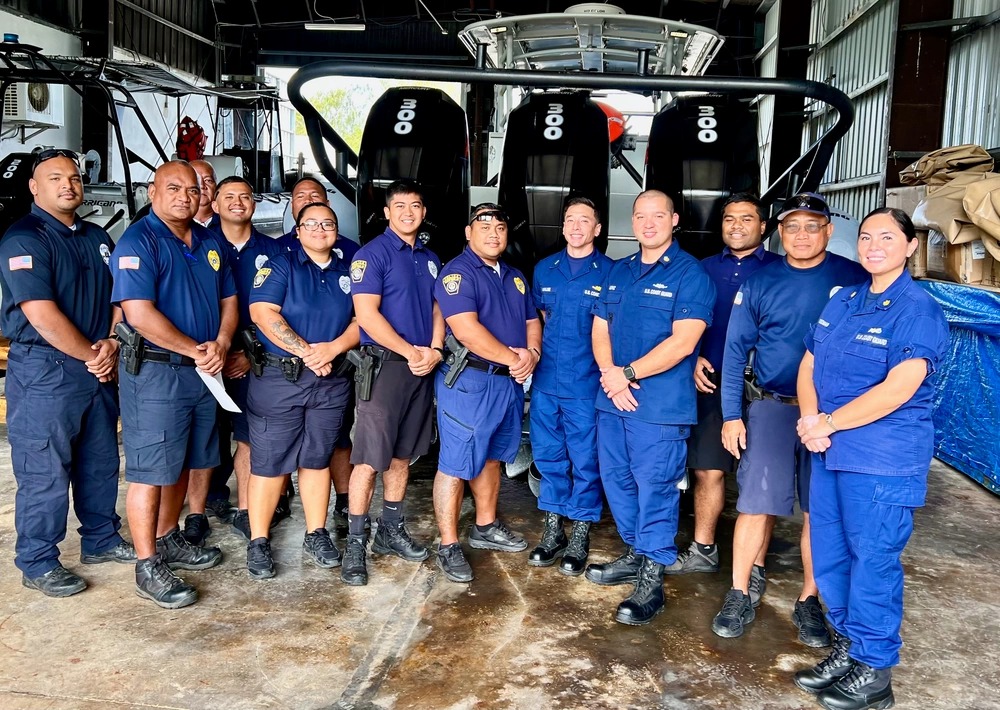
SANTA RITA, Guam —The U.S. Coast Guard conducted a subject matter exchange with boating safety and customs counterparts in Saipan in the Commonwealth of the Northern Mariana Islands on March 21, 2023, to enhance maritime operations management. 

Personnel from U.S. Coast Guard Forces Micronesia/Sector Guam and USCGC Sequoia (WLB 215) with small boat station experience worked with the CNMI Department of Public Safety – Boating Safety and the CNMI Customs and Biosecurity – Marine Unit. 

The exchange was based on the standards used by U.S. Coast Guard small boat stations nationwide and focused on administrative topics, such as completing unit organization manuals, standing orders, detailed duties, assignments, and watch schedules. 

“The engagements were at no cost to our search and rescue and law enforcement partners,” said Lt. Cmdr. Christine Igisomar, U.S. Coast Guard FM/SG maritime advisor. “Future engagement topics will include navigation, training, personal protective equipment, and naval engineering. This engagement series will culminate in a search and rescue exercise in the CNMI, currently slated for August.” 

The U.S. Coast Guard’s last Saipan-based search and rescue exercise took place in August 2022 with 40 CNMI participants from six CNMI agencies and eight Coast Guard members. 

“The excellent participation, support, and free exchange of experience and ideas made for a successful endeavor,” according to Lt. Henry Dunphy, the chief of emergency management and force readiness at U.S. Coast Guard FM/SG. 

That exercise simulated a response to a capsized kayak off Tanapag Harbor, leading to tabletop discussions on planning, safety, and communications, followed by search patterns and boat handling offshore the following day. 

Forces Micronesia/Sector Guam, personnel hold training and search and rescue exercises in Guam, the CNMI, and the Compact of Free Association states. They evaluate notification and response procedures and identify shortfalls in communication and coordination of response during SAR incidents. Each agency holds individual capabilities that complement each other’s efforts and bolsters the overall success of the SAR system. 

U.S. Coast Guard Forces Micronesia/Sector Guam comprises nearly 300 personnel and provides a significant portion of the U.S. Coast Guard’s enduring regional presence in Oceania. These teams conduct the service’s six major operational mission programs: maritime law enforcement, maritime response, maritime prevention, marine transportation system management, maritime security operations, and defense operations. 


Raytheon Technologies awarded $320 million for StormBreaker smart weapon   

Release from Raytheon Technologies 

***** 

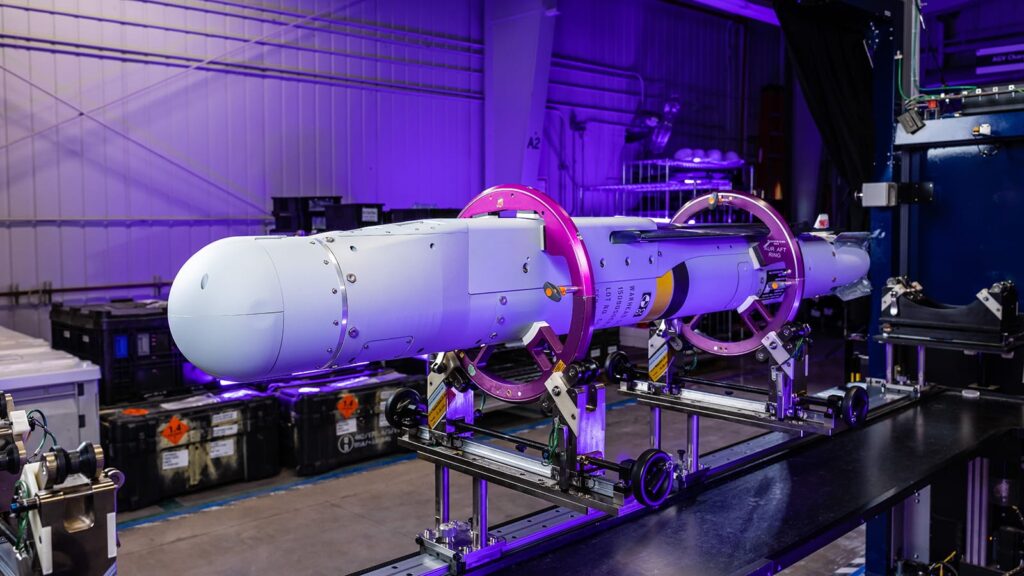
TUCSON, Ariz., (March 23, 2023) — The U.S. Air Force awarded Raytheon Technologies a $320 million contract to produce and deliver 1500 StormBreaker® smart weapons, which are air-to-surface, network enabled weapons that can engage moving targets in all weather conditions using its multi-effects warhead and tri-mode seeker. 

“Having StormBreaker in the warfighter’s arsenal provides unprecedented capability against moving targets, regardless of conditions,” said Paul Ferraro, president of Air Power at Raytheon Missiles & Defense. “It also expands our production line and reinforces our commitment of ensuring the warfighter has the next-level munitions they need to safely and successfully accomplish the mission.” 

StormBreaker is fielded on the F-15E Strike Eagle with testing underway on the F-35B and F/A-18; between the three platforms, StormBreaker has had hundreds of successful operational test shots to date. 

Click here learn more about the StormBreaker smart weapon.  


NIWC Atlantic Provides IT Solutions to the USNS Comfort

Release from Naval Information Warfare Center Atlantic. 

***** 

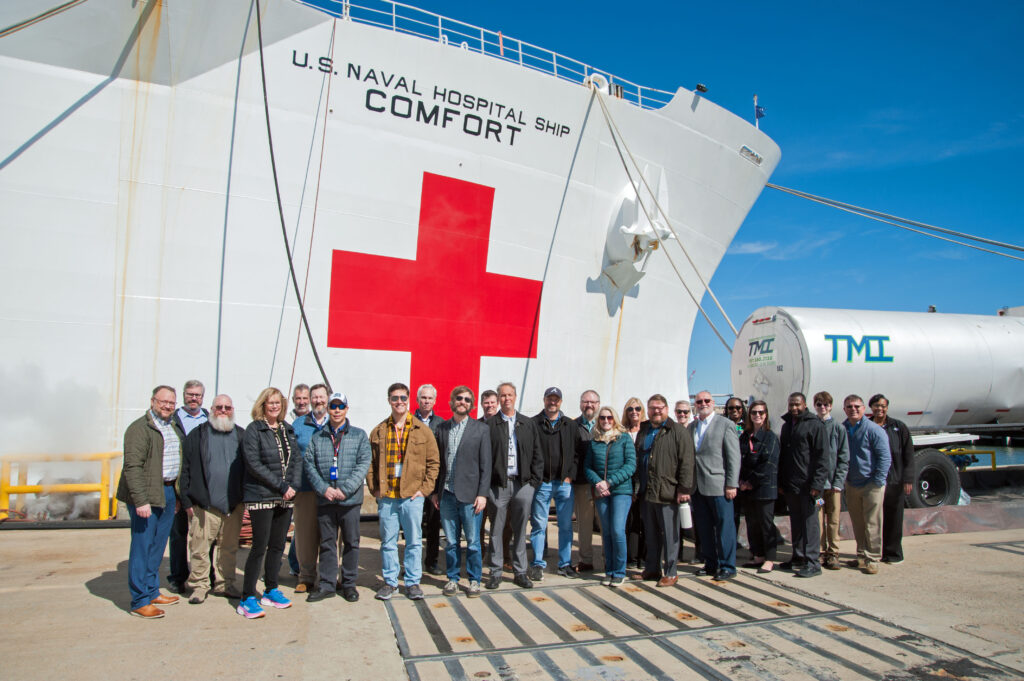
CHARLESTON, S.C. — Naval Information Warfare Center (NIWC) Atlantic employees toured the USNS Comfort (T-AH 20), one of only two hospital ships, in early March to gain better insight of the information technology (IT) on-board with the goal of providing technological solutions. 

“While touring the USNS Comfort, we were able to see the current onboard medical treatment facility IT infrastructure and the infrastructure challenges medical staff encounter while providing patient care including maintaining health record documentation and delivery of pharmacy services, radiology procedures, and laboratory testing,” said Shawn Belcher, Defense Health Readiness Engineering (DHRE) lead. “As new hospital ships are constructed, we will provide input so that current and future critical IT infrastructure security needs are met, ensuring that the very best care for patients and care providers is available.” 

The three-hour tour aboard USNS Comfort allowed employees to see IT equipment that NIWC Atlantic supports and interact with the shipboard users to better understand how support and services can be improved in the future. 

“During the tour, we were able to get eyes on all areas of this hospital ship with humanitarian and combat mission related capabilities as well as the significant IT, power, and heat challenges faced in the delivery of care,” said Bruce Carter, Shore Command and Control, Intelligence, Surveillance, Reconnaissance and Integration Department head. “We are committed to teaming with appropriate organizations and helping them find solutions for these technical obstacles as well as address any that arise in the future during the construction of new of medical ships.” 

The USNS Comfort provides emergency, on-site care for humanitarian missions, primarily in South America, and U.S. combatant forces deployed in war or other operations. Last summer, the ship went on a two-month humanitarian deployment to South and Central American countries where medical staff treated more than 13,000 patients. Prior to any deployment, NIWC Atlantic has multiple IT tasks to accomplish aboard the ship including verifying that user accounts are active and that the electronic health record system is functioning properly as well as providing equipment and technology training for patient administration personnel, pharmacy, radiology, and laboratory technicians that will be used aboard the USNS Comfort during deployment.  

“Engaging with our customers and Sailors to gain a better understanding of their technology challenges is our top priority,” said Capt. Nicole Nigro, NIWC Atlantic commanding officer. “We take every opportunity to interact with the fleet, in their environment, to learn first-hand their limitations so we can provide them with the best solutions and capabilities possible.” 


PEO Ships and NSWC Philadelphia Mark Major Milestone with the Next Generation Guided-Missile Destroyer (DDG(X)) Land Based Test Site 

Release from Naval Surface Warfare Center Philadelphia Division

***** 

By Gary Ell 

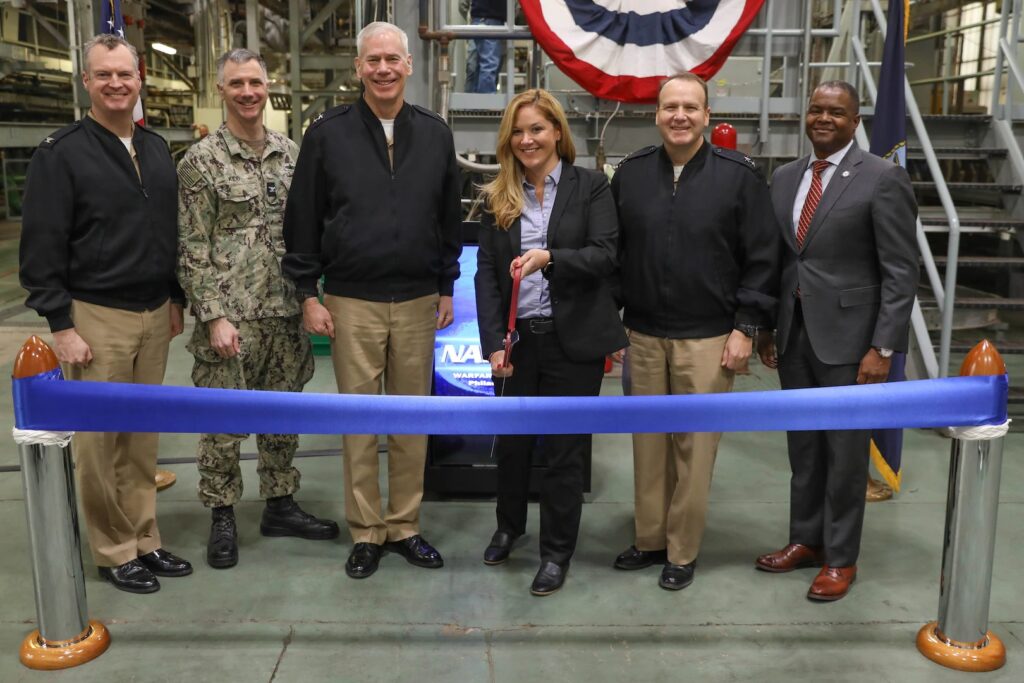
Philadelphia – Program Executive Office (PEO) Ships and Naval Surface Warfare Center, Philadelphia Division (NSWCPD) marked a major milestone with the new DDG(X) Land Based Test Site (LBTS) during a ribbon cutting ceremony on March 21, 2023. The test site program will be used to support and improve reliability and capability, and will also assist with risk reduction efforts and technical oversight for DDG(X) critical systems. 
 
“Today we mark the beginning of a unique test site that will be used to advance the design, reliability and capability of our Nation’s next-generation guided-missile destroyer, the DDG(X), the successor to the supremely successful DDG 51 Arleigh Burke-class,” NSWCPD Commanding Officer Capt. Joseph Darcy said. “The DDG(X) Land Based Test Site is an evolutionary engineering test and evaluation asset that will help build the future: Our Nation’s newest and most advanced destroyers.” 
 
Darcy also focused on the critical role people bring to the development of such advanced U.S. Navy technology. 
 
“NAVSEA’s dedicated and diverse workforce designs, builds, delivers, and maintains the most powerful Navy in the world,” Darcy said. “Our team at NSWCPD has an unrivaled passion to support the Fleet at a time when naval presence and capability is essential to our national security.” 
 
The keynote speaker for the event, Rear Adm. Fred Pyle, Director, Surface Warfare Division (N96), Office of the Chief of Naval Operations and DDG(X) resource sponsor, spoke on the significance of the programmatic milestone. 
 
“Since 1972, many successful applications of land-based testing have proven highly successful for the Navy. Ship classes such as Spruance, Oliver Hazard Perry, Arleigh Burke, and Zumwalt used sites like these to understand new technologies in both the combat system and the HM&E domains,” Pyle said. 
 
Pyle continued, “The LBTS allows us to deliberately reduce risk in advance of construction and write requirements from a place of knowledge instead of uncertainty. We are aligned with Congress on the needs for this important test site, because we know the most expensive place to have discovery is in the shipyard during construction. We need and want to avoid that and these investments allow us to do that.” 
 
“Right here in this complex, you can see Philadelphia’s involvement in DDG 51 acquisition and sustainment from lead ship to our recent DDG 125 crew training in support of Flight III. Our DDG(X) Land Based Test Site will continue that legacy,” NSWCPD Technical Director Nigel C. Thijs (SES) said during his closing remarks. 
 
Along with increased capability and capacity, DDG(X) will provide significant increases in range, efficiency, and time-on-station, providing Fleet Commanders with increased operational flexibility while also decreasing the demand on Fleet logistics. 
 
“Taking an evolutionary vice revolutionary approach, incorporating lessons learned from other major shipbuilding programs and integrating elements of the DDG 51 Class allows DDG to efficiently and smoothly transfer into production as the country’s next enduring guided missile destroyer,” DDG(X) Program Manager Katie Connelly said, “DDG(X) will provide the flexibility and margins needed for readiness today and for decades to come.” 
 
NSWCPD is also home to the DDG 51 Class Land Based Engineering Site (LBES), which is a full scale propulsion system testing experience. LBES testing has been a specialty of NSWCPD since 1943. 
 
“We’ve leveraged experience across our land based test and engineering sites to integrate our significant knowledge of and history with DDG 51 with the lessons learned from more recent test site builds,” Thijs said. “We will continue to share knowledge gleaned from motor and other equipment under test evolutions by holding deliberate engagements across the LBES enterprise to foster a culture of learning and are committed to continually self-assessing and correcting.” 
 
DDG(X) is currently in concept refinement, prior to entering the preliminary design phase. 
 
As one of the Defense Department’s largest acquisition organizations, PEO Ships is responsible for executing the development and procurement of all destroyers, amphibious ships, special mission and support ships, boats and craft. 
 
NSWCPD employs approximately 2,800 civilian engineers, scientists, technicians, and support personnel. The NSWCPD team does the research and development, test and evaluation, acquisition support, and in-service and logistics engineering for the non-nuclear machinery, ship machinery systems, and related equipment and material for Navy surface ships and submarines. NSWCPD is also the lead organization providing cybersecurity for all ship systems. 


Curtiss-Wright Awarded Contract to Provide U.S. Marine Corps with Expeditionary Network Communications Technology

Release from Curtiss-Wright

***** 

DAVIDSON, N.C. – March 23, 2023 –Curtiss-Wright Corporation, (NYSE: CW) today announced that it has been awarded a follow-on contract by the United States Marine Corps (USMC) to provide small form factor network router and switch modules to support communications modernization with highly portable expeditionary 
network communications technology
. Under the contract, Curtiss-Wright will provide a Modular Open Systems Approach (MOSA) deployed baseband system for the Marine Corps Wideband Satellite-Expeditionary (MCWS-X) program. 

“As a leading supplier of tactical battlefield communications solutions, we are very proud to provide the Marine Corps with our proven field-deployable network communications technology to support the MCWS-X program,” said Lynn M. Bamford, Chair and CEO of Curtiss-Wright Corporation. “This contract further strengthens the long and successful relationship we have with the USMC and highlights Curtiss-Wright’s ability to enhance interoperability and improve cost efficiencies with electronics systems that adhere to the DoD’s mandate for solutions based on the Modular Open Systems Approach.” 

Curtiss-Wright is performing the work within its Defense Solutions division in the Defense Electronics segment. The products covered by this agreement will be shipped to the USMC from the Curtiss-Wright Defense Solutions facility in Portland, Oregon. 

For more information on Curtiss-Wright’s Defense Solutions division products, please visit https://www.curtisswrightds.com


Second New England-based Fast Response Cutter to be commissioned in Boston

Release from Coast Guard 1st District

***** 

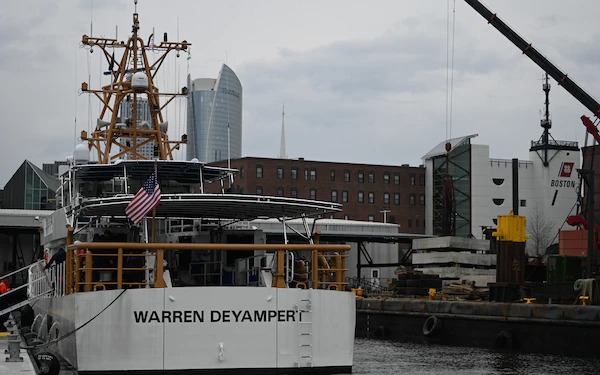
BOSTON — The Coast Guard Cutter Warren Deyampert (WPC-1151) is scheduled to be commissioned during a ceremony at Coast Guard Base Boston March 30. 

The Coast Guard’s newest cutter was accepted by the Coast Guard on Dec. 23, 2022, and will be the second of six Fast Response Cutters homeported in Boston. 

The Sentinel-class fast response cutter (FRC) is designed for multiple missions, including drug and migrant interdiction; ports, waterways and coastal security; fishery patrols; search and rescue; and national defense. The Coast Guard has ordered 65 FRCs to replace the 1980s-era Island-class 110-foot patrol boats. The FRCs feature advanced command, control, communications, computers, intelligence, surveillance and reconnaissance equipment; over-the-horizon cutter boat deployment to reach vessels of interest; and improved habitability and seakeeping. 

Born in Attalla, Alabama, the cutter’s namesake joined the Coast Guard at age 19 and served aboard the Coast Guard Cutter Escanaba during World War II, beginning in August 1941. Deyampert’s primary role was within the food service rating, but he also served as one of the ship’s three rescue swimmers. 

Following a torpedo attack on the U.S. Army transport ship Dorchester in North Atlantic waters on Feb. 3, 1943, Deyampert swam in absolute darkness to rescue survivors in the freezing waters of the North Atlantic. His efforts affected the rescue of more than 100 crew members, many of whom were hypothermic and unable to swim. 

Four months later, June 13, 1943, the Escanaba sank, following an explosion onboard that was believed to be from a torpedo attack. All but two crewmembers were killed in the explosion. Deyampert was posthumously awarded the Navy and Marine Corps Medal and Purple Heart Medal for his heroic rescue of the Dorchester crew. 


Two-Carrier Buy for Navy Beats Inflation, Suppliers Say

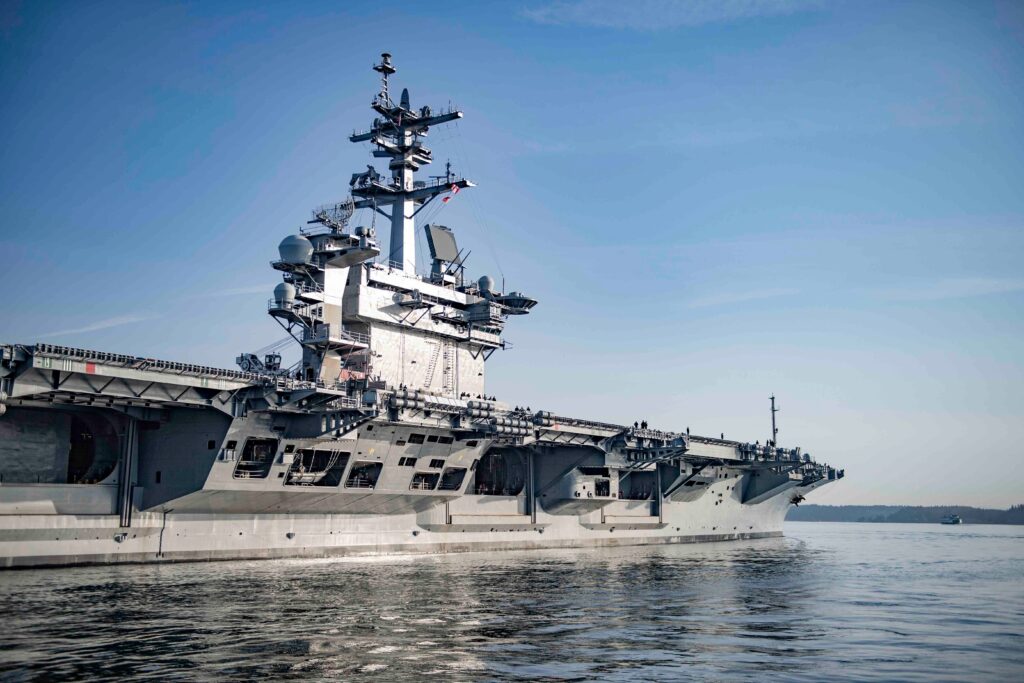
BREMERTON, Wash. (March 17, 2023) The Nimitz-class aircraft carrier USS Theodore Roosevelt (CVN 71) transits the Puget Sound after departing Bremerton, Washington, March 17, 2023. Theodore Roosevelt is conducting a change of homeport to San Diego following an 18-month docking planned incremental availability at Puget Sound Naval Shipyard and Intermediate Maintenance Facility. (U.S. Navy photo by Mass Communication Specialist 2nd Class Gwendelyn L. Ohrazda)

***** 

WASHINGTON — Building two aircraft carriers in a single procurement is economical for the Navy not only in terms of economic order quantities but also in mitigating the effects of inflation. 

Rick Giannini, chairman of the Aircraft Carrier Industrial Base Coalition, an organization of suppliers of components and materials to the building of aircraft carriers, told Seapower in a March 20 interview that the dual procurement of CVN 80 and CVN 81 saved the Navy an estimated $4 billion, and probably considerably more than that because of advance order of materials and components before the increased inflation of the past two years. 

Giannini said that a recent survey of the suppliers showed that inflation is a major concern of the suppliers. 

“Any one of the suppliers that received those advance procurement funds in the two-carrier order “removed [inflation] from the equation,” said Giannini, who also is the former CEO of Milwaukee Valve, one of the suppliers of components to aircraft carriers. “I know our company alone was able to procure two shipsets worth of products, locked in the prices, paid in advance with those funds because of the procurement funding in advance. The value was tremendous compared to prior prices. When you evaluated against what the inflationary cost of those products would be, if we were buying them today, it’s a tremendous advantage.” 

Giannini said that with the current two-ship buy, the suppliers that don’t have advance funding “are struggling with inflationary factors and, like the rest of the country, many of us are struggling to keep and hire competent folks.”   

“We are focused right now on advocating for the next two carriers [CVN 82 and 83] and the funding for the current carriers,” he said. “We continue to talk about stability and predictability. What that really boils down to is the simple message: 2-3-4, which is two carriers with a minimum three-year advance planning funding and built at four-year centers. 

“If we can continue with that it will be a major advantage to our Navy, as it has been for [CVNs] 80 and 81,” he said. “The two-year buy is going to be a major value to the Navy and the shipyards. 

Giannini also pointed out that the mid-life Refueling and Comprehensive Overhauls (RCOH) of aircraft carriers “are a critical part of the industrial supply base. It provides a lot of opportunity for us and it’s a critical part of the whole program, keeping carriers in service. 

“Knowing the RCOH is going to happen is always a good thing — exactly which parts they need to complete that carrier overhaul [are] a lot less known quantities than the original build,” he said. “That always puts a little more pressure on the industrial base. Knowing that it’s going to happen is critical.  

The ACIBC includes 2,000 suppliers across 44 states and 276 congressional districts. 

A recent survey showed that 97% of the suppliers agreed that an increase in centers of carrier procurement from four to five years would negatively impact their business. 

“The supply base has really stepped up and thrived on this last buy for [CVNs] 80 and 81 and [is] performing at a much better level than we have in the past, particularly compared to the first two carriers [CVNs 78 and 79],” Giannini said. “It puts inflation at bay, which is a top concern.” 

The stability of procurement also helps suppliers hire and retain workers with critical skills, he said. 

“Having the advance funding does allow us to be as efficient as possible in building and procuring the materials,” said Lisa Papini, president and CEO of Dante Valve and currently ACIBC vice chair, who is succeeding Giannini as chair and was present for the interview. 


Ashland Completes Forward Deployment to Sasebo

The amphibious dock landing ship USS Ashland (LSD 48) departs Commander, Fleet Activities Sasebo, Japan (CFAS) March 22, 2023. Ashland’s new homeport will be San Diego after serving as a forward-deployed ship in U.S. 7th Fleet since August 2013. (U.S. Navy photo by Mass Communication Specialist 1st Class Jeremy Graham)

Release from Expeditionary Strike Group 7 Public Affairs

***** 

From By Lt. Cmdr. Andrew Degarmo, Expeditionary Strike Group 7 Public Affairs Officer 

SASEBO, Japan — The dock landing ship USS Ashland (LSD 48) departed Sasebo March 22, 2023 for its new homeport of San Diego, California. 

This will be a permanent change of station for the crew and family members. 

“I can’t thank the wonderful city of Sasebo enough for all their warm hospitality,” said Cmdr. Dirk Sonnenberg, the commanding officer of Ashland. “I’ve done multiple tours in Japan, but Sasebo will always be special to me as the warmest and most welcoming city to be hosted at. The experience will never be forgotten by the Sailors who served here. It has been an extreme privilege for Ashland to have served the U.S./Japan Alliance for nearly 10 years from Sasebo.” 

Ashland arrived at Sasebo in August of 2013 and conducted operations under Expeditionary Strike Group 7. 

The ship participated in numerous exercises and operations, to include Iron Fist, Balikatan, and Cooperation Afloat Readiness and Training (CARAT) series events. Additionally, the crew conducted humanitarian assistance and disaster response operations in Saipan and Tinian in 2015 and 2018. 

Ashland’s operations included first-in-class and proof of concept tasking to increase the interoperability of the U.S. Navy with Allies and partners in the region. 

“Coming from Shelbyville, Kentucky, it was amazing to come half-way around the world to experience Sasebo and everything the Western Pacific has to offer,” said Hull Maintenance Technician 3rd Class Stephen Ruddy. “Everyone in Sasebo was so helpful and friendly. I’ll miss the camaraderie of being stationed in such a great town.” 

Maintaining a forward-deployed naval force capability with the most advanced ships supports the United States’ commitment to the defense of Japan and the security and stability of the Indo-Pacific region. 

Ashland’s homeport change complies with the National Defense Authorization Act (NDAA), which mandates that U.S. Navy ships forward deployed to Japan not exceed 10 years.  The ship expects to arrive in San Diego in mid-Spring, following her Trans-Pacific voyage. 


Rolls-Royce awarded second contract to supply mtu generator sets for U.S. Navy frigate program 

Release from mtu 

***** 

mtu Series 4000 marine gensets to be manufactured in the US; adding facility upgrades, additional jobs at two production locations 

Seamless transfer of state-of-the-art naval genset technology from Germany to US 


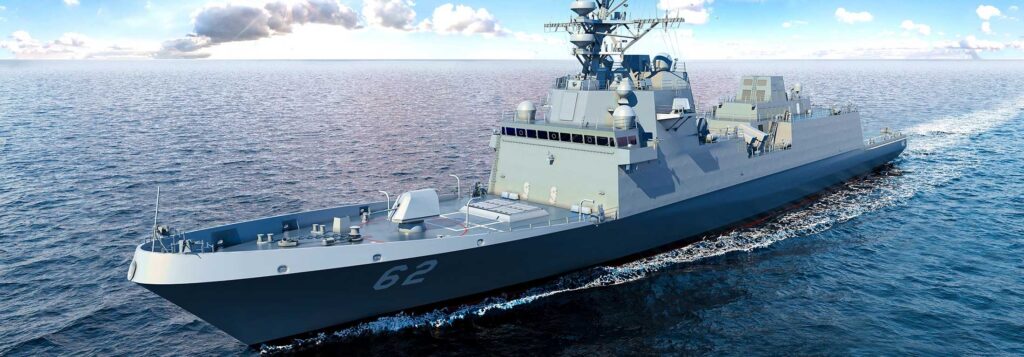
The Power Systems division of Rolls-Royce (LSE:RR., ADR: RYCEY) has been selected to supply a further four of its mtu naval generator sets for the USS Congress (FFG-63), the second ship in the U.S. Navy’s Constellation Class Guided-Missile Frigate program, previously known as the FFG(X) program. Rolls-Royce has made significant investment at its production facilities in Aiken, S.C. and Mankato, Minn. to support the program and manufacture the gensets in the US. 


Rolls-Royce is currently supplying mtu gensets for the lead ship in the Constellation Class program, the USS Constellation (FFG 62), relying on its established team in Friedrichshafen, Germany, to fulfil the project. For the second ship, the FFG-63, the company has successfully transferred advanced technology and detailed manufacturing processes to the US, investing in new facility improvements and creating new jobs to enhance its Aiken and Mankato plants. This investment will not only accommodate the specific needs of the FFG(X) program but also support future potential US naval business. Among the significant investments made at the facilities are new assembly tooling and material handling equipment, upgraded hoist systems, adapted test cells and building expansion, in addition to the creation of up to 20 new jobs. 


Adam Wood, Managing Director, Rolls-Royce Solutions America, said: “We’re not only proud to continue our support of our partners in the U.S. Navy but are also thrilled to bring the manufacturing of our mtu naval gensets to the US. Working with our colleagues in Germany for a seamless technology transfer to our Aiken and Mankato facilities has strengthened our ability to meet the high expectations of this project and better position us to compete for future government programs.” 


The USS Congress (FFG-63) is a multi-mission warship designed for operation in littoral and blue water environments to conduct air, anti-submarine, surface and electronic warfare, in addition to information operations. The four generator sets, each rated at 3000 kWe, are based on the proven and most power-dense mtu 20V 4000 M53B engine and will provide a total power output of 12 MW for propulsion and on-board power supply. 


Fincantieri Marinette Marine (FMM) of Marinette, Wisc. was awarded the build contract for the project. The completed vessel will be powered by a combined diesel-electric and gas turbine, allowing for energy-efficient diesel power generation for propulsion at normal cruising speeds with extended range, while enhancing anti-submarine capability in its extremely quiet diesel-electric configuration. When completed, the ship will be nearly 500 feet in length, accommodate up to 200 crew and be capable of speeds in excess of 26 knots, with a range of 6,000 nautical miles at 16 knots. 


Imagery is available for download from: Media Center (mtu-solutions.com) 


Flag Officer Announcements

Release from U.S. Department of Defense 

***** 

Secretary of Defense Lloyd J. Austin III announced today that the president has made the following nominations: 

Navy Rear Adm. Daniel L. Cheever for appointment to the grade of vice admiral, and assignment as commander, Naval Air Forces; and commander, Naval Air Force, U.S. Pacific Fleet, San Diego, California.  Cheever is currently serving as chief of staff, North American Aerospace Defense Command and U.S. Northern Command, Colorado Springs, Colorado. 

Navy Rear Adm. James P. Downey for appointment to the grade of vice admiral, and assignment as commander, Naval Sea Systems Command, Washington, D.C. Downey is currently serving as program executive officer for Aircraft Carriers, Washington, D.C. 

Navy Vice Adm. Daniel W. Dwyer for reappointment to the grade of vice admiral, and assignment as deputy chief of naval operations for Warfighting Development, N7, Office of the Chief of Naval Operations, Washington, D.C.  Dwyer is currently serving as commander, Second Fleet; and commander, Joint Forces Command Norfolk, Norfolk, Virginia.