Navy’s CNIC Launches Wellness, Food Service Pilot Programs
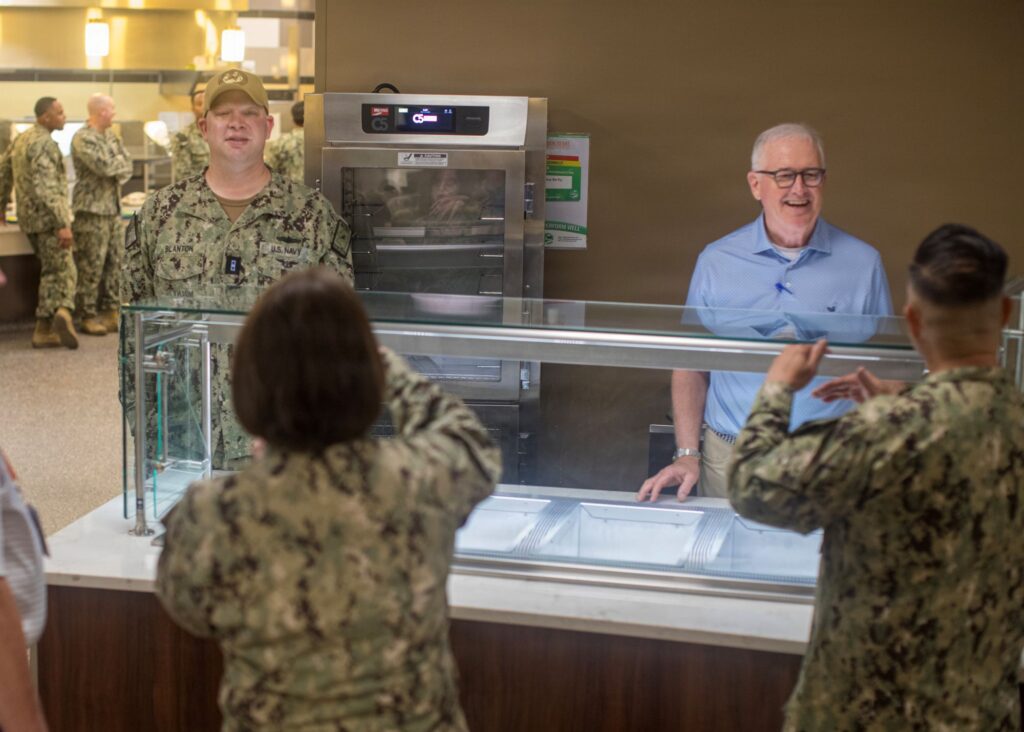
Naval Construction Battalion Center Gulfport Colmer Dining Facility underwent a multi-million dollar modernization project as part of the Commander, Navy Installations Command’s Shore Food Service Transformation pilot program, May 23. NCBC Gulfport was selected to implement the “campus style dining” initiative in support of the Navy’s commitment to warfighter readiness, wellness and performance through better nutrition. Photo credit: U.S. Navy | Jovi Prevot

The U.S. Navy’s Commander, Navy Installations Command (CNIC) has launched two related pilot programs aimed at expanding the quality and variety of food to which Sailors have access and improving their holistic wellness.

Those pilots are the Human Performance Optimization, or HPO program, and the Shore Food Service Transformation initiative.

The HPO launched Feb. 2 at Naval Base San Diego and provides Sailors with expert-led training across all aspects of physical, nutritional and mental wellness. Instead of the gym being just a place to work out, the HPO provides a “higher-end experience,” Vice Admiral Scott Gray, commander of Navy Installations Command, told reporters in an interview at the Washington Navy Yard.

Sailors at the Harborside Sports & Fitness Complex in San Diego now have access to a team of experts, including a dietician, cognitive specialist and human performance specialists to coach Sailors on proper nutrition, optimum sleep strategies, injury prevention and recovery, stress management and more.

“Everyone in that gym is going to be a fitness expert,” Gray said.

So far, 13,000 people have participated in the program and the Navy is monitoring the results.

“The whole point of the initiative is to learn from it,” Gray said.

Food Service Transformation

The food service transformation initiative has two pilot programs of its own, one that launched May 29 at Naval Construction Battalion Center Gulfport, Mississippi, and one launched June 3 at Naval Base Kitsap-Bangor in Washington state.

They have slightly different aims. The Gulfport pilot focuses on expanding and rotating ethnic food stations and refreshing and modernizing the interior of the galley. The Kitsap-Bangor pilot will allow Sailors to use their meal entitlements at Navy Morale, Welfare and Recreation (MWR) branded restaurants.

The galleys will continue to use “go for green” signage to help Sailors make healthy choices. Green is good, yellow means be cautious and red means food that should be an occasional treat.

“Everybody wants a burger now and then, but that shouldn’t be your only food source,” Gray said.

Galleys are also now providing healthy “grab and go” options for Sailors who might have missed galley mealtimes but still need to eat; that option should be rolled out to all installations by the end of this month, Gray said.

The Kitsap-Bangor pilot gives Sailors greater dining flexibility while still allowing them to use their meal allotments instead of paying out of pocket for meals outside of the galleys.

After spending nine months at sea eating in a ship’s galley, “the last thing they want to do is eat in another galley,” Gray said.

Galley gooks are also being trained by the Culinary Institute of America, which not only means better meals for Sailors but more skills training for the cooks.

As with the HPO, the Navy will be watching the results of the pilots. Will more Sailors eat in the galleys if they provide better options? Will they use their allotments at MWR-branded restaurants?

“We want to make our options and our expanded options attractive to our Sailors so that they use it, and that’s one of the things that we’re looking for is, as this plays out and as we roll it out, we’re looking to ensure that our utilization rate goes up and that the Sailors are taking better advantage of their entitlement, because it’s a significant portion of their compensation and when they’re not using it, they’re not helping themselves financially,” Gray said.

Eventually, CNIC plans to roll these two pilots together and offer them at all installations, although some will have more MWR-branded dining options than others and some installations may just have improved galleys.

“Ultimately, you will have expanded food options inside the galley and expanded food options outside the galley where we can provide it,” Gray said.

CNIC is assessing the first phase of rollout after the pilots, and anticipates rolling the transformation out to nine additional facilities between March and July of next year, with additional phases to follow after that.

The cost of all this is not insignificant — $1.4 million for the San Diego HPO site alone and $3.2 million for construction, renovation and training at the two food pilot sites — but needs to be done after years of budgetary neglect of Navy shore services, Gray said.

“We set that money aside before we started and come hell or high water we’re going to continue it and follow it through, and we will transform our food service, we will continue the expansion of Human Performance Optimization, even if I have to reshuffle things to make it happen,” Gray said. “I’m committed.”

CNIC oversees 10 Navy regions, 70 installations, and nearly 50,000 employees focused on warfighting and manning, training and equipping shore installations.
Annual Anchors Aweigh Fly-In Spreads Sea Services Knowledge Across Capitol Hill

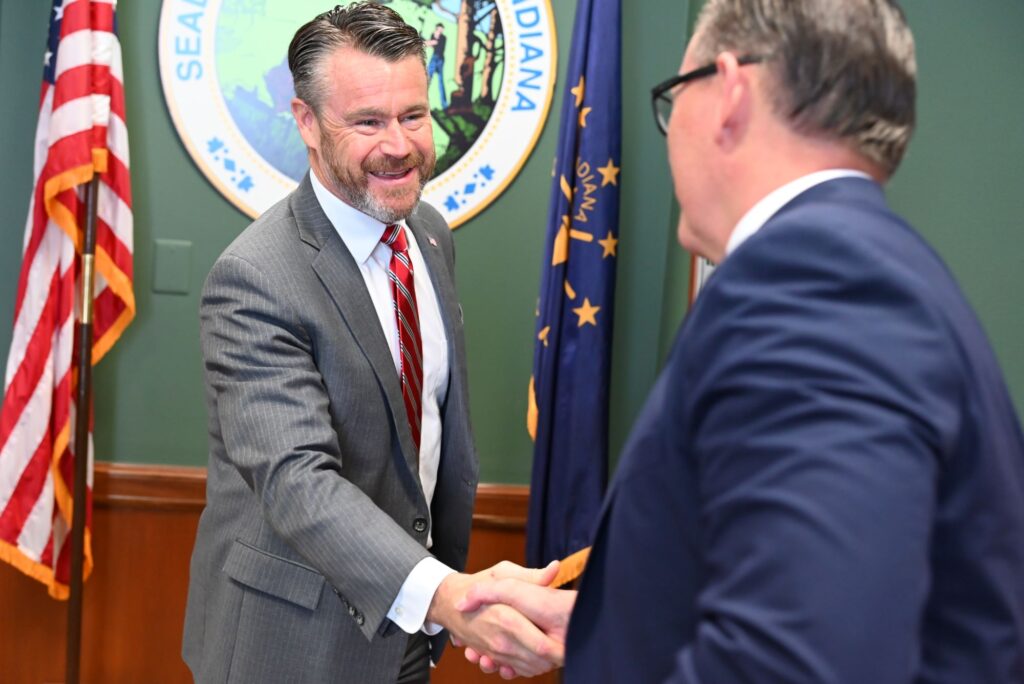
Sen. Todd Young of Indiana greets Navy League CEO Mike Stevens during the Anchors Aweigh Fly-In. Photo credit: James Peterson

Navy League members from across the country fanned out across Capitol Hill on June 2 as part of the annual Anchors Away Fly-In, where they educated lawmakers and their staff on the importance of sea service budgets and policy.

They presented congressional representatives with data about sea service budgets and requirements, and urged predictable spending levels, multi-year procurement programs and moving away from continuing resolutions, which have slowed down shipbuilding.

They also urged support for the Maritime Security Trust Fund, which would provide long-term mandatory funding outside of the annual appropriations cycle for merchant mariners and would help rebuild facilities and education for maritime academies.

The Navy Leaguers also urged members to cosponsor legislation including the SHIPs for America Act, the Pay Our Troops Act and the SERVE Act. Among budget issues, they urged support for a $50 billion annual shipbuilding budget and a $20 billion annual Coast Guard budget.

“The day was great. We saw three principals and three staffers, for a total of six, and most were friends of the Navy League,” National President Larry Salter said at a reception following the day of meetings.

Salter said his team emphasized support of the SHIPs for America Act, aimed at revitalizing the U.S. maritime industry, but most of the people they visited were supporters or even co-writers of the legislation.

“It was a friendly crew and it was great to emphasize what we are doing,” Salter said.

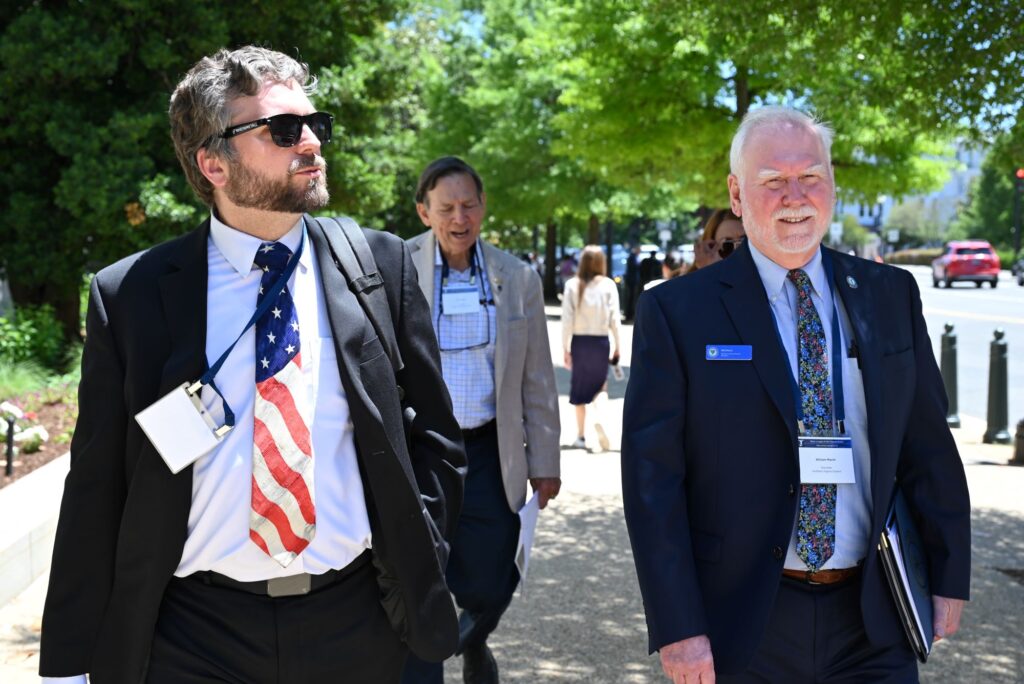
Navy League members fanned out across House and Senate office buildings to discuss the needs of the sea services. Photo credit: James Peterson

Ed Duffet of the Denver Council was on his second Fly-In visit, and this year was the sole representative of the Rocky Mountain region, doing his six meetings as a one-man band. He had high praise for the Navy League Legislative Affairs team.

“Everything’s set. They give you the briefing, they give you everything you might need to hand out to folks, they tell you tips and tricks,” he said, and members can leave knowing they made a difference.

“I’m coming back again. This was so much fun,” he said. “… This is a joy. If they had it twice a year I’d come twice a year.”

Taylor Smith came from the Portland-Blueback Council and attended nine meetings, including in-person sessions with Sen. Jeff Merkley (D-Oregon) and Rep. Cliff Bentz (R-District 2).

“Everybody was very receptive to all the information we presented, especially regarding the SHIPs for America Act, it seems like a lot of support for that across the board,” Smith said. “It all seemed very positive overall and was a great trip.”

“It was remarkably successful,” said Randall Myers of the Mobile Council.

His group met with five of the seven staffs from Alabama, and “we’re all in agreement that we need a state-level maritime security board, so we’re doing some things nobody else is doing, primarily to push forward and provide the support that the U.S. group needs at the state level, so we’re kind of working from the bottom up while they’re pushing these various acts,” he said.

The Fly In is a big part of one of the Navy League’s core missions, that of advocating for the sea services, Salter said.

“The members get to meet other members, meet some of their elected officials, and they get to discuss what’s important for them and the Navy League in supporting sea services,” he said.


Overwatch Imaging’s ASO Software Integrates AI with Sensors

ARLINGTON, Va. – Integration of artificial intelligence (AI) with imaging sensors relieves operator workload on some drones and Navy aircraft and enables those operators to focus on decision making rather than sifting through overwhelming amounts of data, a sensor technology expert said.  

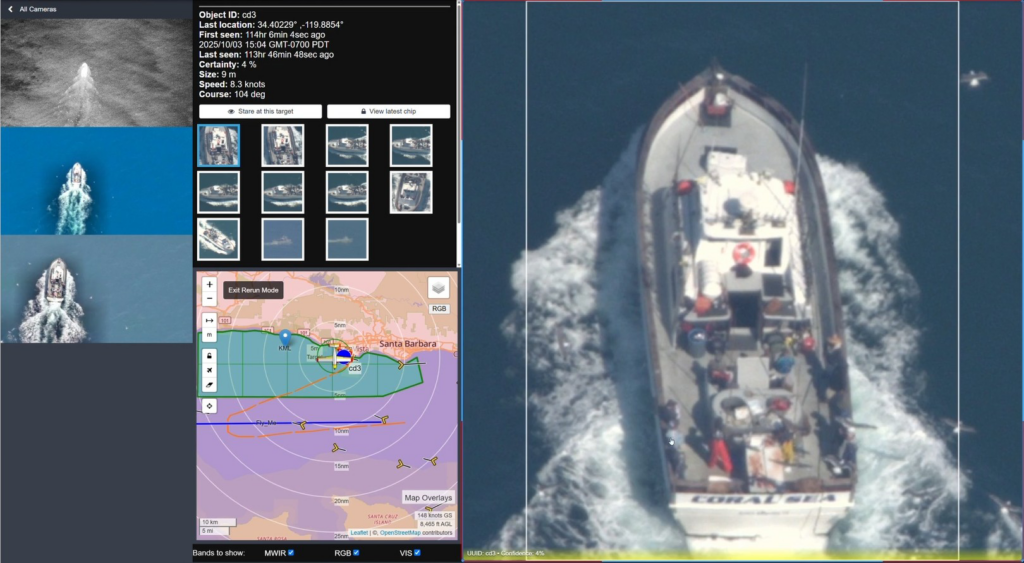
“We focus on automating the experience of using sensors — especially in the maritime environment but also overland — to make it easier and faster as well as better for crews to gain intelligence from the sensors that they use,” said Greg Davis, founder and CEO of Overwatch Imaging, an imagery intelligence technology company, in an interview with Seapower.  “That process uses artificial intelligence and autonomy to reduce the workload for the crews that are using sensors and also provide those crews with a super-human vision — to see more than they can naturally see by using the power of computing and AI.” 

“The Navy has this problem [in that] they collect a lot more data than they can look at,” Davis said. “Sometimes they don’t even collect data because they know they can’t look at it.”  

Davis likened the task as “needing to find a needle in a haystack.” 

Over watch’s software, called Automated Sensor Operator (ASO), uses a connection to a sensor that same as the crew would.  

“The crew interacts with a sensor through ethernet corrections or serial connections,” Davis said. “We use that same method of connecting to the sensor. We sit between the crew member and the sensor. From that position we can take command of the sensor and accomplish the job that the sensor operator wants to accomplish and do that in an automated way that allows the crew member to focus on something else. We provide alerts when there’s something to see.” 

No modifications to an aircraft’s mission computer are required, Davis said.  

“We add a small edge processor, a small, ruggedized computer that basically lives between the sensor and the operator workstation,” he said. “That small computer does the AI, the sensor autonomy, right there at the edge between the sensor and the crew in a way that does not change the existing airworthiness of the kit.” 

Overwatch puts the ASO software on sensors of its own designs and the ASO is “compatible with third-party sensors like sensors that are on Navy [MH-60] Seahawks or on the [P-8] Poseidon,” he said.  

Overwatch Imaging, based in Hood River, Oregon, has deep roots in the autonomous systems and drone industry, Davis said. It has had an existing SBIR contract for 2 years that started with a Navy requirement for AI-enabled video processing. Overwatch is expanding its work to include a contract with another unnamed agency. 

Davis noted that special operations forces, the Coast Guard, Customs and Border Protection all have “the same characteristic of needing to search big areas to find small things. Once you find the small things, our crews are very good at responding.  

The company also is working on applying its technology to radar 

“We started building ASO for image-based sensors, but next up this summer for us is an ASO for other types of sensors,” Davis said. “Probably a synthetic-aperture radar will be the first extension for us beyond image-based sensors. But eventually we’ll probably make this for all of the sensors in use on naval aircraft and other kinds of sophisticated aircraft. The crew can focus on making decisions, rather than looking at a lot of raw data. Let’s use computers to look at the raw data. … freed up that crew time to do decision making rather than staring at a [computer] screen. 


Navy Awards SAIC $50.6M Torpedo Defense Services Task Order

From SAIC, June 3, 2026 

Modernizes technology and infrastructure of existing and new torpedo defense systems – including “Nixie” – to mitigate threats, enhance vessel survivability, and ensure mission success 

RESTON, Va., June 03, 2026 (GLOBE NEWSWIRE) — Science Applications International Corp. (NASDAQ: SAIC) has been awarded a follow-on $50.6 million task order from the U.S. Navy’s leader in Torpedo Defense (TD) – Naval Undersea Warfare Center (NUWC) in Newport, R.I. – to continue the company’s work of providing critical torpedo defense system design, modernization, and sustainment services. This contract builds on SAIC’s two decades long legacy of proven collaboration with the Navy and success in advancing technology capabilities of the most sophisticated torpedo defense systems. 

SAIC will leverage its advanced digital engineering capabilities to revolutionize the Navy’s TD systems by streamlining the design conceptualization, prototyping, and fabrication processes of hardware and software. This approach will integrate cutting-edge modeling simulation (SIM) and stimulation (STIM) – enabling more robust system analyses, data-driven insights, and seamless cybersecurity implementation. These advancements will ensure that upgraded TD systems achieve new levels of operational effectiveness to enhance vessel survivability and empower the Navy to maintain superior mission success in evolving maritime threat environments. 

The company will support critical NUWC TD systems such as AN/SLQ-25 Torpedo Countermeasures Transmitting Set (commonly known as “Nixie”), Acoustic Device Countermeasures (ADCs), MK 58 Compact Rapid Attack Weapon (CRAW), EX 2 Torpedo Warning System, Submarine Launched Unmanned Aerial System (SLUAS), as well as emergent technologies and intelligence projects for Navy and Foreign Military Sales (FMS) that guide upgrades to the TD systems. 

“SAIC’s long-standing partnership with the Navy and NUWC is built on trust, technical excellence, and an unwavering commitment to the mission;” said Barbara Supplee, SAIC Executive Vice President of the Army Navy Business Group. “This award reflects the Navy’s confidence in our team’s continued ability to deliver the modern torpedo defense systems needed to protect our fleet and outpace emerging threats. We are proud to continue supporting NUWC Code 85 with the engineering rigor, innovation, and agility required to ensure our warfighters remain safe, informed, and ready.” 

The follow-on task order supports key NUWC Code 85 program offices such as Undersea Warfare Systems Program Office (PEO-UWS PMS415), International Fleet Support Program Office (PMS326), Office of Naval Research (ONR), and Office of Naval Intelligence (ONI), among others. 


USS Springfield Returns Home to Naval Base Guam

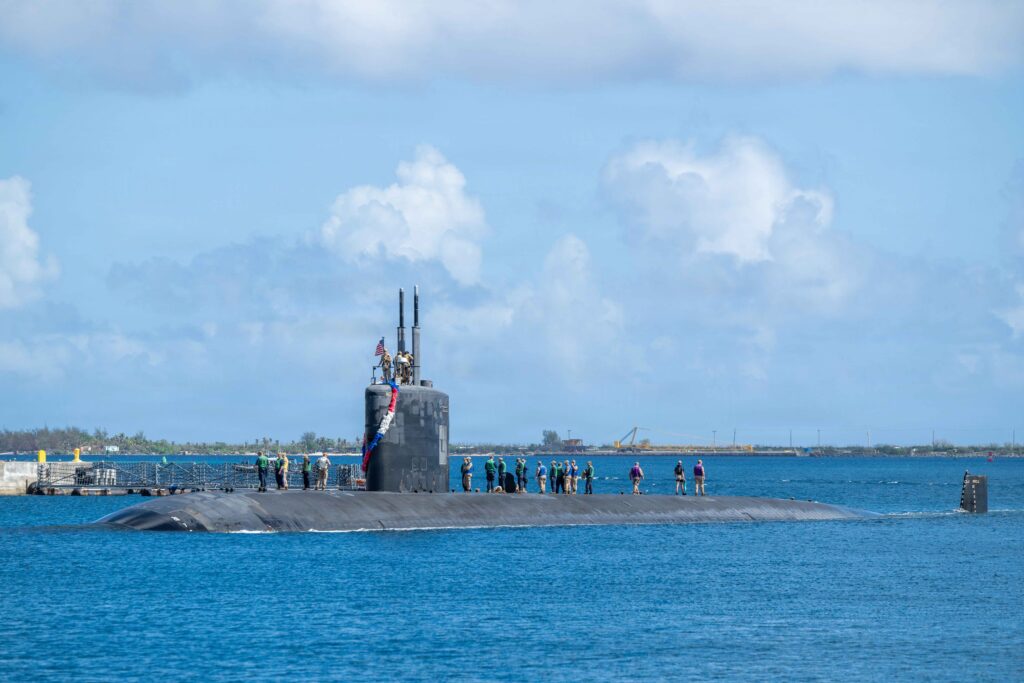
NAVAL BASE GUAM (May 31, 2026) – Los Angeles-class fast-attack submarine USS Springfield (SSN 761) transits Apra Harbor at Naval Base Guam, returning to its homeport after completing a routine deployment in the Indo-Pacific, May 31, 2026. Assigned to Commander, Submarine Squadron 15, based at Polaris Point, Naval Base Guam, Springfield is one of five forward-deployed fast-attack submarines. (U.S. Navy photo by Mass Communication Specialist 1st Class Bryan Mai)

From the Navy Office of Information, June 3, 2026 

NAVAL BASE GUAM (May 31, 2026) – Los Angeles-class fast-attack submarine USS Springfield (SSN 761) returned to its homeport of Naval Base Guam, May 31, 2026, after completing a routine deployment in the Western Pacific. 

“Springfield’s presence in theater reaffirmed its role in maintaining security and stability throughout the region,” said Capt. Neil Steinhagen, commander, Submarine Squadron 15. “Through sustained forward presence and operational readiness, Springfield embodied its motto, ‘United for Freedom,’ while promoting peace through strength in support of a free and open Indo-Pacific.” 

Springfield’s deployment underscores the Navy’s commitment to maintaining a persistent, forward-deployed undersea presence ready to respond to evolving challenges across the Pacific. 

“Springfield’s operations directly supported forward-deployed readiness and reinforced the Navy’s ability to operate where it matters most,” said Cmdr. Greg Storer, commanding officer of USS Springfield. “The crew performed exceptionally, remained determined through every challenge, and executed every task with professionalism and purpose. I am incredibly proud of what they accomplished and grateful for the commitment they demonstrated every day.” 

During the deployment, four Springfield Sailors advanced in rank, while three officers and fifteen enlisted Sailors earned their submarine warfare insignia, commonly known as “dolphins” or “fish.” The insignia signifies qualification in submarine operations and reflects mastery of watch stations, systems, and responsibilities required to operate in the undersea domain. 

“Every day brought new challenges, and this crew met each one head-on,” said Master Chief Information Systems Technician (Communications) Chris Ries, Springfield’s chief of the boat. “They came together as one team, remained focused under pressure, and consistently looked out for one another. Their hard work, resilience, and dedication show why our Sailors are the true strength behind this submarine and our fleet.” 

Commissioned on Jan. 9, 1993, the Springfield is the fourth U.S. Navy ship to bear the name, honoring the cities of Springfield, Illinois, and Springfield, Massachusetts. Assigned to Commander, Submarine Squadron 15 at Polaris Point, Naval Base Guam, the Springfield is one of five forward-deployed fast-attack submarines. Renowned for their speed, endurance, stealth, and mobility, fast-attack submarines are the backbone of the Navy’s submarine force. Regarded as apex predators of the sea, Guam’s fast-attack submarines serve at the tip of the spear, reaffirming the submarine force’s forward-deployed presence in support of a free and open Indo-Pacific. 


MARTAC Announces Opening of Innovation Center West in San Diego, California

New west coast facility expands MARTAC’s operational footprint and accelerates growth of autonomous maritime capabilities 


From MARTAC 

San Diego, CA — June 3, 2026 — Maritime Tactical Systems, Inc. (MARTAC), a leading provider of fully autonomous unmanned surface vessels (USVs), today announced the opening of the MARTAC Innovation Center West in San Diego, California. The new facility marks a significant milestone in the company’s strategic expansion, strengthening its ability to serve defense, security and commercial customers across the West Coast and Pacific regions. 

The MARTAC Innovation Center West will serve as a hub for research, development, testing and customer engagement, complementing MARTAC’s headquarters in Melbourne, Florida. San Diego’s deep ties to the U.S. Navy, its thriving defense technology ecosystem and its access to open-water testing environments make it the ideal location for MARTAC’s next phase of growth. 

“The opening of our Innovation Center West represents a pivotal step in MARTAC’s growth strategy,” said Jim Harvey, Chief Technology Officer of MARTAC. “San Diego is home to the largest concentration of naval assets in the world and an unmatched community of defense innovators. Establishing this facility allows us to work more closely with our customers, accelerate development timelines, and expand the reach of our autonomous maritime solutions.” 

The new center will support a range of activities, including advanced engineering and systems integration, live-water demonstrations of MARTAC’s autonomous vessels, customer training and mission planning and collaborative development with defense and industry partners. The facility is expected to create new jobs in the San Diego area and further cement MARTAC’s position as a leader in the rapidly growing unmanned maritime systems market. 

MARTAC’s facility expansion comes at a time of accelerating demand for autonomous maritime capabilities. The U.S. Navy has outlined plans to significantly grow its fleet to include a substantial number of uncrewed vessels, and MARTAC’s combat-proven platforms—including the MANTAS™ T-series and Devil Ray™—are already in operational deployment supporting fleet operations worldwide. 

“Our customers are telling us they need more capacity, faster delivery and closer collaboration,” Tony Smeraglinolo, CEO added. “The Innovation Center West answers all three. It positions MARTAC to scale alongside the growing demand for autonomous maritime systems and ensures we remain at the forefront of this critical national security capability.” 


RTX’s Raytheon awarded $515 million contract for SPY-6 family of radars

Over the next decade, SPY-6 is expected to be deployed on more than 50 U.S. Navy ships, enhancing defense against air, surface, ballistic and electronic warfare threats. (Photo credit: Huntington Ingalls Industries)

Contract accelerates integration and test support for the U.S. Navy’s most advanced maritime radar 

From RTX 

ANDOVER, Mass. (June 3, 2026) — Raytheon, an RTX (NYSE: RTX) business, has been awarded a $515 million contract from the U.S. Navy for the SPY-6 family of radars. The contract is a follow-on to the Integration and Production Support contract, which was awarded in June 2025, and includes upgrading Flight IIA destroyers with the SPY-6(V)4 variant. 

Under the sole source award, Raytheon will provide continued support for the SPY-6 family of radars to the U.S. Navy, including the government of Germany with the potential for other countries to be added under the Foreign Military Sales program. 

“With over a decade of demonstrated success at sea, SPY-6 remains the U.S. Navy’s most advanced maritime radar, providing the fleet with unmatched sensing power and multi-mission readiness to counter evolving threats,” said Barbara Borgonovi, president of Naval Power at Raytheon. “Backed by an $800 million investment to modernize our radar manufacturing facilities, we’re accelerating production and are expecting to double SPY‑6 output by 2028.” 

SPY-6 is now aboard two commissioned U.S. Navy ships and is installed on 11 others, all of which are undergoing various stages of testing. Over the next decade, SPY-6 is expected to be deployed on more than 50 U.S. Navy ships, enhancing defense against air, surface, ballistic and electronic warfare threats. 

SPY-6 is one of several radar programs designed and manufactured at Raytheon’s Radar Development Facility in Andover, Massachusetts, a 30,000-square foot site supporting the production of diverse types of radars for U.S. and allied forces. This vertically integrated and highly automated site is one of the most advanced in the world, complete with a gallium nitride (GaN) foundry to produce the semiconductors essential for SPY-6 and other Raytheon radars. 

Raytheon is actively hiring engineers across multiple disciplines to support this critical program. Interested candidates can learn more by visiting our website


HII’s Romulus USV Advances to U.S. Navy Medium Unmanned Surface Vessel At-Sea Testing Phase

From HII 
 

MCLEAN, Va., Statement by Andy Green, executive vice president of HII and president of HII’s Mission Technologies division, on the U.S. Navy’s selection of HII’s Romulus Unmanned Surface Vessel to advance to the at-sea testing phase of the Medium Unmanned Surface Vessel (MUSV) program: 

“HII is proud that Romulus USV has advanced to the U.S. Navy’s Medium Unmanned Surface Vessel evaluation phase, a milestone that reflects HII’s longstanding track record for delivering mission-ready autonomous capabilities that support the U.S. Navy’s evolving operational requirements. 

“At the core of the Romulus USV is HII’s extensive experience as a global leader in autonomous unmanned maritime systems, combined with HII’s Odyssey Autonomous Control Solutions, a proven autonomy software suite and a key differentiator of our solution. Demonstrated across programs supporting the U.S. Navy, U.S. Marine Corps, U.S. Coast Guard, and allied partners, Odyssey enables intuitive command and control of autonomous platforms and swarms across domains, enhancing fleet lethality, survivability, and operational effectiveness. 

“Romulus brings together advanced autonomy, scalable platform design, and efficient manufacturing in a production-ready solution engineered to meet the demands of distributed maritime operations and integrated manned-unmanned teaming. Its endurance, flexibility, and payload capacity provide the operational versatility required for future naval missions. 

“We appreciate the U.S. Navy’s confidence in Romulus and look forward to demonstrating the platform’s maturity, reliability, and operational effectiveness in support of the service’s vision for autonomous maritime operations.” 


MARTAC, Mystic Powerboats to Expand Production Capacity for Autonomous USV Deliveries 

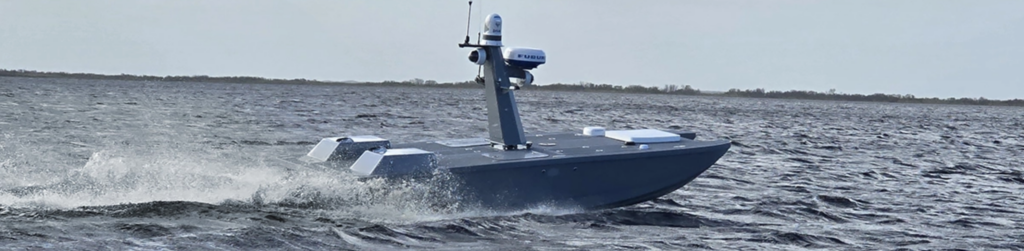
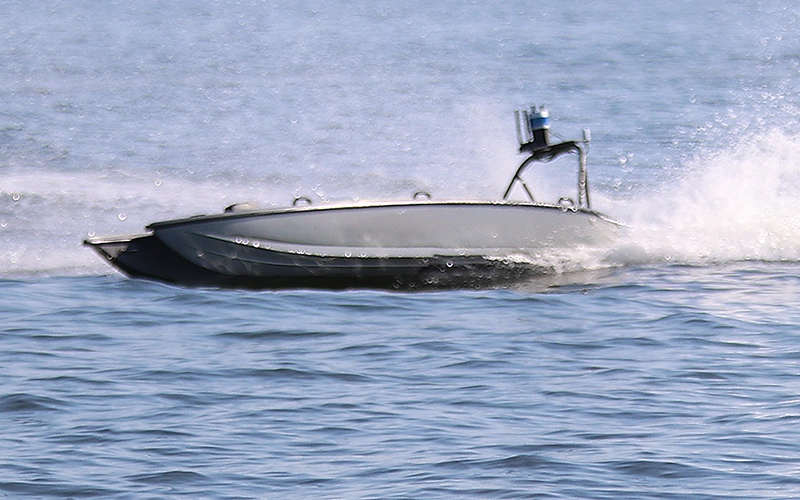
MARTAC T18 USV 
 

From Tactical Systems Inc. 

Partnership combines autonomous maritime expertise and advanced composite manufacturing to accelerate U.S. and allied defense vessel production 

MELBOUORNE, Fla., June 1, 2026 — Maritime Tactical Systems Inc. (MARTAC), a leading provider of high-performance autonomous unmanned surface vehicles (USVs), and Mystic Power boats (Mystic), a leader in high-performance composite vessel construction, today announced a co-production partnership to increase MARTAC’s domestic production capacity to meet growing requirements from U.S. and allied customers. 

Demand for autonomous maritime systems is accelerating as defense and national security organizations expand their use of autonomous capabilities in distributed maritime operations, maritime domain awareness, logistics support and force protection. MARTAC’s family of USVs, including the Devil Ray™ and MANTAS™ platforms, has been operationally proven for over ten years in multiple government programs and exercises. The company is now positioned to expand current capacity that meets both near-term needs and can scale with the market demands over time. 

Mystic Powerboats brings three decades of expertise in advanced carbon-fiber and composite manufacturing, operating from a nearly 100,000-square-foot production facility equipped with the tooling, workforce and processes required to produce high-strength, lightweight hull structures at scale. Mystic’s proven capabilities in epoxy resin infusion, carbon-fiber lamination and foam-core construction align directly with the materials and methods used in MARTAC’s Devil Ray and MANTAS platforms, making the company an ideal co-production partner for scaling autonomous vessel deliveries. 

“Accelerating autonomous maritime capability is imperative as nations place greater emphasis on maintaining maritime awareness, ensuring force protection across distributed maritime operations and protecting critical shipping lanes” said John Cosker, Founder and Chief Executive Officer of Mystic Powerboats. “We are proud to leverage our heritage of applying advanced technology to deliver high-performance, rigorously tested watercraft to now help advance the autonomous capabilities our nation and our allies need.” 

“The United States is home to exceptional marine manufacturing companies with deep expertise in advanced composites and maritime construction,” said “Seamus Flatley, Chief Growth Officer at MARTAC. “Mystic Powerboats is a great example of this ‘made in America’ ingenuity. They are a world-class builder with the advanced composite manufacturing capabilities and skilled workforce needed to produce the high-performance hull structures our platforms require. Partnering with Mystic is a key step in our strategy to rapidly scale production while ensuring that our systems remain operationally proven and ready to deploy.” 

MARTAC’s partnership with Mystic is the first of several pending domestic co-production partnerships the company is finalizing that will support a significant expansion of its co-production framework. The distributed production model strengthens MARTAC’s ability to meet operational demand by increasing surge capacity, diversifying the supply chain, and accelerating delivery timelines. 


U.S. Defends, Disables Threats in Response to Iranian Aggression 

From U.S. Central Command, May 31, 2026 

TAMPA, Fla. — U.S. Central Command (CENTCOM) conducted self-defense strikes on Iranian radar and command and control sites for drones in Goruk, Iran and Qeshm Island this weekend. 

The measured and deliberate strikes occurred on Saturday and Sunday in response to aggressive Iranian actions that included the shootdown of a U.S. MQ-1 drone that was operating over international waters. U.S. fighter aircraft swiftly responded by eliminating Iranian air defenses, a ground control station, and two one-way attack drones that posed clear threats to ships transiting regional waters. 

No American service members were harmed. CENTCOM will continue to protect U.S. assets and interests in response to unwarranted Iranian aggression during the ongoing ceasefire.