TEXTRON AVIATION SPECIAL MISSIONS BEECHCRAFT KING AIR 260 CHOSEN AS NEW U.S. NAVY MULTI-ENGINE TRAINING SYSTEM (METS)
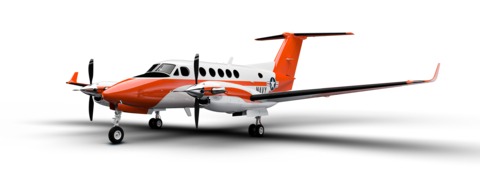
Beechcraft King Air 260 Multi-Engine Training System (METS) T-54A for the U.S. Navy (Photo: Business Wire)

Release from Textron Aviation 

***** 

February 16, 2023 

WICHITA, Kan.–(BUSINESS WIRE)– Textron Aviation today announced it has been awarded the Multi-Engine Training System (METS) contract by Naval Air Systems Command (NAVAIR) through a full and open competition. 

Beechcraft King Air 260 Multi-Engine Training System (METS) T-54A for the U.S. Navy (Photo: Business Wire) 

The contract award is for up to 64 King Air 260 aircraft, which will be known as the T-54A. The initial Lot I award will procure 10 new Beechcraft King Air 260 commercial aircraft and associated support. Lot II and Lot III, if the options are exercised, would each procure up to 27 aircraft. Aircraft deliveries are planned from 2024 to 2026. 

The Beechcraft King Air 260 aircraft acquired under the METS contract will replace the Chief of Naval Air Training (CNATRA) fleet of T-44C Pegasus aircraft. The T-44C Pegasus aircraft is a variant of the twin-engine and pressurized Beechcraft King Air 90. The T-44 has been in service since 1977. 

“We are honored the U.S. Navy has again selected the Beechcraft King Air to fulfill its training needs,” said Bob Gibbs, vice president, Special Missions Sales for Textron Aviation. “METS will modernize multi-engine aircraft training at CNATRA, providing an intermediate and advanced training platform for U.S. Navy, U.S. Marine Corps and U.S. Coast Guard aviators into the P-8, EP-3, KC-130, E-6, E-2, CMV-22, CV-22 and MV-22 aircraft.” 

METS specific capabilities include factory options for TACAN (Air to Air), angle of attack (AOA), V/UHF radio, digital audio system, engine trend monitoring, condition-based maintenance plus, observer/jump seat, passenger mission seats, and full-face oxygen masks. 

“With its advanced technology, the new METS platform will be more representative of fleet aircraft,” said Capt. Holly Shoger, Naval Undergraduate Flight Training Systems Program Office (PMA-273) program manager. “The T-54A will include an updated avionics suite, automation qualities, and virtual reality and augmented reality devices to better prepare students for the advanced aircraft they will fly in the fleet.” 

The King Air 260 METS aircraft will be delivered in a fully compliant, METS mission ready configuration from Textron Aviation’s King Air production line in Wichita, Kansas. 

Endless Special Missions Possibilities 

When government, military and commercial customers want airborne solutions for critical missions, they turn to Textron Aviation. The company’s aviation solutions provide the high performance and flight characteristics required to address the unique challenges of special missions operations. With unparalleled quality, versatility and low operating costs, Textron Aviation products are preferred for air ambulance, ISR, utility transport, aerial survey, flight inspection, training and a number of other special operations. 

King Air Leadership 

More than 7,700 Beechcraft King Air turboprops have been delivered to customers around the world since 1964, making it the best-selling business turboprop family in the world. The worldwide fleet has surpassed 62 million flight hours in its 58 years, serving roles in all branches of the U.S. military and flying both commercial and special missions roles around the world. 

About the King Air 260 

The King Air 260 brings state-of-the art technology to the cockpit and offers greater ease of flight. The cockpit features the Innovative Solutions & Support (IS&S) ThrustSense Autothrottle system, which supports pilots in their critical mission of delivering people or cargo by automatically managing engine power from the takeoff roll through the climb, cruise, descent, landing, and go-around phases of flight. This enhancement reduces pilot workload and is designed to prevent over-speed or under-speed, over-temp and over-torque conditions. 

The King Air 260 cockpit also features a digital pressurization controller, which automatically schedules cabin pressurization during both climb and descent, reducing pilot workload and increasing overall passenger comfort. The pressurization gauges have been integrated with the powerful Collins Aerospace Pro Line Fusion flight deck. 

The aircraft includes the Collins Multi-Scan RTA-4112 weather radar, providing pilots with a fully automatic system that is optimized to detect short, mid and long-range weather.
USS Barry Departs 7th Fleet and Japan after Six Years of Forward-Deployed Service 

Release from Commander Task Force 71 

***** 

16 February 2023 

From Commander, Task Force 71/Destroyer Squadron 15 Public Affairs 

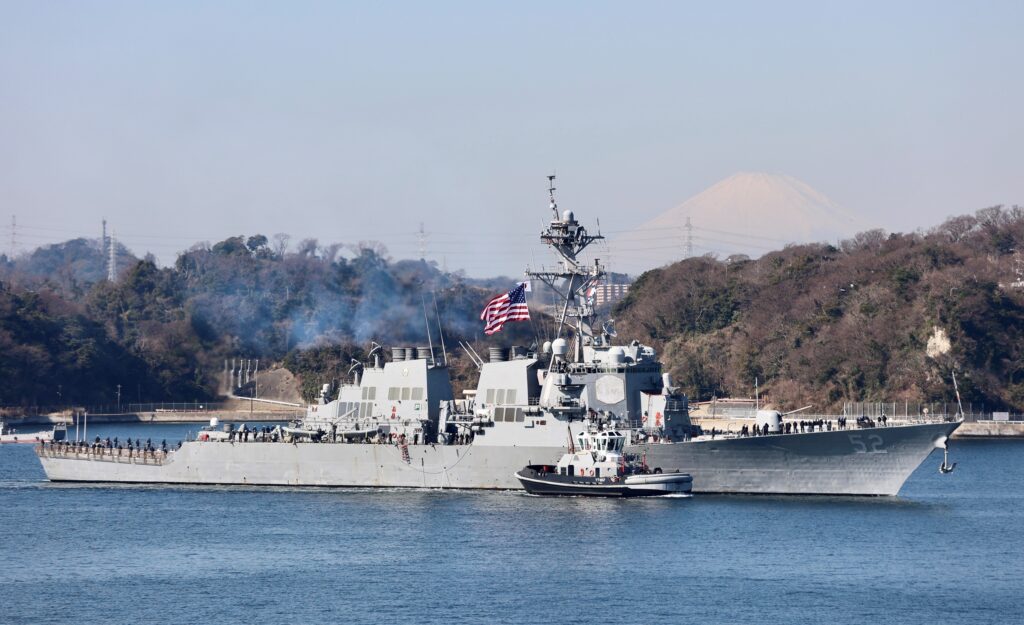
YOKOSUKA, Japan - USS Barry (DDG 52) departed Commander, Fleet Activities Yokosuka, Japan Feb. 17, as part of a scheduled homeport shift following six years of service forward-deployed to U.S. 7th Fleet. 

Barry operated in the Indo-Pacific while assigned to Commander, Task Force (CTF) 71/Destroyer Squadron (DESRON) 15, the Navy’s largest forward-deployed DESRON and the 7th Fleet’s principal surface force. 

“Barry and her crew stood the watch in the Western Pacific for nearly seven years,” said Capt. Walt Mainor, commodore, CTF 71/DESRON 15. “She leaves with an incredible legacy of being the Navy’s oldest destroyer who still accomplished the mission. She held the line and provided incredible firepower to our team without fail. We will miss the fight and determination of the Barry Bulldogs, but look forward to seeing her provide that same fire power to her new squadron-mates in DESRON 31.” 

The Arleigh Burke-class guided-missile destroyer will move to Everett, Washington — where the ship will undergo routine maintenance, joining the U.S. 3rd Fleet. Barry will be part of the Ke Koa O Ke Kai of DESRON 31 after her transit across the International Date Line. Barry arrived in Yokosuka in 2016 and successfully participated in numerous multilateral maritime exercises such as MALABAR, Maritime Counter Special Operations Exercise (MCSOFEX), Bilateral Advanced Warfare Training (BAWT), working alongside Allies and partners from Japan, South Korea, India, Australia, New Zealand, Singapore, Great Britain, and the Philippines, to ensure a free and open Indo-Pacific. 

Barry’s performance during Integrated Ship and Air Team Training (ISATT), Surface Warfare Advanced Tactical Training (SWATT), and presence and Carrier Strike Group Operations with USS Ronald Reagan (CVN 76), resulted in Barry’s receipt of the Meritorious Unit Commendation Award during the COVID-19 pandemic while assigned to Carrier Strike Group (CSG) 5 during the 2020 deployment. 

Barry’s list of accolades continues, as she was the first ship to be awarded the Spokane Trophy and the Battenberg cup in 2020, the Battle Efficiency “Battle E”, the Unit Tactics Award, and Bloodhound Anti-Submarine Warfare award in 2021. 

“The ship and crew got the job done. Barry is leaving the 7th Fleet family on a high note.” said Cmdr. Grant Bryan, commanding officer, USS Barry. “Our families will miss Japan, and our Sailors will miss sailing alongside our nation’s strongest Allies.” 

While assigned to CTF 71, USS Barry participated in seven Allied and coalition exercises, 12 foreign port visits, and sailed nearly 3.8 million miles across the Pacific. 

“There’s nothing quite like serving alongside so many friends and partners in such a dynamic region of the world,” said Bryan. “Only 7th Fleet can provide the unique and unforgettable experiences to our Sailors that they will carry with them for the rest of their careers.” 

Boatswains Mate 3rd Class Jonathan Perezbaez has served onboard Barry for five of the six years in Japan, and said, “This ship has been through a lot, but every single challenge we met them head-on and we came out on top. Attitude reflects leadership, and every one of us onboard knows that our team is the greatest of all time.” 

7th Fleet is the U.S. Navy’s largest forward-deployed numbered fleet, and routinely interacts and operates with Allies and partners in preserving a free and open Indo-Pacific region. 


AUSTAL USA DELIVERS USNS APALACHICOLA (EPF 13) TO THE NAVY

Release from Austal USA 

***** 

FEBRUARY 16, 2023 

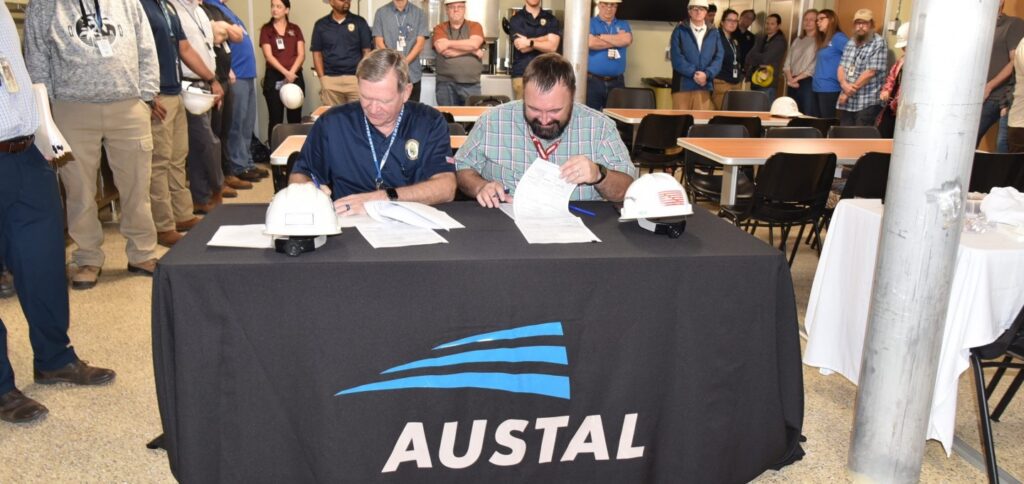
MOBILE, Ala. – Austal USA delivered Expeditionary Fast Transport USNS Apalachicola (EPF 13) to the U.S. Navy, today. This is the 2nd Navy ship named after the coastal Florida city; both ships were built in Mobile. 

EPF 13 is now the largest surface ship in the U.S. Navy fleet with autonomous capability. EPF 13 went to sea five times over a several-month duration allowing Austal USA and their industry partners, L3Harris and General Dynamics Mission Systems, to test and analyze not only her typical ship systems but those resulting from autonomous design and construction contract modifications required by the Navy to establish EPF 13 as an autonomous prototype.  

“Austal USA is proud to deliver this ship to our Navy – it’s innovative and is going to be a critical asset as unmanned capabilities continue to push boundaries and redefine how missions are achieved,” commented Austal USA President Rusty Murdaugh. “Apalachicola will also be the first EPF with the ability to conduct V-22 flight operations, and launch and recover 11 meter Rigid Hull Inflatable Boats (RHIBs). A lot of capability is being delivered to our warfighters with this ship and I’m incredibly proud of our team of shipbuilders.” 

With a shallow draft and high-speed, the EPF’s agility provides a positional advantage in the littorals and makes it an ideal candidate to prototype large vessel autonomous operations, including logistics, tendering and adjunct magazine mission profiles. 

Fundamental to the autonomy effort was Austal USA’s highly automated in-house designed machinery control system (MCS), which allows the ship to be minimally manned by centralizing machinery operations to the bridge. All Spearhead-class EPFs built to date incorporate the Austal USA MCS design which is secure, scalable, distributive and reconfigurable for multiple propulsion configurations. 

Combined with the already highly automated hull, mechanical & electrical systems installed on EPF class ships, Austal USA added automated maintenance, health monitoring, and mission readiness to provide EPF 13 with the capability to conduct up to 30 days of operation without human intervention. 

EPF 13 is also the first Expeditionary Fast Transport vessel to be delivered to the Navy with enhanced capabilities to support V-22 flight operations and launch and recover 11 meter RHIBs. These upgrades along with EPF’s speed, maneuverability and shallow water access are key enablers for support of future Expeditionary Advanced Base Operations around the world. 

Autonomous vessel capability has been identified as an area of strategic importance by the Navy. Austal USA is working to advance autonomous capability and is partnered with L3Harris on the MCS upgrade of Overlord vessel, Mariner (OUSV 3), and construction of Vanguard (OUSV 4), and with Saildrone, Inc. on the manufacture of Surveyor unmanned surface vehicles. Combined with investments from academia in uncrewed technology, south Alabama is quickly becoming the epicenter of autonomous naval architecture.


USCGC Bear returns home following 60-day deployment in Florida Straits

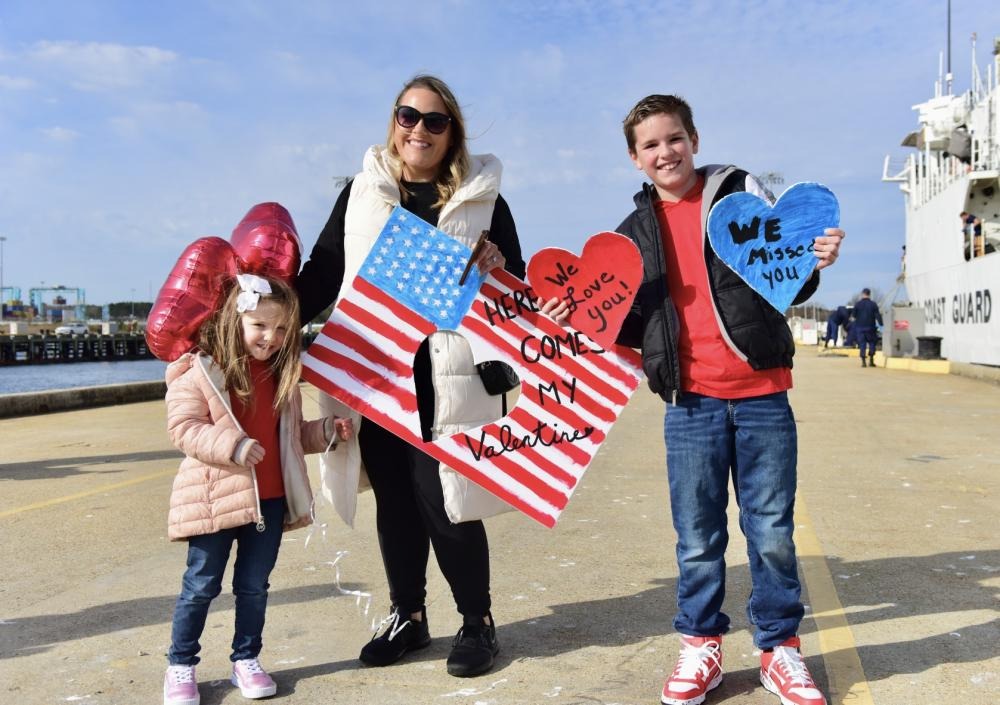
Family members of a USCGC Bear (WMEC 901) crew member pose for a photo on the pier in Portsmouth, Va., Feb. 15, 2023. Bear returned home following a 60-day deployment conducting maritime safety and security missions in the Florida Straits. (U.S. Coast Guard photo by Petty Officer 2nd Class Brandon Hillard)

Release from United States Coast Guard

***** 

Feb. 15, 2023 

Editor’s Note: For b-roll of Bear’s patrol, click here; homecoming footage can be viewed here. 

PORTSMOUTH, Va. — The crew of the USCGC Bear (WMEC 901) returned to their homeport in Portsmouth Wednesday after completing a 60-day deployment in the Florida Straits and Windward Passage. 

Bear’s crew supported Homeland Security Task Force – Southeast and Operation Vigilant Sentry in the Coast Guard’s Seventh District area of operations. While underway, Bear’s crew conducted maritime safety and security missions while working to detect, deter and intercept unsafe and illegal migrant ventures bound for the United States. 

Within the first days of patrol, Bear interdicted an overloaded Cuban rustic vessel in the Florida Straits and transferred 27 migrants on board the cutter. 

Bear also spent part of the patrol acting as a visual deterrence to illegal migration in the region by operating close to Haiti’s shore, which resulted in the interdiction of two overloaded migrant voyages. Both vessels were approximately 50 feet in length and each carried more than 200 migrants. After providing food, water, and medical care, Bear’s crew repatriated the migrants back to Haiti. 

Throughout the deployment, Bear’s crew members cared for and provided medical attention to 502 migrants on board the cutter before repatriating them to their country of origin. 

“Bear’s mission was to deter illegal maritime migration and rescue those in distress before the sea claimed their lives,” said Cmdr. Brooke Millard, Bear’s commanding officer. “This deployment was challenging. It’s tough to witness fellow humans risk all for a better way of life in an unforgiving sea. Know that your Coast Guard is ‘all in’ to protect our maritime border as well as save lives.” 

Since the fiscal year began in October, Coast Guard crews have interdicted over 7,100 Cubans and Haitians at sea. 

Bear is a 270-foot, Famous-class medium endurance cutter with a crew of 100. The cutter’s primary mission areas include homeland security, law enforcement, counter drug, search and rescue, migrant interdiction, and fisheries enforcement in support of U.S. Coast Guard operations throughout the Western Hemisphere. 


Wreck Site Identified as World War II Submarine USS Albacore (SS 218)

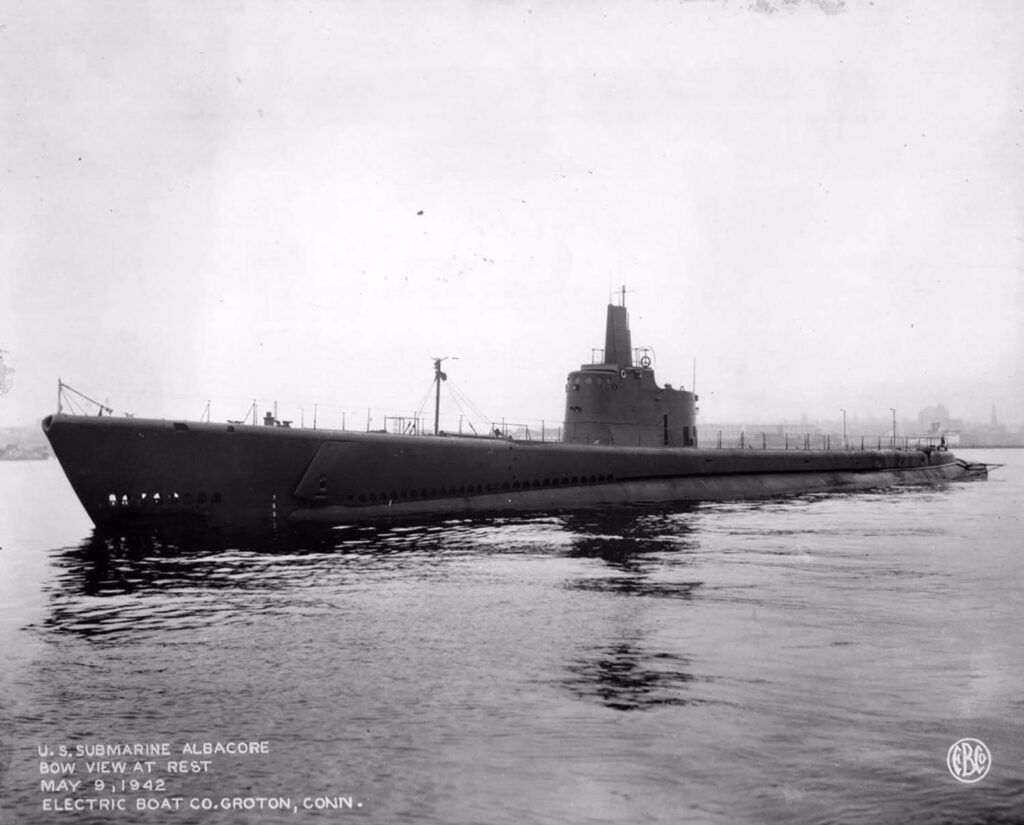
WASHINGTON (Feb. 16, 2023) A file photo dated May 19, 1942 of the Gato-class submarine USS Albacore (SS 218) as it departs Groton, Conn. Albacore served in the Pacific theater during WWII and was presumed lost and stricken from the Naval Vessel Register on March, 30 1945. The wreck site of Albacore was confirmed Feb. 16, off the coast of Hokkaido, Japan. (U.S. Navy photo)

Release from United States Navy 

***** 

From Petty Officer 1st Class Abigayle Lutz, Naval History and Heritage Command 

WASHINGTON - Naval History and Heritage Command (NHHC) confirmed the identity of a wreck site off the coast of Hokkaido, Japan, as USS Albacore (SS 218) Feb. 16. 

NHHC’s Underwater Archaeology Branch (UAB) used information and imagery provided by Dr. Tamaki Ura, from the University of Tokyo, to confirm the identity of Albacore, which was lost at sea Nov. 7, 1944. 
 
“As the final resting place for Sailors who gave their life in defense of our nation, we sincerely thank and congratulate Dr. Ura and his team for their efforts in locating the wreck of Albacore,” said NHHC Director Samuel J. Cox, U.S. Navy rear admiral (retired). “It is through their hard work and continued collaboration that we could confirm Albacore’s identity after being lost at sea for over 70 years.” 
 
Japanese records originating from the Japan Center for Asian Historical Records (JACAR) covering the loss of an American submarine on Nov. 7, 1944, guided Dr. Ura’s missions. The location mentioned in the records matched a separate ongoing effort by UAB volunteers to establish the location of the shipwreck. 
 
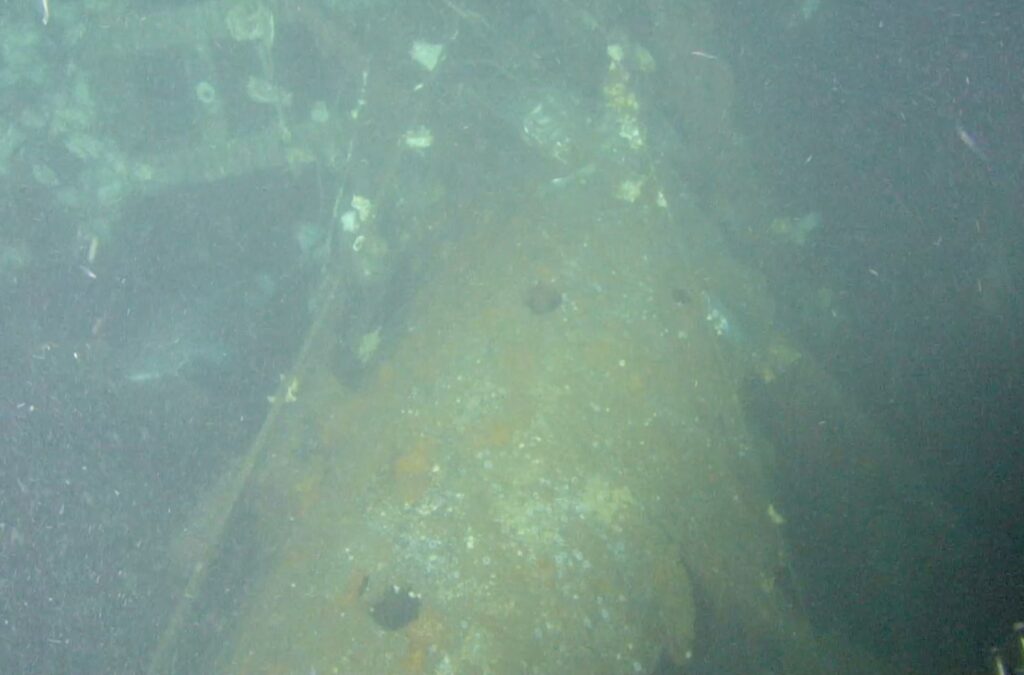
Dr. Ura’s team collected data using a Remotely Operated Vehicle to confirm the historical data. Strong currents, marine growth, and poor visibility on site made it challenging to fully document the wreck or obtain comprehensive images. However, several key features of a late 1944 Gato-class submarine were identified in the video. 
 
Indications of documented modifications made to Albacore prior to her final patrol such as the presence of an SJ Radar dish and mast, a row of vent holes along the top of the superstructure, and the absence of steel plates along the upper edge of the fairwater allowed UAB to confirm the wreck site finding as Albacore. 
 
The wreck of Albacore is a U.S. sunken military craft protected by U.S. law and under the jurisdiction of NHHC. While non-intrusive activities, such as remote sensing documentation, on U.S. Navy sunken military craft is allowed, any intrusive or potentially intrusive activities must be coordinated with NHHC and if appropriate, authorized through a relevant permitting program. Most importantly, the wreck represents the final resting place of Sailors that gave their life in defense of the nation and should be respected by all parties as a war grave. 
 
Albacore was constructed by the Electric Boat Company in Groton, CT and commissioned on June 1, 1942. Before being lost in 1944, she conducted 11 war patrols and is credited with 10 confirmed enemy vessel sinkings, with possibly another three not yet confirmed. Albacore earned nine battle stars and four Presidential Unit Citations during her career. Six of the ten enemy sinkings were enemy combatant ships, ranking her as one of the most successful submarines against enemy combatants during World War II. 
 
For more information on Albacore, please visit our website.

 
NHHC, located at the Washington Navy Yard, is responsible for preserving, analyzing, and disseminating U.S. naval history and heritage. It provides the knowledge foundation for the Navy by maintaining historically relevant resources and products that reflect the Navy’s unique and enduring contributions through our nation’s history and supports the fleet by assisting with and delivering professional research, analysis, and interpretive services. NHHC comprises many activities, including the Navy Department Library, the Navy Operational Archives, the Navy art and artifact collections, underwater archeology, Navy histories, 10 museums, USS Constitution repair facility, and the historic ship Nautilus. 


BAE Systems successfully tests Lockheed Martin Skunk Works®‘ small uncrewed aerial systems on ACV C4/UAS  

Release from BAE Systems 

***** 

SILVER SPRINGS, Nev. – Feb. 16, 2023 – BAE Systems and Lockheed Martin Skunk Works® conducted a successful test of the Stalker and Indago small uncrewed aerial systems (UAS) on an Amphibious Combat Vehicle Command, Control, Communication and Computers/Uncrewed Aerial Systems (ACV C4/UAS) variant.  

Both UAS will provide unprecedented, long-endurance reconnaissance capabilities to support the U.S. Marine Corps’ expeditionary warfare and battle management capabilities aboard the ACV C4/UAS. 

“We’re focused on giving Marines an advanced technology solution to meet their reconnaissance requirements,” said Mark Brinkman, program manager for ACV design and development. “That’s why we’re teamed with companies like Lockheed Martin—to provide Marines with the best possible capabilities for their expeditionary needs.” 

BAE Systems tested Skunk Works’ Stalker and Indago UAS along with a number of other technology suppliers as part of contractor verification testing, a key event in the ACV C4/UAS program’s lifecycle. Now that contractor verification testing is complete, the Marine Corps will conduct its own series of tests to evaluate if the ACV C4/UAS is a capable and cost-effective Government Off The Shelf (GOTS) solution for the Advanced Reconnaissance Vehicle (ARV) program.  

Skunk Works’ Stalker and Indago UAS provide industry-leading endurance, a broad operating envelope, and an open systems architecture to allow them to execute diverse and demanding missions while maintaining a small operational footprint and crew requirement.  

“Collaboration with our SOCOM and Marine Corps customers and industry partners has enabled the rapid development of needed capabilities for the warfighter – as exemplified through this partnership with BAE Systems,” said Jacob Johnson, Skunk Works UAS and Attritable Systems director. “By integrating Stalker and Indago on BAE Systems’ ACV platform, we are delivering greater mission flexibility in a small form factor that supports Marine Corps operations.”  

BAE Systems’ ACV C4/UAS vehicle is a Mobile Systems Integration Lab (SIL) built to demonstrate the transformational technology Marines need to conduct reconnaissance, surveillance, and acquisition capabilities, including the ability to sense and communicate targets over the horizon using cutting edge C4 systems. Skunk Works’ Stalker and Indago UAS are some of the technology components that the ACV C4/UAS employs to achieve this goal. 


Navy Admirals Detail Russian Arctic Build-Up

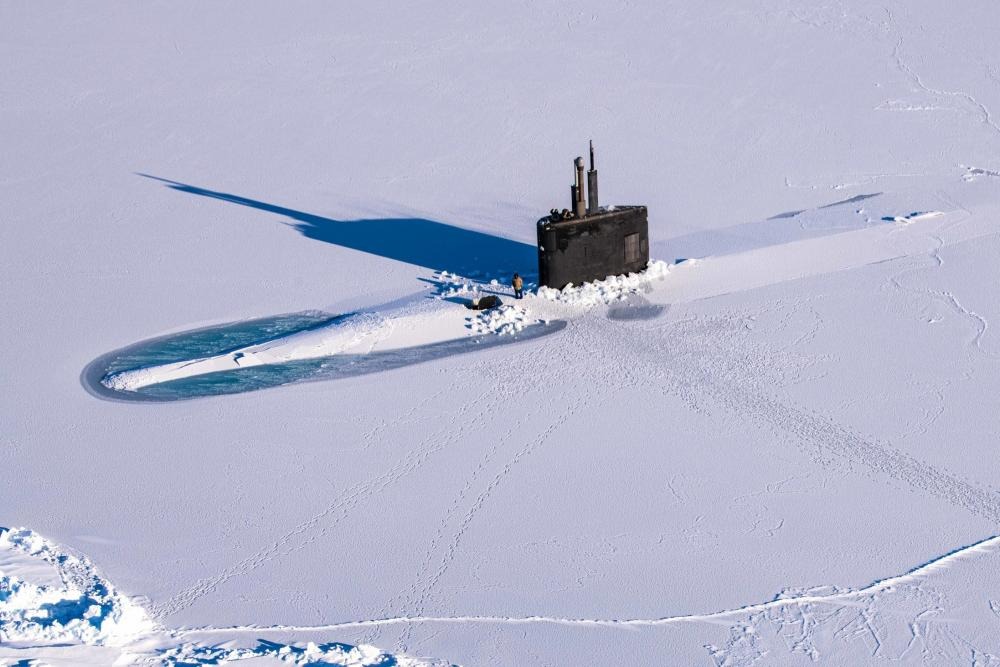
The Los Angeles-class fast-attack submarine USS Pasadena (SSN 752) breaks through the ice in ICEX, which happened concurrently with Arctic Edge 2022. Arctic Edge is a U.S. Northern Command biennial defense exercise designed to demonstrate and exercise the ability to rapidly deploy and operate in the Arctic. (U.S. Navy Photo by Mass Communication Specialist 2nd Class Trey Hutcheson) Photo by Petty Officer 2nd Class Trey Hutcheson

***** 

WASHINGTON — Senior U.S. Navy leaders in the Atlantic and European regions discussed, in some detail, the nature of the Russian build-up and naval activity in the Arctic region during a recent seminar in Washington. 

Speaking Feb. 9 at a seminar sponsored by the Wilson Center’s Polar Institute and the Center for Maritime Strategy (CMS), a think tank of the Navy League of the United States — Deterring Russia at Sea in the High North — were Adm. Daryl Caudle, commander, U.S. Fleet Forces Command and Vice Adm. Dan Dwyer, commander, U.S. Second Fleet. The seminar was moderated by retired Adm. James Foggo, dean of CMS. 

“Russia now has six bases, 14 airfields, 16 deep-water ports, and 14 icebreakers built,” Caudle said of the Russian build-up. 

“They dominate the Arctic geography and possess the corresponding ability to dominate in capability and infrastructure,” he said. “They do have legitimate sovereign interests and have elevated their Northern Fleet to constitute its own military district — think, combatant command.” 

For decades, Russia and its prior Soviet Union entity have been especially protective of the northern approaches of the Barents Sea and Artic Ocean out of a desire to maintain a protective bastion for its nuclear-tipped missile force deployed on its ballistic-missile submarines.  

Caudle said Russia has the largest icebreaker fleet in the world and has even armed icebreakers with the Kalibr cruise missile.  

“They have an active defense system that has high readiness, mobility, and firepower in the Northern Fleet,” he said. “They centralize the command-and-control authority of the S-400 [surface-to-air] missile system. They have strong anti-access and access-denial capability that reaches from the Arctic to the Baltic to the GIUK [Greenland-Iceland-United Kingdom] Gap. They have long-range, precision-guided strike weapons especially focused in and near the Kola Peninsula.” 

Caudle said those weapons include submarine-launched Kalibr submarine-launched land-attack cruise missiles, the Kinzhal long-range anti-ship missile, and the Screwdriver mobile land-attack cruise missile. 

Arctic Upgraded as Russian Priority

Dwyer, whose fleet had increased its excursions into the High North, said “[t]he stability that we enjoyed in the High North is in fact being challenged not only by climate change but by Russia themselves. 

He said that in July 2022 Russia released its new maritime doctrine, “prioritizing the Arctic as its most important maritime direction, pledging to protect these waters ‘by all means.’ This includes increasing attention on the Arctic littorals as well as the introduction of new missile capabilities … to focus on its bastion of the Northern Fleet…. Prior to this announcement, the Arctic was their number three priority. The Atlantic was their number one priority. Now Russians realize that the Arctic is the key to their economy and to their defense as they see the receding of the Arctic ice cap.” 

Dwyer also noted that in August 2022, Russia, “unveiled plans for a new strategic missile-carrying submarine cruiser for Atlantic operations. Moreover, in September Russia conducted Exercise Inka in the Arctic, deploying several submarines together, showing their capability in the High North. It is worth noting that Russia has renovated many Arctic sites and opened new ones. This is why we at JFC [NATO’s Joint Forces Command] Norfolk do everything in our power to manage and mitigate risk, prevent escalation, and ensure transparency of NATO operations in the Arctic.”   


HII Plans Additional Demonstration for Pharos Launcher for LDUUVs

HII press conference 14 Feb 2023

***** 

ARLINGTON, Va. — Huntington Ingalls Industries (HII) is seeking an opportunity to demonstrate its new launch and recovery platform for large-diameter UUVs (LDUUVs) at sea on a U.S. Navy amphibious landing platform dock ship, a company official said. 

Brian Blanchette, vice president for Quality and Engineering at HII’s Ingalls Shipbuilding, spoke to reporters in a teleconference at West 2023 on Feb. 14, a trade show and symposium of the Armed Forces Communications and Electronics Association and the U.S. Naval Institute, and said the company would welcome a demonstration of the Pharos launch and recovery system from the well deck of an LPD either underway or in port.  

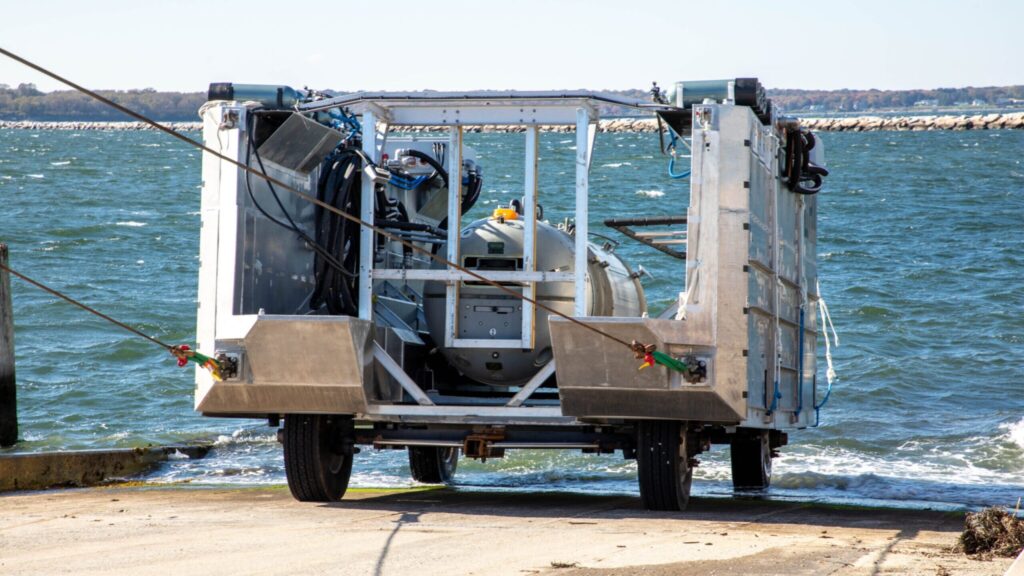
The Pharos system is a prototype cradle large enough to accommodate an LDUUV than can be streamed behind the well deck of an LPD or a well-deck-equipped amphibious assault ship (LHA/LHD) to launch the LDUUV or recover it. The cradle is tethered to a winch. 

The Pharos concept was developed by HII and underwent additional testing through cooperative agreements with the Naval Surface Warfare Center Panama City, Florida, and the Naval Undersea Warfare Center Division Newport, Rhode Island. 

The Pharos was tested dockside in the HII Ingalls shipyard in Pascagoula, Mississippi in June 2022 and towed in a river, Blanchette said. The payload for the demonstration was HII’s Proteus LDUUV. 

He said that interface testing was conducted in September 2022 with a surrogate for the Navy’s Snakehead LDUUV, followed in October 2022 with a ballast/de-ballast test with the Snakehead.  

Scalable Concept 

“When we went through the design process for this vehicle [Pharos], we did computations, including dynamic studies, to evaluate where in the wake zone of the LPD would be a favorable location for a launch and recovery vehicle and also did model basin testing at the University of New Orleans in their tow tank to look at a physical scale model and better understand the capabilities of the system at speed simulating a tow. 

“We feel like we understand some of the challenges and have designed the system around those, but we look forward to at-sea testing to further validate the concept,” he said. “We are in talks with the Navy trying to find a target of opportunity to interface with an LPD either pier-side or at sea.”  

HII also plans this year to integrate the Pharos with the REMUS 6000 UUV. 

Blanchette said the Pharos concept is scalable and could be built to accommodate extra-large-diameter UUVs such as the Orca being developed by Boeing for the Navy. 


AUSTAL USA CELEBRATES OPENING OF SAN DIEGO WATERFRONT SHIP REPAIR FACILITY 

Release from Austal USA

***** 

FEBRUARY 13, 2023 

San Diego, Calif. – Austal USA celebrated the opening of the company’s new San Diego waterfront ship repair facility today during an afternoon reception that brought together military and community leaders, elected officials, and representatives from across the ship repair industry. 

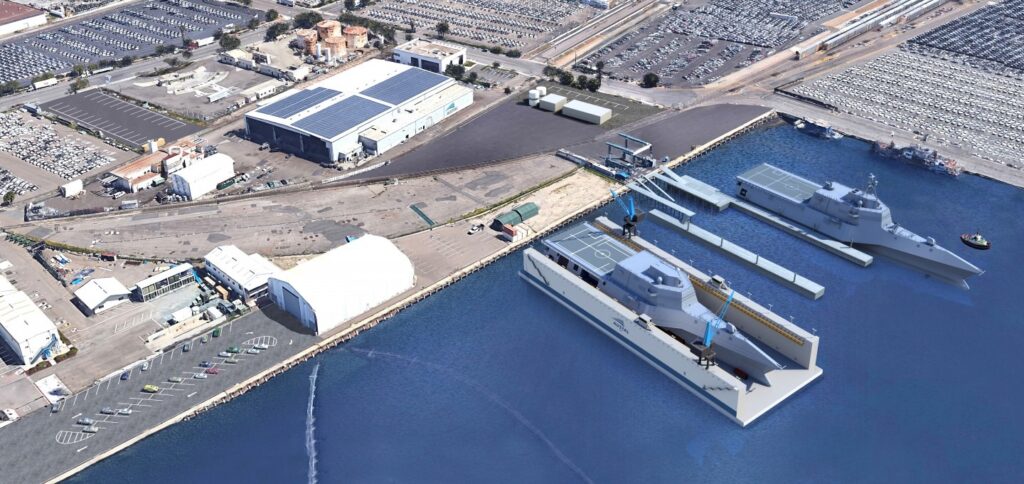
The shipyard, located adjacent to Naval Base San Diego, will provide full-service repair, maintenance and modernization services for small surface combatants, unmanned and autonomous vessels, and auxiliary ships. 

Since finalizing an agreement for the property over a year ago, Austal USA has invested over $100 million in facility upgrades and a new floating dry dock to transform the facility. The 15-acre site now provides 678 feet of improved San Diego Bay shoreline, 80,000 square feet of covered working space, and has been equipped with new pier fenders and moorings, modernized shore power conversions, and enhanced security. 

“As much as this is a significant day for Austal USA, this is a significant day for our Nation, Navy and Coast Guard customer, the National City community and surrounding Port tenants, as well as our fellow industry colleagues,” stated Austal USA President Rusty Murdaugh. “Together, we have a shared commitment to maintaining an operationally ready and available surface fleet and we are proud to join a community here on the southwest waterfront dedicated to that mission.”  

Austal USA is currently executing its first availability in its new facility, the post shakedown of the future USS Canberra (LCS 30). With the company’s new floating dry dock on schedule to be fully operational by summer 2023, Austal USA will have the capability to execute more extensive depot maintenance on Littoral Combat Ships, Frigates, and other similar sized surface combatants and auxiliaries. 

“Getting our Nation’s ships ready and out to sea is critically important. Our team responded to the need to increase capacity here in San Diego and we will similarly respond to the need to deliver ships safely from their availabilities on-time, on-budget, and warfighting ready,” Murdaugh said. “Our team is energized and we’re ready to get to work.” 

With repair and service capabilities previously established in Mobile, Ala. and Singapore, recent expansions into steel shipbuilding, and a technology center in Charlottesville, Va., the San Diego shipyard opening continues Austal USA’s growth as a full service defense provider. 


Northrop Grumman Connects Distributed Platforms Across Domains 

Northrop Grumman demonstrates its next generation gateway system on a Triton Flying Test Bed. This multi-platform, multi-domain capability on the Triton platform bolsters the Navy’s interoperability to help enable distributed maritime operations. Photo: Northrop Grumman

Release from Northrop Grumman

***** 

Multi-platform demonstration showcased interoperability among F-35, MQ-4C Triton, E-2D Advanced Hawkeye and naval ships 

SAN DIEGO – Feb. 13, 2022 – Northrop Grumman Corporation (NYSE: NOC) successfully demonstrated its gateway technology in a flight test that proved the ability to connect airborne platforms with naval assets. The first-of-its-kind demonstration was conducted with Naval Air Systems Command, Office of Naval Research, Naval Information Warfare Center Pacific and BAE Systems. 

“Our gateways provide an open, secure and resilient solution needed to enable information advantage for our customers,” said Ben Davies, vice president and general manager, network information solutions, Northrop Grumman. “This powerful combination expands the mission sets of maritime platforms to deliver a seamlessly connected fleet – a critical step as the U.S. Navy achieves its naval operational architecture to enable distributed maritime operations.” 

Equipped on Northrop Grumman’s MQ-4C Triton Flying Test Bed, the airborne gateway shared fifth-generation sensor data to ground-based simulators that represented an F-35, an E-2D Advanced Hawkeye, U.S. Navy Aegis class destroyers and carrier strike groups. The gateway integrated with Triton’s radar and artificial intelligence and machine learning capabilities to significantly enhance situational awareness across previously disconnected platforms. The addition of the gateway on Triton expands data sharing and will improve the warfighter’s ability to stay ahead of the adversary and make decisions faster across a vast and diverse environment. 

“Triton’s altitude, persistence, and robust communication links make it an ideal candidate to host the Gateway system,” said Jane Bishop, vice president and general manager, global surveillance, Northrop Grumman. ”This demonstration highlighted gateway technology enhancements to Triton that would enable information dominance across distributed maritime assets; including access to the F-35’s robust sensor suite and the E-2D’s battle management capabilities.” 

Northrop Grumman recently demonstrated another gateway solution and also unveiled Australia’s first Triton. Northrop Grumman’s family of systems brings enhanced interoperability between joint and coalition forces across air and sea. 

Northrop Grumman is a leading global aerospace and defense technology company. Our pioneering solutions equip our customers with the capabilities they need to connect and protect the world, and push the boundaries of human exploration across the universe. Driven by a shared purpose to solve our customers’ toughest problems, our 95,000 employees define possible every day.