U.S. Navy Awards Metron Contract for Algorithm and Simulation R&D in Applied Undersea Mission Autonomy
RESTON, Va. — Metron Inc. has been awarded a $7.8 million cost-plus-fixed-fee Office of Naval Research (ONR) contract for “Advanced Algorithm Development for Autonomous Marine Systems,” the company announced in a Dec. 15 release.
The contract award will leverage Metron’s expertise in mission and path planning, object detection, tracking and data fusion, autonomous behaviors and Unmanned Underwater Vehicle (UUV) simulation. Under the terms, Metron will provide applied research investigations and software development for undersea mission autonomy. Research and technical elements will include model development, algorithm research and development, mission simulation, objective planning, system-level performance assessments and at sea demonstrations. The improved capabilities developed under the contract terms will have broad applicability across current and emerging Navy UUV systems and programs and will enhance performance across the undersea mission space.
Over the past 12 years, Metron has contributed significantly to ONR initiatives through next-generation unmanned systems, data fusion, simulation and remote sensing to improve the realized utility of undersea vehicles. Metron’s “Resilient Mission Autonomy” is platform, sensor and payload agnostic delivering advanced executive autonomy across a wide range of DoD, civilian and commercial applications.
“We are honored to have been awarded this contract to advance innovation for critical defense technologies used by the U.S. Navy,” stated Christine Judd, vice president, Metron Inc., Unmanned Systems. ” With our culture of innovation, Metron has established a consistent track record of designing, developing and implementing autonomous mission solutions at every stage from R&D through field deployments. Over the years, the Company has played an important role in the development and adoption of LD-UUV and XL-UUV class vehicles across the maritime and defense sectors, and it’s great to see the progress toward a new level of executive autonomy.”
Metron’s other government agency customers include DARPA, NASA, NAVAIR, NAVSEA and NAVWAR.
Muslim Civil Rights Group Protests Name ‘Fallujah’ for U.S. Navy Ship
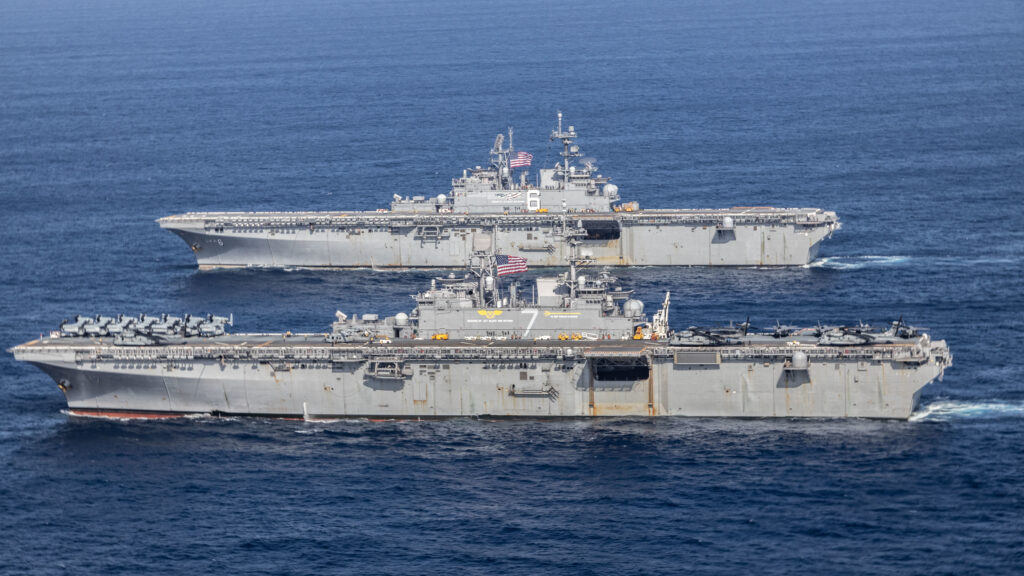
The amphibious assault ship USS Tripoli (LHA 7) sails with the amphibious assault ship USS America (LHA 6) during a photo exercise in the Philippine Sea, Sept. 17, 2022. The future USS Fallujah (LHA 9) will be similar to these ships but equipped with a well deck. U.S. MARINE CORPS / Lance Cpl. Christopher Lape
ARLINGTON, Va. — A Muslim civil rights group is protesting the U.S. Navy’s selection of the name “Fallujah” as the name of a future amphibious assault ship.
The Council on American-Islamic Relations (CAIR), self-described as the nation’s largest Muslim civil rights and advocacy organization, “called on the U.S. Navy to change the name of the future America-class amphibious assault ship ‘USS Fallujah,’” in a Dec. 15 press release.
Secretary of the Navy Carlos Del Toro announced Dec. 14 that a future America-class amphibious assault ship, LHA 9, will be named USS Fallujah. The ship “will commemorate the First and Second Battles of Fallujah, American-led offensives during the Iraq War. The name selection follows the tradition of naming amphibious assault ships after U.S. Marine Corps battles, early U.S. sailing ships or legacy names of earlier carriers from World War II,” the Navy release said.
The First Battle of Fallujah occurred in April 2004 in an effort to capture or kill insurgents responsible for the killing of four U.S. contractors, according to the Navy Department release. The Second Battle of Fallujah, fought between Nov. 7 and Dec. 23, 2004, was a major U.S. led offensive to retake control of the city from insurgents and foreign fighters. With over 100 coalition forces killed and over 600 wounded, Operation Phantom Fury is considered the bloodiest engagement of the Iraq War and the fiercest urban combat involving U.S. Marines since the Vietnam War’s Battle of Hue City.
CAIR has a different regard for the battles.
“The two battles fought in Fallujah, Iraq, in 2004, were the bloodiest fighting of the Iraq War. Hundreds of civilians — including women and children — were killed during the battles,” CAIR said in the release. “To this day, the civilian population is reportedly being negatively impacted by the weapons used in those battles.”
“Just as our nation would never name a ship the ‘USS Abu Ghraib,’ the Navy should not name a vessel after notorious battles in Fallujah that left hundreds of civilians dead, and countless children suffering from birth defects for years afterward,” said CAIR National Deputy Director Edward Ahmed Mitchell, in the CAIR release. “There must be a better name for this ship — one that does not evoke horrific scenes from an illegal and unjust war.”
The secretary of the Navy selected the name of the battles “to memorialize the Marines, Soldiers and coalition partners that fought valiantly and those that sacrificed their lives during both battles of Fallujah. This namesake deserves to be in the pantheon of iconic Marine Corps battles and the LHA’s unique capabilities will serve as a stark reminder to everyone around the world of the bravery, courage and commitment to freedom displayed by those who fought in the battle.”
“Under extraordinary odds, the Marines prevailed against a determined enemy who enjoyed all the advantages of defending in an urban area,” said Commandant of the Marine Corps Gen. David H. Berger, in the announcement. “The Battle of Fallujah is, and will remain, imprinted in the minds of all Marines and serves as a reminder to our Nation, and its foes, why our Marines call themselves the world’s finest.”
Navy Leadership Must Have Balance of Expertise from Civilian, Military and Industry Backgrounds: Analysts
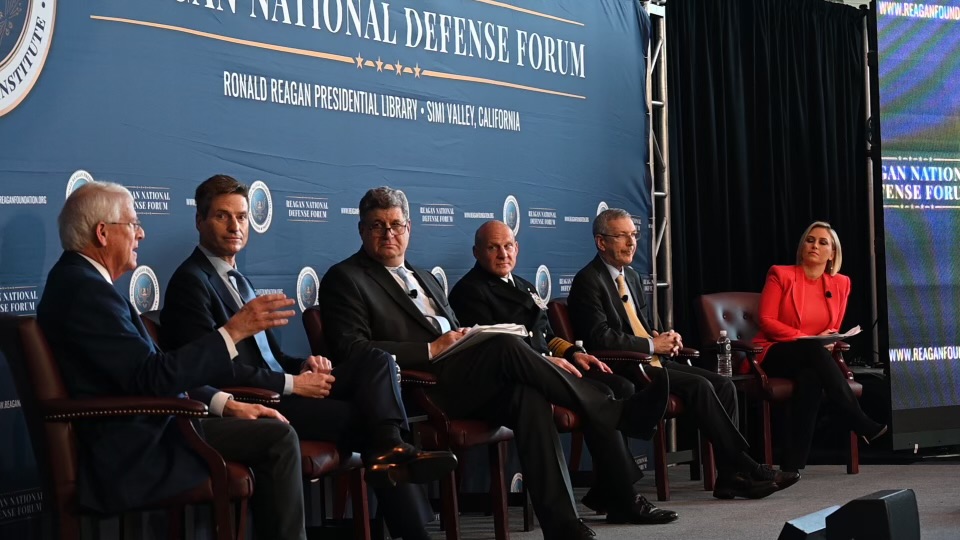
Chief of Naval Operations Adm. Mike Gilday, center, participates in a panel discussion, Restoring Strength at Home: Toward a Robust and Resilient Industrial Base, at the Reagan National Defense Forum (RNDF), Simi Valley, Calif., Dec. 3, 2022. U.S. NAVY / Lt. Michael Valania
WASHINGTON, D.C. — To have a successful future, the U.S. Navy needs to have a proper balance of expertise within its leadership of those with military, civilian and industry backgrounds, analysts with the Center for Strategic and International Studies said during a Dec. 14 event at CSIS headquarters.
Rear Adm. David Oliver (Ret.) and Associate Professor Anand Toprani made the arguments while unveiling their latest book, “American Defense Reform: Lessons from Failures and Successes in the Navy.” The book analyzes the service over “four key periods of disruptive transformation,” such as the Cold War and the fallout from the Vietnam War. In the book, they argue that a collaborative effort between civilians, the military and industry is key to setting the Navy on a course for success in the future.
“When it becomes time to reshape and rebalance defense, process is more important than personalities,” read one slide presented by Oliver. “The military — our country’s subject matter experts — must be integrally involved while civilian leaders provide leadership but not direction.”
Toprani argued that often, civilian leaders step in to provide direction on military matters when they are not qualified to do so, and civilian leaders should trust military leaders to handle those aspects.
“Just because you have the statutory power to direct, doesn’t mean they should direct it in matters they don’t have competency too,” he said.
Also, the military is often reluctant to accept innovation, and so the commercial world should become more involved in the defense industry to stem the “explosive” weapons cost growth, they argued.
To address this imbalance, Oliver and Toprani say the Navy should establish a representative team of senior subject matter experts; gather information on past, present and future trends from the trusted sources of each of the services and the Office of the Secretary of Defense; regularly review advancements in commercial technology; audit existing programs to determine opportunity costs; and review major defense acquisition programs.
People from both civilian and military backgrounds have something to offer, and the Navy should be doing a better job at leveraging their expertise, Toprani argued.
“Both sides should seek to leverage each other’s strengths,” he said.
Task Force 59 Completes Digital Horizon Event
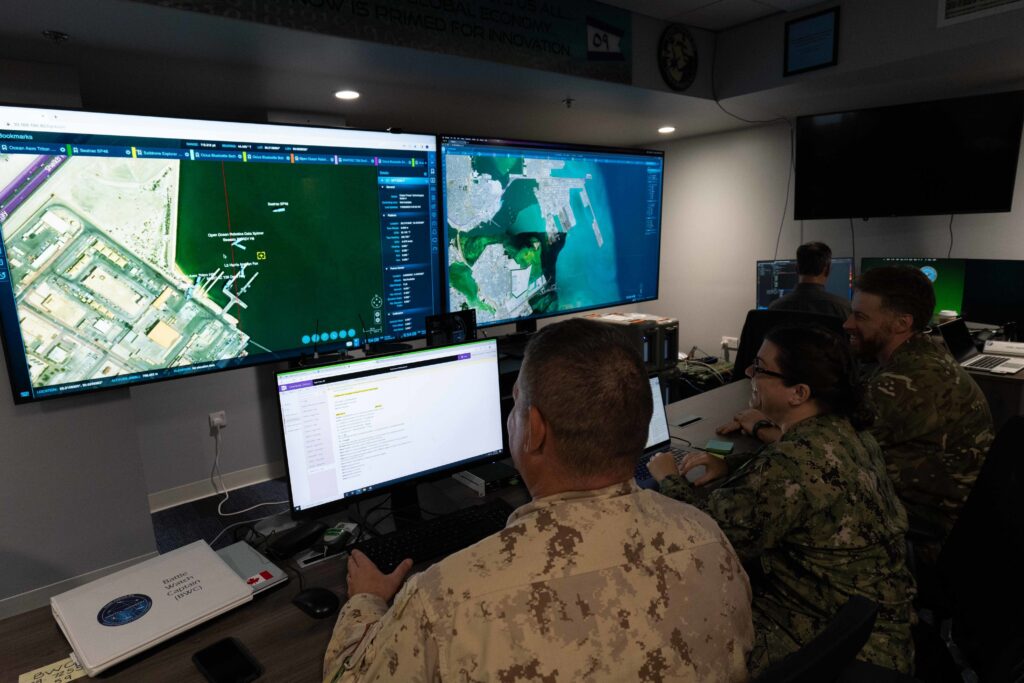
Royal Canadian Navy Lt. Cmdr. Brian MacMillan, left, Intelligence Specialist 1st Class Samantha Jordan, center, and UK Royal Navy Lt. Andrew Burns, participate in Digital Horizon 2022 in the Task Force 59 Robotics Operations Center, Nov. 28. U.S. NAVY / Mass Communication Specialist 1st Class Anita Chebahtah
MANAMA, Bahrain — U.S. 5th Fleet concluded Digital Horizon, Dec. 15, a three-week unmanned and artificial intelligence event in Bahrain that involved 17 industry partners, U.S. Naval Forces Central Command Public Affairs said in a Dec. 15 release.
The event included 15 advanced systems, 10 of which operated in the Middle East for the first time. Task Force 59 led industry partners during phased evolutions ashore and at sea to advance fleet efforts that will enhance regional maritime awareness.
“The pace of innovation throughout Digital Horizon was unbelievable,” said Capt. Michael Brasseur, commander of Task Force 59. “We pushed beyond technological boundaries and discovered new capabilities for maritime domain awareness to enhance our ability to see above, on and below the water.”
During Digital Horizon, Task Force 59 leveraged artificial intelligence to create an interface on one screen, also called a “single pane of glass.” The screen displayed relevant data from multiple unmanned systems for watchstanders in Task Force 59’s Robotics Operations Center.
The task force also launched an unmanned aerial vehicle (UAV) from USCGC Emlen Tunnell (WPC 1145), marking the first time Task Force 59 operated a UAV from a U.S. Coast Guard cutter. The launch also enhanced Task Force 59’s ability to create a mesh network for unmanned systems to relay imagery to command centers ashore and at sea in a communications denied environment.
“It has been an incredible opportunity to work with new systems and new partners to drive the innovation process forward for the U.S. Navy,” said Lt. Jay Faylo, the task force’s director of artificial intelligence.
Over the past year, Task Force 59 has operated unmanned surface vessels in regional waters for more than 25,000 hours, which equates to 12 years of nine-to-five testing five days a week.
NAVCENT is headquartered in Manama, Bahrain and includes maritime forces operating in the Arabian Gulf, Gulf of Oman, Red Sea, parts of the Indian Ocean and three critical choke points at the Strait of Hormuz, Suez Canal and Bab al-Mandeb.
USCGC Campbell Returns to Homeport Following 60-day Eastern Pacific Patrol
U.S. Coast Guard Cutter Campbell (WMEC 909) transits toward its homeport, on Nov. 30, 2022. Campbell completed a 60-day counterdrug patrol in the eastern Pacific Ocean to support Joint Interagency Task Force – South. U.S. COAST GUARD / Ensign Olivia Anthony
NEWPORT, R.I. — The crew of the U.S. Coast Guard Cutter Campbell (WMEC 909) returned to their homeport in Newport, Rhode Island, Dec. 9, after a 60-day counterdrug patrol in the Eastern Pacific Ocean to support Joint Interagency Task Force – South.
With the assistance of an embarked Helicopter Interdiction Tactical Squadron detachment based out of Jacksonville, Florida, Campbell was tasked with the disruption and interdiction of illicit narcotics originating in Central and South America.
Throughout October and November, Campbell’s crew boarded five different vessels, resulting in the successful detention of 12 suspected drug smugglers and the interdiction of over 9,700 pounds of marijuana worth approximately $9.7 million.
Campbell’s actions directly contributed to the United States’ ongoing efforts to combat transnational criminal organizations.
During the deployment, the crew took multiple opportunities to strengthen ties with partner nations across the region. Campbell embarked two members of the Panamanian National Aeronaval Service for the duration of the deployment to the Eastern Pacific. Campbell also conducted joint training with members of the Costa Rican and Ecuadorian maritime forces, strengthening regional partnerships in the Western Hemisphere.
While transiting home in December, crew members from Campbell rescued nine migrants who were stranded on an uninhabited Bahamian island.
In early December, Campbell completed a drug offload in Fort Lauderdale, Florida, transferring over 14,500 pounds of cocaine and marijuana worth an estimated $320 million. The contraband was the result of interagency and international collaboration, and included busts from Campbell, USCGC Forward (WMEC 911) and HNLMS Holland (P 840) of the Royal Netherlands Navy.
Campbell is a 270-foot, Famous-class medium-endurance cutter with a crew of 100. Its primary missions include search and rescue, maritime law enforcement, marine environmental protection, homeland security and national defense operations.
Philippine Navy Commissions First Two FAIC-M / SHALDAG Mk5 Vessels with RAFAEL’s Integrated Naval Combat Suite
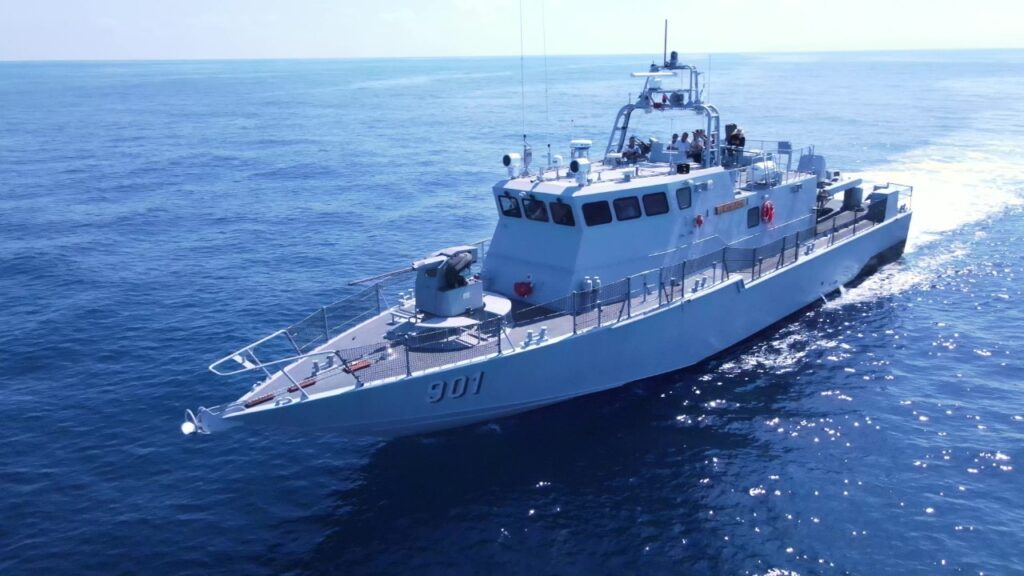
SHALDAG MK5 vessels with RAFAEL’s integrated Naval combat suite. RAFAEL
HAIFA, Israel — RAFAEL Advanced Defense Systems Ltd. announced Dec. 15 that two FAIC-M/SHALDAG MK5 vessels with a fully-integrated RAFAEL naval combat suite have been commissioned by the Philippine Navy. The two vessels manufactured by Israel Shipyards Ltd., provided to the Philippine Navy, serve as the first fully integrated vessels with the naval combat suite out of a total of nine which the Philippine Navy will ultimately receive.
RAFAEL’s naval combat suite, which is valued at hundreds of millions of dollars, includes a Combat Management System (CMS), Typhoon and Mini-Typhoon Remote Operating Weapon Systems, Naval Spike Missiles, SeaCom Internal and external Communication System and BNET Tactical Data Link, as well as training, support and maintenance services.
RAFAEL’s Naval Combat Suite is based on combat-proven technology and systems, relying on years of experience and deep operational know-how in various naval arenas and scenarios, and integrating combat-proven technologies in all domains. RAFAEL’s off-the-shelf, leading technologies and solutions, provide naval forces defense superiority in littoral and blue water against all modern naval threats above and below the waves.
Future Destroyer USS Sam Nunn Marks Start of Fabrication
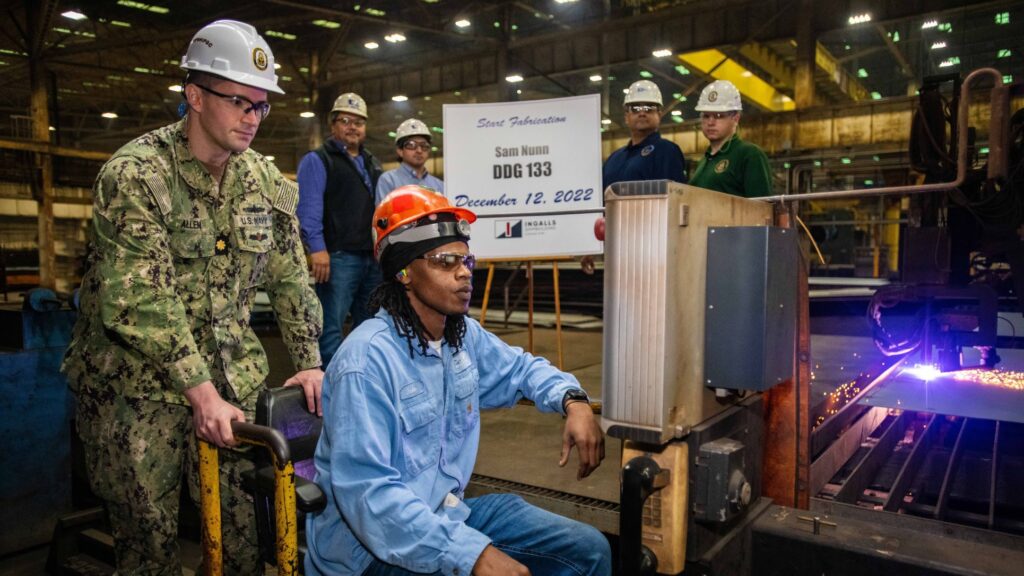
HII has started fabrication for the future USS Sam Nunn. HII
PASCAGOULA, Miss. — The U.S. Navy and HII marked the start of fabrication for the future USS Sam Nunn (DDG 133) with a ceremony at HII’s shipyard on Dec 12, Team Ships Public Affairs said in a Dec. 14 release.
DDG 133 will be a DDG 51 Flight III guided missile destroyer centered on the AN/SPY-6(V)1 Air and Missile Defense Radar and will provide greatly enhanced warfighting capability to the fleet. The Flight III baseline begins with DDGs 125-126 and continues with DDG 128 and follow-on ships.
The ship is named for Samuel Augustus Nunn Jr., a United States senator who represented Georgia from 1972 to 1997 and served as chairman of the United States Senate Committee on Armed Services and the Permanent Subcommittee on Investigations.
“The future USS Sam Nunn will provide 21st Century offensive and defensive warfighting capabilities for decades to come,” said Capt. Seth Miller, DDG 51 program manager, Program Executive Office (PEO) Ships.
In addition to Sam Nunn, HII’s Pascagoula shipyard is also currently in production on future destroyers Jack H. Lucas (DDG 125), Ted Stevens (DDG 128), Jeremiah Denton (DDG 129) and George M. Neal (DDG 131).
Standing NATO Maritime Group Two Transfers Flagship in Rota
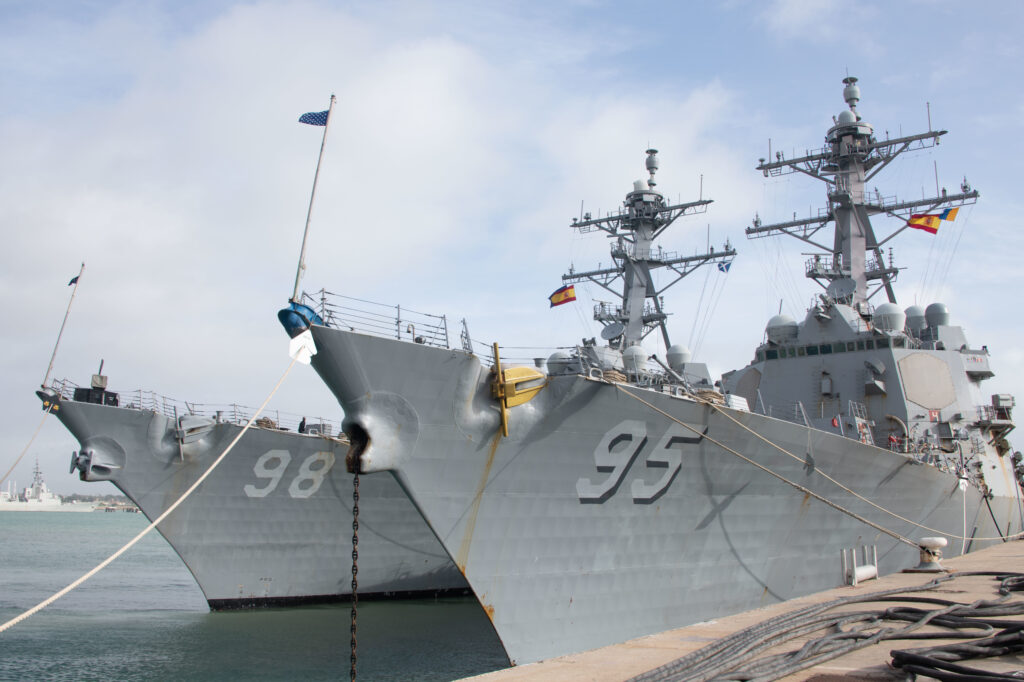
Standing NATO Maritime Group Two transfers its flagship from USS Forrest Sherman (DDG 98) to USS James E Williams (DDG 95) as USS Forrest Sherman completes its deployment and prepares to return to homeport in Norfolk, VA. U.S. NAVY / Petty Officer 3rd Class Ezekiel Duran
ROTA, Spain — Standing NATO Maritime Group Two (SNMG2) transferred its flagship as scheduled from U.S. Navy Arleigh Burke-class guided-missile destroyer USS Forrest Sherman (DDG 98) to U.S. Navy Arleigh Burke-class guided-missile destroyer USS James E. Williams (DDG 95) at Naval Station Rota on Dec. 13, said Cmdr. Fernando Estrella, NATO Allied Maritime Command, in a release.
USS Forrest Sherman assumed flagship duties for SNMG2 on July 1.
While operating in the Euro-Atlantic area she provided continuous maritime capability by operating throughout the Mediterranean Sea, Ionian Sea, Adriatic Sea, Aegean Sea and Tyrrhenian Sea. Her vigilance activities stretched from the Straits of Gibraltar to the Syrian Channel and as far as the northern Adriatic Sea.
“I can’t express enough how proud I am of the Sailors on board USS Forrest Sherman,” said U.S. Navy Rear Admiral Scott Sciretta, commander of SNMG2. “They served admirably, meeting and exceeding each and every operational commitment and challenge. Their persistent presence as the flagship for an international task group served as an active deterrent to our adversaries and ensured peace and respect for national sovereignty, territorial integrity, human rights and international law. As a result of their efforts, the NATO Alliance is stronger than ever and we will continue to demonstrate how our combat-credible, forward-deployed force is the most potent, flexible and versatile instrument of military power. To the Sailors of Forrest Sherman and their families whose sacrifices allow them to serve, thank you.”
USS Forrest Sherman demonstrated a high level of interoperability by serving as the flagship for a task group of 21 different rotating ships from seven NATO nations. Additionally, she led the task group as it integrated with various other Allied maritime groups to include Standing NATO Mine Countermeasures Group Two (SNMCMG2), the U.S. Navy Harry S. Truman Carrier Strike Group (HSTCSG) and George H.W. Bush Carrier Strike Group (GHWBCSG), the French Navy Charles De Gaulle Carrier Strike Group, the Italian Navy Cavour Carrier Strike Group and the Royal Navy HMS Albion Littoral Readiness Group. Throughout her deployment she visited nine different ports in seven countries, proudly flying the NATO flag, and serving as a visible reminder of the Alliance’s solidarity and cohesion afloat.
“Serving as the flagship for SNMG2 has been an incredible privilege,” said U.S. Navy Cmdr. Lawrence Heyworth IV, commanding officer of USS Forrest Sherman. “The crew of the Forrest Sherman enjoyed working closely with ships and Sailors from 12 different nations throughout this deployment, and we are proud of the interoperability and interchangeability we have developed with our NATO Allies and partners.”
USS Forrest Sherman is scheduled to complete her six-month deployment and return to her homeport in Norfolk, Virginia, in the United States. USS James E. Williams is scheduled to serve as SNMG2’s flagship throughout the remainder of her deployment.
“The crew of James E. Williams is prepared and ready to engage the challenges that lie ahead as we assume flagship duties for SNMG2,” said U.S. Navy Commander Robert Ireland, commanding officer of USS James E. Williams. “We look forward to continuing to strengthen our relationship with NATO Allies and partners while operating in the Euro-Atlantic area.”
As a NATO task group, SNMG2 prioritizes its mandate to enhance the collective readiness, responsiveness, deployable readiness, integration and interoperability of its forces. Its focus is on deterrence and defense against all adversaries in the maritime domain, upholding freedom of navigation, securing maritime trade routes and protecting the main lines of communication.
SNMG2 is a multinational integrated task group that projects a constant and visible reminder of the Alliance’s solidarity and cohesion afloat. This continuous maritime capability performs a wide range of tasks, including exercises and real-world operations in periods of crisis and conflict.
SNMG2 is one of four Standing Naval Forces that operate under NATO Allied Maritime Command, headquartered in Northwood, United Kingdom.
Future USS Carl Levin Successfully Completes Acceptance Trials
The future USS Carl M. Levin (DDG 120) returned to General Dynamics Corp’s Bath Iron Works Bath shipyard from acceptance trials, flying three brooms signaling clean sweeps of performance tests. GENERAL DYNAMICS
Bath, Maine — The future USS Carl M. Levin (DDG 120) successfully completed acceptance trials on Dec. 9, returning to General Dynamics Corp’s Bath Iron Works (BIW) Bath shipyard after spending two days at sea, Team Ships Public Affairs said in a Dec. 12 release.
During acceptance trials, the ship and its crew performed a series of demonstrations for review by the U.S. Navy’s Board of Inspection and Survey (INSURV). These demonstrations are used by INSURV to validate the quality of construction and compliance with Navy specifications and requirements prior to delivery of the ship to the U.S. Navy. Many of the ship’s onboard systems, including navigation, damage control, mechanical and electrical systems, combat systems, communications and propulsion applications, were tested to validate performance met or exceeded Navy specifications.
“The future USS CARL M. LEVIN performed exceptionally at sea and is ready to deliver to the Navy early next year,” said Capt. Seth Miller, DDG 51 program manager, Program Executive Office (PEO) Ships. “The Navy is excited to welcome yet another of these multi-mission warships to our Sailors.”
DDG 120 is named for the late Michigan Senator, Carl M. Levin, who served in the U.S. Senate for 36 years from 1979-2015. As the longest serving senator in Michigan state history, Levin became a staunch supporter of the armed services through his work and leadership as Chairman and Ranking Member of the Senate Committee on Armed Services.
As a Flight IIA destroyer, DDG 120 is equipped with the Aegis Baseline 9C2 Combat System, which includes Integrated Air and Missile Defense capability and enhanced Ballistic Missile Defense capabilities. This system delivers quick reaction time, high firepower and increased electronic countermeasures capability against a variety of threats.
The shipyard is also continuing production on future destroyers John Basilone (DDG 122), Harvey C. Barnum Jr. (DDG 124), Patrick Gallagher (DDG 127), Louis H. Wilson Jr. (DDG 126) and William Charette (DDG 130).
U.S. Navy Retrieves Artemis I Orion Spacecraft
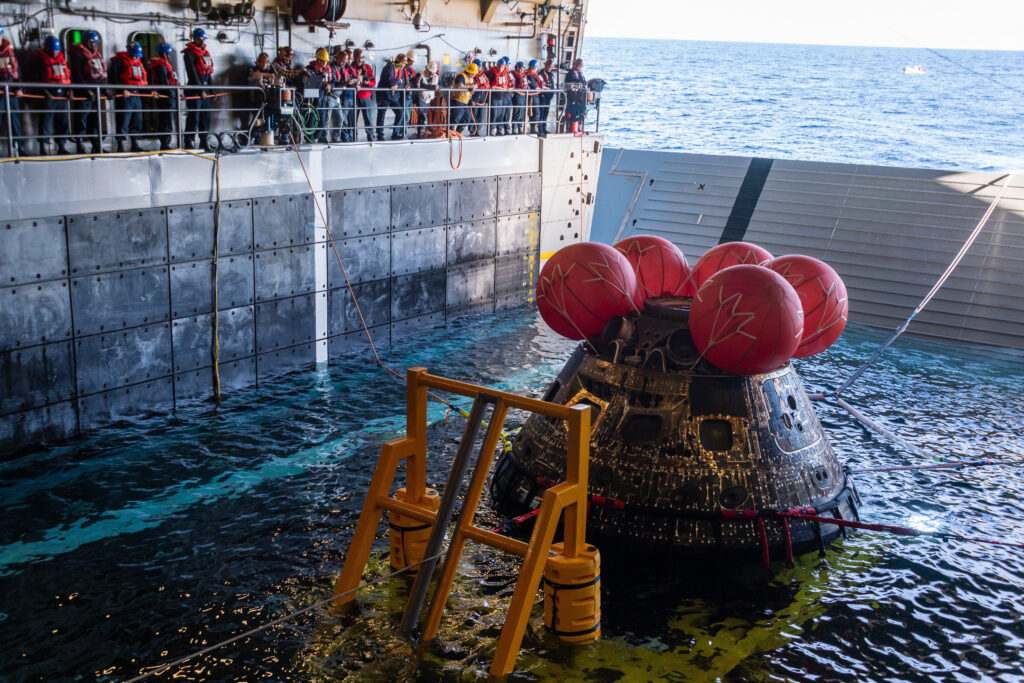
Sailors aboard the amphibious transport dock USS Portland (LPD 27) use a line load attenuating mechanism assembly to pull the NASA Artemis I Orion spacecraft into the well deck, Dec. 11, 2022. U.S. NAVY/ Mass Communication Specialist 2nd Class Devin Kates
SAN DIEGO — Amphibious transport dock USS Portland (LPD 27) retrieved the Artemis I Orion spacecraft in coordination with multiple organizations including NASA, U.S. Space Command, fellow U.S. Navy ship Independence-variant littoral combat ship USS Montgomery (LCS 8), Helicopter Sea Combat Squadron (HSC 23) and Explosive Ordnance Disposal Expeditionary Support Unit (EODESU) 1, Dec. 11, Expeditionary Strike Group Three said in a release.
NASA chose to use these Navy surface ships due to their adaptable capabilities. Portland’s medical facilities provide at-sea support for ground crews and astronauts as needed, and embarked helicopters are poised to aid flight hardware recovery, conduct medical evacuation to shore and collect imagery. Portland is equipped with extensive communication suites, enabling the multi-agency landing and recovery team to talk with the flight control team in Texas and NASA’s exploration ground systems team at the Kennedy Space Center in Florida.
“I am extremely proud of our team’s ability to execute a historic moment in history by successfully recovering the Orion capsule,” said Capt. John Ryan, commanding officer of Portland. “Each organization that participated in this mission underwent an extensive amount of training and our ability to work together as a unit demonstrates our adaptability and effectiveness as an amphibious platform.”
Montgomery, a surface warfare mission package LCS, provides flexible surface warfare capabilities like 11-meter rigid-hull inflatable boats (RHIBs) that could serve as surface connectors for ship-to-ship movements, flight hardware retrieval, and to move the capsule from the sea into the ship. The ship’s mission bay is large enough to store the capsule, and the flight deck can support MH-60S/R Sea Hawk helicopters or MQ-8C Fire Scouts. Montgomery was responsible for providing security in the area of operation and served as a back-up source of small boats.
“Our Navy has a long history of working with NASA spaceflight programs, and the Montgomery crew was truly honored to be a part of this historical partnership,” said Cmdr. Edison C. Rush III, commanding officer of Montgomery “The successful capture of the Orion only motivates our crew to continue training and increasing our capabilities as a littoral combat ship.”
Artemis I is the first integrated test of NASA’s deep space exploration systems. Artemis I is the first in a series of increasingly complex missions. It is an uncrewed flight test that will provide a foundation for human deep space exploration and demonstrate our commitment and capability to return humans to the moon and extend beyond.
“We are extremely excited to have worked with the U.S. Navy to accomplish this mission,” said Melissa Jones, NASA Landing and Recovery Director. “For years our teams have trained together for this and could not be happier with how well the recovery mission was executed.”
Portland began early morning efforts to recover the Orion capsule with the launch of four small boats and two combat rudder raiding craft. The small crafts located the capsule in the open ocean, inspected the capsule and rigged lines to the outside of the capsule to facilitate the movement toward the ship. Aboard those craft were Navy Expeditionary Combat Command’s EODESU-1 divers, who received vigorous training at NASA Johnson Space Center’s Neutral Buoyancy Laboratory. The highly trained Navy divers are proficient in open water and small boat procedures, adaptable to changing situations, excel at on-the-spot problem solving and experts at salvage and towing operations. These expeditionary capabilities make them the ideal personnel to assist in the safe recovery and transportation of the Orion capsule from the ocean to Portland’s well deck. Following the launch of the small boats, Navy and NASA personnel rigged tending lines and guided the capsule through the water to Portland. The Orion capsule was then winched into place on the Orion recovery cradle assembly aboard the ship.
Portland and Montgomery are assigned to Expeditionary Strike Group. ESG 3 comprises four amphibious squadrons, 15 amphibious warships and eight naval support elements including approximately 18,000 active-duty and reserve Sailors and Marines. As the deputy commander for amphibious and littoral warfare, U.S. 3rd Fleet, the ESG 3 commander also oversees Mine Countermeasures Group 3 and the 14 littoral combat ships and two subordinate divisions under Littoral Combat Ship Squadron 1. ESG 3 is postured in support of U.S. 3rd Fleet as a globally responsive and scalable naval command element, capable of generating, deploying and employing naval forces and formations for crisis and contingency response, forward presence and major combat operations focusing on amphibious operations, humanitarian and disaster relief and support to defense civil authorities and expeditionary logistics.