1,200 U.K. Jobs Created as Naval Shipbuilding Returns to Belfast 
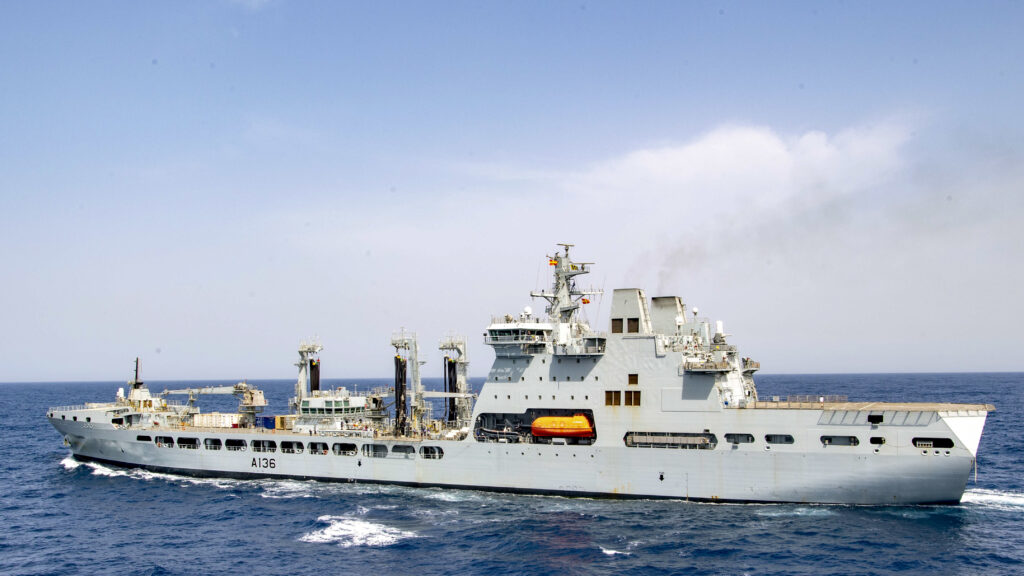
The Royal Fleet Auxiliary replenishment tanker RFA Tidespring (A 136) transits the Gulf of Aden in preparation for a refueling-at-sea with the guided-missile cruiser USS Shiloh (CG 67), not pictured, July 12, 2021. U.S. NAVY / Mass Communication Specialist 1st Class Rawad Madanat

LONDON — The Ministry of Defence has selected a preferred bidder to build support ships for the Royal Navy, with a contract that will create 1,200 U.K. shipyard jobs, hundreds of graduate and apprentice opportunities and an expected 800 further jobs across the U.K. supply chain, the ministry said in a Nov. 16 release.  

British-led Team Resolute, comprising BMT, Harland & Wolff and Navantia UK, has been appointed as the preferred bidder to deliver three crucial support ships to the Royal Fleet Auxiliary (RFA). Team Resolute will be awarded a £1.6 billion contract, before inflation, to manufacture the vessels providing munitions, stores and provisions to the Royal Navy’s aircraft carriers, destroyers and frigates deployed at sea, subject to HM Treasury and Ministerial approval. 

Pledging to invest £77 million in shipyard infrastructure to support the British shipbuilding sector, the investment will create one of the most advanced yards in the United Kingdom, significant for future export and domestic shipbuilding and offshore opportunities. 

The entire final assembly for all three ships will be completed at Harland & Wolff’s shipyard in Belfast, with the three 216m long vessels — each the length of two Premier League football pitches — built to Bath-based BMT’s entirely British design.  

The majority of the blocks and modules for the ships will be constructed at Harland & Wolff’s facilities in Belfast and Appledore, with components to be manufactured in their other delivery centres in Methil and Arnish. This program, which will also support a significant British-based supply chain, will be undertaken in collaboration with internationally renowned shipbuilder, Navantia. Build work will also take place at Navantia’s shipyard in Cadiz in Spain, in a collaboration that allows for key skills and technology transfer from a world-leading auxiliary shipbuilder.  

“This is a welcome boost to the UK shipbuilding industry,” said Defence Secretary Ben Wallace. “By selecting Team Resolute, the Ministry of Defence has secured £77 million of investment into U.K. shipyards, creating around 2,000 U.K. jobs, and showcasing cutting-edge British design. “Building on ambitions laid out in the National Shipbuilding Strategy, we are also bolstering technology transfer and key skills from a world-renowned shipbuilder, crucial in the modernisation of British shipyards.” 

The contract will deliver 200 further education opportunities on graduate placements and apprentice programs, as well as supporting thousands more supply chain jobs. Harland & Wolff’s welding academy is set to train 300 new U.K. welders during the contract. The contract will also support 120 high-skilled jobs at BMT.  

Delivering on ambitions to bolster U.K. shipbuilding as laid out in the National Shipbuilding Strategy Refresh, the contract will deliver significant capital investment in the United Kingdom while providing ships which are essential to the Carrier-led Maritime Strike Group. 

“Team Resolute is proud to have been selected as preferred bidder to provide the Royal Fleet Auxiliary with three state-of-the-art, adaptable ships which will fulfil the Royal Navy’s needs while strengthening UK sovereign design and shipbuilding capability, as well as generating around £1.4 billion in national social and economic value,” said John Wood, Group CEO of Harland & Wolff, on behalf of Team Resolute. “Team Resolute will be making a significant investment into the U.K. and help to level up U.K. Government defence spend across the whole Union. We will create high quality U.K. jobs, apprenticeships and four facilities across the UK which will have shipbuilding capabilities fit for the 21st century.” 

The ships will be the second longest U.K. military vessels behind the two Queen Elizabeth-class aircraft carriers. They will have commonality with the RFA’s Tide class fleet tankers, also built to a British BMT design.  

The majority of the three ships’ build will take place in the UK, and the contract will increase industrial productivity, develop the domestic supply chain and workforce while improving the industry’s environmental sustainability.  

Designed to support Net Carbon Zero by the end of their 30-year service lives, the RFA vessels will be equipped with energy efficient technologies to reduce power demand and will have the capability to reduce their carbon intensity by adopting low-carbon, non-fossil fuels and future energy sources.  

FSS will deliver worldwide logistic and operational support to the Royal Navy, including the Maritime Strike Group on deployment,” said Vice Adm. Paul Marshall, DE&S Director General Ships. “Significant investment in emerging shipyards across the U.K. will also strengthen and diversify our industrial base. Alongside our investment in the Type 26 and Type 31 frigate programs, this breadth will be vital to grow and support a highly capable and modern Navy.” 

Production is due to start in 2025 and all three support ships are expected to be operational by 2032. The manufacture contract is due to be awarded by DE&S by the first quarter of 2023, subject to completion of a successful preferred bidder stage and final approvals.

FRC Southeast Begins Activation as Second Source of Repair for the F135 Engine

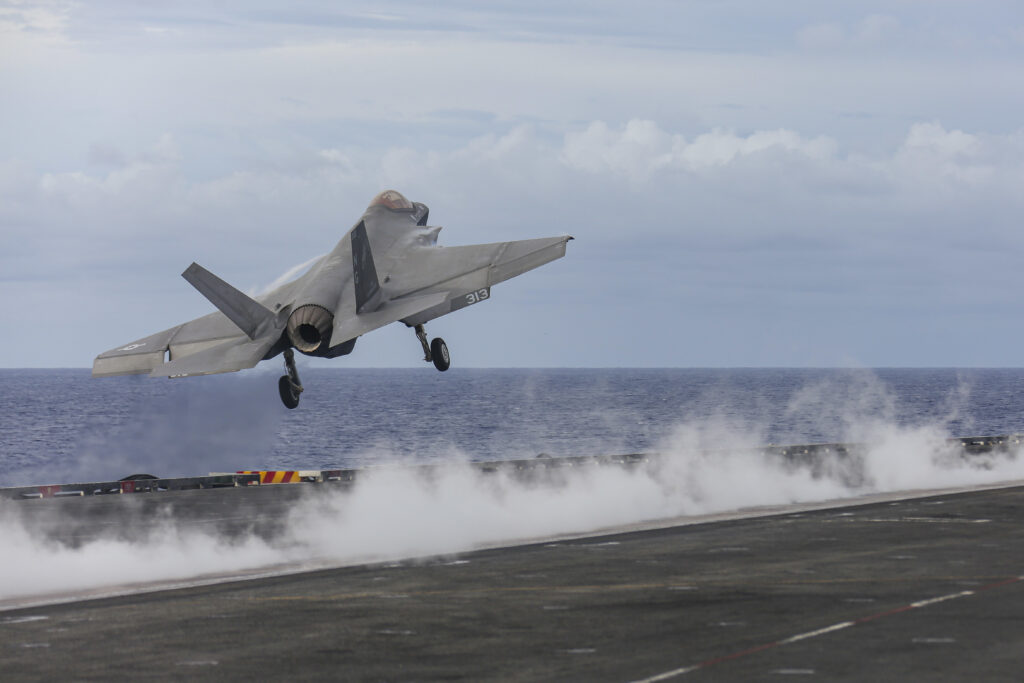
An F-35C Lightning II, assigned to the “Black Knights” of Marine Fighter Attack Squadron (VMFA) 314, launches from the flight deck of the Nimitz-class aircraft carrier USS Abraham Lincoln (CVN 72). U.S. NAVY / Mass Communication Specialist 3rd Class Javier Reyes

JACKSONVILLE, Fla. — Fleet Readiness Center Southeast (FRCSE) recently began activation as a Department of Defense second depot source of repair (DSOR) for the F135 engine, the propulsion system that powers the F-35 Lightning II Joint Strike Fighter. The first DSOR for the F135 was designated in 2012 with activation complete in 2014 at the Oklahoma City Air Logistics Complex, Tinker Air Force Base, Oklahoma.  

“It’s great to be a part of the FRCSE Team as we prepare to activate the F135 engine product line,” said FRCSE’s Commanding Officer, Capt. Grady Duffey. “The new scope of work won’t just expand our support of the Joint Strike Fighter, but will help meet the sustainment demands of our military. I am confident that FRCSE will be ready to answer the call and commence repair of F135 engine modules in the near future, and at an even greater rate later as we expand infrastructure.”   

FRCSE officially activating as second DSOR doesn’t come without certain challenges. Before the command sees its first Power Module (PM), one of the five major modules that make up the F135 power plant, artisans will need to go through a three-phase Pratt & Whitney (P&W) training and maintenance qualification and certification process, which is set to begin in January 2023. 

The first two training phases focus on classroom and practical skills. The engine’s PMs and associated mini-modules (MMs) will be used to accomplish the hands-on portion of the training with artisans and P&W trainers working side-by-side. 

Once the practical hands-on phase is complete, qualification and certification will be the final step in the process. FRCSE is expected to induct its first PM by April 1, 2023, with a second arriving about two weeks later. 

After certification is achieved, F135 engine line artisans will work only on the PM and its four MMs — the high-pressure compressor, high-pressure turbine, low-pressure turbine and diffuser combustor — in designated areas called cells. The current plan is to have nine PM cells and 22 mini-module cells. 

While FRCSE’s Crinkley Engine Facility complex currently performs work on four other engines (F404, F414, TF34 and J85), expansion is a must to support the full anticipated F135 workload.  

“In preparation of this engine workload, we had to make multiple facility improvements along with purchasing new industrial plant equipment and machinery unique to the F135,” said Rick Eveson, FRCSE’s F135 production line director. “New high-capacity bridge cranes, a new entrance, floor paint and Andon lighting have all been procured to support the F135 engine maintenance process, which will also benefit our other engine programs. In addition, we’ve developed a custom shelving unit to more efficiently store parts, tooling and gear.” 

FRCSE won’t just accommodate this new workload through the optimization of shops and processes in its current state, but also through the renovation of its existing engine test cell and construction of an entirely new engine facility by way of military construction (MILCON). A MILCON will be utilized in order to renovate FRCSE’s engine test cell as well as a whole new engine facility to streamline workflow. The new building is expected to break ground in 2026 with completion in 2028, and it will significantly increase the plant’s capacity for F135 work.   

Furthermore, the engine test cell modification project will make significant changes to the existing structure, as the facility must be upgraded to accommodate the F135 engine’s 50,000 pounds of thrust and over 18-foot size. The building’s anticipated completion date is 2027. 

“We expect engine production to ramp up through 2034 to the max production requirement — roughly 600 MMs and 120 PMs annually, correlating to about 600,000 man-hours,” Eveson continued. 

From repair of the F135’s PM and its MMs to establishing depot capability for the F-35 airframe and associated systems, the command is certainly on its way to becoming the go-to facility in support of fifth and future generations of aircraft.   

“The entire FRC Southeast team is excited to begin work on the F135 and showcase our world-class facility,” said Duffey. “We are unequivocally committed to this program’s success and to activating the U.S. Navy’s first F135 engine product line.” 


U.S. Naval Forces Intercept Explosive Material Bound for Yemen

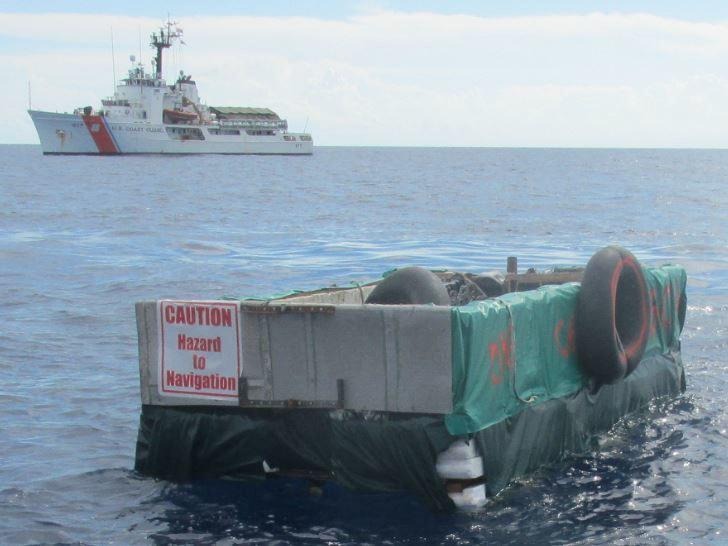
Guided-missile destroyer USS The Sullivans (DDG 68) and patrol coastal ship USS Hurricane (PC 3) sail in the background as Sailors inventory a large quantity of urea fertilizer and ammonium perchlorate discovered on board a fishing vessel intercepted by U.S. naval forces while transiting international waters in the Gulf of Oman, Nov. 9. U.S. NAVY / Sonar Technician (Surface) 1st Class Kevin Frus

MANAMA, Bahrain — On Nov. 8, U.S. 5th Fleet intercepted a fishing vessel in the Gulf of Oman smuggling lethal aid, including a large quantity of explosive material, from Iran to Yemen, U.S. Naval Forces Central Command Public Affairs said in a Nov. 15 release. 

U.S. Coast Guard Cutter John Scheuerman (WPC 1146) and guided-missile destroyer USS The Sullivans (DDG 68) interdicted the vessel as it transited international waters. Patrol coastal ship USS Hurricane (PC 3) and Navy explosive ordnance disposal technicians from U.S. 5th Fleet’s Task Force 56 also assisted during a weeklong effort to fully search the vessel and verify the type of material found. 

U.S. forces discovered more than 70 tons of ammonium perchlorate, a powerful oxidizer commonly used to make rocket and missile fuel as well as explosives. This is U.S. 5th Fleet’s first ever interdiction of ammonium perchlorate. 

“This was a massive amount of explosive material, enough to fuel more than a dozen medium-range ballistic missiles depending on the size,” said Vice Adm. Brad Cooper, commander of U.S. Naval Forces Central Command, U.S. 5th Fleet and Combined Maritime Forces. “The unlawful transfer of lethal aid from Iran does not go unnoticed. It is irresponsible, dangerous and leads to violence and instability across the Middle East.” 

The search also found more than 100 tons of urea fertilizer. Urea is a chemical compound with agricultural applications that is also known for use as an explosive precursor. 

The vessel and its four Yemeni crewmembers were intercepted while transiting from Iran along a route historically used to traffic weapons to the Houthis in Yemen. The direct or indirect supply, sale or transfer of weapons to the Houthis violates U.N. Security Council Resolution 2216 and international law. 

U.S. forces sank the vessel Nov. 13 in the Gulf of Oman after determining it was a hazard to navigation for commercial shipping. The four crewmembers were transferred to Yemen for repatriation Nov. 15 when The Sullivans completed an at-sea exchange in the Gulf of Aden with the Yemen Coast Guard. 

“Alongside our partner forces, CENTCOM is committed to security and stability of the region and to deterring the illegal and destabilizing flow of lethal material into the region over land, in the air and the sea,” said Gen. Michael “Erik” Kurilla, U.S. Central Command commander. 

U.S. 5th Fleet previously seized 40 tons of urea fertilizer Jan. 18 when guided-missile destroyer USS Cole (DDG 67) and patrol coastal ship USS Chinook (PC 9) interdicted another fishing vessel in the Gulf of Oman that had attempted to smuggle illicit weapons off the coast of Somalia months earlier. 

The U.S. 5th Fleet operating area includes 21 countries, the Arabian Gulf, Gulf of Oman, Red Sea, parts of the Indian Ocean and three critical choke points at the Strait of Hormuz, Bab al-Mandeb and Suez Canal. 


USCGC Northland Returns Home after 59-day Caribbean Sea Patrol

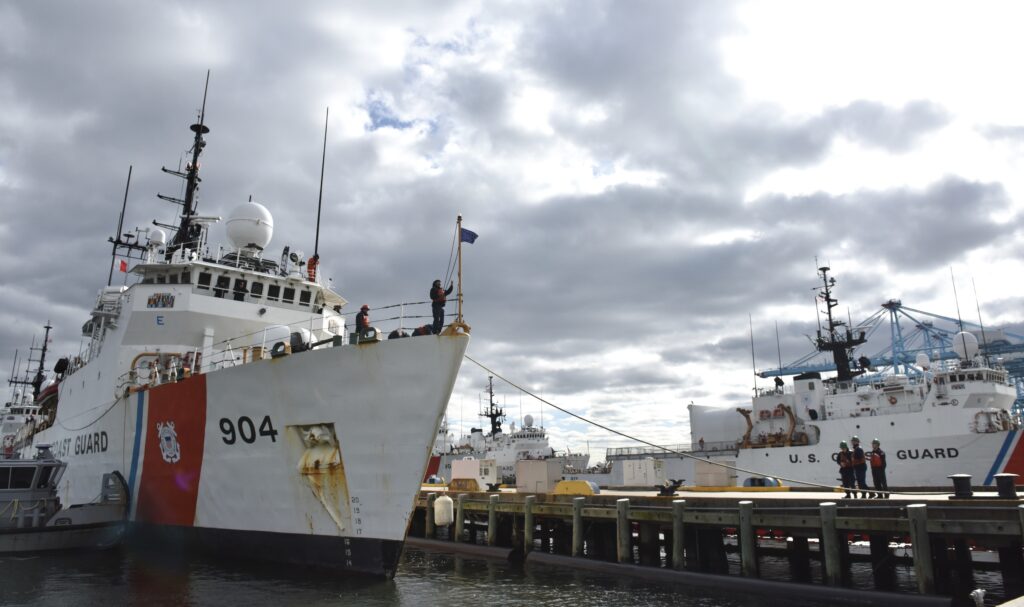
U.S. Coast Guard Cutter Northland prepares to moor at its homeport in Portsmouth, Va., Monday. Northland completed a 59-day patrol in the Caribbean Sea conducting migrant interdiction, law enforcement and humanitarian missions. U.S. COAST GUARD / Petty Officer 2nd Class Brandon Hillard

PORTSMOUTH, Va. — The crew of the U.S. Coast Guard Cutter Northland (WMEC 904) returned to their homeport in Portsmouth, Nov. 14 following a 59-day Caribbean Sea patrol, the Coast Guard Atlantic Area said in a release.  

In support of the Coast Guard’s Seventh District and Operation Vigilant Sentry under Homeland Security Task Force – Southeast, Northland’s crew conducted migrant interdiction, law enforcement and humanitarian operations, collaborating with numerous Coast Guard assets and Department of Homeland Security boats and aircraft to detect, deter and intercept unsafe and illegal ventures bound for the United States. 

During the deployment, Northland’s crew primarily patrolled the Windward Passage between Cuba and Haiti, maintaining a U.S. presence while serving as a deterrent to irregular maritime migration events occurring because of continued instability in Haiti. 

In October, Northland was diverted to patrol near Port-au-Prince, Haiti, at the request of the government of Haiti and in close coordination with the U.S. Department of State, as a clear sign of U.S. resolve in support of Haiti and its people, and to rendezvous with the Haitian Coast Guard for training in the area. 

Northland also supported counterdrug operations in the region by working with other Coast Guard units and the U.S. Navy, offloading approximately 5,363 pounds of cocaine worth more than $101 million and transferring 11 suspected smugglers Nov. 11 in Port Everglades, Florida. The drugs came from five different interdictions in the Caribbean Sea.  

“I am extremely proud of the adaptability, ingenuity and determination demonstrated by this remarkable crew on a daily basis,” said Cmdr. Andrew B. Dennelly, commanding officer of Northland. “Our crew showed day in and day out that we are always ready to deliver exceptional service to the nation, whether it be responding to unsafe and illegal ventures by migrants or assisting in counterdrug operations. Like any deployment, this patrol came with its own challenges — responding to an international crisis, last minute changes in scheduling and harsh weather and sea-states. Through it all, our crew promoted safety and security at sea and demonstrated why the Coast Guard is the preferred maritime partner.”  

Northland is a 270-foot Famous-class medium-endurance cutter. Its missions include law enforcement, search and rescue, drug interdiction, fisheries enforcement, migrant interdiction, homeland security and defense operations, international training and humanitarian operations. Northland patrols the offshore waters from Maine to Florida, the Gulf of Mexico, the Eastern Pacific Ocean and the Caribbean Sea. 


Icebreaker Healy Returns Home after Four-Month Arctic Deployment  

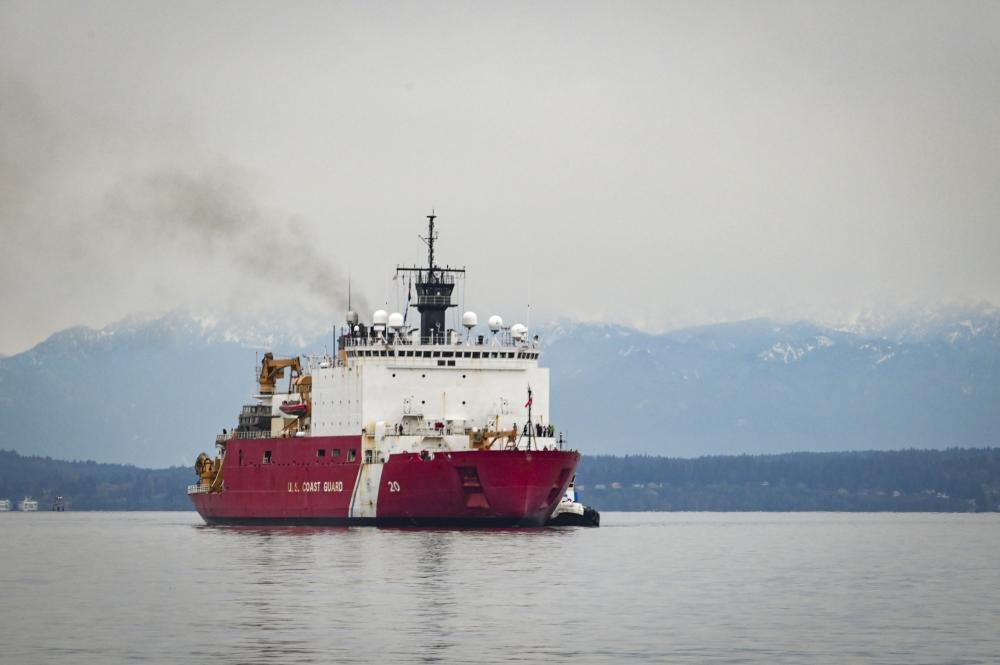
SEATTLE, WA, UNITED STATES 11.11.2022 Photo by Petty Officer 2nd Class Steven Strohmaier

SEATTLE — U.S. Coast Guard Cutter Healy (WAGB 20) returned to its Seattle homeport Nov.11 following a historic 17,000-mile, 124-day deployment in the high Arctic latitudes that included a transit to the North Pole, the Coast Guard Pacific Area said in a release.  

The crew’s efforts demonstrated interoperability in the Polar Region, supported U.S. security objectives, and projected an ice-capable presence in Arctic waters and the Gulf of Alaska. 

“It is more important than ever before to provide security and sovereign presence in the Arctic and expand oceanographic research to understand the impacts of environmental change,” said Capt. Kenneth Boda, commanding officer of Coast Guard Cutter Healy. “The crew of Healy is proud to have completed this mission to the North Pole and back, advancing American interests across the Arctic Ocean.” 

Commissioned in 2000, Healy is a 420-foot medium icebreaker and a uniquely capable oceanographic research platform. Healy’s crew traversed the ice-packed Arctic Ocean to the top of the world, reaching the geographic North Pole on September 30, 2022. This was only the second time a U.S. surface vessel had reached 90 degrees north unaccompanied.   

In July and August, after a port call in Seward, Alaska, Healy traveled into the Beaufort and Chukchi Seas, going as far north as 78 degrees, while supporting an Office of Naval Research-sponsored team from the University of Washington Applied Physics Department and Woods Hole Oceanographic Institution. The embarked team worked with Healy crew to conduct various evolutions, including deploying and recovering sea gliders, underwater sensors and acoustic buoys, throughout the marginal and pack ice zones as part of the Arctic Mobile Observing System. 

During transits to and from the Arctic, Healy participated in flight operations in Kotzebue Sound and off the coast of Kodiak Island, Alaska, with Air Station Kodiak MH-60 helicopter aircrews, conducted passing exercises with the Coast Guard Cutter Kimball (WMSL 756), and completed patrols of the international maritime boundary line between the U.S. and Russia. 

In September and October, after a port visit to Dutch Harbor, Alaska, Healy transited north again to conduct multidisciplinary, internationally collaborative research as part of the Synoptic Arctic Survey. The embarked National Science Foundation-funded team collected samples and data to study environmental changes across the Arctic Ocean. Upon reaching the North Pole, Healy conducted two days of science operations and the crew enjoyed several hours of ice liberty.  

After disembarking all science personnel during a second logistics stop in Dutch Harbor at the end of October, Healy made a final port call in Juneau, Alaska, where friends and family of crewmembers were given the opportunity to sail on the cutter during its final underway leg through the inside passage to Seattle. 

The Coast Guard provides the United States’ most active and visible surface presence in Polar Regions, and is currently recapitalizing its polar icebreaker fleet to ensure continued access to these regions in support of the Nation’s economic, commercial, maritime and national security needs. 

The operational polar fleet currently includes the Healy and the Coast Guard Cutter Polar Star (WAGB 10), a 399-foot heavy icebreaker commissioned in 1976. These cutters are designed for open-water icebreaking and feature reinforced hulls and specially angled bows. 

Polar security cutters will enable the U.S. to maintain defense readiness in the Arctic and Antarctic regions; enforce treaties and other laws needed to safeguard both industry and the environment; provide ports, waterways and coastal security; and provide logistical support – including vessel escort – to facilitate the movement of goods and personnel necessary to support scientific research, commerce, national security activities and maritime safety. 


Bollinger Completes Acquisition of VT Halter, Renamed Bollinger Mississippi Shipbuilding  

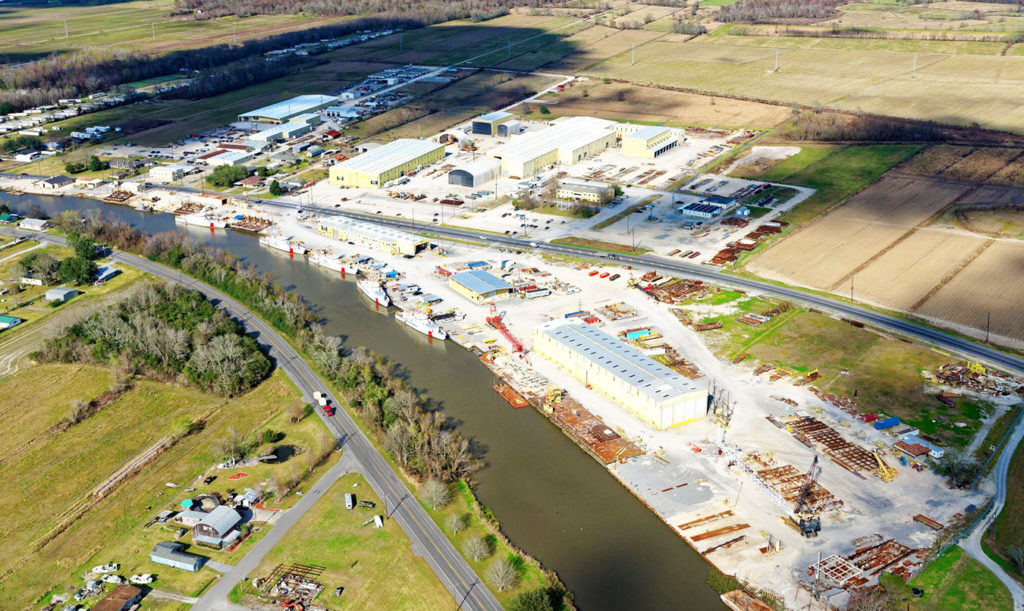
Aerial image of Bollinger’s shipyard at Lockport, Louisiana. BOLLINGER SHIPYARDS

LOCKPORT, La. — Bollinger Shipyards, the largest privately-owned and operated shipbuilder in the United States, has completed its acquisition of VT Halter Marine, Inc. and ST Engineering Halter Marine Offshore (“STEHMO”), Bollinger announced in a Nov. 1 release. The transformational transaction cements Bollinger’s position as a globally recognized, leading designer and builder of high-performance vessels and complex structures for government and commercial customers. 

“Today marks an important milestone for Bollinger and our 76-year history,” said Ben Bordelon, CEO and President of Bollinger Shipyards. “We’re excited to offer our defense and commercial customers an expanded suite of high-quality capabilities, services and solutions. By combining our skilled workforces in Louisiana and Mississippi, I know that there’s no better team in the shipbuilding industry to take on the largest, most complex projects.” 

The addition of the newly acquired yards in Pascagoula, Mississippi, is strategic as it further strengthens Bollinger’s position in the industry and U.S. defense industrial base by increasing capacity and footprint, improving efficiencies, enhancing economies of scale, and building a larger skilled workforce, including increased engineering capacity. It also brings expanded capabilities for future programs, including an ACAT I program. 

Notably, all ongoing programs at VT Halter Marine and STEHMO were conveyed with the transaction, including the Polar Security Cutter (PSC) program for the U.S. Coast Guard and the Auxiliary Personnel Lighter-Small (APL(S)) program for the U.S. Navy. Those programs will continue to be built at Bollinger Mississippi Shipbuilding.  

Bollinger Mississippi Repair offers a full suite of repair services to customers, including ship repair and conversion, dry docking, rig repair, fabrication, new construction and ancillary services. The Bollinger Mississippi team can execute projects from simple to the most complex. 

The acquisition includes 378 acres comprising two shipyards in Pascagoula and two dormant yards north of Pascagoula. The newly acquired yards have been renamed Bollinger Mississippi Shipbuilding and Bollinger Mississippi Repair. The Pascagoula facilities are strategically located with direct, deep-water access to the Gulf of Mexico and houses corporate office space, engineering, fabrication, warehousing and a foreign trade zone. The shipyard consists of 225,000 square feet of covered production area in the main fabrication assembly buildings. The facility is capable of producing Panamax-sized vessels up to 50,000 DWT and features an expanded 225.6m (740ft) tilt-beam launch system.


USCGC Vigilant Returns Home after 48-day Florida Straits Patrol 

10.17.2022 Photo Courtesy of U.S. Coast Guard Atlantic Area

CAPE CANAVERAL, Fla. — The crew of the USCGC Vigilant (WMEC 617) returned to their homeport in Cape Canaveral, Saturday following a 48-day patrol in the Atlantic Ocean and Florida Straits, the Coast Guard Atlantic Ara said in a Nov. 12 release. 

In support of the Coast Guard’s Seventh District, Vigilant conducted search and rescue missions for Hurricane Ian off the Coast of Fort Lauderdale, and migrant interdiction operations in the South Florida Straits, working with multiple Coast Guard and joint interagency assets to detect, deter, and intercept unsafe and illegal maritime ventures bound for the United States.  

During the patrol, Vigilant’s crew interdicted 11 overloaded and unseaworthy vessels carrying 146 Cuban nationals. In one case, Vigilant’s crew rescued 14 adults and one child who were at sea for six days without food and water. The migrants had been surviving on cooling water from the vessel’s engine. Vigilant’s crew provided critical first aid, food and water.  

In another case, Vigilant’s crew rescued 27 migrants from a sinking vessel during high winds and heavy seas. Overall, Vigilant’s crew cared for 833 Cuban migrants interdicted by various Coast Guard and other Homeland Security Task Force – Southeast law enforcement entities working within the Florida Straits. 

“This is an incredibly challenging and dynamic mission and I couldn’t be more proud of the resiliency, tenacity and professionalism of this crew,” said Cmdr. Jay Guyer, commanding officer of Vigilant. “These maritime migrant voyages are extremely dangerous and we encourage everyone to not take to the sea on these illegal ventures.”  

Vigilant is a 210-foot, Reliance-class medium-endurance cutter with a crew of 76. The cutter’s primary missions include counterdrug operations, migrant interdiction, enforcement of federal fishery laws, and search and rescue in support of Coast Guard operations throughout the Western Hemisphere. 


Fast Response Cutter Commissioned in Boston 

Photo by Petty Officer 2nd Class Ryan Noel

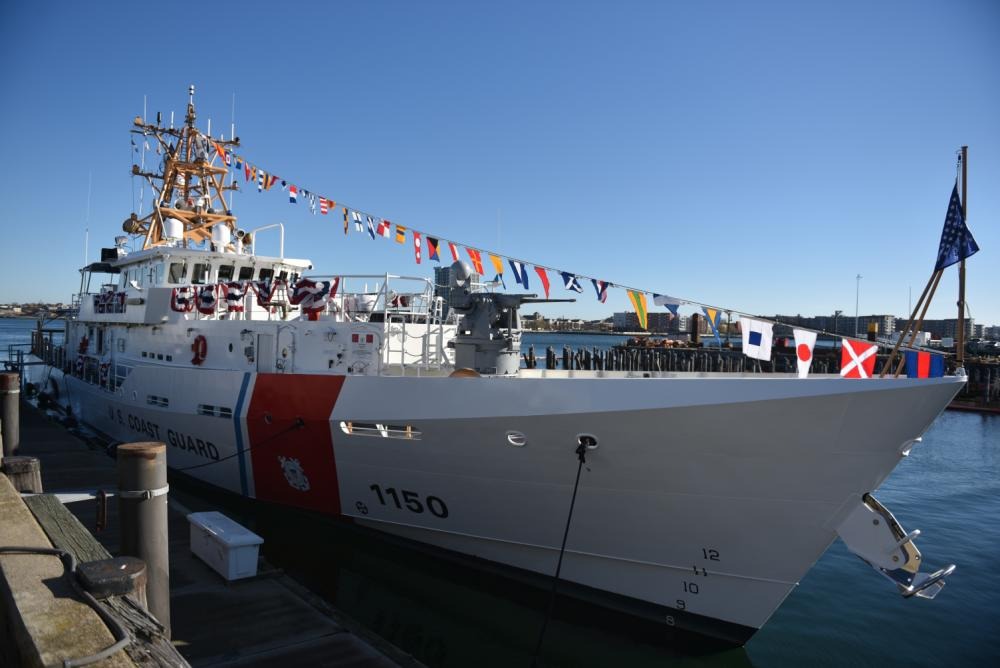
BOSTON — Coast Guard Cutter William Chadwick (WPC-1150) was commissioned Nov. 10 at Coast Guard Base Boston, as the first of six fast response cutters to be stationed in the city, the 1st Coast Guard District said in a release.  

Adm. Steven Poulin, vice commandant of the Coast Guard, and Rear Adm. John Mauger, commander, 1st Coast Guard District, oversaw the ceremony, as Lt. Cmdr. Tyler Kelley assumed command of the 154-foot cutter and its crew. Under Kelly’s command, the 24-person crew will now conduct missions offshore of the Northeast United States. 

These Sentinel-class fast response cutters (FRCs) are designed for multiple missions, including drug and migrant interdiction; ports, waterways and coastal security; fishery patrols; search and rescue; and national defense. The Coast Guard has ordered 65 FRCs to replace the 1980s-era Island-class 110-foot patrol boats. The FRCs feature advanced command, control, communications, computers, intelligence, surveillance and reconnaissance equipment; over the horizon cutter boat deployment to reach vessels of interest; and improved habitability and seakeeping. 

Born in Dover, New Jersey, the cutter’s namesake was a keeper of the Green Island Lifeboat Station in New Jersey and recipient of the Congressional Gold Lifesaving Medal for his rescue of the crew of the schooner George Taulane on Feb. 3, 1880. Chadwick remained keeper of Green Island Station until his retirement in August 1886. 


DoD Awards $20.4M to SENEDIA to Strengthen Submarine Shipbuilding Work Force 

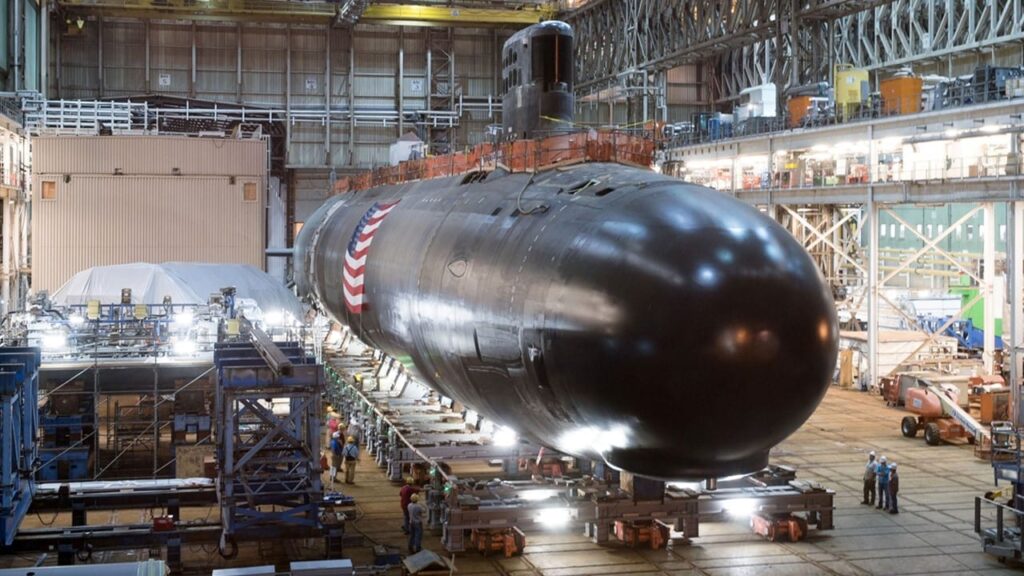
A Virginia-class attack submarine is shown under assembly at the Electric Boat shipyard in Groton, Connecticut. DoD Awarded $20.4 Million to SENEDIA to strengthen the submarine shipbuilding workforce.

MIDDLETOWN, R.I. — SENEDIA, the national alliance for Defense tech, talent, and innovation, today announced a $20.4 million contract extension from the Department of Defense (DoD) to continue its submarine shipbuilding workforce efforts, SENEDIA said in a Nov. 10 release.

“While we are making tremendous progress training the next generation to support our nation’s modern military, this funding extension is essential to continue to grow our high-skilled, high-wage workforce pipeline and build out the New England region training network,” said Molly Magee, SENEDIA executive director. “In particular, we look forward to strengthening our submarine shipbuilding training programs and partnerships in Rhode Island and Connecticut and continuing to expand to Massachusetts, New Hampshire, Maine, and Vermont.”

This contract extension was awarded through the Industrial Base Analysis and Sustainment (IBAS) program and its National Imperative for Industrial Skills (NIIS) initiative, which supports projects nationwide to ensure that the defense industrial base has the skilled workforce to meet the national security needs of the nation.

SENEDIA was originally awarded $18.6 million in 2020 to help coordinate submarine shipbuilding supply chain partnerships and to coordinate workforce pipeline necessary to deliver two Virginia-class submarines and one Columbia-class submarine annually.

“SENEDIA is one of our key partners in submarine shipbuilding,” said Kevin Graney, president of General Dynamics Electric Boat. “This continued investment in our efforts together will help us reach our workforce targets and build the world-class submarines needed by our nation.”

As part of this wide-ranging effort, SENEDIA has to-date:

Launched the Next-Generation Submarine Shipbuilding Supply Chain Partnership, to include 48 regional manufacturing partners and 45 regional stakeholder organizations that work to identify workforce development opportunities and challenges

Developed the New England Regional Training Network, which includes training institutions from across the region executing trades and industrial skills training programs critical to submarine shipbuilding, resulting in over 2,000 people trained and earning full-time employment.

Increased the capacity of the trades and industrial skills training and developed standards across welding, electrical, and pipefitting among others

“We are investing billions of dollars to build next-generation submarines and we must ensure a strong pipeline of skilled workers to power that production,” said Sen. Jack Reed (D-R.I.), the chairman of the Senate Armed Services Committee, and a senior member of the Appropriations Subcommittee on Defense. “SENEDIA’s coordinated workforce development network has strengthened our industrial base and helped people get the right career and technical training to land good-paying, in-demand jobs contributing to our national defense. This federal funding will expand SENEDIA’s successful workforce development model and help more Rhode Islanders take advantage of the hiring boom at Electric Boat and the hundreds of small manufacturing businesses that supply and contribute to submarine production.”


U.S. Coast Guard Conducts Operation Rematau with Oceania Partners

Photo Courtesy of U.S. Coast Guard Forces Micronesia / Sector Guam

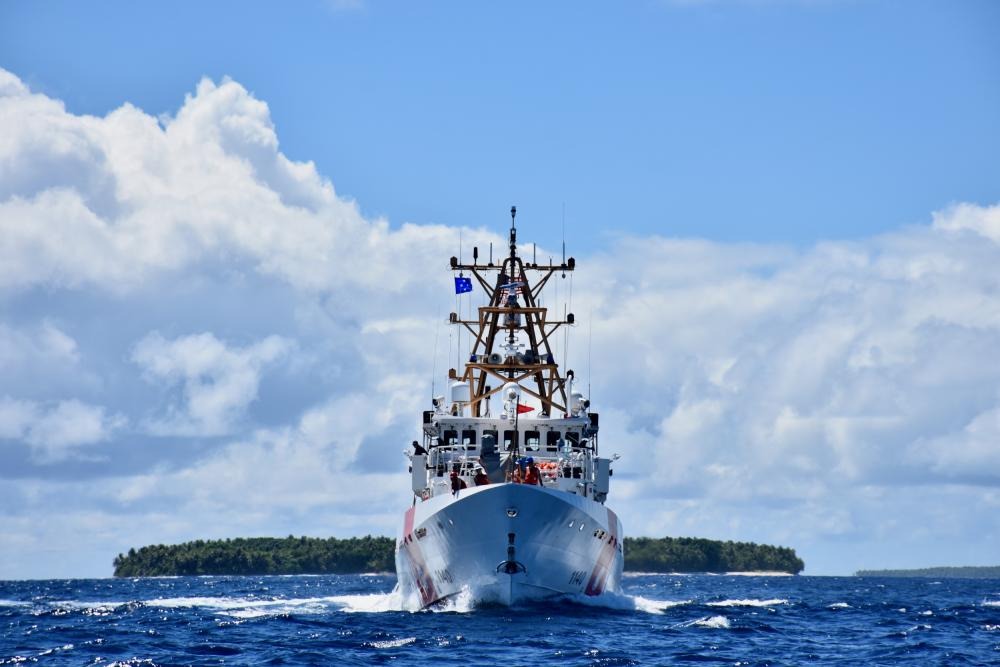
SANTA RITA, Guam — The crew USCGC Oliver Henry (WPC 1140) kicked off Operation Rematau conducting a two-week, nearly 2,000 nautical mile deployment to the high seas and the Federated States of Micronesia countering illegal fishing and strengthening partnerships from Oct. 24 to Nov. 6, U.S. Coast Guard Forces Micronesia Sector Guam (CGFMSG) said in a Nov. 10 release. 

“Operation Rematau is how U.S. Coast Guard Forces Micronesia Sector Guam supports the overarching Coast Guard endeavor Operation Blue Pacific to promote security, safety, sovereignty, and economic prosperity in Oceania,” said Capt. Nick Simmons, commander, CGFMSG. “Rematau means people of the deep sea. It recognizes what our Pacific Island Forum leaders know — securing the future requires long-term vision and a carefully considered regional strategy for the Blue Pacific Continent. It reinforces our commitment to working together to advance Pacific regionalism based on the Blue Pacific narrative, action which supports our national security objectives, bolstering maritime governance and security.” 

The Oliver Henry crew conducted multiple engagements and patrolled the exclusive economic zone of FSM during the deployment. FSM is a group of more than 600 islands in the North Pacific Ocean spanning a swath of ocean 1,480 nautical miles end to end. It sits about three-quarters of the way from Hawaii to Indonesia, consisting of four states – Pohnpei, Chuuk, Yap, and Kosrae. 

“The U.S. Coast Guard, present in the region since before World War II, continues operations in the Federated States of Micronesia, supporting our partners to ensure their sovereignty and resource security,” said Simmons. “I am proud of this team. We consider this a regular patrol for our cutters at Forces Micronesia, but regular still means transiting over 460 nautical miles to reach our partners.” 

Oliver Henry’s first stop was Ulithi Atoll, the first time a fast response cutter visited the atoll. Ulithi was a central U.S. staging area during World War II, and home to a U.S. Coast Guard Loran-C communications station from 1944 to 1965 before operations relocated to Yap and ultimately shuttered in 1987. Oliver Henry delivered 20 boxes of supplies to Ulithi, 50 personal floatation devices, and sporting equipment donated by the cutter crew, the extended U.S. Coast Guard Guam family, Ulithi Falalop Community Action Program, Guam Island Girl Power Foundation, and Ayuda Foundation. 

Their second stop was Yap. With coordination from the U.S. Department of State and U.S. Army Pacific colleagues, the crew undertook several community engagements and Subject Matter Expert Exchanges, meeting leaders, working with students, and providing tours to interested residents. 

“It was a privilege to host Yap’s Council of Pilung – the council of traditional chiefs aboard the cutter,” said Lt. Freddy Hofschneider, commanding officer of Oliver Henry. “The council protects the traditions and customs of the people, and to be welcomed in by them is no small matter. Our visit culminated in our invitation to attend Yap’s first-ever World Coconut Day celebration as honorary guests. It was a whole of community event that included a parade, a large spread of island cuisine, ceremonial dances, and fun activities.” 

The SMEE took place with 42 cadets and 28 faculty from FSM’s Fisheries and Maritime Institute, which included shipboard familiarization covering seamanship, navigation, law enforcement, damage control, engineering casualty control, and small boat operations. In addition to the knowledge exchange, the Oliver Henry crew presented FSM FMI with 100 PFDs donated by CGFMSG. 

“We appreciate Dean Tioti Teburea’s time and support to make this event a success. The cadets truly enjoyed their time with us, and it is always an honor for the crew to showcase shipboard life and Coast Guard operations across the island communities. It was a mutually beneficial event, where we exchanged nautical knowledge and best practices,” said Hofschneider. “Numerous cadets showed strong interest in maritime work and the Coast Guard. We look forward to expanded engagements and underway opportunities with the cadets.” 

The Oliver Henry team held recruiting events in Yap with visits to two local high schools and speaking with juniors and seniors. The crew provided ship tours to interested students from both schools, with 65 students visiting the cutter. 

The U.S. and its Allies are trusted partners in Oceania. Regular regional patrols support the shared goals of Indo-Pacific Command and the Pacific Quadrilateral Defence Coordination Group (Australia, France, New Zealand, and the United States) in support of PIF countries to combat the significant threat of illegal, unregulated, and unreported fishing in their EEZs and improve food security. The scope of U.S. Coast Guard activities helps address maritime security concerns expressed by the PIF in the 2018 Boe Declaration, echoed in the recent U.S.-Pacific Island Country Summit held in Washington, D.C. 

“Our Service’s capability and reach were noted during the biannual FSM joint committee meeting last month,” said Simmons. “Sending Oliver Henry now and doing further engagements in the country soon delivers on U.S. commitments to our Blue Pacific partners. Our exchanges enhance good maritime governance and build capacity that continues a generational legacy of positive bilateral relations with FSM.” 

The Oliver Henry is the 40th 154-foot Sentinel-class fast response cutter named for Oliver T. Henry, Jr., an enlisted African American Coast Guard member first to break the color barrier of a then-segregated Service. During World War II, Henry served under Lt. Cmdr. Carlton Skinner. The latter became the first civilian Governor of Guam and played a critical role in developing the Organic Act in 1950. Henry blazed a trail for minorities in the U.S. military as he climbed from enlisted ranks while serving on ten Coast Guard cutters, finally retiring as a chief warrant officer in 1966. 

The U.S. Coast Guard commissioned Oliver Henry, along with sister ships Myrtle Hazard (WPC 1139) and Frederick Hatch (WPC 1143), in Guam in July 2021. These cutters are a vital part of the U.S. Coast Guard’s enduring regional presence serving the people of the Pacific by conducting 10 of the Service’s 11 statutory missions with a focus on search and rescue, defense readiness, living marine resources protection, and ensuring commerce through marine safety and ports, waterways, and coastal security.