Navy Resumes Flight Operations for Some T-45 Aircraft
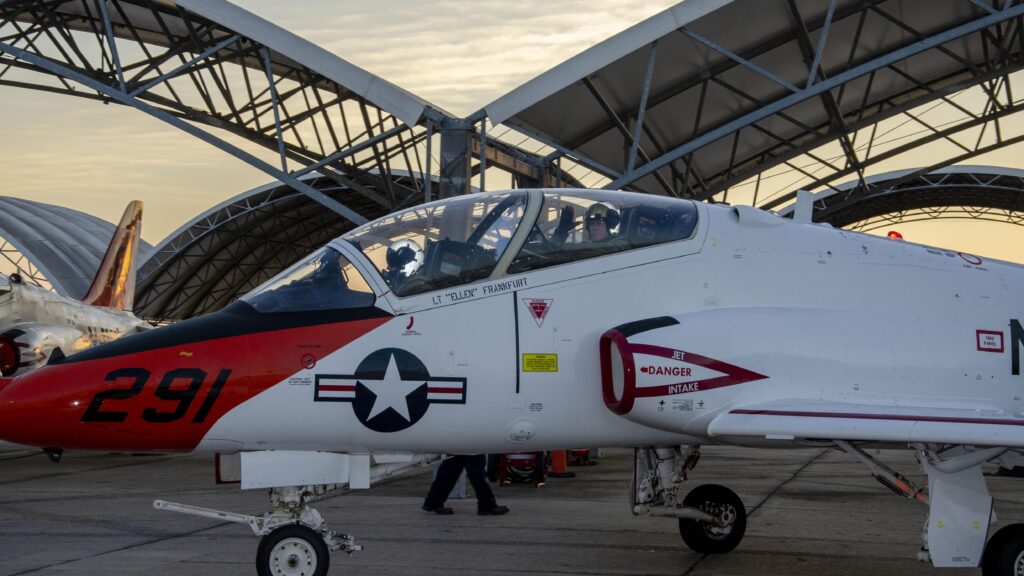
Chief of Naval Air Training Rear Adm. Richard Brophy (right) and Training Squadron 21 Commanding Officer Cmdr. Matthew Starr taxi in a T-45C Goshawk prior to a proficiency flight, Oct. 31. U.S. NAVY
PATUXENT RIVER, Md. — Chief of Naval Air Training (CNATRA) had resumed T-45C Goshawk aircraft flight operations Oct. 31, the Naval Air Systems Command said in a release.
The Navy and Marine Corps’ fleet of T-45Cs have been on a safety pause since Oct. 14 following the discovery of an engine blade failure. Engineering analysis has revealed that a subset of T-45C engine blades do not meet the manufacturer’s engine specifications; those aircraft remain grounded. The T-45Cs that have returned to flight contain engines that are compliant with these specifications.
“The process of returning to operations is based off engineering analysis by NAVAIR, with the most important decision being the safety of our aviators,” said CNATRA Rear Adm. Richard Brophy. “The aircraft we are flying are verified and known-good. We have the highest confidence in the compliance of these aircraft.”
Flight operations for the rest of the T-45C fleet will remain paused as the Navy and its industry partner Rolls Royce continue to evaluate engineering data on the non-conforming parts and work to return additional T-45Cs to operational status. During this time, training air wings and squadrons are maximizing ground training, including classroom lectures, simulators and computer-based training.
The T-45C is a tandem-seat jet trainer whose mission is to train Navy and Marine Corps pilots.
“We sincerely thank the team at NAVAIR for their hard work and commitment to finding the best possible solution for the long-term safety of our aviators and aircraft. While the reintroduction of the T-45C fleet will be a staggered approach, it is not a process that will be rushed. It is essential that our maintenance partners analyze and diagnose this issue thoroughly so training operations can fully resume with the safety of each of our aviators as a top priority,” said Brophy.
“Safety of our student aviators and instructors is paramount,” said Rear Adm. John Lemmon, Program Executive Officer for Tactical Aircraft Programs (PEO(T)). “Our Navy teams and industry partner are diligently and thoroughly analyzing all facets of this issue to determine a safe and expeditious way forward for the rest of the T-45 fleet to return to flight.”
NATO Concludes Successful Vigilance Activity Neptune Strike
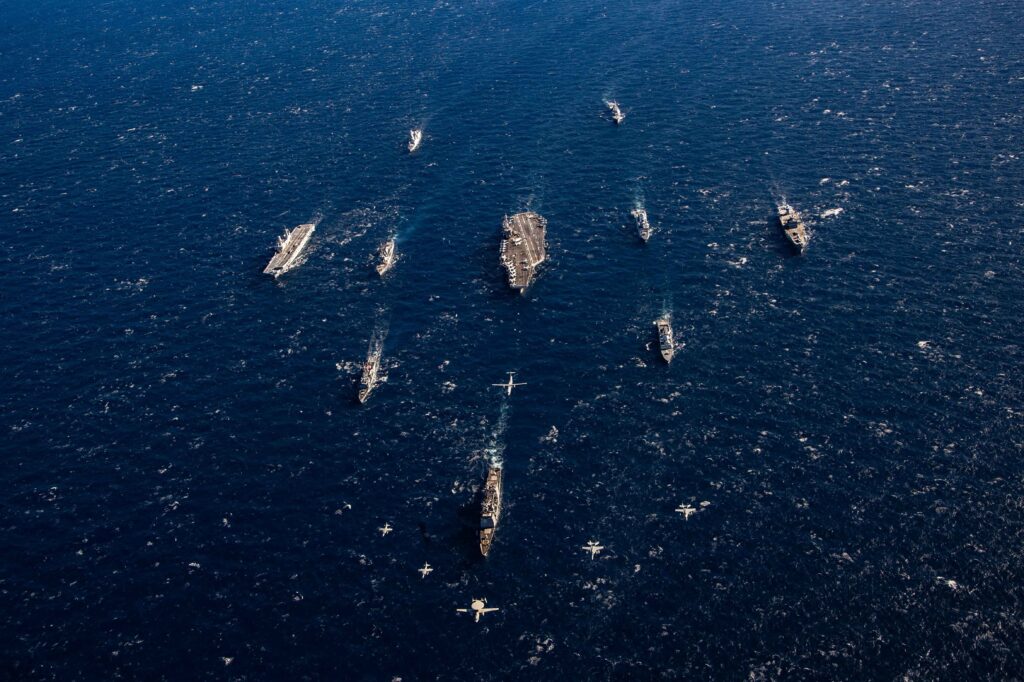
Aircraft assigned to Carrier Air Wing (CVW) 1 and the Italian Navy fly over the Mediterranean Sea as ships from Harry S. Truman Carrier Strike Group (CSG) 8, Standing NATO Maritime Group 2 (SNMG 2), the Italian Navy Cavour CSG and the Blue Ridge-class command and control ship USS Mount Whitney (LCC 20) transit the Mediterranean Sea in support of Neptune Strike 2022, Feb. 2, 2022. U.S. NAVY / Mass Communication Specialist 3rd Class Bela Chambers
OEIRAS, Portugal — Naval Striking and Support Forces NATO (STRIKFORNATO) and U.S. Sixth Fleet (SIXTHFLT) concluded Vigilance Activity Neptune Strike, the eighth phase of NATO’s long-planned Project Neptune series of activities, from STRIKFORNATO headquarters in Oeiras, Portugal, Oct. 28, Naval Striking and Support Forces NATO Public Affairs and U.S. Sixth Fleet Public Affairs said in a release.
Neptune Strike demonstrated the combined capacity of the Alliance while underscoring allied and partner nations’ commitments to deterrence and defense of sovereign Alliance territory. This activity and NATO’s wider strategy deters adversaries and terrorist groups from spreading destabilization, widening disorder or accruing decisive military advantage that would impact allies’ security.
“Neptune Strike sits at the leading edge of NATO’s vigilance activities, providing credible deterrence and demonstrating the inherent flexibility of the carrier strike group while building high-end interchangeability among our NATO allies and partners on a firm foundation of trust,” said Vice Adm. Thomas Ishee, commander of both SIXTHFLT and STRIKFORNATO. “The energy across the entire Naval Striking and Support Forces NATO team was palpable as we pushed the bounds of allied integration in the land, air and on the seas.”
Throughout the two-week long vigilance activity, NATO servicemembers from several allied nations planned, briefed, and executed a variety of specific evolutions, including air-to-land integration with allies including Hungary, Lithuania, North Macedonia, Poland and Slovakia, maritime and interdiction activities, and air-to-air refueling and air-to-air rehearsal events throughout allied airspace.
While allied and partner aircraft flew together in the skies, the ships of the George H. W. Bush carrier strike group (GHWBCSG) sailed alongside multiple allied ships in the Adriatic and Ionian Seas. These included Albanian and Croatian ships, as well as members of Allied Maritime Command’s Standing NATO Maritime Group (SNMG) 2 and Standing NATO Mine Countermeasures Group (SNMCMG) 2 and the United Kingdom’s Littoral Response Group (LRG).
“I could not be more proud of the teamwork, expertise and professionalism displayed by everyone in making Neptune Strike 22.2 a resounding success,” said Ishee. “The evolution of Project Neptune is both a testament to the innovation of the NATO Alliance and a tangible demonstration that we truly are stronger together.”
The diversity and complexity of evolutions conducted during Neptune Strike, through multiple domains and unique scenarios, continued to validate interoperability of a CSG within NATO command and control architectures to contend with a rapidly evolving security environment. The activity is proof of the warfighting advantage that characterizes allied interoperability and, ultimately, the strength of the most successful Alliance in history.
“Neptune Strike has again offered a perfect opportunity to fully integrate the combat power of a U.S. aircraft carrier into enhanced Vigilance Activity in direct support of NATO’s commitment to deter conflict and defend allies. It has offered the chance to combine capabilities from a large number of nations in all warfare domains — on land, at sea and in the air — as a clear demonstration of allied unity of purpose and cohesion,” said Royal Navy Rear Adm. James Morley, deputy commander, STRIKFORNATO. “It has further rehearsed STRIKFORNATO’s role as the primary integrator for U.S. maritime combat power. The George H.W. Bush Carrier Strike Group is now even better prepared to execute complex missions in concert with wider allied efforts to defend the Euro-Atlantic area.”
NATO Secretary General Jens Stoltenberg’s visit to the Nimitz-class aircraft carrier USS George H. W. Bush (CVN 77) on Oct. 25 served as a key highlight of the activity. While aboard the ship, Stoltenberg reflected on the carrier’s presence as a demonstration of U.S. capability and commitment to the Alliance, a general escalation of tension between European powers, and how the conclusion of Neptune Strike – and its inclusion of more than 70 aircraft, 20 ships and 5,000 personnel from 26 NATO allies and partners – demonstrates NATO’s capability on the world stage.
“[Neptune Strike 2022] is a perfect example of the transatlantic bond — Europe and North America working together in NATO,” Stoltenberg said. “[NATO’s] strength helps to prevent any miscalculation by sending a clear message: NATO will protect and defend every inch of allied territory.”
Participating nations in Neptune Strike included Albania, Belgium, Bulgaria, Canada, Czechia, Croatia, Denmark, France, Germany, Greece, Hungary, Italy, Latvia, Lithuania, the Netherlands, North Macedonia, Norway, Poland, Portugal, Romania, Slovakia, Spain, Sweden, Türkiye, U.K. and the U.S.
Vigilance Activities are day-to-day activities, occurring in all domains and across SACEUR’s area of responsibility, to ensure appropriate strategic awareness and force readiness required to sustain peace.
For over 80 years, U.S. Naval Forces Europe-U.S. Naval Forces Africa (NAVEUR-NAVAF) has forged strategic relationships with allies and partners, leveraging a foundation of shared values to preserve security and stability.
Headquartered in Naples, Italy, NAVEUR-NAVAF operates U.S. naval forces in the U.S. European Command (USEUCOM) and U.S. Africa Command (USAFRICOM) areas of responsibility. U.S. Sixth Fleet is permanently assigned to NAVEUR-NAVAF, and employs maritime forces through the full spectrum of joint and naval operations.
STRIKFORNATO, headquartered in Oeiras, Portugal, is Supreme Allied Commander Europe’s (SACEUR) premier, rapidly deployable and flexible, maritime power projection Headquarters, capable of planning and executing full spectrum joint maritime operations.
U.S. Navy Rescues Mariners Who Set Fire to Vessel Smuggling Drugs
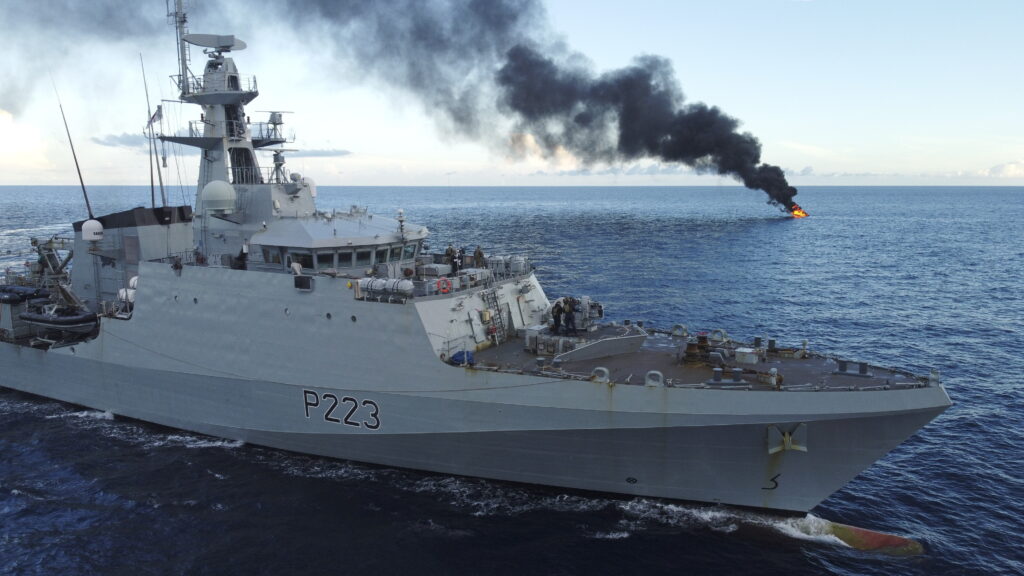
Sailors aboard the coastal patrol ship USS Thunderbolt (PC 12) extinguish a fire aboard a fishing vessel in the Gulf of Oman, Oct. 29, 2022. The vessel, found to be smuggling illicit cargo, was set on fire by the fishing vessel’s crew as U.S. forces approached. U.S. NAVY
MANAMA, Bahrain — U.S. Navy personnel rescued eight civilian mariners in the Gulf of Oman, Oct. 29, after they set their fishing vessel on fire prior to being boarded, U.S. Naval Forces Central Command Public Affairs said in an Oct. 30 release..
U.S. Navy patrol coastal ship USS Sirocco (PC 6) was conducting a counter-smuggling patrol in international waters when the mariners set their fishing vessel ablaze. Sailors from Sirocco rescued the mariners from the water and provided medical aide as USS Chinook (PC 9) and USS Thunderbolt (PC 12) extinguished the fire on the vessel.
“This was a superb effort by all of our crews,” said Vice Adm. Brad Cooper, commander of U.S. Naval Forces Central Command, U.S. 5th Fleet and Combined Maritime Forces. “I couldn’t be prouder of everyone involved in saving lives while carrying out our mission to disrupt destabilizing maritime activity.”
The mariners, who identified themselves as Iranian and Pakistani, admitted to smuggling hashish and methamphetamines. U.S. naval forces recovered 560 kilograms of hashish worth an estimated $1 million, about one-third of the total shipment. The remaining drugs were destroyed in the fire.
After the mariners received immediate medical care, all were transferred to a regional nation for additional treatment and repatriation. The fishing vessel, which sustained significant damage during the fire, sank.
The rescue comes three days after U.S. Navy personnel rescued three civilian mariners in the Gulf of Aden, Oct. 26, after their small motorboat caught fire while transiting international waters.
Guided-missile destroyer USS Nitze (DDG 94) and patrol coastal ship USS Monsoon (PC 4) responded after observing the mariners in distress and immediately rendered assistance. Sailors safely rescued the civilian mariners before their burning vessel sank approximately 50 miles off the coast of Yemen.
The U.S. 5th Fleet operating area includes 21 countries, the Arabian Gulf, Gulf of Oman, Red Sea, parts of the Indian Ocean and three critical choke points at the Strait of Hormuz, Bab al-Mandeb and Suez Canal.
EA-18G Growler Returns to the Skies Five Years After a Mid-Air Collision
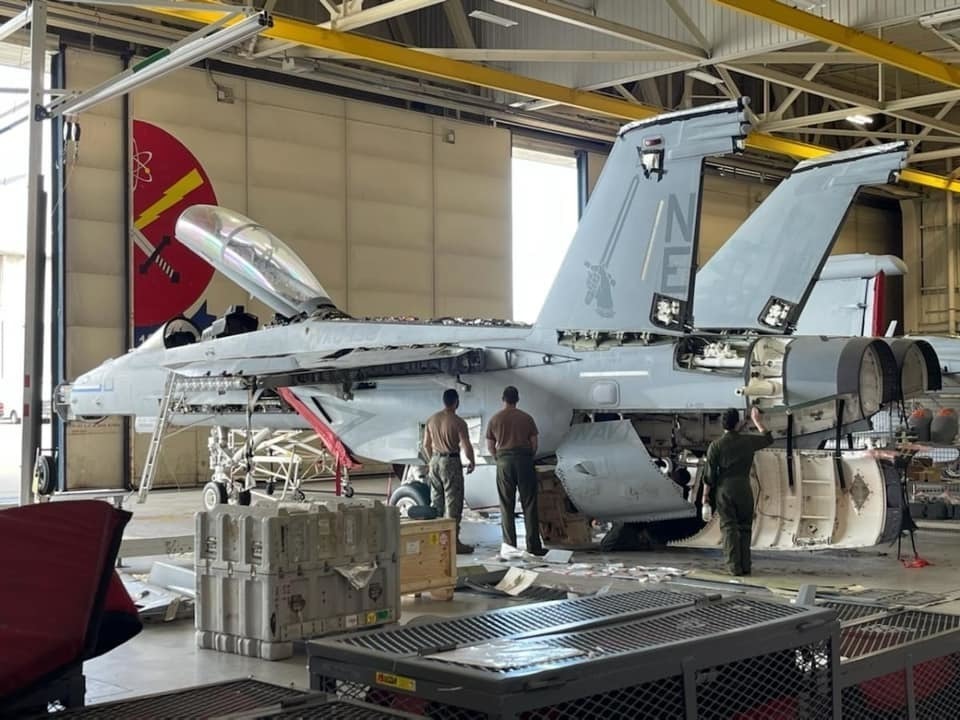
EA-18G Growler 515, assigned to Electronic Attack Squadron (VAQ) 129, is refurbished at Naval Air Station Whidbey Island (NASWI). The aircraft flew its functional check flight on Oct. 17, 2022 at NASWI and will be reentered into service with a forward-deployable squadron in the near future. U.S. NAVY
WHIDBEY ISLAND, Wash. — An EA-18G Growler attached to Electronic Attack Squadron (VAQ) 129, successfully completed a functional check flight at Naval Air Station (NAS) Whidbey Island, Oct. 17, marking the end of a complex transformation process for an aircraft thought to be beyond repair, Commander Naval Air Forces Public Affairs said in an Oct. 2 release. This five-year effort demonstrates large-scale teamwork between multiple organizations over an extended timeline.
The aircraft, then attached to the “Wizards” of VAQ-133, was involved in a mid-air collision with another aircraft attached to Carrier Air Wing (CVW) 2 at NAS Fallon during a training event on Sept. 14, 2017. Both aircraft landed safely and the aircrew were uninjured. The Growler remained at NAS Fallon for several years, as refurbishment of this nature had never been done before and there were no processes or procedures on exactly how the repairs could be completed.
Upon initial inspection, there was little hope the aircraft would be fit to fly due to the complexity of the repairs required following the mishap, as well as weather damage from years of sitting in a desert environment. However, after thorough analysis and continued coordination, the Growler’s road to recovery began when clearance for repair was granted in 2021. In February of that year, the aircraft was loaded onto a flatbed truck and transferred to the Fleet Replacement Squadron, VAQ-129, at NAS Whidbey Island.
Classified as a “special rework,” funding was approved and a long-term hangar space was identified for the unprecedented project. For more than a year, engineers, maintainers and artisans from facilities across the United States collaborated to develop processes, complete repairs and thoroughly inspect the recovered aircraft — more than 2,000 man hours in total.
“This was a team effort by personnel from Fleet Readiness Center (FRC) Southeast, FRC Southwest Engineering and my team from FRC Northwest,” said Tommy Moore, depot lead for FRC Northwest. “We reassembled the aircraft by replacing all major components and turned the aircraft back over to VAQ-129 as a ‘special rework’ complete on April 24, 2022.”
The Growler will soon be transferred to an operational squadron in order to deploy around the globe and be ready to conduct flight operations for decades to come. Capt. David Harris, commodore, Electronic Attack Wing Pacific, commended the efforts of the entire Naval Aviation Enterprise in the accomplishment of this first-of-its-kind mission.
“It was truly amazing to watch the entire Naval Aviation Enterprise team come together to get this much-needed asset back up to flight status,” said Harris. “From the engineers who developed the needed repair designs, to the artisans who accomplished the complex repairs, to the VAQ-129 Sailors who ultimately rebuilt the aircraft to a flight status; it was a true team effort.”
Coast Guard Cutter Returns Home after Encounter with Chinese, Russian Naval Ships
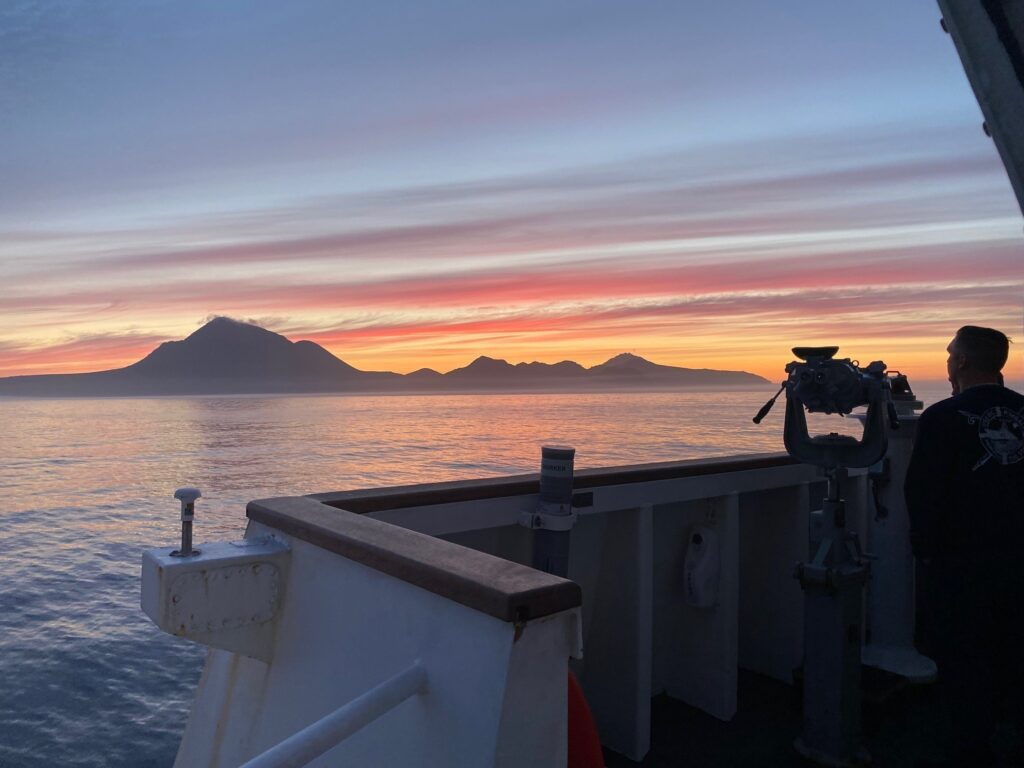
Petty Officer 2nd Class Matthew Nichols observes the sunset aboard the Coast Guard Cutter Kimball (WMSL 756), in the Bering Sea, during its patrol. The Kimball, homeported in Hawaii, completed a 19,000 mile deployment in the Chukchi and Bering Seas, operating as part of Operation Frontier Sentinel. U.S. COAST GUARD
HONOLULU — The Coast Guard Cutter Kimball (WMSL 756), which encountered a formation of Russian and Chinese naval ships near Alaska in September, returned to its Honolulu homeport, Oct. 28, the Coast Guard Pacific Area said in an Oct. 29 release.
The Kimball and its crew covered more than 22,000 miles in over 100 days, conducting search and rescue and fisheries enforcement patrols in the Bering and Chukchi Seas, earning the ship’s first Coast Guard Arctic Service Medal.
While on routine patrol, the vessel encountered a group of Russian and Chinese naval ships in the Bering Sea. The formation, which was transiting through the U.S. Exclusive Economic Zone, did not enter U.S. territorial waters. The Kimball came within about a mile of the naval ships, established and maintained radio contact and ultimately ensured their presence was in accordance with international rules and norms.
“As Arctic sea ice melts, Coast Guard presence in the region is vital to ensuring the safety of increased maritime traffic, protecting critical resources such as fish stocks, and upholding U.S. sovereign interests and international law,” said Capt. Thomas D’Arcy, Kimball’s commanding officer. “It was an honor to lead Kimball’s crew during this patrol, and we’re proud to contribute to a long legacy of essential Coast Guard presence in the Bering Sea and the Arctic.”
Kimball’s crew also monitored fishing vessel safety standards and preserved living marine resources within the U.S. Exclusive Economic Zone by enforcing applicable laws and regulations. Kimball’s crew patrolled both sides of the U.S. – Russia Maritime Boundary Line and conducted multiple boardings inspecting U.S. commercial fishing vessels, including one fishing vessel that has operated for 109 years.
Additionally, Kimball’s crew supported a long-range helicopter medical evacuation of an injured crewmember aboard a bulk carrier ship, and supported a proof-of-concept trial that involved operating larger helicopters on national security cutters. Air Station Kodiak aircrews coordinated efforts with Kimball’s crew, resulting in the first overnight deployment of a Coast Guard MH-60 Jayhawk helicopter on a national security cutter in the Arctic.
The Kimball’s ship and aircrews made multiple visits to remote island and coastal communities, where crew members performed community service and outreach events, reinforcing the Coast Guard’s commitment to the communities it serves.
“It was an extremely rewarding experience to serve aboard Kimball for this unique arctic patrol,” said Ens. Emma Simms, a Kimball junior officer. “I was able to participate in a variety of Coast Guard missions in a single patrol, ranging from conducting fisheries boardings to search and rescue to defending sovereign interests.”
Commissioned in 2019, Kimball is the Coast Guard’s seventh national security cutter. National security cutters are 418-feet-long, 54-feet-wide and have a displacement of 4,600 long-tons. With a range of 13,000 nautical miles, the advanced technologies of this class are designed to support the national objective to maintain the security of America’s maritime boundaries and provide long-range search and rescue capabilities.
HMS Medway, U.S. Coast Guard Law Enforcement Detachment Seize Cocaine in Caribbean
HMS MEDWAY and her embarked U.S. Coast Guard Law Enforcement Detachment team interdicted a vessel carrying over 400kg of cocaine in the Caribbean Sea, Sep. 29, 2022. U.K. ROYAL NAVY
LONDON — A Royal Navy ship and U.S. Coast Guard boarding team seized more than 400 kilograms of cocaine worth around £24m on Britain’s streets from a boat in the Caribbean, the U.K. Ministry Of Defence said in an Oct. 28 release.
Caribbean-based patrol ship HMS Medway and her embarked U.S. Coast Guard Law Enforcement Detachment spotted the vessel near the Dominican Republic with help from a patrol aircraft.
Following a tense chase, the vessel was boarded and the drugs discovered with three crew members detained.
“To secure an interdiction on our first day dedicated to this type of operation in this period has been tremendous,” said Comdr. Chris Hollingworth, commanding officer of Medway. “Everyone involved demonstrated their professionalism during a challenging pursuit. It might be the first, but we’re going to make sure that it won’t be the last, and I speak on behalf of everyone here in saying this has galvanised our determination to succeed.”
The boat contained several large packages which were quickly confirmed as being cocaine prior to being seized and brought aboard the warship.
It is believed the boat had come from South America, a common route taken by smugglers at this time of year.
After an overnight operation to secure the contraband — estimated by the National Crime Agency to be worth around £24m, had those drugs reached the streets of the United Kingdom — and detain the crew, the vessel was sunk by Medway’s gunnery team.
The destruction of the drugs smuggling vessel, which is normal for this type of operation, ensures it is no longer used for illegal activity while also providing valuable gunnery training.
“Although we talk of these boats being commonplace in the Caribbean, that doesn’t in any way diminish the achievement of landing a bust like this,” said a member of the boarding team, U.S. Coast Guard Law Enforcement Detachment 404, who wishes to remain anonymous.
“Together with our partners on board Medway and up in the skies above us, we’re able to smash a hole in the supply chain and disrupt the movement of these harmful drugs before they have the chance to harm people at home and abroad.”
Medway recently helped the people of the Cayman Islands and Turks and Caicos in their recovery efforts following Hurricanes Ian and Fiona.
“It’s a perfect example of Medway’s versatility and demonstrates my team’s ability to shift from Disaster Relief Operations to Counter Illicit Trafficking Operations without missing a beat,” Hollingworth said.
“I’m exceptionally proud of the collective effort of my ship’s company and our colleagues from the U.S. Coast Guard for their proactive attitude and total commitment to the task.”
HII Awarded $2.4 Billion to Build Amphibious Assault Ship LHA 9
The amphibious assault ship USS Tripoli (LHA 7) sails with the amphibious assault ship USS America (LHA 6) during a photo exercise in the Philippine Sea, Sept. 17, 2022. U.S. MARINE CORPS / Lance Cpl. Christopher Lape
PASCAGOULA, Miss. — HII’s Ingalls Shipbuilding division has been awarded a $2.4 billion U.S. Navy fixed-price-incentive contract for the detail design and construction of amphibious assault ship LHA 9. The award includes options, that if exercised, would bring the cumulative value of the contract to $3.2 billion. Ingalls was awarded the original long-lead-time material contract for the fourth ship in the America (LHA 6) class on April 30, 2020.
“Ingalls shipbuilders are ready to build the Navy’s newest LHA,” said Ingalls Shipbuilding President Kari Wilkinson. “We understand how important this work is, and consider it an honor to be given the opportunity to deliver this capability to the fleet. We value our partnership with the Navy and all of our critical supplier partners.”
Construction on LHA 9 is scheduled to begin in December 2022.
Ingalls has a long tradition of building large-deck amphibious ships that are operated by the Navy and Marine Corps. The shipyard has delivered 15 large-decks, including the Tarawa-class, LHA 1-5; the Wasp-class, LHD 1-8; and most recently the America-class, LHA 6 and LHA 7. The third of the America-class, Bougainville(LHA 8), is currently under construction.
The America-class is a multi-functional and versatile ship that is capable of operating in a high density, multi-threat environment as an integral member of an expeditionary strike group, an amphibious task force or an amphibious ready group. LHA 9, like Bougainville, will retain the aviation capability of the America-class design while adding the surface assault capability of a well deck and a larger flight deck configured for F-35B Joint Strike Fighter and MV-22 Osprey aircraft. These large-deck amphibious assault ships also include top-of-the-line medical facilities with full operating suites and triage.
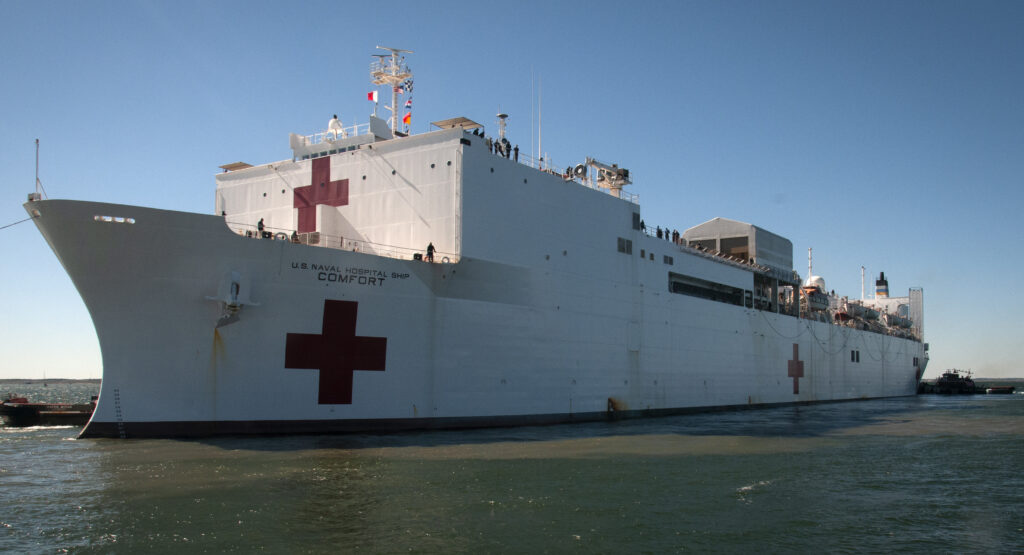
The hospital ship USNS Comfort departs Naval Station Norfolk for the 2-month Continuing Promise 2022 medical mission to Latin America and the Caribbean. U.S. NAVY
MIAMI — Hospital ship USNS Comfort (T-AH 20) departed from Miami after commencing Operation Continuing Promise 2022, Oct. 23, 2022, said Petty Officer 2nd Class Juel Foster of U.S. 4th Fleet Public Affairs said in an Oct. 22 release.
During Comfort’s time in Miami, the ship hosted over 200 guests, including distinguished visitors from more than 15 countries and local and national media outlets. Sailors and crewmembers held tours of the ship and participated in press conferences and interviews. To cap it off, the U.S. Fleet Forces Band performed the “Sunday Night Football” theme song for NBC Sports, which aired Sunday afternoon. Among the distinguished visitors were General Laura J. Richardson, U.S. Southern Command combatant commander, and Rear Adm. Doug Sasse, reserve vice commander, U.S. Southern Command/U.S. 4th Fleet.
“Comfort and its supporting partners demonstrate a continued commitment to the Caribbean, Central and South America,” said Richardson. “The multinational public, private and multiservice team working on this 1,000-man hospital ship really demonstrates the power of partnership. It also demonstrates a profound truth that health security is national security.”
Since its inauguration in 2007, Continuing Promise’s mission has been to utilize trained medical teams to provide care aboard the ship and at land-based medical sites, while working with partner nation medical personnel to increase medical readiness, strengthen partnerships and enhance U.S. Navy and partner nation capabilities to respond to public health disasters and humanitarian crises.
“Continuing Promise 2022 reflects America’s commitment to strengthening friendships, partnerships and solidarity with our Caribbean, Central and South American neighbors,” said Capt. Bryan Carmichael, commodore of Amphibious Squadron 4. “Medical services are a big part of this mission, but we are also building relationships that will have lasting impacts.”
USNS Comfort’s current mission will be the 12th Continuing Promise mission conducted in U.S. Southern Command/U.S. 4th Fleet area of responsibility.
U.S. Naval Forces Southern Command/U.S. 4th Fleet supports U.S. Southern Command’s joint and combined military operations by employing maritime forces in cooperative maritime security operations to maintain access, enhance interoperability, and build enduring partnerships in order to enhance regional security and promote peace, stability and prosperity in the Caribbean, Central and South American region.
Navy to Merge Mine-Countermeasures Helicopter Squadrons
An MH-53E Sea Dragon helicopter from Helicopter Mine Countermeasures Squadron (HM) 12 participates in a nine-aircraft formation flight alongside HM-14 and HM-15. U.S. NAVY / Mass Communication Specialist 3rd Class Jesse Schwab
ARLINGTON, Va. — The Navy plans to deactivate one of its two fleet helicopter mine countermeasures squadrons next year and combine many of its personnel and helicopters with the remaining squadron.
Helicopter Mine Countermeasures Squadron 14 (HM-14), which operates the MH-53E Sea Dragon helicopter from Naval Station Norfolk, Virginia, is scheduled for de-activation effective July 31, 2023, according to a Navy directive.
HM-14’s sister squadron, HM-15, also based in Norfolk, will absorb 102 full-time and 48 reserve enlisted personnel and four full-time and eight reserve officers from HM-14 in order to retain “as much airborne mine countermeasure capability as possible,” the directive said.
The directive used the term “HM-15 MAX” to describe the enlarged squadron.
HM-14 and HM-15 are considered combined Active-Reserve squadrons, with an 80/20 mix of personnel from the two components.
HM-14 maintains a detachment in Pohang, South Korea, in support of the U.S. 7th Fleet, while HM-15 maintains a detachment in Manama, Bahrain in support of the U.S. 5th Fleet.
Another squadron, HM-12, serves as a fleet replacement squadron for the MH-53E fleet.
The Sikorsky-built MH-53E Sea Dragon has two primary missions: airborne mine countermeasures and Navy heavy lift and vertical onboard delivery. The aircraft is a derivative of the CH-53E Super Stallion but is heavier and has a greater fuel capacity and range. Capable of transporting up to 55 troops, the MH-53E can carry a 16-ton payload 50 nautical miles or a 10-ton payload 300 nautical miles. In its primary mission, the MH-53E can tow a variety of mine countermeasures systems, including the Mk105 magnetic minesweeping sled, the AQS-24A side-scan sonar and the Mk103 mechanical minesweeping system. Mission duration can exceed four hours.
The Navy plans to keep the MH-53E in service at least until 2025.
Bahrain Leads Unmanned Exercise for Multinational Task Force
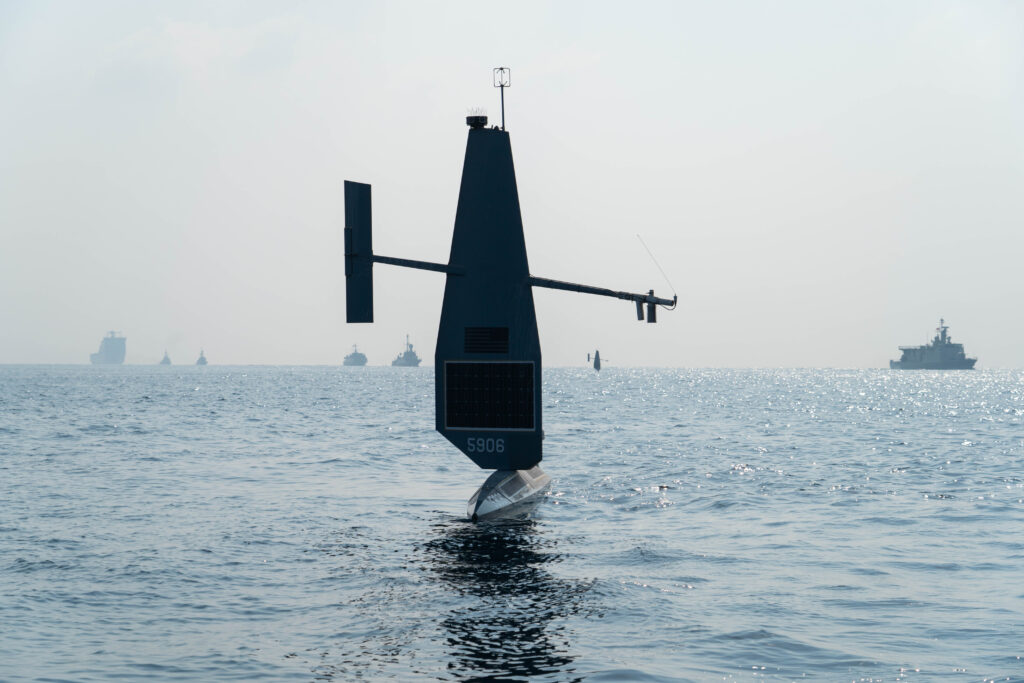
A U.S. Navy Saildrone Explorer unmanned surface vessel operates with patrol coastal ships USS Hurricane (PC 3) and USS Chinook (PC 9) from the United States, UK Royal Navy ships RFA Cardigan Bay (L3009) and HMS Bangor (M109), Royal Bahrain Naval Force ships RBNS Al-Manama and RBNS Al-Fateh, and HMS Khalid from the Royal Saudi Navy in the Arabian Gulf, Oct. 26. U.S. ARMY / Spc. Noah Martin
MANAMA, Bahrain — A multinational naval task force led by Bahrain conducted a one-day training drill in the Arabian Gulf, Oct. 26, featuring the use of unmanned systems and artificial intelligence alongside seven crewed ships, Combined Maritime Forces Public Affairs said in an Oct. 27 release.
Naval forces from Bahrain, Saudi Arabia, the United Kingdom and the United States participated in support of Bahrain-led Combined Task Force (CTF) 152, one of four task forces organized under the Combined Maritime Forces. The naval drill enhanced interoperability in integrating new unmanned technologies to monitor regional waters.
“It is so valuable to get these opportunities to really test how our forces from across different nations can work together with the uncrewed systems,” said Royal Bahrain Naval Force Capt. Rashed Al-Ameen, commander of CTF 152. “It helps us better understand how to work with each other to boost regional security.”
Three U.S. Navy Saildrone Explorer unmanned surface vessels operated with USS Hurricane (PC 3) and USS Chinook (PC 9) from the United States, UK Royal Navy ships RFA Cardigan Bay (L3009) and HMS Bangor (M109), Royal Bahrain Naval Force ships RBNS Al-Manama and RBNS Al-Fateh and HMS Khalid from the Royal Saudi Navy.
CTF 152 led the exercise while embarked aboard Cardigan Bay, as the ship sailed in international waters off the coast of Saudi Arabia. This is the latest drill involving unmanned systems in the Arabian Gulf since the United Kingdom and United States completed a similar bilateral naval exercise Oct. 7.
During both maneuvers, unmanned and artificial intelligence systems operated in conjunction with crewed ships and naval command centers ashore in Bahrain. Sensors from the unmanned vessels were able to locate and identify training aides in the water and relay visual depictions to the command centers.
Established in 2004, CTF 152 oversees maritime security operations in the Arabian Gulf for Combined Maritime Forces. Bahrain assumed command of CTF 152 from Kuwait in August.
Combined Maritime Forces is the world’s largest multinational naval partnership and includes 34 member-nations whose forces operate in the Red Sea, Gulf of Aden, Northern Arabian Sea, Gulf of Oman, Arabian Gulf and Indian Ocean. CMF is headquartered in Bahrain with U.S. Naval Forces Central Command and U.S. 5th Fleet.