Coast Guard Cutter Northland Diverted to Patrol Near Port-au-Prince, Haiti
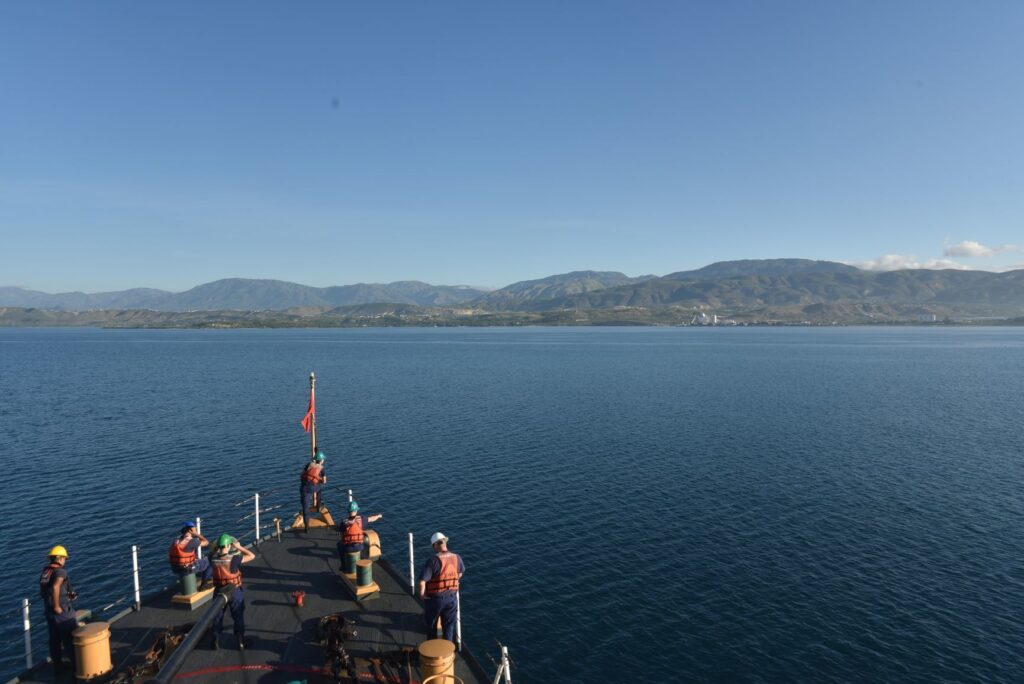
U.S. Coast Guard Cutter Northland (WMEC 904) patrols with the Haitian Coast Guard in vicinity of Port-au-Prince, Haiti, Oct. 12, 2022. The U.S. Coast Guard is one part of a whole-of-government approach to assist the Haitian government with security and stability throughout Haiti through the deterrence and prevention of dangerous, irregular maritime migration. U.S. COAST GUARD / Seaman Rachelle Amezcua-Gonzales
MIAMI — The Coast Guard diverted one of its major cutters to patrol near Port-au-Prince, Haiti, Wednesday, at the request of the government of Haiti and in close coordination with the U.S. okay Department of State, the Coast Guard 7th District said in an Oct. 12 release.
USCGC Northland (WMEC 904) was diverted to Haiti as a clear sign of U.S. resolve in support of the Government of Haiti and its people, and to rendezvous with the Haitian Coast Guard for training in the area.
Northland was previously patrolling within the Windward Pass under the direction of the Coast Guard’s Seventh District, headquartered in Miami, in support of Operation Vigilant Sentry, a standing maritime law enforcement operation.
“The U.S. Government has a vested interest in regional security throughout the Caribbean Sea and is aware of the ongoing situation of civil unrest and gang violence within Haiti,” said Rear Adm. Brendan C. McPherson, commander of the Seventh Coast Guard District. “The Coast Guard is one part of a whole-of-government approach to assist the Haitian government with security and stability throughout Haiti, especially as it relates to the deterrence and prevention of dangerous, irregular maritime migration.”
The Coast Guard has a longstanding relationship with the Haitian Coast Guard. In January 2010, USCGC Forward (WMEC 911), a 270-foot Famous-class medium-endurance cutter, was the first U.S. asset to respond and render humanitarian aid and assistance following a 7.0-magnitude earthquake in Haiti. In August 2021, the Coast Guard was among the first U.S. agencies to respond with humanitarian aid following a 7.2-magnitude earthquake in Haiti.
In August 2022, USCGC Robert Yered (WPC 1104), a 154-foot Sentinel-class fast response cutter, delivered firefighting equipment sourced as a donation from Miami-Dade Fire Rescue to better equip the Haitian firefighting department at Port-au-Prince-Toussaint Louverture International Airport. In September 2022, the Coast Guard’s international training team visited Haiti to facilitate the second of two iterations of small boat operations training with the Haitian Coast Guard to ensure uniform and repeatable training standards for the maintenance and safe operation of the Haitian Coast Guard’s surface fleet.
The Coast Guard continues to patrol the Caribbean Sea to deter undocumented migration by sea. In fiscal year 2022, the Coast Guard interdicted 7,173 Haitian migrants attempting to enter the United States illegally by sea.
Northland is a 270-foot Famous-class medium endurance cutter homeported in Portsmouth, Virginia. Northland’s missions include law enforcement, search and rescue, drug interdiction, fisheries enforcement, migrant interdiction, homeland security and defense operations, international training, and humanitarian operations. Northland patrols the offshore waters from Maine to Florida, the Gulf of Mexico, the Eastern Pacific Ocean and the Caribbean Sea.
Kaman Selected to Build Cargo UAS Prototype for Marine Corps
The Marine Corps’ first two Kaman K-MAX Helicopters arrived at Marine Corps Air Station Yuma, Ariz., Saturday, May 7, 2016. U.S. MARINE CORPS / Pfc. George Melendez
BLOOMFIELD, Conn. — Kaman Air Vehicles, a division of Kaman Corporation, has been selected to build a logistics UAS prototype for the United States Marine Corps, the company said in an Oct. 10 release. Kaman will build a funded military version of its KARGO UAV, a purpose-built autonomous medium-lift logistics vehicle. KARGO UAV carries up to 800 pounds of payload and is designed to operate in austere environments.
The Marine Corps project is being managed by NAVAIR PMA-263 under the Medium Unmanned Logistics Systems – Air (MULS-A) program. Once the prototype is constructed, KARGO UAV will complete a Field User Capability Assessment conducted in an operationally relevant test environment.
Kaman began development of its KARGO UAV last year and flew a scaled demonstrator in Fall 2021 to prove out the concept. A full-scale demonstrator is under construction, with first flight scheduled for later this year. Near Earth Autonomy, from Pittsburgh, Pennsylvania, was selected as the autonomy provider on KARGO UAV, and parallel testing is ongoing for the autonomy systems that will be employed on the Marine Corps prototype.
“We have been tracking the need for expeditionary logistics for some time,” said Carroll Lane, president of Kaman’s Precision Products segment. “And we are thrilled to see our focused R&D efforts to provide an affordable, reliable and maintainable logistics vehicle come into alignment with such an important program as MULS-A.” Lane stressed that KARGO UAV development for the U.S. Marines would remain a priority for the foreseeable future.
Built with the Marines’ future operating concept in mind, KARGO UAV offers rugged design optimized for expeditionary employment. Compact form-factor of the system fits in a standard CONEX shipping container and is designed to be unloaded and operated by as few as two people.
USS Billings (Gold Crew) Returns Home After 4th Fleet Deployment
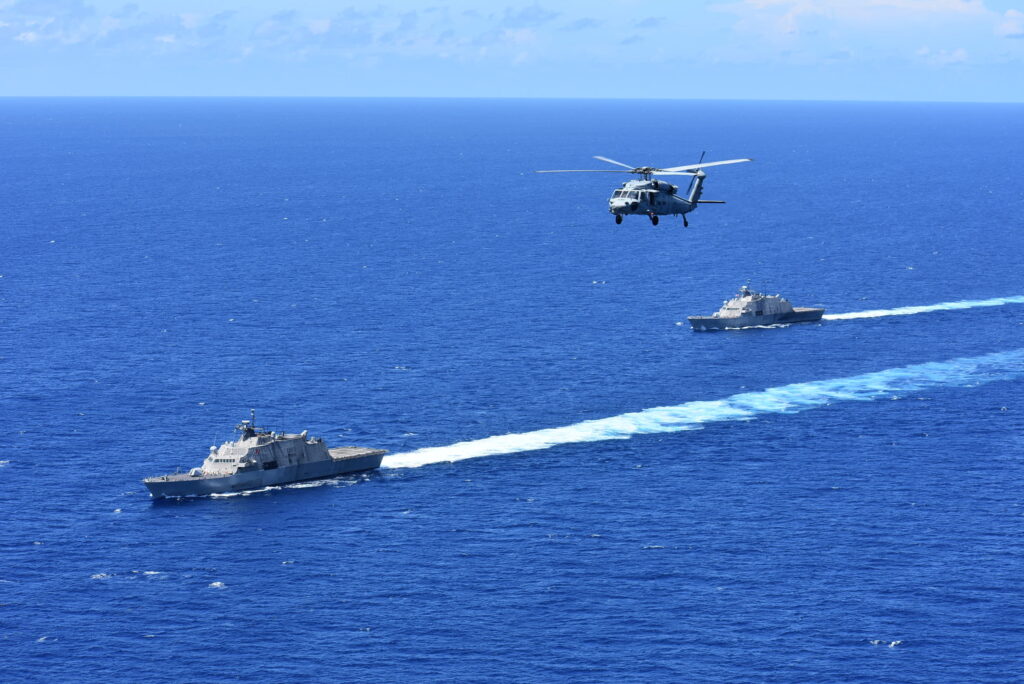
The Freedom-variant littoral combat ships USS Wichita (LCS 13), left, USS Billings (LCS 15), and an MH-60s Sea Hawk helicopter assigned to Helicopter Sea Combat Squadron (HSC) 28, Detachment 6, participate in a photo exercise in the Caribbean Sea, Sept. 10, 2022. U.S. NAVY / Mineman 2nd Class Justin Hovarter
MAYPORT, Fla. — The Freedom-variant littoral combat ship USS Billings (LCS 15) Gold Crew returned to Mayport, Fla., Oct. 7th, following its second successful deployment to the U.S. 4th Fleet area of operations, the fleet’s public affairs office said in an Oct. 8 release.
Billings, along with the “Valkyrie” of Helicopter Sea Combat Squadron (HSC) 28, Detachment 8, deployed in April 2022 to support Joint Interagency Task Force South’s counter-narcotics operations in the Caribbean Sea and Eastern Pacific Ocean. The USS Billings (LCS 15) conducted the first east coast littoral combat ship overseas (OCONUS) exchange of command and has operated forward-deployed since December 2021.
During the deployment, Billings, with her embarked U.S. Coast Guard Law Enforcement Detachment (LEDET), assisted in disrupting an estimated 3,065 kilograms of cocaine along with 1,841 pounds of marijuana worth an estimated street value of $217.7 million and removed twelve suspected drug traffickers from the narcotics trade.
“I am once again incredibly proud of the Sailors on Billings for everything they accomplished this deployment,” said Cmdr. Brett Seeley, Billings’ commanding officer. “They professionally sailed the mighty Billings from the Atlantic into the Pacific Ocean and crossed the equator for the first time in the ship’s history. The crew built upon the successes of her maiden deployment a year ago and succeeded at working with our partner nations strengthening our interoperability and taking narcotics off the streets. We look forward to watching our sister crew continue the sustained operations downrange as the mighty Billings leads the way for the littoral combat ship community.”
Billings conducted bilateral maritime exercises with Jamaica and participated in the French led multi-national maritime humanitarian assistance/disaster relief (HADR) exercise CARAIBES 2022 to strengthen partnerships and build interoperability among forces.
During a port visit to Ocho Rios, Jamaica, the ship hosted the U.S. Ambassador to Jamaica, the honorable Noah Nickolas “Nick” Perry along with senior members of the Jamaican Defence Force to showcase the capabilities of the USS Billings (LCS 15) and discuss the continued partnership and commitment shared between our two countries.
“Billings’ Gold Crew Sailors again showed superior performance in countering malign activities and conducting theater security cooperation,” said Rear Adm. Jim Aiken, U.S. Naval Forces Southern Command/U.S. 4th Fleet. “They continued to build onto the firm foundation of demonstrating forward-deployed operations and maintenance, and met U.S. Southern Command objectives for the region.”
The Billings’ Blue Crew has relieved the Gold Crew and the Billings will remain deployed to the U.S. 4th Fleet area of operations.
U.S. Coast Guard, U.K Ships Seize $93 Million in Drugs in Middle East
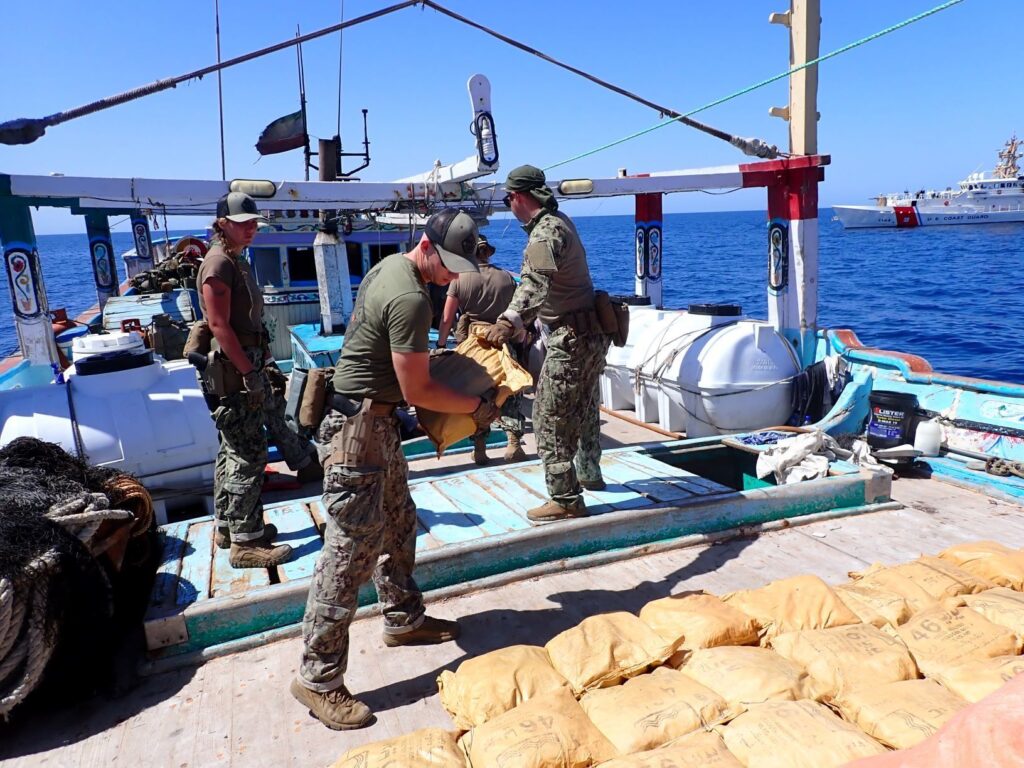
Personnel from U.S. Coast Guard fast response cutter USCGC Glen Harris (WPC 1144) inventory illicit drugs seized from a fishing vessel in international waters in the Gulf of Oman, Oct. 10. U.S. COAST GUARD
MANAMA, Bahrain — A U.S. Coast Guard fast response cutter seized an estimated $48 million worth of drugs from a fishing vessel while patrolling the Gulf of Oman, Oct. 10, while a week earlier a Royal Navy frigate seized $45 million worth of drugs in the Gulf of Oman, said U.S. Naval Forces Central Command Public Affairs said in Oct. 9 and 11 releases.
While operating in support of Combined Task Force (CTF) 150, USCGC Glen Harris (WPC 1144) seized 5,000 kilograms of hashish and 800 kilograms of methamphetamine as the fishing vessel transited international waters.
Glen Harris previously interdicted another fishing vessel Aug. 30 while patrolling the Gulf of Oman. The interdiction led to CTF 150 seizing 2,980 kilograms of hashish and 320 kilograms of amphetamine tablets worth $20 million. This followed two earlier Glen Harris seizures of heroin, methamphetamine and amphetamine pills worth $28 million in the same body of water in May.
The fast response cutter arrived in the Middle East in January and operates from the U.S. Navy base in Bahrain where CMF is headquartered with U.S. Naval Forces Central Command and U.S. 5th Fleet.
The Royal Navy frigate HMS Montrose (F 236) was operating in international waters in the Gulf of Oman as part of CTF 150 when it seized 870 kilograms of crystal methamphetamine. Montrose is a Duke-class frigate that has been operating in the Middle East since March 2019.
“HMS Montrose again proves the value of having a forward-deployed presence in the region,” said Cmdr. Claire Thompson, the ship’s commanding officer. “This shows the professionalism of the boarding team and whole ship’s company.”
Led by the Royal Saudi Navy, CTF 150 is one of four task forces under Combined Maritime Forces, the largest multinational naval partnership in the world. CTF 150 conducts maritime security operations in the Gulf of Oman and North Arabian Sea to help ensure the free flow of commerce.
Combined Maritime Forces is the largest multinational naval partnership in the world. The organization includes 34 nations and is headquartered in Bahrain with U.S. Naval Forces Central Command and U.S. 5th Fleet.
Navy EA-18G Squadron Home from Emergency EUCOM Deployment
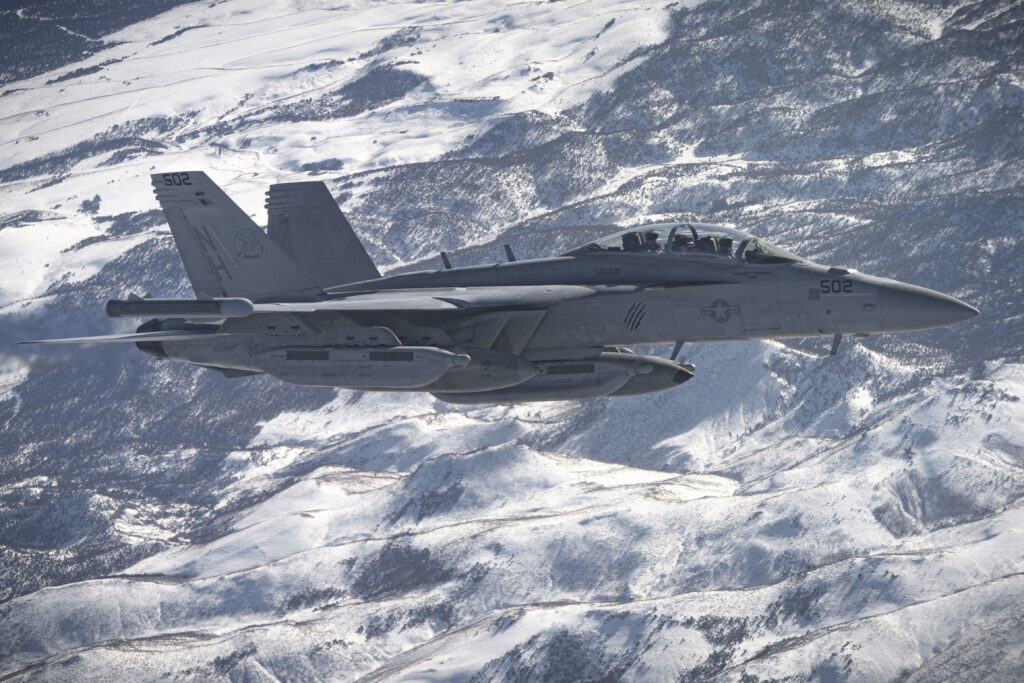
A U.S. Navy EA-18G Growlers assigned to the “Garudas” Electronic Attack Squadron (VAQ) 134, Naval Air Station Whidbey Island, Washington, waits to receive air-to-air refueling from a Royal Air Force Voyager tanker assigned to 101 Squadron, RAF Brize Norton, United Kingdom, during a Red Flag-Nellis 22-1 mission Feb. 3, 2022, at Nellis Air Force Base, Nevada. U.S. AIR FORCE / Airman 1st Class Zachary Rufus
ARLINGTON, Va. — A squadron of U.S. Navy EA-18G Growler electronic warfare aircraft has returned to its home base after more than six months deployed to the European Command as part of the build-up of forces in support NATO’s eastern flank.
Electronic Attack Squadron 134 (VAQ-134) has returned home to Naval Air Station Whidbey Island, Washington, from U.S European Command, according to a source. The squadron had deployed to Spangdahlem Air Base in Germany in late March 2022.
“The purpose of this deployment is to bolster readiness, enhance NATO’s collective defense posture and further increase air integration capabilities with our allied and partner nations,” said then- Defense Department spokesman John Kirby said in a release that month. “They are not being deployed to be used against Russian forces in Ukraine. They are being deployed completely in keeping with our efforts to bolster NATO’s deterrence and defense capabilities along that eastern flank. The deployment is not in response to a perceived threat or incident.”
The Navy has five-land-based expeditionary VAQ squadrons in addition to nine carrier-based VAQ squadrons, all equipped with EA-18Gs. For many years they deployed to bases in Southwest Asia to support combat in Afghanistan, Iraq, and Syria, and currently deploy to Misawa, Japan. The Navy’s Growlers provide electronic attack support for all of the armed services. The aircraft can jam enemy radars and communications and fire anti-radiation missiles at radar sites.
It has not been announced if VAQ-134 was replaced in Europe by another VAQ squadron. A carrier-based squadron, VAQ-140, currently is deployed to the region on board the USS George H.W. Bush.
In its 2023 budget proposal, the Navy proposed de-activating the five expeditionary VAQ squadrons. While the budget has yet to be passed, the proposal has met heavy opposition in Congress.
22nd MEU, Kearsarge ARG Return from Seven-Month Deployment
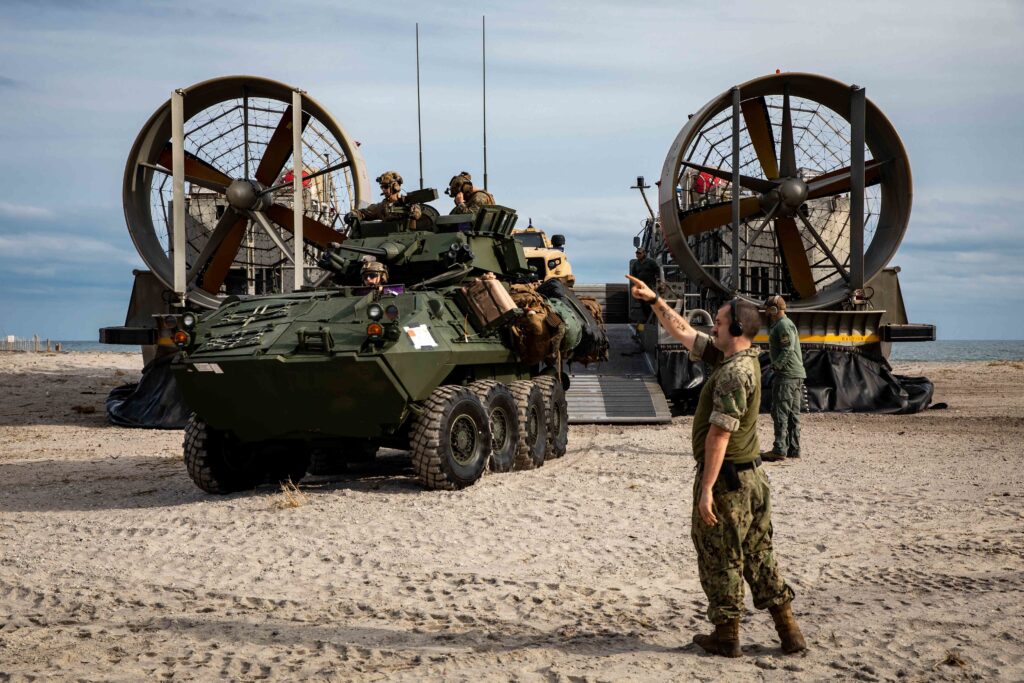
U.S. Navy Construction Mechanic 3rd Class Brandon Baker, assigned to Beach Master Unit (BMU) 2, directs a light armored vehicle, assigned to the 22nd Marine Expeditionary Unit (MEU), off Landing Craft Air Cushion 83, assigned to Assault Craft Unit (ACU) 4, in Morehead City, North Carolina, Oct. 8, 2022. U.S. NAVY / Mass Communication Specialist 1st Class John Bellino
MARINE CORPS BASE CAMP LEJEUNE, N.C. — Sailors and Marines assigned to the 22nd Marine Expeditionary Unit (MEU) returned home to Camp Lejeune, North Carolina, Oct. 9, 2022, after completing a seven-month deployment with the Kearsarge Amphibious Ready Group (ARG) in the U.S. Naval Sixth Fleet area of operations. The Kearsarge ARG is comprised of the Wasp-class amphibious assault ship USS Kearsarge (LHD 3), the San Antonio-class amphibious transport dock ship USS Arlington (LPD 24) and the Whidbey Island-class dock landing ship USS Gunston Hall (LSD 44).
The deployment marked the first time an ARG/MEU maintained a six-month presence in the Baltic region in over 20 years. More than 4,000 Marines and Sailors supported a wide range of interoperability training and exercises in 15 countries within U.S. Sixth Fleet; covering the High North/North Atlantic, Central Mediterranean, and Baltic regions promoting stability, increasing interoperability, sustaining combat readiness, and crisis response capabilities while strengthening relationships with both NATO Allies and partners.
“Our time in the Baltics and the High North was particularly valuable,” said Col. Paul C. Merida, commanding officer, 22nd Marine Expeditionary Unit. “I think all of us in the 22nd MEU came away extremely impressed with the level of military professionalism that our friends in the region possess and the level of enthusiasm for real, integrated defense cooperation was profound wherever we visited. I believe future east coast MEUs will find the High North and the Baltics not only a challenging training environment but a region full of very capable friends and allies.”
Exercises in the Arctic Region included Northern Viking 2022, a multinational amphibious and maritime exercise alongside Allied nations from France, Germany, Iceland, Norway and the United Kingdom; and a two-week bilateral exercise in northern Norway and the Norwegian Sea, exercising integrated cold weather and live- fire training with the Norwegian Armed Forces.
In the Central Mediterranean, Marines and Sailors assigned to USS Arlington participated in bilateral exercises such as Alexander the Great 22, a bilateral U.S.-Greece (Hellenic) amphibious training event; EFES 22, a biennial, multinational, combined, joint and live firing exercise with Turkish Armed Forces and U.S. Army’s Explosive Ordnance Disposal (EOD) and medical teams; as well as African Lion 22, an exercise enhancing the U.S. African Command’s partnership and security cooperation with the Tunisian Ministry of Defense.
While operating in the Baltic region, Kearsarge and Gunston Hall participated in an Estonian-led exercise, Hedgehog (Siil) 22 with Estonian Defense Forces and forces from Task Group 61/2.4 and the NATO-led exercise Neptune Shield. All of these exercises incorporated 18 NATO Allies and partners working together through multiple domains throughout the European continent and waters. In June, Kearsarge and Gunston Hall participated in the joint, annual multinational exercise, Baltic Operations (BALTOPS 22) designed to enhance interoperability, capability and demonstrate cohesion among Allied and partner forces in defending the Baltic Sea region.
Following BALTOPS22 and AL22, the Kearsarge ARG-MEU conducted scheduled maintenance availability periods in Brest, France, Rijeka, Croatia, and Copenhagen, Denmark throughout July 2022. The maintenance availability periods, which included mid-deployment voyage repair (MDVR) evolutions, allowed U.S. Navy ships to accomplish necessary and preventative repairs to continue their missions in the region while simultaneously strengthening relationships with host nations.
Once MDVRs were successfully completed, the Kearsarge ARG-MEU team returned to the Baltic region as a combined force to continue strengthening relationships and partnerships. Through rapid planning, coordination, and execution, the ARG-MEU team successfully completed bilateral training events with Finland, Sweden, and Standing NATO Maritime Group ONE (SNMG 1) during the months of August and September.
Upon conclusion of operations in the Baltic region, the ARG-MEU successfully completed a cumulative of 29 port visits across the ARG visiting 14 NATO Allied and partner countries including Reykjavik, Iceland; Narvik and Tromsø, Norway; Volos and Alexandropoulos, Greece; Tallinn, Estonia; Helsinki, Finland; Stockholm and Visby, Sweden; Gabés, Tunisia; Kiel, Germany; Brest, France; Rijeka, Croatia; Copenhagen and Kalundborg, Denmark; Riga, Latvia; Klaipeda, Lithuania; and Gdańsk and Gdynia, Poland. During each visit, the ARG-MEU engaged with representatives from embassies, ministries of defense, and local government, military and civilian officials to strengthen relationships with NATO Allies and partners through in-person key leader engagements and exchanges including media availabilities, ship tours, office calls, ceremonies and receptions, and community service projects.
“After a busy seven-month deployment it’s good to get the 22d MEU team back home to Lejeune,” Col. Paul Merida said. “We believe this was the first East Coast MEU deployment in a long while that was spent entirely in the 6th Fleet area of operations and the Marines did a tremendous job operating from above the Arctic Circle, to the Baltics, to the Mediterranean Sea. All of this was done with the backdrop of the Russia-Ukraine War, which added an additional sense of importance to our work; much of which was done alongside our NATO Allies and other key regional partners. Our families and friends should be proud of the service their Marines rendered and I believe the 22nd MEU has represented II Marine Expeditionary Force and the U.S. Marine Corps accordingly.”
The 22nd MEU’s mission is to provide the United States with a forward-deployed, amphibious force-in-readiness capable of executing missions across the full spectrum of combat and military operations and consists of four elements – a command element, a ground combat element, Battalion Landing Team (BLT) 2/6, a logistics combat element, Combat Logistics Battalion (CLB) 26, and an aviation combat element, Marine Medium Tiltrotor Squadron (VMM) 263 Reinforced.
The ARG-MEU’s presence overseas in U.S. Sixth Fleet area of operations supported strategic interests and contributed to regional security and stability and reassured the United States commitment to the High North, Mediterranean, and Baltic regions. The blue-green team provided operational flexibility to combatant commanders by providing a versatile contingency response force using sea, air, land and logistical assets. The versatility inherent to the amphibious force allowed for flexible and mission-tailored forces, while representing our nation’s strength, capability and resolve to partners and allies and deterring potential adversaries.
Coast Guard Cutter Steadfast Returns Home after 55-Day Counter-Drug Patrol
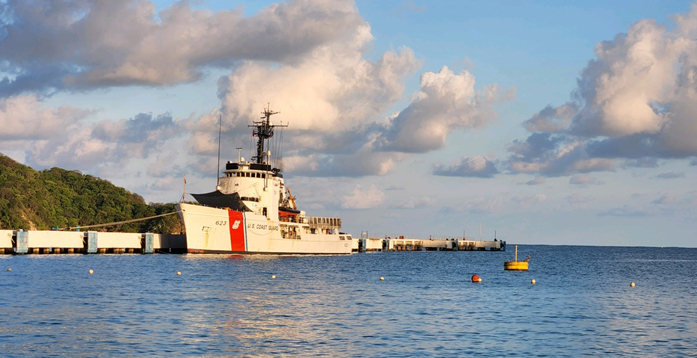
The Coast Guard Cutter Coast Guard Cutter Steadfast (WMEC 623) is moored while the cutter made a port call to Huatulco Mexico, Aug. 29, 2022. Steadfast returned to their Astoria homeport Oct. 3, 2022, following a 55-day counter narcotics patrol. U.S. COAST GUARD
ASTORIA, Ore. — The U.S. Coast Guard Cutter Steadfast (WMEC 623) returned to their Astoria homeport Monday following a 55-day counter-narcotics patrol, the Coast Guard Pacific Area said in an Oct. 9 release.
The crew aboard the 210-foot medium-endurance cutter steamed more than 11,000 miles conducting training, law enforcement, search and rescue, and helicopter operations in international waters ranging from Oregon to Central America.
The Steadfast deployed with additional crew members from Maintenance Augmentation Team Seattle, Electronic Support Detachment Petaluma, and the soon-to-be-commissioned U.S. Coast Guard Cutter Argus (WMSM 915).
While en route to the cutter’s patrol area in the Eastern Pacific Ocean, Steadfast’s crew hosted a helicopter operations proficiency event for multiple aircrews from Coast Guard Air Stations San Francisco, Barbers Point, Humboldt Bay, and North Bend. For three days, the crews conducted numerous flight operations including over 100 landings and various other operations. The resulting aviator qualifications across the four aviation units included one initial pilot qualification, and one upgrade to instructor pilot.
While in theater, Steadfast’s crew identified and located a high-speed, panga-style vessel suspected of smuggling contraband. After initially pursuing the vessel with the cutter’s over-the-horizon small boat, they handed off the case to a partner nation for intercept as the vessel neared partner nation territorial seas.
During the transit back to Astoria, Steadfast’s crew conducted flight operations with Air Station Humboldt Bay. Steadfast and the aircrew completed six night landings for pilot training and qualification. Flight operations were cut short when the aircrew was diverted for a search-and-rescue case involving a hiker stranded and in distress. Steadfast’s crew quickly adapted, refueled the helicopter on deck, and allowed the MH-65 to respond within minutes of receiving the call, demonstrating the versatility and adaptability of the cutter and crew to respond to any of the Coast Guard’s missions.
This was the first patrol aboard Steadfast for the new commanding officer, Cmdr. Brock S. Eckel, who assumed command in July.
“This was a wildly productive deployment with noteworthy enhancements to crew qualifications and proficiency following a significant personnel turnover,” said Eckel. “I am overwhelmed by the camaraderie of the Steadfast crew and honored to join them for adventure on the high seas.”
Steadfast is a 54-year-old Reliance-class cutter that has been homeported in Astoria since 1994. Previously, Steadfast was homeported in St. Petersburg, Florida, where she earned the nickname “El Tiburon Blanco” (‘the White Shark’), from drug smugglers for her notoriety in counter-narcotics operations in the Florida Straits and the Caribbean Sea.
NATO Uses Unmanned Systems Exercises to Stay Ahead in Capability Development
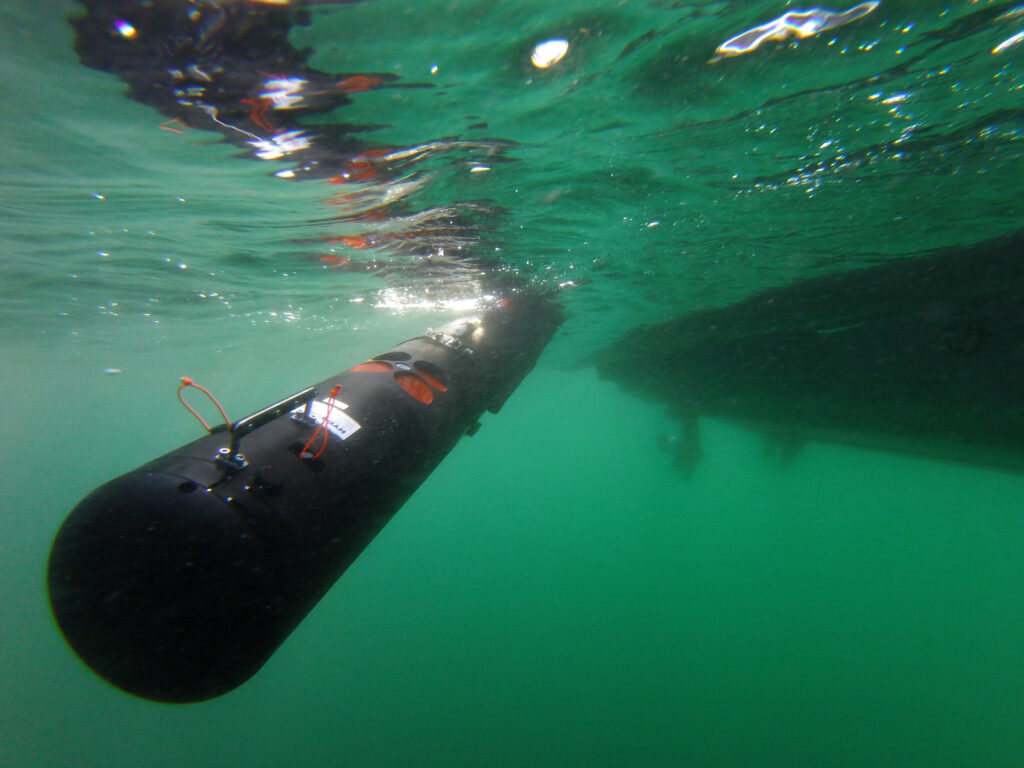
A REMUS 100 unmanned underwater vehicle deploys after being launched by a Sailors during REP(MUS) in Portugal, 2019. REP(MUS) 2022 merged into NATO’s Dynamic Messenger exercise in 2022. U.S. NAVY / Chief Mass Communication Specialist Travis Simmons
TROIA, Portugal — NATO, the Portuguese Navy, industry and other stakeholders recently conducted back-to-back exercises designed to integrate unmanned capabilities into naval operations and assist the alliance and its member states in maintaining an operational edge.
The Portuguese Navy-hosted REP(MUS) exercise — the navy’s Recognized Environmental Picture (REP) activity, amalgamated since 2019 with NATO’s Maritime Unmanned Systems (MUS) initiative — took place across September’s first three weeks. REP(MUS) merged into Dynamic Messenger, NATO Maritime Command’s inaugural maritime unmanned systems exercise, which took place in September’s final week. Both exercises occurred off Troia in southern Portugal.
The exercises aimed to drive forward NATO and member state integration of maritime unmanned systems into operational experimentation.
“These [exercises] are an accelerant to making sure we think ahead to stay ahead,” Vice Adm. Keith Blount, a UK Royal Navy officer and commander of Maritime Command, told a press briefing at Striking and Support Forces NATO headquarters in Lisbon.
“We’re setting commanders at sea real challenges in trying to adjust from a traditional command-and-control way of delivering warfighting capability to one that is very much at the technological edge, using equipment many of these commanders have probably not seen and operated with before,” Blount added. “That drives tactics, training, procedures, the education of officers … [and] the doctrine we follow.”
Regarding Dynamic Messenger, Blount said, “This has been quite a journey in the development and construction of this exercise, going back more than two years …. We build naturally on the success of REP(MUS), a well-established exercise, and now take it on to the next step — the integration of the capability into our [activities] at sea.”
For the journey’s next steps, Blount said, “One of the very first things that’s going to happen is we’re going to start planning next year’s Dynamic Messenger, building on the lessons from this year. We’re doing a lot of other work as well, to try and make operational experimentation more of a norm outside of exercises so we can have it as a free good to being out in the maritime commons, doing this without any detriment to the capability we are delivering day by day.”
Alongside MARCOM, Supreme Allied Command Transformation was the second NATO strategic-level headquarters involved in delivering Dynamic Messenger.
“SACT has particular roles around innovation and experimentation within the alliance, so Dynamic Messenger provides an excellent opportunity for us to pursue both those areas,” Royal Navy officer Vice Adm. Guy Robinson, SACT’s chief of staff, told the briefing. “Working closely with [MARCOM], we can come together hopefully to get some really useful insights from which we can both develop capability within the alliance and help allies shape their own capability investments.
“We’re always trying to look ahead and ensure we maintain that competitive edge, and to embrace those new technologies when the time is right for the alliance,” Robinson said. “Exercises like this can help showcase opportunities for allies to see where they may want to invest in the future.
“The real advantage of an exercise like [Dynamic Messenger] is that … by bringing Admiral Blount’s operational commanders into the picture, we then understand the real, practical application of these new technologies,” Robinson said. Unmanned systems “may work well in an isolated environment. [However], when you put them with commanders who have to deploy them, recover them, and see whether they are now more effective and more efficient, that’s when you get the real insight. That’s when you get the data you need to really see how they can change the battlespace.”
Navy Demonstrates VLS Reload in San Diego Harbor
Sailors aboard Arleigh Burke-class guided-missile destroyer USS Spruance (DDG 111) guide training ordnance into the ship’s forward vertical launch system (VLS) cells during a proof-of-concept evolution in San Diego, Oct. 4. U.S. NAVY / Mass Communication Specialist 3rd Class Taylor Crenshaw
SAN DIEGO — The U.S. Navy is scheduled to demonstrate re-arming the vertical launch system aboard Arleigh Burke-class destroyer USS Spruance (DDG 111) at Naval Air Station North Island and in the San Diego Harbor from Oct. 4 – 7, Commander, U.S. Third Fleet Public Affairs said in an Oct. 6 release
This will be the first time the Navy has tested VLS reloading from an offshore support vessel platform, using Military Sealift Command fleet experimentation ship MV Ocean Valor.
The demonstration is being conducted to provide proof of concept that an offshore support vessel can reload the weapons system pierside and while the ship is at sea, with a goal of expanding the capability of VLS reloading in expeditionary environments.
The launch system re-load has been tested previously, in 2016 and 2019, using other Military Sealift Command platforms.
Spruance, named for Adm. Raymond A. Spruance, who commanded U.S. forces at the Battle of Midway, is homeported in San Diego. The ship returned to the Naval Base San Diego in August following a seven-month deployment with Carrier Strike Group 3 to the U.S. 3rd and 7th Fleets. Spruance was also one of 38 ships from 26 partner nations who took part in Exercise Rim of the Pacific 2022 in the Hawaiian Islands Operating Area from June to August.
Built in 2002, MV Ocean Valor is an MSC-contracted vessel that supports logistics experimentation for fuel, stores, passengers and ordnance delivery.
The demonstration will not include live ordnance and there is no danger posed to the residents of San Diego, the harbor or sea life.
Future USS Lenah Sutcliffe Higbee Completes Acceptance Trials
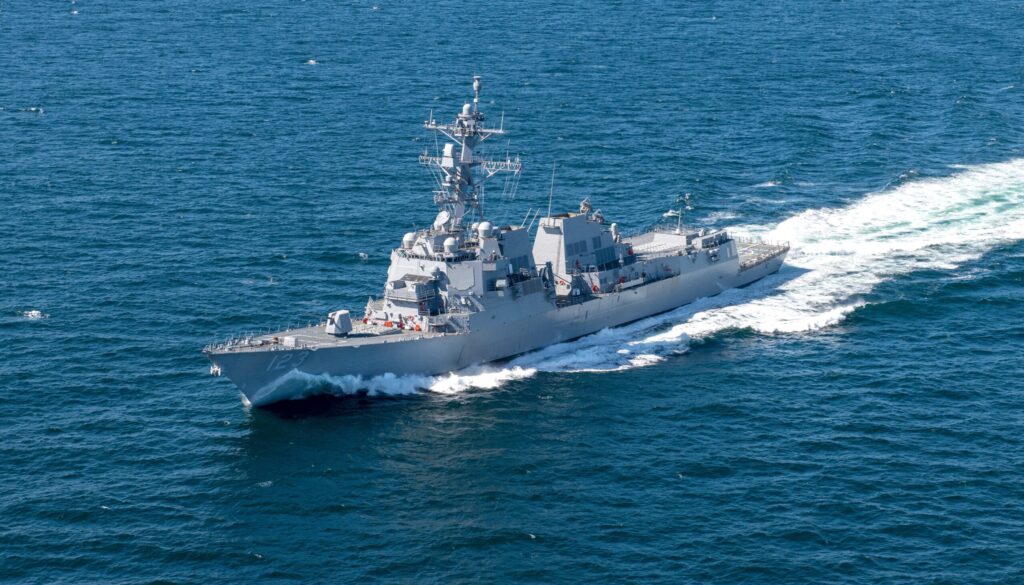
The future USS Lenah Sutcliffe Higbee (DDG 123) completed Acceptance trials, Oct. 6. HII
WASHINGTON — The future USS Lenah Sutcliffe Higbee (DDG 123) completed Acceptance trials, October 6, Team Ships Public Affairs said in a release.
During trials, the Navy’s Board of Inspection and Survey inspected the ship performing a series of demonstrations while pier side and underway to validate performance. The ship’s onboard systems, including navigation, damage control, mechanical and electrical systems, combat systems, communications and propulsion applications, met or exceeded Navy specifications.
DDG 123 is named for the first ever woman to receive the Navy Cross, Lenah Sutcliffe Higbee. Higbee served in the Navy for 14 years, including 11 as superintendent of the U.S. Navy Nurse Corps. She joined the Navy Nurse Corps in October 1908 and was promoted to chief nurse less than a year later. She was named superintendent in January 1911.
“We are proud to introduce another advanced warship to the fleet,” said Capt. Seth Miller, DDG 51 program manager, Program Executive Office (PEO) Ships. “The Navy is honored to recognized Lenah Sutcliffe Higbee with this fully capable, mission-ready ship.”
The DDG 51 Arleigh Burke-class ships are multi-mission guided missile destroyers designed to operate offensively and defensively, independently, or as units of Carrier Strike Groups, Expeditionary Strike Groups, and Surface Action Groups in multi-threat environments that include air, surface and subsurface threats. These ships will respond to Low Intensity Conflict/Coastal and Littoral Offshore Warfare scenarios, as well as open ocean conflict, providing or augmenting power projection, forward presence requirements and escort operations at sea.
DDG 123 is a Flight IIA destroyer equipped with the Aegis Combat System Baseline 9C2. This system delivers quick reaction time, high firepower and increased electronic countermeasures capability against a variety of threats.
The ship is expected to be delivered to the Navy later this year from Huntington Ingalls Industries’ Ingalls Shipbuilding division in Pascagoula, Mississippi. The shipyard is also in production on future destroyers Jack H. Lucas (DDG 125), Ted Stevens (DDG 128), Jeremiah Denton (DDG 129) and George M. McNeal (DDG 131).