CNO, Commander of the Romanian Naval Forces Discuss Maritime, Regional Security
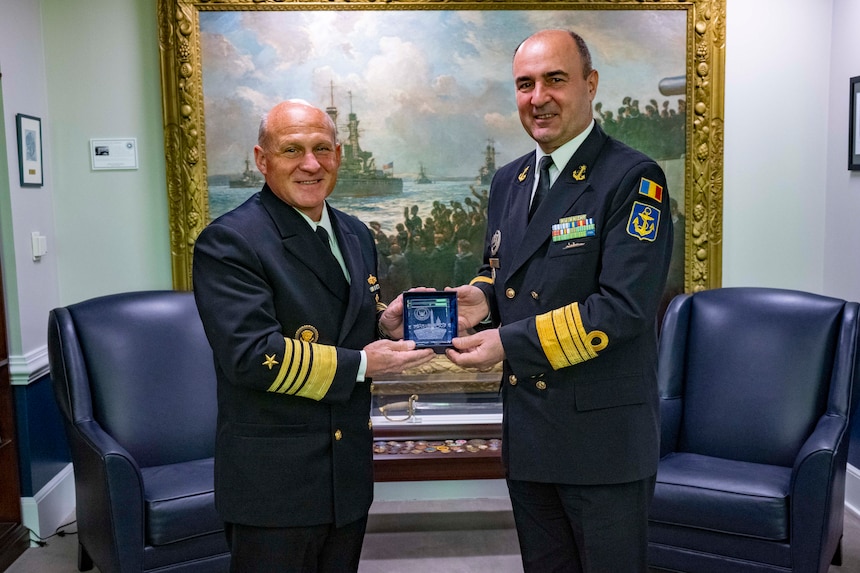
Chief of Naval Operations Adm. Mike Gilday meets with Commander of the Romanian Naval Forces Rear Adm. Mihai Panait at the Pentagon for an office call Sept. 29. U.S. NAVY / Chief Mass Communication Specialist Amanda Gray
WASHINGTON — Chief of Naval Operations Adm. Mike Gilday met with Commander of the Romanian Naval Forces Rear Adm. Mihai Panait at the Pentagon for an office call on Sept. 29, the CNO’s public affairs office said in a release.
The leaders discussed regional stability and maritime security, allied cooperation efforts, as well as modernization and deterrence.
“My discussions with Rear Adm. Panait were very productive and focused on future operations,” said Gilday. “The U.S. and Romania have a shared commitment to promoting safety and stability in the Black Sea, and the Romanian Naval Forces are an active contributor to maritime security operations there, as well as an important partner throughout the region. The U.S. Navy will continue to operate alongside our Romanian allies.”
The U.S. Navy and Romanian Naval Forces regularly operate together. Most recently, both navies participated in the Bulgarian exercise Breeze alongside Allies and partners Albania, Belgium, Georgia, Greece, Italy, Latvia, Turkey and the United Kingdom.
Romania hosts U.S. Aegis Ashore Missile Defense System Romania, located aboard Naval Support Facility Deveselu in Deveselu, Romania. USAAMDSRO is under the operational control of the U.S. Navy’s 6th Fleet based in Naples, Italy, and is part of the European Phased Adapted Approach, which protects European NATO Allies and U.S. deployed forces in the region. This land-based missile defense facility is designed to detect, track, engage, and destroy ballistic missiles in flight outside the atmosphere. Its technology is nearly identical to and works in coordination with the systems used on the four forward-deployed Aegis destroyers stationed in Rota, Spain.
Panait attended the U.S.-led 2021 International Seapower Symposium in Newport, Rhode Island, and will see Gilday again in Venice, Italy, next month for the Trans-Regional Seapower Symposium. This was their first official meeting.
Littoral Combat Ship Training Facility Atlantic Established
NAVAL STATION MAYPORT, Fla. — Marking a significant milestone event for the waterfront community, the Littoral Combat Ship Training Facility Atlantic was established during a ceremony onboard Naval Station Mayport, Sept. 23.
The training facility, formerly managed and operated by Surface Combat Systems Training Command Detachment Southeast, became a separate command under the SCSTC domain.
Before Littoral Combat Ship Training Facility Atlantic was officially established, Cmdr. Carl Brobst was relieved by Lt. Cmdr. Aloysius Elzie as SCSTC Det Southeast’s officer in charge during a change of charge. From July 2019, when Brobst assumed duties as OIC, to September 2022, Brobst and his team helped shape the next generation of surface warfighters. The det’s annual throughput more than quadrupled and they delivered over 18,840 combat-ready Sailors to the Fleet. Brobst will retire later this year after 30 years of naval service.
Immediately following the change of charge, Cmdr. Dan Reiher assumed command of Littoral Combat Ship Training Facility Atlantic. Reiher is already well-known in the LCS community. He served aboard USS Sioux City (LCS 11) as executive officer and commanding officer Gold Crew. Most recently, he was the commanding officer of USS Wichita (LCS 13).
“I am truly humbled to become the first commanding officer of LTF LANT and honored to join and lead an outstanding team of professionals in training future LCS warfighters,” he said.
The establishment of Littoral Combat Ship Training Facility Atlantic is part of Surface Combat Systems Training Command’s large internal realignment effort that begun in 2021 with the changing of its name, formerly the Center for Surface Combat Systems. The name change and realignment define the command’s critical mission of training surface warfighters. SCSTC, with its surface community partners and force development counterparts, provides system and platform specific combat systems training to a growing surface Navy. Littoral Combat Ship Training Facility Atlantic, with the responsibility of training all LCS Freedom-class ships and their crews, supports the increased demand for LCS training at the waterfront.
Capt. George A. Kessler, Jr., commodore of SCSTC, presided over the ceremony and delivered remarks as the keynote speaker.
“Being here in Mayport, you can see and feel the impact of today’s event for not only SCSTC, but also the waterfront,” Kessler said. “LTF LANT is part of the domain’s overall realignment effort but the significance of LTF LANT is about the mission. A mission that is growing in importance each day. Strategic competition at sea is not an amorphous concept but an everyday reality and it demands that our Sailors have the tactical competence and proficiency needed to execute the mission across the spectrum of operations in today’s challenging environment. Our warfighters must be ready to fight and LTF LANT provides the high-end tactical training needed to ensure warfighting readiness, which leads to security for our country and our allies and maintains the freedom of the seas we so richly enjoy.”
The LTF LANT is located onboard Naval Station Mayport, Fla. The first Freedom variant LCS arrived at Naval Station Mayport in 2016 and the number of LCSs have grown.
LTF LANT facilitates the training concepts of Train-to-Qualify and Train-to-Certify for the LCS 1 USS Freedom ship variant. It provides an integrated command and control environment to support training in both navigation and combat systems mission areas. LTF LANT is comprised of three components which can be used independently or in concert with the others to provide more complex training scenarios. Each section of the trainer replicates the basic layout and design of the LCS command and control, bridge, and propulsion control systems. Using mockups of these areas, which includes video screens reproducing scenes from a ship’s bridge windows, the SCSTC team produces realistic training scenarios.
NAVCENT: Saudi Arabia Expands Maritime Partnership with International Coalition
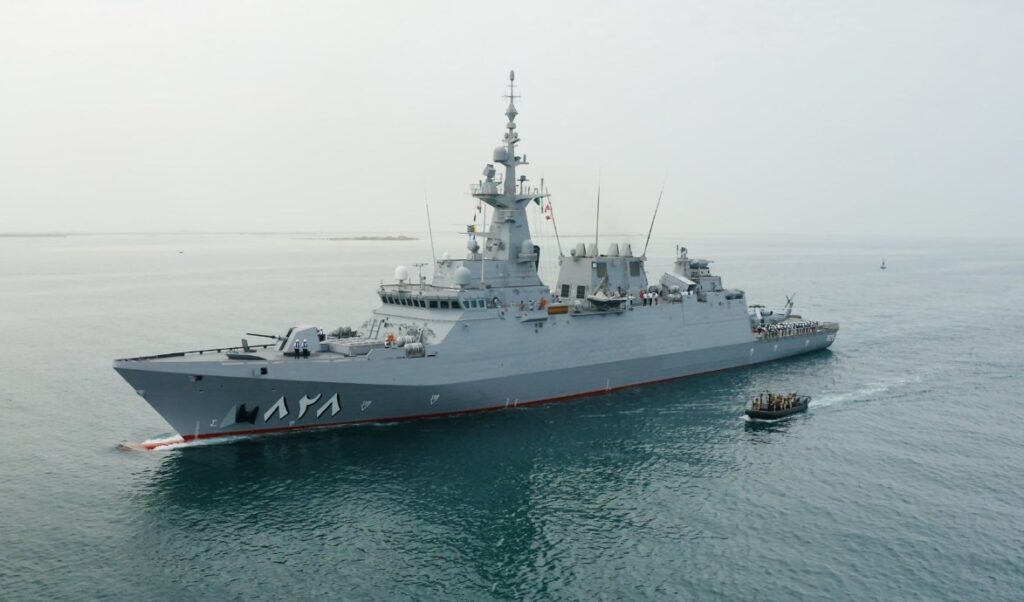
Royal Saudi Navy ship HMS Al Jubail. U.S. NAVY
MANAMA, Bahrain — Saudi Arabia’s western naval fleet began operating for the first time with the International Maritime Security Construct (IMSC) in the Red Sea, Sept. 27, signaling an expanded partnership between the multination coalition and Royal Saudi Naval Forces, NAVCENT Public Affairs said in a Sept. 28 release.
The Royal Saudi Navy Western Fleet, concentrated in the Red Sea, is now contributing to IMSC missions near the Bab al-Mandeb Strait as HMS Al Jubail (828) conducts patrols in support. Its Eastern Fleet has been operating with IMSC since 2019, when Saudi Arabia joined the nine-member coalition.
“As the Western Fleet joins with IMSC, we are able to bring reassurance to our maritime industry partners as they transit the Bab al-Mandeb Strait into the Red Sea,” said United Kingdom Royal Navy Commodore Ben Aldous, commander of IMSC and Coalition Task Force (CTF) Sentinel, the operational arm of the maritime partnership.
IMSC was formed in July 2019 in response to increased threats to freedom of navigation for merchant mariners transiting international waters in the Middle East. CTF Sentinel was established four months later to deter state-sponsored malign activity and reassure the merchant shipping industry in the Strait of Hormuz and Bab al-Mandeb.
Approximately 17,000 merchant ships transit through Bab al-Mandeb into the Red Sea annually.
“The Kingdom of Saudi Arabia’s Western Fleet goes a long way to enhancing maritime security in this well transited region.”
The multinational coalition is headquartered in Bahrain with U.S. 5th Fleet and includes Albania, Bahrain, Estonia, Lithuania, Romania, Saudi Arabia, United Arab Emirates, United Kingdom and the United States.
Gonzalez Returns To Norfolk from 9-Month Deployment
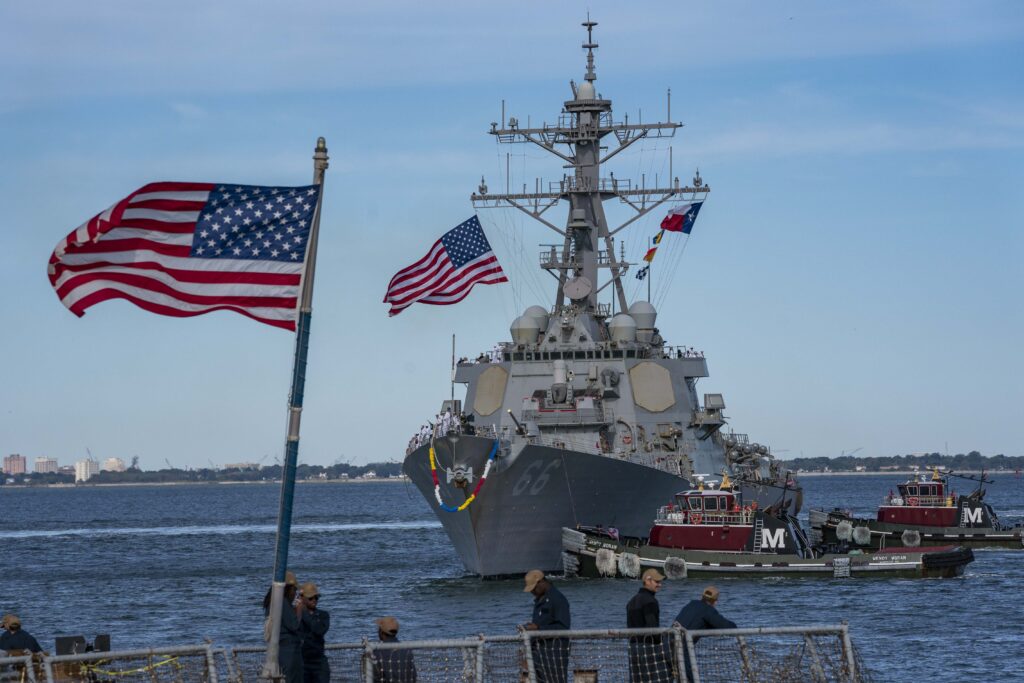
The Arleigh Burke-class destroyer USS Gonzalez (DDG 66) returns to Naval Station Norfolk after a regularly scheduled deployment in the U.S. 5th Fleet and U.S. 6th Fleet areas of operations, Sept. 28. U.S. NAVY / Mass Communication 2nd Class Nathan T. Beard
NORFOLK, Va. — The Arleigh Burke-class guided-missile destroyer USS Gonzalez (DDG 66) returned to its homeport of Naval Station Norfolk, Sept. 28, 2022, USS Harry S. Truman Public Affairs said in a release.
Gonzalez deployed Jan. 23 as part of a surge deployment of five destroyers under commander, U.S. 2nd Fleet, that included the Arleigh Burke-class guided-missile destroyers USS Donald Cook (DDG 75), USS Mitscher (DDG 57), USS The Sullivans (DDG 68) and USS Forrest Sherman (DDG 98) before Gonzalez joined the Harry S. Truman Carrier Strike Group (HSTCSG) in the Mediterranean Sea as a part of Destroyer Squadron (DESRON) 28.
The ship was dynamically employed by U.S. 5th and 6th Fleets, traveling throughout the regions participating in a multitude of bi-lateral and multi-lateral training opportunities ensuring maritime security and stability.
“We left on this deployment to bolster relationships with key allies and partners as well as defend international interests in the U.S. 5th and 6th Fleets,” said Cmdr. Timothy Battles, Gonzalez’s commanding officer. “I am proud of the men and women of this ship and all that they have accomplished since we left home and know they can feel a strong sense of pride for a job well done.”
The crew’s outstanding efforts complemented the ship’s diversity of mission sets and substantial capabilities. “The Sailors aboard USS Gonzalez lead the way in demonstrating resolve and dedication to support the mission and each other,” said Cmdr. Kate Stegner, Gonzalez’s executive officer. “As an independent deployer, our team met each mission with continued success. I am humbled to be a part of this great crew.”
While operating in the U.S. 5th Fleet area of operations, Gonzalez conducted multiple escort transits through the Bab-el-Mandeb Strait and conducted counter smuggling operations in support of Combined Task Force (CTF) 150 in the Gulf of Oman. Gonzalez also conducted security patrols in support of the recently established CTF 153 to ensure international maritime security and capacity building efforts in the Red Sea, Bab al-Mandeb Strait and Gulf of Aden.
During their operations in U.S. 6th Fleet, Gonzalez demonstrated cohesion and capability by sailing and operating with Forward Deployed Naval Forces-Europe ships, as well as those of Standing NATO Maritime Group (SNMG) 2 and the HSTCSG.
In the Mediterranean, Gonzalez helped pave the way for the NATO-led exercise Neptune Shield 22, conducting dual and tri-carrier operations with the Italian and French navies. The multinational exercise demonstrated NATO’s ability to integrate the high-end maritime warfare capabilities of allied aircraft carrier strike groups, amphibious ready groups and marine expeditionary units to support the defense of the alliance. Training exercises and vigilance activities throughout the deployment provided the opportunity to enhance relationships with European Allies and partners.
As the ship finally pulled into homeport, Command Master Chief Lance Connolly, Gonzalez’s senior enlisted leader, reflected on the sacrifices made by those onboard and those waiting at the pier.
“They conducted themselves admirably the past months despite the many challenges presented throughout our deployment,” said Command Master Chief Connolly. “I could not have been more pleased with the resiliency and warrior spirit of our crew.”
The Nimitz-class aircraft carrier USS Harry S. Truman (CVN 75), commanded by Capt. Gavin Duff, serves as the flagship of the HSTCSG; additional elements include the nine squadrons of Carrier Air Wing (CVW) 1, commanded by Capt. Patrick Hourigan; the staff and guided-missile destroyers of Destroyer Squadron 28, commanded by Capt. Blair Guy, which have included: USS Bainbridge (DDG 96), USS Cole (DDG 67), USS Gravely (DDG 107), USS Forrest Sherman (DDG 98) and USS Jason Dunham (DDG 109).
U.S. Navy Expands Maintenance Provider Base in Africa
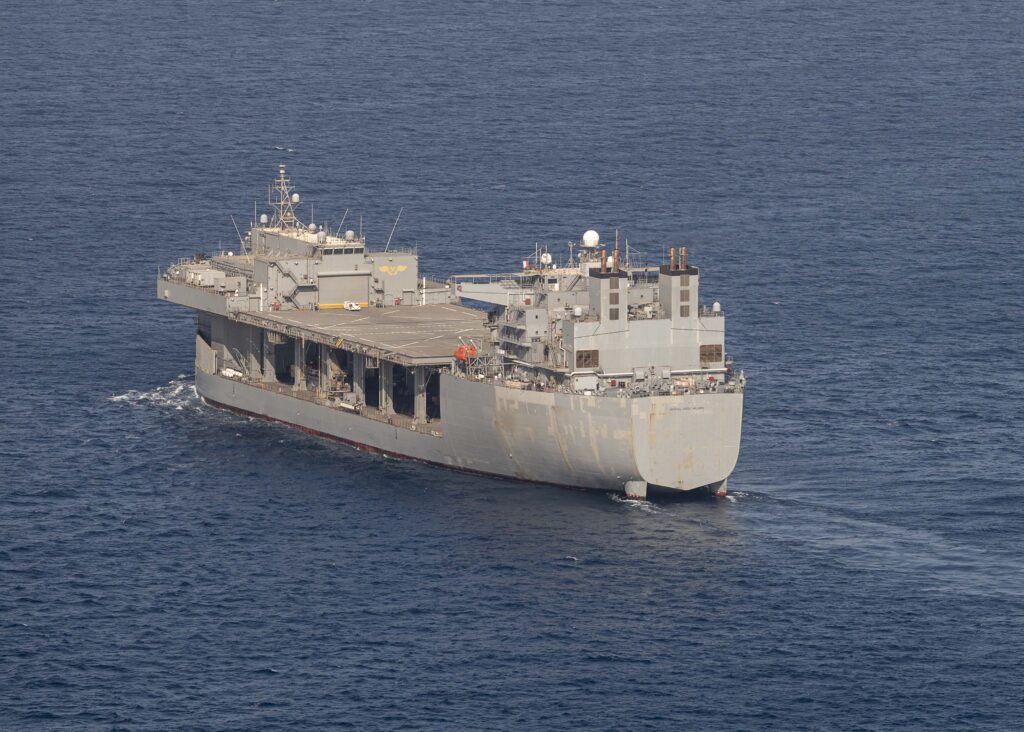
The Lewis B. Puller-class expeditionary sea base USS Hershel “Woody” Williams (ESB 4) sails in the Gulf of Aden, July 26. Hershel “Woody” Williams is rotationally deployed to the U.S. Naval Forces Africa area of operations, employed by U.S. 6th Fleet, to defend U.S., allied and partner interests. U.S. AIR FORCE / Staff Sgt. Dylan Murakami
WALVIS BAY, Namibia — Lewis B. Puller-class expeditionary sea base ship USS Hershel “Woody” Williams (ESB 4) and Forward Deployed Regional Maintenance Center (FDRMC) ship repair experts hosted a ship check event attended by commercial maintenance providers during a recent port visit to Walvis Bay, Namibia, Sept. 5, U.S. Naval Forces Europe-Africa Public Affairs said Sept. 27.
Ship checks provide opportunities to meet regional maintenance providers in person and allow representatives to visit the ship ahead of potentially bidding on a maintenance contract. During the first-ever ship check for Hershel “Woody” Williams in Namibia, FDRMC representatives led the attendees around the vessel to identify areas and equipment in need of maintenance ahead of an upcoming voyage repair availability.
Following the ship check event, Naval Supply Systems Command Fleet Logistics Center Sigonella (NAVSUP FLCSI) contracting officers and FDRMC ship repair experts and U.S. Transportation Command’s Military Sealift Command hosted a virtual industry engagement. This event educated maintenance provider representatives about the U.S. government contract solicitation process, contracting regulations and how to submit competitive solicitations to the government to perform any of the ship’s needed maintenance.
“The U.S. Navy cannot operate effectively and execute its mission overseas without the labor and expertise of commercial ship repair vendors,” said Capt. Paul Haslam, NAVSUP FLCSI chief of contracts. “Ship checks and virtual industry engagement events like those we conducted aboard HWW serve to strengthen relations with key partners like Namibia and, in general, help pave the way for future maintenance and logistics capability overseas. These events also broaden mutual understanding and improve cooperation between NAVSUP and our mission partners.”
Having the maintenance provider tour the ship at the same time as the ship check exposed them to needed work aboard Hershel “Woody” Williams. Similarly, during the virtual industry engagement, they had the opportunity to learn about the U.S. government contract solicitation process, contracting regulations and how to submit competitive solicitations to the government to perform any of the ship’s needed maintenance.
“Building relationships with regional maintenance providers is critical to ensure U.S. Navy ships receive quality and on-time maintenance during future availabilities,” said Marie Hahn, NAVSUP FLCSI Ship Repair Division director. “We haven’t done work in Namibia yet; so it was expected that commercial vendors in attendance benefited from the virtual industry engagement.”
Hershel “Woody” Williams is the first U.S. Navy vessel to be assigned to the U.S. Africa Command area of responsibility whose presence is to promote maritime security through a persistent presence in African waters in close cooperation with African partners.
FRC Seizes $85 Million in Heroin in NAVCENT Region
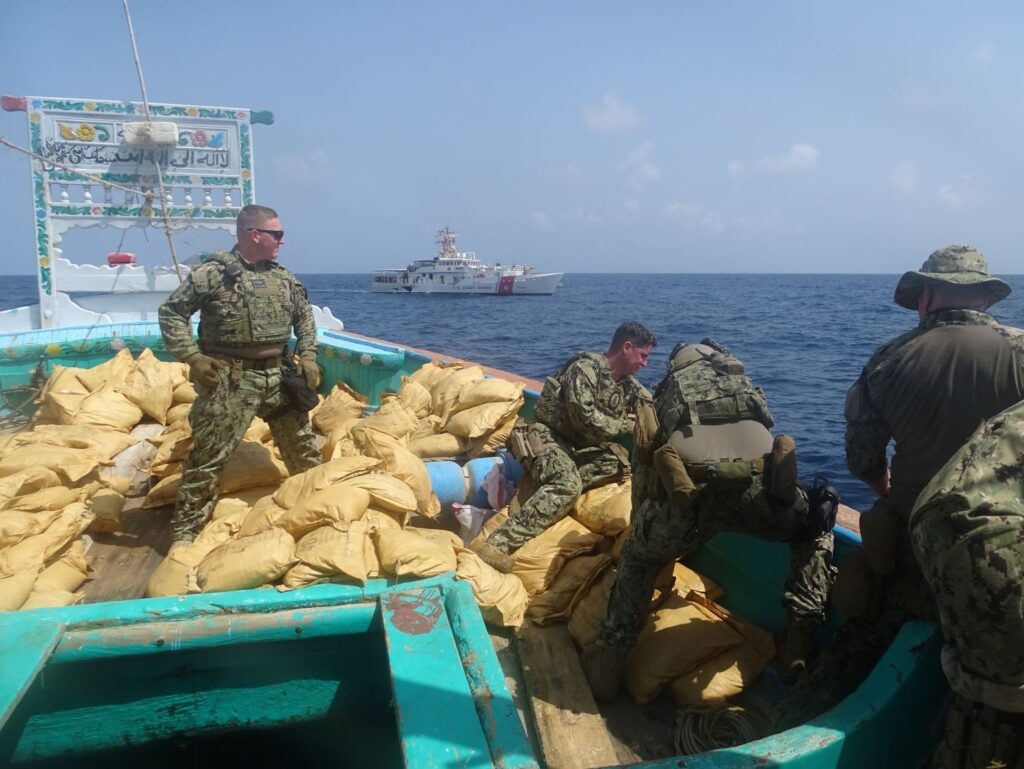
A U.S. Coast Guard interdiction team seizes bags of illegal narcotics from a fishing vessel interdicted by fast response cutter USCGC Charles Moulthrope (WPC 1141) in the Gulf of Oman, Sept. 27. U.S. COAST GUARD
MANAMA, Bahrain — A U.S. Coast Guard fast response cutter seized an estimated $85 million worth of heroin from a fishing vessel while patrolling the Gulf of Oman, Sept. 27, representing the largest illegal drug interdiction in the Middle East by international naval forces this year, Naval Forces U.S. Central Command Public Affairs said in a release.
While operating in support of Combined Task Force 150, USCGC Charles Moulthrope (WPC 1141) seized 2,410 kilograms of heroin as the fishing vessel transited international waters. CTF 150 is one of four task forces under the Combined Maritime Forces, the world’s largest multinational naval partnership.
The Royal Saudi Navy assumed command of CTF 150 in July during a ceremony in Manama, Bahrain, where the task force is headquartered.
“This sizable seizure demonstrates a profound commitment among our international partners to disrupting and deterring destabilizing activity in the region,” said Vice Adm. Brad Cooper, commander of U.S. Naval Forces Central Command, U.S. 5th Fleet and CMF. “I am proud of the flawless efforts by CMF, the Saudi-led CTF 150 team and the Charles Moulthrope crew.”
Charles Moulthrope began operating in the Middle East in May 2021. Its crew of nearly 30 Coast Guardsmen includes the ship’s 24 plank owners who were the original crewmembers when the ship commissioned in January 2021.
CMF consists of 34 member-nations whose forces operate in the Red Sea, Gulf of Aden, Northern Arabian Sea, Gulf of Oman, Arabian Gulf and Indian Ocean.
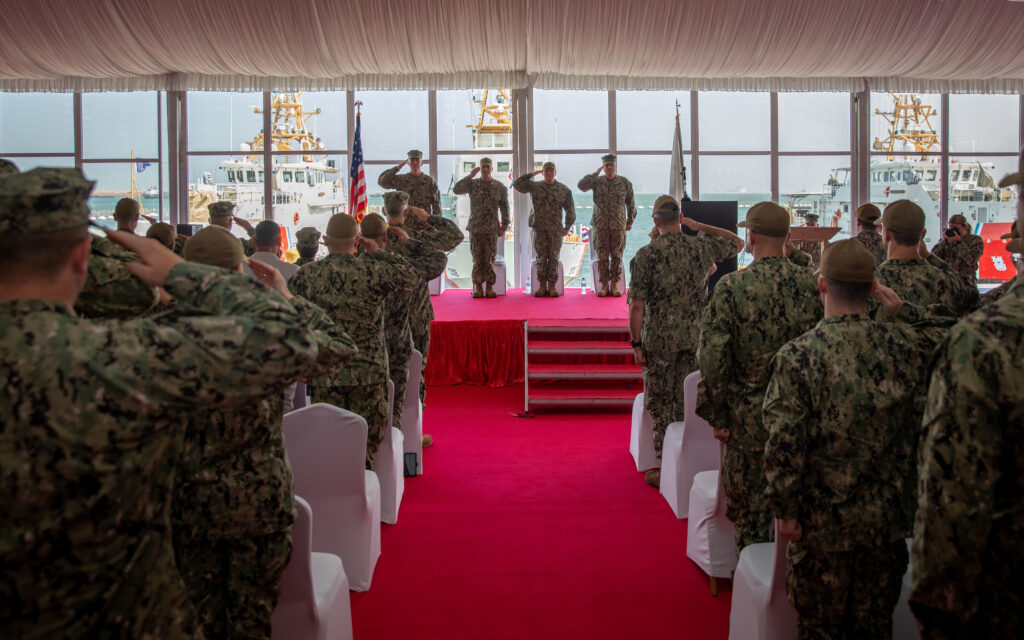
U.S. Coast Guardsmen conduct a decommissioning ceremony for USCGC Baranof (WPB 1318) in Manama, Bahrain, Sept. 26. Baranof decommissioned after 34 years of service. U.S. ARMY / Spc. Noah Martin
MANAMA, Bahrain— The USCGC Baranof (WPB 1318) was decommissioned during a ceremony aboard Naval Support Activity Bahrain, Sept. 26., the Coast Guard Atlantic Area said in a release,
Vice Adm. Kevin Lunday, commander of U.S. Coast Guard Atlantic Area, presided over the ceremony.
“USCGC Baranof’s exemplary service to our nation is a testament to both the Island-class platform and the crews that have manned Baranof over the past 34 years,” said Lunday. “Whether it was conducting law enforcement and search and rescue in the Caribbean, or deploying to the present-day homeport of Bahrain to support U.S. Central Command, those that have manned Baranof have continually met the needs of America.”
Baranof was commissioned into service on May 20, 1988 at Coast Guard Base Miami Beach in Miami. The 18th of 49 Island-class patrol boats, Baranof received orders to the U.S. 5th Fleet area of operations in support of Operation Iraqi Freedom in 2002. Shortly after their arrival in Bahrain, Baranof’s crew was underway conducting maritime interdiction operations in the North Arabian Gulf.
Baranof was replaced by the USCGC Clarence Sutphin Jr. (WPC 1147), which arrived at NSA Bahrain on Aug. 23, 2022. As part of the Coast Guard’s fast response cutter program, the service is acquiring 65 Sentinel-class fast response cutters, with six of those assigned to U.S. Coast Guard Patrol Forces Southwest Asia (PATFORSWA).
PATFORSWA, the Coast Guard’s largest unit outside of the United States, oversees the cutters in Bahrain. The ships are forward deployed to U.S. 5th Fleet to help ensure maritime security and stability across the Middle East. The 154-foot-long vessels feature advanced communications systems, and improved surveillance and reconnaissance equipment.
PATFORSWA, which is operationally attached to 5th Fleet’s Commander Task Force 55, is composed of six FRCs, shoreside mission support personnel and a maritime engagement team. The unit plays a crucial role in maritime security, maritime infrastructure protection, and regional theater security cooperation. The unit also supports other U.S. Coast Guard deployable specialized forces operating throughout the Middle Eastern region.
Russian, Chinese Naval Ships Operate Near the Aleutians
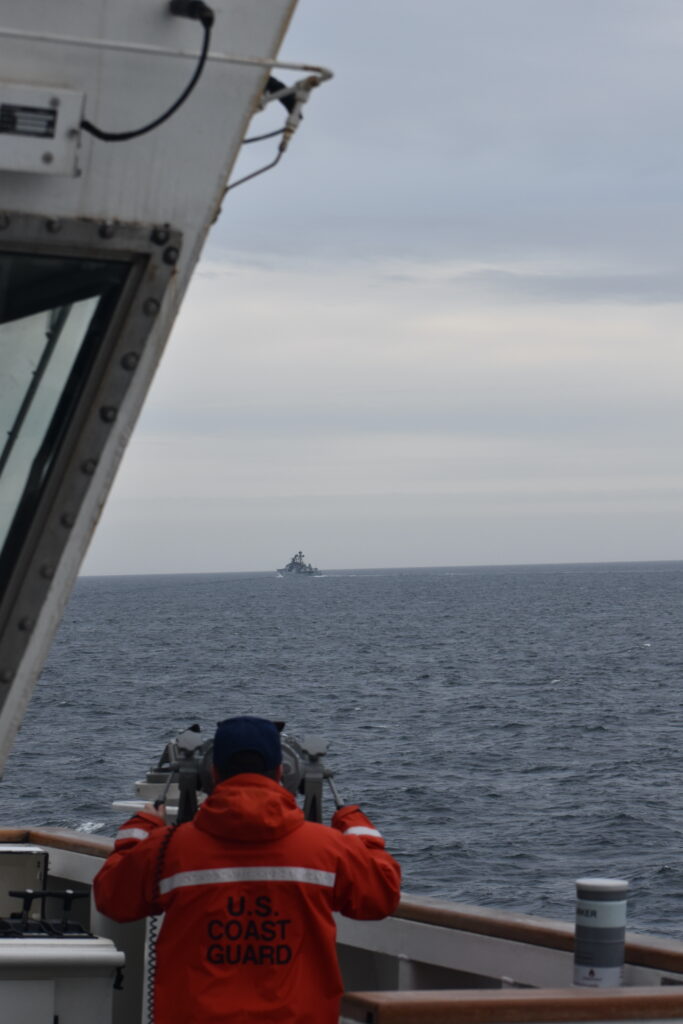
A Coast Guard Cutter Kimball crewmember observing a foreign vessel in the Bering Sea, Sept. 19. The Coast Guard Cutter Kimball crew on a routine patrol in the Bering Sea encountered a People’s Republic of China Guided Missile Cruiser, Renhai CG 101, sailing approximately 75 nautical miles north of Kiska Island, Alaska. U.S. COAST GUARD
JUNEAU, Alaska — The crew of Coast Guard Cutter Kimball crew on a routine patrol in the Bering Sea encountered a People’s Republic of China Guided Missile Cruiser, Renhai CG 101, sailing approximately 75 nautical miles north of Kiska Island, Alaska, September 19, 2022, the Coast Guard 17th District said in a Sept. 26 release.
The Kimball crew later identified two more Chinese naval vessels and four Russian naval vessels, including a Russian Federation Navy destroyer, all in a single formation with the Renhai as a combined surface action group operating in the U.S. exclusive economic zone.
As a result, the Kimball crew is now operating under Operation Frontier Sentinel, a 17th Coast Guard District operation designed to meet presence with presence when strategic competitors operate in and around U.S. waters. The U.S Coast Guard’s presence strengthens the international rules-based order and promotes the conduct of operations in a manner that follows international norms. While the surface action group was temporary in nature, and Kimball observed it disperse, the Kimball will continue to monitor activities in the U.S. EEZ to ensure the safety of U.S. vessels and international commerce in the area. A Coast Guard Air Station Kodiak C-130 Hercules air crew provided support to the Kimball’s Operation Frontier Sentinel activities.
In September 2021, Coast Guard cutters deployed to the Bering Sea and North Pacific Ocean also encountered Chinese naval vessels, including a surface action group transiting approximately 50 miles off the Aleutian Island chain.
“While the formation has operated in accordance with international rules and norms,” said Rear Adm. Nathan Moore, 17th Coast Guard District commander, “we will meet presence-with-presence to ensure there are no disruptions to U.S. interests in the maritime environment around Alaska.”
Kimball is a 418-foot Legend-class national security cutter homeported in Honolulu.
Navy Accepts Delivery of Future USS Cooperstown
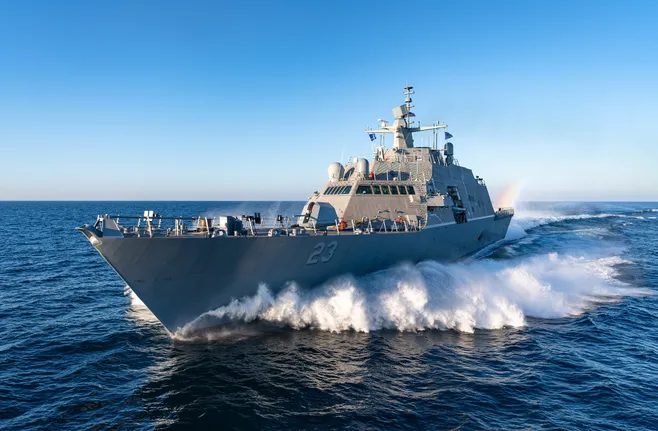
The future USS Cooperstown. LOCKHEED MARTIN
WASHINGTON — The Navy accepted delivery of the future USS Cooperstown (LCS 23) at the Fincantieri Marinette Marine shipyard in Marinette, Wisconsin, Sept. 20, PEO Unmanned and Small Combatants Public Affairs said in a release.
The ship is the 12th Freedom-variant Littoral Combat Ship designed and delivered by the Lockheed Martin-led industry team. Delivery marks the official transfer of the ship from the shipbuilder to the Navy. Following delivery, the ship will sail away for a commissioning ceremony in New York City before transiting to its homeport in Mayport, Florida.
“Today marks a significant shipbuilding milestone in the life of the future USS Cooperstown, ‘America’s Away Team,’ an exceptional ship and the latest inductee into the Navy’s arsenal conducting operations around the globe.” said Capt. Andy Gold, PMS 501 (Littoral Combat Ships) program manager.
LCS 23 is the second Freedom-variant ship outfitted with the combining gear correction that will allow unrestricted operations. The correction addresses a class-wide flaw that was identified as the fleet deployed these ships in greater numbers.
The future USS Cooperstown will be the first naval ship to honor the Village of Cooperstown in Otsego County, New York. The village is located at the southern end of the historic Otsego Lake in the central region of the state. Cooperstown, New York, is the home of the National Baseball Hall of Fame and Museum, which is the source of the ship’s motto, “America’s Away Team.”
Several more Freedom variant ships are under construction at the Fincantieri Marinette Marine shipyard in Marinette, Wisconsin. The future USS Marinette (LCS 25) is scheduled for delivery in early 2023. Additional ships in various stages of construction include the future ships USS Nantucket (LCS 27), USS Beloit (LCS 29) and USS Cleveland (LCS 31). LCS 31 will be the final Freedom-variant LCS.
The LCS class is now the second-largest surface ship class in production. The future USS Cooperstown is the fourth LCS delivered in Fiscal Year 2022, following the deliveries of the Freedom-variant USS Minneapolis-Saint Paul (LCS 21), Independence-variant USS Canberra (LCS 30), and Independence-variant USS Santa Barbara (LCS 32).
The LCS is a fast, agile, mission-focused platform designed to operate in near-shore and open ocean environments, capable of winning against 21st-century coastal threats such as mines and swarming small craft. The ships are capable of supporting forward presence, maritime security, sea control and deterrence.
“I look forward to seeing Cooperstown step up to the plate with her sister ships in Mayport to bring her slugging capabilities to the fleet.” Gold said.
USS Hué City Decommissioned After 31 Years of Service
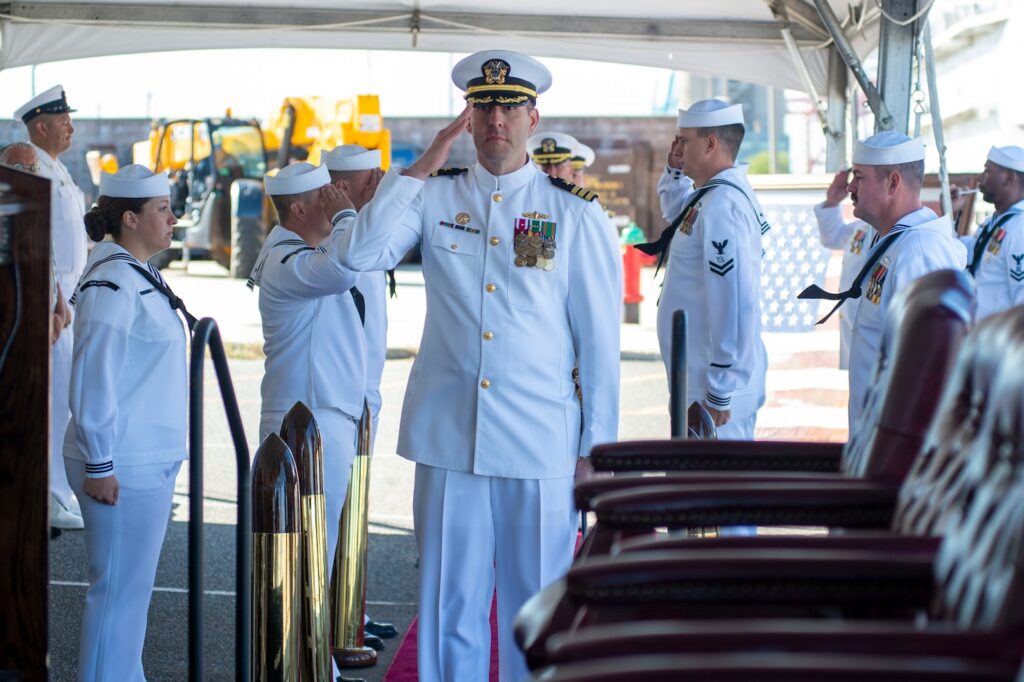
Cmdr. Thad D. Tasso, commanding officer USS Hué City (CG 66), salutes as he arrives for the decommissioning ceremony of the Ticonderoga-class guided- missile cruiser USS Hué City (CG 66) after 31 years of naval service. U.S. NAVY / Mass Communications Specialist 2nd Class Darien G. Kenney
NAVAL STATION NORFOLK — With plank owners, former crew members and veterans of the Battle of Hué in attendance, the crew of USS Hué City (CG 66) decommissioned their ship at a Naval Station Norfolk, Virginia, ceremony on Sept. 23, the ship’s public affairs office said in a release.
The event comes just nine days after the ship’s 31st commissioning anniversary. Hundreds gathered to celebrate the ship’s distinguished history and military service and to honor those who sacrificed in the battle for which the ship is named.
The ceremony’s presiding officer and a native of Hue, Vietnam, Rear Adm. Huan Nguyen, Naval Sea Systems Command Deputy Commander for Cyber Engineering, shared his 1968 Tet Offensive experiences and the important place USS Hué City holds in the Navy.
“To me, the Hue City represents the very simple democracy and freedom and fighting spirit of all the heroes who defend and protect her,” said Nguyen. “Those values are what continue to inspire me to serve our great nation, to live a life of fidelity, courage and honor. It is the crew, former and present, that I would like to honor and thank.”
“BZ to the USS Hue City, to the former and present crew. Thank you for your service and may her fighting spirit live on forever.”
Current Hué City Commanding Officer, Cmdr. Thad D. Tasso, spoke of the unbreakable connection between a ship and the Sailors who serve onboard and of the life-long connections made through shared experiences and challenges. His words resonated with the audience as they bade farewell to their ship.
“While the decommissioning of a ship is traditionally a somber affair, it is also an opportunity for us to celebrate our warship’s heritage and the impact she has had on our Navy,” said Tasso.
Hué City was built at Ingalls Shipbuilding in Pascagoula, Miss., and commissioned there Sept. 14, 1991. The ship is named in commemoration of the Vietnam War battle which was fought in and around the city of Hué during the 1968 Tet Offensive from Jan. 31 to March 2, 1968. During the battle, three understrength U.S. Marine battalions, consisting of fewer than 2,500 men, attacked and soundly defeated more than 10,000 entrenched enemy troops, liberating the city of Hué and handing the enemy a costly defeat.
The Ticonderoga-class, guided-missile cruiser is the only U.S. Navy warship to be named in commemoration of a Vietnam War battle.
Over its 31 years of service, Hué City has played an important part in the Navy’s timeless role of protecting America at sea. The ship and its crew completed several deployments, supported numerous exercises and provided important humanitarian assistance, including off the coast of New York in response to the 9/11 terrorist attacks.
From 2002 to 2017, the ship deployed seven times in support of the Global War on Terror and Operation Enduring Freedom. The ship deployed for the final time in 2017 to support Operation Inherent Resolve.
“For 31 years USS Hué City defended our nation and kept the oceans of the world free,” added Tasso.
“Her crew sailed with the full knowledge of the heritage that sailed with them and in striving to remain true to it, built a legacy of success of their own. As she now takes her rightful place in our Navy’s history, I can think of no more fitting epitaph for her service than ‘she was worthy of the name she bears’.”
After decommissioning, the ship is slated to be towed Oct. 31, to the Navy’s Inactive Ship’s facility in Philadelphia, where it will be in a Logistical Support Asset status.