Bahrain Conducts Fifth Sentinel Shield Exercise with IMSC; Includes Saildrone USV  
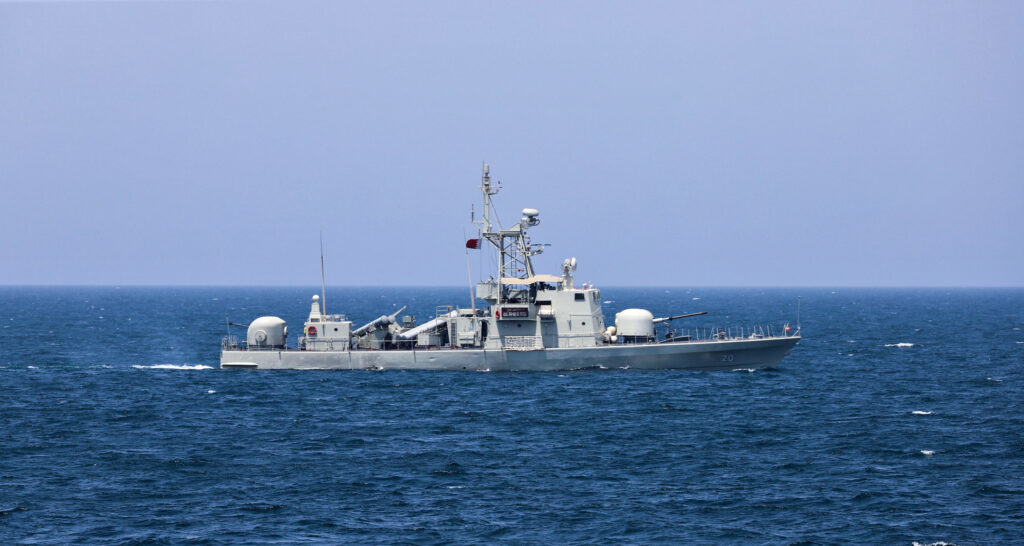
Royal Bahrain Naval Force patrol boat RBNS Ahmed Al-Fateh (P20) sails in the Arabian Gulf during exercise Sentinel Shield on Aug. 23. U.S. COAST GUARD / Electronics Technician 1st Class Jason Pickens

MANAMA, Bahrain — Forces from Bahrain and the United States completed a joint exercise in the Arabian Gulf on Aug. 23, led by a nine-nation coalition staff based in the Middle East, NAVCENT Public Affairs said Aug. 25.  

Royal Bahrain Naval Force ship RBNS Ahmed Al-Fateh (P20) and U.S. Coast Guard patrol boat USCGC Baranof (WPB 1318) participated in exercise Sentinel Shield with a Saildrone Explorer unmanned surface vessel from U.S. 5th Fleet.  

Sentinel Shield is a monthly exercise series organized by the International Maritime Security Construct (IMSC) to enhance communication and coordination among partner naval forces. This month’s iteration was the first designed to integrate unmanned systems.  

“The continued interoperability and coordination of U.S. and Bahraini naval assets are crucial to stability in the Arabian Gulf,” said Lt. Vaughn Gehman, commanding officer of Baranof. “Integration of unmanned systems is a force-multiplier for IMSC and its ability to detect and deter malign activity.”  

IMSC was formed in July 2019 in response to increased threats to freedom of navigation for merchant mariners transiting international waters in the Middle East. Coalition Task Force Sentinel was established four months later to deter state-sponsored malign activity and reassure the merchant shipping industry in the Bab al-Mandeb and Strait of Hormuz.  

The coalition is headquartered in Bahrain under U.S. 5th Fleet and includes forces from Albania, Bahrain, Estonia, Lithuania, Romania, Saudi Arabia, the United Arab Emirates, the United Kingdom and the United States.  

“I was delighted to see our host nation participating in this month’s exercise, and especially pleased to again see Bahrain leading the way in unmanned systems integration,” said British Royal Navy Commodore Ben Aldous, commander of IMSC and CTF Sentinel.  

In October, Bahrain was the first nation U.S. 5th Fleet partnered with after establishing a new unmanned systems and artificial intelligence task force. During a two-day training exercise, U.S. patrol craft and Bahrain Defense Force maritime assets sailed alongside Mantas T-12 unmanned surface vessels in the Arabian Gulf, marking the first time the platforms operated in regional waters.  

“Incorporating unmanned systems into Sentinel Shield enables the coalition to plan for the future by developing and exercising concepts of employment that most effectively utilize this new technology to benefit the Sentinel mission and strengthen our coalition,” said Aldous. 


Coast Guard Offloads $3.1M in Seized Cocaine, Transfers Custody of 8 Smugglers  

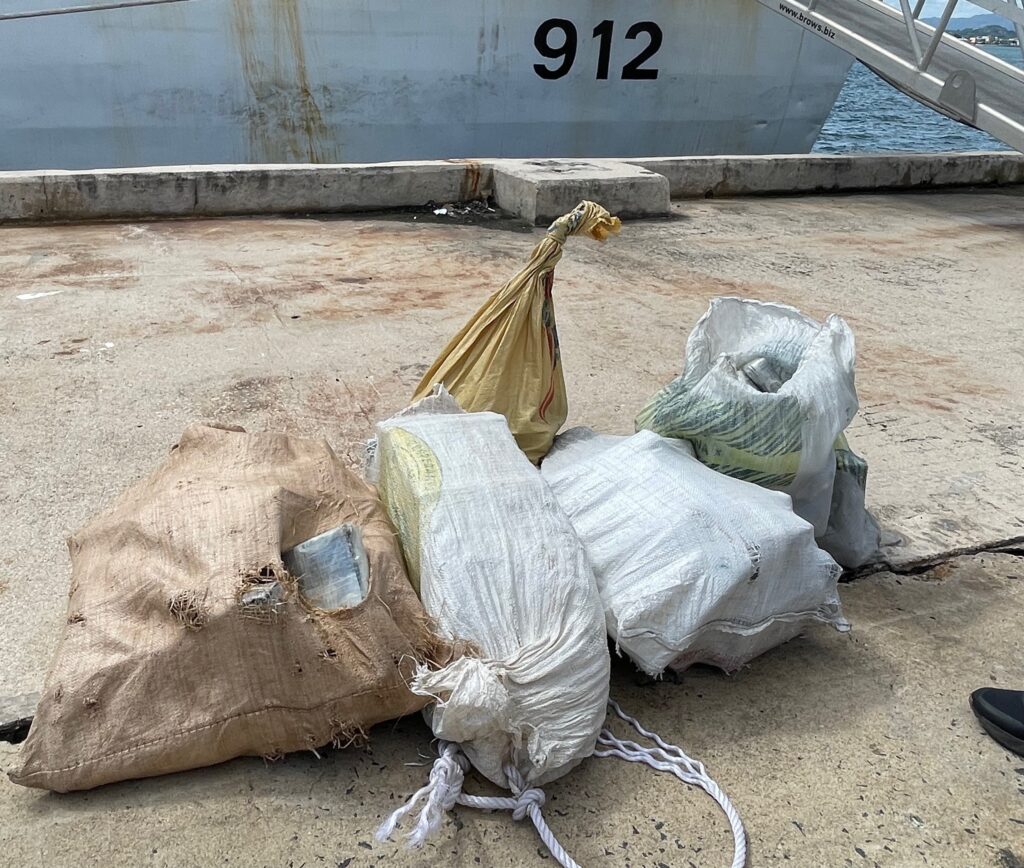
The Coast Guard offloaded 330 pounds of seized cocaine and transferred custody of eights suspected smugglers to Caribbean Corridor Strike Force agents in San Juan, Puerto Rico Aug. 24. U.S. COAST GUARD

SAN JUAN, Puerto Rico — The crew of the Coast Guard Cutter Legare and Caribbean Corridor Strike Force agents offloaded 330 pounds of seized cocaine Aug. 24 in San Juan, following the interdiction of a smuggling vessel near Puerto Rico, the Coast Guard 7th District said Aug. 25. 

The eight men apprehended in this case claimed to be Dominican Republic nationals and are facing federal prosecution in Puerto Rico. The seized contraband has an estimated wholesale value of approximately $3.1 million. 

Special Agents supporting the Caribbean Corridor Strike Force are leading the investigation into this case. The apprehended smugglers are facing federal prosecution in Puerto Rico on drug smuggling criminal charges of conspiracy to possess with intent to distribute a controlled substance aboard a vessel subject to the jurisdiction of the United States. The charges carry a minimum sentence of 10 years imprisonment and a maximum sentence of imprisonment for life.  

During the late night hours of Aug. 16, the aircrew of a Customs and Border Protection Air and Marine multi-role enforcement aircraft detected a 25-foot suspect vessel north of Isabela, Puerto Rico. During the interdiction, the smugglers jettisoned multiple bales of suspected contraband into the water. The Coast Guard Cutter Joseph Doyle stopped the suspect vessel, apprehended eight men and recovered five bales of the jettisoned cargo. 

“This interdiction is an example of how successful interagency cooperation can be through the use of our collective resources,” said Lt. Cmdr. Charles Wilson, cutter Joseph Doyle commanding officer. “Customs and Border Protection Caribbean Air Marine Branch and the Coast Guard worked seamlessly to detect and interdict this suspected narcotics trafficking operation before it reached the shores of Puerto Rico.”  

The seized contraband and the apprehended men were transferred to the cutter Legare for their final transport to Puerto Rico.


DARPA’s NOMARS Program to Build, Test, Demonstrate First Unmanned Ship 

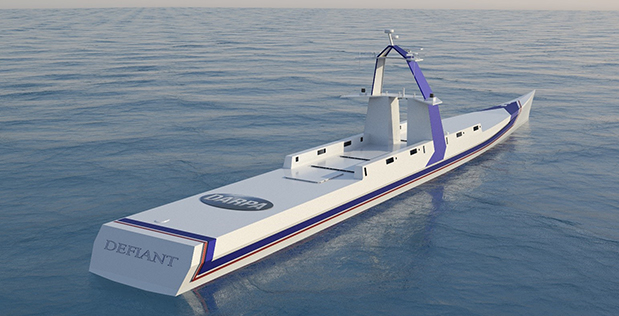
A concept design for the NOMARS Defiant unmanned ship. DARPA

ARLINGTON, Va. — DARPA is moving into Phase 2 of the No Manning Required Ship (NOMARS) program, which seeks to build and demonstrate a revolutionary new medium unmanned surface vessel that can go to sea and perform missions with unprecedented reliability and availability, while carrying a significant payload, the agency said Aug. 22. DARPA selected Serco Inc.’s design to move forward at the conclusion of Phase 1. 

NOMARS took a clean-sheet approach to ship design, holding to the requirement there will never be a human on board the vessel while it is at sea, including during underway replenishment events. By eliminating all constraints and requirements associated with humans, NOMARS opened up the design space to novel ship configurations and capabilities that could never be considered for crewed vessels. 

NOMARS is also pushing the boundaries on ship reliability. Because there is no crew on board to perform maintenance, NOMARS required new approaches for power generation, propulsion, machinery line-up, and control schemes to ensure continuous functionality throughout a long mission in all weather, temperature, and sea states. 

“NOMARS plans to demonstrate a next-generation completely unmanned ship that will enable entirely new concepts of operations,” said Gregory Avicola, program manager in DARPA’s Tactical Technology Office. “We will enable methods of deploying and maintaining very large fleets of unmanned surface vessels that can serve as partners, across the globe, for the larger crewed combatants of the U.S. Navy.” 

In Phase 1, Serco developed a new Design Space Exploration toolset that can evaluate spaces with a variety of parameters and outputs millions of ship designs to meet a diverse set of performance objectives and constraints. Serco used their DSX tool to create a set of ship designs ranging from 170-270 metric tons, then refined those into a single ship for the preliminary design review, which the company dubbed Defiant. In Phase 2, Serco will finalize ship design, build the ship and work through a series of rigorous testing activities before taking it to sea for a three-month demonstration event.

Defiant will be the first of its kind. The 210-metric ton medium USV-class ship aims to maximize performance, reliability, and maintenance efficiency while still carrying significant payload at tactically useful ranges. The goal is to achieve ultra-reliability objectives by integrating distributed hybrid power generation, podded propulsors and high-capacity batteries.

A key philosophy of NOMARS is “graceful degradation,” which allows individual equipment to fail over time by having enough system-level redundancy to meet full system requirements at speeds of at least 15 knots after one year at sea. The major system components of the selected design are modularized, so repairs can be conducted with equipment typically found in yacht yards worldwide. This maintenance philosophy supports rapid turnaround, allowing the ships to spend a majority of their lifetime at sea performing missions. 


BAE Systems to Perform Extended Work aboard USS Ross  

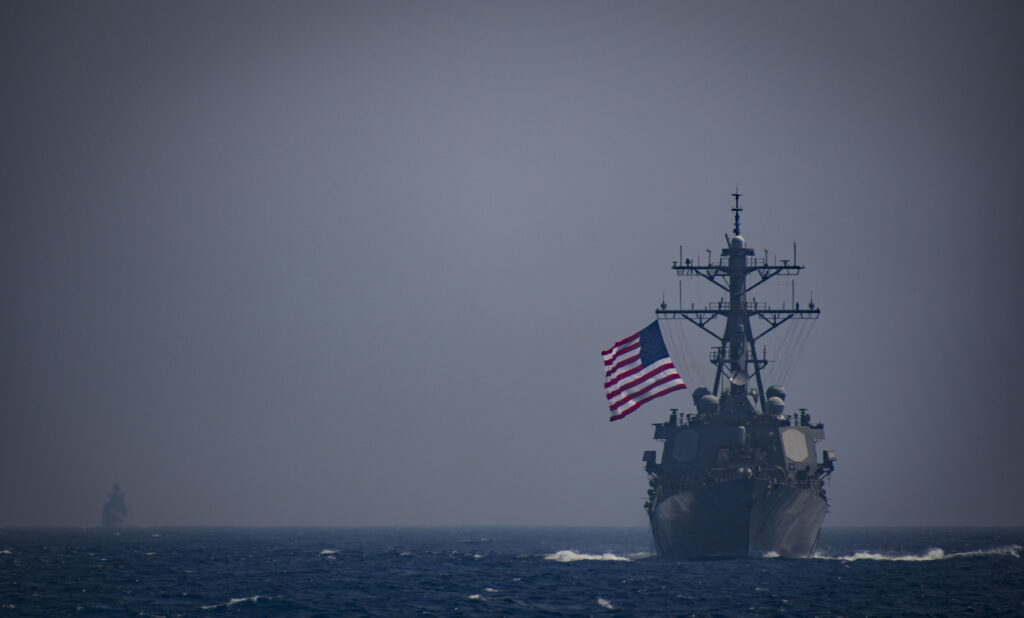
The Arleigh Burke-class guided-missile destroyer USS Ross (DDG 71) transits the Mediterranean Sea Sept. 3, 2018. U.S. NAVY / Mass Communication Specialist 1st Class Ryan U. Kledzik

NORFOLK, Va. — BAE Systems has received a $107.7 million contract from the U.S. Navy to modernize the guided-missile destroyer USS Ross (DDG 71), the company said Aug. 24.

Under this extended dry-docking selected restricted availability contract, the company will perform the modernization work at its Norfolk, Virginia shipyard. The contract includes options that, if exercised, would bring the cumulative value to $123.8 million. 

BAE Systems will dry-dock USS Ross to perform maintenance on the underwater hull, repair the ship’s main propulsion system, preserve internal ballast and fuel tanks and external superstructure and rehabilitate crew berthing and dining compartments. The modernization project is scheduled to take more than 500 days and be completed in April 2024. Once complete, the ship will be capable of serving in the fleet for another 10 years. The 16-year-old ship recently completed a seven-year operational period in Rota, Spain as a forward-deployed U.S. Navy combatant.  

“This is an important job for our employees, subcontractors, and the Navy to accomplish,” said Mike Bruneau, vice president and general manager of BAE Systems Norfolk Ship Repair. “We look forward to meeting the long-term maintenance goals for USS Ross to sustain the future capability and readiness of the ship.”  

The USS Ross was commissioned in June 1997. The ship is named after the first Medal of Honor recipient of World War II, Donald K. Ross. While serving aboard the battleship USS Nevada (BB 36) during the attack on Pearl Harbor on Dec. 7, 1941, Ross valiantly helped the badly damaged ship get underway during the attack. USS Ross is part of the Arleigh Burke class of destroyers. 


Navy Ready to Christen New Overlord USV ‘Mariner’ 

The Navy’s newest medium unmanned surface vessel, soon to be christened Mariner, on display at the U.S. Naval Academy in Annapolis. RICHARD R. BURGESS

ANNAPOLIS, Md. — The U.S. Navy’s newest Overlord medium unmanned surface vessel (MUSV) is moored at the U.S. Naval Academy in Annapolis, Maryland, for its Aug. 23 christening ceremony after a period of tours by dignitaries, Navy officials, academy midshipmen and media reporters. 

The MUSV, produced by prime contractor Leidos, with Gulf Craft of Franklin, Louisiana, as the builder, is to be christened “Mariner” by Stacy Small, wife of Capt. Pete Small, program manager for Unmanned Maritime Systems in the Program Executive Office, Unmanned and Small Combatants (PEO-USC). 

The Mariner is the fourth Overlord MUSV to be acquired by the Navy, although the third vessel, Vanguard, is still under construction. The first two Overlord MUSVs, Ranger and Nomad, were built under the Strategic Capabilities Office’s Ghost Fleet Overlord Program and transferred to the Navy early in 2022. They are assigned to Unmanned Surface Vessel Division One in San Diego, California and participated in the Rim-of-the-Pacific Exercise off Hawaii this summer.  

The Mariner, delivered to the Navy in March, recently completed a period at Little Creek, Virginia, for installation of some government-furnished equipment, said Brian Fitzpatrick, principal assistant program manager. Eventually it will be transferred to USV Division One via a transit of the Panama Canal.  

Rear Adm. Casey Moton, program executive officer, PEO-USC, said the Overlord program is leveraging both at-sea and land-based testing. The at-sea testing is used to evaluate the performance of the MUSV in a corrosive salt-water environment. 

Casey pointed out that each of the four Overlord vessels is different, with a variety of different hull, mechanical, and engineering systems and mission systems. Each MUSV also is evaluated with different mission systems that are changed out.  

The Mariner, halfway built when the Navy bought it, is based on a fast supply vessel designed to service offshore oil rigs. The vessels are already significantly automated. 

The MUSV is equipped with satellite communications; three radars of different bands; a mast-mounted electro-optical sensor, an electro-optical/infrared system camera system on six sides of the ship; Link 16; and several radios.     

The Mariner, for example, can carry two 20-foot containers and four 40-foot containers on its aft section. The containers can contain mission systems, spare parts, weapons and other systems. 

The Mariner can accommodate a small crew — including two merchant marine captains — as needed while the technology and concepts of operation for the MUSVs are evaluated. Fitzpatrick showed reporters the “red button” at the bridge control panel that allows a captain to take control of the ship if needed.  

The Mariner is powered by five 2,000-horsepower diesel engines that drive five water jets. The ship also is equipped with bow thrusters. The ship was built with two generators but a third was installed by the Navy to provide power for the expected needs of the payloads, some of which may be deployed on the ship with their own power and cooling systems. 

Redundancy is necessary on an unmanned ship more than a manned ship, and for each of its diesel engines the Mariner is equipped with three oil filters instead of one.  

‘Pushing Boundaries’

The admiral said the Overlord vessels are designed to deploy in open oceans but declined to say they would be deployed to the Western Pacific, noting that the Ranger and Nomad deployed to Hawaii for RIMPAC. 

Fitzpatrick said the Overlord MUSVs will need to be able to be refueled at sea, currently conducted by an onboard crew. 

“We have to work through that,” he said. 

Fitzpatrick said the program is collecting massive amounts of data — 400 terabytes so far — and has started to process it. 

Moton said the Overlord program will influence the discussion in Congress and the Navy on the value and operation of MUSVs and that the program will have an impact beyond the U.S. Navy into the international maritime market, including commercial operations.  

The Vanguard will be longer than the Mariner — 205 feet vice 19 feet — with a wider beam and greater capacity for payloads. Fitzpatrick said the program is “purposely pushing boundaries” with the Vanguard. 


Naval Station Newport Now Homeport for Two Coast Guard Cutters 

U.S. Coast Guard Cutters Tahoma (WMEC 908) and Campbell (WMEC 909) sit moored at Naval Station Newport, Rhode Island, Aug. 19. Tahoma and Campbell were welcomed to Naval Station Newport during a change of homeport ceremony. U.S. COAST GUARD / Petty Officer 3rd Class Briana Carter

NEWPORT, R.I. — The Coast Guard held a joint change-of-homeport ceremony for USCGC Tahoma (WMEC 908) and USCGC Campbell (WMEC 909) Aug. 19 at Naval Station Newport, Rhode Island.  

The Tahoma and Campbell are 270-foot Famous-class medium-endurance cutters previously based at the Portsmouth Naval Shipyard in Kittery, Maine. The relocation of these two cutters will allow the U.S. Navy to conduct infrastructure upgrades as part of a Shipyard Infrastructure Optimization Program at the Portsmouth Naval Shipyard. 

Adm. Linda L. Fagan, commandant of the U.S. Coast Guard, presided over the ceremony. 

“For these two ships, this is actually a homecoming,” said Fagan. “Nine of the Coast Guard’s 270-foot medium endurance cutters, including the Tahoma and Campbell, were constructed right here in Rhode Island. These cutter’s new berths in Newport will provide a continued pathway for our crews to maintain geographic stability in southeastern New England while they conduct historic missions throughout the globe in support of the Atlantic Area commander.” 

Attendees at today’s ceremony included Rhode Island Senators Jack Reed and Sheldon Whitehouse, Rep. David Cicilline, Newport Mayor Jeanne-Marie Napolitano, Capt. James McIver, commanding officer of Naval Station Newport, and other local officials. 

“We are proud to welcome USCGC Tahoma and USCGC Campbell home to Naval Station Newport,” said McIver. “As fellow members of the United States’ maritime services, we look forward to the return of these units to their original birthplace here in Rhode Island and supporting them as they carry out global missions to meet the needs of our nation and the Joint Force.“ 

Tahoma is the third Coast Guard cutter to bear the name. Campbell is the sixth Coast Guard cutter to bear its name. Tahoma and Campbell are the eighth and ninth cutters, respectively, of 13 Famous-class cutters in service by the Coast Guard. Both cutters were commissioned in 1988 and are under the operational control of Coast Guard Atlantic Area. 


New Coast Guard Cutter Douglas Denman Arrives in Alaska 

The crew of Coast Guard Cutter Douglas Denman arrived at the cutter’s new homeport in Ketchikan, Alaska, Aug. 19. U.S. COAST GUARD

KETCHIKAN, Alaska — The crew of Coast Guard Cutter Douglas Denman arrived in Ketchikan, Alaska on Aug. 19 after a 36-day transit from Key West, Florida, the Coast Guard 17th District said in a release.  

Douglas Denman, the Coast Guard’s 49th fast response cutter, traveled nearly 7,000 miles from the most southeastern city in the U.S. to the most southeastern city in Alaska, transiting through the Caribbean Sea, the Panama Canal and up the west coast of Central America and the U.S. 

Following production of the ship in 2020, the first crewmember arrived in Ketchikan summer of 2021. Since then, the crew has undergone a year of administration and training in preparation to take ownership of the cutter. The engineering department alone attended a total of three months of school in addition to the crew’s seven weeks of familiarity training in Lockport, Louisiana, and seven weeks of post delivery availability phase in Key West.    

“It’s been a long but extremely rewarding journey to get to this point,” said Chief Petty Officer Hayes Printy, the cutter’s engineering chief. “Seeing the crew’s growth throughout the process and being able to make this unit what we want is an experience I will cherish and not forget.”  

The cutter will be commissioned at the end of September and fully operational in its area of responsibility in Southeast Alaska where the missions will include law enforcement, fisheries enforcement, search and rescue and national security.   

The Douglas Denman is scheduled to be permanently homeported in Sitka, Alaska, upon completion of required shore infrastructure improvements. 


Navy Taps BIW, Raytheon for Conventional Prompt Strike Work on Zumwalt DDGs  

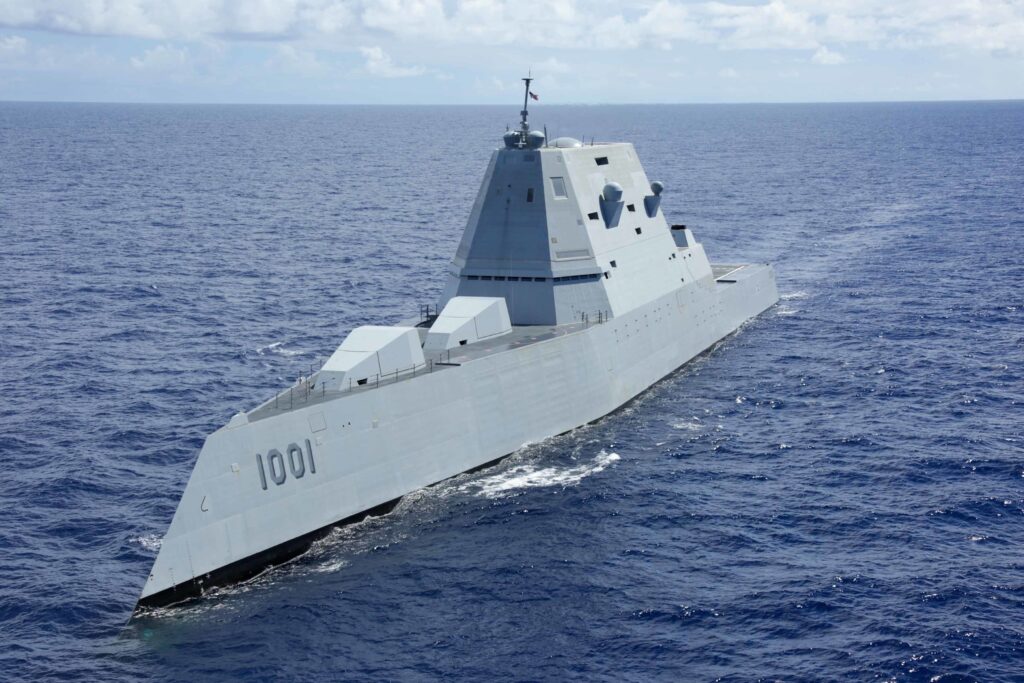
The Zumwalt-class guided-missile destroyer USS Michael Monsoor (DDG 1001) sails in formation during Rim of the Pacific (RIMPAC) 2022. U.S. NAVY / Mass Communication Specialist 3rd Class Aleksandr Freutel

ARLINGTON, Va. — As the U.S. Navy moves to deploy Conventional Prompt Strike missile systems on its three Zumwalt-class (DDG 1000) guided-missile destroyers, the service recently awarded two contracts to further that goal. 

The Navy’s Supervisor of Shipbuilding, Conversion, and Repair, Bath, Maine, has awarded General Dynamics Bath Iron Works a $20 million cost-plus-fixed-fee contract modification “for procurement of long-lead time material for the Large Missile Vertical Launch System [LMVLS] launch module fabrication on DDG 1000,” an Aug. 18 Defense Department contract announcement said. Work is expected to be completed by June 2024.  

Bath Iron Works is the prime contractor for the Zumwalt-class DDG. Raytheon is the contractor for the ship’s Total Ship Computing Environment. 

The Naval Sea Systems Command has awarded Raytheon an $11.2 million firm-fixed-price contract modification for “Total Ship Computing Environment Lab hardware for modernization/technical refresh and Conventional Prompt Strike to support DDG 1000-class combat system activation, sustainment and modernization,” according to an Aug. 19 Defense Department contract announcement. Work is expected to be completed by November 2023. 

The Navy plans to field the Conventional Prompt Strike capability on the USS Zumwalt in 2025 as the first platform for the new weapon. The LMVLS is needed because the ship’s existing Mk57 launchers for its Standard and Tomahawk missiles are too small to accommodate the CPS missile.  

The Conventional Prompt Strike capability will be fielded later in the decade on the Block V version of the Virginia-class attack submarine. 


Lockheed Martin Delivers Integrated Multi-Mission Laser Weapon System to The Navy 

HELIOS provides directed energy capability to the Navy fleet. LOCKHEED MARTIN

SAN DIEGO — Lockheed Martin has delivered to the U.S. Navy a 60+ kW-class high energy laser with integrated optical-dazzler and surveillance (HELIOS), the first tactical laser weapon system to be integrated into existing ships and provide directed energy capability to the fleet, the company said Aug. 18.

Integrated and scalable by design, the multi-mission HELIOS system will provide tactically relevant laser weapon system warfighting capability as a key element of a layered defense architecture. 

“Lockheed Martin and the U.S. Navy share a common vision and enthusiasm for developing and providing disruptive laser weapon systems,” said Rick Cordaro, vice president of Lockheed Martin Advanced Product Solutions. “HELIOS enhances the overall combat system effectiveness of the ship to deter future threats and provide additional protection for Sailors, and we understand we must provide scalable solutions customized to the Navy’s priorities. HELIOS represents a solid foundation for incremental delivery of robust and powerful laser weapon system capabilities.” 

HELIOS provides an additional layer of protection for the fleet with its deep magazine, low-cost per kill, speed of light delivery and precision response, the company said.


CNO Visits Spain, UK, Meets with Sailors, Focuses on Partnerships   

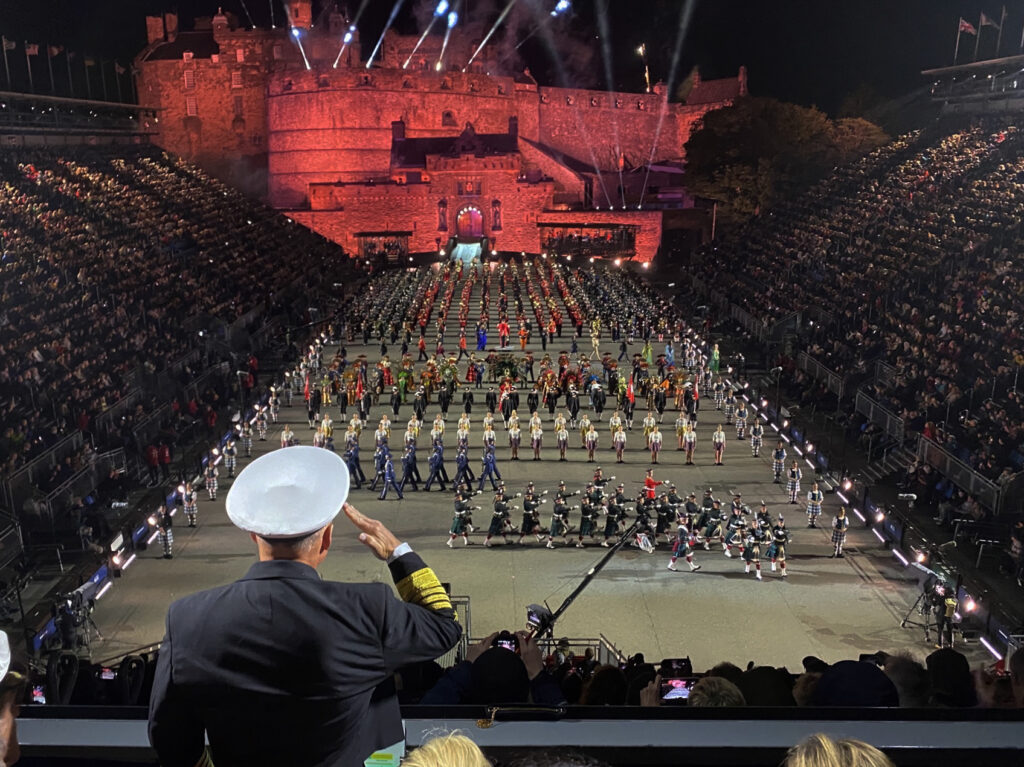
Chief of Naval Operations Adm. Mike Gilday renders a salute as the Royal Navy’s guest of honor at the Royal Edinburgh Military Tattoo in Edinburgh, Scotland, Aug. 20. U.S. NAVY / Capt. Gregory Leland

EDINBURGH — Chief of Naval Operations Adm. Mike Gilday and his wife, Linda, visited Spain and the United Kingdom, Aug. 16-21 to meet with Sailors, government and military leaders, the CNO’s public affairs office said Aug. 19.   

The CNO spoke with U.S. Sailors, as well as service members assigned to allied and partner militaries in Rota, Spain, London and Faslane and Edinburgh, Scotland.    

Gilday’s visit to Rota coincided with the arrival of the guided-missile destroyer USS Bulkeley (DDG 84) to its new homeport, Naval Station Rota, Aug. 17. Bulkeley joins three other U.S. Navy destroyers that are part of Forward Deployed Naval Forces-Europe: USS Arleigh Burke (DDG 51), USS Paul Ignatius (DDG 117) and USS Roosevelt (DDG 80).      

Gilday participated in a flag-raising ceremony alongside Admiral of the Spanish Fleet, Adm. Eugenio Díaz del Río Jaudenes, where together they hoisted the Spanish flag aboard Bulkeley.    

Speaking afterward to media, Gilday explained the significance of presence and the strength of the partnership between the U.S. and Spanish navies.   

“Spain remains one of our closest partners particularly in the maritime,” said Gilday. “The global economy floats on seawater … the U.S. Navy’s ability to have our destroyers forward-deployed in Spain is an exceptional opportunity for us to help keep sea lanes open, to work with closely with our allies and partners.”   

He later explained, “Our ships here in Rota are equipped with the most advanced capabilities and together with the Spanish navy we will continue to operate and sail strongly side by side to assure our NATO allies.”   

The Gildays also toured and spoke with Sailors assigned to Arleigh Burke.   

“What you do every day is not insignificant. I am extremely proud of this ship and everything you are doing, the ship means nothing without the crew and this is an exceptionally talented and dedicated team of warfighters,” Gilday said while speaking to the Sailors.   

Gilday began his U.K. engagements in London, where he was the keynote speaker at the dedication ceremony of the USS Osprey (AM 56) bell at the United States Embassy. USS Osprey was a Raven-class minesweeper that supported the invasion of Normandy, Operation Overlord. The ship struck an enemy mine the night before the invasion of Normandy while clearing the channel for the invasion. Six members of the crew died, becoming among the first of D-Day casualties. 

Gilday also visited the London Tech Bridge, where he exchanged views on the importance of this innovation hub and the partnership and collaboration with the U.S.-U.K. military, industry, academia and small businesses. 

“Collaborating, sharing information, being interoperable and truly interchangeable strengthens our ability to prevail in conflict and bolsters integrated deterrence against potential adversaries,” said Gilday. “We must continue to pursue innovative solutions, experiment and put capabilities in the hands of warfighters quickly if we want to maintain warfighting advantages.”   

During a visit to HM Naval Base Clyde at Faslane, Scotland, a logistical base for warships and submarines operating in European waters, he observed Valiant Jetty which was built to support operations by the latest Astute-class Royal Navy attack submarines. Gilday spoke with U.S. Navy Sailors who are training with Royal Navy sailors, toured cutting-edge boats, and also congratulated newly qualified Royal Navy British submariners who received their qualifications and pins.   

Gilday, the Royal Navy’s guest of honor, attended the Royal Edinburgh Military Tattoo, an annual series of artistic performances by 900 performers, including British armed forces, commonwealth and international military bands from across the globe.  

The focus of Gilday’s visit to the U.K. was to advance and further strengthen the maritime partnership and work toward becoming truly interchangeable. Throughout his visit, Gilday met with Royal Navy Adm. Sir Ben Key, First Sea Lord and chief of the Naval Staff of the United Kingdom.