Pilot Safe after Ejection from Navy T-45C Crash near NAS Kingsville, Texas
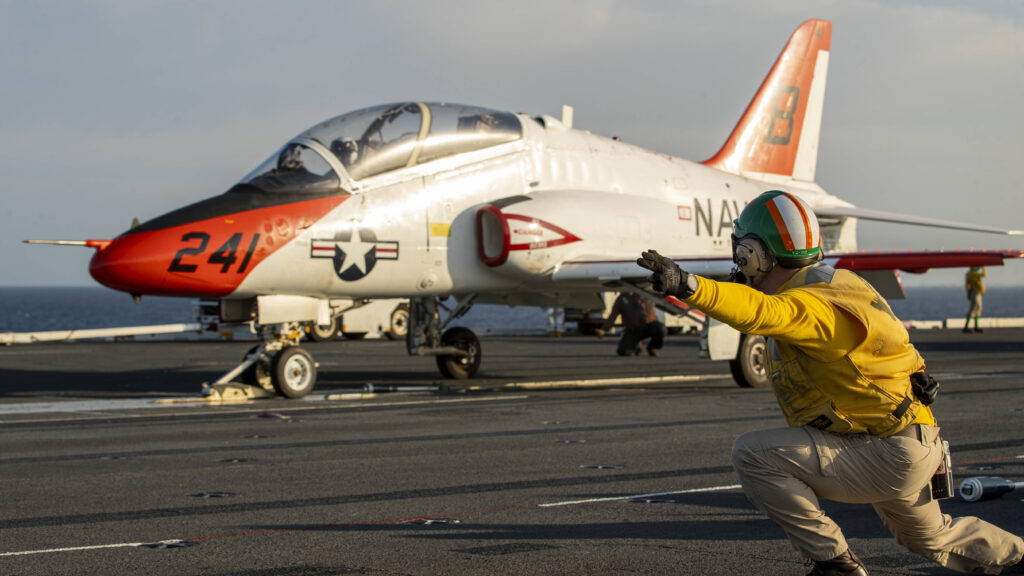
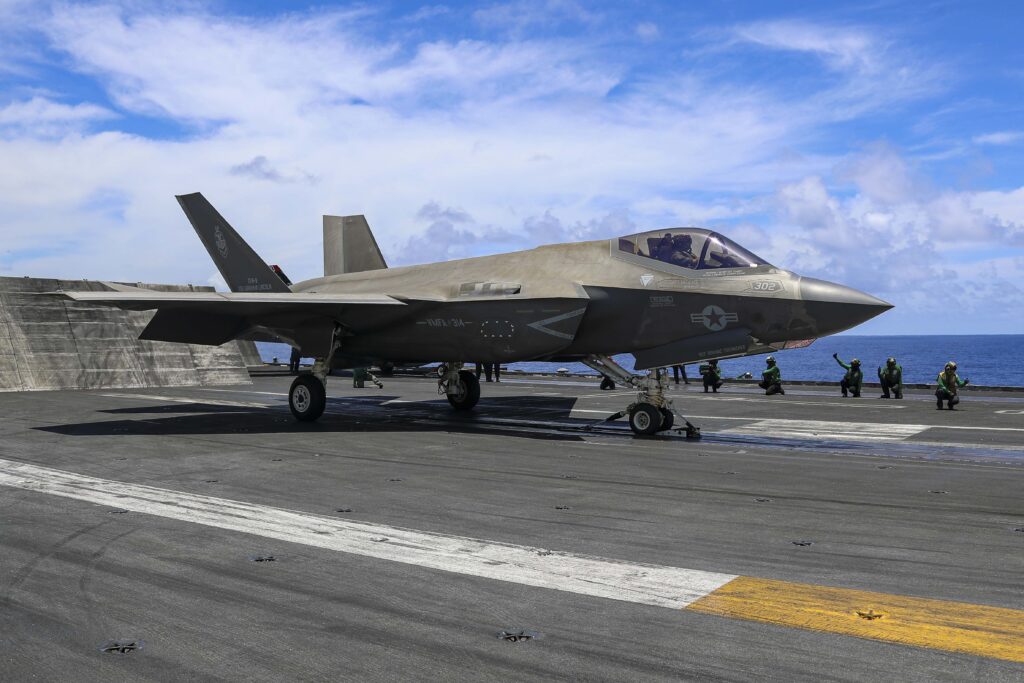
Lt. Joseph Dejunco, from Atlanta, assigned to the aircraft carrier USS Gerald R. Ford (CVN 78) air department, signals a T-45C Goshawk attached to Training Air Wing (TW) 2 to launch from the flight deck, March 17, 2021. U.S. NAVY / Mass Communication Specialist 3rd Class Riley McDowell
CORPUS CHRISTI — On Aug. 16 at approximately 12:00 p.m. CDT, a U.S. Navy T-45C Goshawk jet trainer aircraft assigned to Training Air Wing 2 at Naval Air Station Kingsville, Texas, crashed on approach to NAS Kingsville, the Chief of Naval Air Training Public Affairs Office said in a release.
One instructor pilot was aboard and ejected from the aircraft. The pilot has been transported to Christus Spohn Hospital-Kleberg for further evaluation.
The aircraft impacted an empty field on Navy property just north of the airfield. NAS Kingsville Emergency Services and Kingsville Sheriff’s Office responded to the scene. No civilians were harmed in this incident.
The pilot was conducting a routine training flight that originated at NAS Kingsville. The incident is under investigation.
This loss is the first for a T-45 this calendar year. Three were lost in 2021.
Keel Authenticated for Future USS Jeremiah Denton
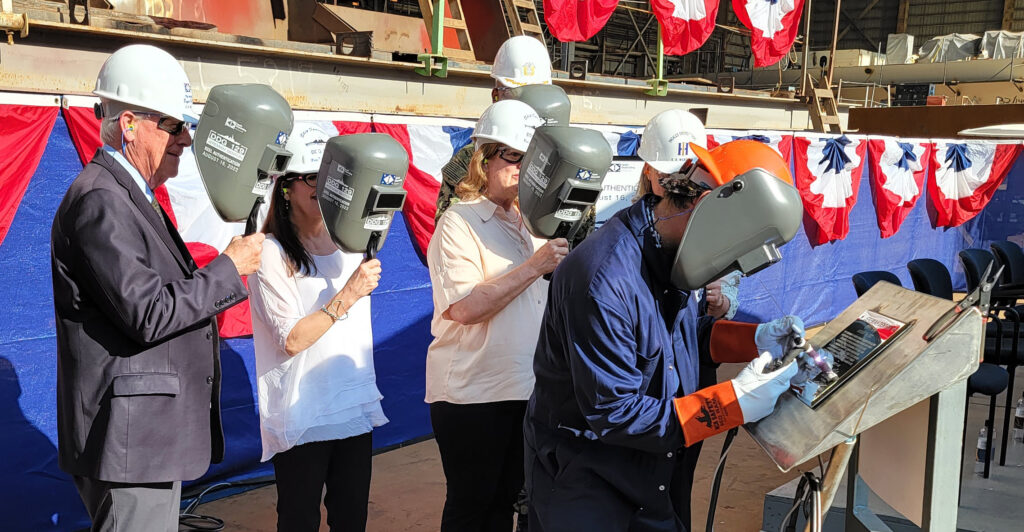
Ingalls welder Troy Maddox traces the sponsors’ initials on a keel plate that will be permanently placed in Jeremiah Denton (DDG 129) on August 16, 2022 at Huntington Ingalls Industries (HII) Ingalls Shipbuilding division, Pascagoula, Mississippi. Michael Duhe
WASHINGTON — The keel for the future USS Jeremiah Denton (DDG 129), a Flight III Arleigh-Burke class destroyer was ceremonially laid at Huntington Ingalls Industries (HII) Ingalls Shipbuilding division, August 16, Team Ships Public Affairs said in a release.
The ship is named for former Senator Jeremiah Denton, Jr., a Vietnam War veteran who was awarded the Navy Cross for his heroism as a prisoner of war. Following his Navy career, he was elected to the U.S. Senate representing his home state of Alabama in 1980.
The contemporary keel laying ceremony represents the joining together of a ship’s modular components at the land level. The keel is authenticated with the ship sponsors’ initials etched into a ceremonial keel plate as part of the ceremony. Co-sponsors of DDG 129 are the daughters of the namesake, Madeline Denton Doak and Mary Denton Lewis.
“We are honored to build a ship named for the late Senator Denton and to have his family present to celebrate this important milestone on the path to delivering another Flight III destroyer to the Fleet,” said Capt. Seth Miller, DDG 51 class program manager, Program Executive Office (PEO) Ships. “The USS Jeremiah Denton is the Navy’s next great warship, which will provide power projection with the latest advanced combat capability.”
The DDG 51 Flight III upgrade is centered on the AN/SPY-6(V)1 Air and Missile Defense Radar and incorporates upgrades to the electrical power and cooling capacity plus additional associated changes to provide greatly enhanced warfighting capability to the fleet. Flight III is the latest Flight upgrade in the more than 30-year history of the class, building on the proud legacy of Flight I, II and IIA ships before it.
HII’s Ingalls Shipbuilding is also in production on the future USS Lenah Sutcliffe Higbee (DDG 123), the future USS Jack H. Lucas (DDG 125), the future USS Ted Stevens (DDG 128) and the future USS George M. Neal (DDG 131).
Marine Corps Awards BAE Systems $88 million Contract for ACV-30 Test Vehicles
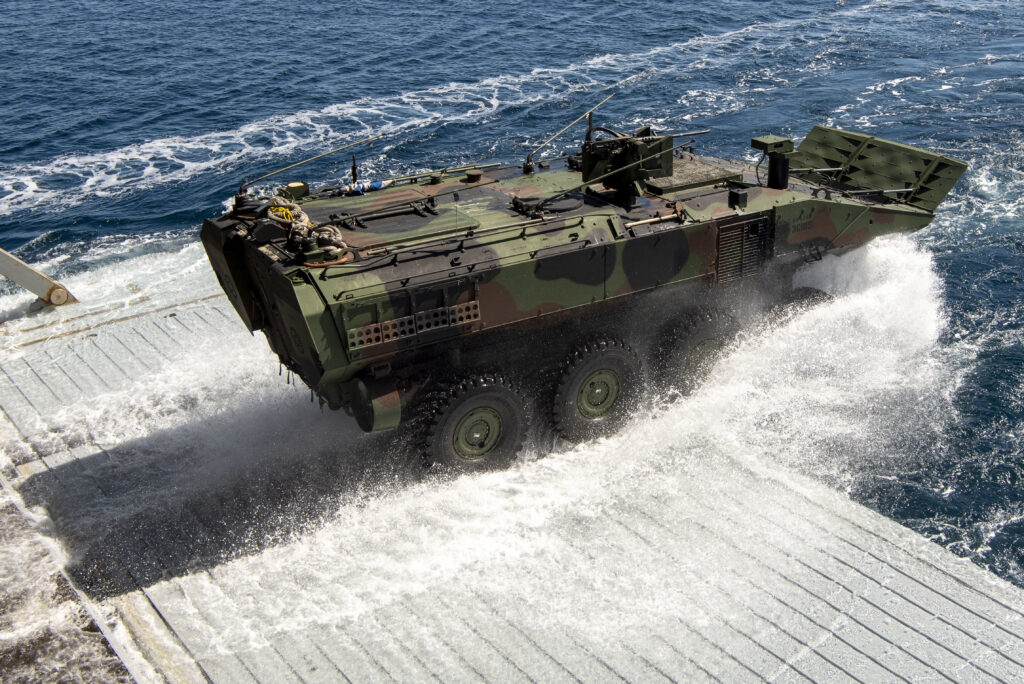
An Amphibious Combat Vehicle (ACV) with the 3rd Assault Amphibian Battalion, 1st Marine Division disembarks the well deck of the amphibious transport dock USS Anchorage (LPD 23) during waterborne training. Anchorage is underway conducting routine operations in U.S. 3rd Fleet. U.S. NAVY / Mass Communication Specialist 2nd Class Hector Carrera
STAFFORD, Va. — The U.S. Marine Corps has awarded BAE Systems an $88 million contract to build multiple ACV-30 Production-Representative Test Vehicles (PRTVs), BAE Systems said in an Aug. 15 release. Once delivered, the PRTVs will undergo a period of testing prior to a full-rate production decision.
The ACV-30 mounts a stabilized, medium caliber Remote Turret System manufactured by KONGSBERG. The 30mm RT-20 is a remotely controlled and operated weapons system that enhances crew protection. The remote turret eliminates the space requirement of legacy lethality systems. It provides more space to transport troops or mission essential equipment, and reduces weight for better mobility.
“We are committed to equipping the Marine Corps with the best technology available to provide them with a decisive edge,” said John Swift, vice president of amphibious programs at BAE Systems. “We have carefully chosen proven industry partners who are equally committed to ensuring Marines have the capabilities to dominate on the battlefield.”
The ACV represents the optimum balance of sea/land mobility and survivability, with future growth potential. The ACV was born out of a combination of BAE Systems’ amphibious vehicles legacy and Iveco Defence Vehicles’ long history of producing more than 30,000 multi-purpose armored vehicles.
“The unmanned KONGSBERG RT-20 medium caliber turret is designed to meet the current and future needs of the Marine Corps as they move forward in implementing the future operating vision known as Force Design 2030,” said Scott Burk, president of KONGSBERG Protech Systems USA. “The fielding of this vehicle system provides the Marines with a low risk, and operationally proven solution.”
The ACV-30 is one of four variants in the ACV Family of Vehicles. BAE Systems is under contract for a personnel variant (ACV-P), a command variant (ACV-C), and a recovery variant (ACV-R).
In addition, BAE Systems has received task instructions from the U.S. Marine Corps to complete a study of incorporating a Command, Control, Communication and Computers/Unmanned Aerial Systems mission payload into an Amphibious Combat Vehicle (ACV) variant.
ACV production and support is taking place at BAE Systems locations in: Stafford, Virginia; San Jose, California; Sterling Heights, Michigan; Aiken, South Carolina; and York, Pennsylvania.
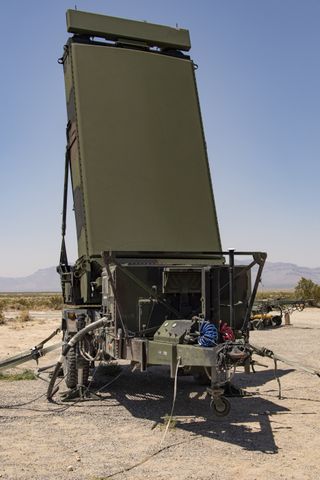
G/ATOR supporting a series of live-fire tests in White Sands Missile Range, New Mexico. Northrop Grumman
BALTIMORE — Northrop Grumman Corporation’s AN/TPS-80 Ground/Air Task Oriented Radar (G/ATOR) multifunction sensor successfully detected and tracked multiple cruise missile threats simultaneously during a recent live-fire test at White Sands Missile Range, New Mexico, the company said in an Aug. 15 release. G/ATOR successfully tracked each target immediately after launch and passed relevant information in real time to intercept numerous cruise missile targets from multiple angles.
The tests were part of the U.S. Marine Corps’ mid-tier acquisition rapid prototyping effort, known as the Ground Based Air Defense Medium-Range Intercept Capability (GBAD MRIC), a developmental program established to protect high-value areas and assets from airborne threats such as cruise missiles and aircraft.
“During this test event, the AN/TPS-80 demonstrated a combination of performance capabilities during a realistic representation of an adversary attack,” said Michael Hahn, director, advanced land radar solutions, Northrop Grumman. “G/ATOR is an expeditionary radar and is unrivaled in its ability to simultaneously provide weapons quality tracks on numerous, concurrent airborne targets while maintaining 360-degree surveillance coverage. The software-defined nature of the AN/TPS-80 was critical in rapidly developing and demonstrating this advanced capability in support of challenging threat scenarios to support the Marine Corps.”
The rapid emplacement and displacement of the AN/TPS-80 means troops can quickly stand up this mission capability in the field, perform the mission, and rapidly move assets to avoid vulnerability of enemy targeting. Unlike traditional sensors, multifunction systems like G/ATOR consolidate multiple capabilities into a single sensor, decreasing the size, weight and power requirements. G/ATOR is one piece of the solution providing the joint forces with an operational picture and deep breadth of data to operate in today’s contested environment, in support of the Marine Corps’ Force Design 2030 strategy.
The GBAD MRIC program, led by the Marine Corps, integrates existing systems — specifically, G/ATOR and the Common Aviation Command and Control System (CAC2S) — with components of the Israeli Iron Dome System including the Tamir interceptor to provide integrated surveillance and coverage.
Joint Strike Fighter Lot 15 Ceiling Allows 28 F-35s for Navy, Marine Corps
An F-35C Lightning II, assigned to the “Black Knights” of Marine Fighter Attack Squadron (VMFA) 314, prepares to launch from the flight deck of the Nimitz-class aircraft carrier USS Abraham Lincoln (CVN 72) while the ship is underway in the Philippine Sea. U.S. NAVY / Mass Communication Specialist 3rd Class Javier Reyes
ARLINGTON, Va. — The Defense Department has increased the ceiling for its contract for Lot 15 Joint Strike Fighters to 129, the department said in an Aug. 12 release.
The Naval Air Systems Command awarded Lockheed Martin a not-to-exceed $7.63 billion firm-fixed-price, fixed-price incentive (firm target), un-definitized modification to a previously awarded advanced acquisition contract, the Defense Department said in the release. The modification increases the contract ceiling to procure 129 F-35s.
Of the 129 F-35s, the total includes three F-35Bs and 10 F-35Cs for the U.S. Marine Corps and 10 F-35Cs for the U.S. Navy. The numbers notionally will enable the Navy and Marine Corps each to add one F-35C squadron to its force structure.
The total also includes 49 F-35As for the U.S. Air Force; 32 F-35As and four F-35Bs for non-U.S. program partners; and 16 F-35As for Foreign Military Sales customers. The contract also includes 69 shipsets of hardware.
The Navy currently has two F-35C fleet squadrons on strength, while the Marine Corps has one. The Corps also fields five fleet F-35B squadrons.
Work on the contract is expected to be completed in October 2024.
U.S. Coast Guard Participating in Operations Island Chief, Blue Pacific 2022
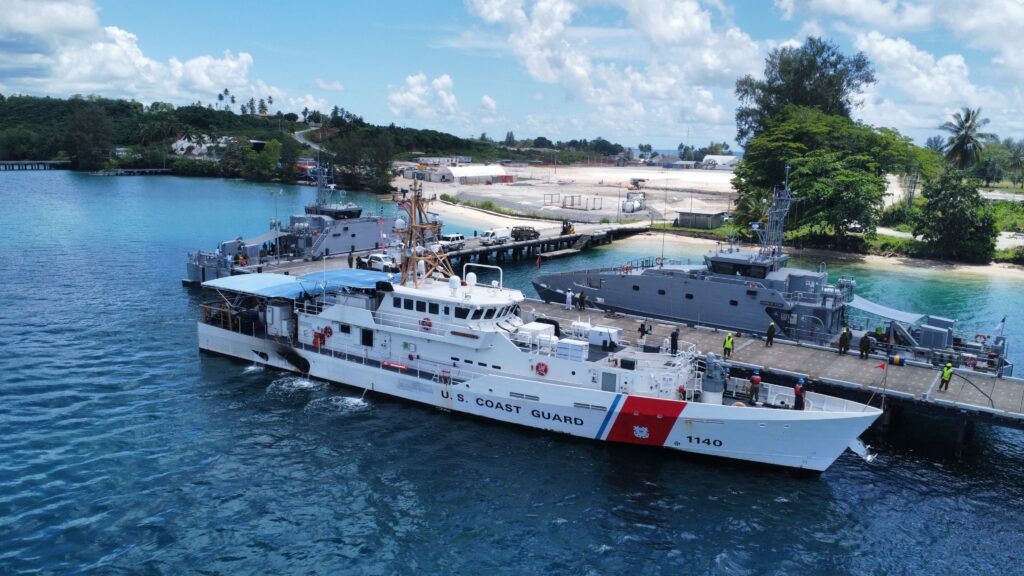
The USCGC Oliver Henry (WPC 1140) crew arrives in Manus, Papua New Guinea, on Aug. 14, 2022, from Guam as part of a patrol headed south to assist partner nations in upholding and asserting their sovereignty while protecting U.S. national interests. U.S. Coast Guard / SW3 Victor Villanueva, NMCB-FOUR
MANUS, Papua New Guinea — The U.S. Coast Guard is participating with partners to support the Pacific Islands Forum Fisheries Agency-led Operation Island Chief and the larger Operation Blue Pacific through patrols in the Western Pacific in August and September 2022, the Coast Guard’s Micronesia Sector said in an Aug. 14 release.
“Employing our unique authorities, capabilities, and access within Oceania is a privilege. We are eager to further integrate with our Allies and regional partners to protect national interests and combat illicit maritime activity such as illegal, unreported, and unregulated fishing,” said Capt. Nick Simmons, U.S. Coast Guard Forces Micronesia/Sector Guam commander. “Strengthening governance and modeling professional maritime behavior on the high seas and the surrounding waters is one way to counter predatory activity and reinforce the Pacific as a positive center of gravity and sustainable economy.”
The operation covers a substantial area of the Pacific on the high seas and the exclusive economic zones of the Federated States of Micronesia, Papua New Guinea, Australia, and the Solomon Islands, while renewing relationships bolstered by local knowledge and expertise.
The USCGC Oliver Henry (WPC 1140), a 154-foot Sentinel-class fast response cutter, and crew deployed from Guam are making their first port call of the patrol in Manus, Papua New Guinea. During the patrol, the cutter will also have aerial support from a forward deployed HC-130 Hercules airplane crew from U.S. Coast Guard Air Station Barbers Point and New Zealand Defence Force P-3 Orion airplane crew. Where possible, the crew will also conduct subject matter expert exchanges and engagements.
Operation Island Chief is one of four operations conducted annually under FFA. It includes the Pacific waters of 11 participating FFA member nations – Fiji, Federated States of Micronesia, Kiribati, Palau, Papua New Guinea, Nauru, the Marshall Islands, Samoa, the Solomon Islands, Tuvalu, and Vanuatu.
“The Oliver Henry crew are committed to regional collaboration and sharing best practices to strengthen our relationships and information sharing,” said Lt. Freddy Hofschneider, commanding officer of Oliver Henry. “The U.S. Coast Guard has been a dedicated partner in the region for decades. We appreciate the support of our colleagues as we take this ship across vast distances in this region, making some transits and port calls for the first time.”
A significant emphasis of the operation for the U.S. Coast Guard is the ongoing emphasis on fisheries and resource protection.
“The Pacific Ocean is home to some of the world’s most abundant fisheries,” said Simmons. “These fisheries are living marine resources, part of the global food chain, representing food security and an economic engine for many of the Pacific Island Nations. By leveraging our cutters, aircraft, and intelligence professionals, the U.S. Coast Guard continues our strong partnership with the Pacific Islands Forum Fisheries Agency and its members to protect this vital marine ecosystem and ensure continued economic prosperity and a thriving ocean for future generations.”
According to FFA, partners are seeing increasing success through multilateral operations in the Pacific to tackle IUUF. These operations evolved from a focus on protecting against illegal boats entering the fisheries to policing the operations of licensed vessels that haven’t followed the rules and regulations governing their activities. The Pacific region is a vast expanse, and collaboration across the many partners, providing personnel and assets, is crucial to ongoing success.
The Oliver Henry is the 40th Sentinel-class fast response cutter. The ship arrived in Guam and was commissioned along with its sister ships, Myrtle Hazard and Frederick Hatch, in July 2021. In the time since, the crew has participated in several search and rescues cases, completed a counternarcotics patrol off Guam with the Japan Coast Guard patrol vessel Mizuho, and conducted sovereignty and fisheries patrols in the Forces Micronesia/Sector Guam area of responsibility.
General Dynamics Electric Boat Awarded $236.2 Million Contract Modification for Support of Operational Submarines
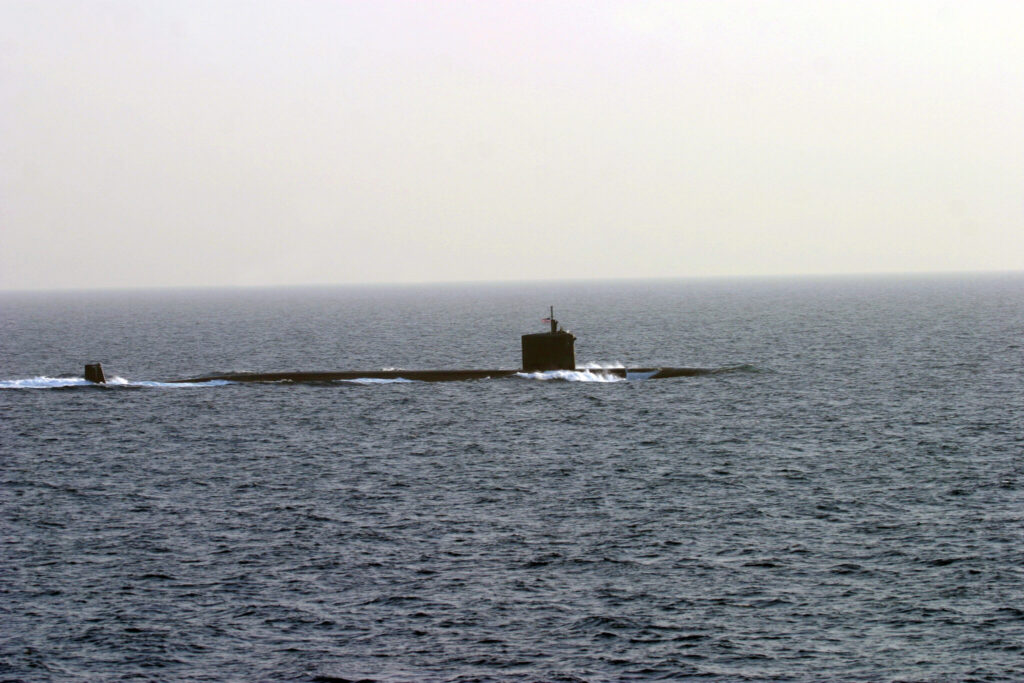
The Los Angeles-class attack submarine USS Hartford, shown underway in the Persian Gulf in 2009. U.S. NAVY
GROTON, Conn. — General Dynamics Electric Boat, a business unit of General Dynamics, was awarded a modification of the previously awarded U.S. Navy contract for engineering, technical, design and planning yard support for operational strategic and attack submarines, the company announced in an Aug. 12 release.
The contract modification has a value of $236,182,606 million. Work will be performed in Groton, Connecticut; Kings Bay, Georgia; Bangor, Washington; Pearl Harbor, Hawaii; North Kingston, Rhode Island; and Newport, Rhode Island, and is expected to be completed by September 2023.
“The shipbuilders of Electric Boat are proud to continue our role providing lifecycle maintenance and modernization support to the U.S. Navy’s operational submarine fleet in keeping with our mission to provide sailors with the advantage that helps protect our nation,” said Kevin Graney, president of General Dynamics Electric Boat.
General Dynamics Electric Boat designs, builds, repairs and modernizes nuclear submarines for the U.S. Navy. Headquartered in Groton, Connecticut, the company employs approximately 18,000 people.
Marines Commemorate 80th Anniversary of the Battle of Guadalcanal
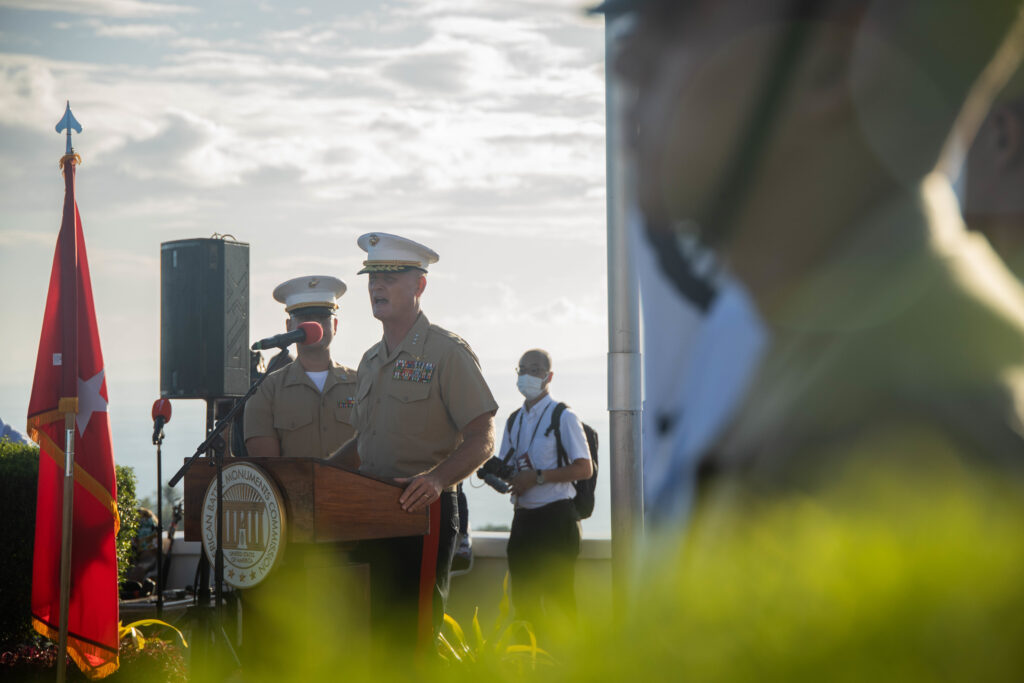
U.S. Marine Corps Lt. Gen. Steven R. Rudder, commander, U.S. Marine Corps Forces, Pacific, makes remarks during the anniversary of the Battle of Guadalcanal at the Guadalcanal American Memorial in the Solomon Islands, Aug. 7, 2022. The ceremony commemorated the 80th anniversary of the battle, and served to honor the fallen and strengthen the U.S. relationship with the Solomon Islands and other Pacific allies and partners. The historic battle was codenamed Operation Watchtower and was the first major offensive and decisive victory for the allied forces in the Pacific theater. U.S. Marine Corps / Cpl. Dillon L. Buck
CAMP H. M. SMITH, Hawaii —Gen. Steven Rudder, commander, U.S. Marine Corps Forces, Pacific (MARFORPAC), traveled to Honiara, Solomon Islands, as part of a U.S. interagency delegation led by Deputy Secretary of State Wendy Sherman from Aug. 7-9, said Chuck Little, of U.S. Marine Corps Forces, Pacific, in a release. The delegation, which also included U.S. Ambassador to Australia Caroline Kennedy and other senior U.S. military officers, participated in several events commemorating the 80th anniversary of the Battle of Guadalcanal, and further strengthened long-standing partnerships between the United States and the nations in attendance: Solomon Islands, Japan, Australia, and New Zealand.
Rudder was joined on the trip by other senior U.S. military officers, including fellow Marines Lt. Gen. Stephen Sklenka, deputy commander, U.S. Indo-Pacific Command; Lt. Gen. George Smith, commanding general, I Marine Expeditionary Force; and Maj. Gen. Benjamin Watson, commanding general, 1st Marine Division. The delegation included U.S. military officers from units that also heroically fought during the battle: Vice Admiral Andrew Tiongson, commander, U.S. Coast Guard Pacific Area; Rear Adm. Jeffrey J. Kilian, commander, Naval Facilities Engineering Systems Command Pacific/director, Fleet Civil Engineer, U.S. Pacific Fleet, U.S. Navy; and Maj. Gen. Joseph Ryan, commanding general, 25th Infantry Division, U.S. Army.
On Sunday, Aug. 7, the United States hosted a memorial ceremony on Skyline Ridge, the site of the World War II Guadalcanal American Memorial. The hour-long ceremony, which started at 7 a.m., was largely planned and executed by MARFORPAC Marines. The ceremony was the first time a joint service color guard marched on Guadalcanal, carrying the national ensign and flags from each of the military services that fought in the battle: the U.S. Marine Corps, U.S. Army, U.S. Navy, and U.S. Coast Guard. A quintet from the 1st Marine Division provided music for the event.
In his remarks, Rudder highlighted the important impact of the battle.
“So we’re here to remember those sacrifices that were made; it changed the history of the Solomon Islands, and it changed the history of our nation,” Rudder said. “I do not want to pass up the opportunity to show my dear appreciation for the Solomon Islanders. They were instrumental in everything we did and they endured hardships that we can’t imagine.”
“But it makes no sense to remember those sacrifices without looking to the future; and we pledge from Indo-PACOM and the United States Marine Corps, that we will look forward.”
Other speakers at the ceremony included American Battle Monuments Commissioner Mr. Bud Pettigrew and Deputy Secretary of State Mrs. Wendy Sherman.
Sherman, whose Marine father fought and was wounded on Guadalcanal, spoke of the impact of the battle on both the military and Solomon Islanders. “With the benefit of hindsight, it is easy for us gathered here today to recognize the Battle of Guadalcanal as a turning point in the Pacific theater, and indeed in the Second World War. But for the Marines patrolling the dense and humid jungle, who had to be wary of both enemy snipers and crippling disease; for the sailors who fought terrifying night battles in the seas around these islands; for the airmen who engaged in countless dogfights in the skies above, the future was unknown and unknowable. And in many of those places – like here in Solomon Islands – civilians saw their world upended as well, as bombs and mortars fell on their towns and villages, destroying the lives of innocents.”
During the ceremony, Sklenka and Rudder placed a wreath at the base of the monument on behalf of all U.S. service members.
Immediately following the U.S. ceremony, the Solomon Scouts and Coast Watchers (SSCW) Trust hosted a memorial event at the SSCW monument. At this ceremony, during which Ambassador Kennedy spoke, MARFORPAC provided a color guard at the request of the event organizers. Sklenka and Rudder laid a wreath at this ceremony on behalf of all U.S. service members.
Following the SSCW ceremony, the U.S. delegation traveled to the Point Cruz Yacht Club to attend a ceremony hosted by the U.S. Coast Guard, honoring Medal of Honor recipient Douglas Albert Munro. Afterward, the U.S. delegation traveled to the Japanese War Memorial Peace Park for a ceremony hosted by the Government of Japan. At both ceremonies, Sklenka and Rudder laid a wreath on behalf of all U.S. service members.
On Monday, Aug. 8, the U.S. delegation attended the fifth and final ceremony, which was hosted by the government of Solomon Islands. The event took place at the Bloody Ridge National Peace Park, which was named after an important battle fought by U.S. Marines in September 1942.
Throughout the seven-month battle for the island, American forces fought side-by-side with Allies from the Solomon Islands, Australia, Britain, New Zealand, the Kingdom of Tonga, and Fiji. The bravery, determination, and commitment of the Allied forces was critical to ensuring the strategic victory that marked a turning point of the war in the Pacific.
In her remarks at the Skyline Ridge ceremony, Deputy Secretary of State Sherman reflected on what came out of the battle for Guadalcanal 80 year ago. “Today – as we have been every day since the war ended – former combatants are united here as partners in peace. We have built schools and clinics together, conducted scientific research together, shared vaccines to combat the pandemic together. We have helped each other recover from natural disasters, protected each other from the impacts of climate change. We have celebrated and mourned and grown together. And above all – forged in the experience of the Second World War and made deeper with each passing year – we have built profound and enduring ties with each other, as one Pacific family.”
Abraham Lincoln Carrier Strike Group Returns from Indo-Pacific Deployment
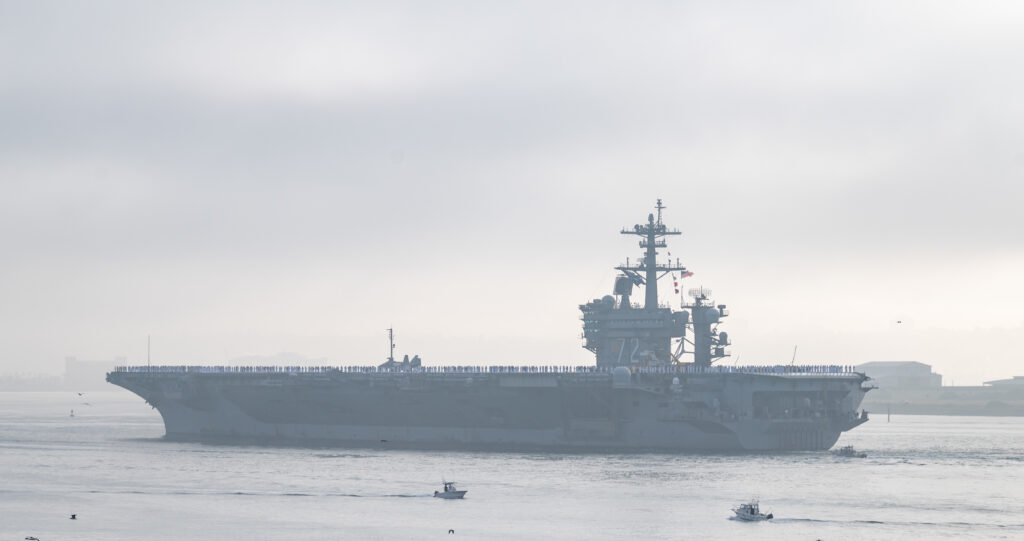
USS Abraham Lincoln (CVN 72) returns to Naval Station North Island Aug. 11 following a seven-month deployment. U.S. NAVY / Mass Communication Specialist 2nd Class Maria Llanos
SAN DIEGO — The Abraham Lincoln Carrier Strike Group returned home Aug. 11, marking the end of a seven-month deployment to U.S. 3rd and 7th Fleet area of operations, the USS Abraham Lincoln’s public affairs office said in a release.
The strike group’s flagship, Nimitz-class aircraft carrier USS Abraham Lincoln (CVN 72), arrived at Naval Air Station North Island, while Ticonderoga-class guided missile cruiser USS Mobile Bay (CG 53) and Arleigh Burke-class guided missile destroyer USS Spruance (DDG 111) also arrived at Naval Base San Diego. USS Gridley (DDG 101) and USS Momsen (DDG 102) returned to Naval Station Everett, Washington.
After departing their homeport in San Diego, the strike group conducted dual carrier operations in the South China Sea with the Carl Vinson Carrier Strike Group to demonstrate the U.S. Indo-Pacific Command’s ability to deliver a powerful maritime force with a combined 14,000 Sailors and Marines.
While underway for 220 days, the strike group sailed over 65,000 nautical miles conducting deterrence and presence operations and multinational exercises, including maritime security operations, integrated training between surface and air units, long-range maritime strike, anti-submarine warfare, information warfare operations, maritime interdiction operations, personnel recovery, air defense operations, multiple ship navigation, formation maneuvering and refueling-at-sea operations.
“Abraham Lincoln Sailors have worked exceptionally hard during this dynamic deployment and should be proud of their accomplishments,” said Capt. Amy Bauernschmidt, Abraham Lincoln commanding officer. “It is incredibly humbling to serve alongside these professionals and observe their dedication to the mission. Every day of our seven month deployment, this talented crew displayed grit, resilience and professionalism in the execution of their jobs. Their hard work made the difference as we operated alongside joint and combined forces to ensure a free and open Indo-Pacific.”
The Abraham Lincoln Carrier Strike Group is the first carrier strike group to deploy with a U.S. Marine Corps F-35C Lightning II squadron, Marine Fighter Attack Squadron (VMFA) 314, and the second to deploy with a Navy CMV-22 Osprey squadron, Fleet Logistics Multi-Mission Squadron (VRM) 30. During the deployment, Carrier Air Wing (CVW) 9, embarked aboard Lincoln, executed more than 21,307 fixed-wing and helicopter flight hours comprising of 10,250 sorties, 8,437 launches and 8,487 aircraft arrestments.
The strike group operated alongside other strike groups including the Ronald Reagan Carrier Strike Group, led by Nimitz-class aircraft carrier USS Ronald Reagan (CVN 76), and the Essex Amphibious Ready Group, led by Wasp-class amphibious assault ship USS Essex (LHD 2).
The strike group consists of Abraham Lincoln, embarked staffs of CSG-3, CVW-9 and Destroyer Squadron (DESRON) 21, Mobile Bay, and destroyers USS Fitzgerald (DDG 62), Gridley, Sampson and Spruance. Fitzgerald will return to San Diego at a later date.
The squadrons that make up Carrier Air Wing Nine 9 are fighter attack squadron (VFA) 41, VFA 151 and VFA 14; VMFA 314; VRM 30; electronic attack squadron (VAQ) 133; airborne early warning squadron (VAW) 117; helicopter sea combat squadron (HSC) 14; and helicopter maritime strike squadron (HSM) 71.
Newport News Shipbuilding to Host Ceremonial Keel-Laying of Enterprise (CVN 80)
NEWPORT NEWS, Va. — HII’s Newport News Shipbuilding division will host a ceremonial keel-laying for Gerald R. Ford-class aircraft carrier Enterprise(CVN 80) on Saturday, Aug. 27, the company said in a release.
CVN 80 is the third Gerald R. Ford-class aircraft carrier. Designed to replace Nimitz-class carriers, the Ford class features a new nuclear power plant, a redesigned island, electromagnetic catapults, improved weapons movement, an enhanced flight deck capable of increased aircraft sortie rates, and growth margin for future technologies. Enterprise will be the first aircraft carrier not only designed digitally but also built digitally.
Olympic gold medalists Simone Biles and Katie Ledecky are the ship’s sponsors. Ledecky will participate in the keel-laying ceremony in person, while Biles will participate via video.
CVN 80 will be the ninth Navy vessel to bear the name Enterprise. It carries on the name of the first nuclear-powered aircraft carrier in history, CVN 65, which was also built at Newport News Shipbuilding. As America recognizes the 100-year legacy of aircraft carriers this year, all nuclear-powered aircraft carriers operating in the U.S. Navy fleet today were built at Newport News Shipbuilding.