Ship to Shore Connector LCACs Get Lift of Opportunity Aboard Future USS Fort Lauderdale
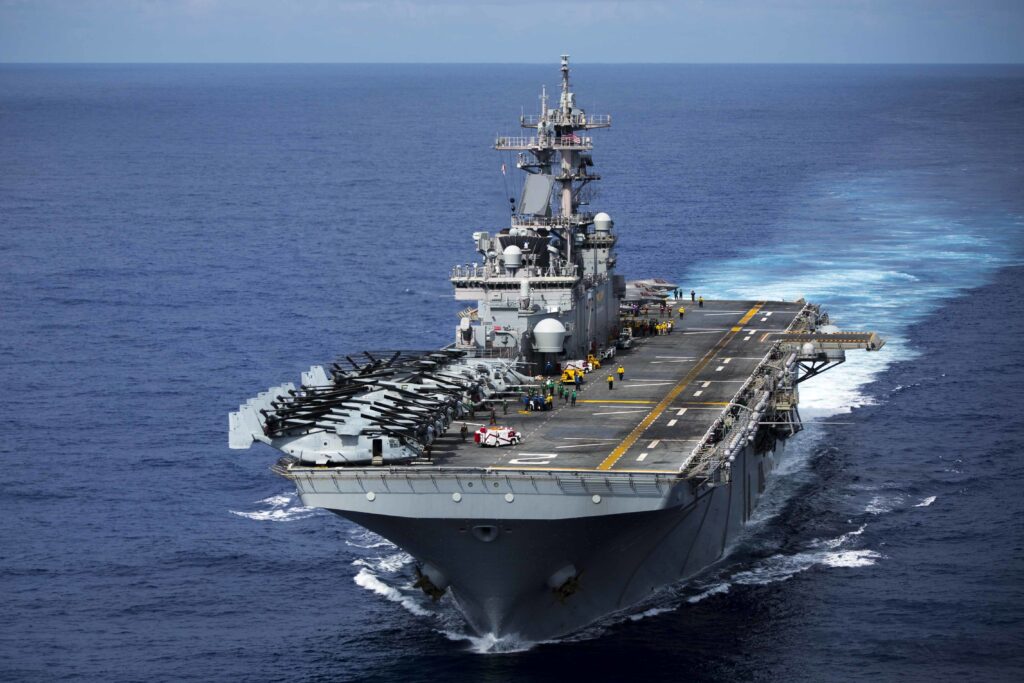
The Navy’s newest amphibious transport dock ship is transporting the Navy’s newest connectors to their new homeport, highlighting the significant capabilities being delivered to the Navy from the Gulf Coast. U.S. NAVY / Ronnie Newsome
WASHINGTON — The Navy’s newest amphibious transport dock ship is transporting the Navy’s newest connectors to their new homeport, highlighting the significant capabilities being delivered to the Navy from the Gulf Coast.
Ship to Shore Connector, Landing Craft, Air Cushion (LCAC) 103 and 104, received a lift of opportunity aboard future USS Fort Lauderdale (LPD 28), July 16, Team Ships Public Affairs said July 19.
During LPD 28’s transit from Huntington Ingalls Industries’ Ingalls Shipbuilding Division in Pascagoula, Mississippi, to Fort Lauderdale, Florida, where the ship will soon be commissioned, the newest LPD worked with Assault Craft Unit 4 (ACU 4) as LCAC 103 and 104 entered the well deck. The craft will remain aboard the ship as it transits to its homeport in Norfolk after commissioning.
“As the future USS Fort Lauderdale readies for commissioning, the LOO [lift of opportunity] provides the opportunity to further demonstrate a capability that will be essential to the future amphibious fleet for years to come,” said Capt. Cedric McNeal, program manager, Amphibious Warfare Program Office, Program Executive Office Ships. “We welcome the opportunity to bring together key Navy and Marine Corps next generation capabilities as we look to strengthen and advance the amphibious maritime mission.”
LCAC 103 and 104, delivered to the Navy by Textron Systems in December 2021 and June 2022 respectively, have been at Naval Surface Warfare Center Panama City Division receiving post-delivery upgrades and participating in test and trials events. Once the craft are in Norfolk, they will proceed to ACU 4 in Little Creek, Virginia, where they will join LCAC 101 and 102 to continue post-delivery test and trials and fleet introduction.
LCACs/SSCs are used primarily to transport vehicles, heavy equipment, and supplies through varied environmental conditions, from amphibious ships to over the beach. Delivery of this craft will significantly enhance the Navy’s and Marine Corps’ capability to execute a broad spectrum of missions well into the 21st century, from humanitarian assistance and disaster response to multidimensional amphibious assault.
CNO, Commander-in-Chief of the Chilean Navy Discuss Partnership
Chief of Naval Operations Adm. Mike Gilday meets with Commander-in-Chief of the Chilean Navy Adm. Juan Andrés de la Maza Larrain at the Pentagon for an office call on July 18. U.S. NAVY / Mass Communication Specialist 1st Class Michael B. Zingaro
WASHINGTON — Chief of Naval Operations Adm. Mike Gilday welcomed Commander-in-Chief of the Chilean Navy Adm. Juan Andrés de la Maza Larrain at the Pentagon for an office call, July 18, the CNO’s public affairs office said in a release.
The two leaders discussed maritime security, cyber defense, unmanned technology and their shared commitment to deepening partnership through future exercises and combined naval presence.
“As we face shared global maritime security challenges, we must partner with like-minded nations and create opportunities to increase collaboration, enhance interoperability, and build our collective capacity,” said Gilday. “Chile is a longstanding and trusted partner, and the U.S. Navy will continue to work with Chile and other regional maritime forces to deepen our security cooperation and pursue opportunities to promote peace and stability throughout the Americas.”
“I am very pleased to greet today Admiral Gilday, whom I had not had the opportunity to meet in person, due to the pandemic that forced to suspend this important meeting,” said de la Maza.
“Taking advantage of the visit we will make to the frigate Lynch deployed at RIMPAC [Rim of the Pacific Exercise], we have arranged this meeting where I can mention that the various cooperation and exchange activities with the United States Navy, as Admiral Gilday mentions, have been carried out for many years. We have common challenges and we must face them in a combined manner, because they are global problems that require solutions in which all countries participate.”
Gilday added, “My meeting today with Admiral de la Maza was very productive and I look forward to seeing him in Hawaii as we observe the RIMPAC exercise.”
The U.S. Navy and Chilean Navy operate regularly together around the globe. Chile regularly participates in RIMPAC and is represented in this year’s iteration by the Chilean Navy frigate Almirante Lynch (FF 07).
The Chilean Navy also participates annually in the UNITAS multinational maritime exercise in the waters of the Eastern Pacific and South Atlantic, and leads the biennial Teamwork South maritime exercise.
This was the first in-person meeting between the two heads of navy since de la Maza assumed command in 2021.
Artillery Rapid Mobility Key to Survival, Marine Assistant Commandant Says
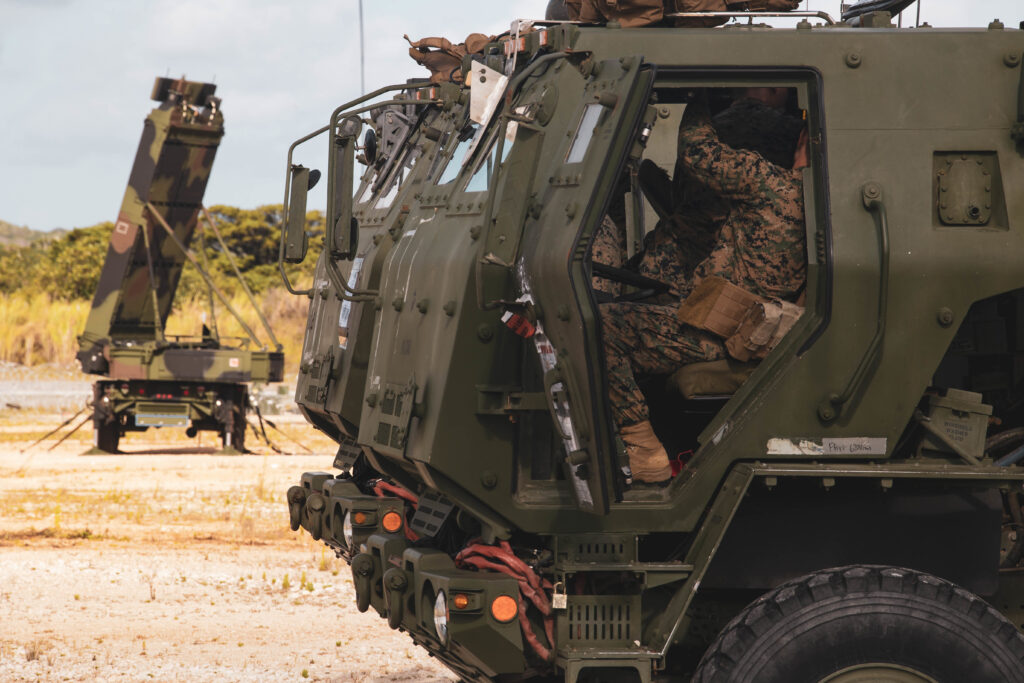
U.S. Marines with 5th Battalion, 11th Marine Regiment, 1st Marine Division, set up high mobility artillery rocket systems (HIMARS) in front of an AN/TPS-80 Ground/Air Task Oriented Radar set to detect, identify and track airborne threats, during Valiant Shield 22, at Andersen Air Force Base, Guam, June 13. U.S. MARINE CORPS / Lance Cpl. Tyler Andrews
WASHINGTON — The Russian invasion of Ukraine is showing the value of the High Mobility Artillery Rocket System (HIMARS) in providing long-range precision fires while shifting positions to avoid counter-battery fire, a senior Marine Corps general said, showing its advantages over towed tube artillery and supporting the investment of HIMARS in Force Design 2030.
“What we’re focused on is long-range fires, and longer-range fires is better,” said Gen. Eric Smith, assistant commandant of the Marine Corps, speaking July 18 during a webinar hosted by the Center for Strategic and International Studies and the U.S. Naval Institute and sponsored by HII. “You want to be able to out-stick your adversary. The introduction of HIMARS for us is absolutely vital, as is our NMESIS — Navy-Marine Expeditionary Ship Interdiction System — [with the] Naval Strike Missile, which [has a] range in excess of 100 miles.
“The capability that is brought by long-range fires is what we seek,” Smith said. “Towed artillery has a max range. It also has a mobility issue because towed things like boats, U-Hauls, things that are on a trailer are not as mobile as individual vehicles. That’s why the [HIMARS] is so good.”
Smith that artillery must be highly mobile to avoid detection and targeting by drones.
“You have to be able to fire and move immediately,” Smith said. “You no longer have six minutes, which is [the capability of] a really well-oiled gun crew from ‘pull last round’ till ‘you’re on the move.’ What we have to see now is that there are autonomous loitering munitions that are looking for that signature. And as soon as they see that signature — we call it a POO, a point of origin — they’ve already got lethal authority to strike that. You don’t have six minutes to move, whereas with a HIMARS you can shoot and be gone literally in seconds, less than a minute. So that is a key lesson learned for long-range fires.
Smith said the artillery has to contend with ubiquitous, inexpensive drones and you have to drop your signature, either because you radiate or you are physically seen, because you are targeted almost immediately.
Under Force Design 2030, the Marine Corps is increasing its HIMARS batteries and reducing its M777 155mm tube artillery batteries. Having decided initially to reduce the number of tube artillery batteries to five, experimentation led the Corps to increase the number of tube artillery batteries to seven.
The Defense Department has shipped a number of HIMARS and M777 systems to the Ukrainian armed forces to aid in their resistance to the Russian invasion.
GA-ASI to Supply 8 MQ-9A Extended-Range UAS for Marine Corps
General Atomics Aeronautical Systems Inc. will provide eight MQ-9A Extended Range aircraft as part of the ARES contract, the company announced July 17. GA-ASI
SAN DIEGO — General Atomics Aeronautical Systems Inc. was awarded a contract for eight MQ-9A Extended Range unmanned aircraft systems as part of the Agile Reaper Enterprise Solution (ARES) contract from May 27, 2022, the company said in a July 17 release.
GA-ASI anticipates awards later this year for ground control systems, spares and ground support equipment as part of the first increment of the Marine Air Ground Task Force Unmanned Expeditionary program of record.
GA-ASI will begin first delivery of aircraft and support equipment this winter to facilitate the fleet standup in late summer 2023 for U.S. Marine Corps’ Marine Unmanned Aerial Vehicle Squadron (VMU) 3 located at Marine Corps Air Station Kaneohe Bay, Hawaii. As part of the Marine Corps’ Force Design 2030 efforts, VMU-3 will operate these MQ-9A ERs with their unique sensors and network capabilities to support training for the Marine Littoral Regiment.
“We look forward to rapid deployment of these MQ-9A ERs for our USMC customer,” said Patrick Shortsleeve, GA-ASI vice president of DoD Strategic Development. “This capability will be a key ISR contributor for the Marine Air Ground Task Force — and ultimately for U.S. Indo-Pacific Command — as we pace ourselves to outmaneuver our adversaries.”
The MQ-9A Extended Range is designed with field-retrofittable capabilities such as wing-borne fuel pods and reinforced landing gear that extends the aircraft’s endurance to more than 30 hours, while further increasing its operational flexibility. It provides long-endurance, persistent surveillance capabilities, with full-motion video and synthetic aperture radar/moving target indicator/maritime mode radar. An extremely reliable aircraft, MQ-9A ER is equipped with a fault-tolerant flight control system and triple redundant avionics system architecture.
Navy’s F-5 Modernization Completes Engineering Phase; Moves into Production, Deployment
The ARTEMIS program will blend commercial-off-the-shelf solutions and industry partner investments to reduce potential safety risks by adding necessary upgrades to instrumentation increasing safety and capability. U.S. NAVY
PATUXENT RIVER, Md. — The Navy’s Specialized and Proven Aircraft program office (PMA-226) F-5N+/F+ Avionics Reconfiguration and Tactical Enhancement/Modernization for Inventory Standardization (ARTEMIS) program successfully reached Milestone C decision June 28, effectively moving into production and deployment, the Naval Air systems Command said July 14.
To meet the Navy and Marine Corps requirement to increase fleet adversary training capacity with high-altitude tactical fighters, the PMA-226 Adversary Team is inducting 22 repatriated, former Swiss Air Force F-5E/F aircraft into the ARTEMIS modification program. This program will reconfigure the airframe and incorporate a block upgrade consisting of emerging and existing commercial technology while capitalizing on industry’s private investment and lessons learned to upgrade necessary safety and capability features on the aircraft. The program office will reconfigure the airframes and convert the F-5E/F engines to the Navy and Marine Corps standard F-5N/F. Once that is complete, the program will integrate the block upgrade, which consists of a new glass cockpit and avionics suite that uses technology found in more modern aircraft to improve safety and capability.
Subsequent to this upgrade, the 22 aircraft will be in the F-5N+/F+ baseline configuration. The Adversary Team and industry partner Tactical Air Support Inc. (Tactical Air Support) will execute the F-5N+/F+ ARTEMIS program. Tactical Air Support owns and operates F-5AT aircraft currently supporting PMA-226 tactical fighter training and has performed similar modernization and safety upgrades on its own fleet of aircraft. Tactical Air Support assisted in the validation of the block upgrade F-5N+/F+ configuration on two of the prototype Navy F-5Ns completed earlier this year.
Capt. Gregory Sutton, PMA-226 program manager said, “This program will provide a fleet of upgraded, safe and modernized adversary aircraft, providing the realistic and relevant tactical training that our aviators need to win in the fight.”
To improve and enhance aircraft safety and mission effectiveness and to meet existing and emerging requirements and obsolescence issues, the ARTEMIS program integrates fully digitized avionics instrumentation and provides increased safety and capability upgrades. These upgrades will also add tactical capabilities designed to improve air-to-air training.
“PMA-226’s Adversary Team drove to a successful milestone decision by challenging norms to tailor the program requirements using a blend of commercial solutions and the lessons learned by our industry partners with a focus on desired outcomes and risk mitigation,” said Boyd Forsythe, PMA-226 F-5 Adversary Team lead.
Given the significant use of commercial-off-the-shelf components with well-defined maintenance and support equipment requirements that are used for the F-5N+/F+ configured aircraft, the product support strategy will be to execute Navy and Marine Corps maintenance procedures at the original equipment manufacturer (OEM) maintenance facility, with fleet support teams within close proximity to the OEM facility to assist. The program’s preventive maintenance will consist of inspections, cleaning and scheduled maintenance tasks.
Raytheon Missiles & Defense Delivers First SPY-6 Radar Arrays to Aircraft Carrier
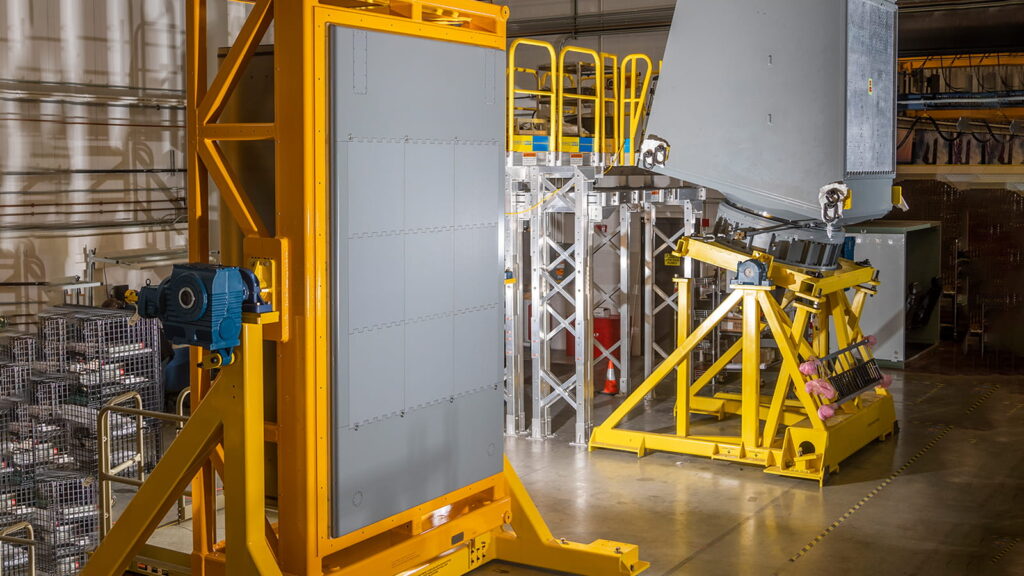
When three SPY-6(V)3 radar arrays (left) are combined, they provide 360 degree coverage for aircraft carriers, like the future USS John F. Kennedy. RAYTHEON MISSILES & DEFENSE
NEWPORT NEWS, Va. — Raytheon Missiles & Defense has delivered SPY-6 radar arrays to the future USS John F. Kennedy (CVN 79), the first aircraft carrier to receive the advanced radar, the company announced July 18.
This delivery is the first of three for the aircraft carrier. Together, the three fixed-face radar arrays will form a SPY-6(V)3, also known as the Enterprise Air Surveillance Radar, which provides 360-degree coverage for the ship. In addition to the proven multi-mission capabilities across the SPY-6 family, SPY-6(V)3 has unique features that meet the needs of an aircraft carrier, including weather mapping and air traffic control functionality.
“This is the first aircraft carrier that will be equipped with SPY-6 radars, the leading naval radar system in the world,” said Kim Ernzen, president of Naval Power at Raytheon Missiles & Defense. “With the recent contract, SPY-6 will provide premier detection and coverage for more than 40 ships in the U.S. Navy throughout the next decade.”
The SPY-6 family of radars provides integrated air and missile defense for seven classes of ships. Its radar modular assemblies, known as RMAs, allow SPY-6 to be scalable and modular to support production for the U.S. and partner nations across all variants.
Missile Exercise Sends Frigate to the Bottom
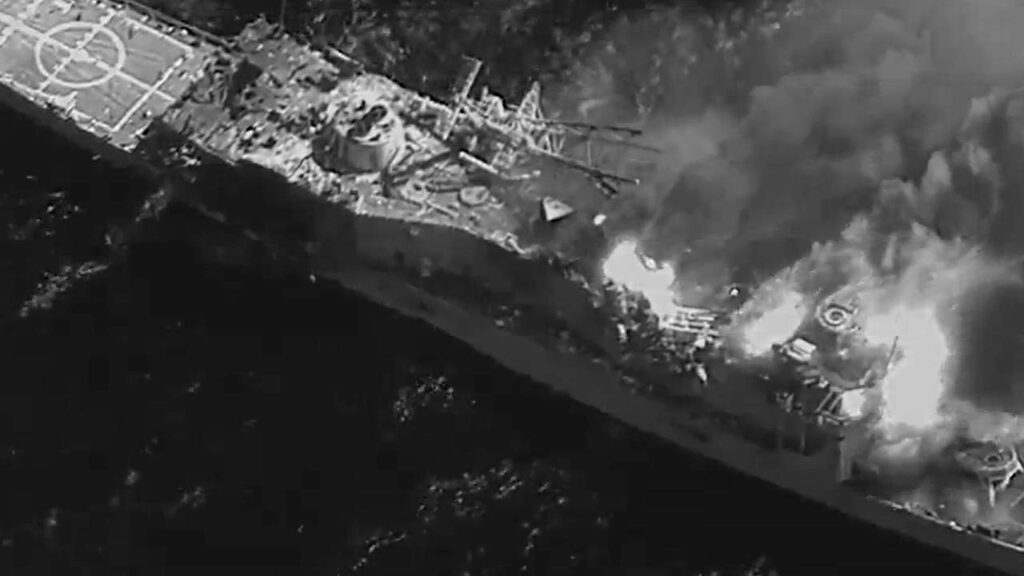
Rim of the Pacific 2022 military forces from Australia, Canada, Malaysia and the United States fired upon and sunk the decommissioned ex-USS Rodney M. Davis (FFG 60), July 12, during a sinking exercise to gain proficiency in tactics, targeting and live firing against a surface target at sea. U.S. NAVY
HAWAII — Units from Australia, Canada, Malaysia and the United States took part in a live-fire missile exercise that resulted in the sinking of a former U.S. Navy guided missile frigate at sea on July 12.
The ships and aircraft, which were participating in the Rim of the Pacific 2022 (RIMPAC) exercise, sank the decommissioned ex-USS Rodney M. Davis (FFG 60) July 12, in waters 15,000 feet deep, 50 nautical miles north of Kauai.
According to a statement from the RIMPAC Combined Information Bureau, “Live-fire events provide realistic training that refine partner nations’ abilities to plan, communicate and conduct complex maritime operations such as precision and long-range strike capabilities.”
The objective of the sinking exercise, or SINKEX, is to “gain proficiency in tactics, targeting and live firing against a surface target at sea,” the statement said.
“This exercise provided a great opportunity for the extremely talented Sailors, soldiers and aviators who comprise the RIMPAC 2022 team to hone their skills in a live-fire setting,” said Royal Canadian Navy Rear Adm. Christopher Robinson, deputy commander of the RIMPAC Combined Task Force. “There is nothing that really replaces the training value of opportunities such as this, which enable us to test our weapons and their associated combat systems with as much realism as possible. These live-fire exercises are vital for maintaining our proficiencies, building our interoperability, and increasing our readiness for future operations.”
Royal Canadian Navy frigate HMCS Winnipeg (FFH 338) fired two Harpoon missiles as part of the SINKEX. A U.S. Navy P-8A Poseidon maritime patrol aircraft deployed an AGM-84D Harpoon missile, and an F/A-18F Super Hornet from Nimitz-class aircraft carrier USS Abraham Lincoln (CVN 72) launched an GBU-16 laser guided bomb for the event.
The 1,850-ton, 321-foot Royal Malaysian Navy corvette KD Lekir fired an Exocet MM40 missile during the SINKEX. Lekir is the first Royal Malaysian Navy ship to launch a missile and hit a target outside of Malaysian waters. The ship had also recently fired an Exocet during the Taming Sari exercise north of the Strait of Malacca in May.
“The SINKEX was a professionally enriching experience for the crew of KD Lekir,” said Adm. Mohd Reza Mohd Sany, chief of the Royal Malaysian Navy. “These events provide an excellent platform toward enhancing interoperability amongst the participating navies. The involvement is an experience that will elevate the professionalism of the KD Lekir crew,” said Mohd Reza. “The biggest international maritime exercise is an opportunity for a joint exercise involving various countries while strengthening cooperation among the participants,”
“The coordinated firing of anti-ship munitions is a complex activity. This SINKEX demonstrates the interchangeability of the capable and adaptive RIMPAC partners,” said Royal Australian Navy Commodore Paul O’Grady, commander of the RIMPAC maritime forces component. “In doing so, significant measures were taken to protect the maritime training environment.”
The ex-Rodney M. Davis was a 4,100-ton, 453-foot Oliver Hazard Perry-class guided missile frigate that served in the U.S. Navy from 1987 to 2015. Preparing decommissioned ships for sinking follows a rigorous process to ensure there are no hazardous materials, fuels or lubricants still onboard. The target ships must be sunk in water at least 6,000 feet deep and at least 50 nautical miles from land.
RIMPAC Fire
At least one mishap was reported during RIMPAC. A Peruvian navy corvette, BAP Guise (CC 28), suffered a fire outbreak July 18. A statement from the Peruvian navy said the fire was “mitigated and controlled by the crew with support of foreign units.”
The ship was not identified in the initial statements from the RIMPAC Command Information Bureau, but the Guise was identified in subsequent statement from the Peruvian navy.
According to a statement from the CIB, the RIMPAC watch floor received the report of a fire and potential injuries aboard a Combined Task Force ship around 8:00 a.m., Sunday morning Hawaii time. “Two critically stable patients were evacuated from the ship by a helicopter from French Navy frigate FS Prairial (F731) to USCGC Midgett (WMSL 757), and have since been transferred ashore by U.S. Navy helicopter from USS Abraham Lincoln (CVN 72),” the statement said.
“Two crew members suffered burns as a result of it and were evacuated by helicopter for their respective care at a specialized hospital in Honolulu, the details having been communicated to their relatives,” the Peruvian Navy statement said. “It should be noted that the rest of the naval personnel are unharmed.”
RIMPAC is the world’s largest international maritime exercise, with 26 nations, 38 ships, four submarines, more than 170 aircraft, more than 30 unmanned systems and 25,000 personnel participating this year in and around the Hawaiian Islands and Southern California. The biennial exercise will conclude Aug. 4. RIMPAC 2022 is the 28th exercise in the series that began in 1971.
US Marine Corps Successfully Tests Iron Dome-Based Air Defense Prototype
The U.S. Marine Corps has tested Rafael’s Iron Dome ground launcher and Tamir interceptor with its Medium-Range Interceptor Capability prototype, G/ATOR radar and Common Aviation Command & Control System. RAFAEL
HAIFA, Israel — The U.S. Marine Corps conducted a successful live-fire test of Israel-based Rafael’s Iron Dome ground launcher and Tamir interceptor missile integrated with the USMC Medium-Range Intercept Capability prototype, Rafael said July 18.
The test included the Marine Corps’ Ground/Air Task Oriented Radar and Common Aviation Command & Control System.
“This demonstration proves that we do now have a relevant capability,” said Don Kelley, program manager for ground based air defense at PEO Land Systems, immediately following the successful test.
“Once again, Rafael’s systems have proven that they are capable of seamless, optimized integration with other defense systems,” said Brig. Gen. (Res.) Pinhas Yungman, executive vice president and head of Rafael’s Air Defense Systems Directorate.
“This test has proven the Iron Dome Tamir Interceptor and associated ground components can be integrated quickly and efficiently in any relevant defense architecture and intercept various aerial threats successfully in complex and advanced scenarios,” said Moshe Patel, head of the Israel Missile Defense Organization within Israel’s Ministry of Defense. “We look forward to further partnerships with the U.S. Armed Forces on air and missile defense.”
Xerox Elem Additive and U.S Navy Deploy First Metal 3D Printer at Sea
The amphibious assault ship USS Essex (LHD 2), shown here in 2018, now has an ElemX liquid metal printer onboard. U.S. MARINE CORPS / Cpl. A. J. Van Fredenberg
NORWALK, Conn. — Xerox Elem Additive Solutions announced July 18 that an ElemX liquid metal printer was recently installed onboard USS Essex (LHD 2), making it the first metal additive manufacturing machine deployed on a U.S. naval vessel.
The ElemX was placed on the ship earlier this month in Pearl Harbor, with at-sea trials beginning immediately. The installation is the latest step in the U.S. Navy’s strategy of using additive manufacturing to increase operational readiness for the fleet. It also builds on the relationship between the U.S. Navy and Xerox Elem Additive that began with the Naval Postgraduate School in Monterey, California, receiving the first installation of the ElemX in 2020.
“The military supply chain is among the most complex in the world, and putting the ElemX on USS Essex means Sailors can now bypass that complexity and print parts when and where they need them,” said Tali Rosman, GM of Elem Additive. “We are proud to continue our partnership with the Navy to help them advance their additive manufacturing capabilities and execute their long-term vision.”
The ElemX leverages Xerox’s liquid metal additive manufacturing technology that uses standard aluminum wire. Unlike other metal 3D printing technologies, there are no hazardous metal powders with ElemX and no need for special facility modifications or personal protective equipment to operate the machine. The printer also requires minimal post-processing and therefore provides a faster time-to-part. This ability to produce reliable replacement parts on-demand reduces the dependency on complex global supply chains for deployed forces.
To withstand various sea states and environmental challenges that U.S. naval warships encounter, the ElemX was installed in an industrial shipping container to ruggedize it. Trials have already begun to establish operational guidelines and technical feasibility studies to determine applications and use cases. A team on USS Essex will design and print shipboard items and provide feedback to NPS and Commander, Naval Surface Force Pacific.
The ElemX 3D printer was commercially introduced in February 2021, and since then Elem Additive Solutions has expanded operations, including opening an Additive Manufacturing Center of Excellence in Cary, North Carolina. The ElemX is a safer and simpler metal 3D printer, addressing supply chain resiliency for transportation, aerospace, defense and industrial manufacturing.
U.S. Affirms Support for Philippines Over Disputed Islands
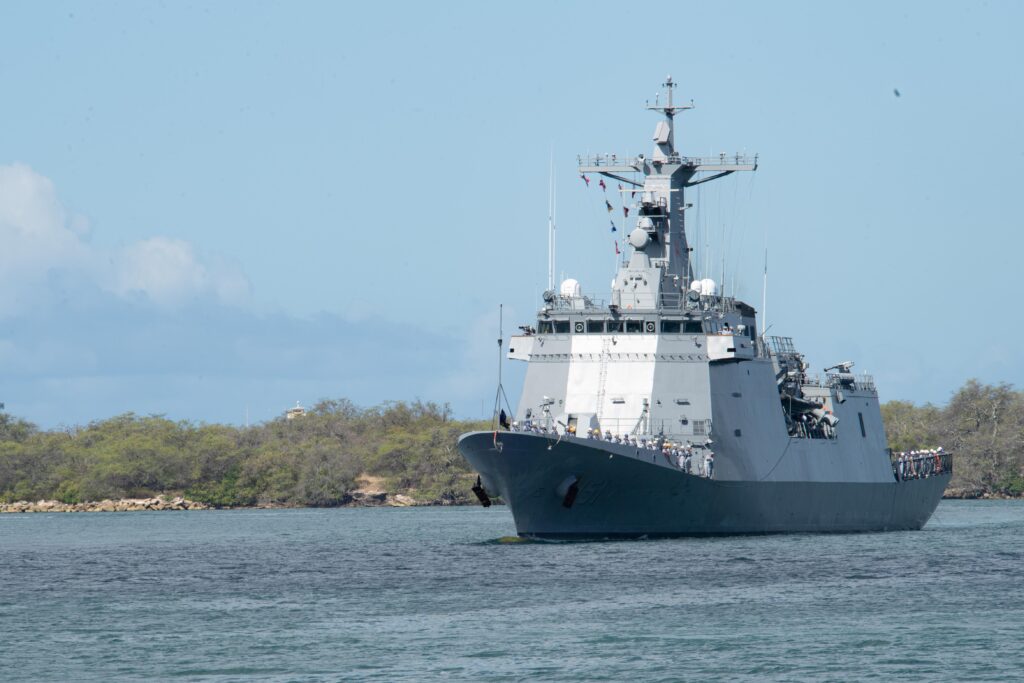
Philippine Navy frigate BRP Antonio Luna (FF 151) arrives at Joint Base Pearl Harbor-Hickam to participate in the Rim of the Pacific 2022. U.S. NAVY / Mass Communication Specialist 3rd Class Demitrius J. Williams
MANILA, Philippines — Demonstrators gathered outside the Chinese embassy in Manila on July 12 to mark the sixth anniversary of 2016 international court arbitration ruling that invalidated Beijing’s vast territorial claims in the South China Sea. The Philippines say China continues to harass its vessels and personnel near the disputed islands and in the country’s exclusive economic zone.
In a statement issued by the U.S. Embassy in Manila on July 12, U.S. Secretary of State Antony Blinken called on the Peoples Republic of China to comply with the decision by an arbitration tribunal after the Philippine government complained in 2013 about China’s increasingly assertive claims and aggressive actions around its islands in the South China Sea.
China has unilaterally claimed that virtually all islands in the South China Sea belongs to it.
Blinken said the Arbitral Tribunal, which was constituted at The Hague under the 1982 Law of the Sea Convention, delivered a unanimous decision, which is final and binding on the Philippines and the PRC. “In its ruling, the Tribunal firmly rejected the PRC’s expansive South China Sea maritime claims as having no basis in international law. The Tribunal also stated that the PRC has no lawful claim to the areas determined by the Arbitral Tribunal to be part of the Philippines’ exclusive economic zone and continental shelf. We also reaffirm that an armed attack on Philippine armed forces, public vessels, or aircraft in the South China Sea would invoke U.S. mutual defense commitments under Article IV of the 1951 U.S.-Philippines Mutual Defense Treaty.”
In a May address at George Washington University, Blinken said China is advancing unlawful maritime claims in the South China Sea and undermining peace and security, freedom of navigation, and commerce.
Philippine Foreign Secretary Enrique Manalo said Tuesday called the 2016 arbitration ruling an “indisputable” decision.
“These findings are no longer within the reach of denial and rebuttal and are conclusive as they are indisputable,” said Manalo. “The award is final.”
Despite rhetoric by the previous president of the Philippines, Rodrigo Duterte, where he said the Philippines would move away from U.S. influence and establisher closer ties with China, he later had a change of heart when his overtures failed to deliver results.
The new Philippine President Ferdinand Marcos Jr., who assumed office on June 30, and his government are expected to seek closer ties with the U.S. And today, the U.S.-Philippines partnership remains strong.
In August of last year, Adm. John C. Aquilino, commander of U.S. Indo-Pacific Command, traveled to the Philippines to mark the 70th anniversary of the U.S.-Philippine Mutual Defense Treaty and reaffirm the U.S. commitment to the alliance with the Philippines.
“Both of our nations have made it clear that we are committed to the alliance, and that we remain prepared to fight alongside and defend each other using all of our capabilities to preserve peace and stability in the region — just as we have before,” Aquilino said.
On May 23 of this year, Aquilino and the chief of staff of the armed forces of the Philippines, Gen. Andres Centino, signed the Maritime Security (Bantay Dagat) Framework at USINDOPACOM headquarters on Camp Smith, Hawaii. According to a statement from INDOPACOM, “Bantay Dagat” is a Tagalog term that means “Guardian of the Sea,” illustrating U.S. and Philippine resolve to improve regional maritime domain awareness and confront maritime challenges together. The framework is designed to enable a holistic, intergovernmental approach to maritime security through the interoperability of U.S. and Philippine maritime forces and option to include interagency organizations, and is a testament to the strength of the U.S.–Philippines alliance.”
The Philippine navy’s 2,600-ton, 351-foot guided-missile frigate BRP Antonio Luna (FF-151) is currently participating in the 2022 Rim of the Pacific exercises off Hawaii.