Navy Confirms Wreck Site off Philippines Coast that of USS Samuel B. Roberts
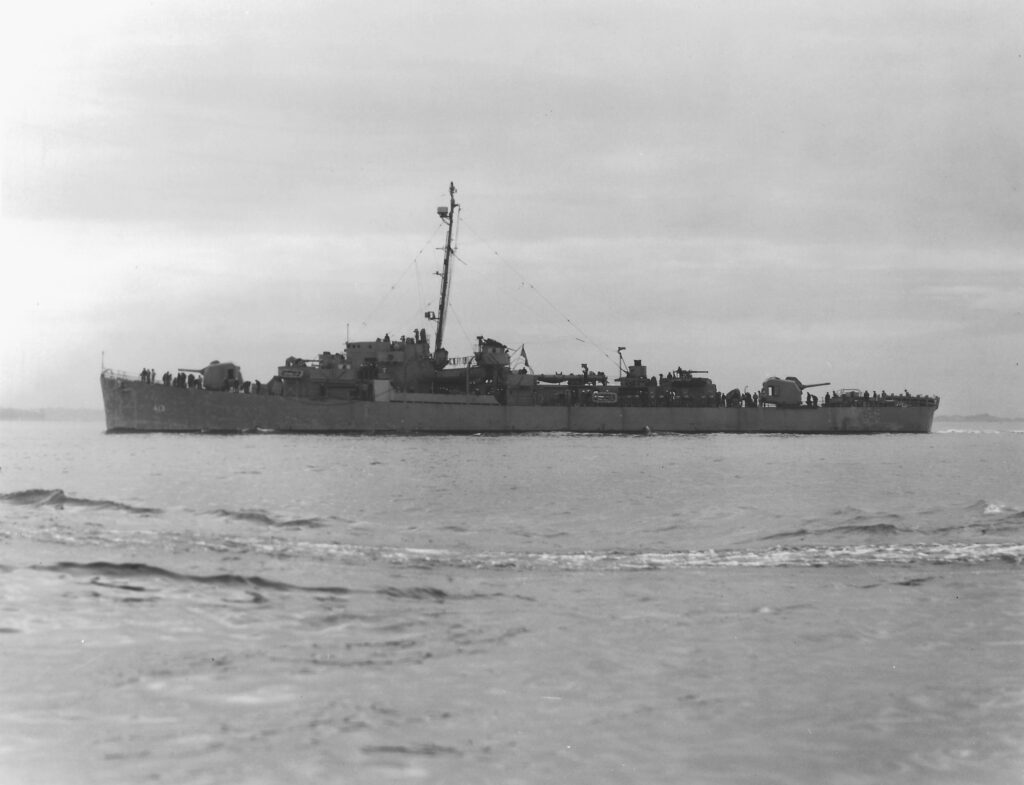
The U.S. Navy destroyer escort USS Samuel B. Roberts (DE-413) circa June 1944, while off Boston, Massachusetts. NAVAL HISTORY AND HERITAGE COMMAND
WASHINGTON — Seventy-eight years after its loss during World War II, the U.S. Navy confirmed on June 25 the location of USS Samuel B. Roberts (DE 413), the Naval History and Heritage Command said June 27.
As announced on Twitter June 24 by retired naval officer and underwater explorer Victor Vescovo, he and a team from the undersea technology company Caladan Oceanic located the destroyer escort ship more than four miles beneath the surface in the Philippine Sea.
Vescovo tweeted, “With sonar specialist Jeremie Morizet, I piloted the submersible Limiting Factor to the wreck of the Samuel B. Roberts [DE 413]. Resting at 6,895 meters, it is now the deepest shipwreck ever located and surveyed. It was indeed the ‘destroyer escort that fought like a battleship.’”
USS Samuel B. Roberts was the first ship named for Coxswain Samuel Booker Roberts Jr., who was killed in the Battle of Guadalcanal. Commissioned April 28, 1944, the destroyer escort was lost that same year during the Battle off Samar when it, along with several other U.S. warships, engaged Japanese forces off the Philippine coast and selflessly put itself in harm’s way to protect U.S. invasion forces in Leyte Gulf.
“USS Samuel B. Roberts was lost in one of the most valiant actions in the history of the U.S. Navy,” said Naval History and Heritage Command Director Samuel Cox, a retired rear admiral. “The gallantry of her crew serves to inspire U.S. Navy personnel today, knowing they are entrusted with upholding the legacy and example of this ship and crew.”
Now that USS Samuel B. Roberts has been positively identified, the wreck site is considered a Department of the Navy sunken military craft protected from unauthorized disturbance by the Sunken Military Craft Act. Violations of the act can carry penalties of up to $100,000 a day, confiscation of the vessel used to disturb the sunken military craft and liability for damages caused. Permission to disturb U.S. Navy sunken military craft for archaeological, historical, or educational purposes is sought from the Naval History and Heritage Command. There are no plans to disturb USS Samuel B. Roberts.
“The site of the wreck marks the location of a hallowed war grave,” Cox added. “It serves to remind all Americans of the great cost born by previous generations for the freedom we should not take for granted today.”
More than 40 years after the ship’s historic actions in WWII, the story of DE 413 and its crew’s heroism inspired another generation of Sailors serving on a ship with the same name.
A bronze plaque commemorating the crew of DE 413 was aboard the Oliver Hazard Perry-class guided missile frigate USS Samuel B. Roberts (FFG 58) when the ship struck an Iranian mine in the Persian Gulf April 14, 1988. The mine blew a 15-foot hole in the hull of the ship, breaking its keel. Because of the fast actions of the crew, after a five-hour effort to purge water and fight fires, the ship was saved. The captain of the vessel, Cmdr. Paul Rinn, noted that while running to their stations to save the ship, the FFG crew would touch the plaque for good luck to honor and recognize the bravery of the crew of DE 413.
The plaque is now in the collection at the National Museum of the U.S. Navy at the Washington Navy Yard in Washington, D.C. It reads: “In Memory of Those Who Have Sailed Before Us/USS Samuel B. Roberts (DE-413)/LCDR R. W. Copeland, Commanding Officer.” The remainder of the plaque includes the names of the original crew of the USS Samuel B. Roberts.
Two DDGs from Truman Strike Group Return Home
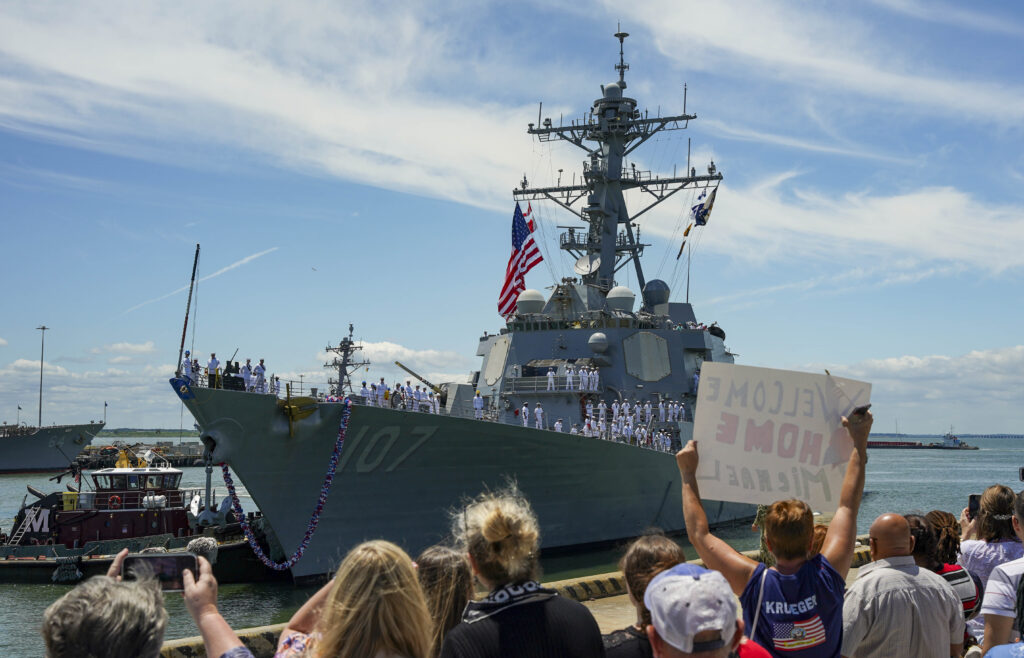
The Arleigh Burke-class guided-missile destroyer USS Gravely (DDG 107) returns to Naval Station Norfolk after a regularly scheduled deployment in support of maritime security operations and theater security cooperation efforts, June 23. U.S. NAVY / Mass Communication Specialist 2nd Nathan T. Beard
ARLINGTON, Va. — The USS Gravely (DDG 107) returned to Naval Station Norfolk June 24, becoming the first ship of the strike group to return home. USS Jason Dunham (DDG 109) followed on June 26, returning to its homeport of Naval Station Mayport, Florida.
USS Gravely participated in numerous exercises during its time in European waters, including Neptune Strike 2022, Cold Response, Operation Songwright, Dynamic Manta, Neptune Shield 2022, and Hedgehog 22 with forces from Finland, France, Germany, Italy, Norway, Spain, Sweden, Turkey and the United Kingdom, according to a release.
“Exercises with our allies and partners allowed for a more cohesive alliance and fluid operations,” Cmdr. Hunter Washburn, Gravely’s commanding officer said in the release. “Operating with allies and partners is paramount to further developing our communication and operational capabilities to ensure mission readiness at a moment’s notice.”
USS Jason Dunham also operated in the U.S. 6th Fleet area of responsibility, but also spent part of its deployment perated with the U.S. 5th Fleet in the Middle East. The DDG escorted ships through the Bab-el-Mandeb Strait multiple times.
During operations in U.S. 6th Fleet, the DDG operated with Forward Deployed Naval Forces-Europe ships, the Standing NATO Maritime Group 2 and the Harry S. Truman Carrier Strike Group.
“In the Mediterranean, Jason Dunham took part in NATO-led activity Neptune Shield 22, demonstrating NATO’s ability to integrate the high-end maritime warfare capabilities of allied aircraft carrier strike groups, amphibious ready groups and marine expeditionary units to support the defense of the alliance,” according to a release.
U.S. 5th Fleet Gains First LCS, USS Sioux City, in Historic Deployment
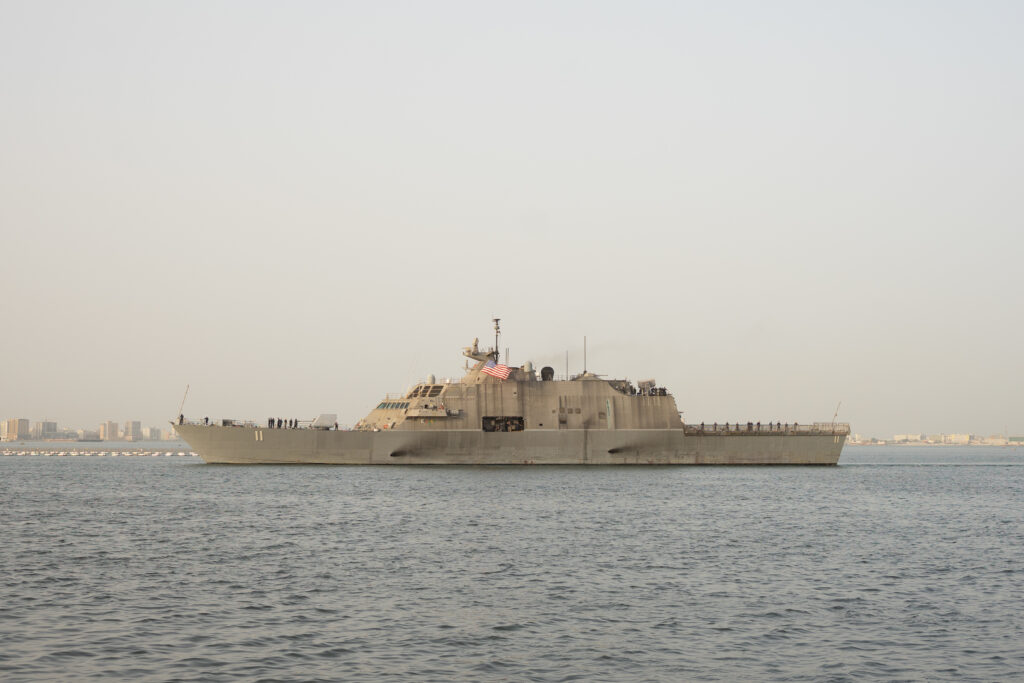
Littoral combat ship USS Sioux City (LCS 11), arrives at Naval Support Activity Bahrain, June 25. U.S. Army / Sgt. Terry Vongsouthi
MANAMA, Bahrain — USS Sioux City (LCS 11) arrived at Bahrain for a scheduled port visit, June 25, marking the completion of a 10,000-mile journey while becoming the first littoral combat ship to operate in the Middle East, U.S. Naval Forces Central Command Public Affairs said June 25.
The ship and crew of 75 personnel departed Mayport, Florida, in April. While in the U.S. 5th Fleet region, Sioux City has provided maritime security presence enabling the free flow of commerce in key corridors of trade.
“We’re thrilled to have Sioux City’s crew here helping us understand how to integrate the LCS platform into our operations, and we’re exercising every one of the ship’s support capabilities,” said Capt. Robert Francis, commander of Task Force 55. Task Force 55 oversees U.S. surface forces operating in the Middle East.
After arriving in the Middle East in May, Sioux City operated in support of Combined Task Force (CTF) 153 and focused on maritime security and partner capacity building in the Red Sea, Bab al-Mandeb and Gulf of Aden. CTF 153 is one of four multinational task forces organized under Combined Maritime Forces, the largest international naval partnership with 34 nations. Led by the United States, Combined Maritime Forces is headquartered in Bahrain with U.S. 5th Fleet.
“I’m incredibly proud of our Sailors for executing every mission we’ve been tasked with,” said Cmdr. Scott Whitworth, commanding officer of USS Sioux City. “We are forging a new frontier for littoral combat ships.”
Sioux City is deployed with an MH-60 Seahawk helicopter from Helicopter Sea Combat Squadron 22.
The U.S. 5th Fleet region includes 21 countries, the Arabian Gulf, Gulf of Oman, Red Sea, parts of the Indian Ocean and three critical choke points at the Strait of Hormuz, Bab al-Mandeb and Suez Canal.
Munsch Assumes Command of U.S. Naval Forces Europe-Africa
The change of command ceremony of Allied Joint Forces Command Naples (JFC Naples) from Adm. Robert P. Burke to Adm. Stuart B. Munsch took place at JFC Naples, Italy, June 27, 2022. The Change of Command Ceremony at JFC Naples symbolizes the continuity and unity that is NATO and comes during a time of a changed security environment in Europe. U.S. Marine Corps / Master Sgt. Scott McAdam
ALLIED JOINT FORCES COMMAND NAPLES, Italy — U.S. Navy Adm. Stuart B. Munsch relieved Adm. Robert P. Burke as commander of U.S. Naval Forces Europe-Africa (NAVEUR-NAVAF) during a change of command ceremony held onboard Joint Forces Command (JFC) Naples Headquarters in Naples, Italy, June 27, U.S. Naval Forces Europe-Africa/U.S. Sixth Fleet Public Affairs said in a release.
U.S. Army Gen. Stephen J. Townsend, commander, U.S. Africa Command (AFRICOM), and U.S. Air Force Gen. Tod D. Wolters, North Atlantic Treaty Organization (NATO) Supreme Allied Commander Europe (SACEUR) and commander, U.S. European Command (EUCOM), served as the presiding officers of the ceremony.
Townsend commenced the official remarks and reflected on Burke’s steadfast leadership as the commander of U.S. Africa Command’s maritime component.
“At U.S. Africa Command, we fully appreciate how important sea lines of communication are to Western economies and to our ability to project power,” said Townsend. “It is also apparent to me that our adversaries appreciate these facts as well. Every day, they are competing with us, the United States, NATO and our other allies and partners to gain an edge in the maritime domain.”
Townsend spoke to NAVAF’s critical role in stemming malign activities in Africa, highlighting Burke’s unwavering support to African partners to promote maritime security and stability across the continent.
“In the face of these challenges, and arguably a more complex portfolio than Europe, Bob Burke ensured that NAVAF was always at the right place at the right time to maximize our strategic impact and provide seamless support to our allies and our partners,” said Townsend.
Townsend noted that despite heavy operational demands and fiscal pressures, Burke didn’t just hold the line, he advanced America’s interests in Africa and every facet of the maritime domain.
During his remarks, Townsend also welcomed the incoming commander, Munsch.
“You have an impressive resume of operational experience, and your time at key strategic positions in the Pentagon is going to pay off for us here,” said Townsend. “I know that NAVAF has steady hands on the helm.”
Wolters also praised Burke and his wife Barbara for 39 years of dedicated service during the ceremony.
“Barbara, we know that you have delivered to us, one of the most spectacular commanders in the history of conflict, and we thank you so much for facilitating the extraordinary accomplishments of your husband, and we thank you so much for the sacrifices that you’ve made in the past,” said Wolters. “Bob, I am so proud of you. We’re old shipmates, I’m going to miss you. We talked a lot on the phone because there has been a lot of late night duty and the one thing that you knew about Bob Burke is that 1000 percent of the time, he was going to be ready. Bob, we wish you and Barbara the calmest of seas and the bluest of skies, as you press back to Florida and congratulations on 39 years of superior service. Well done my friend.”
Wolters acknowledged the tremendous responsibilities that Burke managed during his tenure as commander of NAVEUR-NAVAF as well as his many NATO duties as the commander of JFC Naples, chief among them being Operation Allies Welcome and Russia’s invasion of Ukraine, which he called Burke’s most important task.
“For me as the SHAPE Commander, the single human being on planet earth that is most responsible for deterring our sovereign soil and the effectiveness that we’ve been able to sustain to this point is Bob Burke,” said Wolters.
Burke touched on his role in the current geopolitical situation in Europe, underscoring the gravity of the moment and the continued work that will be required from the NAVEUR-NAVAF team.
“We are living through a seminal moment in trans-Atlantic security. You have been front and center for the U.S. response to that reality, playing key roles in the most fundamental recalibration of the U.S. Navy in Europe I’ve seen in 40 years of service,” said Burke. “I am so grateful for your commitment to service, teamwork, learning and innovation – all of which ensures this inspiring team of teams stands ready to fight and win should the need arise.”
During his tenure, Burke assumed operational responsibility for naval forces and activities in a wide expanse of territory, including 93 countries from the North Pole to the Cape of Good Hope and eastward from the mid-Atlantic to the Caspian Sea. In addition to overseeing units and personnel typically assigned to Commander, Navy Region Europe, Africa, Central and U.S. Sixth Fleet, Burke also led multiple carrier strike groups as well as amphibious ready groups and marine expeditionary units. Burke and the NAVEUR and SIXTHFLT teams established Task Force 61 Naval Amphibious Forces Europe/2d Marine Division (TF-61/2) to synchronize Navy and Marine Corps efforts across Europe and Africa.
Under Burke’s leadership, Naval Forces Europe enhanced interoperability with NATO allies and partners through some of the largest and most successful multinational exercises and activities, including BALTOPS, Formidable Shield, and the Project Neptune Series, Allied multi-carrier operations, and unprecedented support to NATO enhanced air policing missions.
As the commander of Naval Forces Africa, he bolstered relations throughout the African continent, spearheading projects like Women, Peace and Security and the expeditionary sea base USS Hershel “Woody” Williams’ (ESB 4) circumnavigation of the African continent. Williams’ circumnavigation also featured the first voyage repair availability of the ESB platform in South Africa. Additionally, NAVAF facilitated the regional Express Series exercises, Obangame in Western Africa, Cutlass in Eastern Africa and Phoenix in Northern Africa, as part of a comprehensive strategy to provide collaborative opportunities amongst African forces and international partners that addresses maritime security concerns, including interdiction operations.
“Together, you are maintaining an unprecedented level of activity throughout the European Command and Africa Command areas of responsibility and demonstrating that our collaborative network at sea remains the Joint Force’s asymmetric advantage,” said Burke.
Munsch, a native of North Dakota, recently served as director for Joint Force Development, J-7, Joint Staff, Washington D.C. Other notable assignments include serving aboard USS Will Rogers (SSBN 659), USS Jefferson City (SSN 759), USS Kitty Hawk (CV 63), on the staff of Commander, Cruiser Destroyer Group 5, and USS Tucson (SSN 770). He also commanded USS Albuquerque (SSN 706) from 2002 to 2005, followed by duty in the Pentagon as the military assistant to the Deputy Secretary of Defense and then as executive assistant to the Director, Submarine Warfare, Office of the Chief of Naval Operations (OPNAV N87).
“In some way, this tour represents coming full circle for me. My father was in the Navy for one enlistment, but it gave him a lifetime of stories,” said Munsch. “And his favorite place to visit was always Italy, and in particular, Naples because of the people and of course because of the food.”
Munsch thanked Burke for his enduring contributions and outlined his goals upon assuming command as NAVEUR-NAVAF and JFC Naples.
“I would like to thank the Burkes, you have been most gracious both professionally and personally to ease us into this transition. Thank you so much,” said Munsch. “I look forward to working with [JFC Naples and NAVEUR-NAVAF] to deter and defend, to advance our interoperability and strengthen our alliance.”
In closing, Burke thanked Sailors and leadership for their extraordinary work and urged all hands to continue to confront emerging challenges with steadfast resolve.
“Our two headquarters here in Naples continue to punch well above their weight. It’s what we’ve needed and what we’ll continue to rely on as our margins for error are getting thinner and two revisionist powers continue to exploit their perceived advantages,” said Burke. “Uncertainty is the new normal, leaving us with the imperative to always press the advantages that we have while staying ready for anything, from any direction, at any time.”
For over 80 years, NAVEUR-NAVAF has forged strategic relationships with allies and partners, leveraging a foundation of shared values to preserve security and stability.
Headquartered in Naples, Italy, NAVEUR-NAVAF operates U.S. naval forces in the EUCOM and AFRICOM areas of responsibility. U.S. Sixth Fleet is permanently assigned to NAVEUR-NAVAF, and employs maritime forces through the full spectrum of joint and naval operations.
Cutter Diligence Returns Home After 65-day Caribbean Sea Patrol
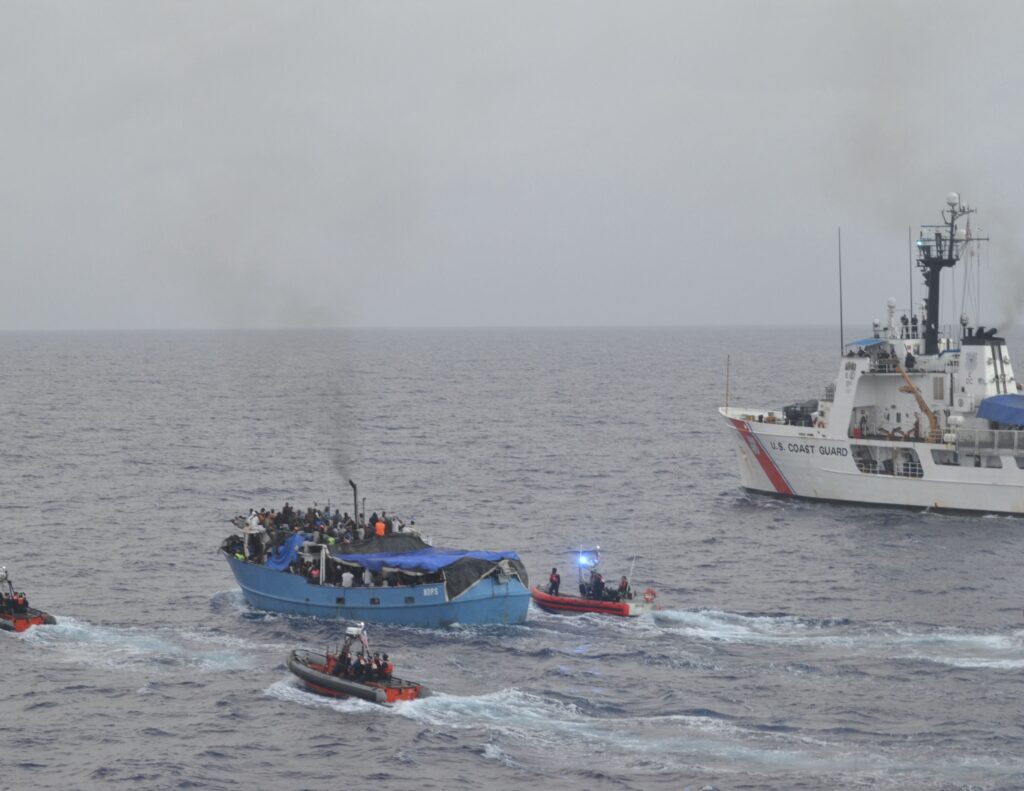
The Coast Guard interdicts a migrant vessel on the Caribbean Sea. The overloaded Haitian vessel was interdicted by the Coast Guard Cutters Diligence (WMEC-616) and Confidence (WMEC-619) while engaged in an illegal maritime migration. U.S. Coast Guard / Petty Officer 3rd Class Seth Rentz
PENSACOLA, Fla. — The crew of Coast Guard Cutter Diligence returned to their home port in Pensacola, Florida on Friday after a 65-day Caribbean Sea patrol, the Coast Guard 8th District said in a June 26 release.
During the patrol, Diligence’s crew conducted migrant interdiction operations in support of Operation Southeast Watch, in an interagency effort to detect and deter vessels engaged in illegal maritime migration.
Partnering with six other Coast Guard cutters and three Coast Guard aircraft, Diligence interdicted, cared for and repatriated 127 migrants who departed from Haiti and Cuba. Additionally, Diligence’s crew worked with the cutter Confidence to safely escort one overloaded vessel engaged in an illegal migrant venture, ensuring the safety of more than 500 people.
The Diligence crew also completed the Coast Guard’s biennial shipboard training assessment, Tailored Ships Training Accountability (TSTA), at Naval Station Mayport in Mayport, Florida. TSTA is a three-week training period in which a team of evaluators assess the crew’s mission readiness and ability to respond to shipboard emergencies and execute missions. Diligence achieved a 98% drill average during weapons, command and control, damage control, engineering, navigation and seamanship evaluations.
“Throughout the deployment, Diligence’s crew exemplified the Coast Guard’s core values of honor, respect and devotion to duty,” said Cmdr. Jared Trusz, Diligence’s commanding officer. “In response to a challenging mission, they supported national security objectives by deterring illegal maritime migration, while ensuring the safety of life at sea. The crew provided humanitarian care for those interdicted and treated all migrants with dignity and respect until we were able to safely return them to Haiti. I cannot thank Diligence’s crew enough for the hard work and sacrifices made during this patrol.”
Diligence is a 210-foot medium-endurance cutter homeported in Pensacola with 78 crewmembers. The cutter’s primary missions are counter drug operations, migrant interdiction, enforcing federal fishery laws, as well as search and rescue in support of Coast Guard operations throughout the Western Hemisphere.
Cutter Steadfast Returns Home after 55-day Counter-Narcotics Patrol
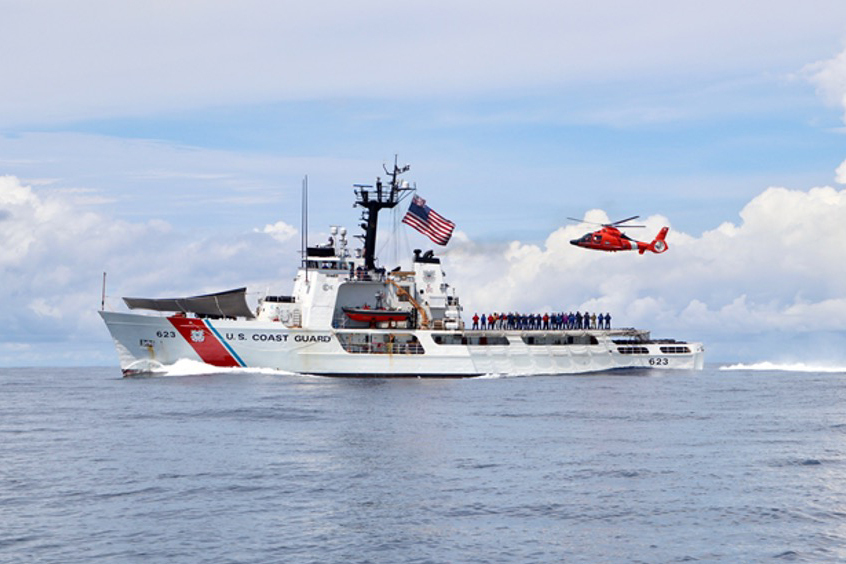
The crew aboard U.S. Coast Guard Cutter Steadfast (WMEC-623) stands in formation on the ship’s flight deck while underway off the coast of Central America Memorial Day, 2022. An embarked MH-65 Dolphin helicopter detachment crew from Air Station Port Angeles hovered overhead for the photo in recognition of the day of remembrance. U.S. Coast Guard / Seaman Brad O’Brien
ASTORIA, Ore. — United States Coast Guard Cutter Steadfast (WMEC-623) returned to homeport in Astoria on Saturday, June 18, following a 55-day counter narcotics deployment to the Eastern Pacific Ocean, the Coast Guard 13th District said in a release.
The 210-foot medium-endurance cutter and crew covered more than 11,000 miles conducting law enforcement and search-and-rescue operations in international waters off Central America from Mexico to Costa Rica.
The Steadfast deployed with an MH-65E Dolphin helicopter and aviation crew from Air Station Port Angeles, Washington, and with additional Coast Guard members from the Tactical Law Enforcement Team Pacific, Electronics Support Detachment Detroit, Base Galveston and three Coast Guard Academy cadets.
The crew of the Steadfast also worked with Mexican law enforcement assets on two occasions, to locate, track, and interdict fast-moving drug smuggling vessels, resulting in the seizure of 2,747 kilograms of cocaine by Mexican authorities, valued at $109 million.
While transiting south of Mexico, Steadfast’s bridge team sighted a disabled and adrift open-hull vessel with two Mexican adult males waving life jackets. Steadfast approached the vessel to investigate and determine the nature of distress. The imperiled mariners stated that they were fishermen who had been adrift for 23 days after their vessel had been beset by weather. Steadfast embarked both persons, provided meals and medical care, and returned them safely back to Mexico.
This was the last patrol for Cmdr. Craig Allen Jr., who has served as the Steadfast’s commanding officer since July 2020. A change-of-command ceremony is scheduled to take place on July 22 in front of the Columbia River Maritime Museum.
Steadfast is a 54-year-old Reliance-class cutter that has been homeported in Astoria since 1994. Previously, Steadfast was homeported in St. Petersburg, Florida, where she earned the nickname “El Tiburon Blanco” (‘the White Shark’), from drug smugglers for her notoriety in counter-narcotics operations in the Florida Straits and Caribbean Sea.
Navy to Commission Virginia-Class Fast Attack Submarine Montana
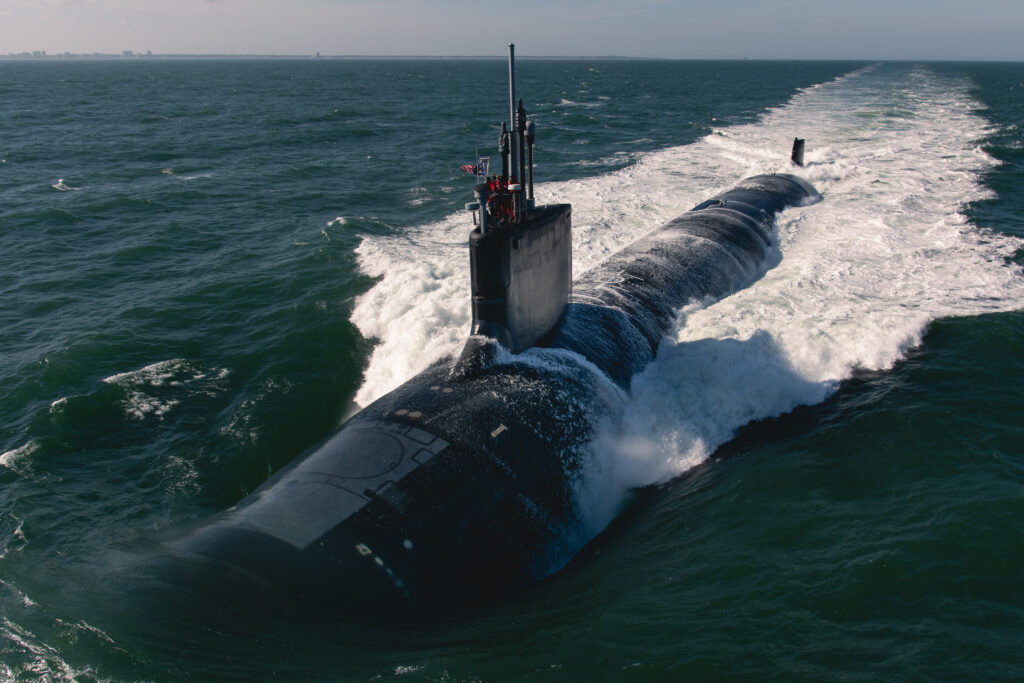
The U.S. Navy submarine USS Montana (SSN-794) conducts initial sea trials in the Atlantic Ocean Feb. 1. HII / Ashley Cowan
ARLINGTON, Va. — The Navy will commission the future USS Montana (SSN 794), the newest Virginia-class fast attack submarine, during a 10:00 a.m. EST ceremony on Saturday, June 25, at Naval Station Norfolk, the Defense Department said June 24.
Gov. Greg Gianforte of Montana will deliver the principal address. Additional speakers include U.S. Rep. Bobby Scott of Virginia’s 3rd District; Undersecretary of the Navy Erik Raven; Adm. James Caldwell, director, Naval Nuclear Propulsion Program; and Jennifer Boykin, president of Newport News Shipbuilding.
The submarine’s sponsor is Sally Jewell, former Secretary of the United States Department of Interior. Montana was christened at Newport News Shipbuilding, a division of Huntington Ingalls Industries, in Newport News, Virginia, on Sept. 12, 2020. Jewell will give the order to “man our ship and bring her to life.”
The future USS Montana (SSN 794) honors the Treasure State and will be the second commissioned warship bearing the name. The first USS Montana (ACR-13), an armored cruiser, was also built at Newport News Shipbuilding and commissioned in July 1908. ACR-13 served in the Atlantic and Mediterranean, landed Marines during unrest in Haiti in 1914, and escorted convoys during World War I. The Navy decommissioned the first USS Montana in 1921, and two other vessels named after the state never saw commissioned service.
“This boat is a true treasure of the U.S. Navy, and will play an integral part in protecting and promoting American prosperity and security abroad,” said Secretary of the Navy Carlos Del Toro. “I am so proud of the brave men and women who will man this submarine, and I look forward to their success on the high seas.”
Montana is the third Block IV Virginia-class submarine to enter service, designed to carry out the core missions of the submarine force: antisubmarine warfare; anti-surface warfare; delivery of special operations forces; strike warfare; irregular warfare; intelligence, surveillance and reconnaissance; and mine warfare. These capabilities allow the submarine force to operate anywhere, at any time, and contribute to regional stability and the preservation of future peace.
Montana is 377 feet long, has a 34-foot beam, and will be able to dive to depths greater than 800 feet and operate at speeds in excess of 25 knots submerged. It has a crew of approximately 136 Navy personnel.
Navy to Christen Expeditionary Sea Base Ship USS John L. Canley
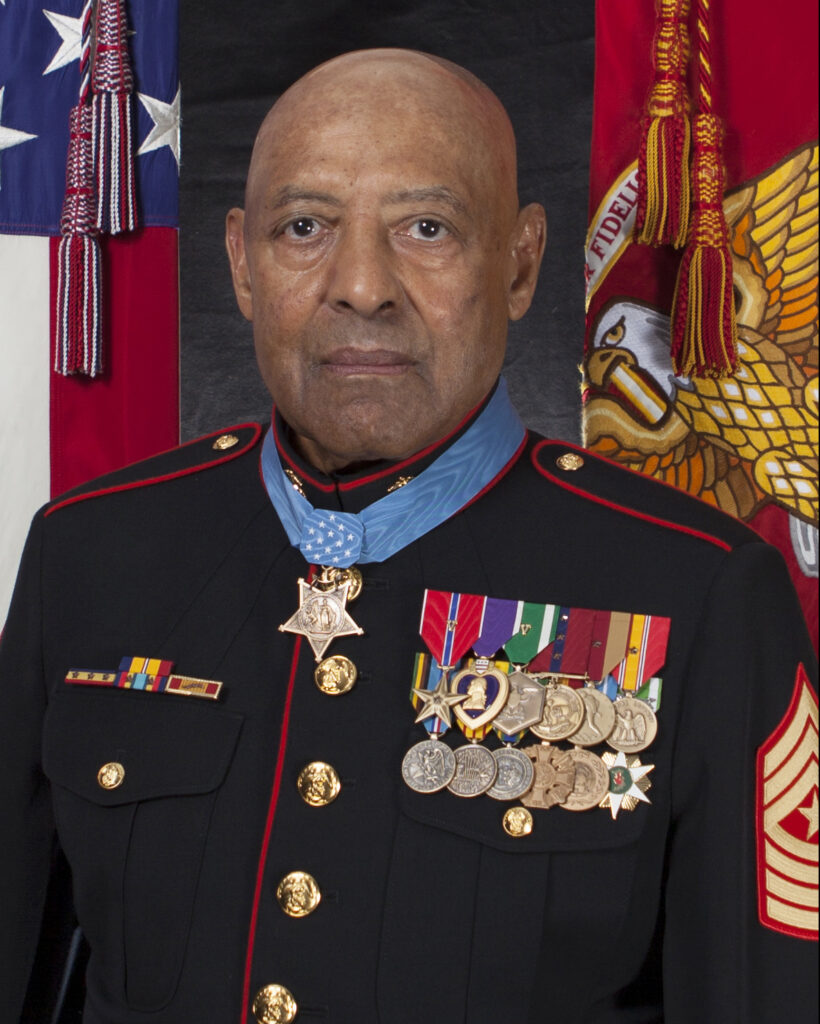
Retired U.S. Marine Corps Sgt. Major John L. Canley, the 300th Marine Medal of Honor recipient, poses for a command board photo at the Pentagon in Arlington, Virginia, Oct. 18, 2018. U.S. MARINE CORPS / Lance Cpl. Morgan Burgess
ARLINGTON, Va. — The Navy will christen its newest expeditionary sea base, the future USS John L. Canley (ESB 6), during a 9:00 a.m. PDT ceremony Saturday, June 25, at General Dynamics National Steel and Shipbuilding Company (GD-NASSCO) shipyard in San Diego, the Defense Department said June 24.
The principal speaker is Lt. Gen. Michael Langley, commanding general, Fleet Marine Force, Atlantic, and commander, Marine Forces Command and Marine Forces Northern Command. Additional speakers include Deputy Assistant Secretary of the Navy for Installations, Energy, and Facilities Robert Thompson; Vice Adm. Ross Myers, commander, U.S. Fleet Cyber Command/commander, U.S. 10th Fleet; Thomas Kiss, director of ship management, Military Sealift Command; Sgt. Maj. David Wilson, command sergeant major, First Marine Division; and David Carver, president of GD-NASSCO.
In a time-honored Navy tradition, the ship’s sponsor, Patricia Sargent, daughter of Sgt. Maj. Canley, will christen the ship by breaking a bottle of sparkling wine across the bow.
The ship is named for Medal of Honor recipient, retired Sgt. Maj. John L. Canley. Canley, who served in the Marine Corps for 28 years, was awarded the nation’s highest honor 50 years after his actions while serving as Company Gunnery Sergeant, Company A, First Battalion, First Marine Division in the Republic of Vietnam during the Battle of Hue City. Initially awarded the Navy Cross for his actions, his award was upgraded to the Medal of Honor in 2018. Canley passed away on May 11, 2022.
“Tomorrow we christen the future USS John L. Canley, recognizing a pioneer in the Marine Corps and a devoted patriot, who earned our nation’s highest honor for his gallant actions in the Battle of Hue City,” said Secretary of the Navy Carlos Del Toro. “Sgt. Maj. Canley is an example to the men and women who will proudly serve aboard this ship and he will be remembered every day ESB 6 operates.”
ESBs are highly flexible platforms used across a broad range of military operations, supporting multiple operational phases and directly contributing to American prosperity and security abroad. Acting as a mobile sea base, they are a part of the critical access infrastructure that supports the deployment of forces and supplies to provide prepositioned equipment and sustainment with adaptable distribution capability.
Coast Guard Cutter Campbell Returns Home after 80-Day Patrol
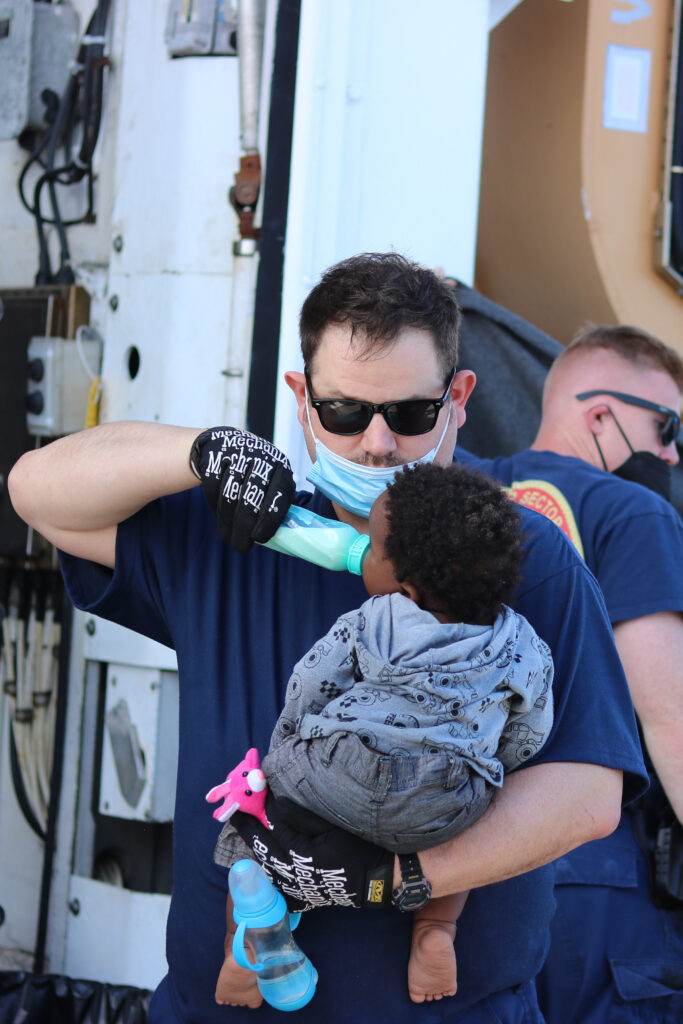
Coast Guard Cutter Campbell’s crew member feeding a baby near Anguilla Cay, Bahamas, April 11, 2022. Coast Guard Cutter Charles Sexton crew transferred 67 Haitians to Bahamian authorities after the Cutter Campbell crew rescued them. U.S. COAST GUARD
BOSTON — Coast Guard Cutter Campbell’s crew returned home to Newport, Rhode Island, June 23, following an 80-day, multi-mission patrol in the Caribbean Sea and Atlantic Ocean in support of the Coast Guard 7th District’s Operation Southeast Watch and the U.S. Navy’s Composite Training Unit Exercise, the Coast Guard 1st District said in a release.
Amidst the largest surge in maritime migration in nearly two decades, Campbell patrolled the Windward Pass and South Florida Straits, tasked with the disruption and interdiction of dangerous and illegal migrant ventures departing from Haiti and Cuba.
On April 10, within hours of entering the South Florida Straits, Campbell’s crew intercepted a wooden sail freighter with 67 Haitians aboard. The group, which included minors as young as five months, departed the north coast of Haiti nearly a week prior, and ran dangerously short on food, water, baby formula, and other essential supplies. The crew embarked the distressed migrants, providing care and medical attention before transferring the case to the Royal Bahamian Defense Force.
Throughout April and May, Campbell interdicted five additional migrant vessels that departed from Haiti and Cuba. In one notable case, Campbell interdicted a 50-foot, power-driven vessel carrying 212 Haitians south of Turks and Caicos. In total, Campbell’s crew rescued and cared for 528 Haitians and 21 Cubans during the patrol.
In June, Campbell shifted focus and joined a U.S. Navy Carrier Strike Group for COMPTUEX, a joint training mission off the North Carolina and Florida coasts. The training exercise, which serves as the Navy’s capstone prior to overseas deployment, included live-fire weapons exercises, formation steaming, and multi-day at-sea combat simulations.
The Campbell, a 270-foot Cutter with a crew complement of 100, is homeported in Newport, Rhode Island. The crew’s missions include search and rescue operations, counter-drug, migrant interdiction and living marine resources protection.
Coast Guard Cutter Thetis Returns Home from 77-day Counter-Narcotic Deployment
U.S. Coast Guardsmen assigned to the U.S. Coast Guard Cutter Thetis (WMEC 910), boost morale during a 77-day counter-narcotic deployment in the Caribbean sea, June 19. U.S. COAST GUARD
KEY WEST, Fla. — The U.S. Coast Guard Cutter Thetis (WMEC 910) crew returned to homeport in Key West, June 21, after a 77-day counter-narcotics patrol in the Caribbean Sea, the Coast Guard Atlantic Area said in a release.
The Thetis crew repatriated 88 Haitian migrants to Cap Haitien, Haiti, after they were reported to be on an unseaworthy sailing vessel in the Windward Passage between Cuba and Haiti.
An embarked U.S. Coast Guard law enforcement detachment disabled a smuggling vessel transporting an estimated 1,323 pounds of cocaine in the Central Caribbean.
The Thetis’s crew assisted with a search and rescue case of 14 mariners that went into the water after their commercial ship began taking on water in the middle of the Caribbean Sea.
“While on a counter-narcotics patrol, our crew quickly shifted gears to help locate and provide situational awareness during an unfortunate search and rescue case,” said Cmdr. Justin Nadolny, the commanding officer of the Thetis. “Working alongside our international and commercial partners showcased the can-do spirit of mariners and our universally shared duty of assisting those in distress and ensuring safety of life at sea.”
The Thetis’s crew strengthened international partnerships while in Cartagena, Colombia, hosting Colombian naval officers aboard to gain a deeper understanding of maritime activity in the region and to develop relationships with international maritime partners operating in Caribbean waters.
The Thetis, a 270-foot Famous-class cutter homeported in Key West and has a crew of 104. Their primary missions are counter-drug operations, migrant interdiction, the enforcement of federal fisheries laws, and search and rescue in support of U.S. Coast Guard operations throughout the Western Hemisphere.