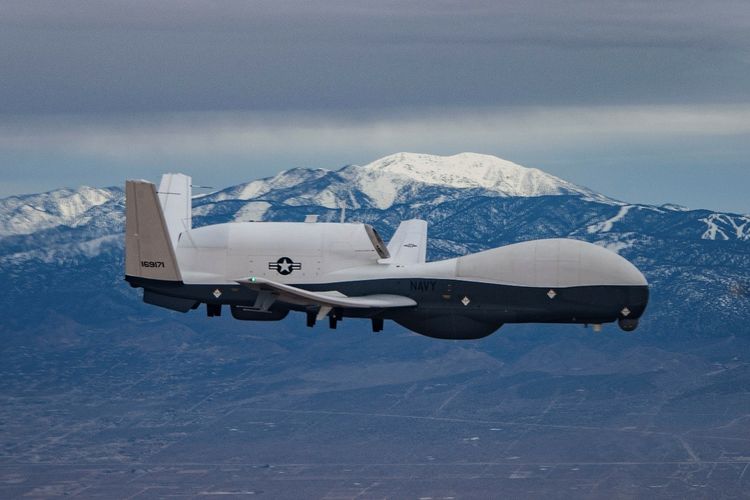
An MQ-4C Triton takes to the skies over the California desert as the Triton low-rate initial production schedule progresses. NORTHROP GRUMMAN
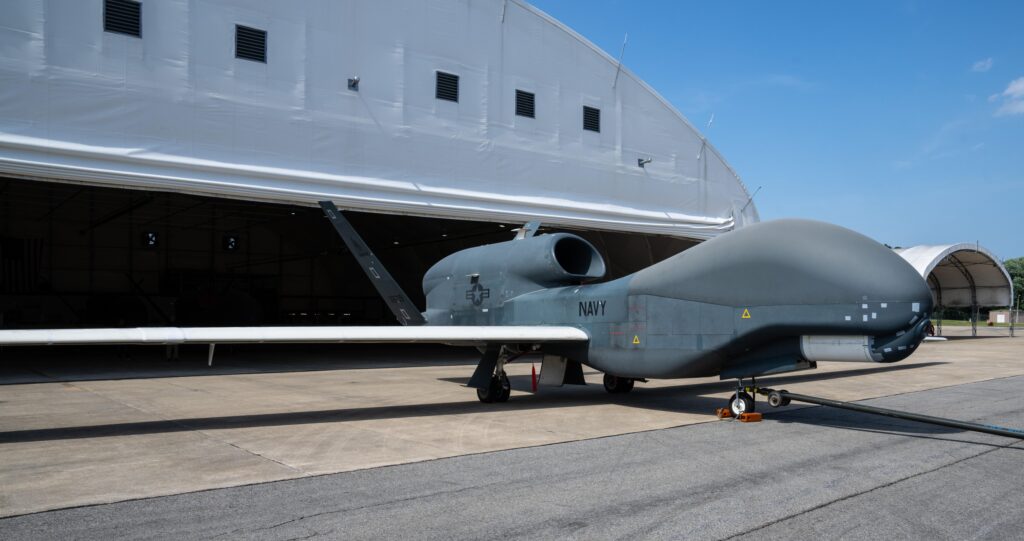
ARLINGTON, Va. — The U.S. Navy has ordered two more MQ-4C Triton high-altitude, long-endurance unmanned aerial vehicles from Northrop Grumman, the Defense Department said June 22.
The Naval Air Systems Command, Patuxent River, Maryland, awarded Northrop Grumman Systems a $248.2 million contract modification to procure two MQ-4Cs as an addition to Lot 5 low-rate initial production.
The contract modification follows two other contracts awarded in June to Northrop Grumman for the Triton program.
The Naval Air Systems Command awarded Northrop Grumman a $15.1 million contract modification on June 14 to incorporate production engineering change proposals that modify MQ-4C Triton unmanned aircraft system production UAVs to an integrated functional capability 4.0 multiple intelligence configuration for the Navy and the government of Australia.
Another contract issued June 16 awarded the company $20.5 million to incorporate IFC-4 for MQ-4Cs construction numbers B13 through B15.
The MQ-4C’s IFC-4 is designed to bring an enhanced multi-mission sensor capability as part of the Navy’s Maritime Intelligence, Surveillance, Reconnaissance and Targeting transition plan. The Triton in the IFC-4 configuration is designed to complement the Navy’s P-8A Poseidon maritime patrol aircraft and eventually will enable the Navy to retire its EP-3E Orion electronic reconnaissance aircraft. The initial operational capability for the Triton will be declared in 2023 when IFC-4-configured Tritons are deployed in enough quantity to field one complete orbit.
Work on the two additional UAVs is expected to be completed in February 2027.
Navy’s RQ-4A BAMS-D UAVs End 13-Year Mideast Deployment
The Broad Area Maritime Surveillance Demonstrator returned from 5th Fleet to Patuxent River, Maryland, June 17 after accruing more than 42,500 flight hours and over 2,000 oversea missions during a 13-year deployment. NORTHROP GRUMMAN
ARLINGTON, Va. — The Navy has brought home from the Middle East its last deployed RQ-4A Global Hawk Broad-Area Maritime Surveillance – Demonstrator (BAMS-D) unmanned aerial vehicle, culminating a 13-year span of operations that began as a six-month experiment.
According to a June 22 release from the Naval Air Systems Command, the RQ-4A returned to its home base, Naval Air Station Patuxent River, Maryland, from the U.S. 5th Fleet area of responsibility on June 17.
The Navy had deployed the RQ-4A to Southwest Asia since 2009 as a component of the BAMS-D program. Five Block 10 RQ-4As were acquired from the U.S. Air Force and were based at Patuxent River and operated in sequence over the years by detachments of Patrol Reconnaissance Wings 5, 2, and 11. The detachment kept at least one RQ-4A in the rotation to a base in the Persian Gulf region. One was lost in a mishap in Maryland in June 2012. Another was shot down June 19, 2019, in an unprovoked attack in international airspace over the Strait of Hormuz by an Iranian surface-to-air missile.
“BAMS-D has been a singular force multiplier for 5th Fleet and U.S. Central Command and has provided invaluable insights into the use of unmanned air systems as part of an overall concept of operations for naval ISR,” said Dave Seagle, BAMS-D deputy program manager, who has led the program since its inception, in the release.
BAMS-D provided more than 50% of maritime intelligence, surveillance and reconnaissance in theater accruing over 42,500 flight hours in 2,069 overseas missions, the Navy said.
“By 2013, BAMS-D had ramped up its capabilities to 15 24-hour missions every month, supplementing its first deployed aircraft with a second aircraft,” Seagle said. “Through the next nine years, BAMS-D provided uninterrupted operations and collected almost 1.4 million ISR scenes, highlighted over 11,500 targets of interest and provided the fleet with over 15,000 tactical reports, becoming an indispensable asset for the warfighter. One of many notable achievements occurred as recently as August 2021 when BAMS-D provided ISR coverage to non-combatant evacuation operations during the U.S. drawdown in Afghanistan.
“Despite the aging of the system and limited spares available, BAMS-D’s incredible operations and maintenance team achieved an overall mission availability rate of 96%, with more than 94% of scheduled missions completed,” he said.
The BAMS-D Integrated Sensor Suite featured electro-optical/infrared, synthetic aperture radar, ground moving target indicator and wide-area search modes retained from the Air Force production system. To improve performance in the maritime environment, LR-100 electronic surveillance sensors, Automatic Identification System receiver, inverse synthetic-aperture radar, and maritime search and maritime moving target indicator radar modes were integrated into the demonstrator system. The ground segment consisted of three launch and recovery elements, two mission control elements and a Navy-designed tactical auxiliary ground station.
In the Navy’s 2022 budget request, divestment of the RQ-4A Global Hawk Broad-Area Maritime Surveillance-Demonstrator UAV had been planned for acceleration from 2023 to 2022, with the savings invested in higher priorities.
The BAMS-D is being replaced by a Global hawk derivative, the MQ-4C Triton, which has been deployed to the Western Pacific in an Early Operational Capability deployment. The Triton with an upgraded sensor capability will be deployed in 2023.
Sea Machines Unveils Advancement in Vessel Navigation Instrumentation
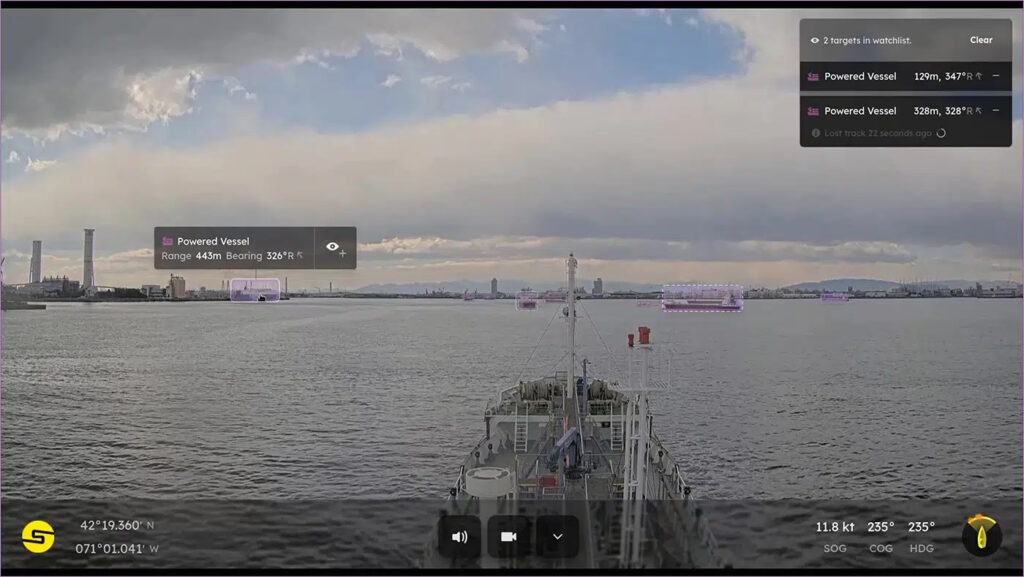
BOSTON — Sea Machines Robotics Inc., a developer of autonomous command and control and advanced perception systems for the marine industries, has unveiled AI-ris, a new marine computer vision navigation sensor designed to improve safety and performance while vessels are underway, the company said June 21.
The company revealed this new technology during Seawork2022, the largest European commercial marine exhibition. Sea Machines’ AI-ris, (artificial intelligence recognition and identification system) uses digital cameras and AI-processing to detect, track, classify and geolocate objects, vessel traffic and other potential obstacles in the majority of operational conditions, day or night, to equip crew with best-in-class situational awareness. Computer vision helps improve safety for vessels and is also a critical technology for the advancement of autonomous command and control systems.
Boats and ships operate in the planet’s most dynamic environment and the limitations of conventional navigation sensors leave the bulk of perception work to the human eye and brain for continuous scanning of the waterway. Fatigue, distraction, and confusion can lead to misses and mistakes. The U.S. Coast Guard reported that in 2020, 36% of boating accidents were collisions and allisions, with the primary cause being improper lookouts and operator inattention. The commercial marine industry suffers from similar challenges. Sea Machines designed AI-ris to be ever alert, with the ability to deliver predictable operational results that can improve vessel reliability, as well as eliminate liabilities caused by human error.
“Sea Machines is dedicated to building the future of ocean mobility. We envision a future with fewer accidents at sea. We are revolutionizing marine navigation with data-driven intelligence, autonomy and connectivity,” said CEO Michael G. Johnson, Sea Machines. “AI-ris enables a tremendous performance and safety increase. The superior capabilities of computer vision and AI will ensure a safer, more productive voyage.”
“AI-ris is always scanning for obstacles and can alert the operator of potentially dangerous situations. It also labels objects very small in size, like swimmers, kayakers or animals, to those very large, like another ship,” said CTO Trevor Vieweg, Sea Machines. “With the ability to detect, classify and geolocate such targets via optical sensors, AI-ris augments and surpasses the capabilities of existing marine sensor technologies, like radar and automatic identification system, enabling greater performance and achieving the highest levels of safety. In the future, this technology may also help responders detect marine oil spills.”
AI-ris is commercially available now and can be installed aboard existing vessels, as well as new builds.
CNO Visits Germany to Attend BALTOPS, Meets with Navy and Government Leaders
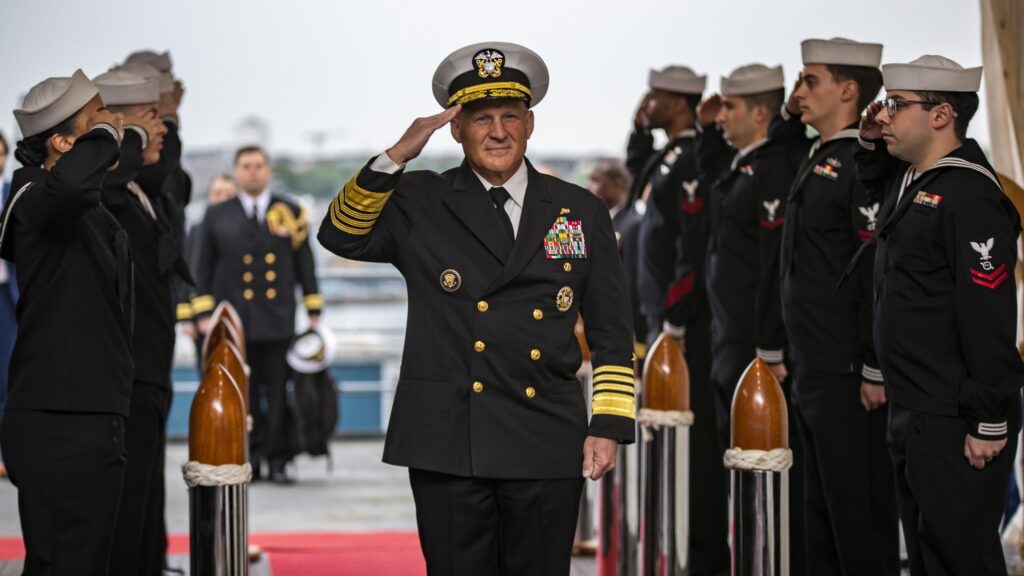
Chief of Naval Operations Adm. Mike Gilday arrives at the BALTOPS22 closing reception aboard the Blue Ridge-class command and control ship USS Mount Whitney (LCC 20) in Kiel, Germany, June 17. U.S. NAVY / Mass Communication Specialist 2nd Class Scott Barnes
KIEL, Germany — Chief of Naval Operations Adm. Mike Gilday traveled to Kiel, Germany June 15-18 for the conclusion of BALTOPS 22, The CNO’s Public Affairs office said June 18.
In its 51st iteration, BALTOPS is an annual coordinated exercise that reinforces interoperability with allies and partners and provides collective maritime security in the Baltic Sea.
Gilday visited the guided-missile destroyer USS Porter (DDG 78) at sea during the final days of the exercise.
“Our Sailors are our asymmetric advantage against any threat,” said Gilday. “Watching the incredible multi-domain coordination with our international partners, and seeing Sailors in action, is always inspiring.”
This year, 14 NATO allies, two NATO partner nations (Finland and Sweden), more than 45 ships, 75 aircraft, and approximately 7,000 personnel participated in BALTOPS 22.
“The United States’ strong defense relationships with our Northern European allies and partners constitute our greatest strategic advantage in the region,” said Gilday. “BALTOPS achieves a multitude of objectives by demonstrating NATO interoperability, interchangeability, and readiness.”
He added that naval forces are participating in this exercise and are focused on interoperability with Sweden and Finland, as well as the other allied nations of NATO. “We are trained, proficient and ready, BALTOPS demonstrates just that and our commitment to defending NATO is ironclad.”
While in Kiel, Gilday met with Vice Adm. Jan Kaack, chief of the German navy, as well as Vice Adm. Frank Lenski, vice chief of the German navy, to discuss operational areas of mutual interest, NATO operations, and Transatlantic security.
“I sincerely welcome the continued commitment of the U.S. Navy in Europe. Since 1972, the BALTOPS exercise has been taking place in the Baltic Sea under US leadership — this year for the 51st time,” said Lenski. “Our ties with the U.S. Navy are strong and will remain so because the Baltic Sea is part of NATO’s northern flank. It is our vital interest to guarantee freedom and security in this area.”
The trip culminated with a BALTOPS reception aboard the U.S. 6th Fleet flagship USS Mount Whitney (LCC 20), where Gilday met with U.S and foreign naval leadership as well as members of the local community. This was Gilday’s first visit to Germany.
Lockheed Martin Partners with U.S. Indo-Pacific Command in Successful Multi-Domain Experiments
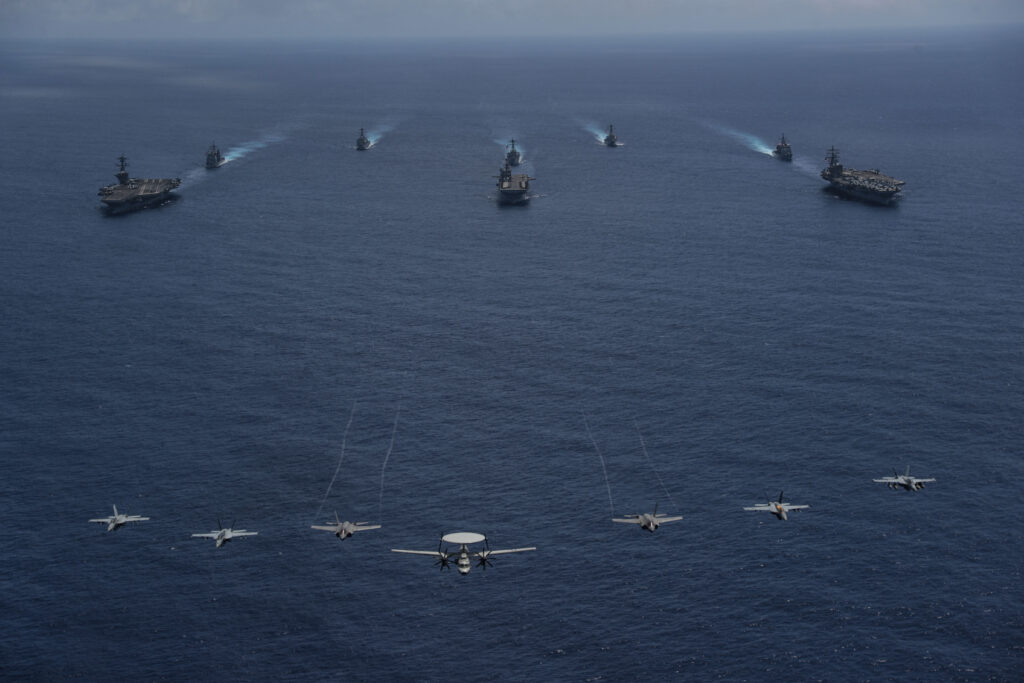
Aircraft from Carrier Air Wing (CVW) 9 fly over the Nimitz-class aircraft carrier Abraham Lincoln (CVN 72), front left, America-class amphibious assault ship USS Tripoli (LHA 7), front center, Nimitz-class aircraft carrier USS Ronald Reagan (CVN 76), front right, Ticonderoga-class guided-missile cruiser USS Mobile Bay (CG 53), middle left, Arleigh Burke-class guided-missile destroyer USS Benfold (DDG 65), middle center, Ticonderoga-class guided-missile cruiser USS Antietam (CG 54), middle right, Arleigh Burke-class guided-missile destroyer USS Spruance (DDG 111), back left, and Arleigh Burke-class guided-missile destroyer USS Fitzgerald (DDG 62), back right, as they sail in formation during Valiant Shield 2022. U.S. NAVY / Mass Communication Specialist 3rd Class Thaddeus Berry
BETHESDA, Md. — Lockheed Martin paired its DIAMONDShield battle management system with four Virtualized Aegis Weapon System nodes deployed across hundreds of miles to successfully demonstrate multi-domain operations during a recent U.S. military exercise, the company said June 21.
The exercise, Valiant Shield 2022, is a biennial training activity involving thousands of U.S. military personnel and more than 200 ships, aircraft and ground vehicles with a focus on integrating forces in multiple domains, and is a cornerstone of the U.S. Indo-Pacific Command’s integrated deterrence strategy to prevent conflict in the region.
During the 12-day event in Guam and other locations in the Pacific, Lockheed Martin partnered with the U.S. Indo-Pacific Command to experiment with using artificial intelligence to enable rapid decision-making — in seconds or minutes compared to hours — at strategic, operational and tactical levels of missions across air, land, sea and space.
“We recognize our customers’ need to rapidly integrate emerging technologies into mission-focused solutions,” said Joe Ferrara, Lockheed Martin’s advanced concepts director supporting the exercise. “Through experiments like Valiant Shield, we are learning collaboratively with our customers to advance Joint All Domain Operations, with the intent of delivering capability faster to the warfighter.”
With 14 Lockheed Martin engineers in the field, the company introduced DIAMONDShield and VAWS into a series of offensive and defensive scenarios involving Lockheed Martin’s High Mobility Artillery Rocket System and PAC-3 Missile Segment Enhancement. DIAMONDShield’s artificial intelligence technology analyzed operational command and control data in real-time during dynamic fires, and provided commanders with decision aids to recommend assets to respond to incoming threats.
After commanders decided how to engage, the VAWS next-generation combat system routed precision targeting data and detailed orders to front-line assets like the PAC-3 MSE and HIMARS. Using machine-to-machine interfaces, VAWS transmitted the information digitally across existing military service data stovepipes, a concept known as coordinating “digital force orders.” In this case, the Marine end user was able to execute a commander’s intent without having to manually translate the order into Marine doctrine, regardless of whether the order came from an Air Force, Army, or Navy commander. This also saved users time because they no longer had to read coordinates over a radio, and it reduced room for error by eliminating the risk of misinterpreting spoken instructions.
The team will use the experience and feedback to optimize training and improve the systems for the next exercise.
This is the fifth military exercise in which the company has partnered with the U.S. Indo-Pacific Command. Beginning in 2019 with Talisman Sabre and as part of the command’s Pacific Deterrence Initiative, Lockheed Martin has participated in a series of exercises that have each demonstrated progressively expanded capabilities: Talisman Sabre 2021 and 2019, Northern Edge 2021 and Valiant Shield 2020.
Cutter Offloads More than $99M in Illegal Narcotics at Base Miami Beach
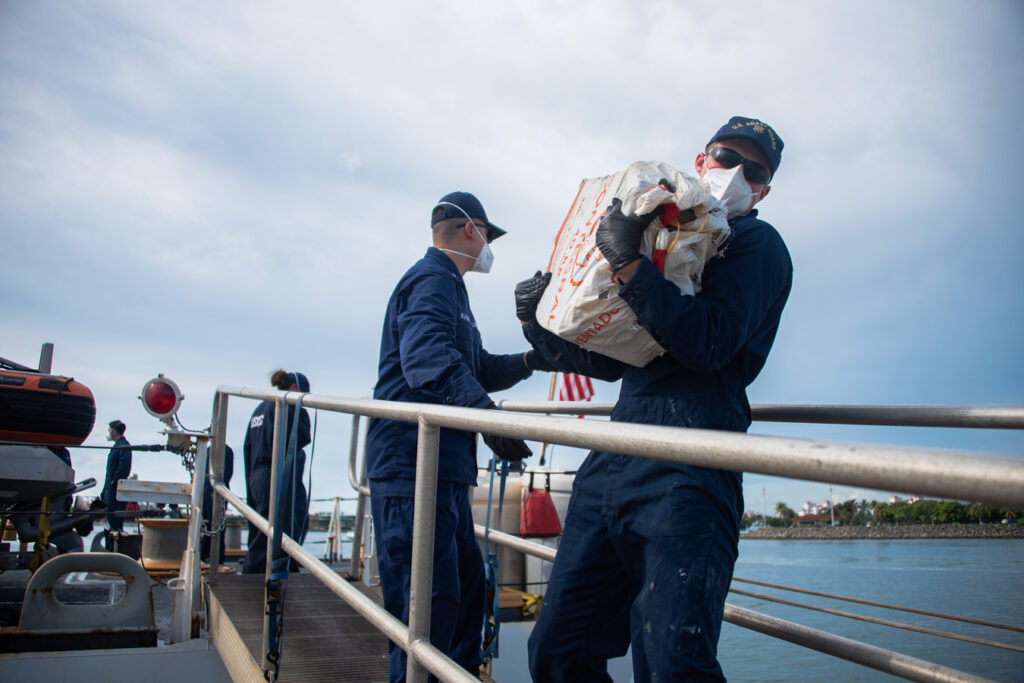
U.S. Coast Guard Cutter Thetis’ (WMEC 910) crew offloads approximately 5,237 pounds of illegal narcotics on June 17 at Coast Guard Base Miami Beach. U.S. COAST GUARD / Petty Officer 3rd Class Vincent Moreno
MIAMI — U.S. Coast Guard Cutter Thetis’ crew offloaded more than $99 million in illegal narcotics at Base Miami Beach, June 18, the Coast Guard 7th District said in a release.
Coast Guard and partner agency crews seized approximately 5,237 pounds of cocaine in the Caribbean Sea.
The drugs were interdicted in the international waters of the Caribbean Sea by crews from Coast Guard Cutter Donald Horsley, His Netherlands Majesty’s Ship Friesland and His Netherlands Majesty’s Ship Groningen.
“Interdicting drug traffickers on the open ocean is challenging work and every interdiction is complex and unique,” said Cmdr. Justin Nadolny, commanding officer of Thetis. “This offload is a testament to the teamwork and devotion of every crew assigned to carry out this mission, and it showcases the strength of the valuable international partnerships united to combat transnational organized crime.”
The fight against drug cartels in the Caribbean Sea requires unity of effort in all phases from detection, monitoring and interdictions, to criminal prosecutions by international partners and U.S. Attorneys’ Offices in districts across the nation.
During at-sea interdictions, a suspect vessel is initially detected and monitored by allied, military or law enforcement personnel coordinated by Joint Interagency Task Force-South based in Key West, Florida. The law enforcement phase of operations in the Caribbean Sea is conducted under the authority of the Seventh Coast Guard District, headquartered in Miami. The interdictions, including the actual boardings, are led and conducted by members of the U.S. Coast Guard.
The Thetis, a 270-foot Famous-class medium-endurance cutter, is homeported in Key West and patrols the Caribbean Sea and the Gulf of Mexico, performing counter-drug operations, migrant interdiction operations, search and rescue, and fisheries enforcement.
Coast Guard’s Force in Middle East Supports National Security Mission
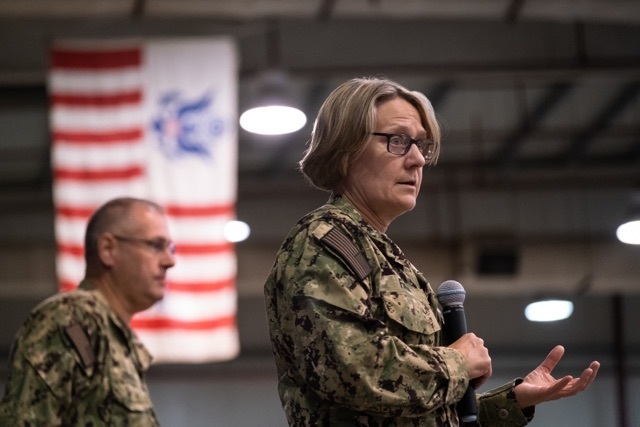
Commandant of the U.S. Coast Guard Adm. Linda Fagan speaks to Coast Guardsmen assigned to Patrol Forces Southwest Asia in Bahrain, June 15, as part of her first official visit overseas after assuming her new role as the service’s top officer. U.S. COAST GUARD / Petty Officer 1st Class Brandon Giles
MANAMA, Bahrain — U.S. Coast Guard Patrol Forces Southwest Asia (PATFORSWA) conducted a change of command ceremony on Thursday, June 16 at Manama, Bahrain, as Capt. Eric Helgen relieved Capt. Benjamin Berg.
Presiding over the ceremony was Adm. Linda Fagan, Commandant of the Coast Guard.
“PATFORSWA has a unique area of operations and mission,” Fagan said. “The cutters homeported here are attached to Commander, Task Force 55 to support U.S. Naval Forces Central Command and Combined Maritime Forces strategic objectives. They provide a constant and reliable presence to maintain maritime domain awareness, deter acts of maritime piracy and smuggling, protect critical maritime infrastructure, and ensure the safe flow of goods and materials. There is no other Coast Guard unit that has a stronger link to the joint force in support of the national defense mission.”
Fagan said the cutters have participated in many high-impact operations. “They were on scene for tense boardings of commercial vessels; they navigated interactions with the Iranian Revolutionary Guard Corps Navy; and they conducted extensive interdiction operations.”
Fagan recognized the 110-foot Patrol Boats that served in PATFORSWA. “Adak, Aquidneck, Maui, Monomoy and Wrangell stayed on mission to the very end with operations in the Arabian Gulf and Gulf of Oman.”
One remains, USCGC Baranof, which will be decommissioned soon. “The Baranof is out conducting critical missions as we speak,” Fagan said.
The 110-foot patrol boats are being replaced by the new Fast Response Cutters. “Taking the baton from the 110s, the Fast Response Cutters have proven to be an exceptional platform to project the Coast Guard’s regional expertise to national and coalition forces,” said Fagan.
The four FRCs now in PATFOR SWA are USCGC Charles Moulthrope (WPC 1141), USCGC Robert Goldman (WPC-1142), USCGC Glen Harris (WPC 1144) and USCGC Emlen Tunnell (WPC 1145). Two more FRCs, USCG John Scheuerman (WPC 1146) and USCGC Clarence Sutphin (WPC 1147) arrive in PATFORSWA soon.
While operating with CTF-150, a task force within the Combined Maritime Forces, newly reporting FRCs conducted boardings in the Gulf of Oman that resulted in seizures of heroine, methamphetamine and hashish with a U.S. street value of 17 million dollars.
PATFORSWA provides shoreside teams to support the cutter crews with antiterrorism/force protection, naval engineering, supply and personnel administration along the way. Training teams also support the Navy and partner nations. The Advanced Interdiction Teams embark on the U.S. warships to conduct boardings and seizures of illicit cargos. Several months ago, AITs aboard USS Tempest and USS Typhoon seized 1,400 AK-47 rifles and 226 thousand rounds of ammunition from a stateless fishing vessel in the North Arabian Sea.
“That illegal arms shipment would have contributed to violence and instability in the region had it reached its destination,” Fagan said.
“Any illegal activity at sea — whether it is drug smuggling, weapons shipments, or illegal, unreported or unregulated fishing — erodes the rule of law and regional stability,” Fagan said. “The United States Coast Guard is the global model for maritime governance, the positive force that protects maritime safety, security and economic prosperity.”
Critical Partnerships
In today’s connected world, maritime governance is a collaborative effort. Fagan said partnerships are critically important.
“PATFORSWA leads the way with international engagement throughout the region. The Maritime Engagement Team supports CENTCOM’s theater campaign plan through participation in multi-lateral, interagency exercises and subject matter expert exchanges with foreign militaries. This year the team engaged with more than 350 people from 16 partner nations, sharing expertise on boarding tactics and small boat operations,” she said.
And the Shoreside team contributed in this area, too. “In addition to supporting the 110s and FRCs, they provided electronics and engineering assistance to the Yemeni Coast Guard, and the Lebanese Armed Forces – Navy, a critical 5th Fleet partner who will soon receive three 87-foot Coastal Patrol Boats.”
Additionally, the Shoreside team deployed 25 people for three weeks of support to Operation Allies Refuge, the DoD and DHS operation to safely vet, protec, and transport more than 7,000 evacuees from Afghanistan to Bahrain.
“They were the first people the non-combat evacuees encountered on the flight line after arriving direct from Kabul,” Fagan said.
Helgen is reporting from the 7th Coast Guard District in Miami where he served as the deputy of the Office of Maritime Enforcement.
“I’m exceptionally honored and deeply humbled to have the opportunity to be part of a team whose members sacrifice a year away from their families to execute such a vital mission in support of the United States,” Helgen said.
“PATFORSWA excelled under Captain Berg’s leadership because this crew trusted him, they responded to his vision and leadership, and they rose to the challenge,” said Fagan.
“It has been my absolute pleasure to serve with the outstanding Coast Guard women and men of Patrol Forces Southwest Asia. The dedication and professionalism was evident in every patrol, repair and forward deployment,” Berg said. “I’m certainly pleased of the operational accomplishments of our cutters, crews and partner nation engagements, but I was more energized each day to observe the crews taking pride knowing their work was bringing stability and rule of law to the region.”
Navy Orders Third Constellation-Class Frigate from Fincantieri Marinette Marine
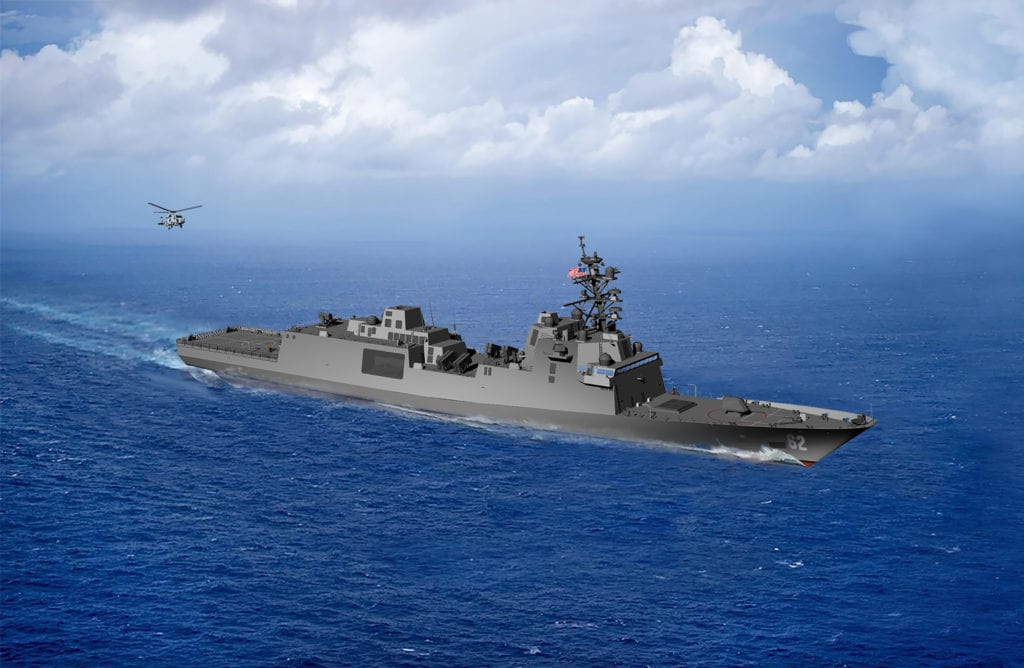
An artist’s rendering of the Constellation-class guided missile frigate. U.S. NAVY
ARLINGTON, Va. — The U.S. Navy has exercised a contract option to order the third Constellation-class guided-missile frigate (FFG) from Fincantieri Marinette Marine.
The Naval Sea Systems Command awarded Marinette Marine Corp., Marinette, Wisconsin, was awarded a $536.9 million “fixed-price incentive (firm target) and firm-fixed-price modification to previously awarded contract” for the future USS Chesapeake (FFG 64), the Defense Department announced June 16.
The order follows the $553.8 million contract option exercised on May 20, 2021, for the second ship of the class, the future USS Congress (FFG 63).
The Marinette Marine shipyard is currently working on the detailed design for the first ship of the class, the future USS Constellation (FFG 62). Cutting of first steel is scheduled for later this year.
The Navy has a requirement for 20 frigates. Marinette Marine is now under contract for the first three FFGs with options for seven more.
The Constellation class FFG is based largely on the Italian FREMM frigate.
Work on the latest contract option is expected to be completed by August 2028.
USS Paul Ignatius, Newest FDNF-E Ship, Arrives in Homeport Rota, Spain
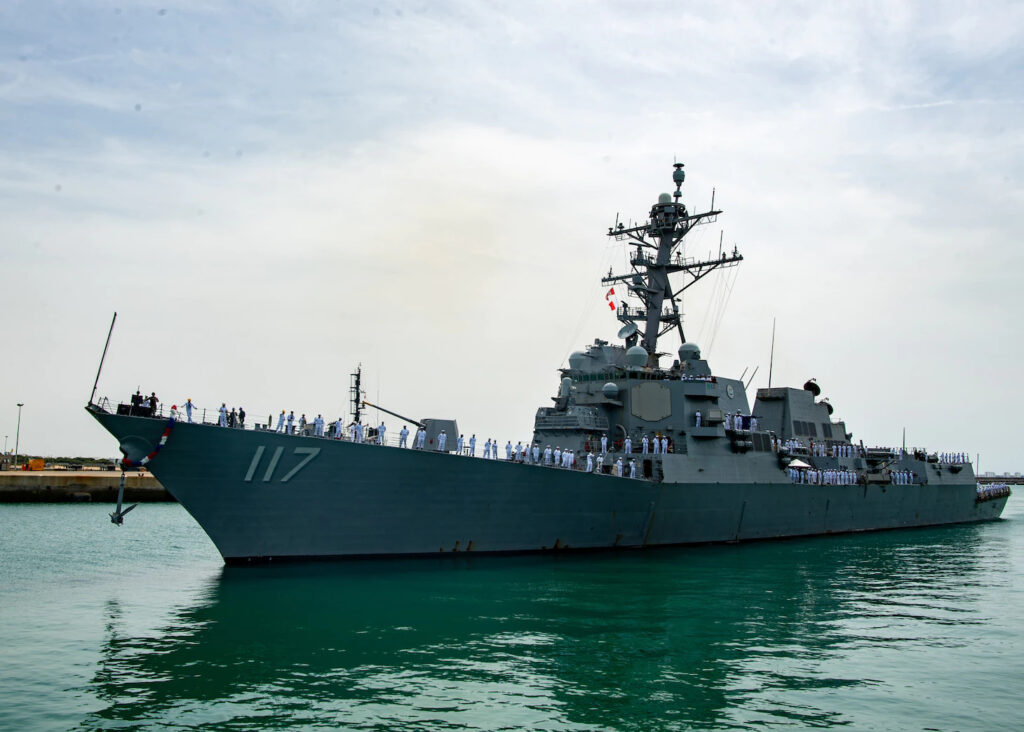
Arleigh Burke class guided-missile destroyer USS Paul Ignatius (DDG 117) pulls into port, completing its homeport shift to Naval Station Rota, Spain, June 17. U.S. NAVY / Mass Communication Specialist 2nd Class Jacob Owen
NAVAL SUPPORT ACTIVITY ROTA, Spain — The Arleigh Burke-class guided-missile destroyer USS Paul Ignatius (DDG 117) arrived in its new homeport of Naval Station Rota, Spain, on June 17 as the U.S. Navy’s newest Forward Deployed Naval Forces–Europe (FDNF-E) destroyer, 6th Fleet Public Affairs said in a release.
Prior to arriving in Rota, Paul Ignatius operated alongside British, Canadian, French, German and Norwegian allies as part of exercises Cable Car and Green Light. The ship also conducted port visits in Ponta Delgada, Portugal and Bergen, Norway. In the Baltic Sea, Paul Ignatius integrated with the 2nd Marine Division and the Kearsarge Amphibious Readiness Group with embarked Amphibious Squadron Six and 22nd Marine Expeditionary Unit. The ship also conducted interoperability exercises with the USS Sioux City (LCS 11) during the inaugural deployment of a Freedom-class littoral combat ship to 5th and 6th Fleet areas of operation.
“We certainly met and exceeded our goals,” said Cmdr. Aaron Arky, commanding officer of Paul Ignatius. “I couldn’t be more proud of the team as they superbly conducted undersea, air-defense and expeditionary operations during this patrol.”
Commissioned in 2019, Paul Ignatius is the second of eight Flight IIA technology insertion ships, bringing enhanced capability and technological advancements to U.S. Naval Forces Europe and Destroyer Squadron 60. The ship is the 67th Arleigh Burke-class guided-missile destroyer, a class capable of conducting a variety of missions from sea control and power projection to peacetime presence and humanitarian assistance and disaster relief.
The ship’s arrival in Rota brings substantial capabilities to the FDNF-E force already in place. Arriving to their new homeport also allows Paul Ignatius Sailors the opportunity to get acquainted with their new duty station and to reunite with their families, many of whom have already arrived in Rota.
“The uniqueness of this homecoming cannot be understated, as we are both returning to our families and arriving at our new homeport,” said Arky. “The tremendous support network established by Naval Station Rota and Destroyer Squadron 60 has immensely helped the families and Sailors alike. For that, we are grateful.”
Navy to Christen Guided-Missile Destroyer John Basilone
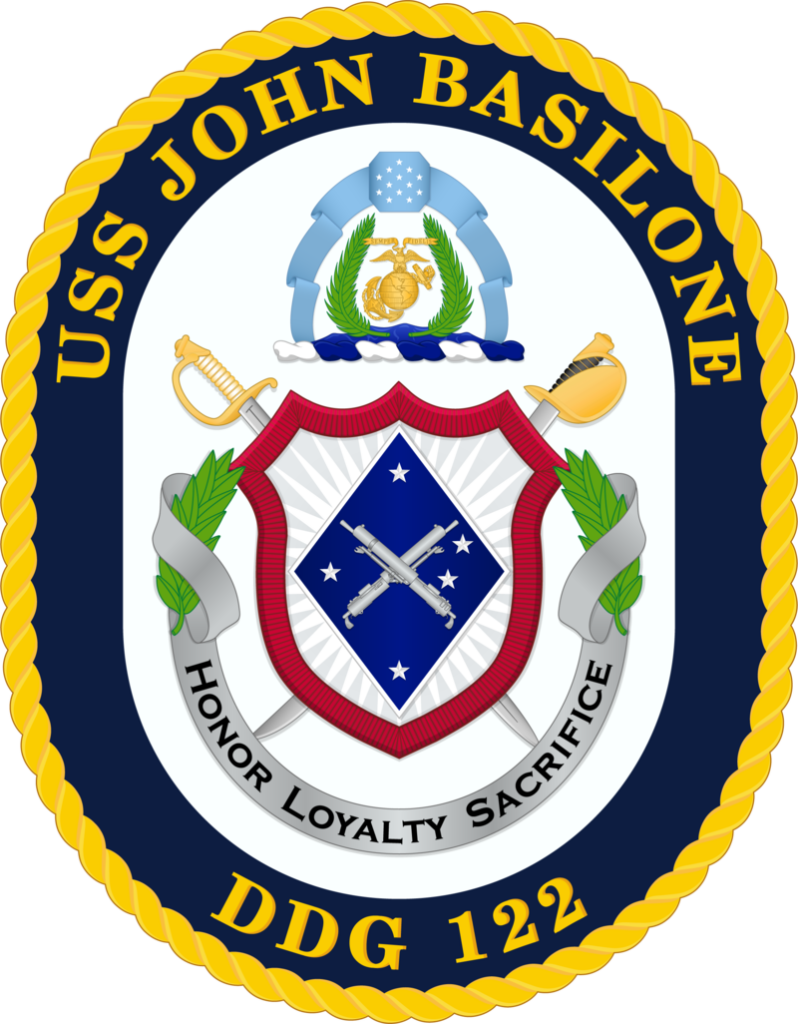
ARLINGTON, Va. — The Navy will christen the future USS John Basilone (DDG 122) during a 10:30 a.m. EDT ceremony on Saturday, June 18, at General Dynamics Bath Iron Works in Bath, Maine, the Defense Department announced June 17.
Sgt. Maj. of the Marine Corps Troy Black will deliver the christening ceremony’s principal address. U.S. Sen. Susan Collins of Maine, Vice Adm. Francis Morley, principal military deputy to the assistant secretary of the Navy for research, development, and acquisition, Vice Adm. Scott Conn, deputy chief of naval operations for warfighting requirements and capabilities, Don Basilone, brother of the ship’s namesake and Charles Krugh, president of General Dynamics Bath Iron Works, will also provide remarks. The ship’s sponsors are Ryan Manion and Amy Looney Heffernan, president and vice president of the Travis Manion Foundation. Heffernan is unable to attend the event. In a time-honored Navy tradition, Manion will christen the ship by breaking a bottle of sparkling wine across the bow.
The ship’s namesake, Gunnery Sgt. John Basilone, received the Medal of Honor for heroism displayed in the Battle of Guadalcanal during World War II, where he led his heavy machine gun sections in defense of a critical position and inflicted heavy casualties on the enemy. Basilone later returned to action at the Battle of Iwo Jima in February of 1944, where he single-handedly destroyed an enemy blockhouse and led a Marine tank under fire safely through a minefield. He was killed in action later that day and was posthumously awarded the Navy Cross for his unwavering devotion and valiant spirit of self-sacrifice.
“The future USS John Basilone will serve as a constant reminder of the immense impact that actions taken by any one Sailor or Marine can truly have,” said Secretary of the Navy Carlos Del Toro. “Gunnery Sgt. Basilone is a national hero and this ship and crew will honor his legacy for decades to come.”
This is the second ship to honor Basilone. The first, USS Basilone (DD 824), was a Gearing-class destroyer in service from 1945 to 1977.