SECNAV Names Future Arleigh Burke-class Destroyer USS J. William Middendorf 
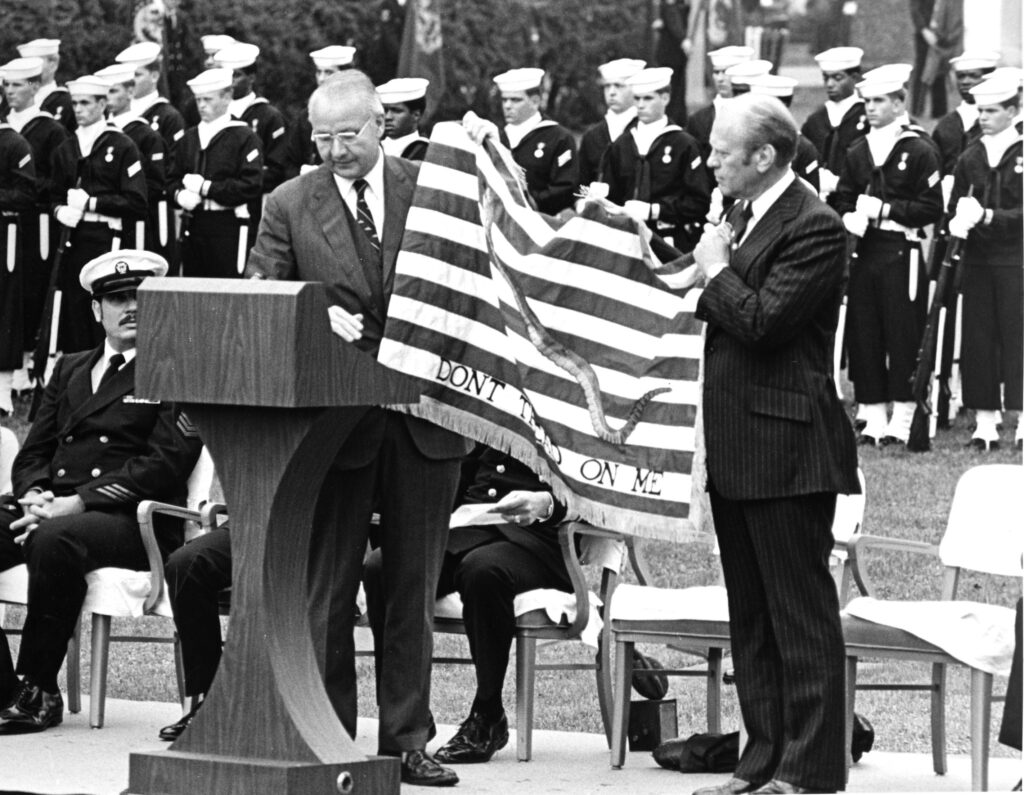
President Gerald R. Ford receives the prototype of the ceremonial Continental Navy Jack from Secretary of the Navy J. William Middendorf, II during a ceremony in Washington in October 1975. A smaller version of the flag was flown from the jack staff of every U.S. Navy ship in December 1976 as part of the Navy’s bicentennial celebration. U.S. NAVY / Chief Journalist Richard Montgomery

ARLINGTON, Va. — Secretary of the Navy Carlos Del Toro announced June 10 during the Naval War College commencement that future Arleigh Burke-class guided-missile destroyer DDG-138 will be named USS J. William Middendorf, the Defense Department said in a release.   

The future USS J. William Middendorf will honor former Secretary of the Navy and U.S. Ambassador J. William Middendorf II. The name selection follows the tradition of naming destroyers after U.S. naval leaders and heroes.   

In 2020, former Secretary of the Navy Richard Spencer announced his intention to name a ship after Middendorf but had not dedicated the name to an assigned hull number. Del Toro assigned the name to DDG-138, which was appropriated in the fiscal year 2022 budget.   

“I am pleased to honor Secretary Spencer’s previous decision to name a ship after Ambassador J. William Middendorf and I am incredibly proud to announce it here, at the Naval War College, during the commencement of our future leaders,” said Del Toro. “Middendorf’s spirit of innovation and questioning helped champion programs that are still defending our nation today. This namesake ship will continue to inspire that legacy.” 

Middendorf was born in 1924, in Baltimore, Maryland. Throughout 1944-1946, while serving in the Navy aboard landing craft support ship, USS LCS(L)(3)-53, he earned his Bachelor of Naval Science. After a discharge from naval service he earned an additional B.A. from Harvard University and then an M.B.A. from New York University. In 1969, he was appointed U.S. Ambassador to the Netherlands and continued in the position until 1973. He then served as undersecretary of the Navy with an appointment from President Richard Nixon. On April 8, 1974, Middendorf became the 62nd secretary of the Navy. During his tenure as Secretary of the Navy, he championed the Trident submarine program, Aegis Missile system, oversaw the creation of the famed Marine Corps Marathon, and was instrumental in the development of the F/A-18 Hornet. In addition to his career in public service, Middendorf is widely respected philanthropist and an accomplished author, artist, and composer.  

“I met with Middendorf recently, affirming my decision to move forward with the previous naming decision. His ongoing leadership and respect provides a worthy cause for the naming of a destroyer,” said Del Toro. “The men and women who will sail upon this vessel will undoubtedly be inspired and strengthened by legacy of the namesake, ultimately impacting actions and decisions that will further our nation and freedom across the globe.”
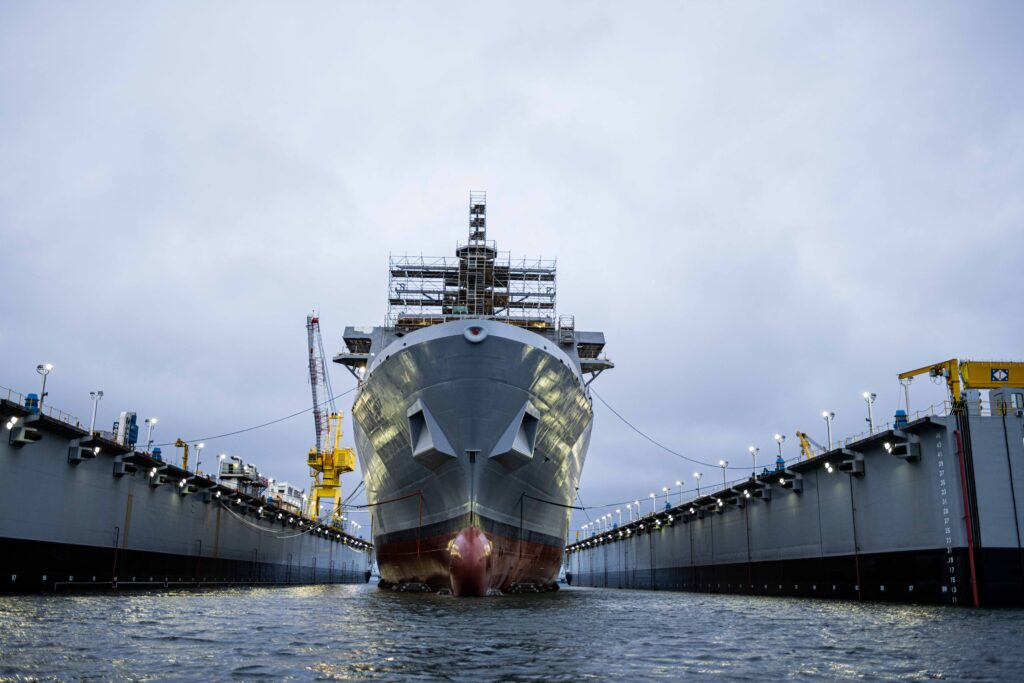
HII Christens LPD Richard M. McCool Jr. 

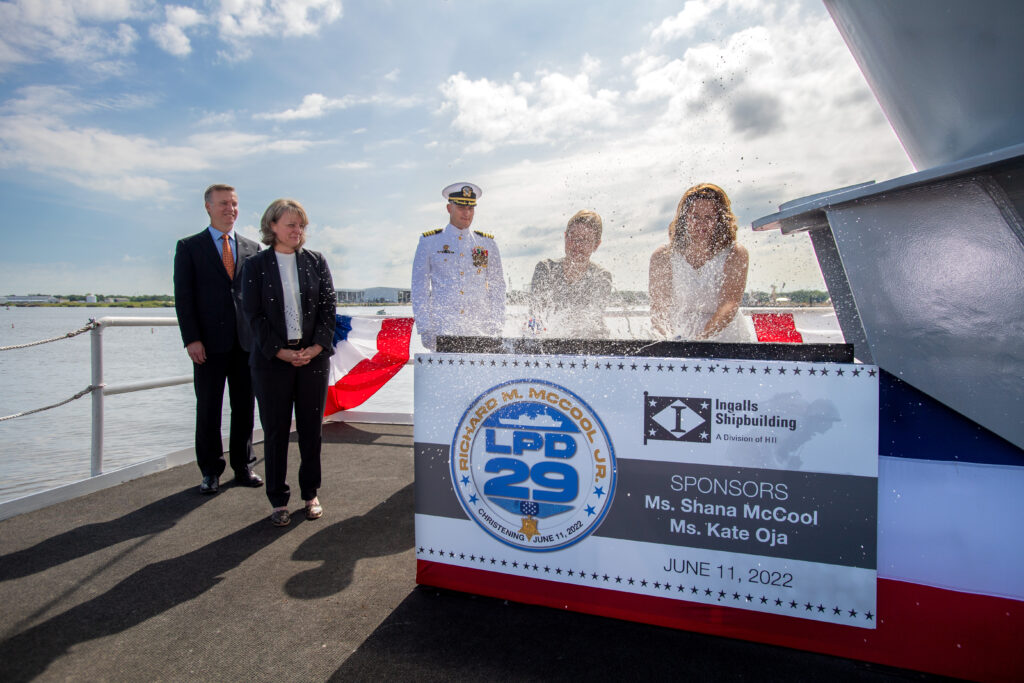
Ship sponsors Kate Oja and Shana McCool christen the ship named after their grandfather, Richard M. McCool Jr., on June 11. Looking on are Eric Raven, undersecretary of the Navy, Kari Wilkinson, president of Ingalls Shipbuilding, and Capt. Jeffrey Baker, prospective commanding officer of the ship. HII

PASCAGOULA, Miss. — HII announced June 11 that its Ingalls Shipbuilding division christened the company’s 13th amphibious transport dock, Richard M. McCool Jr. (LPD 29), constructed for the U.S. Navy. 

“For nearly two decades, we have had the opportunity to build these amphibious ships, and we look forward to continuing this journey with such a valued partner,” Ingalls Shipbuilding President Kari Wilkinson said. “Today we reflect on Richard M. McCool Jr.’s bravery and heroism in front of a ship that will carry another generation of brave Sailors and Marines into missions defending our freedom.” 

LPD 29 is named to honor U.S. Navy Capt. Richard M. McCool Jr., who was awarded the Medal of Honor for his heroic actions in rescuing survivors from a sinking destroyer and for saving his own landing support ship during a World War II kamikaze attack. His rescue efforts took place exactly 77 years prior to the day Richard M. McCool Jr. (LPD 29) was christened.          

Undersecretary of the Navy Erik Raven was the keynote speaker. 

“Richard M. McCool Jr. truly embodied the spirit of service above self,” Raven said. “The Sailors and Marines who will sail on this future ship carry on that legacy following the example of spirit, patriotism and selflessness set by Richard M. McCool Jr.” 

When speaking of America’s defense capabilities, Raven said, “We are able to deploy exquisite capabilities across the globe in great part due to our dedicated shipbuilders and our talented team. These talented Americans are essential to making sure that our naval forces have the ships that they need.” 

Richard M. McCool Jr. is co-sponsored by Shana McCool and Kate Oja, granddaughters of the ship’s namesake. Together, the two sponsors officially christened Richard M. McCool Jr. by smashing a bottle of sparkling wine across the bow of the ship. McCool spoke on behalf of both sponsors at today’s ceremony. 

When speaking about her grandfather’s heroic acts some 77 years ago, McCool said, “To the commanding officer and future crew of this ship, may she (the ship) keep you safe. And in the words of our grandfather, may you always remember to fight as a unit and not as individuals.” 


London Tech Bridge Breaks Down Barriers with New Collaboration Space      

WESTMINSTER, London — The United Kingdom-based Tech Bridge hosted a ribbon-cutting ceremony June 13 to celebrate the grand opening of its innovation hub, said Liz Mildenstein of NavalX. 

The London Tech Bridge will leverage partnerships with the U.S. Office of Naval Research Global and the Royal Navy Office of the Chief Technology Officer to foster connectivity, agility and innovation. The location will sponsor dialogue, joint investment and cooperative development between the two navies. 

“The opening of the London Tech Bridge’s innovation hub represents a new way for great minds to come together in a unique atmosphere, share ideas and technologies, and foster more effective research collaboration,” said Chief of Naval Research Rear Adm. Lorin Selby. “This joint U.S.-U.K. partnership is critical to advance new ideas and keep our naval forces dominant.  

“We’re looking for partners with strong curiosity, a passion for action and a commitment to scientific and technological excellence.” 

Initially launched at the end of 2020 during a virtual ceremony, the London Tech Bridge has already made strides in moving the innovation needle.   

For example, it played a critical role in the recent APEX underwater Challenge. The London Tech Bridge coordinated and arranged sponsorship for three research grants to teams from the University of Rhode Island in the United States, Robert Gordon University in Scotland and TNO (Netherlands Organisation for Applied Scientific Research) to execute the challenge. These teams helped unmanned underwater vessels sense objects with sonar or optical cameras and communicate what they “saw” to operators. 

“The London Tech Bridge does exactly what it says on the tin,” said Rear Adm. James Parkin CBE, cutting the ribbon on behalf of the Royal Navy. “Being in London, right next to the strategic headquarters of our armed forces, and at the heart of this great global city, allows exposure not only to the latest thinking in defense innovation, but provides physical access to those varied organizations and individuals conducting some of the most exciting technological research and development anywhere in the world.  

“As such, it’s all about tech — sharing our understanding of exciting developments in autonomy, materials, platforms, sensors, processing and concepts, and unlocking the Royal Navy’s connections to those world leading academic, industrial and public sector organizations in the U.K., towards achieving our common goals. 

“And perhaps most importantly, it’s a figurative Bridge, one that permits the Royal Navy to reach across the Atlantic into the U.S. Navy, and vice versa, enabling our great nations to join forces in collaborating ever closer, in order to identify the opportunities, and solve the problems, that either or both of us have identified.” 

The London Tech Bridge’s new location will also conduct its initial “Tea and Tech” in June, kicking off a monthly session with industry in specified technology areas. Tea and Tech will allow companies to pitch their ideas and technology to the U.S. and U.K. navies. 

The Tech Bridge Network 

The Tech Bridge network, powered by NavalX, spans 18 national and international locations. The network is designed to bridge the gap between the Navy and emerging entities like startups, small businesses, academia, nonprofits and private capital that aren’t traditionally part of the Navy’s development and acquisition process.  

Although there is some commonality among them, the Tech Bridges offer unique services and focus areas within their ecosystems, based on the needs of the customers in their respective areas of responsibility. The London Tech Bridge uniquely builds upon the historic relationship between the U.S. and U.K., and seeks innovation and technology in several key focus areas, including artificial intelligence, autonomous systems, directed energy, green energy, advanced manufacturing and maintenance and sustainment.  

While the Tech Bridge has defined these focus areas to guide its work, it remains open to innovative ideas and game-changing technologies; it remains agile and anticipates its focus areas evolving over time. Its U.K. co-director, Royal Navy Commander Laurence Mallinson, emphasized the need for flexibility in the Tech Bridge.   

“Having started virtually a year ago, it is great to finally have a place to hold those vital face-to-face meetings and collaboration events. We are right in the heart of one of the world’s most advanced tech centers and so able to bring cutting-edge tech solutions to our navies’ problems,” he said. “We will focus on challenging industry with solving some of the most pressing problems that our navies are trying to resolve, and bring to the attention of our sailors and marines some of the greatest new technologies in the U.K.” 

The addition of a physical innovation hub to the London Tech Bridge framework removes the typical meeting barriers of attending events on a military base and allows for the free flow of thoughts and innovation with limited bureaucracy. 


HII Successfully Demonstrates Coordinated Manned and Unmanned Operations 

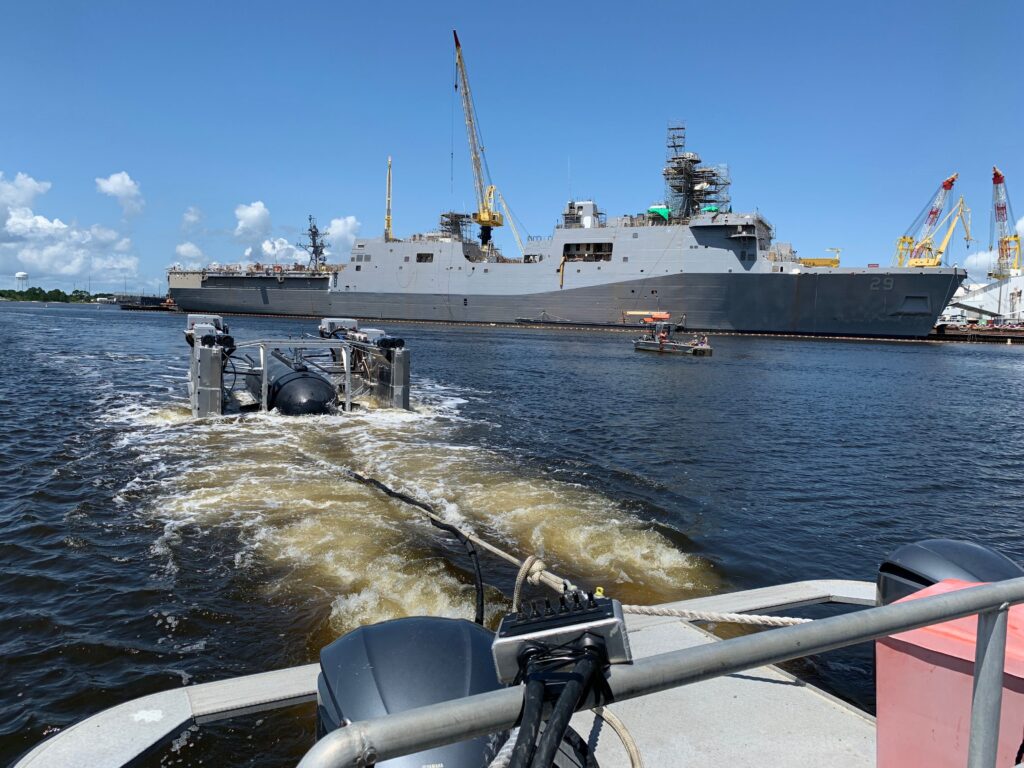
HII’s prototype Pharos platform being towed behind a vehicle in the Pascagoula River while recovering HII’s LDUUV during a June 8 demonstration. HII

PASCAGOULA, Miss. — HII demonstrated capabilities enabling amphibious warships to launch, operate with and recover large-diameter unmanned underwater vehicles, the company said June 13.  

“HII is committed to advancing the future of distributed maritime operations and demonstrating our capability to support unmanned vehicles on amphibious ships,” said Kari Wilkinson, president of Ingalls Shipbuilding, which hosted and partnered in the demonstration between HII’s Ingalls Shipbuilding and Mission Technologies, with all of the participating vehicles being built by HII. “I am very proud of our team’s initiative to strengthen the flexibility of the ships we build by anticipating the challenges and opportunities that exist for our customers.” 

HII-built San Antonio-class amphibious warships have unique well decks that can be flooded to launch and recover various maritime platforms. The U.S. Navy has previously demonstrated the ability to recover spacecraft from the amphibious warship well deck. 

HII’s Advanced Technology Group, comprised of employees from across the company, performed the launch and recovery demonstration with a prototype platform called Pharos and HII’s LDUUV Proteus. The demonstration took place in the Pascagoula River. 

The demonstration involved having the LDUUV approach and be captured by the Pharos cradle, while Pharos was being towed behind a small craft that simulated an amphibious ship at low speed. Pharos was put in a tow position, then using a remote control, it was ballasted down in the trailing position allowing the LDUUV to navigate into Pharos. Once the unmanned vehicle was captured, Pharos was de-ballasted back up into a recovery and transport position. The demonstration also included ballasting down to launch the LDUUV after the capture. 

Pharos is outfitted with heavy duty wheels to allow its transport maneuverability within the well deck of an amphibious ship for stowage on the vehicle decks. Pharos can be rolled off the back of an amphibious ship while using the ship’s existing winch capabilities to extend and retract the platform from the well deck. The Pharos design is scalable and reconfigurable to fit various unmanned underwater or unmanned surface vehicles. 

The Pharos design was conducted by HII, and three main partners supported the development. The University of New Orleans, in conjunction with the Navy, performed the initial model testing, and the prototype device was fabricated by Metal Shark in Louisiana. 

HII is currently exploring modifications for other UUVs and participating in live demonstrations with the fleet within the next year. HII will use results from the Pharos demonstration to further mature concepts and continue to develop innovative national security solutions. 


Navy to Christen Amphibious Transport Dock Ship Richard M. McCool Jr. 

The future USS Richard M. McCool Jr., launched earlier this year at Ingalls Shipbuilding Division. HII

ARLINGTON, Va. — The Navy will christen its newest amphibious transport dock, the future USS Richard M. McCool Jr. (LPD 29), during a 9 a.m. CDT ceremony Saturday, June 11, at the HII Ingalls Division shipyard in Pascagoula, Mississippi, the Defense Department said June 10. 

The principal speaker is Undersecretary of the Navy Erik Raven. Additional speakers include Lt. Gen. David Bellon, commander, United States Marine Corps Reserve and Marine Corps Forces, South; Vice Adm. Randy Crites, deputy chief of naval operations for integration of capabilities and resources; and Kari Wilkinson, president of Ingalls Shipbuilding. In a time-honored Navy tradition, the ship’s sponsors and granddaughters of its namesake, Shana McCool and Kate Oja, will christen the ship by breaking a bottle of sparkling wine across the bow. 

The ship is named in honor of Navy veteran and Medal of Honor recipient, retired Capt. Richard Miles McCool Jr., who was awarded the Medal of Honor for the heroism he displayed June 10 and 11, 1945, in coordinating damage control and rescue operations after a series of Japanese kamikaze aircraft attacks during the Battle of Okinawa. On June 10, 1945, his leadership efforts greatly assisted in evacuating survivors from a sinking destroyer. After his ship was struck by a kamikaze June 11, then Lt. McCool Jr., despite suffering from shrapnel wounds and painful burns, led vigorous damage control efforts to save his ship from destruction and personally rescue Sailors trapped in blazing compartments. McCool passed away on March 5, 2008. 

“Tomorrow we christen the future USS Richard M. McCool Jr., recognizing a Medal of Honor awardee and true American hero for his unwavering devotion to duty and service to our country,” said Secretary of the Navy Carlos Del Toro. “This historic occasion brings us one step closer to ‘manning the rails’ with the men and women who will carry on the proud naval tradition of defending our nation and working towards a more peaceful world.” 

The future Richard M. McCool Jr. is the 13th San Antonio-class ship, designed to support embarking, transporting, and bringing elements of 650 Marines ashore by landing craft or air-cushion vehicles. A flight deck hangar further enhances the ship’s capabilities, which can support the MV-22 Osprey tilt-rotor aircraft. 

San Antonio-class ships can support a variety of amphibious assault, special operations, or expeditionary warfare missions, operating independently or as part of Amphibious Readiness Groups, Expeditionary Strike Groups or joint task forces. These capabilities allow the U.S. Navy to protect America’s security abroad and promote regional stability and preserve future peace. 


Navy Accepts Delivery of Ship-to-Shore Connector LCAC 104 

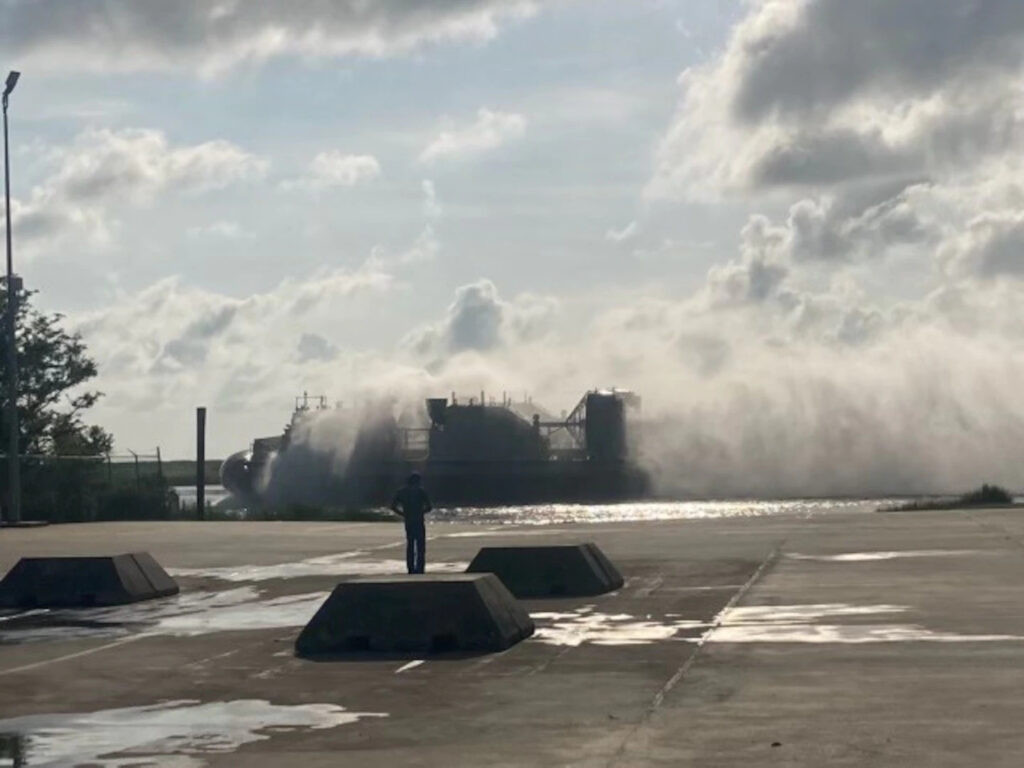
The Navy accepted delivery of Landing Craft, Air Cushion (LCAC) 104 on June 9. U.S. NAVY

WASHINGTON — The Navy accepted delivery of the next generation landing craft, Ship-to-Shore Connector, Landing Craft, Air Cushion (LCAC) 104, June 9, Team Ships Public Affairs said in a release. 

LCAC 104’s delivery follows the completion of acceptance trials with the Navy’s Board of Inspection and Survey to test the readiness and capability of the craft and to validate requirements. 

“These next generation craft provide our Navy and Marine Corps team with essential agility and speed to complete their missions,” said Capt. Jason Grabelle, program manager, Amphibious Assault and Connectors Programs, Program Executive Office Ships. “The reliability and flexibility of the LCAC make them an essential asset to the fleet, protecting the maritime domain now and in the future.”  

LCACs are built with similar configurations, dimensions and clearances to the legacy LCAC, ensuring the compatibility of this next-generation air cushion vehicle with existing well deck-equipped amphibious ships. 

The LCAC program is currently in serial production on LCACs 105 – 116 at Textron Systems. 


Four Crew Members Survive MH-60S Crash 

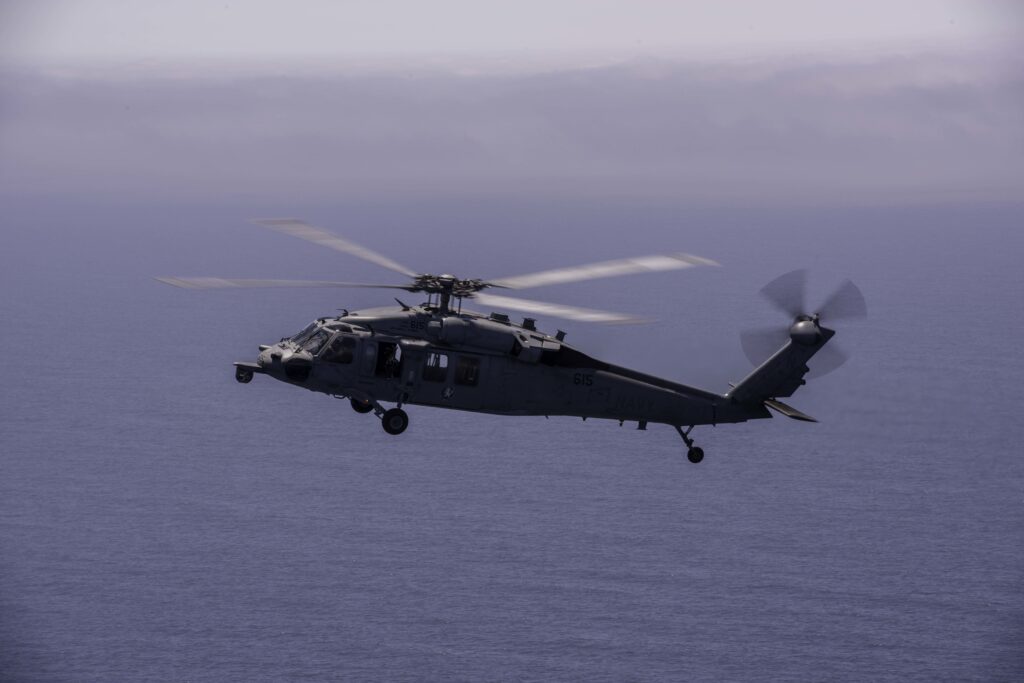
An MH-60S Seahawk Helicopter flies over the Pacific Ocean in this 2018 photo. U.S. NAVY

ARLINGTON, Va. — A Navy MH-60S Seahawk helicopter crashed June 9 near El Centro, California, but all four crew members on board survived and were safely recovered, commander, Naval Air Force Pacific public affairs office, said in a release. One crew member suffered non-life-threatening injuries. 

The MH-60S was assigned to Helicopter Sea Combat Squadron Three based at Naval Air Station North Island, California. HSC-3 if the fleet replacement squadron for the U.S. Pacific Fleet’s MH-60S squadrons. 


Coast Guard, DHS Partners Establish Joint Coordination Center in Houston 

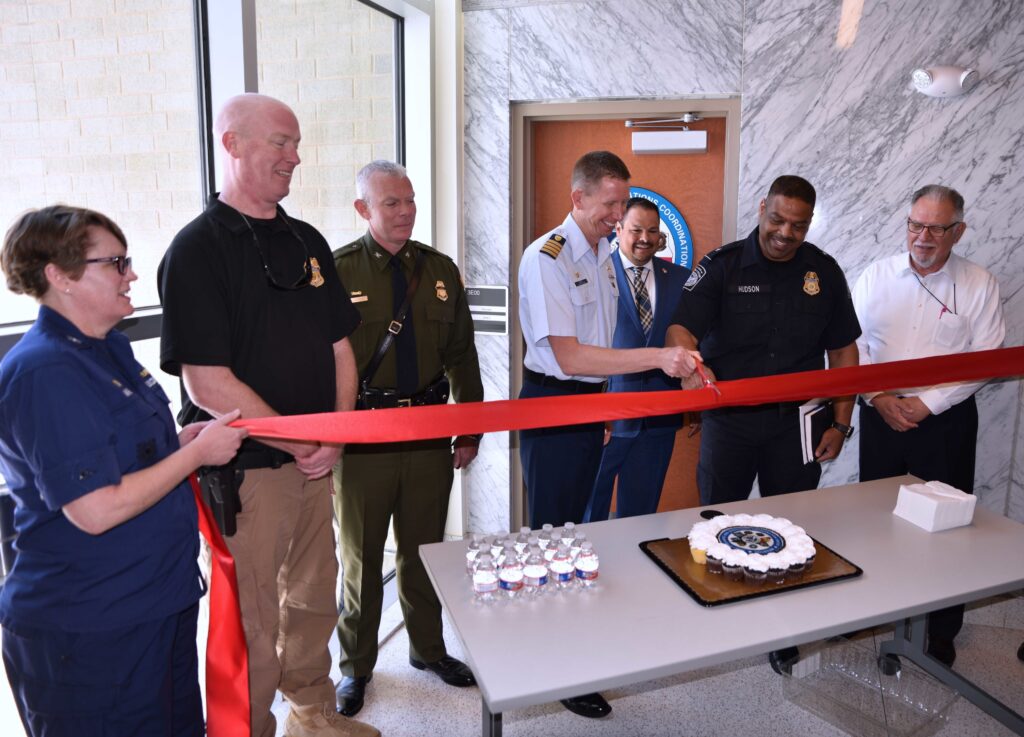
Leaders from Coast Guard Sector Houston-Galveston, Homeland Security Investigations Houston, U.S. Customs and Border Protection Houston and Transportation Security Administration Houston commemorate the establishment of a Joint Intelligence and Operations Coordination Center June 7. U.S. COAST GUARD / Tim Oberle

HOUSTON — Leaders from Coast Guard Sector Houston-Galveston, Homeland Security Investigations Houston, U.S. Customs and Border Protection Houston and Transportation Security Administration Houston announced June 9 the establishment of a Joint Intelligence and Operations Coordination Center. 

Located within Sector Houston-Galveston, the new multi-agency coordination center will directly support the Southeast Texas and Southwest Louisiana Regional Coordinating Mechanism and be staffed with personnel from the Coast Guard, HSI, CBP and TSA. JIOCC staff will include a full-time counterdrug analyst from the Texas National Guard whose focus will be providing analytical support to DHS components. 

The JIOCC’s primary purpose is to act as a unified control center and coordinate operations between participating agencies to bolster interoperability and deconflict where an agency’s operations may overlap with others. Additionally, the JIOCC will serve as a ready-made event command post in the event of a natural disaster or other emergency, such as a strong hurricane. 

The establishment of the JIOCC is part of DHS efforts to modernize the Maritime Operations Coordination Plan by establishing coordination cells in strategic locations around the country to facilitate intelligence sharing and coordinate operations for an efficient, effective and unified departmental response to threats against the United States in the maritime environment. 

“By bringing together and leveraging each agency’s unique strengths, authorities and capabilities, we are better postured to protect the ports and waterways of Southeast Texas and Southwest Louisiana,” said Coast Guard Capt. Jason Smith, commander, Sector Houston-Galveston and ReCoM executive committee member. “The establishment of this JIOCC illustrates our commitment to enhancing maritime homeland security by improving intelligence and information sharing and increasing operational integration and deconfliction.” 


CNO Hosts Israel’s Head of Navy, Focused on Partnership and Maritime Security 

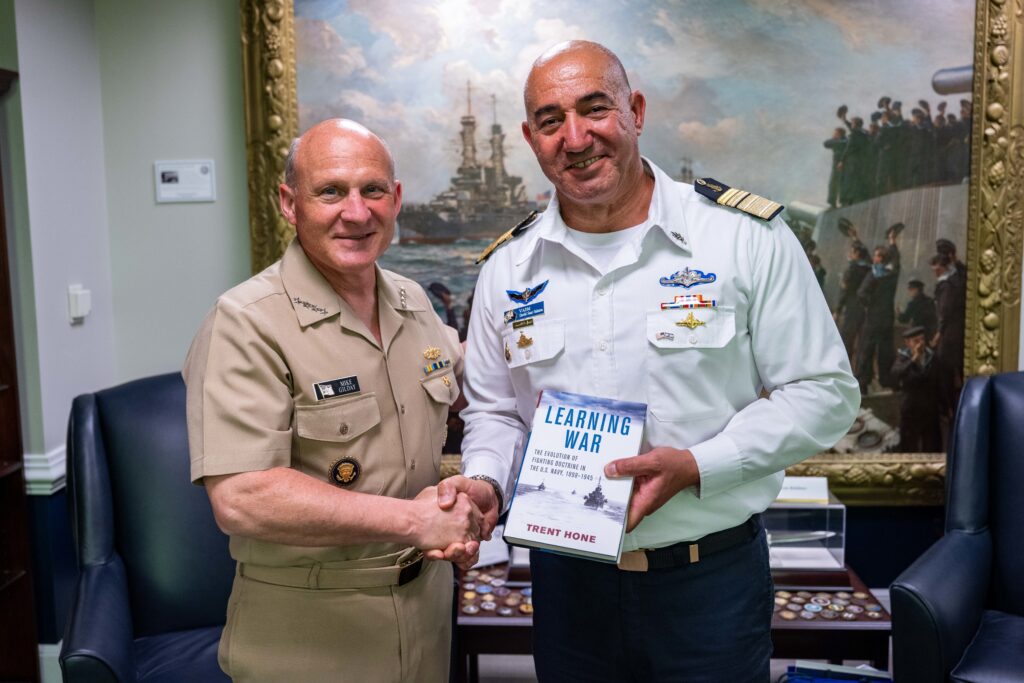
Chief of Naval Operations Adm. Mike Gilday meets with Commander in Chief of the Israeli Navy Vice Adm. David Saar Salama during an office call at the Pentagon, June 8. U.S. NAVY / Mass Communication Specialist 2nd Class T. Logan Keown

WASHINGTON — Chief of Naval Operations (CNO) Adm. Mike Gilday hosted the commander in chief of the Israeli Navy, Vice Adm. David Saar Salama, in Washington, D.C., for a formal counterpart visit, June 8-9, the CNO’s public affairs office said in a release.  

The two leaders discussed several topics of shared interest including force design, strategic competition, unmanned technologies and regional security efforts.  

The two-day visit included a full honors ceremony, meetings with senior U.S. Navy leadership and a visit to the United States Holocaust Memorial Museum. 

“Our strategic partnership with Israel is ironclad and enduring,” said Gilday. “United by our commitment to a rules-based international order, free and open seas, and advancing collective capabilities, our two navies have never been more aligned than they are today. I look forward to working closely with Adm. Salama to strengthen our partnership and interoperability.”   

“‏The cooperation between the Israeli Navy and the U.S. Navy, led by my friend Adm. Mike Gilday, is another testament to the strength of the strategic partnership and friendship between the two navies,” said Salama. “The joint work with the U.S. Navy, especially with the 5th and 6th Fleets, will continue to yield many achievements for Israel and overall maritime security. Together, we will continue to face the challenges ahead in order to maintain stability at sea.” 

U.S. Navy and Israeli Naval Forces regularly operate together around the world, particularly in the U.S. 5th and 6th Fleet Area of Operations. Most recently, the U.S. Navy and the Israeli Navy participated in Intrinsic Defender 22, a bilateral exercise focused on maritime security operations, explosive ordnance disposal, health topics and unmanned systems integration. 

On Sept. 1, 2021, the U.S. Department of Defense officially reorganized Israel within the area of responsibility of U.S. Central Command. 

This was the first meeting between Gilday and Salama. 


Navy SSBN PEO: Data Clearly Supports Building More than 12 Columbia Subs 

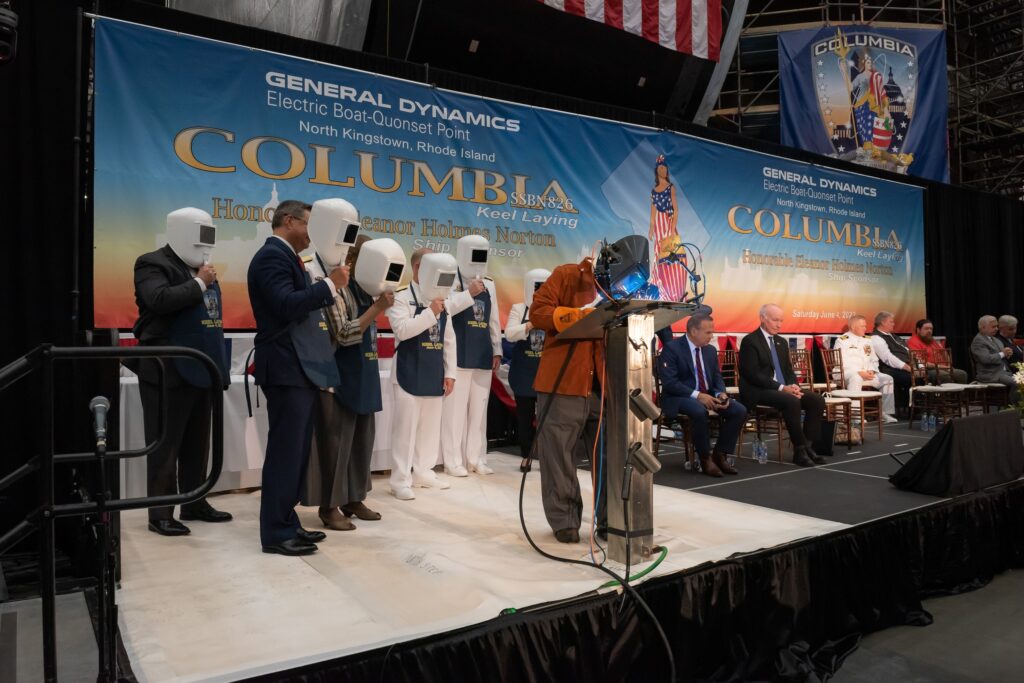
General Dynamics Electric Boat welder Maria Betance-Pizarro welds the initials of the sponsor of the future U.S. Navy ballistic missile submarine District of Columbia onto a metal plate at a ceremony at the Electric Boat facility in Quonset Point, Rhode Island, June 4. Looking on are the ship’s sponsor, U.S. Rep. Eleanor Holmes Norton (D-District of Columbia), and officials from Electric Boat, other members of Congress, and officers of the U.S. Navy. U.S. NAVY / GENERAL DYNAMICS ELECTRIC BOAT

ARLINGTON, Va. — The admiral in charge of building the Navy’s next-generation nuclear-powered ballistic-missile submarine said there may be an advantage to building more than the 12 planned boats. 

“I have clear data that says, ‘It clearly makes more sense to have more than 12 [Columbia-class SSBNs] to meet the current requirements that [U.S.] Strategic Command has defined for us,’” said Rear Adm. Scott Pappano, program executive officer for Strategic Submarines, speaking during a June 9 Hudson Strategic Forces Seminar in Washington. 

“I have the data that will show the risks of what the current program of record is, and here is how those risks are mitigated if I go to 13 or 14 or 15 or 16, how that affects those requirements,” Pappano said. “It’s probably a late ‘20s decision, sometimes before the end of the next block that we are doing.” 

The current U.S. Nuclear Posture Review defines the requirement for “at least” 12 Columbia-class SSBNs. 

Pappano said building extra SSBNs would not be a technological problem but a matter making decisions early enough to keep submarine programs on schedule. 

“It’s really getting both the cadence for the Columbia class and to be able to get back on cadence for Virginia [attack submarine],” he said.  

The contract for building the first new SSBN, the future USS District of Columbia, calls for delivery 84 months of formal program start. Pappano’s goal is to deliver the boat in 78 months. With the construction started during the COVID-19 pandemic, construction “got a little bit slower start than we wanted” so it was lagging slightly behind 78 months but still ahead of the required maximum of 84 months. 

“It’s not only delivering [the lead ship] on time … but we’ve got to get the cadence right for the rest of the class,” he said. “We have to be delivering Columbia class at a one-per-year cadence [in fiscal 2026].” 

With the future USS District of Columbia and USS Wisconsin under contract, the Navy originally had planned to build the next three boats in the next block to get economic order quantity of the SSBNs and the Virginia-class SSNs.  

“We’re working right now with our stakeholders to include five boats in the second block,” he said, to make that block buy in 2026 and “at least a five-ship block” for the third block.  

The 12 Columbia-class SSBNs will be replacing the 14 Ohio-class SSBNs that each are scheduled to be retired at 42 years of service. The first of the Ohio SSBNs to be retired will be inactivated in 2027.  

“There is going to be a period of time [for] much of the ‘30s we have to have 10 ships ready for sea, out of a depot period, and we’re going to have exactly 10 for a lot of that time,” Pappano said. “If you look at it month by month, there are periods where we might dip below nine.” 

He said the Navy is looking at starting advance procurement for each boat “a little bit early… about six monthsish” for Columbia boats two through 12, a plan supported in the 2023 budget request.  

The first Columbia-class SSBN is required to be on patrol in the first quarter of fiscal 2031. Pappano said the Navy is looking at squeezing more service life out of five Ohio-class boats with short service-life extensions of the boats that are in the best condition. The admiral said that fiscal 2026 would be the time to make the decision, with the first Ohio extension completed in fiscal 2029, and each taking three years. 

Pappano said one advantage of extending an Ohio-class boat is during the 2036-2039 time frame, a submarine will be needed to test-launch the D5LE2 version of the Trident ballistic missile in support of the Strategic Systems Program. This would avoid having to take a submarine off the strategic deterrence patrol cycle to test the missiles.