Raytheon Technologies Establishes Global Headquarters Office in Northern Virginia
Raytheon Technologies’ building in Arlington, Virginia. RAYTHEON TECHNOLOGIES
ARLINGTON, Va. — Raytheon Technologies announced today June 7 it will establish its global headquarters in Arlington, Virginia, just outside of Washington, D.C., a move similar to the one recently announced by Boeing.
The location increases agility in supporting U.S. government and commercial aerospace customers and serves to reinforce partnerships that will progress innovative technologies to advance the industry, Raytheon said in a press release, adding that Washington, D.C., serves as a convenient travel hub for the company’s global customers and employees.
The new global headquarters office will be in Arlington’s Rosslyn neighborhood alongside the Raytheon Intelligence & Space business. Each of the company’s four business units currently have operations in Virginia, the company said, and it will maintain its U.S. presence, which includes 600 facilities across 44 states and territories.
Raytheon Technologies said it has not accepted or sought any financial incentives from any state or municipality to support the establishment of the global headquarters office in Virginia.
DC Congresswoman Pushes DC Statehood at Keel-Laying for Navy Submarine
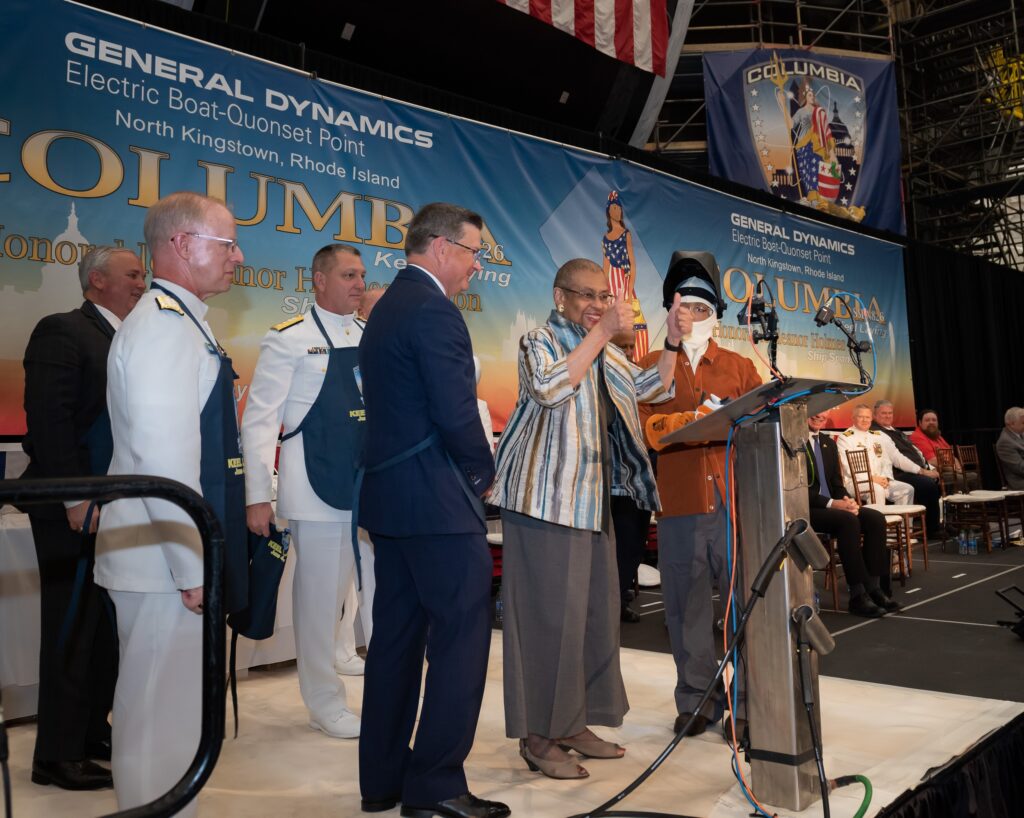
U.S. Rep. Eleanor Holmes Norton (D-District of Columbia), approves the welding of her initials onto a metal plate during a ceremony at the General Dynamics Electric Boat Facility at Quonset Point, Rhode Island, June 4. The congresswoman is the sponsor of the future U.S. Navy ballistic missile submarine District of Columbia. U.S. NAVY / GENERAL DYNAMICS ELECTRIC BOAT
ARLINGTON, Va. — The keel-laying of the U.S. Navy’s next-generation ballistic-missile submarine (SSBN) was celebrated June 4 in Quonset Point, Rhode Island, by the submarine’s designers and builders and the Navy that will operate it.
At the ceremonies for the future USS District of Columbia (SSBN 826), one of the ship’s two sponsors, Rep. Eleanor Holmes Norton, D-District of Columbia, also used the event as an occasion to advocate for the cause of her life: statehood for the District of Columbia.
The day before the ceremonies, Navy Secretary Carlos Del Toro announced that the first ship of the Columbia class would be named USS District of Columbia, instead of Columbia.
“The decision to name SSBN 826 is to alleviate any name conflicts with the already-commissioned USS Columbia (SSN 771). §10 U.S.C. 8662(a) states that not more than one vessel of the Navy may have the same name,” the secretary’s public affairs officer said in a June 3 release. “The Columbia program was named in 2016 with the lead ship projected to enter service in 2027, consequently overlapping with the existing USS Columbia (SSN 771). SSBN 826 will be named after the nation’s capital while SSN 771 is named after cities in South Carolina, Missouri, and Illinois named Columbia, following the naval tradition of SSNs being named after U.S. cities.”
General Dynamics Electric Boat President Kevin Graney presided at the keel-laying ceremonies. Also speaking were Jennifer Boykin, president of Newport News Shipbuilding, a Huntington Ingalls company that builds sections of the Columbia-class submarines; Rep. Joe Courtney (D-Connecticut), in whose district the Columbia SSBNs will be assembled; Reps. David Cicilline and Jim Langevin and Sens. Sheldon Whitehouse and Jack Reed, all Democrats from Rhode Island, site of Electric Boats’ Quonset Point fabrication facility; Adm. Daryl Caudle, commander, U.S. Fleet Forces Command; Del Toro; and Norton.
Graney said the new SSBN was going to be “the most capable and quiet submarine ever built.”
He noted Electric Boat invested almost $2 billion in facilities and hired thousands of workers to build the Columbia class, and that as the program progressed the company would “need to hire and train many thousands more.”
Graney called the Columbia class SSBN was “arguably be the greatest engineering achievement of the most advanced military in the world.”
Boykin noted that “our Sailors’ lives depend on the quality of our product, and it is this responsibility that guides everything that we do.”
She noted Newport News Shipbuilding has been allied with Electric Boat in the Virginia-class attack submarine program that began nearly 25 years ago.
“As every ballistic-missile submarine has since the keel laying of USS George Washington (SSBN 598) here at Electric Boat in November 1958 — the District of Columbia, and all those in its class will continue to serve as the most survivable leg of the nuclear triad — standing constant watch far beneath the waves, as we have done for over 63 years, a stalwart deterrent against those who would seek to do the unspeakable,” Caudle said.
Del Toro noted the Washington Navy Yard in the district is the Navy’s oldest shore facility.
“While it’s common to refer to D.C. as our nation’s capital, I also like to think of it as our naval capital,” Del Toro said, in reference to notable Sailors and Marines who were born and raised in the district. “That’s why I want to make it clear that this boat honors the people and the spirit of the District of Columbia.”
Norton — the boat’s sponsor along with the district’s mayor, Muriel Bowser — wrote her initials on a steel plate. The initials were then welded onto the plate by Electric Boat welder Maria Betance-Pizarro. The plate will be fixed to the structure of the submarine.
“I can’t say how pleased I am today as we celebrate the USS District of Columbia-class submarine, commissioned in recognition of my hometown and the jurisdiction I represent in the Congress, the District of Columbia,” Norton said.
Norton, who has been a staunch advocate for statehood for the district during her long career, used the occasion to plug her top political goal.
Norton said the submarine’s name is “fitting that it recognizes the jurisdiction that will become the 51st state of the United States of America. … As we celebrate this keel-laying today, we also underline the Congress must no longer exclude the residents of our nation’s capital from the democratic presence, forcing residents to watch from the sidelines as Congress votes on laws that affect the nation or votes even on laws on the duly elected government. Democracy demands more, D.C. residents demand much more. They deserve statehood.”
Mayflower Autonomous Ship Reaches Canada After Suffering Mechanical Issues
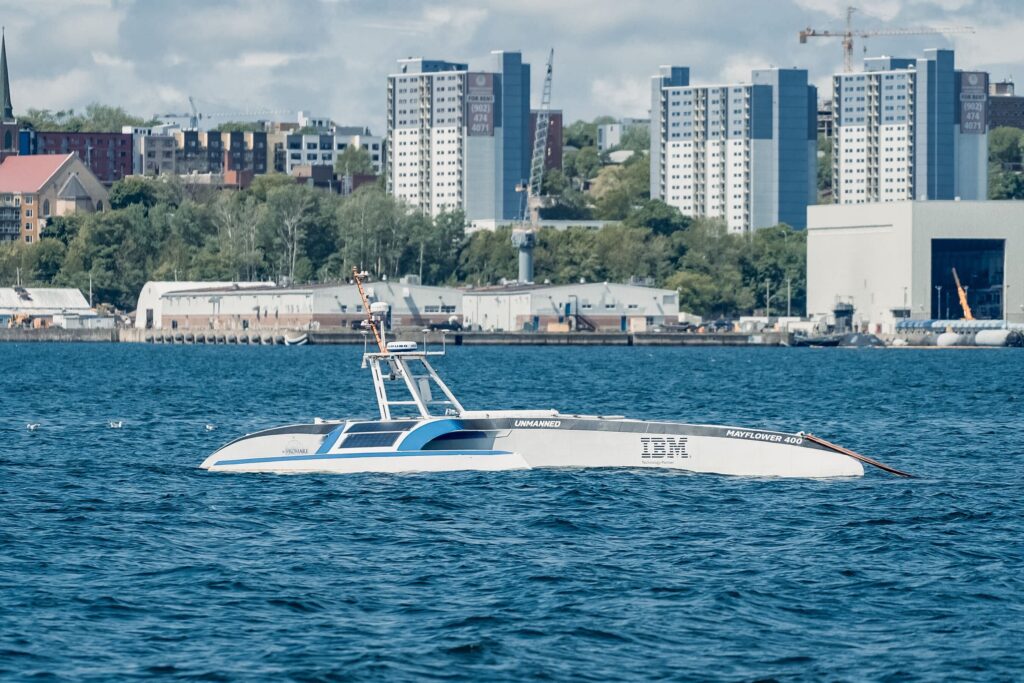
The Mayflower Autonomous Ship arrives in Halifax, Nova Scotia, for equipment troubleshooting before continuing its journey. IBM
HALIFAX, NOVA SCOTIA — After a 40-day voyage, and after more than year of delay due to a mechanical problem, the Mayflower autonomous ship arrived in North America, at Halifax, Nova Scotia on June 5, announced program partners IBM and ProMare.
The ship has been dogged by mechanical problems even as its artificial intelligence guidance system was able to guide it across the ocean.
The catamaran traveled from Plymouth, United Kingdom, to Halifax, and later is expected to make appearances in the Washington, D.C. area. According to IBM, it’s the first nautical vessel to complete an unmanned, crewless voyage across the Atlantic.
Mayflower was intended to reach Plymouth, Massachusetts. Over the May 28-29 weekend, the Mayflower developed an issue with the charging circuit for the generator starter batteries, according to IBM.
On May 30, the team had to switch to the back-up navigation PC. ProMare decided to divert to Halifax, Nova Scotia, as the closest viable port, to investigate and fix these issues.
The ship was designed and built by marine research nonprofit ProMare, with IBM acting as lead technology and science partner.
Artificial intelligence and edge computing technologies underpin the ship’s AI Captain, which uses six cameras, more than 30 sensors and 15 edge computing devices to help make decisions.
“This makes it possible for the AI Captain to adhere to maritime law while making crucial split-second decisions, like rerouting itself around hazards or marine animals, all without human interaction or intervention,” IBM said in a blog post.
Navy Identifies Pilot Killed in Super Hornet Crash Near Trona, California
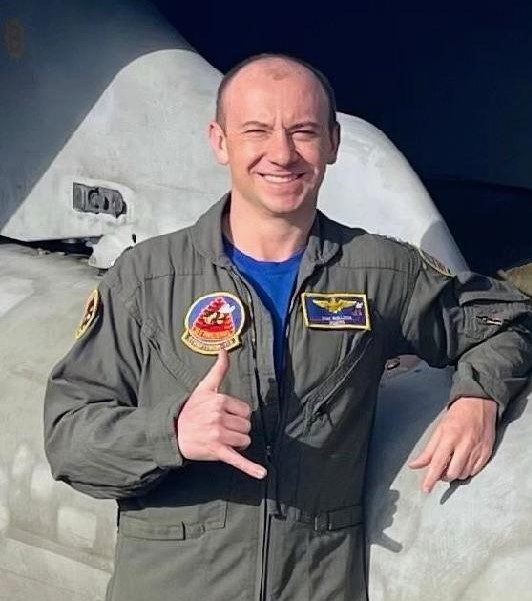
U.S. Navy pilot Lt. Richard Bullock. U.S. NAVY
SAN DIEGO – U.S. Navy pilot Lt. Richard Bullock was killed when his F/A-18E Super Hornet crashed in the vicinity of Trona, Calif., at approximately 2:30 p.m. (PDT), June 3, Naval Air Force, U.S. Pacific said in a June 5 release.
Bullock was assigned to Strike Fighter Squadron (VFA) 113 based at Naval Air Station Lemoore, California, and was flying a routine training mission at the time before his aircraft when down in a remote, unpopulated area. No civilians were harmed as a result of this incident.
The incident is currently under investigation and the scene of the crash is secured by Navy and local authorities while recovery efforts are ongoing.
Coast Guard Accepts Delivery of 49th Fast Response Cutter Douglas Denman
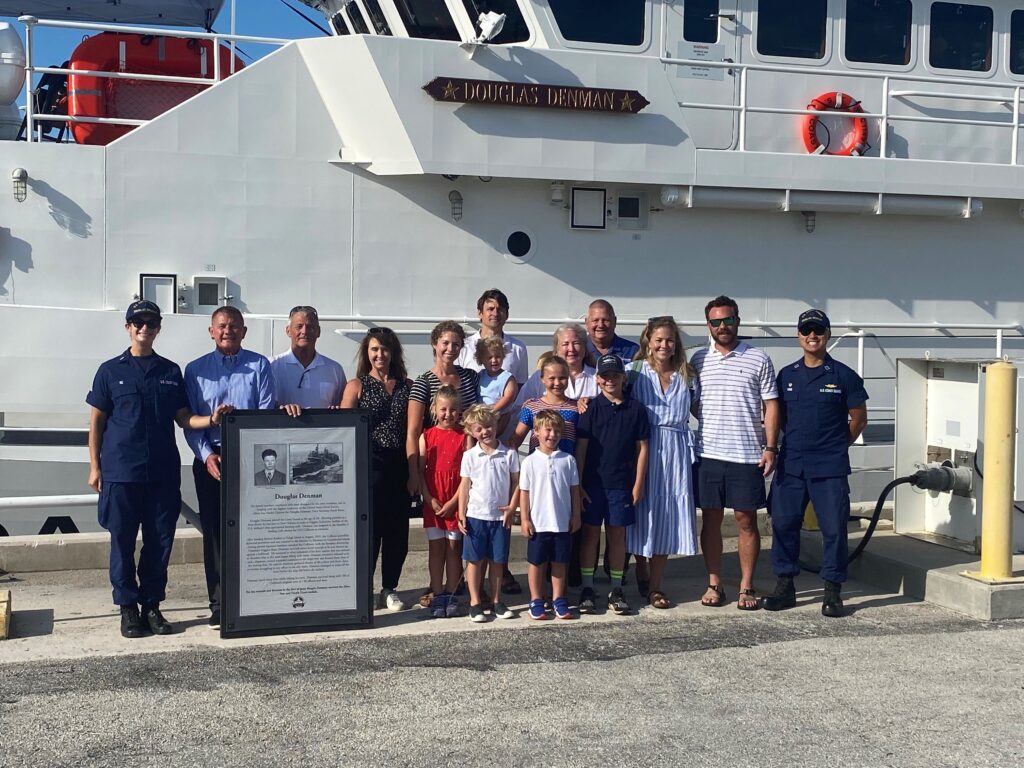
The Coast Guard accepts delivery of the 49th Fast Response Cutter Douglas Denman, in Key West, Florida, May 26, alongside the Denman family. The cutter will be homeported in Ketchikan, Alaska. U.S. COAST GUARD
KEY WEST, Fla. — The Coast Guard accepted the Coast Guard Cutter Douglas Denman (WPC 1149), the 24th Fast Response Cutter built by Bollinger Shipyards, during a May 26 ceremony at Coast Guard Sector Key West, the Coast Guard 17th District said June 2.
“We were honored to have Douglas Denman’s son, Doug Jr., and daughter Karen there for the momentous occasion,” said Lt. Paul Kang, commanding officer of the cutter. “In addition to that, two of Douglas Denman’s granddaughters drove down from Georgia with their families.”
The cutter, which is 154 feet long and has a crew complement of 24, will be homeported in Ketchikan, Alaska.
The Douglas Denman is scheduled for commissioning in September in Ketchikan. It is the third Fast Response Cutter to be stationed in the Coast Guard’s 17th Coast Guard District, which covers the state of Alaska and the North Pacific. The Denman will join the John McCormick (WPC 1121) and the Bailey Barco (WPC 1122), which arrived in Alaska in 2016 and 2017.
Born in Tallapoosa, Georgia, the cutter’s namesake joined the U.S. Coast Guard in 1940 and was eventually assigned as a coxswain to the USS Colhoun (DD-85), a Wickes-class destroyer in the U.S. Navy during World War I and later re-designated APD-2 in World War II. On Aug. 30, 1942, the Colhoun was positioned off the coast of Guadalcanal when it was attacked by hostile aircraft. Denman was seriously wounded during the attack but remained at his duty station. When the order was given to abandon ship, Denman and another crew member helped evacuate the crew and get life jackets to those already in the water. Because of Denman’s selfless actions, 100 of the 150 officers and staff survived the attack and sinking of Colhoun. Denman received the Silver Star and Purple Heart medals for his heroic efforts. He served for 20 years in the Coast Guard, retiring as a senior chief petty officer in 1961.
The Fast Response Cutter is replacing the aging Island-class 110-foot patrol boats and features advanced command, control, communications, computers, intelligence, surveillance, reconnaissance equipment, and an over-the-horizon cutter boat. The cutter features advanced seakeeping capabilities and can achieve more than 32 mph (28 knots). The cutter has an endurance of five days. The Coast Guard is in the middle of the FRC acquisition program.
Earlier this year, President Biden signed the Consolidated Appropriations Act for Fiscal Year 2022, which included a $130 million increase for two additional FRCs, continuing the program beyond its 64-vessel program of record. This is the second time Congress has added FRCs beyond the original 58 vessel program of record.
Douglas Denman is designed for multiple missions, including law enforcement, fisheries enforcement, waterways and coastal security, search and rescue, and national defense.
U.S. Coast Guard Cutter Helps Solomon Islands Patrol Their Waters
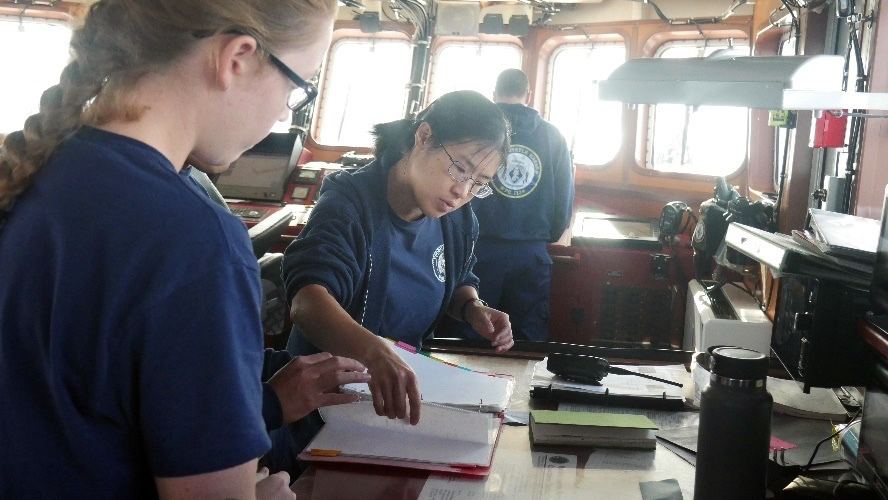
Crewmembers aboard the Coast Guard Cutter Myrtle Hazard stand watch on the bridge while underway in Oceania. The crew recently helped to fill the operational presence needed by conducting maritime surveillance to deter illegal, unreported, and unregulated fishing in the northern Solomon Islands. U.S. COAST GUARD
SOLOMON ISLANDS — The U.S. Coast Guard has responded to a request from the Solomon Islands to help patrol that country’s exclusive economic zone while maintenance was being conducted on the Royal Solomon Islands Police Vessel Taro.
The Fast Response Cutter Myrtle Hazard (WPC 1139) was dispatched on short notice to provide operational presence by conducting maritime surveillance to deter illegal, unreported, and unregulated fishing in the northern Solomon Islands.
The 154-foot Myrtle Hazard was already deployed on an expeditionary patrol in support of Operation Blue Pacific, where the is cutter was protecting against IUU fishing in the EEZs of five different Pacific Island Countries and the high seas.
According to a Coast Guard statement, IUU fishing has replaced piracy as the leading global maritime security threat and has the potential to jeopardize the efforts of PICs to conserve fish stocks, an important renewable resource in the region.
The Solomon Islands has a population of 652,000 people, and encompasses more than 900 islands. The capital, Honiara, is located on the island of Guadalcanal. It has an EEZ of more than 600,000 square miles. Like its neighbors in Oceania, the country is reliant of fisheries for sustenance and income.
Myrtle Hazard’s mission followed coordination between the Coast Guard, the Solomon Islands’ commissioner of police, assistant commissioner of police, and the deputy commissioner for national security and operations.
The Coast Guard’s assistance is significant because the government of the Solomon Islands recently signed an agreement on policing cooperation with China and is reportedly in the process of concluding a security agreement that could allow an ongoing Chinese military and naval presence. Such an agreement has been characterized by some as “destabilizing” for the region.
According to the Washington Post, China is trying to formalize agreements with other Pacific island countries on policing, cybersecurity, maritime surveillance, fishing rights and the creation of a free-trade area.
“We need to respond to this because this is China seeking to increase its influence in the region of the world where Australia has been the security partner of choice since the Second World War,” said Australian Prime Minister Anthony Albanese in an interview with the Australian Broadcasting Corporation.
Federated States of Micronesia President David Panuelo called the deal a “smokescreen” hiding a Chinese attempt to “acquire access and control of our region.”
“Through Operation Blue Pacific, the United States Coast Guard looks for opportunities to assist our regional partners with maritime governance and security,” said Capt. Craig O’Brien, chief of response of Coast Guard District 14. “Working closely with the Forum Fisheries Agency and the government of Solomon Islands, it was a privilege for the United States Coast Guard to assist the Solomon Islands while their police vessel was down for maintenance.”
With the controversy over China’s engagement with the Pacific nations, and the Solomon Islands in particular, the request from the Solomon Islands to the U.S. Coast Guard is especially meaningful.
NATO Concludes Vigilance Activity Neptune Shield 22
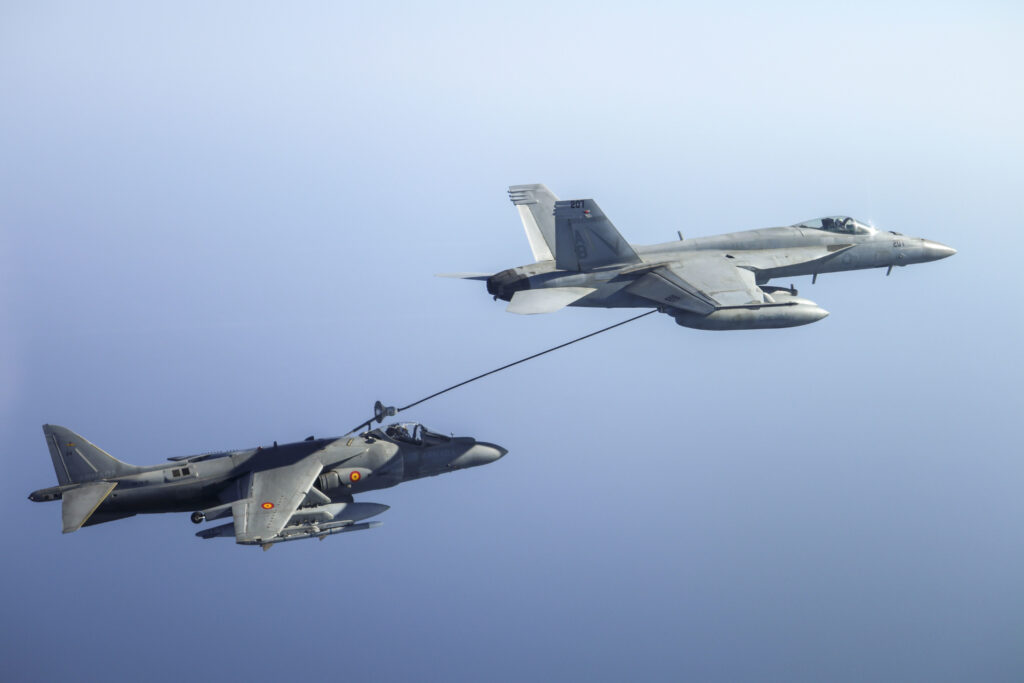
An F/A-18E Super Hornet, attached to the “Fighting Checkmates” of Strike Fighter Squadron (VFA) 211, refuels a Spanish air force AV-8B II+ Harrier in support of Neptune Shield 22, May 21. U.S. NAVY / Strike Fighter Squadron 11
OEIRAS, Portugal — Naval Striking and Support Forces NATO (STRIKFORNATO) and U.S. 6th Fleet concluded the NATO-led Vigilance Activity Neptune Shield 2022 from STRIKFORNATO’s Joint Operations Centre in Oeiras, Portugal, May 31, STRIKFORNATO said June 3.
The two-week vigilance activity demonstrated NATO’s ability to integrate the command and control of multiple carrier strike groups, an amphibious ready group and a Marine expeditionary unit, involving the participation of 25 NATO allied and partner nations.
Neptune Shield kicked off May 17 from the Baltic, Adriatic, Ionian and Mediterranean Seas, and involved missions at sea, in the air and on the ground across Europe, supporting both Allied Joint Force Command Naples and Joint Force Command Brunssum.
“Credible force projection to defend the alliance has to be integrated across multiple domains; sea, air, land as well as space and cyberspace. NESH22 further integrated those domains, and was an essential step in the progression of the Neptune series to demonstrate NATO’s ability to defend against any threat from any direction,” said Adm. Robert P. Burke, commander, JFC Naples.
While STRIKFORNATO executed command and control of the USS Harry S. Truman CSG, the ITS CAVOUR CSG and the Combined Task Force 61/2, which included the USS Kearsarge ARG and the 22nd MEU, Supreme Headquarters Allied Powers Europe coordinated the activity, integrating NATO Allied Maritime Command and NATO Allied Air Command.
“Demonstrating and enhancing NATO’s high-end maritime warfare capabilities shows the world the true strength and teamwork of our alliance,” said Vice Adm. Gene Black, commander, STRIKFORNATO and 6th Fleet. “NATO’s capacity to conduct integrated operations in the maritime domain ensures stability and peace throughout Europe, and validates more than seven decades of alliance interoperability.”
STRIKFORNATO led and coordinated maritime and expeditionary forces composed of four carrier strike groups from three different nations, more than 30 ships and 160 aircraft, including forces from the Harry S. Truman CSG, the Kearsarge ARG-MEU, the Italian Navy CAVOUR CSG, the Spanish Navy Juan Carlos I CSG and the Standing NATO Maritime Group 1 and 2. More than 200 aircraft sorties and 80 vigilance activities were executed by more than 11,000 personnel from 25 NATO and partner countries.
Nations participating in Neptune Shield 2022 included Albania, Belgium, Bulgaria, Canada, Czech Republic, Croatia, Denmark, Estonia, Finland, France, Germany, Greece, Hungary, Italy, Latvia, Lithuania, the Netherlands, Poland, Portugal, Romania, Slovenia, Spain, Turkey, the U.K. and the U.S.
Textron Systems Selected for Continued U.S. Navy Expeditionary Sea Base UAS Operations
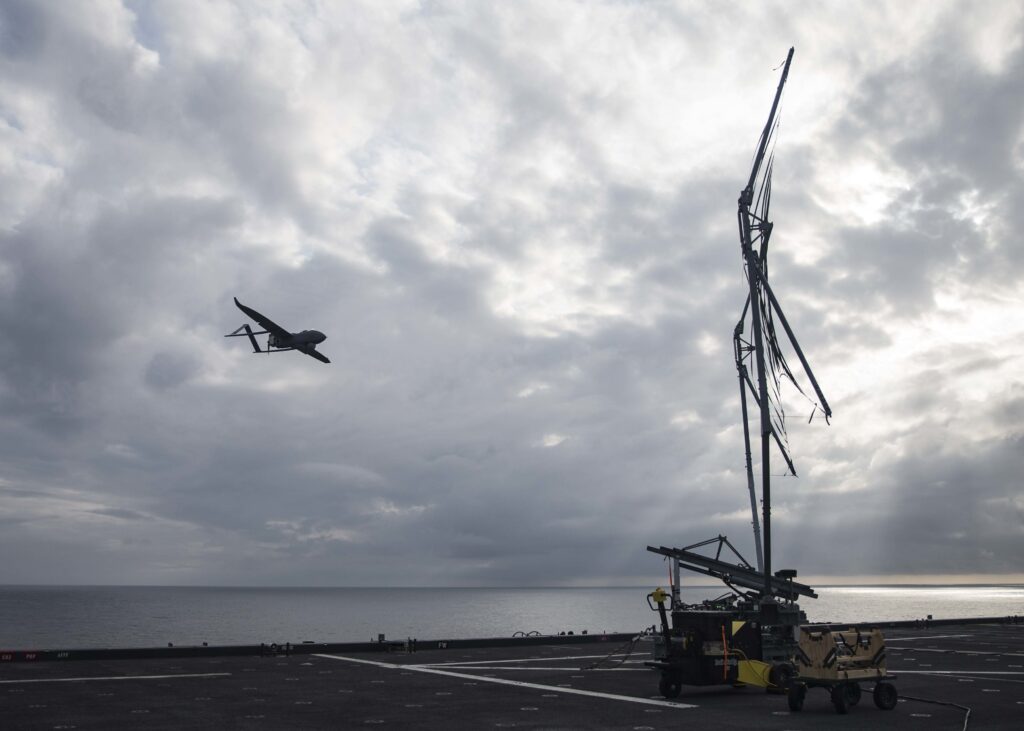
The Aerosonde unmanned arial surveillance vehicle Buck G returns to the Expeditionary Sea-Base USS Hershel “Woody” Williams (ESB 4) from a 10- hour night surveillance in the Atlantic Ocean, Sept. 26, 2020. U.S. MARINE CORPS / Sgt. Megan Roses
HUNT VALLEY, Md. — Textron Systems Corp. has been awarded a contract valued up to $18.3 million including all options by the U.S. Navy’s Naval Air Systems Command to provide continued unmanned aerial systems operations support for the USS Hershel “Woody” Williams (ESB 4), the company said June 2.
The one-year base contract includes two 12-month options and two six-month options, for a total potential performance period of four years. The company was originally selected to support the ESB 4 in 2018.
Under this contract, Textron Systems will continue to deploy its Aerosonde UAS to provide maritime operations aboard the ESB 4. The company’s personnel work alongside Sailors to provide on-demand Aerosonde UAS operations to support a variety of maritime missions.
“Our shipboard customers need UAS solutions that can deliver actionable data from multiple mission payloads without sacrificing valuable space on deck,” said Wayne Prender, senior vice president, Air Systems. “It’s equally important that we create a strong support ecosystem to keep availability and reliability rates high as operational tempo demands. In continuing to support our ESB 4 customer, we maintain our focus on setting the bar higher and higher in all these areas to keep our Sailors informed and out of harm’s way.”
Textron Systems’ UAS operators also support U.S. Navy Arleigh Burke-class guided-missile destroyers with the Aerosonde UAS, as well as multiple DoD and international customers with land-based contractor owned, contractor operated activities.
Boeing Teams with Canadian Industry to Offer P-8A Poseidon
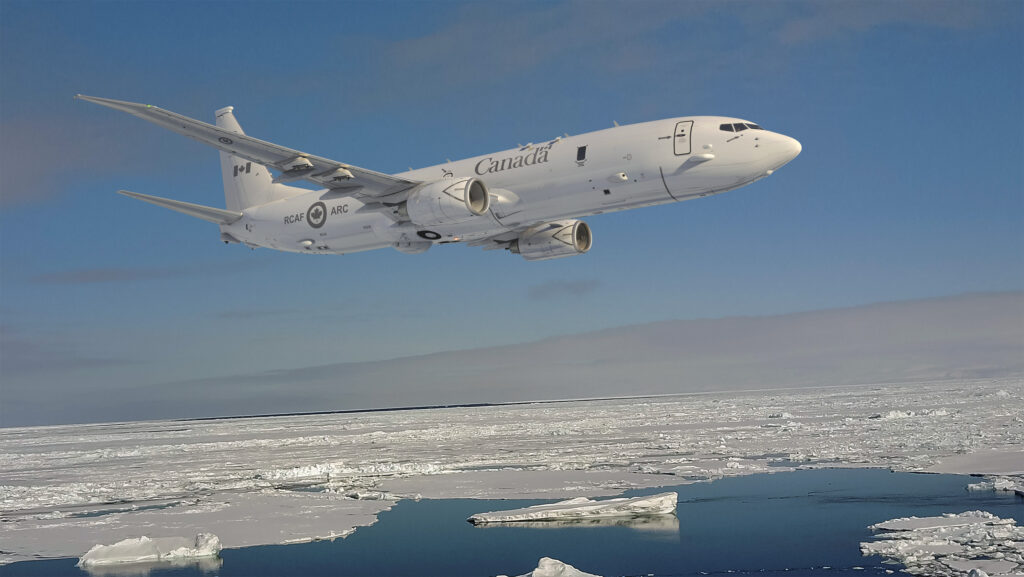
Boeing and Canadian industry partners plan to collaborate to provide the P-8A Poseidon for the Canadian Multi-Mission Aircraft requirement. BOEING
OTTAWA, Ontario — Boeing and several Canadian industry partners announced June 1 their intent to collaborate to provide the capability and sustainability of the proven P-8A Poseidon for the Canadian Multi-Mission Aircraft requirement.
Team Poseidon, consisting of CAE, GE Aviation Canada, IMP Aerospace & Defence, KF Aerospace, Honeywell Aerospace Canada and Raytheon Canada, forms the cornerstone of a Canadian P-8 industrial footprint. The team builds on 81 Canadian suppliers to the platform and to more than 550 Canadian suppliers across all provinces contributing to Boeing’s annual CAD $5.3 billion in economic benefit to Canada, supporting more than 20,000 Canadian jobs.
The Boeing P-8A is a proven military off-the-shelf solution with nearly 150 aircraft delivered to five nations to date. The P-8 will improve Canada’s capability to defend its northern and maritime borders while ensuring interoperability with NORAD and NATO allies. As a leading platform for reducing the environmental impact of military aircraft, the P-8 can operate on a 50% blend of sustainable aviation fuel today with aspirations to move toward 100% with investment in new technology.
“As a dedicated partner of Canadian industry for more than a century, Boeing is proud to bring together a world-class team of companies in support of our P-8 offering to Canada,” said Heidi Grant, president, Business Development, Boeing Defense, Space & Security and Government Services. “Together, we will bolster Canada’s aerospace and defense industry through a 100% Industrial and Technical Benefits commitment if awarded the CMMA contract.”
The P-8A Poseidon offers advanced anti-submarine warfare, anti-surface warfare, intelligence, surveillance and reconnaissance, and search and rescue capability, and is the only in-service, in-production multi-mission aircraft that meets all CMMA requirements. The P-8 also has the added distinction of strengthening the connection between national security and environmental stewardship.
Built on the proven 737 Next-Generation airframe, P-8’s 86% commonality with more than 4,000 in-service 737NGs delivers lower life-cycle sustainment costs due to large economies of scale.
Navy Successfully Completes First Flight Test of Mission Computer Alternative on the T-45
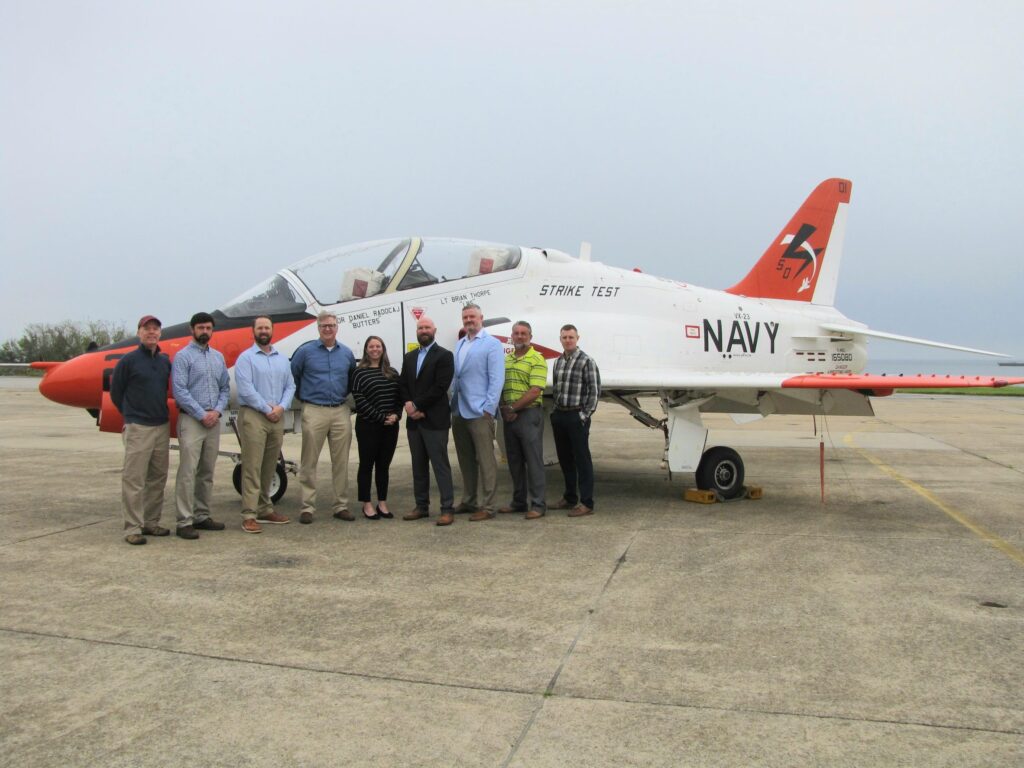
The Navy’s Air Combat Electronics program office (PMA-209) successfully completed first flight test of the Mission Computer Alternative in a T-45, at Naval Air Station Patuxent River on March 30. Pictured are PMA-209 team members (from left) Bill Brown, Michael Kay, Jason Bean, Jeff Boyce, Kelly Pruitt, Jeff Williamson, Brandon Patz, Richard Boecher and Tom Adams. U.S. NAVY
PATUXENT RIVER, Md. — The Navy’s Air Combat Electronics program office (PMA-209) recently completed the first test flight of the T-45 trainer aircraft’s Mission Computer Alternative, intended to improve readiness for the legacy system, the Naval Air Systems Command said May 31.
PMA-209 collaborated with the Naval Undergraduate Flight Training Systems program office (PMA-273), which manages the T-45 aircraft, and Air Test Evaluation Squadron (VX) 23 to execute the March 30 flight at Patuxent River and test out the design replacement for the existing Mission Display Processer.
“The flight was flown successfully, proving MCA is on the right track,” said Lt. Alex Mensing, VX-23 test pilot. “We know what needs to be improved and will continue to work together to bring an accurate and reliable system to the fleet.”
PMA-273 sought out MCA as a mission computing solution primarily to address the potential obsolescence issues the Navy may face on an aging platform. They plan to leverage the MCA to support additional capabilities such as required navigation performance/area navigation.
The MCA is a Hardware Open Systems Technologies-conforming mission computer that drastically reduces schedule for regular hardware and software updates associated with mission computing. It can be economically and rapidly adapted to support platform requirements and processing needs. The system is on track to provide required navigation performance/area navigation in the near future.
“The Navy developed this mission computer technology using OA standards, bringing the government one step closer to getting much needed capabilities and functionality to the fleet cheaper and faster,” said Capt. Margaret Wilson, PMA-209 program manager.
The Navy will leverage investments made during the MCA’s development to support and minimize development cost of future MCA iterations, and lower the hardware and software logistics lifecycle funding footprint by using common, commercial-off-the-shelf hardware and software development designed to OA standards.