Ingalls Shipbuilding: Ready to Take on More Navy Shipbuilding 
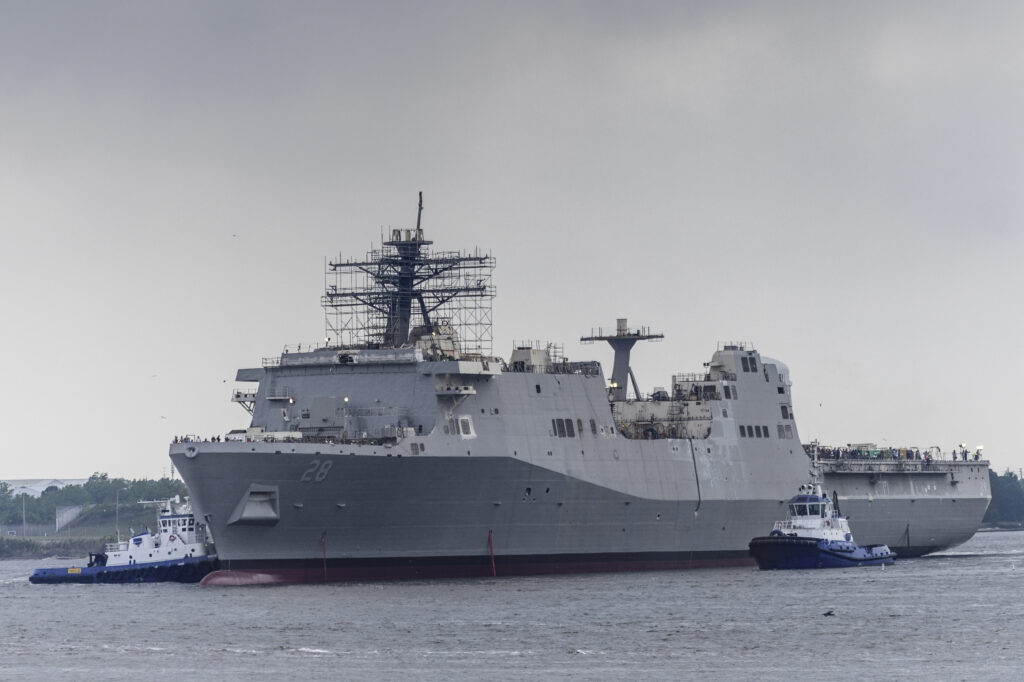
USS Fort Lauderdale was translated via Ingalls’ rail car system to the floating dry dock prior to launch. The dock was moved away from the pier and then flooded to float the ship. With the assistance of tugs, USS Fort Lauderdale came of the dock on March 29. HII / Lance Davis

ARLINGTON, Va. — Ingalls Shipbuilding, HII’s builder of surface warships, has the industrial facilities and workforce to add to the capacity of its portfolio, a senior Ingalls official said. 

“We have the ability to take on more work that we do today,” said George Nungesser, vice president for program management at Ingalls, speaking May 11 to reporters at the Modern-Day Marine Expo in Washington. 

Ingalls’ 11,500 workers are building Arleigh Burke-class guided-missile destroyers, Legend-class national security cutters, America-class amphibious assault ships (LHAs), and Flight I/II San Antonio-class amphibious transport dock ships (LPDs). They also are activating the combat system of the third Zumwalt-class guided-missile destroyer. 

Nungesser said that Ingalls has three LPDs under construction. LPD 28, the future USS Fort Lauderdale, will sail away from the shipyard for commissioning in July. Nungesser said this LPD represented the best cost and schedule performance to date in the LPD 17 program. 

LPD 29, the future USS Richard M. McCool Jr., was launched in January and is 75% complete. Nungesser said it would be delivered to the Navy by the end of 2023. 

LPD 29 and LPD 30 are transition ships to the Flight II version of the class. 

LPD 30, the future USS Harrisburg, is 25% complete.  

Fabrication of LPD 31, the future USS Pittsburgh, is scheduled to begin in September. 

LPD 32 has been requested by the Navy in the 2023 budget. However, the budget plan would truncate the LPD 17 program with LPD 32 being the last to be procured. The Marine Corps has listed advance procurement funding of an additional ship, LPD 33, in its Unfunded Priorities List for 2023. 

Nungesser said the Navy did a good job with the technology transition to the Flight II ships, including accommodation of the SPY-6(V)2 active electronically scanned array radar and the CH-53K helicopter. 

Ingalls completed the post-shakedown availability of the America-class LHA USS Tripoli (LHA 7), work which including modifying the ship to operate F-35B Lightning II strike fighters.  

LHA 8, the future USS Bougainville, is 50% complete. 

LHA 9 was authorized and funded in fiscal 2021.  

Nungesser said that Ingalls has a solid backlog of work in the short term and is working to modernize its facilities and is working closely with its vendors to sustain the industrial base. Ingalls is in discussion with its vendors to get price quotes for LPD 32. 

He said that it would be ideal for the workforce to have the LPD production centered on building one every two years and LHA production every four years. 

Ingalls wants to be the builder of the future Light Amphibious Warship, Steve Sloan, Ingalls’ LPD program manager, also speaking in the roundtable.
Marine Infantry to Become More Commando-Like

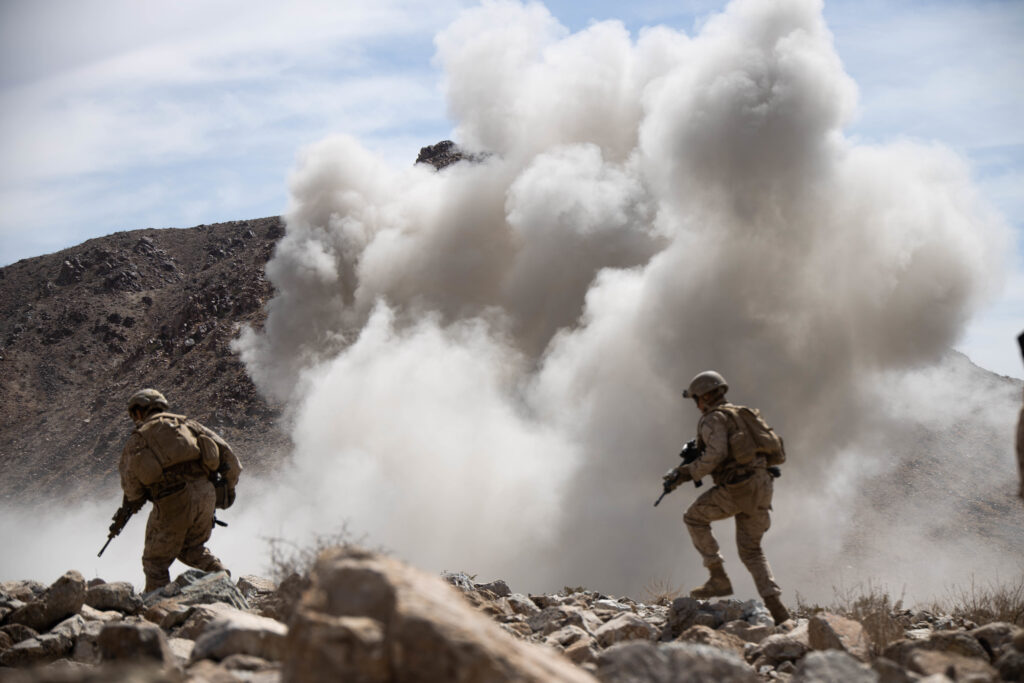
U.S. Marines with India Company, 3d Battalion, 1st Marine Regiment, 1st Marine Division, breach the objective while conducting Range 400 as a part of Integrated Training Exercise (ITX) 3-22 at Marine Corps Air Ground Combat Center Twentynine Palms, Calif., April 10, 2022. ITX is a month-long training evolution comprised of multiple ranges to refine combined arms maneuver in offensive and defensive combat operations. U.S. MARINE CORPS / Lance Cpl. Brayden Daniel

WASHINGTON – A critical element of the Marine Corps’ 2030 force transformation process is a sweeping array of changes in how they train and educate their Marines, from recruiting training, through infantry and advanced skills instruction to the combat exercises among the war-fighting units. The basic thrust of these dramatic changes is to create a more lethal, resilient and innovative force that can adapt to the rapidly changing technological character of war and the actions of any future peer adversary, a panel of the Corps’ top training officers said May 12.

The goal is “to create a generation of Marines who will be able to out wit, out pace and out fight any 21st century adversary,” said Col. Howard Hall, assistant chief of staff of the Marines Training and Education Command (TECOM). But throughout these dramatic transformations, the traditional Marine “rigorous standards will continue to apply” so the future Corps will be “a certain force in an uncertain world,” Hall said.

A major focus of the improved training is on the infantry, with expansion and intensification of the initial and advanced training for both enlisted and officer infantry Marines and higher standards for assignment to what has traditionally been the essential core of the Marines’ warfighting doctrine.

Responding to direction from Marine Corps Commandant Gen. David Berger, “we’re going to make our infantry Marines more like (Army) Rangers, more commando-like,” said Maj. Gen. Julian Alford, commanding general of Training Command. To prepare for that change, Alford said he and his staff visited the 75th Ranger Regiment, who are designed as light-assault raiders, and the British Royal Marines, who are traditionally labeled as “commandos. And to better serve these commando-like infantry units, the Marines will require the Navy hospital corpsmen assigned to those units to go through basic infantry training.

Among the training changes underway, are higher intelligence scores, better swimming capabilities and proven performance on obstacle courses, to qualify for basic infantry training, a four-week extension of that training and the addition of a sergeant or staff sergeant to supervise a 14-Marine element during training, he said. They also are extending the infantry officer training course by four weeks, adding more field training including combined arms instruction, Alford added. And there will be additional training in crew-served and anti-armor weapons.

Although the initial recruit training program will not be extended, it will be modified to include periods in which the recruits are given more opportunity to demonstrate leadership and initiative, and the marksmanship training will shift from the standard shooting at fixed-range targets to more combat-like responding to unexpected targets, said Col. Col. Joseph Jones, Commanding Officer Recruit Training Regiment, Marine Corps Training Depot San Diego.

The recruits also will be given a lot more swimming training to improve water survival skills and their training will be more closely supervised by an officer, Jones said.

But Jones said, “the critical element , the legendary relationship between the drill instructor and the recruits, will remains. It still is as powerful as it’s ever been.”

To support this intensified and redirected training, the Corps is making major expansion and modernization to its combat training infrastructure, with more simulation and constructive capabilities that can tie widely separated personnel into a combat scenario.

The overall factor in these significant changes is the need to change from what Hall called “industrial-age training models, one size fits all,” to produce quantity of bodies to an “information-age” process to prepare for the future “multi-domain, multi-spectral fight.”


Raytheon Flies APG-79(V)4 GaN-AESA Radar in Marine Corps F/A-18 

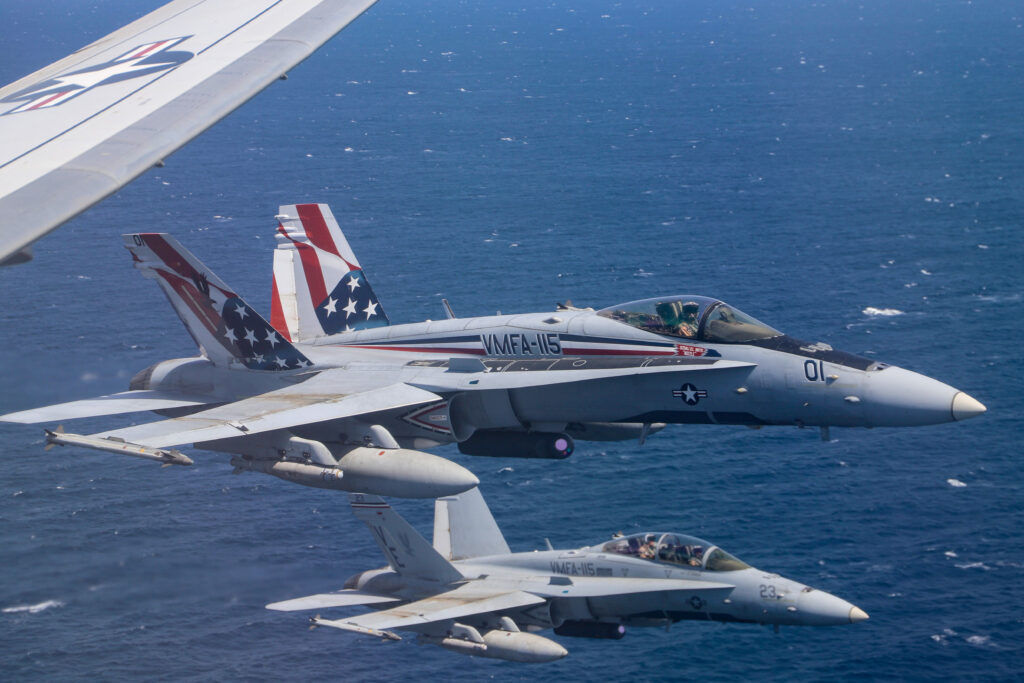
F/A-18C Hornets attached to Marine Fighter Attack Squadron 115 fly in formation during a Bab Al Mandeb transit, Feb. 3, 2022. U.S. NAVY

EL SEGUNDO, Calif. — Raytheon Intelligence & Space’s (RI&S’s) pre-production APG-79(V)4 radar system was successfully flown on a U.S. Marine Corps F/A-18 Hornet earlier this year, at Naval Air Weapons Station in China Lake, California. This is the radar system’s first flight on the aircraft since RI&S delivered the prototype radar in 2021.

The APG-79(V)4 is an APG-79 radar derivative that employs the first airborne GaN-AESA fire-control radar to help pilots detect and track enemy aircraft from greater distances with greater accuracy and meets the power and cooling requirements of legacy aircraft.

“Following successful ground testing and the delivery of the prototype radar, this flight test was critical to observe performance in the air,” said Thomas Shaurette, vice president of F/A-18 & Global Strike Radars for RI&S. “It allowed our partners to see the V4 radar’s enhanced detection and tracking abilities in real-time.”

The U.S. Marine Corps pilot demonstrated the radar’s seamless integration with the legacy Hornet avionics. The APG-79(V)4 radar is common in parts and technology with the legacy AN/APG-79 radar used in the U.S. Navy’s F/A-18 Super Hornet, thus optimizing cost and sustainment. Flight tests will continue to support weapons system integration on the fleet.

The Naval Air Systems Command recently awarded additional contract modifications to equip the Hornet fleet with more radars in 2021, and the total production value for domestic and foreign military sales customers is over $300 million.


Medium Range Interceptor Capability Proves Effective in Marine Corps Test 

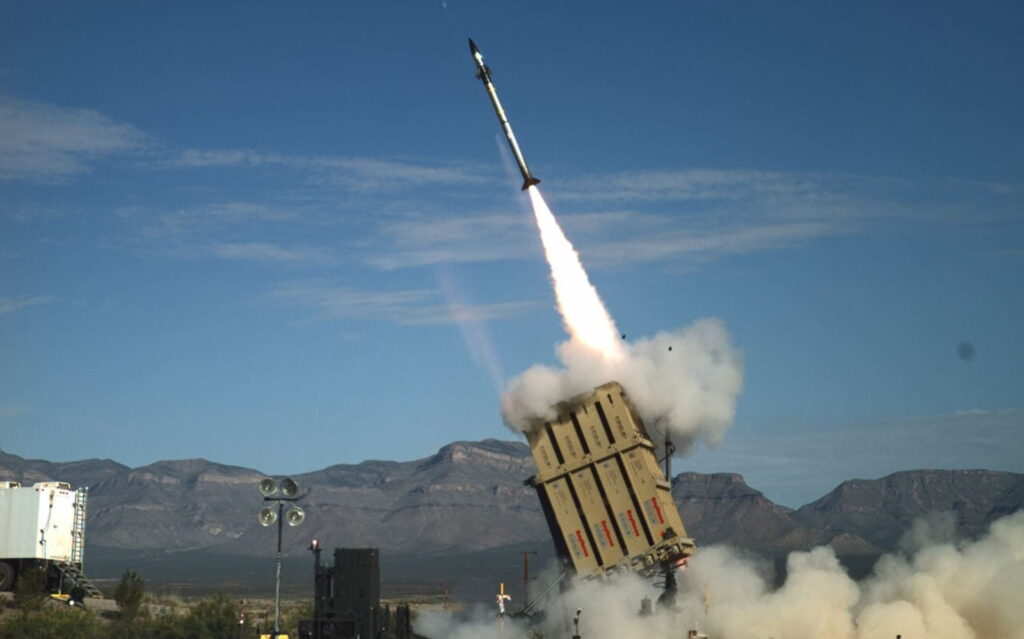
Live fire of the Medium Range Interceptor Capability with the US Marine Corps’ AN/TPS-80 Ground/Air Task Oriented Radar, Common Aviation Command and Control System, and components of the Iron Dome Weapon System, including the Tamir interceptor. U.S. MARINE CORPS

TUCSON, Ariz. — Raytheon Missiles & Defense, a Raytheon Technologies business, and RAFAEL Advanced Defense Systems Ltd., an Israeli-based defense technology company, successfully conducted a live fire of the Medium Range Interceptor Capability (MRIC). During the U.S. Marine Corps event, MRIC engaged targets representative of cruise missile threats, Raytheon said in a May 6 release. 

The test examined MRIC’s integration capabilities with the US Marine Corps’ AN/TPS-80 Ground/Air Task Oriented Radar, Common Aviation Command and Control System, and components of the Iron Dome Weapon System, including the Tamir interceptor. 

This test is a first in a series designed to prove out the MRIC’s ability to intercept cruise missiles threats. The live fire also stressed the MRIC system to assess its proficiency against high-end threats used by near-peer adversaries. 

“This test proved the interoperability of sensors and effectors working together as an integrated air and missile defense capability,” said Tom Laliberty, president of Land Warfare & Air Defense at Raytheon Missiles & Defense. “The demonstration showcased the benefits of integration, extending the capabilities of individual systems into a solution greater than the sum of its parts.” 

The Ground Based Air Defense program office at Program Executive Office Land Systems in the U.S. Marine Corps is developing the MRIC prototype in support of a Fleet Marine Forces modernization initiative. According to the U.S. Marine Corps, MRIC is designed is to defeat cruise missile threats and other manned and unmanned aerial threats for fixed and operationally semi-fixed sites. 

“We are excited about the success of this live-fire,” said Brig. Gen. (res.) Pini Yungman, executive vice president for Air and Missile Defense of RAFAEL Advanced Defense Systems. “Iron Dome continues to demonstrate its capabilities against more advanced threats, further proving its ability as one of the most premier lower-tier missile air and missile defense systems in the world.” 

Raytheon Missiles & Defense and RAFAEL have teamed for more than a decade on Iron Dome, with more than 4,000 operational intercepts and a success rate exceeding 90 percent.  


CNO: Keep R&D Alive for Nuclear Sea-Launched Cruise Missile

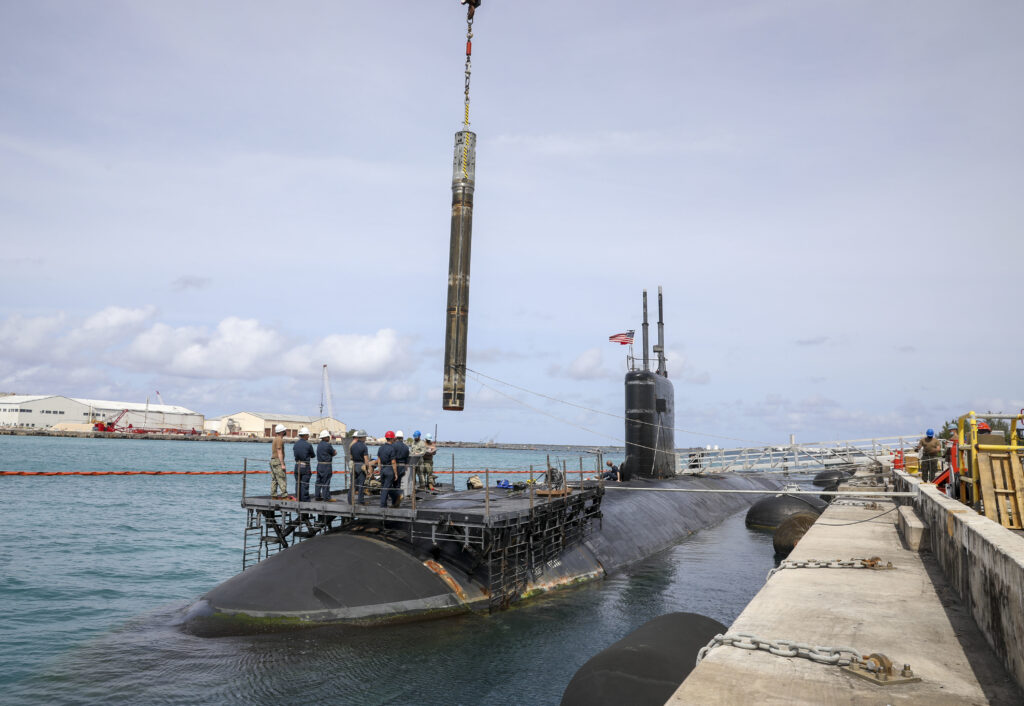
A Tomahawk cruise missile is removed from Los Angeles-class attack submarine USS Asheville at Polaris Point, Guam. An SLCM-N would occupy the place in naval armament formerly occupied by the now retired nuclear-armed version of the Tomahawk. U.S. NAVY / Mass Communication Specialist 1st Class Victoria Kinney

WASHINGTON — The Navy’s top officer did not request any funds for procurement of the Sea-Launched Cruise Missile – Nuclear (SLCM-N) in the 2023 budget proposal but would like to fund a small amount of research and development to keep the industrial base in place should the missile be funded in the future. 

Testifying May 11 before the House Armed Services Committee, Chief of Naval Operations Adm. Michael Gilday said that “having served on a nuclear-capable surface ship in the late 1980s, that mission does not come without a cost. There is a significant amount of attention that has to be paid to any platform that carries that type of weapon in terms of training, in terms of sustainability, in terms of reliability, in terms of the force’s readiness to be able to use them and be able to conduct that mission. I’m not convinced yet that we need to make a $31 billion investment in that particular system to close that particular gap.  

“It makes sense to me that we keep a small amount of money against R&D to keep that “warm,’ if you will, within the industrial base, while we get a better understanding of the world we live in with two nuclear-capable peer competitors,” Gilday said. “At the same time, the fact that we’re about to put hypersonics into play this year with the Army, in 2025 with the Navy, that’s also a deterrent we should factor in the conversation in terms of the investments that we’re going to make, in my opinion.” 

Rep. Doug Lamborn, R-Colorado, addressed the CNO and reminded the officials present that this year the HASC had heard testimony from Chairman of the Joint Chiefs of Staff Gen. Mark Milley, Vice Chairman of the Joint Chief of Staff Adm. Christopher Grady, U.S. Strategic Command Commander Adm. Charles Richard and U.S. European Command Commander Gen. Todd Wolters that “their best military advice was to continue with the SLCM-N program. 

“Do you believe that we should continue the program or at least the research so that we don’t lose that capability in the workforce and in our labs that’s actually proceeding apace right now and, then, from that, make informed decisions about whether or not we want to invest a significant amount of money in that capability understanding what both of those nuclear-powered peers bring to the table?” he said.  

Lamborn said that opponents of SLCM-N say the Navy did not have the bandwidth to handle a nuclear cruise missile aboard ships, but he pointed out that the Navy deployed a nuclear-armed version of the Tomahawk cruise missile on ships and submarines during and after the Cold War. 

He asked the CNO if “given the mission of certifying and carrying a SLCM-N, are you confident that the Navy would be up to the task, given that assigment?”  

Gilday affirmed that “given the assignment, we would, sir,” while again noting the cost. “I think it deserves some study in terms on how we’re going to balance that, given other things that we’re doing.” 

Lamborn told Navy Secretary Carlos Del Toro, who also testified at the hearing, that Del Toro’s predecessor, “promised certain documents and emails related to the then-rumored cancellation of the SLCM-N program. Last year’s NDAA [National Defense Authorization Act] fenced a large amount of money until these documents and the analysis of alternatives for SLCM-N were provided to Congress. We have yet to receive any of this information.  

“Despite the proposal in the Nuclear Posture Review to cancel SLCM-N and its being zeroed out of this year’s proposed budget request, when can we expect the Navy to comply with our directives and produce these documents?” Lamborn asked. 

Del Toro responded that he “was not aware that those documents had not been provided to the Congress, however I will promise you that I will go back and ensure that we do provide necessary required documents that you have requested.”      


Berger: Holistic Look Needed for Maritime Prepositioning Force 

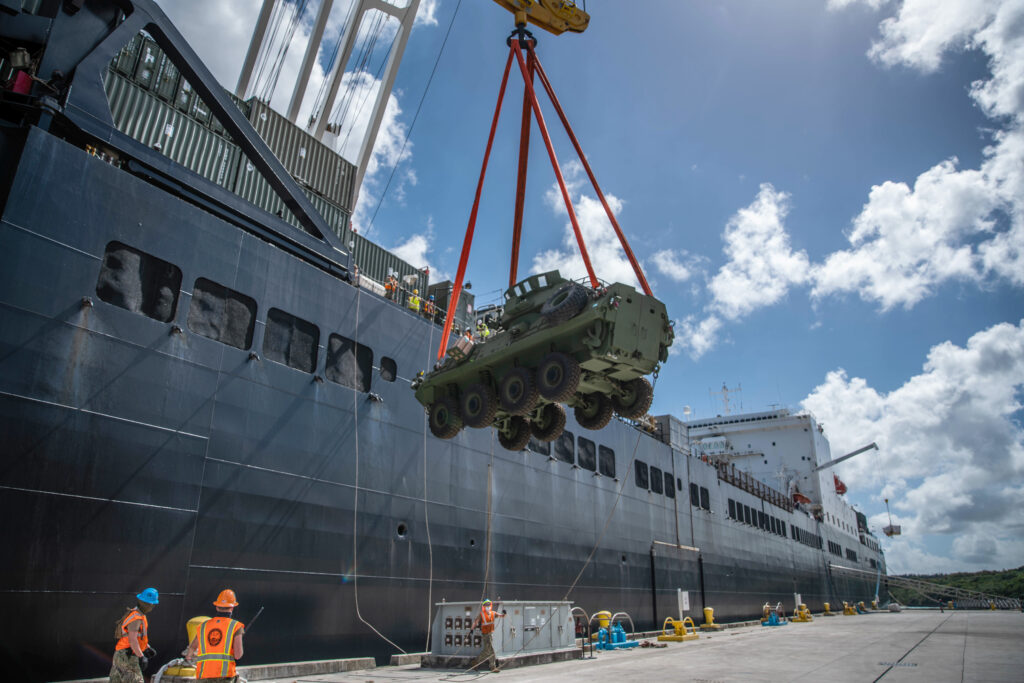
U.S. Marines with Combat Logistics Regiment 3, 3d Marine Logistics Group and Sailors with Navy Cargo Handling Battalion 1 offload a light armored vehicle from the Bob Hope-class vehicle cargo ship USNS Pililaau (T-AKR 304) during Hagåtña Fury 21 at Naval Base Guam, Feb. 21, 2021. U.S. MARINE CORPS / Lance Cpl. Moises Rodriguez

ARLINGTON, Va. — The Marine Corps’ commandant sees a continued need for the Maritime Prepositioning Force in the future as his Force Design 2030 initiative is implemented.  

The MPF, managed by the Military Sealift Command, is comprised of two squadrons of ships in full operating status. The squadrons are located at Guam and Diego Garcia. The squadrons carry enough carry enough equipment and supplies to sustain more than 16,000 Marine Expeditionary Brigade and Navy personnel for up to 30 days. The ships can offload equipment at established port facilities or while anchored, using onboard watercraft operated by naval support element forces. The MPS ships complement naval amphibious forces. 

Gen. David H. Berger, speaking to reporters May 5 about his update to Force Design 2030, said that “in conjunction with Army prepositioning and the other services’ prepositioning, we’re going to have to take a holistic look at prepositioning in the future. The current framework, like our current posture around the world, is not set optimally for what the National Defense Strategy requires us to do. So, as we adjust global force posture of the joint force — including the Marines — we’re also going to need to adjust maritime prepositioning.  

“I won’t speak for the Army, but I would think for the joint force, those adjustments have to be made in conjunction with each other,” Berger said. “There is no possible way you’re going to be able to generate all of the airlift that you need to lift all that we’re going to need anywhere in the globe. Prepositioning cuts the time frame to respond dramatically. We’re going to have to look at MPF and find out how it matches the adjustments we’re going to make with global force posture.”   


Marines Prep for ‘Stand-in Force’ Goal of Operating in Enemy Weapon Engagement Zones

Col. Timothy Brady, commanding officer of the 3rd Marine Littoral Regiment said exercises like the upcoming Rim of the Pacific will play a part in the new regiment gaining full operational status in two years U.S. MARINE CORPS / Lance Cpl. Wesley Timm

WASHINGTON – A key part of the Marine Corps’ ongoing Force Design 2030 is creation of a “stand-in force,” which is intended to be relatively small, highly mobile but lethal units that are to operate well within the enemy’s “weapons engagement zone,” primarily in the Western Pacific. Although this would appear to be a radical, new and potentially dangerous task, a panel of senior Marine officers intensely engaged in the process argued May 11 that the Marines are inherently prepared for this mission and, they emphasized repeatedly, those Marine units would be fighting as part of the U.S. joint force and closely aligned with allies and partners in the Pacific theater.

Force Design 2030 and the concept of the stand-in force is a recognition of the rapidly changing character of war, driven by the fielding of high-tech sensors and precision weapon and the growing involvement of cyberwarfare, said Brig. Gen. Joseph Clearfield, deputy commander of Marine Forces Pacific. “I am so proud that the Marine Corps is out in front on this change,” Clearfield told an audience at the Modern Day Marine exposition at the Walter E. Washington Convention Center.

But Clearfield and his fellow panelists said the Marines traditionally train for the skills needed for the stand-in mission. “We are incredibly well positioned to assume this mission,” Clearfield said.

Col. Timothy Brady, commanding officer of the still-forming 3rd Marine Littoral Regiment, which is to be the first of the units specifically prepared for the stand-in mission, said his regiment “is a small element of MarForPac, part of what will fight inside the enemy’s weapons engagement zone” to set the stage for the joint force.

And Col. Stephen Fiscus, assistant chief of staff for Force Development in MarForPac, who said he is tasked with implementing Force Design, added that “we fight as part of the joint force” and are “already working with our allies and partners.” Clearfield noted that Australia and Japan, America’s closest Pacific allies, are starting to develop similar units.

Brady said his regiment, which was redesignated as the 3rd MLR last year, has its infantry battalion and is to add logistics and air defense battalions as it moves to full operational status in two years. But, he noted, the initial units already have conducted a large-scale exercise with Philippine forces and will engage in even larger tests during the massive Rim of the Pacific Exercise later this year.

While stressing the Marines’ inherent capabilities for the stand-in mission, the three officers acknowledged they need additional capabilities for “persistent stare” sensing and targeting and greater mobility, particularly at sea. Clearfield specifically cited the proposed light amphibious warships, which the Navy’s shipbuilding plan had delayed for at least another year.

Clearfield warned that although the Marines’ force design process is aimed at producing a new organization by 2030, “we may not have that much time,” because of the rapid change in the character of war.


Berger, Del Toro: New Technology Combined With Old Platforms Can Thwart Adversaries

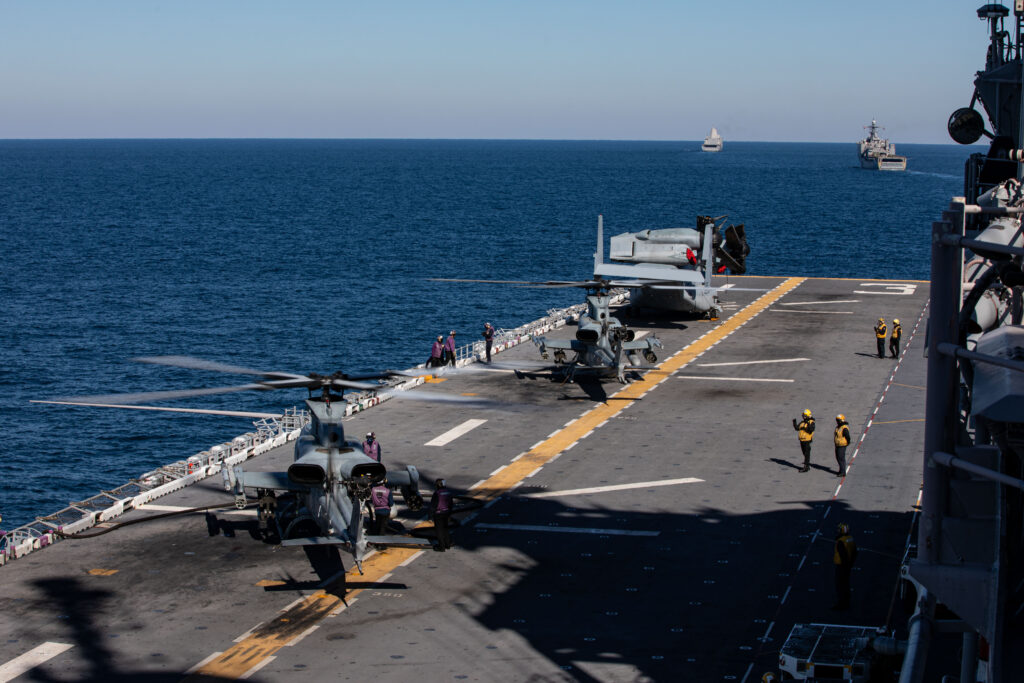
U.S. Navy Sailors refuel UH-1Y Cobras during Composite Training Unit Exercise aboard the USS Kearsarge (LHD 3), Jan. 24, 2022. The 22nd MEU and Amphibious Squadron 6 are underway for COMPTUEX in preparation for an upcoming deployment. COMPTUEX is the last at-sea period in the MEU’s Predeployment Training Program; it aims to test the capabilities of the ARG/MEU and achieve deployment certification. U.S. MARINE CORPS / Sgt. Armando Elizalde

WASHINGTON — U.S. Marine Corps Commandant Gen. David Berger and Secretary of the Navy Secretary Carlos Del Toro are promoting air, surface and undersea unmanned vehicles, and some new uses for old platforms, as a way for the redesigned force to keep adversaries off balance.

Discussing the state of the Marine Corps at the Modern Day Marine exhibition May 10, the two leaders also explained the importance of Berger’s Force Design 2030 plan to prepare the Corps for future challenges from near-peer competitors like China and Russia, and other adversaries in a rapidly changing environment.

“Today’s Marines confront a threat environment characterized by rapid mobility, anti-access/aerial denial systems and cyberwarfare,” Del Toro said, adding that he has “strongly supported Gen. Berger’s Force Design 2030 since his very first day as Navy secretary.

Critics of the force redesign have faulted Berger for shrinking the size of the Corps, eliminating all of its battle tanks and much of its towed artillery, but the 38th commandant has said he is investing in equipment and tech-savvy Marines that will be more effective in a widely distributed, highly mobile and stealthy force using unmanned systems, sensors, and anti-ship and anti-aircraft missiles to dominate the littorals of the Indo-Pacific region and other maritime choke points.

However, he told the Modern Day Marine audience there are existing platforms like amphibious ships, which can be used in innovative ways, especially when paired with unmanned systems. “As more and more uncrewed technology comes to maturity and the cost of production goes down, I think new capabilities are within reach,” Berger said.

“Drone technology over the last 20 years has been transformational on the battlefield,” Del Toro said, “and exactly the kind of technology we need to embrace.”

Berger suggested an Amphibious Ready Group-Marine Expeditionary Unit could launch unmanned undersea vessels from an amphib well deck for antisubmarine warfare, counter reconnaissance, finding minefields and ISR. “No platform, no unit, is capable of a more diverse set of missions across the range of military operations than an ARG-MEU,” he said.

Initial experimentation with the long-range unmanned surface vessel, armed with loitering munitions “has demonstrated the potency of that kind of capability,” Berger said, adding the potential use of UUVs launched from an amphibious well deck is limited “only by your imagination.” On the other hand, a well deck “taxes the imagination of the adversary,” because it conceals what’s on it, Berger said. “If you can’t figure out what’s on the inside, you’re going to spend a whole lot of time trying to do that. It slows down their decision-making. That’s what we want.” Another way to keep an adversary off balance is with drone-delivered loitering munitions. “There’s a psychological impact. You don’t know whether it’s got a camera system or a warhead on it,” Berger said.


Coast Guard Commissions Cutter Pablo Valent 

Crew members of the Coast Guard Cutter Pablo Valent man the ship during the commissioning ceremony at Coast Guard Sector St. Petersburg, Florida May 11, 2022. Pablo Valent, a Sentinel-class vessel, will be based in St. Petersburg and will operate throughout the Gulf of Mexico including the Florida Keys. U.S. COAST GUARD / Petty Officer 1st Class Ayla Hudson

ST. PETERSBURG, Fla. — The Coast Guard commissioned the 48th Sentinel-class fast response cutter Pablo Valent (WPC 1148) into service at Coast Guard Sector St. Petersburg, Florida, May 11, the Coast Guard 7th District said in a release. 

Rear Adm. Brendan McPherson, commanding officer of the Coast Guard 7th District, presided over the ceremony. Ms. Cecilia Guillot, Valent’s great-niece, is the ship’s sponsor.  

The cutter’s namesake Pablo Valent was originally from Corpus Christi, Texas, and joined the United States Life-Saving Service in 1912. In September 1919, Valent helped rescue the crew of the hurricane-damaged schooner Cape Horn off the coast of Texas. For his heroic efforts, Valent received the Silver Lifesaving Medal and the Grand Cross of the American Cross of Honor Society. Valent was one of the first Hispanic Americans to receive these honors.  

The Valent is the 48th FRC and is the first to be homeported in St. Petersburg with missions including search and rescue, maritime law enforcement, coastal security, and living marine resources. There are 12 other FRCs in Florida, which operate throughout the Caribbean Sea. 

Each cutter is designed for a crew of 24, has a range of 2,500 miles and is equipped for patrols up to five days. The FRCs are part of the Coast Guard’s overall fleet modernization initiative. 

FRCs feature advanced command, control, communications, computers, intelligence, surveillance and reconnaissance equipment as well as over-the-horizon response boat deployment capability and improved habitability for the crew. The ships can reach speeds of 28 knots and are equipped to coordinate operations with partner agencies and long-range Coast Guard assets such as the Coast Guard’s National Security Cutters. 


Berger: Marines Need More MQ-9 Drones for ‘Organic ISR’

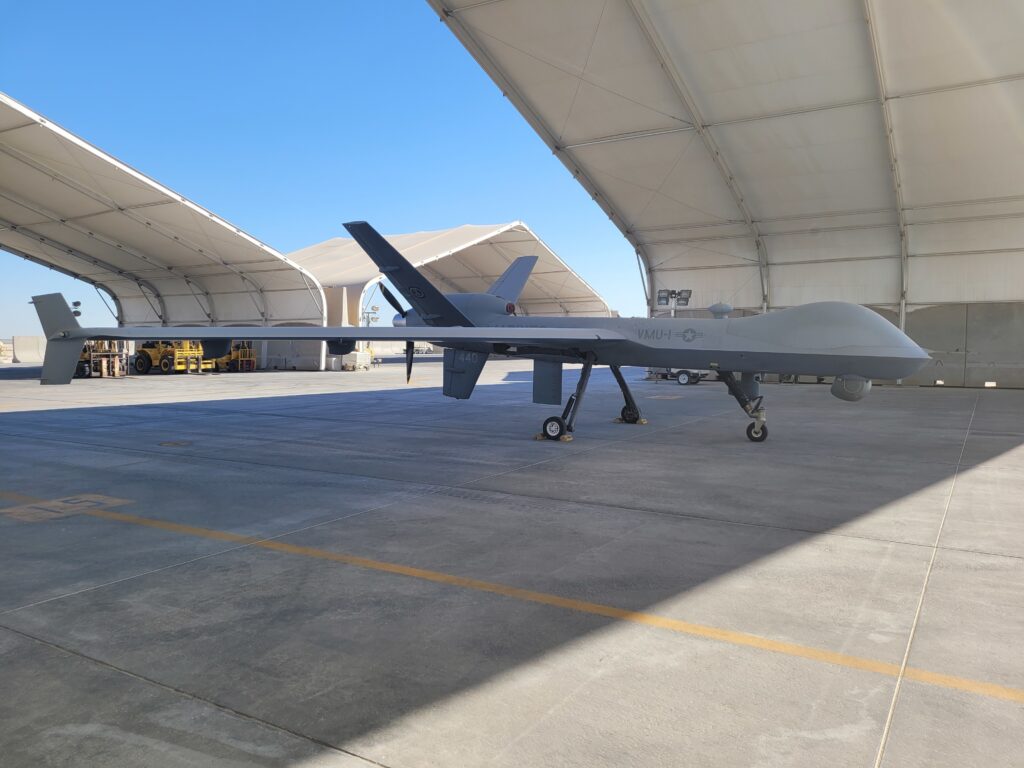
The Marine Corps’ first MQ-9A at an undisclosed location in the Central Command area of responsibility. U.S. Marine Corps

WASHINGTON — The U.S. Marine Corps will expand its fleet of MQ-9 Reaper drones to meet growing intelligence, surveillance and reconnaissance needs, the commandant said May 10.

“We’re going to move from three squadrons right now to perhaps double that,” Gen. David Berger told an audience at the Modern Day Marine exposition. “And the reason why is the need for organic ISR.”

The MQ-9A Block 5 aircraft can stay aloft for more than 26 hours, attain air speeds of 220 knots and can operate to an altitude of 45,000 feet. Manufactured by General Atomics Aeronautical Systems Inc., the Reaper has a 3,850-pound payload capacity that includes 3,000 pounds of external stores. It provides a long-endurance, persistent surveillance capability with full-motion video and synthetic aperture radar.

Berger said that ISR needs were increasingly critical for Marine Corps units, large and small. “So absolutely, we’re going to expand in Group 5, large-scale, big-wing, medium-altitude, long-endurance, uncrewed aircraft. That’s so we can have, for the naval force, persistent organic ISR access from the MEF [Marine Expeditionary Force] level on down to the squad level,” he said.

Over that last year-and-a-half, the Marines have conducted nine force-on-force exercises at the Marine Air Ground Task Force Training Command and Marine Corps Air Ground Combat Center at Twentynine Palms, California, Berger said. All of them showed that “small, distributed lethal teams that can employ organic ISR, loitering munitions, and weapons like the Javelin and Carl Gustav [recoilless rifle] are much more lethal than larger formations that are using traditional force structures and concepts,” backing up the concepts behind his Force Design 2030 plan to retool the way the Corps fights.

The Marines began leasing two Reapers in 2018 under a company owned/company operated agreement, later acquiring them from GA-ASI in 2021 as the first increment of the Marine Air-Ground Task Force unmanned aircraft expeditionary program of record. The Marines procured 16 more of the aircraft to operate in support of distributed maritime operations and expeditionary base operations, particularly in the Indo-Pacific region.